Performance analysis
GTA V (2015): what it takes to run it
Measured on 288 gaming laptops at 1920×1080, High preset, upscaling off.

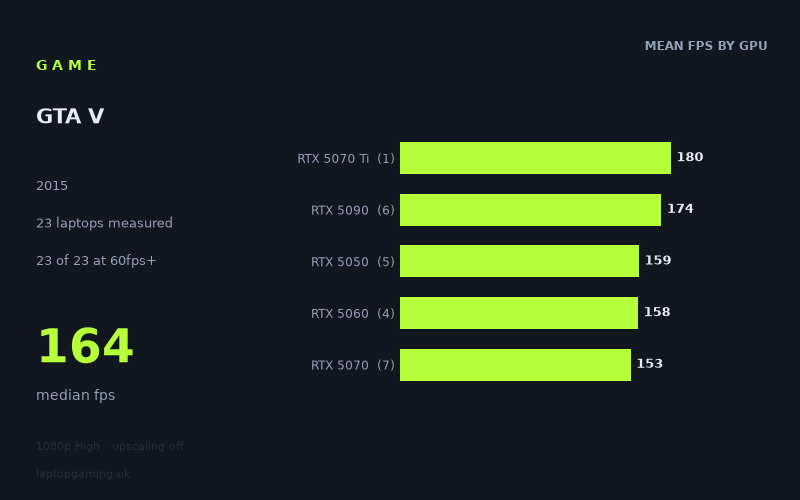
Every laptop we have figures for
Frame rates measured by Notebookcheck.
What it asks of a laptop
Almost nothing, in GPU terms. That is the headline, and the measured figures make it unusually clear-cut.
Across 17 laptops at 1920x1080 on the High preset with upscaling off, every single machine cleared 60fps. Every single machine cleared 100fps. Fourteen of the seventeen cleared 144fps. The slowest result in the entire set — 120fps from a Lenovo Legion 5 15AHP G10 running an RTX 5060 at 115W — is a frame rate most games in this list would be delighted to hit on their fastest configuration.
The more telling number is the spread. Fastest is 187fps (Asus ROG Strix Scar 18, RTX 5090 at 175W), slowest is 120fps, median 164fps. That is a range of roughly 1.56x between the cheapest silicon here and the most expensive. In a genuinely GPU-bound title you would expect an RTX 5090 to be somewhere north of three times the speed of an RTX 5050. It isn't. It's about 15% faster on average.
Look at the tier means and the picture stops being subtle:
- RTX 5090: 171fps (5 laptops)
- RTX 5050: 159fps (5 laptops)
- RTX 5070: 155fps (4 laptops)
- RTX 5060: 152fps (3 laptops)
The RTX 5050 averages higher than both the 5070 and the 5060. That is not a measurement error and it is not a reason to buy a 5050 over a 5070 — it is the signature of a workload that has stopped scaling with graphics hardware entirely. Once the GPU is no longer the bottleneck, results are decided by CPU speed, memory latency, power budget and how a given chassis sustains clocks. The GPU badge on the lid becomes close to irrelevant, and small platform differences shuffle the order.
You can see the same effect inside a single tier. Among the five RTX 5090 laptops, results run from 187fps down to 156fps on the Razer Blade 16 with Core Ultra 9 — a 20% swing across identical GPU silicon. Among the RTX 5050 machines, the Medion Erazer Scout 17 E1 posts 170fps while the HP Victus 15-fa2160ng manages 132fps. Same GPU class, 38fps apart. If graphics performance were the limiting factor, those gaps would not exist.
So the honest answer to "what does GTA V demand of a gaming laptop" is: a working one. The difficulty, such as it is, comes from CPU and platform throughput rather than rendering load, and even that difficulty only shows up as the difference between "very fast" and "extremely fast".
What runs it
60fps: 17 of 17. There is no configuration in this data set that struggles. The floor is double the target.
100fps: 17 of 17 again. Even the slowest machine has 20fps of headroom over the mark.
144fps: 14 of 17 clear it. The three that don't are the Lenovo Legion 5 15AHP G10 (RTX 5060 at 115W, 120fps), the Razer Blade 14 (RTX 5070 at 115W, 127fps) and the HP Victus 15-fa2160ng (RTX 5050, 132fps). Note what those three have in common: two are explicitly power-constrained 115W parts and all three are compact or budget chassis. This is a thermal and power story, not a GPU-tier story.
Working down the tiers concretely:
- RTX 5050: 132–170fps. Four of five clear 144fps. The Medion Erazer Scout 17 E1 at 170fps beats every RTX 5070 in the set and all but two of the RTX 5090s.
- RTX 5060: 120–176fps. The HP Omen 16-ap0091ng hits 176fps, third-fastest overall; the 115W Legion 5 sits at the bottom of the entire chart. That 56fps gulf within one GPU tier tells you everything about where the variance lives.
- RTX 5070: 127–167fps. The MSI Katana 17 HX leads at 167fps; the compact Razer Blade 14 at 115W trails at 127fps.
- RTX 5090: 156–187fps. Consistently at or near the top, but paying five figures of GPU premium for what amounts to roughly 12fps over the median.
The cheapest laptop that handles it
The MSI Cyborg 15 with an RTX 5050, at £984, is the least expensive machine in the set and it returns 162fps — comfortably above the 144fps mark, only 2fps below the 17-laptop median, and within 25fps of a £4,884 RTX 5090 machine. On a per-pound basis nothing else here comes close.
Stepping up, the ASUS TUF Gaming A18 (RTX 5070 at 115W, £1,489) manages 159fps — three frames slower than the Cyborg for £505 more, as far as this title is concerned. The MSI Katana 17 HX (RTX 5070, £2,312) reaches 167fps, five frames ahead of the £984 machine.
At the top, the Medion Erazer Beast 16 X1 Ultimate (RTX 5090, £4,884) posts 185fps and the Razer Blade 16 Core Ultra 9 (RTX 5090, £4,979) posts 156fps — the more expensive of the two being the slower, and slower than the £984 Cyborg 15. That single comparison is the clearest possible illustration of what this workload does and does not reward.
What this means if you're buying
Do not use this title to justify a GPU upgrade. The measured figures show no meaningful return above the entry tier: an RTX 5050 in a decent chassis lands within a handful of frames of an RTX 5090, and the RTX 5090 average of 171fps against the RTX 5050 average of 159fps represents a 7.5% gain for an enormous price delta.
What does matter is sustained power and cooling. Every result below 144fps in this data set came from either a 115W-limited configuration or a budget 15in chassis. If you're buying with a high-refresh panel in mind and you want this title to saturate it, prioritise a machine with a healthy power budget and a larger cooling envelope over one with a bigger GPU number and a tighter thermal design. A 175W-class 16in or 17in laptop at the mid tier will serve you better here than a thin 14in with a nominally superior GPU.
And if you already own any RTX 50-series laptop, there is nothing to consider. The floor across 17 machines is 120fps. You're fine.
How these numbers were produced
Frame rates here are not measured by us, and we label how each one was arrived at. A figure marked measured comes from a published run on that exact machine. A figure marked representative is derived from the GPU and its power limit (TGP) and cross-referenced against published reviews - a sound estimate of what that configuration delivers, but not a measurement of that specific laptop. Unless stated otherwise, numbers are 1920x1080, High preset, upscaling off. Where a laptop ships in several power configurations we use the wattage of the exact SKU listed, because a 140W RTX 5070 and a 115W one are not the same product.