Review
Schenker XMG Focus 15 review
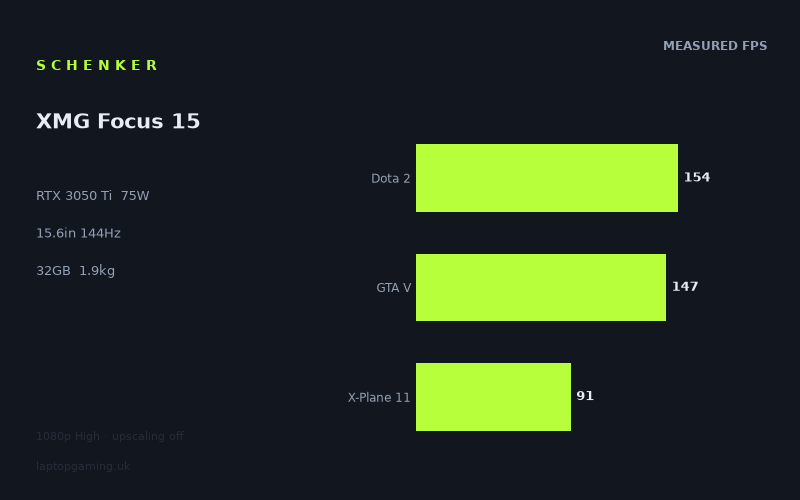
Frame rates
1920×1080, High preset, upscaling off.
Measured on this machine. Source: Notebookcheck, 2021-09-30.
Not scored: incomplete benchmark suite
Every scored laptop on this site is averaged over the same 5 games, and this one is short of Cyberpunk 2077, Baldur's Gate 3. A mean over 5 games is not comparable to a mean over 5, so we publish the figures we have and leave the score blank rather than rank it against machines tested on a different set. The numbers below are real - the suite is just incomplete.
How these numbers were produced
Frame rates here are not measured by us, and we label how each one was arrived at. A figure marked measured comes from a published run on that exact machine. A figure marked representative is derived from the GPU and its power limit (TGP) and cross-referenced against published reviews - a sound estimate of what that configuration delivers, but not a measurement of that specific laptop. Unless stated otherwise, numbers are 1920x1080, High preset, upscaling off. Where a laptop ships in several power configurations we use the wattage of the exact SKU listed, because a 140W RTX 5070 and a 115W one are not the same product.
In use
The short version
The Schenker XMG Focus 15 is a capable 1080p gaming laptop built around an RTX 3050 Ti running at a 75W GPU power limit, a Core i7-11800H and 32GB of memory. The important part is not simply that it has an RTX 3050 Ti badge, but that Notebookcheck’s benchmark data shows it delivering very different experiences depending on the game. In lighter, older or particularly well-optimised titles, it can make convincing use of its 144Hz screen. In more demanding games, it is better understood as a machine for smooth 1080p High-preset gaming rather than one that consistently fills a 144Hz panel.
The measured figures are strong at the easy end of the test list. FIFA 21 reaches 205fps, Dota 2 manages 154fps, Star Wars Squadrons records 151fps, GTA V runs at 147fps and Monster Hunter Stories 2 reaches 143fps. Those are the results that make the 144Hz IPS panel feel appropriate rather than excessive. Dota 2, GTA V and several other games can sit around the screen’s refresh ceiling at the stated settings, while FIFA 21 has considerably more performance available than the panel can show at once.
That is not the whole story, though. The same published measurements put The Witcher 3 at 102fps, Far Cry 5 at 93fps, X-Plane 11 at 91fps, Death Stranding at 86fps and Days Gone at 80fps. These are still useful frame rates for a gaming laptop with a 1920x1080 display, but they are distinctly below 144fps. Move into the heaviest games in the supplied list and the gap grows: Deathloop and Final Fantasy XV each reach 57fps, while Crysis Remastered records 47fps. This is a laptop that can play those games at the stated High preset, but it does not have the graphics headroom to treat 144Hz as a universal target.
Notebookcheck’s mean across the five scoring-suite games is 112fps. That is a healthy result in isolation, but it should not be read as a promise of 112fps in every game. The individual results range from Dota 2 at 154fps to Final Fantasy XV at 57fps within that scoring group. The average is useful as a broad indicator of capability; the individual game figures are more useful for deciding whether this is the right machine for a particular library.
The Core i7-11800H and 32GB memory specification mean there is no obvious compromise in the listed processor or memory configuration. However, the data still points to the RTX 3050 Ti at 75W as the component setting the gaming ceiling in the harder titles. At 1080p High with upscaling off, it can provide excellent responsiveness in esports-oriented games and older blockbusters, comfortable performance in a substantial group of demanding games, and a more limited experience in the toughest releases represented here.
There is no value verdict for this exact configuration because its UK price is not confirmed. That is not a criticism of the laptop or a gap in the benchmark record: the frame-rate suite is complete and the machine ranks normally by performance, but any useful value judgement needs a real UK price rather than a guess.
Buy the XMG Focus 15 if your priority is a relatively light 15.6in gaming laptop with a 144Hz 1080p screen, 32GB of memory and published evidence of high frame rates in competitive and less demanding games. It is also a reasonable fit for someone content to adjust settings in the most demanding titles rather than expecting every game to run close to the panel’s maximum refresh rate. Do not choose it simply because the display says 144Hz if your main aim is to run the heaviest games at High settings and remain near 144fps. The available measurements do not support that expectation.
Performance
What the 75W RTX 3050 Ti means in practice
The XMG Focus 15 uses an RTX 3050 Ti with a 75W GPU power limit. That power limit matters because a laptop GPU name alone does not tell the whole performance story. The benchmark data is therefore more useful than any assumption based on the graphics chip’s branding. Here, the published measurements show a laptop that is clearly competent at 1920x1080, but whose performance changes markedly as game demands rise.
The settings are consistent across the supplied data: 1920x1080 resolution, High preset and upscaling disabled. That matters because the numbers are not boosted by a lower resolution, a reduced preset or an upscaling mode. The figures represent native-resolution High-preset performance. For a 15.6in 1920x1080 screen, that is the most relevant baseline: it shows what the laptop can do without asking the buyer to compromise before they have even started adjusting options.
At the fast end of the measurements, the Focus 15 has genuine high-refresh capability. FIFA 21 at 205fps is well beyond the 144Hz panel’s refresh rate. Dota 2 reaches 154fps, Star Wars Squadrons achieves 151fps and GTA V records 147fps. Each of those results is at or beyond the display’s 144Hz refresh rate, apart from nothing more than the narrowest margin in GTA V’s case. Monster Hunter Stories 2 at 143fps is effectively on the same boundary. For these games, the laptop’s panel is not merely a specification-sheet extra. The GPU has enough throughput to make high-refresh play meaningful at the tested settings.
That is particularly encouraging for players whose regular games resemble Dota 2, FIFA 21 or GTA V in their performance demands. A gaming laptop does not need to produce the same frame rate in every title to be useful; it needs to produce the right sort of frame rate in the games its owner actually plays. Someone who spends most of their time in Dota 2 will see a very different side of this system from someone whose library is led by Crysis Remastered, Deathloop and Final Fantasy XV.
The next group remains comfortably fast, even though it no longer fully exploits the panel’s refresh rate. Strange Brigade records 112fps, The Witcher 3 reaches 102fps, Far Cry 5 manages 93fps and X-Plane 11 returns 91fps. These are not marginal results. They indicate that 1080p High is still viable in games with more demanding graphics workloads or, in X-Plane 11’s case, a workload that can be demanding in ways that do not resemble an esports title. But these figures also make the distinction between “smooth” and “144Hz-class” performance clear. A game running at 91fps or 102fps can look and feel good on this screen; it is simply not using every refresh the panel can offer.
Death Stranding at 86fps, Days Gone at 80fps, Hunt Showdown at 79fps and Yakuza Like a Dragon at 76fps form another meaningful band. This is still substantially above the level where the laptop would feel unsuitable for gaming, but it is a reminder that high refresh is conditional. In these titles, the Focus 15’s display gives the machine room to show frame rates above a conventional 60Hz level, yet it cannot make those games behave like the much lighter titles at the top of the list.
Outriders runs at 70fps, Mafia Definitive Edition reaches 68fps and Serious Sam 4 records 67fps. These results are useful because they show where the laptop’s 75W GPU begins to move from “fast 1080p” to “solid but not lavishly over-provisioned 1080p”. There is still enough performance for the stated resolution and quality setting, but little evidence here of surplus capacity for users who want to raise graphics settings beyond High, chase very high refresh rates or expect demanding future games to behave like the lighter titles in the list.
At the lower end, Deathloop and Final Fantasy XV both manage 57fps, while Crysis Remastered reaches 47fps. Those are the figures that should shape a buyer’s expectations more than the 205fps FIFA 21 result does. They show that the RTX 3050 Ti at 75W is not a universal High-preset, high-refresh GPU. It can run demanding games at the tested settings, but the heaviest examples here are far from the screen’s 144Hz ceiling. Anyone buying specifically for titles with similarly demanding graphics should view the 144Hz panel as useful headroom for lighter games, not as a performance promise for everything.
The benchmark spread matters more than a single average
The Focus 15’s 112fps mean across the five scoring-suite games is a concise summary, but it hides a large spread. Dota 2 reaches 154fps, GTA V records 147fps, Strange Brigade manages 112fps, X-Plane 11 achieves 91fps and Final Fantasy XV returns 57fps. The machine’s average is therefore made up of results that range from above the display refresh rate to well below it.
This is why a single benchmark average should never be used as a shopping shortcut. A buyer seeing a mean of 112fps could reasonably conclude that this is a laptop that sits somewhere between 60Hz and 144Hz performance. That would be broadly fair, but incomplete. The laptop is not delivering a uniform 112fps experience. It is delivering very high frame rates in some games, strong but sub-144fps results in others, and performance closer to a conventional 60fps target in the hardest entries.
For competitive games, the top-end results are more relevant than the average. Dota 2 at 154fps is a strong outcome for the 144Hz panel. FIFA 21 at 205fps is similarly reassuring for a player who wants quick presentation without needing to cut image quality. In these scenarios, the hardware combination appears well balanced around the screen: the GPU can provide the frames, while the Core i7-11800H and 32GB memory specification avoid an obvious listed shortfall elsewhere in the system.
For single-player games with demanding graphics, the lower group matters more. Deathloop at 57fps and Crysis Remastered at 47fps show that the Focus 15 is not operating with vast graphics reserve. The practical implication is not that the machine cannot run those games. It plainly can, according to the published High-preset numbers. The implication is that a buyer who wants more performance may need to change settings rather than assume that native 1080p High will always be enough to reach the panel’s maximum refresh rate. The supplied data does not tell us which individual settings would offer the best gains, so it would be wrong to invent an exact adjustment path. It does tell us that expectations should be set game by game.
The middle group is arguably the most representative of what this laptop does well. The Witcher 3 at 102fps, Far Cry 5 at 93fps, X-Plane 11 at 91fps, Death Stranding at 86fps, Days Gone at 80fps and Hunt Showdown at 79fps all support the same broad conclusion: this is a capable native-1080p gaming machine that can exceed 60fps by a useful margin in a range of recognisable demanding games. It is neither limited to esports gaming nor equipped to make every demanding game a 144fps experience.
High settings, native resolution and no upscaling
The “upscaling off” condition is particularly relevant for interpreting the numbers. The Focus 15’s figures come from 1920x1080 High-preset testing without an upscaling mode. That makes the results straightforward to read. A 57fps result in Deathloop, for example, is not an artificial high-refresh outcome produced by a lower internal resolution. It is the published result at the stated native screen resolution and High preset.
For buyers, that provides a reliable starting point rather than a complete forecast of every game setting. The data says that FIFA 21, Dota 2, Star Wars Squadrons, GTA V and Monster Hunter Stories 2 can make very strong use of the display under the tested conditions. It says that The Witcher 3, Far Cry 5, X-Plane 11, Death Stranding and Days Gone remain comfortably playable but do not generally sit at the screen limit. It says that Deathloop, Final Fantasy XV and Crysis Remastered are where compromises become more likely if the aim is a substantially higher frame rate.
The key advantage of having the actual figures is that this is not guesswork based on a component list. The RTX 3050 Ti has been measured in this particular laptop configuration at its 75W power limit. That is more useful than treating every RTX 3050 Ti laptop as equivalent. The numbers show the realised performance of the XMG Focus 15, not a theoretical position for its GPU tier.
CPU and memory context
The Core i7-11800H is paired with 32GB of memory. The benchmark data does not provide separate processor or memory measurements, so it would be wrong to claim a particular CPU advantage in a particular game. What can be said is that the listed configuration is not a stripped-back gaming specification: 32GB is a substantial memory allocation alongside the Core i7-11800H.
That context is useful when looking at the high frame rates in Dota 2, GTA V, FIFA 21 and Star Wars Squadrons. In games capable of producing well above 100fps, overall platform balance matters. The Focus 15 has a processor and memory configuration that is appropriate to the frame rates Notebookcheck recorded. The lower results in Crysis Remastered, Deathloop and Final Fantasy XV are better read as evidence that demanding game workloads are reaching the limits of the graphics side at the tested settings, rather than as a reason to dismiss the rest of the specification.
There is also a broader lesson in the data: laptop gaming performance cannot be reduced to a GPU label. The Focus 15’s 75W RTX 3050 Ti produces a wide result range at the same resolution and quality setting. That is normal because game engines, graphics effects and processor demands differ. The sensible buying decision is therefore to match the laptop to the games nearest the results you care about, not to focus on the headline mean alone.
The screen
A sensible 1080p gaming target
The XMG Focus 15 has a 15.6in IPS display with a 1920x1080 resolution and 144Hz refresh rate. This is an appropriate resolution for the published GPU performance. The benchmark data is already gathered at the screen’s native 1920x1080 resolution, so there is no need to extrapolate from a different display target. The laptop’s best results arrive exactly where the panel is designed to be used.
A higher-resolution panel would demand more graphics performance at the same quality settings. This machine instead pairs its RTX 3050 Ti at 75W with a 1080p display, and the figures demonstrate the benefit of that pairing. FIFA 21 at 205fps, Dota 2 at 154fps, Star Wars Squadrons at 151fps and GTA V at 147fps all show that the Focus 15 can deliver the kind of frame rates for which a 144Hz panel makes practical sense.
The 144Hz refresh rate should nevertheless be read as a ceiling rather than a baseline. The measured list itself makes this clear. Monster Hunter Stories 2 is close at 143fps, but Strange Brigade is at 112fps, The Witcher 3 reaches 102fps, Far Cry 5 runs at 93fps and X-Plane 11 manages 91fps. Those are all below 144fps despite using the same 1920x1080 High-preset test conditions.
That does not make the panel a mismatch. A 144Hz display can still be beneficial below 144fps, especially where the laptop is running above 60fps. But it does mean a prospective buyer should avoid the simplistic assumption that a 144Hz specification automatically means 144fps in every game. The Focus 15’s benchmark record supports high-refresh gaming in selected titles, not across every title in the list.
Where it can drive the panel
The clearest panel matches are FIFA 21, Dota 2, Star Wars Squadrons and GTA V. At 205fps, FIFA 21 runs beyond the screen’s stated refresh rate. Dota 2 at 154fps and Star Wars Squadrons at 151fps also exceed it. GTA V at 147fps is just over the 144Hz mark, while Monster Hunter Stories 2 at 143fps is effectively adjacent to it. These are the games in which the Focus 15 can reasonably be expected to feel like a high-refresh gaming system at the tested settings.
For a buyer focused on those kinds of games, the display specification is a meaningful part of the package. It would be wasteful to pair such frame rates with a low-refresh panel, and the XMG does not do that. The screen gives these lighter or less GPU-heavy games somewhere to go.
Strange Brigade at 112fps is also a good example of the screen still being relevant even when its full refresh rate is not reached. The game is well above 60fps and below 144fps. That is precisely the territory where a 144Hz display offers headroom without implying that the laptop must reach the maximum refresh rate to be enjoyable. The same applies to The Witcher 3 at 102fps, Far Cry 5 at 93fps and X-Plane 11 at 91fps.
Where the GPU becomes the limitation
The heavier results put a firmer boundary around the panel’s usefulness. Death Stranding at 86fps, Days Gone at 80fps, Hunt Showdown at 79fps and Yakuza Like a Dragon at 76fps are all materially below 144fps. They still suit a responsive screen better than a display limited to 60Hz, but their performance level is governed by the GPU workload rather than by the panel’s maximum refresh capability.
Outriders at 70fps, Mafia Definitive Edition at 68fps and Serious Sam 4 at 67fps reinforce that point. These are not figures that suggest a broken relationship between GPU and display; they are figures that show the GPU is being asked to handle games that are more demanding than the titles at the top of the list. The screen can refresh at 144Hz, but the graphics processor cannot generate 144 frames each second in these games at 1920x1080 High with upscaling off.
Deathloop and Final Fantasy XV at 57fps, followed by Crysis Remastered at 47fps, are the strongest evidence against buying this machine for a blanket “144fps at High settings” expectation. The laptop’s screen remains a good specification because it benefits the games where performance is available. It simply cannot change the fact that demanding workloads are demanding workloads.
The IPS specification
The panel is IPS, which identifies its display technology, but the supplied information does not include measurements for brightness, contrast, colour coverage, response behaviour or outdoor visibility. It would therefore be inappropriate to make claims about image quality beyond the published panel type, size, resolution and refresh rate.
What the benchmark data does establish is that the 1920x1080 and 144Hz specification is performance-appropriate in a selective rather than universal way. It is a good fit for Dota 2, FIFA 21, GTA V and Star Wars Squadrons. It has useful headroom for games in the 70fps to 112fps range. It is not fully driven by Deathloop, Final Fantasy XV or Crysis Remastered under the stated settings. That is the honest interpretation of the screen and GPU pairing.
Build, size and portability
The XMG Focus 15 weighs 1.94kg. For a 15.6in gaming laptop with a Core i7-11800H, RTX 3050 Ti and 32GB of memory, that is the key portability specification supplied. It is not a machine that can be discussed as an ultraportable in the absence of further dimensions, but neither does the listed weight suggest an unusually large desktop-replacement approach. Its role is best understood as a conventional 15.6in gaming laptop that can move between locations without being defined solely by a fixed desk setup.
The 1.94kg weight matters because the Focus 15’s appeal is not just its frame rates. A laptop intended only to remain connected to a monitor and mains power can accept more bulk in pursuit of higher graphics limits. This Schenker instead combines a 15.6in screen with a sub-2kg listed weight and a 75W GPU power limit. The specification suggests a more balanced aim: enough GPU power for credible native-1080p gaming, without presenting itself through the supplied data as an extreme high-power machine.
There is no dimensions data in the supplied specification, so no claim can be made about thickness, footprint, bag fit or how much desk space it occupies. There is also no published information here about materials, keyboard layout, trackpad, port selection, webcam, speaker quality, chassis temperatures or fan noise. Those omissions should matter to a buyer whose decision depends on them. A gaming laptop can have compelling benchmark results and still be unsuitable if its physical layout or acoustic behaviour does not fit the intended use, but the supplied data does not allow a reliable judgement on those areas.
The battery capacity is 49Wh. Capacity alone is not a measured battery-life result. There are no published battery-runtime figures in the provided information, so it would be wrong to turn 49Wh into an estimate for browsing, video playback, work or gaming away from mains power. The responsible conclusion is simply that the laptop has a 49Wh battery and that battery-life expectations cannot be verified from the available data.
For someone carrying the Focus 15 regularly, the weight is the concrete figure to use: 1.94kg. Whether that is acceptable depends on the buyer’s own travel pattern and tolerance for a 15.6in gaming system. It is more informative than pretending that a gaming laptop with this display size and hardware should be judged by the same standard as a smaller general-purpose machine. The XMG’s portability case is based on its listed weight, not on unsupported claims about endurance or chassis dimensions.
There is also a practical distinction between carrying a laptop and gaming away from mains power. The published performance figures are benchmark measurements at 1920x1080 High with upscaling off, but the supplied material does not say whether they were obtained on battery or how performance behaves away from a charger. Buyers should not assume the listed gaming figures describe unplugged operation. The data supports conclusions about benchmark performance, not battery-powered gaming behaviour.
How it compares
The comparison set is useful because it spans machines from the same GPU generation rather than presenting only a superficially similar rival. It includes the two closest results, a machine the Focus 15 beats by the largest supplied margin, and a machine that outperforms it by the largest supplied margin. Each comparison is based only on games held in common, with preference given to the scoring suite. That limitation is important: these are shared-game averages, not a claim that every game will show the same gap.
Against the MSI Prestige 15
Against the MSI Prestige 15 with an RTX 3050 Ti at 105W, the XMG Focus 15 averages 58fps ahead across four shared games. On the face of it, that is the most surprising comparison in the group. The MSI has the same named GPU family and a higher listed GPU power limit, yet the Focus 15’s shared-game average is substantially higher.
The correct response is not to invent a single explanation that the supplied figures cannot prove. The result may reflect the specific shared games, the wider configuration of each laptop, or the way those particular benchmark runs behave. What the data firmly supports is narrower but still important: in the shared games available for this comparison, the XMG Focus 15 is ahead by 58fps on average. That is a major observed difference, and it is a warning against buying a laptop on GPU name and GPU power limit alone.
It also reinforces why the Focus 15 should be judged on its own measured frame rates. A 75W RTX 3050 Ti might look modest beside a 105W RTX 3050 Ti if the comparison stopped at specifications. The benchmark comparison says that the real shared-game outcome is decisively in the Schenker’s favour. A buyer considering these particular two systems should give more weight to the measured result than to the assumption that the higher listed power limit must win.
Neither laptop has a confirmed UK price in the supplied data, so this is a performance comparison rather than a value recommendation. The XMG’s advantage is clear in the shared-game average; whether that advantage is worth paying for cannot be determined without actual prices.
Against the Razer Blade 14 Ryzen 9 RTX
The Razer Blade 14 Ryzen 9 RTX uses an RTX 3070 at 100W. Across five shared games, the XMG Focus 15 averages 1fps ahead. A difference that small should not be treated as a meaningful performance victory for the Schenker, nor should the Razer’s RTX 3070 label be used to claim a decisive advantage over the XMG in this particular shared set. The measured outcome is effectively a tie.
That near-zero result deserves explanation because the component labels look far apart. At 1080p, lighter titles in the shared games can become CPU-bound, which compresses genuine GPU differences. Put simply, once a game is limited by something other than the graphics processor, a faster GPU does not automatically create a proportionally higher frame rate. That is why a 75W RTX 3050 Ti system can sit alongside a 100W RTX 3070 system in a selected 1080p shared-game comparison.
This does not mean the two GPUs are universally equivalent. The XMG’s own results in demanding games already show that it has limits: Deathloop at 57fps, Final Fantasy XV at 57fps and Crysis Remastered at 47fps are not evidence of unlimited graphics headroom. The comparison means only what it says: in the five games both machines hold for this comparison, the average difference is 1fps in the Focus 15’s favour. For this particular set, the gap is too small to drive a purchase decision.
Buyers comparing these machines should therefore look beyond the shared-game average. The supplied facts identify different GPU power limits and different GPU classes, but they do not provide screen, weight, battery or pricing details for the Razer in this comparison. There is no confirmed UK price for it either. The sensible conclusion is that the XMG is demonstrably competitive in the shared 1080p game selection, not that it replaces every reason someone might choose the Razer.
Against the Acer Nitro 5
The Acer Nitro 5 uses an RTX 3070 at 85W. As with the Razer, the Focus 15 averages 1fps ahead across five shared games. Again, this should be read as a practical tie rather than an XMG win worth celebrating. The difference is so small that it tells a buyer the tested shared selection does not separate these two laptops meaningfully.
The explanation is again rooted in the nature of 1080p testing and the titles held in common. Lighter games can be CPU-bound at 1080p, reducing the visible advantage a more powerful GPU might otherwise show. That does not erase underlying GPU differences in every workload. It does explain why the shared-game results can compress to a near-zero margin despite the Nitro 5 carrying an RTX 3070.
This comparison is valuable precisely because it prevents simplistic conclusions. The XMG Focus 15 should not be dismissed as automatically much slower than every RTX 3070 laptop merely because it uses an RTX 3050 Ti. In this particular five-game overlap, it is essentially level with the Acer Nitro 5. Conversely, the XMG should not be described as an RTX 3070 replacement on that basis. Its own results in the more demanding games remain the better guide to its likely limits at native 1080p High settings.
As with the other rivals, no confirmed UK price is available for the Acer configuration. There is therefore no responsible way to turn this tied shared-game result into a value conclusion. Performance in the shared set is effectively level; purchase suitability would depend on factors not supplied here, as well as real prices.
Against the MSI Raider GE77 HX
The MSI Raider GE77 HX is the machine that beats the Focus 15 by the widest supplied margin. It uses an RTX 3080 Ti at 175W, and the XMG averages 57fps behind across five shared games. This is the comparison that most clearly illustrates the limits of the Focus 15’s 75W RTX 3050 Ti configuration.
A 57fps average deficit is large enough that it should not be explained away as ordinary game-to-game variation. The Raider is a substantially higher-powered graphics configuration, and the shared-game data reflects that. Buyers seeking consistently greater graphics headroom, particularly for demanding games or high-refresh targets beyond the lighter titles, should understand that the Focus 15 is not competing in the same performance class as this MSI.
The XMG’s advantage is that it does not need to compete with the Raider in every role to make sense. It weighs 1.94kg and has a 15.6in display, while the supplied data gives no equivalent portability figures for the Raider. It would be wrong to infer the Raider’s weight, size or battery behaviour without the relevant facts. What can be said is that the performance difference is clear, while the broader ownership trade-off cannot be fully evaluated from the supplied information.
The comparison also puts the Focus 15’s results in perspective. Its 112fps mean across the five scoring-suite games is respectable, but the Raider’s shared-game lead indicates how much additional headroom exists in a much higher-powered GPU configuration. If your buying priority is the strongest possible frame rate in demanding titles, the XMG is plainly not the machine to choose from this pair. If your priority is a 1.94kg 15.6in system with credible 1080p performance, it occupies a different place in the market.
What the rival spread tells us
Taken together, the rivals demonstrate why published benchmarks are more revealing than component names alone. The Focus 15 is 58fps ahead of the MSI Prestige 15 with a 105W RTX 3050 Ti across four shared games. It is effectively tied with both the 100W RTX 3070 Razer Blade 14 Ryzen 9 RTX and the 85W RTX 3070 Acer Nitro 5 across five shared games, each by a 1fps margin. It trails the 175W RTX 3080 Ti MSI Raider GE77 HX by 57fps across five shared games.
Those results do not contradict each other. They show that laptop performance is determined by the whole machine, the tested games and the settings, not merely by the GPU name. They also show why the 1080p context matters. Where games are CPU-bound, GPU gaps can shrink dramatically. Where graphics demand rises, the advantage of substantially more powerful GPU hardware becomes much clearer.
For the XMG Focus 15, the useful conclusion is precise. It can be unusually competitive in a shared selection against some nominally stronger GPU configurations, especially at 1080p where lighter games may compress differences. It cannot match a much higher-powered RTX 3080 Ti system across the shared set. That aligns with its own game list: exceptional figures in FIFA 21 and Dota 2, good results through much of the middle of the table, and much lower performance in Crysis Remastered, Deathloop and Final Fantasy XV.
Who it’s for
Buy it for high-refresh 1080p gaming in the right games
The XMG Focus 15 is best suited to someone whose gaming priorities include titles where the published figures are near or above the 144Hz display limit. Dota 2 at 154fps is a particularly good match for the screen. FIFA 21 at 205fps, Star Wars Squadrons at 151fps and GTA V at 147fps are similarly convincing. Monster Hunter Stories 2 at 143fps is also close enough to the panel’s refresh rate to show why 144Hz was included.
For this buyer, the machine’s appeal is straightforward. It offers a 15.6in IPS display at 1920x1080 and 144Hz, a Core i7-11800H, 32GB of memory and benchmark evidence that the GPU can drive high frame rates in selected games. The 1.94kg weight also gives it a more portable proposition than a machine chosen solely for maximum graphics power, although the supplied information does not include dimensions or measured battery endurance.
It is also a sensible choice for a player with a mixed library who accepts that not every title needs to run at 144fps to be enjoyable. The Witcher 3 at 102fps, Far Cry 5 at 93fps, X-Plane 11 at 91fps, Death Stranding at 86fps and Days Gone at 80fps make a strong case for the Focus 15 as a broadly competent 1080p High-preset laptop. These are not top-of-table high-refresh results, but they are well above the performance level that would make the system feel narrowly specialised for esports alone.
The 32GB memory configuration is also attractive for buyers who do not want a minimal memory allocation alongside a gaming GPU. The provided information does not include workload-specific memory testing, so there is no basis for claiming a measured productivity benefit. It does mean the laptop is specified with 32GB rather than a lower amount, and that is a concrete advantage for buyers who place value on having more memory in the listed configuration.
Buy something else if demanding games are the priority
Buy something else if your main requirement is to run the most demanding games in the supplied list at High settings while remaining close to 144fps. The Focus 15 does not do that. Deathloop at 57fps, Final Fantasy XV at 57fps and Crysis Remastered at 47fps are clear evidence. Outriders at 70fps, Mafia Definitive Edition at 68fps and Serious Sam 4 at 67fps also show that the laptop’s performance reserve is limited once game demands rise.
This is not a criticism based on an imagined standard. It is a direct reading of the measurements. The XMG can run those games at 1920x1080 High with upscaling off, which is meaningful. But a buyer whose definition of success is consistently using the 144Hz display to its full potential in demanding releases needs more GPU headroom than the published results show here.
The MSI Raider GE77 HX is the clearest rival example of that higher-performance direction. Its RTX 3080 Ti runs at 175W and it is 57fps ahead of the Focus 15 on average across five shared games. No price or portability recommendation can be made between the two because those details are not confirmed for the rival in the supplied facts. But if frame rate in demanding titles is the overriding concern, the performance evidence says the Raider-class approach is materially stronger.
Do not buy it on GPU branding alone
The Focus 15 is also a machine for buyers willing to look past simple GPU labels. Its 75W RTX 3050 Ti sounds less ambitious than the RTX 3070 configurations in the Razer Blade 14 Ryzen 9 RTX and Acer Nitro 5. Yet it is effectively tied with both in the supplied shared-game comparisons, averaging 1fps ahead across five games in each case. At 1080p, lighter titles in the shared set can be CPU-bound and can compress genuine GPU gaps.
That makes the Focus 15 potentially attractive to a buyer who plays games similar to the shared comparison set, but it should not be used to claim that the laptop will match every RTX 3070 system in every title. The XMG’s own lower results in the hardest games are too important to ignore. Buy it because its measured game list fits your library, not because a narrow shared-game tie is turned into a universal performance claim.
Likewise, do not assume the MSI Prestige 15’s 105W RTX 3050 Ti must be better solely because its listed power limit is higher. The Focus 15 is 58fps ahead across four shared games. That result makes the Schenker the stronger performance choice in that particular overlap, while also demonstrating why laptop buying should start with attributable benchmark data rather than a hierarchy built only from product names.
Who should wait for more information
Some buyers should wait for confirmed pricing and further measurements before deciding. The UK price for this exact XMG Focus 15 configuration is not confirmed. Without it, there is no sound way to judge whether the combination of RTX 3050 Ti performance, 32GB memory, 15.6in 144Hz IPS display and 1.94kg weight is competitively priced.
Buyers who care strongly about battery life should also wait for measured runtime data. The laptop has a 49Wh battery, but no battery-life figure is provided. Capacity is not runtime. It does not tell us how long the machine lasts in work, video, browsing or games, and it does not tell us how performance changes away from mains power.
The same applies to users for whom noise, thermals, ports, keyboard quality, display brightness, colour performance or chassis dimensions are decisive. None of those areas is covered by the supplied facts. The absence of data does not mean the laptop is poor in those respects; it means a responsible review cannot pretend to know.
Final buying advice
The Schenker XMG Focus 15 is an appealing performance proposition for a specific kind of 1080p player. It has a 144Hz 15.6in IPS display that is genuinely useful in games such as FIFA 21, Dota 2, Star Wars Squadrons and GTA V, where Notebookcheck’s figures reach 205fps, 154fps, 151fps and 147fps. It remains capable across a broad middle ground, including The Witcher 3 at 102fps, Far Cry 5 at 93fps and Death Stranding at 86fps.
Its limitation is equally clear. The 75W RTX 3050 Ti cannot make the 144Hz panel a universal High-preset target. The hardest measured games fall to 57fps or 47fps, and the laptop is substantially behind the much higher-powered RTX 3080 Ti rival in shared games. Buyers seeking uncompromising high-refresh performance in demanding releases should look elsewhere.
For everyone else, the Focus 15 deserves consideration on its actual numbers rather than on assumptions. It is a 1.94kg 15.6in laptop with a Core i7-11800H, 32GB memory and a benchmark record that ranges from excellent high-refresh performance to competent but more constrained gaming in the toughest titles. Match it to the games you play, insist on a confirmed UK price before making any value call, and treat the 144Hz display as an asset best exploited by the lighter and better-performing part of its library.