Review
Medion Erazer Beast X40 review
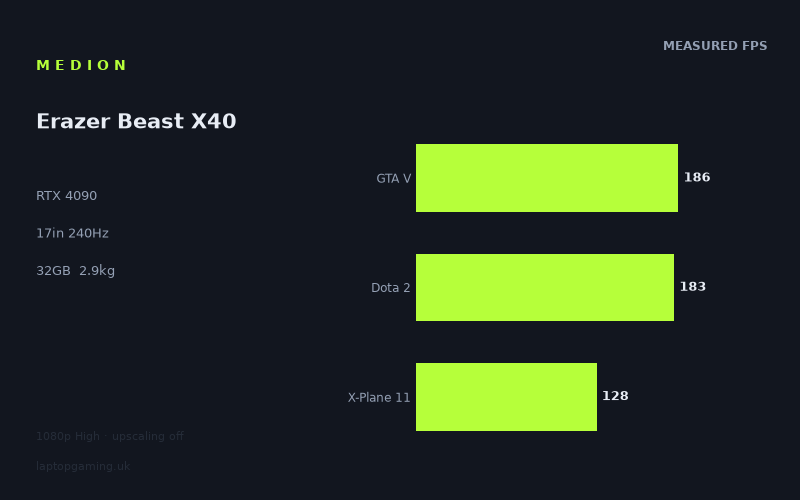
Frame rates
1920×1080, High preset, upscaling off.
Measured on this machine. Source: Notebookcheck, 2023-03-24.
Not scored: incomplete benchmark suite
Every scored laptop on this site is averaged over the same 5 games, and this one is short of Cyberpunk 2077, Baldur's Gate 3. A mean over 3 games is not comparable to a mean over 5, so we publish the figures we have and leave the score blank rather than rank it against machines tested on a different set. The numbers below are real - the suite is just incomplete.
How these numbers were produced
Frame rates here are not measured by us, and we label how each one was arrived at. A figure marked measured comes from a published run on that exact machine. A figure marked representative is derived from the GPU and its power limit (TGP) and cross-referenced against published reviews - a sound estimate of what that configuration delivers, but not a measurement of that specific laptop. Unless stated otherwise, numbers are 1920x1080, High preset, upscaling off. Where a laptop ships in several power configurations we use the wattage of the exact SKU listed, because a 140W RTX 5070 and a 115W one are not the same product.
In use
The short version
The Medion Erazer Beast X40 is a powerful large-format gaming laptop built around an RTX 4090, a Core i9-13900HX, 32GB of memory and a 17in 2560x1600 IPS display with a 240Hz refresh rate. On the available Notebookcheck benchmark data, it produces extremely high frame rates at 1920x1080 on the High preset with upscaling switched off. Several measured results are comfortably above the screen’s refresh rate at that test resolution, while the more demanding games still remain well into high-refresh territory.
That makes the Beast X40 easy to recommend to a buyer whose priority is maximum frame rate in a 17in machine, particularly for games such as Strange Brigade, The Witcher 3, Back 4 Blood, F1 22, Hunt Showdown and Company of Heroes 3. Those results show that the laptop has substantial performance available in many games even before upscaling is considered. It also delivers strong results in heavier titles including Hogwarts Legacy, Returnal, Guardians of the Galaxy and Atomic Heart, although the gap between those results and the panel’s 240Hz ceiling matters. A 240Hz display does not mean every game will reach 240fps, and the measured data shows exactly why that distinction matters.
The important qualification is resolution. The panel is 2560x1600, but the supplied figures are measured at 1920x1080. They are therefore useful evidence of the laptop’s performance at the benchmark settings, but they are not evidence that the Beast X40 reaches the same frame rates at the display’s native resolution. There are no supplied 2560x1600 figures, no supplied settings comparisons beyond the High preset, and no supplied upscaling results. A buyer choosing this model specifically for native-resolution gaming should recognise that the available data does not establish its exact performance at 2560x1600.
There is also no confirmed UK price. That prevents a meaningful value judgement. The specification is high-end, the frame-rate data is strong, and the display is unusually fast for a 17in 2560x1600 IPS panel, but value depends on what Medion asks for the configuration in the UK. Until that price is confirmed, the sensible conclusion is about capability rather than bargain status.
There is one further limitation for anyone looking at rankings. The available scoring-suite mean is based on GTA V, Dota 2 and X-Plane 11, but there are no figures for Cyberpunk 2077 or Baldur’s Gate 3. As every scored laptop is averaged across the same five games, this incomplete set cannot be used to rank the Beast X40 against fully scored machines. The partial data is still useful: GTA V, Dota 2 and X-Plane 11 show very different kinds of performance behaviour, and the much broader list of available measured games gives a better picture than a single headline average would anyway. It just should not be turned into a formal league-table position.
The Beast X40 is most convincing for someone who wants a desktop-replacement-style gaming laptop with a large, fast screen and has a real use for very high frame rates at 1920x1080. It is less straightforward for someone who intends to play every game at 2560x1600 and expects the panel’s full refresh rate in all of them, or for someone who needs a laptop that is genuinely easy to transport. At 2.88kg, it is a substantial machine before any accessories are considered, and the supplied information does not give dimensions that might soften or worsen that practical reality.
Performance
The published benchmark data comes from Notebookcheck and was measured at 1920x1080, using the High preset with upscaling off. That is an important and relatively clean comparison point. It shows the machine’s frame-rate capability without attributing any of the result to upscaling, but it also means the figures are not a direct guide to what happens at the laptop’s 2560x1600 native resolution. The Beast X40’s display has substantially more pixels than the benchmark resolution, so it would be wrong to treat a 1920x1080 result as a native-resolution promise.
At the top end of the results, the Beast X40 is exceptionally quick. Strange Brigade is measured at 369fps and The Witcher 3 at 364fps. Back 4 Blood follows at 309fps, while F1 22 reaches 268fps and Hunt Showdown reaches 262fps. Company of Heroes 3 records 235fps. These are not merely good results in isolation: they demonstrate that, in these particular games and at these particular settings, the machine can operate around or beyond the 240Hz panel refresh rate.
That does not mean the 240Hz display is automatically fully exploited in every one of those games. Strange Brigade, The Witcher 3, Back 4 Blood, F1 22 and Hunt Showdown all exceed 240fps in the supplied figures. Company of Heroes 3, at 235fps, sits just below the screen’s maximum refresh rate. The practical message is clear enough without pretending there is a universal answer: some games have enough available performance to meet or exceed the panel’s ceiling at the test settings, while others land close to it rather than reaching it.
Hogwarts Legacy is measured at 204fps. That is below the display’s 240Hz maximum, but it remains a very high result. GTA V records 186fps, Riders Republic 185fps and Dota 2 183fps. The Quarry is measured at 177fps, while Final Fantasy XV is at 176fps. This group is a useful reminder that a frame rate below a panel’s maximum refresh rate is not necessarily a weak result. In these cases, the notebook is still producing far more frames than conventional lower-refresh displays can show, but it is not reaching the ceiling of the 240Hz panel according to the available figures.
Far Cry 5 and Yakuza Like a Dragon both register 167fps. Returnal is close behind at 164fps, with Death Stranding at 163fps and Guardians of the Galaxy at 158fps. Atomic Heart is measured at 144fps. These results remain strong, but they show a more restrained relationship with the screen’s refresh rate. The panel can refresh at 240Hz; the benchmark results in these games do not reach that limit at 1920x1080 High with upscaling off.
The lower end of the available set is equally important because it keeps the review grounded in the games where a top-tier specification does not translate into a near-panel-limit result. X-Plane 11 is measured at 128fps. Elex 2 follows at 116fps, Sons of the Forest at 88fps. These are still playable-looking figures in a general sense, but the key comparison here is not against an unspecified standard of acceptability. It is against the Beast X40’s own 240Hz display. In these games, the supplied data suggests that the panel offers more refresh-rate headroom than the measured output uses at the test settings.
Sons of the Forest is especially useful because it illustrates why a single RTX 4090 label cannot tell a buyer everything they need to know. The same machine that reaches 369fps in Strange Brigade and 364fps in The Witcher 3 records 88fps in Sons of the Forest. That is not a contradiction in the data. Games differ in how they use the CPU and GPU, how demanding their rendering workloads are, and how their individual settings affect performance. The benchmark spread is precisely why a laptop review should list attributable figures rather than implying that one component name guarantees one universal gaming experience.
The difference between 369fps in Strange Brigade and 88fps in Sons of the Forest is large, but it should not be reduced to a simplistic claim that the laptop is either “a 240fps machine” or not. It is capable of more than 240fps in some measured games at 1920x1080 High with upscaling off. It does not do so in others. It sits close to the panel limit in Company of Heroes 3. It runs well below that limit in titles including Hogwarts Legacy, Returnal, Atomic Heart, X-Plane 11, Elex 2 and Sons of the Forest. Buyers who mainly play games resembling the faster end of the listed set will take more advantage of the 240Hz panel than buyers whose library resembles the more demanding end.
The partial scoring-suite results reinforce that point. GTA V is measured at 186fps, Dota 2 at 183fps and X-Plane 11 at 128fps. Their stated mean is 166fps. That mean is informative as a summary of those three games, but it is not a complete performance rating for the laptop. There are no supplied scoring-suite figures for Cyberpunk 2077 or Baldur’s Gate 3, so the usual five-game basis is incomplete. It would be misleading to use the partial mean as if it were interchangeable with a fully populated five-game result.
It is also worth looking at what the three scoring-suite games imply rather than treating their mean as the whole story. GTA V and Dota 2 are very close to one another in the supplied data, at 186fps and 183fps respectively. X-Plane 11 is materially lower at 128fps. The result is that the three-game mean is neither dominated by the highest game in the wider list nor dragged down to the lowest result in the wider list. It is simply the average of those specified scoring-suite measurements. For a buyer, the individual figures are more useful than a single combined number because they make clear that the machine’s output depends heavily on the game.
The Core i9-13900HX and 32GB of memory sit alongside the RTX 4090, but there is no supplied processor benchmark data, memory-speed information or storage-performance result. The benchmark figures show the combined behaviour of the tested configuration; they do not isolate the contribution of the processor, memory or SSD. It would therefore be wrong to claim that a particular game result is caused solely by the CPU or solely by the GPU. The supplied rival comparison does note that lighter titles at 1920x1080 can be CPU-bound, compressing genuine GPU gaps, and that matters when interpreting very small performance differences between machines.
The GPU power limit needs similar care. The fact sheet identifies the Beast X40 as an RTX 4090 machine, but it does not state this laptop’s GPU power limit. There is no basis here for claiming that the RTX 4090 is running at a particular wattage, for describing it as power-limited or fully powered, or for treating its performance as a direct expression of a stated GPU power setting. The measured figures are what matter: they show strong performance in the listed games, but they do not reveal the power configuration behind those figures.
That absence is particularly relevant because the rival list does provide power limits for some other machines. The Lenovo Yoga Pro 9 16IMH9 RTX has an RTX 4050 at 100W, the Lenovo Legion 5 16IRX G9 has an RTX 4060 at 115W, and the Asus Zephyrus Duo 16 has an RTX 4090 at 175W. Those details should not be used to reverse-engineer the Medion’s own setting. Different machines can produce close results in parts of a shared set for reasons that cannot be determined from the supplied figures alone, especially when the shared titles are lighter at 1920x1080 and CPU limits compress the differences.
For actual buying decisions, the performance data supports a simple approach. If the objective is the highest possible frame rate in games where the Beast X40 is already above 240fps at the benchmark settings, the 240Hz panel is an appropriate match. If the objective is a consistently panel-saturating result across every game, the data does not support that expectation. If the objective is native 2560x1600 gaming, the available 1920x1080 figures provide encouraging evidence of general performance strength but not a direct answer. There are no native-resolution measurements in the supplied information.
Upscaling is also outside the evidence available here. The benchmark configuration explicitly has upscaling off. That makes the results easier to interpret as straightforward measured performance, but it leaves open how individual games might behave with upscaling enabled. A buyer should not assume an upscaled result, an image-quality trade-off or a particular route to 240fps in the games that fall below it. Those are all questions not answered by this data set.
The sensible verdict on performance is therefore strongly positive but specific. The Beast X40 delivers very high measured frame rates across a broad list of games at 1920x1080 High without upscaling. It can meet or exceed the panel’s refresh rate in several of them. It cannot be described as a universal 240fps machine from these figures, because many listed games remain below that threshold and some sit much lower. It also cannot be described as proven at native 2560x1600, because that is not the resolution Notebookcheck’s supplied numbers use.
The screen
The Beast X40 has a 17in IPS screen with a 2560x1600 resolution and a 240Hz refresh rate. On paper, that combination is clearly aimed at a buyer who values both a large working area and high-refresh gaming. The 17in size and 2560x1600 resolution establish the display as a central part of the machine’s appeal rather than a token specification attached to powerful internals. The 240Hz refresh rate gives it headroom for the very high frame rates shown in the Notebookcheck data.
The refresh rate is the easy part to assess because the benchmark data contains multiple results around or above it. At 1920x1080 High with upscaling off, Strange Brigade reaches 369fps, The Witcher 3 reaches 364fps, Back 4 Blood reaches 309fps, F1 22 reaches 268fps and Hunt Showdown reaches 262fps. In those cases, the measured output exceeds the 240Hz panel ceiling. The display cannot show more than its stated refresh rate, so those benchmark results indicate performance headroom rather than a promise of visibly distinct output above that limit.
Company of Heroes 3 at 235fps is close enough to the panel ceiling to make the screen’s refresh rate highly relevant, even though the supplied figure is below 240fps. Hogwarts Legacy at 204fps is further from that ceiling but still high enough to make a 240Hz display a sensible fit. GTA V at 186fps, Riders Republic at 185fps and Dota 2 at 183fps likewise sit below the screen maximum while remaining in a range where a high-refresh panel has clear room to display more frames than a lower-refresh alternative would.
The middle and lower portions of the benchmark set put a more practical limit on the “240Hz gaming” description. The Quarry at 177fps, Final Fantasy XV at 176fps, Far Cry 5 and Yakuza Like a Dragon at 167fps, Returnal at 164fps, Death Stranding at 163fps and Guardians of the Galaxy at 158fps all fall below the refresh-rate ceiling. Atomic Heart at 144fps, X-Plane 11 at 128fps, Elex 2 at 116fps and Sons of the Forest at 88fps fall further below it. The screen remains capable of 240Hz, but the game determines how much of that capability is used.
The crucial issue is that all of those statements apply to 1920x1080, not 2560x1600. The Beast X40’s own panel is specified at 2560x1600, while the measured figures were obtained at 1920x1080. The review can say that the laptop has the measured performance listed above at the benchmark resolution and settings. It cannot say that Strange Brigade, The Witcher 3, Back 4 Blood or any other title reaches the same result at 2560x1600. It cannot say that the screen’s 240Hz ceiling is reached at native resolution in any particular game. No such figures are supplied.
This is not a minor technicality. The whole appeal of a 2560x1600, 240Hz panel is the combination of resolution and refresh rate, and the available data verifies only the high-refresh side at a lower resolution. That does not weaken the display specification itself. It simply defines what the benchmark evidence can and cannot prove. Someone happy to use 1920x1080 in selected games has direct frame-rate evidence. Someone who considers 2560x1600 non-negotiable needs to treat the native-resolution performance question as unanswered by the supplied data.
The IPS panel type is stated, but there are no supplied measurements for brightness, contrast, colour coverage, response times, backlight behaviour or any other display-quality characteristic. It would be wrong to infer those from the IPS label alone. The panel can be described accurately as a 17in, 2560x1600, 240Hz IPS display. Beyond that, there is no basis in the fact sheet for claims about image quality, speed of pixel response or use in bright surroundings.
The display and performance combination is therefore best understood in layers. At the most favourable end of the 1920x1080 benchmark list, the GPU has more output than the 240Hz panel can display. In the broad middle of the list, the laptop supplies high frame rates that remain below the panel’s maximum. At the demanding end, the display’s refresh capability is substantially ahead of the measured frame rate. At native 2560x1600, the supplied data is silent. This is a very capable screen specification, but the evidence supports a conditional rather than absolute claim about how fully it will be driven.
Build, size and portability
The physical facts supplied for the Beast X40 are a 17in screen and a weight of 2.88kg. Those two figures are enough to place it firmly in the large-laptop category, even though no chassis dimensions are supplied. A 17in gaming machine with an RTX 4090, Core i9-13900HX, 32GB of memory, 1TB SSD and a 240Hz screen is clearly configured around performance and display space rather than minimal mass.
At 2.88kg, the Beast X40 should be approached as a machine that can be moved when necessary rather than one selected primarily for effortless carrying. That is not an argument that it cannot travel; it is an argument that weight should be part of the buying decision. A buyer who expects to carry a laptop regularly should take 2.88kg seriously rather than focusing solely on the RTX 4090 and benchmark results.
The supplied information does not include dimensions. There is therefore no evidence here about footprint, thickness, bag compatibility or how much desk space the machine occupies. The 17in display tells us it is a large-screen laptop, but it does not justify a specific claim about the chassis beyond that. Similarly, there are no supplied materials, hinge details, port list, keyboard information, webcam details, speaker information or serviceability information. The review should not pretend those details are known.
There are also no figures for battery life, charging behaviour, temperatures or fan noise. This matters because a high-performance laptop is not judged only by fps, but none of those practical measurements are present in the fact sheet. A prospective buyer who needs quiet operation, long unplugged use, or a temperature comparison should seek attributable data before making a decision. The absence of those measurements does not make the Beast X40 poor in those areas; it simply means there is no evidence here to call it good or bad.
What can be said is that the overall configuration makes the laptop best suited to a more settled pattern of use. The large 17in display, 2.88kg weight, RTX 4090, Core i9-13900HX, 32GB of memory and 1TB SSD indicate a machine intended to deliver serious gaming capability in laptop form. That is a very different proposition from a compact system chosen mainly for light travel. The Beast X40 is likely to make most sense where the screen and performance are used frequently enough to justify carrying the extra mass.
The storage capacity is 1TB, but there is no supplied information about the SSD’s speed, spare slots or upgrade options. The memory capacity is 32GB, but there is no supplied information about its configuration or upgradeability. These are useful headline specifications, but they should not be expanded into claims about loading performance, multitasking behaviour or internal access without supporting evidence. The benchmark results are gaming measurements, not storage or memory benchmarks.
The responsible conclusion on build and portability is restrained. The Beast X40 is a 2.88kg, 17in gaming laptop, which makes it more naturally suited to a buyer willing to prioritise screen size and gaming performance over low weight. It is not possible from the supplied material to judge its dimensions, build quality, acoustics, cooling behaviour, battery life or connection options. Those unknowns matter more here than they would in a purely performance-focused comparison, because a 17in laptop is often bought as an all-purpose home machine as well as a gaming system.
How it compares
The rival data is deliberately a spread rather than a list of machines with identical specifications. It includes an RTX 4050 laptop, an RTX 4060 laptop and two RTX 4090 laptops. That makes the comparisons useful for understanding where the Beast X40 sits in measured shared-game performance, but they should not be turned into broad claims about every laptop carrying those GPU names. The comparisons are only on games both machines hold, with preference for the scoring suite where possible.
Against the Lenovo Yoga Pro 9 16IMH9 RTX, which has an RTX 4050 at 100W, the Beast X40 averages 101fps ahead across seven shared games. That is the largest positive gap in the listed comparison set. It is a substantial measured advantage, and it is the clearest evidence here that the Beast X40 is not merely trading on its RTX 4090 badge. Across the available shared games, it produces much higher frame rates than this RTX 4050 rival.
That comparison does not mean the Lenovo is automatically unsuitable for every buyer. There is no confirmed UK price for the Lenovo, and the fact sheet does not provide its weight, screen specification, battery data or other practical characteristics. What the comparison establishes is narrower and more useful: if the decision is specifically about shared-game frame rate, the Beast X40 is far ahead on the supplied seven-game average. A buyer prioritising gaming performance should regard that as a major distinction.
The Lenovo Legion 5 16IRX G9 presents a more surprising result. It has an RTX 4060 at 115W, yet the Beast X40 averages only 1fps ahead across three shared games. That is a near-zero difference, and it should not be repeated as though it proves the two laptops are generally equal. The fact sheet specifically explains why such a result can happen: at 1920x1080, lighter titles in the shared set can be CPU-bound and compress genuine GPU gaps. In other words, a very small average in this limited shared selection is a result of the selected conditions, not proof that an RTX 4090 and RTX 4060 offer equivalent gaming performance in every game.
This is exactly why the detailed Beast X40 benchmark list matters. The Medion’s own figures range from 369fps in Strange Brigade to 88fps in Sons of the Forest. A shared-game comparison of only three titles can be valuable, but it cannot stand in for a broad assessment across demanding and less demanding games. The near-zero Legion result should be read as a warning against making GPU-label assumptions from a small 1920x1080 set, particularly where the titles may be limited by the CPU rather than the GPU.
The Asus Zephyrus Duo 16 also uses an RTX 4090, stated here at 175W. Across three shared games, the Beast X40 averages 0fps ahead. Again, that is a genuine near-zero result, but it requires explanation rather than exaggeration. It does not prove the two machines will match in every game, at every resolution or at every setting. It shows that in the available three-game shared sample, the measured average difference is effectively absent. The fact sheet’s CPU-bound explanation is relevant here too: at 1920x1080, lighter shared titles can reduce visible differences between GPUs and systems.
The lack of a stated GPU power limit for the Medion is particularly important in this comparison. The Zephyrus Duo 16 is identified as an RTX 4090 at 175W, but the Beast X40’s RTX 4090 power limit is not supplied. The 0fps average cannot therefore be used to claim that the Medion has the same GPU power setting, nor can it be used to claim that wattage does not matter. It only says that the two machines are level on the stated three-game shared average.
The Asus ROG Strix Scar 17 is the strongest listed rival in the available shared-game comparison. It is an RTX 4090 machine, and the Beast X40 averages 33fps behind it across three shared games. That is the largest negative gap in the set. The result matters because it shows that an RTX 4090 badge does not guarantee identical performance between laptops. The Beast X40 is extremely fast in its own published data, but it is not the fastest RTX 4090 laptop in every available comparison.
As with the other rivals, the comparison should be interpreted within its limits. There is no confirmed UK price for the ROG Strix Scar 17. There are only three shared games in the stated comparison. There is no supplied power-limit figure for the Scar 17, and no screen, weight, battery, noise or thermal comparison in the fact sheet. The 33fps deficit is meaningful in the available sample, but it is not enough to determine which machine is better for every kind of buyer. It does establish that the Beast X40 should not be assumed to lead every RTX 4090 alternative.
The rival spread gives the Beast X40 a nuanced position. It is far ahead of the RTX 4050 Lenovo Yoga Pro 9 16IMH9 RTX in the seven shared games. It is effectively level with the RTX 4060 Lenovo Legion 5 16IRX G9 in a limited three-game set where CPU limits can compress differences. It is also level with the RTX 4090 Asus Zephyrus Duo 16 in another limited three-game sample. It trails the RTX 4090 Asus ROG Strix Scar 17 in its three shared games. That is a more honest picture than declaring the Medion universally dominant or dismissing it because one rival is faster.
No price is confirmed for the Beast X40 or for any of the listed rivals. That means no value comparison can be made responsibly. A 101fps shared-game advantage over the Yoga may be worth paying for at one price difference and not at another. A 33fps deficit to the Scar 17 may matter greatly if prices are close and matter much less if they are not. Without UK pricing, performance can be compared; value cannot.
The incomplete scoring suite adds another boundary. The Beast X40 has no supplied figures for Cyberpunk 2077 or Baldur’s Gate 3, so it cannot be given a complete five-game scoring-suite comparison against laptops that have all five results. The rival figures provided here are shared-game averages and remain valid in their stated scope. They should not be mistaken for a complete ranked position.
Who it’s for
The Medion Erazer Beast X40 is for the buyer who wants a large-screen gaming laptop and puts frame rate first. The combination of a 17in 2560x1600, 240Hz IPS display with an RTX 4090, Core i9-13900HX and 32GB of memory is aimed at someone who expects more than merely playable results. The Notebookcheck figures support that expectation at 1920x1080 High with upscaling off. Strange Brigade at 369fps, The Witcher 3 at 364fps, Back 4 Blood at 309fps, F1 22 at 268fps and Hunt Showdown at 262fps demonstrate exactly the kind of game scenarios in which the laptop’s screen refresh rate can be fully used or exceeded.
It is also for someone who understands that the 240Hz screen is headroom, not a guarantee. Company of Heroes 3 at 235fps comes close to the display maximum. Hogwarts Legacy at 204fps, GTA V at 186fps, Dota 2 at 183fps, Returnal at 164fps and Atomic Heart at 144fps show a machine still producing high frame rates but not always saturating the panel. X-Plane 11 at 128fps, Elex 2 at 116fps and Sons of the Forest at 88fps make the same point more sharply. A sensible buyer will appreciate the high-refresh screen while accepting that game demands vary dramatically.
It suits someone happy to use the available performance evidence for what it is: 1920x1080, High preset, upscaling off. That buyer may be especially interested in games that benefit from very high frame rates and may regard the panel’s 240Hz capability as a worthwhile feature even when a given game is below its maximum. The Beast X40 has enough measured speed in several titles to make that position reasonable.
It may suit someone replacing a desktop-style gaming setup with a laptop that still has a 17in screen. The 2.88kg weight does not prevent transport, but it makes most sense for a buyer who will often use the machine in a relatively fixed place and values the large display enough to accept the mass. The 1TB SSD and 32GB memory add to the sense of a configuration designed for substantial gaming use, though there is no supplied evidence on expansion, component access or SSD performance.
The Beast X40 is not the obvious choice for a buyer who requires proof of performance at 2560x1600. The screen’s native resolution is 2560x1600, but the published frame rates are at 1920x1080. There is no native-resolution benchmark data in the supplied information. That does not mean it will perform poorly at its own resolution. It means the available evidence does not quantify what will happen there. A buyer who regards native 2560x1600 as essential should look for attributable measurements at that resolution rather than making assumptions from 1920x1080 figures.
It is not the obvious choice for someone who expects every game to run at 240fps. The data directly contradicts that expectation. Some games exceed 240fps, some sit close to it, many are below it, and Sons of the Forest is measured at 88fps. The screen is capable of 240Hz; the laptop does not deliver 240fps in every measured game at the stated benchmark settings.
It is also not the best fit for a buyer whose priority is low carry weight. At 2.88kg, it is not a lightweight option. There are no dimensions supplied, so it is not possible to make a more detailed portability judgement, but the stated weight alone is enough to make this a machine for a buyer willing to accept a substantial laptop in return for its screen size and performance specification.
Someone who needs long battery life, quiet fans, low temperatures, a particular port selection, a specific keyboard layout or confirmed build quality should not buy on the basis of this fact sheet alone. None of those measurements or specifications are supplied. The right response is not to assume the best or the worst. It is to recognise that the available evidence is concentrated on gaming performance and headline specification.
The Beast X40 is also not an automatic purchase simply because it has an RTX 4090. The comparison data shows why. It is far ahead of the RTX 4050 Lenovo Yoga Pro 9 16IMH9 RTX over seven shared games, effectively level with the RTX 4060 Lenovo Legion 5 16IRX G9 over a limited three-game set, level with the RTX 4090 Asus Zephyrus Duo 16 in another three-game set, and behind the RTX 4090 Asus ROG Strix Scar 17 over three shared games. GPU labels matter, but laptop performance still depends on the specific machine and the specific games measured.
Finally, it is not possible to call the Beast X40 good value or poor value because there is no confirmed UK price. That is a central missing piece rather than a minor footnote. The performance data makes a strong case for capability. Whether that capability represents a sensible purchase depends on the eventual UK asking price and on how it compares with the price of alternatives. Until then, the right conclusion is that this is a highly capable 17in RTX 4090 gaming laptop with excellent published 1920x1080 results, a genuinely fast 240Hz screen, significant weight, and important unanswered questions around native-resolution performance, GPU power limit, battery life, noise, temperatures and UK value.