Review
MSI Creator Z17 review
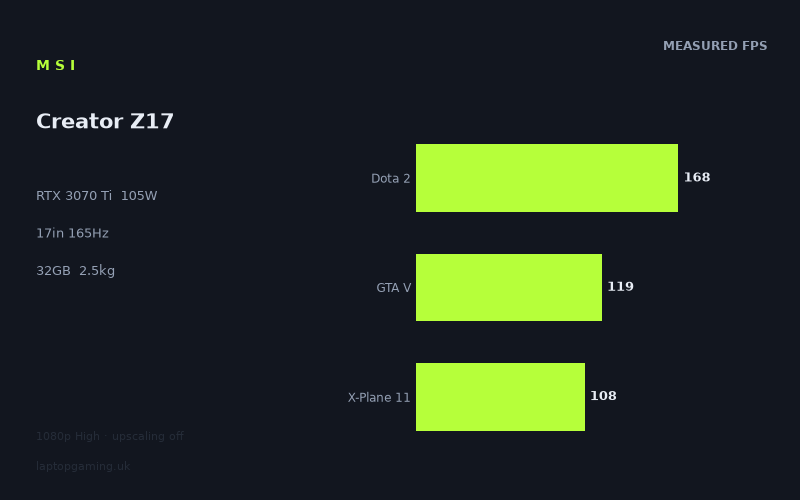
Frame rates
1920×1080, High preset, upscaling off.
Measured on this machine. Source: Notebookcheck, 2022-09-27.
Not scored: incomplete benchmark suite
Every scored laptop on this site is averaged over the same 5 games, and this one is short of Cyberpunk 2077, Baldur's Gate 3. A mean over 4 games is not comparable to a mean over 5, so we publish the figures we have and leave the score blank rather than rank it against machines tested on a different set. The numbers below are real - the suite is just incomplete.
How these numbers were produced
Frame rates here are not measured by us, and we label how each one was arrived at. A figure marked measured comes from a published run on that exact machine. A figure marked representative is derived from the GPU and its power limit (TGP) and cross-referenced against published reviews - a sound estimate of what that configuration delivers, but not a measurement of that specific laptop. Unless stated otherwise, numbers are 1920x1080, High preset, upscaling off. Where a laptop ships in several power configurations we use the wattage of the exact SKU listed, because a 140W RTX 5070 and a 115W one are not the same product.
In use
The short version
The MSI Creator Z17 (A12UGST-054) is an unusual gaming proposition because its headline specification points in two directions at once. It has a large 17in IPS display with a 2560x1600 resolution and 165Hz refresh rate, alongside a Core i9-12900H, 32GB of memory and an RTX 3070 Ti limited to 105W. That is a substantial set of parts for a machine weighing 2.498kg. The available Notebookcheck benchmark data shows that it can deliver genuinely strong frame rates at 1920x1080 on the High preset with upscaling disabled, but it also shows why the screen’s 165Hz refresh rate should not be read as a promise of 165fps gaming in every modern game.
In the measured games, the Creator Z17 is extremely quick in lighter or older titles. Dota 2 reaches 168fps and The Witcher 3 reaches 166fps, effectively matching or edging past the panel’s refresh rate in those particular 1920x1080 High-preset tests. Far Cry 5 is also very fast at 137fps. The picture changes in the more demanding games: GTA V reaches 119fps, X-Plane 11 reaches 108fps, Final Fantasy XV reaches 85fps and Dying Light 2 reaches 67fps. Those are still playable-looking results on paper, but they are a long way from filling a 165Hz panel.
The key point is that the Creator Z17’s RTX 3070 Ti is not operating as a simple badge of performance. Its 105W GPU power limit matters. Laptop GPU names alone do not tell a buyer exactly what level of performance to expect, because the same GPU can appear at different power limits in different designs. Here, the published numbers place the Creator Z17 in a curious middle ground. It has a clear measured advantage over the RTX 3050 Ti-equipped MSI Prestige 15, but its shared-game averages are level with both the lower-power RTX 3060 Dell XPS 17 9720 RTX and the RTX 3080 MSI GP66 Leopard. That does not mean these machines are identical in all workloads or every game. It means that, in the limited common games used for those comparisons, the averages converge.
That convergence matters because it stops the Creator Z17 from being an easy recommendation purely on GPU name. The machine is not measured as consistently faster than every laptop carrying a lower-numbered GPU, nor is it necessarily far behind every machine carrying a higher-numbered one. The benchmark data is more nuanced than that. At 1920x1080, lighter titles in the shared game set can become CPU-bound, which compresses genuine GPU differences. The Core i9-12900H is therefore relevant to why some of these comparisons are so close, but the available numbers should not be stretched into a claim that the GPUs are interchangeable in every situation.
There is also no confirmed UK price for this MSI Creator Z17. That prevents the most important final value judgement. A laptop with these specifications could make sense if it is priced as a premium large-screen creator-oriented machine that can game well, particularly for someone who values the 17in 2560x1600 IPS panel, 32GB of memory and Core i9 processor as much as the graphics performance. It would be much harder to defend if it were priced against purpose-built high-power gaming laptops, especially when the MSI Raider GE77 HX with an RTX 3080 Ti at 175W is measured 33fps ahead across its shared games.
The short verdict is therefore conditional rather than evasive. The Creator Z17 looks like a good fit for a buyer who wants a large, high-refresh, high-resolution IPS screen, a Core i9-12900H and 32GB of memory in one 2.498kg machine, while accepting that its 105W RTX 3070 Ti will not turn every demanding game into a 165fps experience. It is not the obvious choice for somebody whose sole priority is maximum gaming frame rate, because the available results show a wide gap between its best and hardest game results, and because a higher-power RTX 3080 Ti machine is materially faster in the games held in common.
It is also important to be precise about what is and is not known. The benchmark figures are Notebookcheck’s numbers, published on 2022-09-27, at 1920x1080, the High preset and with upscaling off. They are not results at the screen’s native 2560x1600 resolution. The scoring suite is incomplete because there is no figure for Strange Brigade. As every scored laptop is averaged over the same five games, this partial set cannot be ranked fairly against scored machines. That is not a minor administrative caveat: it means anyone looking for a single overall league-table position should not infer one from the figures below.
Performance
What the measured figures say
Notebookcheck’s figures give the Creator Z17 a measured mean of 120fps across the four available scoring-suite games: Dota 2, GTA V, X-Plane 11 and Final Fantasy XV. On its own, that is a useful indication that this is not a marginal gaming laptop. A 120fps mean at 1920x1080 on the High preset, with upscaling disabled, is enough to support a responsive experience in a broad range of games. But the mean should be treated as a summary, not a substitute for looking at the individual titles. The spread is substantial, and the individual game matters far more than a single average when a buyer is trying to decide whether a 165Hz screen will be properly used.
At the quick end, Dota 2 reaches 168fps. That is the one measured result that exceeds the panel’s 165Hz refresh rate, albeit only slightly. It means that in this particular test the hardware has enough performance to supply frames at a rate at least as high as the display can refresh. The Witcher 3 is almost identical at 166fps. Far Cry 5 follows at 137fps. These results establish that the Creator Z17 can make meaningful use of a 165Hz panel in some games, rather than merely carrying a high-refresh display for marketing value.
They do not establish that 165fps is this laptop’s normal performance level. GTA V is measured at 119fps, which is fast but clearly below 165fps. X-Plane 11 is at 108fps. Final Fantasy XV falls to 85fps, and Dying Light 2 is the lowest published result at 67fps. The difference between 168fps in Dota 2 and 67fps in Dying Light 2 is the most useful performance story here. This is not a machine with one fixed “frame rate”. It is a machine whose output depends heavily on the game being run, even under the same stated 1920x1080 High-preset, no-upscaling test conditions.
That is normal behaviour in the sense that games vary greatly in their demands, but it has practical consequences for buyers. A person mostly playing Dota 2, The Witcher 3 and Far Cry 5 can reasonably expect the Creator Z17’s high-refresh display to be relevant at the tested settings and resolution. A person buying specifically for Dying Light 2 should start from the published 67fps figure, not from the panel’s 165Hz number or the GPU’s RTX 3070 Ti name. Final Fantasy XV’s 85fps result points in the same direction: the laptop remains capable, but the 165Hz ceiling becomes more of a display capability than a performance target.
The importance of the 105W RTX 3070 Ti
The RTX 3070 Ti is limited to 105W in this Creator Z17. That power limit should be treated as part of the GPU specification, not as a footnote. Buyers comparing gaming laptops often encounter the same GPU label across machines that are designed for quite different purposes. A 105W implementation is not automatically poor and a higher-power implementation is not automatically the right choice for every person, but the limit helps explain why it is unsafe to judge this MSI solely by its RTX 3070 Ti designation.
The measured results show a laptop that can be very quick, but not one that can be assumed to sit at the same level as every more aggressively configured gaming machine. The Creator Z17’s highest figures, 168fps in Dota 2 and 166fps in The Witcher 3, prove that it is not inherently constrained to modest output. The lower figures of 85fps in Final Fantasy XV and 67fps in Dying Light 2 show that demanding games can expose the limit of the complete configuration more clearly. The GPU power limit is one part of that picture, while the game itself, processor demand and test conditions all affect the final frame rate.
The comparison with the MSI Raider GE77 HX is particularly instructive. The Raider uses an RTX 3080 Ti at 175W, whereas the Creator Z17 uses an RTX 3070 Ti at 105W. Across four shared games, the Creator Z17 averages 33fps behind. That is a meaningful gap. It is not a fractional difference that can be dismissed as measurement noise or a naming curiosity. It supports the straightforward conclusion that a buyer prioritising gaming output should take the higher-power RTX 3080 Ti configuration seriously, subject to price and the rest of each machine’s specification.
At the same time, the Creator Z17 should not be written off because it is not the Raider GE77 HX. Its 120fps mean across the available scoring-suite games shows that the 105W GPU is still doing serious work at the tested settings. The right interpretation is not that 105W makes the RTX 3070 Ti unsuitable for gaming. It is that it makes the laptop’s performance profile more selective. It is strong enough to exploit a high-refresh screen in some games, strong enough for fast frame rates in several measured titles, but not so strong that demanding games can be expected to land anywhere close to 165fps without considering settings, resolution or available upscaling options.
Upscaling was off for all the provided benchmark data, so the figures are a clean view of performance without that assistance. That is useful for comparison, but it also limits what can be claimed. There is no supplied upscaling result for the Creator Z17, so it would be wrong to promise a particular improvement in Dying Light 2, Final Fantasy XV or any other title. Likewise, no frame-rate figure is available for any quality preset other than High. The available evidence supports analysis of the stated test, not a fabricated settings guide.
Where the high-refresh screen is genuinely useful
A 165Hz panel is most valuable when the laptop can regularly provide frame rates that approach or exceed 165fps. In the available numbers, Dota 2 at 168fps and The Witcher 3 at 166fps are the clear examples. In those titles at 1920x1080 on High with upscaling off, the Creator Z17 has the measured performance to match the display’s refresh ceiling. Far Cry 5 at 137fps does not reach that ceiling, but it is still sufficiently high that a 165Hz screen is more relevant than it would be for a machine running at a much lower rate.
GTA V at 119fps and X-Plane 11 at 108fps occupy a sensible middle ground. Neither reaches 165fps, so buyers should not assume a full-refresh experience from them under the published conditions. But both figures are far above the lower end of the measured range, and they reinforce the point that the Creator Z17 is capable of strong high-frame-rate gaming in the right titles. The important distinction is between “high refresh is useful” and “high refresh is saturated”. The data supports the former more consistently than the latter.
Final Fantasy XV at 85fps and Dying Light 2 at 67fps are where the display specification and the gaming result diverge most clearly. A 165Hz panel still has the same hardware capability, but the benchmark data does not show the GPU feeding it at anything like that rate in these games. There is no value in pretending otherwise. Buyers who mainly play demanding titles should view the Creator Z17 as capable of delivering measured performance in the 67fps to 85fps region in these examples, not as a machine bought principally to chase 165fps.
The benchmark range also explains why the four-game mean of 120fps should not be overinterpreted. A mean can make the machine look as though it sits near the middle of all results, but no individual scoring-suite figure is exactly 120fps. The individual outcomes are 168fps in Dota 2, 119fps in GTA V, 108fps in X-Plane 11 and 85fps in Final Fantasy XV. The average is lifted by Dota 2’s very high output and pulled down by Final Fantasy XV. A buyer who does not play Dota 2 should not treat its 168fps result as personally relevant; equally, a buyer focused on Final Fantasy XV should not assume the machine behaves like its mean.
Processor, memory and game dependence
The Creator Z17 pairs the RTX 3070 Ti with a Core i9-12900H and 32GB of memory. The available data does not isolate the contribution of each component, so it would be inappropriate to assign a precise number of frames to the processor or memory. What can be said is that this is not a configuration where a low-end processor or minimal memory allocation makes the graphics chip the only meaningful component. The Core i9-12900H and 32GB of memory are substantial supporting specifications for a laptop expected to cover creator work and gaming.
The rival results demonstrate why system balance matters. The Creator Z17 averages the same across four shared games as the Dell XPS 17 9720 RTX, despite the Dell carrying an RTX 3060 at 70W. It also averages the same across three shared games as the MSI GP66 Leopard with an RTX 3080. Those results do not prove that the Creator Z17’s GPU is equivalent to either rival GPU. They show that, at 1920x1080 in the shared selection, lighter games can be CPU-bound and compress genuine GPU gaps.
This is especially relevant to prospective buyers who look at a GPU hierarchy and expect every title to scale neatly with graphics hardware. The data says otherwise. A zero-fps average gap across a limited shared set is a real published result, not something to ignore, but it needs interpretation. It may reflect the fact that the shared games are not always exposing the full difference between GPUs at 1920x1080. It does not justify a blanket claim that the Dell’s 70W RTX 3060, the Creator’s 105W RTX 3070 Ti and the GP66 Leopard’s RTX 3080 will remain tied in more demanding games, at a different resolution or with a different settings mix.
For the Creator Z17 specifically, this means its measured strengths are credible but should be understood title by title. The Core i9-12900H is part of a configuration capable of producing 168fps in Dota 2 and 166fps in The Witcher 3 under the stated test. The GPU, its 105W limit and the demands of the game all become more visible in results such as 85fps in Final Fantasy XV and 67fps in Dying Light 2. That is a more useful way to read the data than searching for one label that describes every game.
The screen
A large 17in IPS display with a real tension in its specification
The Creator Z17 has a 17in IPS panel with a 2560x1600 resolution and 165Hz refresh rate. On specification alone, that is an appealing screen for someone who wants a large workspace rather than a compact gaming-only display. The 2560x1600 resolution gives it more room than the 1920x1080 benchmark resolution, while the 165Hz refresh rate gives it a high ceiling for motion. The IPS panel type is also part of the machine’s creator-oriented identity.
However, this screen specification creates a basic performance tension. Every supplied frame rate was measured at 1920x1080, not at the panel’s native 2560x1600 resolution. The published figures therefore cannot tell us the exact frame rates this machine will achieve at native resolution. It would be wrong to take the 168fps Dota 2 result, the 119fps GTA V result or the 67fps Dying Light 2 result and present them as native-screen results. They are not.
That distinction is vital because the display’s native resolution is one of the main reasons to consider this laptop. A buyer choosing a 17in 2560x1600 panel is likely to want to use that resolution for some work and perhaps some games. Yet the only attributable gaming data available here is at 1920x1080. The correct conclusion is not that native-resolution gaming is impossible, nor that it will definitely be poor. The correct conclusion is that we do not have Notebookcheck figures for it in this fact sheet. Anyone buying specifically to play at 2560x1600 should treat that as an unanswered performance question rather than filling the gap with assumptions.
165Hz is a capability, not a guarantee
The 165Hz refresh rate is best understood as the screen’s maximum refresh capability. The measured performance shows when the hardware can make good use of it and when it cannot. Dota 2 at 168fps and The Witcher 3 at 166fps are the clearest cases where the Creator Z17 reaches or very slightly exceeds that level in the supplied 1920x1080 High-preset results. Far Cry 5 at 137fps is below 165fps but remains a high-frame-rate result.
In the rest of the data, the display’s refresh ceiling is not reached. GTA V at 119fps, X-Plane 11 at 108fps, Final Fantasy XV at 85fps and Dying Light 2 at 67fps each sit progressively further away from 165fps. This does not reduce the panel to a bad fit; it simply defines the realistic relationship between screen and GPU. The display has headroom for fast games, but the graphics hardware does not deliver 165fps as a universal result.
That is a more attractive compromise for a mixed-use buyer than for a single-minded competitive player. Someone who values a 17in 2560x1600 IPS panel for non-gaming work and also plays games such as Dota 2, The Witcher 3 or Far Cry 5 has evidence that the high refresh rate is not wasted. Someone buying a laptop chiefly because they want every game to run at 165fps has evidence to the contrary in Final Fantasy XV and Dying Light 2.
The fact that the numbers were recorded with upscaling off is useful here. It means the high frame rates in Dota 2 and The Witcher 3 are not dependent on an enabled upscaling setting in the supplied test. It also means there is no basis for saying what might happen if upscaling were enabled in the lower-performing games. The absence of that data should guide the advice. The Creator Z17’s screen is clearly capable of high-refresh presentation; the available benchmarks do not establish a route to 165fps in every game at either 1920x1080 or 2560x1600.
Choosing between resolution and measured gaming certainty
The screen is arguably the most compelling reason to choose this machine over a more conventional gaming laptop, but it is also where buyers need the clearest expectations. The 17in size, 2560x1600 resolution, IPS panel and 165Hz refresh rate describe a display that aims to be flexible rather than narrowly optimised around one gaming scenario. The laptop’s GPU results support that flexibility to a point. They show strong 1920x1080 gaming in several titles, not a documented ability to drive every supplied game at the panel’s native resolution and maximum refresh.
For someone whose priorities begin with screen space and a high-resolution panel, this may be exactly the right trade. The ability to play Dota 2 at 168fps, The Witcher 3 at 166fps and Far Cry 5 at 137fps at the tested settings sits comfortably alongside a display intended to offer more than basic 1920x1080 desktop space. For someone whose priorities begin and end with gaming output, the panel may instead highlight the limitation of the 105W RTX 3070 Ti: it is attached to a display capable of more refresh than the laptop can demonstrate in the heavier games.
No judgement about panel brightness, colour coverage, contrast, response time or adaptive-sync support can be made from the supplied facts. Those are all potentially relevant screen considerations, particularly for a creator-branded laptop, but they are not documented here. The honest assessment is therefore focused on what is known: size, resolution, refresh rate, IPS technology and the relationship between those specifications and the available 1920x1080 frame-rate results.
Build, size and portability
The Creator Z17 weighs 2.498kg. That makes it a substantial laptop rather than a casual carry-everywhere machine. The 17in screen is central to that judgement: a laptop built around a display of this size is naturally aimed at buyers who want more visual workspace and are prepared to accept more mass than they would from a smaller model. The 2.498kg figure is not extreme for a machine combining a 17in display, Core i9-12900H, 32GB of memory, RTX 3070 Ti and 90Wh battery, but it is still a figure that should be taken seriously by anyone planning regular travel.
In practical buying terms, this looks more like a machine to move between a home setup, office, studio, classroom or occasional trip than a machine selected primarily because it disappears into a bag. That is not a criticism of the Creator Z17. It is a recognition that large-screen performance machines involve a compromise. The extra display area and the higher-capacity 90Wh battery come in a laptop whose weight is close to two and a half kilograms.
No dimensions are supplied in the fact sheet, so there is no basis for claiming how much desk space or bag space the chassis takes up beyond the known 17in screen size and 2.498kg weight. Likewise, there is no measured battery-life figure. The 90Wh battery capacity is useful specification context, but capacity is not endurance. Battery life depends on workload, screen behaviour, power settings and many other factors, and none of those outcomes is provided here. A buyer who needs a guaranteed all-day unplugged machine should not treat the 90Wh number as proof of one.
The configuration does, however, make sense for a buyer who wants one large laptop to cover demanding processor work, substantial memory requirements and gaming rather than splitting those jobs between separate desktop and portable devices. The Core i9-12900H, 32GB of memory and RTX 3070 Ti give it a high-end component list, while the 17in 2560x1600 display offers a correspondingly large visual canvas. The cost of that all-in-one ambition is portability. At 2.498kg, the Creator Z17 should be bought because the screen and internal specification justify the bulk, not because it is especially light.
The creator branding should also be interpreted cautiously. The facts establish the processor, memory, screen type and resolution, but do not provide measurements for colour, battery runtime, acoustics, chassis materials, ports, storage, webcam or keyboard. Those omissions matter because they are often the details that separate a genuinely convincing creator machine from a gaming laptop with a different exterior. It is reasonable to say that the known specification is suited to a mixed creator and gaming role. It is not reasonable to claim that every aspect of the design has been validated for professional creative use.
The same restraint applies to cooling and noise. A 105W GPU power limit can be discussed as part of the performance configuration, but no temperature or noise figures are available. There is therefore no evidence here to declare the Creator Z17 quiet, loud, cool-running or hot under load. Buyers sensitive to fan noise should seek attributable acoustic information before deciding. The benchmark results tell us what Notebookcheck measured in games; they do not supply a complete account of the experience around those results.
How it compares
Against the MSI Prestige 15
The MSI Prestige 15 is the clearest performance win for the Creator Z17 among the listed rivals. The Prestige 15 uses an RTX 3050 Ti at 105W, while the Creator Z17 uses an RTX 3070 Ti at 105W. Across four shared games, the Creator Z17 averages 66fps ahead. That is not a marginal advantage. It is the largest positive comparison given for the Creator Z17 and it supports a simple conclusion: if gaming performance is important, the Creator Z17 is in a different class from this particular RTX 3050 Ti-based Prestige 15 result.
The equal 105W power limits make the comparison especially useful as a reminder that GPU tier still matters. The Creator Z17 does not gain its advantage through a higher stated power limit in this pairing; both are listed at 105W. The 66fps shared-game lead therefore shows that the RTX 3070 Ti configuration has substantially more gaming headroom in the games compared. It does not tell us the exact frame rate in every individual shared game, because only the average difference is supplied, but the scale of the average lead is decisive enough that the overall direction is clear.
There is no confirmed UK price for either machine in the facts provided. That means the Creator Z17 cannot be called better value in absolute terms, even with its large measured performance advantage. If the purchase decision is based on gaming capability alongside the Creator Z17’s 17in 2560x1600 165Hz IPS panel, Core i9-12900H and 32GB of memory, it is the more convincing machine on the known evidence. If price, size or other features dominate, the fact sheet does not supply enough information for a broader value verdict.
Against the Dell XPS 17 9720 RTX
The Dell XPS 17 9720 RTX makes the Creator Z17’s position much more complicated. The Dell is listed with an RTX 3060 at 70W, while the MSI has an RTX 3070 Ti at 105W. On paper, it would be tempting to assume that the MSI must hold a clear gaming advantage. The published shared-game result does not show one: across four shared games, the Creator Z17 averages +0fps against the Dell.
That +0fps result deserves explanation rather than repetition. It is a genuine result across the shared games, but it is not evidence that the two GPUs have identical potential. At 1920x1080, lighter titles in the shared set can be CPU-bound and compress genuine GPU gaps. The Creator Z17’s Core i9-12900H may help keep the comparison close in those conditions, but the supplied evidence does not isolate individual bottlenecks game by game. What it does say is that a buyer should not assume that the RTX 3070 Ti at 105W will deliver a visible average advantage over the Dell’s RTX 3060 at 70W in every 1920x1080 game selection.
That is an important warning against shopping by GPU badge alone. The Creator Z17 may still be the more attractive option for someone who specifically wants its 165Hz IPS panel, 32GB memory or other known configuration details. But its measured shared-game average provides no performance-based reason to dismiss the Dell outright. With no confirmed UK price for either laptop, there is no way to determine whether one offers a better deal. The data supports caution, not a simplistic hierarchy.
Against the MSI GP66 Leopard
The MSI GP66 Leopard produces an equally surprising comparison. It has an RTX 3080, yet the Creator Z17 averages +0fps across three shared games. Again, this should not be translated into a claim that the Creator Z17’s RTX 3070 Ti at 105W is universally equal to an RTX 3080. The shared sample is smaller here, covering three games rather than four, and the same 1920x1080 CPU-bound effect can compress differences in lighter titles.
Still, the result matters. It shows that the Creator Z17’s measured performance is not weak merely because it carries a 105W GPU. In the three games available for this comparison, it keeps pace on average with the GP66 Leopard. For a buyer comparing these exact two machines, that may shift attention away from GPU names and towards the rest of the package: screen, weight, processor, memory, price and the games they actually play. The known data does not justify declaring one universally faster.
It also reinforces why game selection matters so much. The Creator Z17’s own published results range from 168fps in Dota 2 to 67fps in Dying Light 2. A three-game average against another laptop cannot capture every point in that range. The GP66 Leopard comparison is evidence that the MSI Creator can be competitive in the common titles tested. It is not a substitute for a broader matched benchmark suite, particularly in more demanding games where GPU differences may be less compressed.
Against the MSI Raider GE77 HX
The MSI Raider GE77 HX is the rival that most clearly beats the Creator Z17. It uses an RTX 3080 Ti at 175W, compared with the Creator Z17’s RTX 3070 Ti at 105W. Across four shared games, the Creator Z17 averages 33fps behind. This is the comparison that best demonstrates what a substantially higher-power gaming-focused configuration can deliver.
A 33fps deficit is large enough to affect the buying decision for anyone focused on frame rate. The Creator Z17 already shows that difficult titles pull it well away from the 165Hz panel ceiling: Final Fantasy XV is measured at 85fps and Dying Light 2 at 67fps. The Raider’s shared-game lead suggests that a buyer whose priority is more performance headroom should not assume that the Creator’s larger high-refresh screen and premium component list make it the better gaming machine. The available comparison points the other way.
That does not make the Raider automatically the right machine for every user. The supplied facts do not give its price, screen specification, weight, battery or other design details, so a complete comparison cannot be made. But the gaming conclusion is firm within the stated shared games: the Creator Z17 is behind, and it is behind by enough that the difference should not be minimised. A buyer who wants the highest available frame rate from this group should view the Raider GE77 HX as the more persuasive performance option on the evidence provided.
Why there is no overall ranking
The Creator Z17 cannot be placed fairly in the site’s scored laptop ranking because the scoring suite is incomplete. There is no Strange Brigade result. Every scored laptop is averaged over the same five games, and a partial set cannot be ranked against machines with a complete set. It would be misleading to turn the available four-game mean of 120fps into a directly comparable five-game ranking.
This limitation is worth stating clearly because the rival comparisons and the scoring-suite mean can otherwise create a false impression of precision. The Creator Z17 can be compared with named rivals where shared-game data exists, and its measured performance can be discussed title by title. What cannot be done honestly is to claim a definitive overall placement among all scored laptops. The missing Strange Brigade figure prevents that.
Who it’s for
Buy it if you want a broad large-screen machine, not only a gaming machine
The Creator Z17 is best suited to someone who wants the combination of a 17in 2560x1600 IPS screen, 165Hz refresh rate, Core i9-12900H, 32GB of memory and RTX 3070 Ti in one machine. That is a wide-ranging specification. The laptop makes most sense when gaming is important but shares space with processor-heavy work, memory-intensive work or simply the desire for a large high-resolution display.
The available benchmark data supports that mixed-use case. Dota 2 at 168fps, The Witcher 3 at 166fps and Far Cry 5 at 137fps show that the machine can provide high frame rates in a number of games at the stated 1920x1080 High-preset conditions. GTA V at 119fps and X-Plane 11 at 108fps remain strong results. These are not figures from a laptop that merely tolerates games. They are figures from a laptop that can handle gaming seriously, provided the buyer understands that performance varies sharply by title.
It is also a reasonable candidate for someone who wants a high-refresh screen but does not need to see 165fps in every game. The panel’s 165Hz capability has real support in the Dota 2 and Witcher 3 results. A buyer playing a varied library, including lighter or older titles, can expect the screen to be used well in at least some cases. The machine is especially easier to justify if those games are genuinely part of the owner’s routine rather than hypothetical examples.
The 2.498kg weight also points towards a buyer who values the larger chassis and screen enough to accept a less portable package. Someone moving between a few regular locations, rather than carrying a laptop for long periods every day, is more likely to find that compromise sensible. The 90Wh battery is a substantial capacity on the specification sheet, but no battery-life measurement is available, so this recommendation is about screen size and internal hardware rather than a promise of unplugged endurance.
Buy something else if maximum frame rate is the priority
Buyers who want the highest possible gaming performance should look elsewhere, particularly towards machines closer to the MSI Raider GE77 HX’s performance profile. The Creator Z17 is measured 33fps behind that RTX 3080 Ti at 175W rival across four shared games. That is the clearest direct evidence in the comparison set, and it aligns with the Creator’s own lower figures in more demanding titles.
Dying Light 2 at 67fps and Final Fantasy XV at 85fps are not disastrous results, but they are not results for someone shopping around a 165Hz target. If those games, or games with similar demands, are central to the purchase, the Creator Z17’s high-refresh panel should not distract from the benchmark data. A machine with more graphics headroom is the more logical place to spend money if the budget allows, though no price comparison can be made here because no confirmed UK price is available for the Creator or its listed rivals.
The Creator Z17 is also not the right choice for someone who needs a highly portable laptop above all else. At 2.498kg with a 17in screen, it is built around scale and capability, not minimal carry weight. The fact sheet does not provide dimensions, so there is no basis for finer claims about bag fit, but the known weight and display size are enough to say that a smaller machine deserves consideration for frequent travel.
Nor should buyers who require documented native-resolution gaming performance purchase on assumption. The screen is 2560x1600, while all supplied gaming data is at 1920x1080. If running games at the panel’s native resolution is essential, the available evidence does not answer the necessary question. The sensible response is to find attributable 2560x1600 benchmark data rather than extrapolate from the 1920x1080 results.
The final buying judgement
The MSI Creator Z17 is a capable large-screen performance laptop with a measured gaming profile that is stronger than a simple creator label might suggest. Its RTX 3070 Ti at 105W produces 168fps in Dota 2, 166fps in The Witcher 3 and 137fps in Far Cry 5 in Notebookcheck’s 1920x1080 High-preset tests with upscaling off. It also delivers a 120fps mean across the four available scoring-suite games. Those are meaningful results.
But it is not a universal 165fps machine, and buyers should not use the 165Hz panel as evidence that it is one. GTA V at 119fps, X-Plane 11 at 108fps, Final Fantasy XV at 85fps and Dying Light 2 at 67fps make that clear. The RTX 3070 Ti name is only part of the story; the 105W power limit and the wide variation between games matter just as much.
The lack of a confirmed UK price means a final value verdict cannot be made responsibly. If the Creator Z17 is available at a sensible level for its 17in 2560x1600 165Hz IPS display, Core i9-12900H, 32GB memory and strong 1920x1080 gaming performance, it has a coherent audience. If it is priced against higher-power gaming laptops, the Raider GE77 HX comparison shows why it could be difficult to justify for frame-rate-first buyers.
Choose it for the balance of large-screen workspace, high-refresh gaming potential and high-end core specification. Avoid it if you need proven 2560x1600 gaming results, the lightest possible laptop, or the greatest gaming performance available from the listed alternatives. Most importantly, do not treat the incomplete benchmark suite as an overall ranking: without a Strange Brigade figure, the Creator Z17 cannot be fairly placed against laptops with complete five-game scoring data.