Review
Schenker XMG Fusion 15 (Mid 22) review
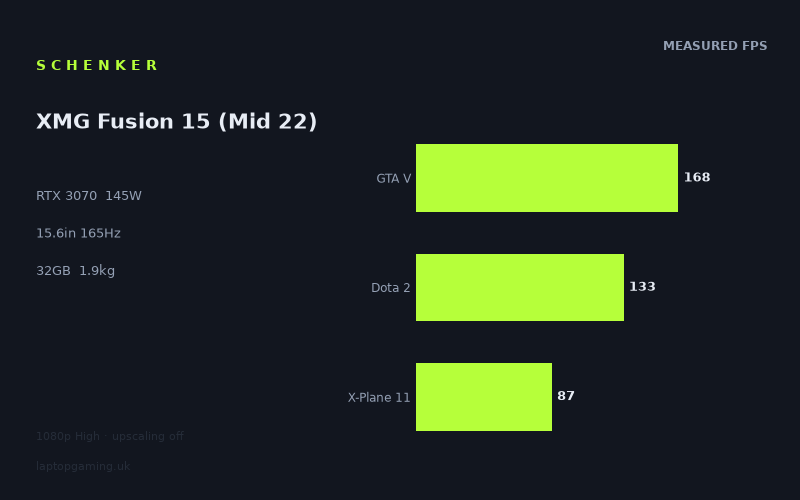
Frame rates
1920×1080, High preset, upscaling off.
Measured on this machine. Source: Notebookcheck, 2022-08-24.
Not scored: incomplete benchmark suite
Every scored laptop on this site is averaged over the same 5 games, and this one is short of Cyberpunk 2077, Baldur's Gate 3. A mean over 5 games is not comparable to a mean over 5, so we publish the figures we have and leave the score blank rather than rank it against machines tested on a different set. The numbers below are real - the suite is just incomplete.
How these numbers were produced
Frame rates here are not measured by us, and we label how each one was arrived at. A figure marked measured comes from a published run on that exact machine. A figure marked representative is derived from the GPU and its power limit (TGP) and cross-referenced against published reviews - a sound estimate of what that configuration delivers, but not a measurement of that specific laptop. Unless stated otherwise, numbers are 1920x1080, High preset, upscaling off. Where a laptop ships in several power configurations we use the wattage of the exact SKU listed, because a 140W RTX 5070 and a 115W one are not the same product.
In use
The short version
The Schenker XMG Fusion 15 (Mid 22) is a strong-performance 15.6in gaming laptop on the evidence that matters most here: its published game results. Its RTX 3070 runs at a 145W GPU power limit, paired with a Core i7-11800H, 32GB of memory and a 1TB SSD. In Notebookcheck’s benchmark data, it produces a mean of 134fps across the five scoring-suite games at 1920x1080, High settings, with upscaling disabled. That is enough to make this a serious high-refresh gaming machine in the right games, rather than merely a laptop which happens to have a 165Hz screen.
The important qualification is that the 165Hz panel is more ambitious than the machine’s results in the heavier games. Strange Brigade reaches 189fps, F1 2021 manages 170fps, GTA V records 168fps and The Witcher 3 reaches 163fps. Those are genuinely close to, at, or beyond the panel’s 165Hz refresh rate. Dota 2 at 133fps is still fast, but does not fully occupy the display’s refresh ceiling in the published result. Far Cry 5 at 115fps, Final Fantasy XV at 94fps and X-Plane 11 at 87fps make the point more clearly: this is not a laptop that automatically turns every demanding game into a 165fps experience simply because its specification says RTX 3070 and 165Hz.
That is not a criticism of the XMG Fusion 15 so much as a useful correction to the way gaming laptops are often sold. The same machine can look extremely quick in one title and merely solid in another. The published spread from 189fps in Strange Brigade to 87fps in X-Plane 11 is substantial. A buyer whose main games resemble Strange Brigade, F1 2021, GTA V or The Witcher 3 has a much stronger case for paying for a 165Hz screen than somebody whose priority is more demanding games, flight simulation, or titles that lean heavily on processor performance.
The 145W GPU power limit is central to the appeal. An RTX 3070 laptop GPU is not a single fixed level of performance: the power limit assigned by the laptop maker is part of the specification that determines how much room the graphics processor has to perform. In this case, Schenker has paired the RTX 3070 with a comparatively substantial 145W limit. The frame-rate data shows a system that can produce very high figures in favourable games, rather than one constrained to modest performance by an unusually low GPU allocation. It does not mean that every game will land at the same level, and the figures demonstrate why that distinction matters.
There is no confirmed UK price for this exact configuration, so there is no overall value judgement here. That is not a warning about the machine and it is not a missing performance result: the benchmark suite is complete and the laptop ranks normally on the frame-rate leaderboard. The missing price simply means value cannot be calculated responsibly. Do not treat that absence as permission to assume it is a bargain, and do not treat the hardware specification as proof that it is expensive enough to avoid comparison. Until a confirmed UK price exists, the sensible assessment is performance-led.
Buy the XMG Fusion 15 if you want a relatively portable 15.6in machine with 32GB of memory, 1TB of SSD storage, a 2560x1440 IPS display, and published 1080p High results which show that its 165Hz panel is attainable in several games. It is particularly appealing for someone who values strong frame rates in a machine weighing 1.94kg, but does not need every game to run at the display’s maximum refresh rate.
Do not buy it on the assumption that an RTX 3070 at 145W guarantees native-resolution 165Hz gaming across the board. Notebookcheck’s supplied results are at 1920x1080 rather than the screen’s 2560x1440 native resolution, and there are no supplied 2560x1440 frame rates for this configuration. A buyer focused on native-resolution performance needs to treat that as an unanswered question rather than fill the gap with optimistic arithmetic. Likewise, anyone who primarily plays X-Plane 11 should pay closer attention to the 87fps result than to the headline-friendly 189fps result from Strange Brigade.
Performance
A useful benchmark result, not a single performance promise
Notebookcheck’s figures were recorded at 1920x1080, High preset, with upscaling off. That is a clear and useful test condition because it avoids treating software upscaling as though it were raw rendering performance. The results are also old enough to need context: they describe the tested games and test conditions, not every game a buyer may install now or later. What they do provide is a consistent view of how this specific Core i7-11800H and RTX 3070 configuration performed in a varied group of titles.
The five-game scoring-suite mean is 134fps. A mean is helpful as a broad summary, but it should not be mistaken for the frame rate a buyer will see in every game. The individual scoring-suite results span from 189fps in Strange Brigade to 94fps in Final Fantasy XV, with GTA V at 168fps, Dota 2 at 133fps and X-Plane 11 at 87fps. That range is too wide for the mean to tell the entire buying story. It does, however, tell us that this is not a marginal RTX 3070 implementation. A 134fps mean at the supplied settings places the machine in a class where display refresh and game type matter just as much as the graphics label.
The top end is persuasive. Strange Brigade at 189fps is above the 165Hz panel refresh rate. F1 2021 at 170fps is also above it. GTA V at 168fps is again above it, while The Witcher 3 at 163fps sits very close to it. In these games, the hardware is not merely producing a result that looks acceptable on paper; it is producing enough frames that the display’s high refresh is relevant. That matters because a 165Hz panel makes most sense when the system can frequently feed it at a suitably high rate. The XMG Fusion 15 can do that in several of the supplied tests.
There is a difference between “can reach the refresh rate in some games” and “will keep every game at the refresh rate”. Dota 2’s 133fps result is a good example. It is a high frame rate, and it sits close enough to the 134fps scoring-suite mean to show why the overall result is strong. But it is still below 165fps. A buyer choosing this laptop specifically for the promise of constant maximum-refresh gaming should not glide past that distinction. The screen can refresh at 165Hz; the benchmark result says that Dota 2, under these settings, ran at 133fps.
Far Cry 5, at 115fps, remains comfortably above the level at which a game would ordinarily feel like it needs lower settings simply to be viable, but it is no longer in the same category as the games approaching the panel’s limit. Final Fantasy XV at 94fps and X-Plane 11 at 87fps sit lower again. Both figures are still substantial in isolation. Their importance is comparative: they show that the XMG Fusion 15’s performance is contingent on the workload. Buyers should be wary of basing their expectations on Strange Brigade alone, just as they should avoid judging the laptop solely through X-Plane 11.
What the 145W GPU power limit means
The RTX 3070 name does not tell the whole performance story in a laptop. The GPU power limit is part of the actual product specification. Here, the listed limit is 145W. That means this is not an analysis of an unspecified RTX 3070 or a generic expectation attached to the model name; it is an analysis of the 145W version in the XMG Fusion 15.
A higher GPU power allocation does not abolish bottlenecks elsewhere in the system. At 1920x1080, particularly in lighter games, processor limits can become more visible because the graphics processor has less rendering work to do than it would at a higher resolution. That is directly relevant to the rival comparisons later on. The XMG Fusion 15 records a near-zero average difference against two laptops with RTX 3060 GPUs limited to 95W, despite the substantial specification gap implied by RTX 3070 at 145W versus RTX 3060 at 95W. The supplied explanation is important: lighter shared games at 1080p can be CPU-bound, compressing real GPU gaps.
That does not make the 145W RTX 3070 meaningless. It means the value of that higher-power implementation depends on the game and test setting. A GPU advantage is easier to expose where the graphics processor is the limiting factor. In games that are more limited by the processor, or otherwise do not place the same kind of demand on the GPU, the headline GPU difference can shrink dramatically in observed frame rate. This is why a buyer should examine the whole game list instead of assuming that a larger-looking GPU specification must translate into a fixed advantage in every title.
The XMG Fusion 15’s own results show the same principle from another direction. The machine achieves 189fps in Strange Brigade but 87fps in X-Plane 11 under the supplied benchmark conditions. The GPU has not changed between these results. What changed is the game workload. There is no honest way to turn the 145W limit into a universal promise of a particular frame rate. What can be said is that the configuration has enough performance headroom to deliver very high output in several titles, and that its lower results illustrate the limits of any one-specification buying shortcut.
The Core i7-11800H also matters in a benchmark set that includes games capable of reaching very high frame rates. The supplied results do not isolate processor performance, so it would be wrong to claim precisely how much of any result comes from the CPU and how much comes from the GPU. Still, the fact that the comparison data specifically notes CPU-bound behaviour in lighter 1080p games is a reason not to treat GPU wattage as the sole explanation for every result. This laptop should be judged as a combined platform: Core i7-11800H, RTX 3070 at 145W, 32GB of memory and the tested 1080p High settings.
The benchmark spread is the main lesson
The spread between the supplied figures is more useful than a single average when choosing what sort of gaming laptop this is. Strange Brigade at 189fps, F1 2021 at 170fps, GTA V at 168fps and The Witcher 3 at 163fps form a high-performance group. These results cluster around the panel’s 165Hz refresh rate, with three above it and one very close below it. In this group, the XMG Fusion 15 makes a coherent case for its display specification.
Dota 2 at 133fps sits in a second group. It is not a disappointing result in the abstract, particularly when considered alongside the 134fps suite mean. But it is evidence that even a high-frame-rate-friendly game does not necessarily mean the panel’s ceiling is reached in this particular benchmark. That matters for buyers who use “165Hz” as shorthand for a guaranteed 165fps experience. The screen and the frame rate are related, but they are not the same thing.
Far Cry 5, Final Fantasy XV and X-Plane 11 form the lower group at 115fps, 94fps and 87fps respectively. These figures do not mean the laptop cannot play those games well. They mean that the published benchmark data places them below the level needed to match the display refresh rate. In a purchasing decision, that is more valuable than vague language such as “handles everything”. The machine handles different games at different levels. That is normal, but it needs to be stated plainly.
The results also show why a buyer should decide which kind of performance matters. Someone prioritising high-refresh responsiveness in titles that run like F1 2021, GTA V or Strange Brigade has evidence that the XMG Fusion 15 can make excellent use of the display. Someone prioritising demanding games whose behaviour is closer to Final Fantasy XV or X-Plane 11 should expect a lower frame-rate relationship with the same screen. The system remains capable, but the practical benefit shifts from “matching 165Hz” to “having a high-refresh display available when the game allows it”.
There is no supplied frame-time data, minimum frame-rate data or performance-at-other-settings data. That means the measured averages should not be expanded into claims about consistency, stutter, low points or game-by-game tuning. There is also no supplied ray-tracing result, no supplied upscaling result and no supplied 2560x1440 result. The clean conclusion is therefore narrower but more trustworthy: at 1920x1080, High settings and upscaling off, Notebookcheck’s figures show strong performance, with several games at or around 165fps and others substantially below it.
The screen
A good specification with an important performance caveat
The XMG Fusion 15 has a 15.6in IPS display with a 2560x1440 resolution and a 165Hz refresh rate. On specification alone, that is a sensible pairing for a laptop aimed at high-end gaming rather than entry-level play. The resolution offers more pixels than the 1920x1080 benchmark setting, while the refresh rate gives the machine scope to show the benefit of high frame rates where the hardware can produce them.
The IPS panel type is useful information, but the supplied specification does not include brightness, contrast, colour coverage, response-time measurements, adaptive-sync information, display coating or any assessment of panel uniformity. Those omissions matter if the screen is a deciding factor. It would be wrong to infer any of those characteristics merely from the IPS label. The known facts are the panel technology, 15.6in size, 2560x1440 resolution and 165Hz refresh rate.
The central issue is the mismatch between the display’s native resolution and the supplied gaming results. Notebookcheck measured the frame rates at 1920x1080, not 2560x1440. The machine records 189fps in Strange Brigade, 170fps in F1 2021, 168fps in GTA V and 163fps in The Witcher 3 at 1920x1080 High with upscaling off. Those numbers show that the hardware can make practical use of a 165Hz panel in several games at the benchmark resolution. They do not prove that the same games reach the same figures at native 2560x1440.
This is not a minor technicality. The 2560x1440 display is one of the most consequential parts of the buying proposition, because it is what the owner will look at every day. Yet the performance evidence supplied here is deliberately at a lower resolution. A responsible review should not bridge that gap with an invented estimate. There are no native-resolution figures in the fact sheet, so there is no basis for saying which games reach 165fps at 2560x1440, which remain above 100fps, or how far the lower-performing titles would fall.
When 165Hz is meaningful here
A 165Hz panel is most meaningful when the game can deliver frame rates close to or above 165fps. In the supplied results, Strange Brigade at 189fps, F1 2021 at 170fps and GTA V at 168fps meet or exceed that level at 1920x1080. The Witcher 3 at 163fps is close enough that the display’s capability is still plainly relevant. For these games and these conditions, the screen is not surplus specification.
Dota 2 at 133fps is another reminder that high refresh does not require an exact one-to-one frame-rate match to be useful. However, it does not reach the 165fps panel limit in the published result. Far Cry 5 at 115fps, Final Fantasy XV at 94fps and X-Plane 11 at 87fps sit further from the refresh ceiling. In those games, the panel’s high refresh rate remains a capability of the laptop, but the measured figures do not show it being fully exploited.
The practical buying conclusion is straightforward. The screen is a good fit for a mixed library where some games are likely to run at very high frame rates and others are not. It is less straightforward for a buyer who sees 165Hz as a strict target in every title. The machine gives evidence of reaching that target in selected games at 1920x1080 High, but the benchmark list itself shows that it is not a universal outcome.
The 2560x1440 native resolution also means that buyers should think about priorities before assuming the right setting. Some users will value the panel’s native resolution more than maximum frame rate; others will prefer to pursue the highest available performance. The supplied facts do not show how this laptop behaves at native resolution, so they cannot settle that choice. What they do show is that the 1080p High results are strong enough to make the 165Hz specification credible in a number of titles, rather than purely aspirational.
Build, size and portability
The XMG Fusion 15 weighs 1.94kg. That is the portability figure available for this configuration, and it is a meaningful one because gaming performance at this level often has to be considered alongside how often the laptop will move between desk, home, office, university or travel bag. At 1.94kg, this is not best understood as an ultra-light machine, but neither does the published specification place it in a category defined solely by staying on one desk.
The 15.6in screen size is important here. This is a compact gaming-laptop format compared with larger-screen alternatives, while still providing a 2560x1440, 165Hz IPS panel. The combination of 15.6in display size and 1.94kg weight makes the XMG Fusion 15 potentially attractive to someone who wants high-performance hardware in a form that is more realistic to move than a larger gaming system. That is a statement about the available specification, not a claim about carrying comfort, bag fit or chassis robustness, none of which is covered by the fact sheet.
No dimensions are supplied. There is no thickness, width or depth measurement, so there is no responsible basis for calling the chassis thin, compact in footprint, bulky, or unusually deep. Weight alone cannot answer those questions. Similarly, there is no information here about the power adaptor, its weight, port selection, keyboard, touchpad, webcam, speakers, cooling-system design, battery capacity, battery runtime, fan noise or chassis temperatures. These are all relevant to daily ownership, especially for a 1.94kg gaming laptop, but they are not facts we have for this review.
That lack of physical data should affect the buying decision. Someone buying mainly for desk use can place most of the emphasis on the published game results, the 145W RTX 3070 and the 165Hz panel. Someone buying for frequent travel should not assume that the laptop’s 1.94kg weight answers the entire portability question. The machine itself is listed at 1.94kg, but the overall experience of moving it depends on information not supplied here.
There is also no basis for making cooling claims from the GPU power limit alone. A 145W RTX 3070 is a meaningful performance specification, but it does not tell us the temperatures, noise levels or long-session behaviour of the complete laptop. It would be tempting to infer that a system capable of these frame rates must be loud, or that a 1.94kg chassis must compromise cooling. Neither statement is supported by the provided evidence. The honest position is that the XMG Fusion 15 combines a 145W RTX 3070 with a listed weight of 1.94kg, while the thermal and acoustic evidence is unavailable here.
The 32GB memory allocation is more generous than a bare-minimum gaming configuration, but the fact sheet does not provide memory speed, memory layout or upgrade information. The 1TB SSD capacity is also clearly specified, but there is no storage performance measurement and no information on additional drive support. These facts help establish that this is a well-equipped configuration rather than a stripped-back one, but they should not be inflated into unsupported claims about responsiveness, upgradeability or workstation suitability.
How it compares
The closest shared-game comparisons are unexpectedly tight
The most interesting comparison result is not the large lead over the RTX 3050 Ti system or the deficit to the RTX 3080 Ti system. It is the near-zero result against both RTX 3060 rivals. Across five shared games, the XMG Fusion 15 averages +0fps against the Gigabyte G5 KE, which has an RTX 3060 at 95W. Across five shared games, it averages -0fps against the Acer Predator Triton 300 SE, also with an RTX 3060 at 95W.
Those figures are real results, not a typo and not an excuse to ignore the XMG Fusion 15’s 145W RTX 3070 specification. The supplied comparison context explains why they can coexist. At 1080p, lighter titles in the shared set can be CPU-bound, and that compresses genuine GPU gaps. In other words, a GPU with more potential does not necessarily produce a visibly higher average when the selected games and settings are limited elsewhere in the system.
This is exactly why buyers should resist shopping by GPU name alone. The XMG Fusion 15 has an RTX 3070 at 145W. The Gigabyte G5 KE and Acer Predator Triton 300 SE have RTX 3060 GPUs at 95W. It would be easy to assume that the XMG Fusion 15 must therefore show a large lead in every 1080p game. The shared-game comparison says otherwise: its average is effectively tied with both machines in this particular set.
That does not establish that the three laptops are equal in every game, at every resolution or at every setting. It establishes something narrower and more useful: in the five shared games used for these comparisons, the published averages are near-identical. A buyer who plays titles resembling that shared set at 1920x1080 should take the tie seriously. A buyer who expects a larger GPU advantage to appear under more GPU-limited conditions should recognise that the provided figures do not quantify such a scenario.
The two opposing near-zero comparisons also demonstrate why a leaderboard needs readable context. Saying the XMG Fusion 15 is +0fps ahead of the Gigabyte G5 KE and -0fps behind the Acer Predator Triton 300 SE is technically accurate, but the more useful conclusion is that the results are functionally tied in the supplied shared-game data. The apparent GPU hierarchy has been compressed by the benchmark conditions and game mix. That is not a reason to dismiss the test; it is the result the test is telling us.
Against the lower-power RTX 3050 Ti machine
The MSI Prestige 15 is the comparison where the XMG Fusion 15’s performance advantage is much clearer. The Prestige 15 uses an RTX 3050 Ti at 105W. Across four shared games, the XMG Fusion 15 averages 67fps ahead. That is a substantial gap, and unlike the near-zero RTX 3060 comparisons, it is large enough that the outcome cannot be described as a benchmark quirk or a rounding-level difference.
The comparison supports the view that the XMG Fusion 15 is built for a substantially higher level of gaming output than the MSI Prestige 15 in their shared titles. The gap matters especially for a buyer attracted to the Fusion’s 165Hz panel. With a 67fps average advantage across the common games, the XMG Fusion 15 is much more likely to make high refresh feel worthwhile in the shared workloads, although the exact per-game results against the Prestige 15 are not supplied and should not be invented.
It would still be wrong to turn this into a blanket claim that the MSI Prestige 15 is unsuitable for gaming or that the Fusion 15 will always be exactly 67fps faster. The figure is an average across four shared games. It is valuable precisely because it is limited and attributable. The reliable conclusion is that the XMG Fusion 15 has a large measured advantage over that RTX 3050 Ti rival in the games both hold.
Against the RTX 3080 Ti machine
The MSI Raider GE77 HX is the machine that outpaces the XMG Fusion 15 by the largest supplied margin. It uses an RTX 3080 Ti at 175W, and across five shared games the XMG Fusion 15 averages 35fps behind. This is the comparison that shows the ceiling above the Fusion 15’s RTX 3070 at 145W configuration.
A 35fps average deficit is meaningful. It tells a buyer who wants the highest possible output in the shared set that the Raider GE77 HX is the faster machine. The XMG Fusion 15 remains strong in absolute terms, as its own 134fps scoring-suite mean demonstrates, but it is not the performance leader of this group. The Raider’s advantage is not near-zero, and it should not be explained away by the same CPU-bound logic that applies to the tighter RTX 3060 results.
At the same time, the Raider comparison should not be used to describe the XMG Fusion 15 as slow. That would be just as misleading as pretending the Raider does not lead. The XMG Fusion 15 reaches or approaches 165fps in several of its own published results, including 189fps in Strange Brigade, 170fps in F1 2021, 168fps in GTA V and 163fps in The Witcher 3. The correct conclusion is that the Raider GE77 HX is materially faster in the shared-game comparison, while the Fusion 15 is still a high-performance laptop in its own right.
What the comparison group actually says
Taken together, the rivals form a useful spread. The XMG Fusion 15 is far ahead of the MSI Prestige 15 with RTX 3050 Ti at 105W, effectively tied with the Gigabyte G5 KE and Acer Predator Triton 300 SE, both using RTX 3060 at 95W, and behind the MSI Raider GE77 HX with RTX 3080 Ti at 175W.
The key lesson is not simply that more powerful hardware wins. That is broadly reflected by the large advantage over the RTX 3050 Ti system and the deficit to the RTX 3080 Ti system. The more revealing lesson is that hardware hierarchy does not map neatly onto every 1080p shared-game average. The Fusion 15’s RTX 3070 at 145W does not establish a measured lead over the two RTX 3060 at 95W laptops in the supplied comparisons. The fact sheet explicitly attributes the compression to CPU-bound behaviour in lighter 1080p titles.
All of the listed rivals also lack confirmed UK prices. That means this comparison should remain about performance, not value. It is not possible to say whether the Fusion 15 is a better purchase than the Prestige 15, Gigabyte G5 KE, Acer Predator Triton 300 SE or Raider GE77 HX without confirmed UK pricing for the relevant exact configurations. A large frame-rate lead can be worthwhile at one price and poor value at another; the numbers needed to make that judgement are not available.
Who it’s for
Buy it if the measured strengths match your games
The XMG Fusion 15 is for the buyer who wants a 15.6in gaming laptop with a 2560x1440 165Hz IPS panel, 32GB of memory and 1TB of SSD storage, but who is prepared to judge gaming performance game by game rather than through a single GPU label. The evidence is particularly strong for someone whose library includes games behaving more like Strange Brigade, F1 2021, GTA V and The Witcher 3 under the tested settings. Those results of 189fps, 170fps, 168fps and 163fps show why the 165Hz display is part of a credible gaming package.
It is also for someone who wants strong 1080p High performance without using upscaling in the measured test. The supplied result of 134fps across the five scoring-suite games is a solid foundation for that use case. The machine does not need speculative native-resolution claims to look capable at the tested resolution. Its published numbers are already high enough to make it suitable for buyers who value fast performance in compatible titles.
The 1.94kg listed weight gives the XMG Fusion 15 another clear audience: buyers who do not want to be confined to a very large gaming-laptop format. That does not make it a proven travel specialist, because there are no dimensions, battery figures or power-adaptor details. But it does mean that the available specification describes a performance-oriented 15.6in laptop rather than a larger-screen desktop replacement by default.
It is also a reasonable choice for somebody who sees 32GB of memory and 1TB of SSD storage as important parts of the configuration. These specifications do not prove anything about upgrade paths or storage speed, but they do mean the laptop is not presented as a bare gaming build whose buyer must immediately focus on increasing memory capacity or storage capacity.
Buy something else if your priorities are different
Buy something else if your non-negotiable requirement is evidence of 2560x1440 gaming performance. The XMG Fusion 15 has a 2560x1440 screen, but the available frame rates are all measured at 1920x1080 High with upscaling off. There is no supplied native-resolution benchmark. A buyer who needs to know how a particular game runs at the panel’s native resolution should seek that evidence rather than assume that 1080p results transfer directly.
Buy something else if you need every game to reach 165fps. The benchmark data directly contradicts that expectation. Strange Brigade, F1 2021 and GTA V are above 165fps, while The Witcher 3 is close at 163fps. But Dota 2 records 133fps, Far Cry 5 115fps, Final Fantasy XV 94fps and X-Plane 11 87fps. The panel is high refresh; the results are not uniformly high enough to fill it in every title.
Buy something else if your priority is the strongest performance among the supplied comparison group. The MSI Raider GE77 HX averages 35fps ahead across five shared games. There is no price comparison available, so that result cannot settle which machine is the better purchase, but it does settle which one is faster in the stated shared-game test.
Buy something else if you want proof of quiet operation, low temperatures, long battery life, a particular port arrangement, a particular keyboard layout, exact chassis dimensions or upgrade access. None of those facts is supplied here. The 145W GPU power limit and 1.94kg weight do not provide substitutes for measured noise, temperature or battery results. For those buyers, the uncertainty is not a small footnote; it is a reason to wait for more complete published information.
Finally, buy something else if confirmed UK value is the deciding factor today. There is no confirmed UK price for this exact configuration. The same is true for the listed rival configurations. The XMG Fusion 15 can be judged as a capable, well-specified performance machine with a complete set of attributable frame-rate results, but it cannot be responsibly described as good or poor value without a price. On performance alone, it is a strong 1080p High gaming laptop whose best results make real use of its 165Hz display, while its weaker results provide the necessary warning against expecting one frame-rate outcome from every game.