Details
Product prices and availability are accurate as of the date/time indicated and are subject to change. Any price and availability information displayed on Amazon.co.uk at the time of purchase will apply to the purchase of this product.Review
Schenker XMG Neo 15 Tiger Lake review
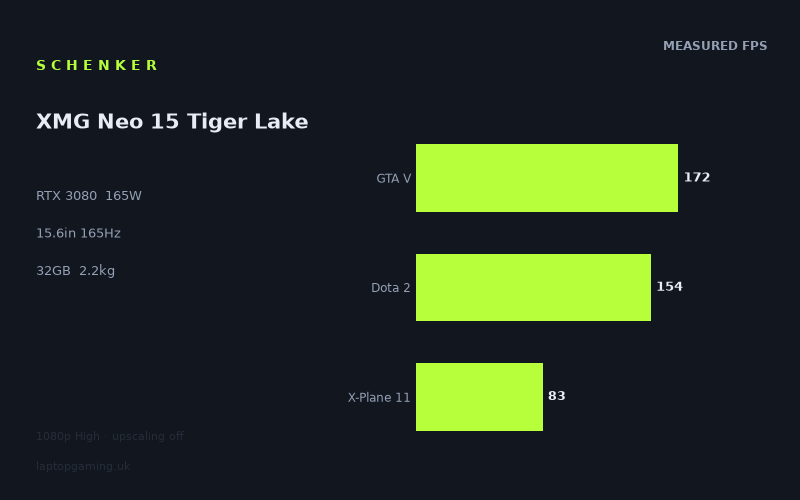
Frame rates
1920×1080, High preset, upscaling off.
Measured on this machine. Source: Notebookcheck, 2021-06-18.
Not scored: incomplete benchmark suite
Every scored laptop on this site is averaged over the same 5 games, and this one is short of Cyberpunk 2077, Baldur's Gate 3. A mean over 5 games is not comparable to a mean over 5, so we publish the figures we have and leave the score blank rather than rank it against machines tested on a different set. The numbers below are real - the suite is just incomplete.
How these numbers were produced
Frame rates here are not measured by us, and we label how each one was arrived at. A figure marked measured comes from a published run on that exact machine. A figure marked representative is derived from the GPU and its power limit (TGP) and cross-referenced against published reviews - a sound estimate of what that configuration delivers, but not a measurement of that specific laptop. Unless stated otherwise, numbers are 1920x1080, High preset, upscaling off. Where a laptop ships in several power configurations we use the wattage of the exact SKU listed, because a 140W RTX 5070 and a 115W one are not the same product.
In use
The short version
The Schenker XMG Neo 15 Tiger Lake is a performance-led 15.6in gaming laptop built around a high-power RTX 3080. Its 165W GPU limit matters: Notebookcheck’s measured figures show that this is not an RTX 3080 being held back by a thin-and-light chassis. At 1920x1080 on the High preset with upscaling off, it reaches 221fps in Strange Brigade, 198fps in The Witcher 3 and 172fps in GTA V. Those are genuinely high results, and they make good use of the 165Hz display in lighter and better-scaling games.
It is less convincing to treat those headline figures as a guarantee of 165fps-class performance everywhere. Dota 2 reaches 154fps, which is close to the panel limit but not quite there. Far Cry 5 lands at 127fps, Final Fantasy XV at 105fps, while Cyberpunk 2077 1.0 and X-Plane 11 both sit in the eighties. This is a fast machine, but it is not a machine that removes compromise from demanding games. Its mean across the five scoring-suite games is 147fps, and that average includes a mixture of games that are easy to run at very high frame rates and games which expose the limits of even a 165W RTX 3080.
The important qualification is the screen resolution. The laptop has a 2560x1440 IPS panel, while the available frame-rate data is at 1920x1080. The benchmark figures are useful for establishing the machine’s general level of performance and for comparing it against the listed rivals, but they do not show native-resolution performance. A buyer choosing this model specifically for 2560x1440 gaming should therefore be clear about what the published data does and does not prove: it demonstrates excellent 1080p High-preset performance, not a measured claim that every listed game will run at the screen’s native resolution near 165Hz.
There is no confirmed UK price for this exact configuration. That means its value cannot be judged responsibly, and this page cannot calculate its value element without a price. Nothing in the benchmark data suggests that there is a problem with the machine’s gaming performance; the missing price simply prevents a complete value judgement.
As a pure performance proposition, the XMG Neo 15 makes most sense for someone who wants a relatively compact gaming laptop with a high-refresh 2560x1440 screen, 32GB of memory, a 1TB SSD and an RTX 3080 configured with a substantial 165W power limit. It is especially suited to buyers who play a broad mixture of older, competitive, well-optimised and visually demanding games rather than expecting every new demanding release to sit at the panel’s maximum refresh rate.
It is not the obvious choice for a buyer whose main priority is maximum native-resolution performance in the hardest games, because the available figures do not measure that scenario. It is also not the right machine to assess primarily as a travel laptop: 2.194kg is a meaningful amount of mass to carry, and no dimensions or battery-runtime measurements are available here to establish how convenient it is away from a desk. The Neo 15 is best understood as a powerful desktop-replacement-leaning 15.6in machine that remains smaller than a larger gaming notebook, rather than as an ultra-portable option.
Performance
A 165W RTX 3080 is the central specification
The defining specification is not merely that the XMG Neo 15 has an RTX 3080. It is that the GPU has a 165W power limit. Laptop GPU names alone do not tell the whole performance story, especially within the same generation. The power limit is part of the machine’s performance identity: it indicates that Schenker has aimed this configuration at sustained gaming performance rather than treating the RTX 3080 badge as a component to be fitted into the smallest possible chassis.
The Notebookcheck figures support that reading. The laptop produces 221fps in Strange Brigade, 198fps in The Witcher 3 and 172fps in GTA V at 1920x1080 on High settings with upscaling disabled. Those are not marginally high results. They establish that the XMG Neo 15 has enough performance for very high refresh rates where the game engine and the rest of the system allow it.
That distinction matters. A high-power GPU does not force every game to deliver the same kind of result. Games differ in their graphics workloads, their CPU demands, their rendering techniques and their ability to turn additional hardware power into additional frames. The Neo 15’s own results show that spread clearly. The gap between 221fps in Strange Brigade and 83fps in X-Plane 11 is not evidence that the hardware changes character from one title to another. It is evidence that the games ask different things of the system.
The useful conclusion is that the 165W RTX 3080 gives the Neo 15 a high ceiling, but the ceiling is not the same in every title. Buyers should focus less on the most flattering single benchmark and more on the complete set: very strong results in lighter titles, strong results in demanding conventional games, and more restrained but still capable results in the most demanding or differently balanced workloads.
The benchmark spread, game by game
Strange Brigade: 221fps. Strange Brigade is the standout result in the published list. At 1920x1080, High settings and with upscaling off, 221fps is above the display’s 165Hz refresh rate. That means this is one of the titles where the Neo 15’s hardware has the performance to drive past the panel’s maximum refresh capability under the measured settings. A 165Hz screen cannot display more than 165 distinct refreshes in a second, but the result still matters. It shows that the machine has substantial performance headroom in this game and that the display refresh rate, rather than the GPU result, becomes the relevant limit.
The Witcher 3: 198fps. The Witcher 3 is another clear high-refresh success. The measured 198fps sits above 165Hz, so the laptop again has sufficient performance under the benchmark settings to exceed the panel’s refresh rate. This is useful evidence for buyers whose libraries include established, well-optimised games: the RTX 3080 at 165W is not merely capable of reaching high frame rates occasionally. It can do so in more than one title with a very different visual style and game engine.
GTA V: 172fps. GTA V is more finely balanced against the screen. The measured 172fps is above 165Hz, but only by a small margin. In practical terms, that makes it a game where the notebook’s High-preset 1080p result lines up closely with the panel’s maximum refresh capability. It is enough to establish that the machine can reach the display’s headline refresh rate in the measured run, but it is not an enormous excess that should be interpreted as unlimited room for different settings or different circumstances. The important point is that the XMG Neo 15 does reach that high-refresh territory rather than falling substantially short of it.
Dota 2: 154fps. Dota 2 is close to, but below, the screen’s 165Hz limit. That is still a strong result, particularly because 154fps is already a high frame rate. However, the difference between “high frame rate” and “fully saturating a 165Hz panel” should not be blurred. Under Notebookcheck’s measured conditions, Dota 2 does not reach 165fps. It comes close enough that the screen remains well matched to the performance, but buyers expecting every lighter or competitive-style game to lock to the panel maximum should not assume that from the RTX 3080 name alone.
Far Cry 5: 127fps. Far Cry 5 shows the next tier of performance. At 127fps, it is comfortably above conventional lower-refresh gaming, but it is clearly below the display’s 165Hz ceiling. This is exactly why a 165Hz display should not be interpreted as a promise of 165fps in every game. The display gives the system room to show very high frame rates when they are available; it does not manufacture those frames in games where the benchmark result is lower. At the measured settings, Far Cry 5 is fast, but it does not fully exploit the panel’s maximum refresh rate.
Final Fantasy XV: 105fps. Final Fantasy XV reaches 105fps. That is still well into high-frame-rate gaming territory, but it is a long way from the figures seen in Strange Brigade, The Witcher 3 and GTA V. The difference is useful because it stops the review becoming a simple exercise in repeating the strongest result. The Neo 15 is powerful, but its performance should be judged across the complete spread. Final Fantasy XV is one of the titles showing that demanding games can place a more meaningful limit on the 165W RTX 3080, even at 1920x1080 and High settings.
Cyberpunk 2077 1.0: 84fps. Cyberpunk 2077 1.0 is among the hardest games in this set for the Neo 15. Notebookcheck recorded 84fps under the stated 1080p High-preset conditions with upscaling off. That is a playable-looking figure in isolation, but it is not a high-refresh result in the same sense as 172fps or 221fps. It is around half the panel’s refresh limit rather than close to it. The laptop is not struggling to the point of an unusable result, but Cyberpunk 2077 1.0 demonstrates that the screen’s 165Hz specification is not the benchmark that should define expectations in every demanding game.
X-Plane 11: 83fps. X-Plane 11 is effectively level with Cyberpunk 2077 1.0 in the available data, at 83fps. Again, this is a substantial result in a difficult title, but it is not evidence that the laptop can make full use of a 165Hz display in every workload. Flight simulation can place a different sort of demand on a gaming laptop than an action game or a conventional graphics benchmark. The published figure underlines the value of looking at a range of titles rather than relying on a mean alone. A mean is useful for ranking and broad comparison, but a buyer interested mainly in X-Plane 11 should pay much more attention to its 83fps result than to the overall 147fps scoring-suite mean.
What the 147fps mean does and does not say
The five-game scoring-suite mean is 147fps. That is a high average, and it places the XMG Neo 15 in the part of the market where a 165Hz display is sensible rather than aspirational. But the mean must be read with care. It is not a frame-rate guarantee, and it does not mean every game is near 147fps. The individual measurements range from GTA V and Strange Brigade at levels beyond the panel refresh rate to Final Fantasy XV at 105fps. The heavier non-scoring titles drop further, with Cyberpunk 2077 1.0 at 84fps and X-Plane 11 at 83fps.
This is why the mean is best treated as a summary rather than a buying recommendation in itself. It says the laptop is consistently fast across the scoring suite. It does not replace game-specific evidence. Someone who spends most of their time in Dota 2 has a different practical experience from someone who spends it in Cyberpunk 2077 1.0, even though both are using the same CPU, GPU, memory and screen.
The good news is that there is no weak result in the published set in the sense of a game collapsing into a clearly low frame-rate category. The less good news, if a buyer has been drawn to the 165Hz specification, is that only some titles reach or exceed that refresh rate under the measured conditions. The Neo 15 is properly powerful. It is not magical.
CPU, memory and storage in context
The system combines the RTX 3080 with a Core i7-11800H, 32GB of memory and a 1TB SSD. The frame-rate figures belong to that complete configuration, not to the GPU in isolation. That matters particularly when interpreting the highest results. At 1080p, lighter titles can become limited by more than raw GPU throughput. Once a system is already producing very high frame rates, differences in CPU behaviour, game engines and platform balance can compress gaps that might appear more visibly in heavier graphics workloads.
The 32GB memory configuration is also part of what distinguishes this from a stripped-back gaming configuration. It is not possible from the supplied data to quantify how much the memory capacity changes performance in any individual title, so there is no basis for claiming a specific uplift. What can be said is that the benchmarked specification is not an RTX 3080 paired with a minimal memory allocation. Buyers comparing configurations should ensure they are comparing like with like rather than assuming that every machine carrying a similar GPU name has the same surrounding specification.
The 1TB SSD is a sensible capacity on paper for a gaming laptop, but no storage-speed measurements are available in this fact sheet. There is therefore no basis to claim fast boot behaviour, fast loading behaviour or a particular class of SSD performance. Its relevance here is simply that the reviewed configuration includes 1TB of storage rather than leaving capacity unspecified.
The screen
A 2560x1440, 165Hz IPS panel is an ambitious match for this hardware
The XMG Neo 15 uses a 15.6in IPS panel with a 2560x1440 resolution and a 165Hz refresh rate. That is a strong on-paper combination for a gaming laptop because it pairs more desktop-like pixel density than 1920x1080 with a refresh rate high enough to show the benefits of fast performance. It avoids the mismatch of placing a high-power RTX 3080 behind a low-refresh panel, while also avoiding a much larger screen format that would make the system inherently less compact.
However, the benchmark data needs to be kept firmly separate from the panel specification. Notebookcheck’s measured results are at 1920x1080, not 2560x1440. The figures therefore show how the laptop performs at a lower resolution than the display’s native resolution. They are still valid and useful measurements, particularly because every listed result uses the same stated test conditions: High preset, upscaling off, 1920x1080. But they cannot be relabelled as native 2560x1440 figures.
This is not a minor technicality. Resolution is one of the main variables in gaming performance. A buyer considering the Neo 15 for its 2560x1440 panel should not read 221fps in Strange Brigade or 84fps in Cyberpunk 2077 1.0 as a direct statement of what will happen at the native panel resolution. No native-resolution frame-rate data is supplied here, so the responsible conclusion is simply that those figures are unknown.
Where the 165Hz panel is fully used
At the measured 1920x1080 settings, Strange Brigade at 221fps and The Witcher 3 at 198fps both exceed 165Hz. GTA V at 172fps also sits above that refresh rate. These are the games where the Neo 15 demonstrates why a 165Hz display belongs on the specification sheet. The screen has sufficient refresh capability that it does not immediately become the bottleneck in those benchmark results.
Dota 2 at 154fps is the closest result below the panel maximum. It does not quite meet 165fps, but it is close enough that the pairing still makes sense. A 165Hz panel is not only useful at exactly 165fps. It is also a good fit for frame rates that sit well above more basic refresh levels without quite reaching the maximum. The key is not to confuse “a suitable display pairing” with “a measured 165fps lock”. The data supports the former; it does not support the latter.
Far Cry 5 at 127fps and Final Fantasy XV at 105fps are further from the display ceiling. Both remain high-frame-rate results, but neither can be described as making full use of 165Hz under the stated benchmark conditions. Cyberpunk 2077 1.0 and X-Plane 11, at 84fps and 83fps respectively, make the point more sharply. In these titles, the display’s maximum refresh rate is a capability the machine does not reach in the available test data.
That is not a criticism of the panel. It is a realistic reading of the relationship between display and GPU. A 165Hz screen is valuable because it gives fast games room to run fast and allows performance headroom to be visible. It does not mean that every modern demanding game will deliver 165fps. The Neo 15’s results are exactly what a serious buyer should want to see in a review: the games that get beyond the refresh limit, the games that get close, and the games that remain well below it.
What is not known about the panel
The panel is specified as IPS, 15.6in, 2560x1440 and 165Hz. Beyond that, this fact sheet does not provide measurements for brightness, colour coverage, response times, contrast, black levels, backlight behaviour or outdoor visibility. Those characteristics can matter as much as resolution and refresh rate to someone choosing a screen, but they are not available here and should not be assumed.
Likewise, the available game results do not establish how the panel behaves at 1920x1080, nor do they establish image quality at non-native resolution. The fact that the benchmark suite uses 1920x1080 is important for performance comparison, but it is not a panel-quality assessment. Buyers for whom display image quality is the deciding factor should treat the supplied screen information as a basic specification rather than a complete display review.
Build, size and portability
The weight says more than the missing dimensions
The XMG Neo 15 weighs 2.194kg. That is the clearest available indicator of its portability. It is a 15.6in gaming laptop with an RTX 3080 at 165W, a Core i7-11800H, 32GB of memory, a 1TB SSD and a 93Wh battery, so it is plainly designed to contain substantial hardware rather than being reduced to the lightest possible form.
A mass of 2.194kg does not make the Neo 15 immobile, but it does mean it should be considered deliberately rather than casually as a machine to carry every day. The laptop can be moved between rooms, taken to another location or used as a main system that is not permanently fixed to one desk. At the same time, the weight is substantial enough that it is sensible to treat portability as a compromise made in exchange for high-power hardware, rather than as one of the central reasons to choose it.
No chassis dimensions are provided. That means there is no evidence here for a claim about its footprint, thickness, bag fit or desk space. The name “Neo 15” and the 15.6in panel establish the screen class, but they do not provide actual measurements of the chassis. Buyers who have a strict requirement for a particular bag, shelf or workspace should not infer the dimensions from the display size alone.
The battery capacity is known; the battery life is not
The battery is rated at 93Wh. That is a meaningful specification, but capacity is not the same thing as measured runtime. There are no published battery-life figures in this fact sheet, so it would be wrong to turn the 93Wh capacity into a claim about working away from mains power, video playback, web use or gaming endurance.
That uncertainty matters especially for a machine with a 165W GPU limit. High gaming performance and long unplugged gaming runtime are separate questions, and the available data only answers the former. The laptop has a 93Wh battery; it does not have a stated number of hours of use in the material supplied here.
For a buyer who mostly uses the Neo 15 at a desk and values the ability to relocate it occasionally, the available specifications make sense. For a buyer who expects a laptop to be primarily used throughout the day away from power, the missing runtime data should be treated as a significant gap rather than filled with assumptions.
What this form factor is really for
The Neo 15’s specification points towards a particular type of use: a gaming machine intended to deliver strong performance in a 15.6in format, without pretending that the RTX 3080 is a low-power part. The 165W GPU limit and 2.194kg mass belong together. One is the performance choice; the other is part of the physical trade-off.
That makes the machine more suitable for someone who wants one system for a desk, a bedroom, a shared home space or occasional travel than for someone whose priority is the lightest possible computer. The combination of 32GB memory and a 1TB SSD reinforces that interpretation. This is configured as a complete higher-end gaming system rather than a minimal configuration designed to hit a particular weight or price target.
There is no supplied information about keyboard quality, port selection, webcam behaviour, speakers, chassis materials, thermal behaviour or fan noise. Those omissions do not make the Neo 15 poor in those areas; they simply mean no reliable judgement can be made here. The performance case is clear from the benchmark data. The wider ownership experience is not fully documented in this fact sheet.
How it compares
Against the MSI Prestige 15 with RTX 3050 Ti at 105W
The largest positive gap in the listed comparison set is against the MSI Prestige 15 with an RTX 3050 Ti at 105W. Across four shared games, the XMG Neo 15 averages 75fps more. That is a large advantage, and it is the clearest illustration of the difference between the Neo 15’s 165W RTX 3080 configuration and a considerably lower-tier, lower-power GPU configuration.
This does not need embellishment. An average lead of 75fps across the shared games is a meaningful separation in real gaming terms. It suggests that the Neo 15 is in an entirely different performance category from the Prestige 15 in those titles. A buyer deciding between them should not approach the comparison as a choice between broadly similar levels of gaming capability with minor differences in design. The published shared-game data says otherwise.
Neither machine has a confirmed UK price in the supplied comparison data, so this cannot become a value comparison. The Neo 15 is faster across the four shared games; whether that speed advantage is worth the cost cannot be established without confirmed prices for the exact configurations.
Against the Razer Blade 17 RTX with RTX 3070 at 130W
The comparison with the Razer Blade 17 RTX is more interesting because the average shared-game difference is +0fps across five games. That is a near-zero result, and it should be treated as such rather than spun into a victory on the basis of a more imposing GPU name. Across the games both machines hold, the data does not show a meaningful average advantage for the XMG Neo 15.
That may look surprising when set against the component specifications: the Neo 15 has an RTX 3080 at 165W, while the Razer has an RTX 3070 at 130W. But a shared-game average at 1920x1080 can compress hardware differences. The fact sheet explicitly notes that lighter titles in the shared set can be CPU-bound at 1080p, which limits how much a GPU advantage can appear in the result. Once frame rates are already high, the difference between GPU configurations does not necessarily express itself as a large numerical gap in every game.
The correct lesson is not that GPU power limits are irrelevant. The wider benchmark list shows that the Neo 15 can produce very high frame rates. Rather, the lesson is that game selection and test resolution matter. In this shared 1080p set, the XMG and Razer are effectively level on average. Buyers comparing the two should not assume that the RTX 3080 label automatically produces a visible advantage in every title.
The Razer Blade 17 RTX is listed at £2,323. The XMG Neo 15 has no confirmed UK price, so no fair price-to-performance comparison can be made. The available data supports a performance tie in the shared games, but it does not establish which is the better purchase.
Against the MSI Stealth GS77 with RTX 3080 Ti at 105W
The MSI Stealth GS77 comparison makes the same point from the opposite direction. The Stealth carries an RTX 3080 Ti, yet the XMG Neo 15 averages -0fps across five shared games. In other words, the shared-game average is effectively level. The extra “Ti” label does not translate into an average lead in this particular 1080p comparison.
Again, that should not be interpreted as proof that the two GPUs are identical or that the model name does not matter. The GPU configurations have different stated power limits: 165W for the XMG Neo 15 and 105W for the MSI Stealth GS77. The benchmark data instead shows why laptop purchasing should not be based on the GPU label alone. The surrounding implementation, the power limit, the game mix and the point at which titles become CPU-bound all affect what the numbers look like.
The near-zero shared-game difference is a real result. It is not an error to be explained away simply because the Stealth has an RTX 3080 Ti name. At 1920x1080, lighter titles can compress genuine GPU gaps when the system reaches CPU-related limits. The published data therefore says that these two laptops are effectively tied across the five shared games, despite their different GPU names and stated power limits.
There is no confirmed UK price for the MSI Stealth GS77 configuration either. That removes value from the comparison and leaves the performance evidence as the main usable conclusion: in the shared 1080p game set, neither machine establishes a meaningful average advantage.
Against the MSI Raider GE77 HX with RTX 3080 Ti at 175W
The MSI Raider GE77 HX is the machine in the listed group that beats the Neo 15 by the greatest margin. Across five shared games, the XMG averages 22fps fewer. This is a substantial enough difference that it should not be dismissed as normal benchmark variation or compressed away by the CPU-bound explanation used for the near-zero comparisons.
The Raider’s RTX 3080 Ti has a 175W power limit, above the Neo 15’s 165W RTX 3080 limit. The result does not establish that power limit alone accounts for every frame of the gap; the laptops are complete systems, not isolated GPUs. But the comparison is directionally consistent with the Raider being configured for higher performance. The XMG Neo 15 is fast, yet the Raider shows that there remains a higher rung available within this GPU generation when the implementation is more performance-focused.
This is useful for setting expectations. The Neo 15 should not be bought on the assumption that a 165W RTX 3080 is automatically the fastest option among comparable-generation gaming laptops. It is strong enough to tie the listed Razer and Stealth machines on their shared 1080p averages, and it is dramatically ahead of the RTX 3050 Ti Prestige. But it is behind the Raider in the same type of shared-game comparison.
The Raider has no confirmed UK price in the supplied data. As with the other unpriced machines, the frame-rate advantage cannot be turned into a verdict on value. A faster result is not automatically a better purchase without knowing the price of the exact configuration. What the data does show is simple: the Raider is the performance leader in this particular rival group, while the Neo 15 occupies a strong but not absolute-top position.
What the rival results mean in practice
The comparison set gives the Neo 15 a more nuanced position than a single GPU name ever could. It is far ahead of the MSI Prestige 15 with its RTX 3050 Ti at 105W. It is effectively tied with the Razer Blade 17 RTX carrying an RTX 3070 at 130W. It is also effectively tied with the MSI Stealth GS77 despite that machine’s RTX 3080 Ti label and 105W power limit. Finally, it loses ground to the MSI Raider GE77 HX with an RTX 3080 Ti at 175W.
That spread is valuable because it demonstrates the two truths of laptop GPU buying. First, component tier and power limit matter: the 75fps lead over the RTX 3050 Ti system and the Raider’s 22fps lead over the Neo 15 are not trivial. Second, not every component-label difference appears in a 1080p shared-game average: the Razer and Stealth comparisons are effectively level.
For the buyer, the message is to compare measured results rather than treating RTX 3080, RTX 3080 Ti and RTX 3070 names as a complete performance ranking. The Neo 15 is evidence that a well-powered RTX 3080 can remain highly competitive. It is also evidence that a buyer seeking the highest attainable results should look at the complete implementation and not stop at the graphics badge.
Who it’s for
Buy it if performance in a 15.6in format is the priority
The XMG Neo 15 is best suited to a buyer who wants high gaming performance in a 15.6in laptop and understands the trade-offs involved. The 165W RTX 3080, Core i7-11800H, 32GB memory, 1TB SSD and 165Hz 2560x1440 IPS panel are the specifications of a serious gaming configuration. The frame-rate data backs that up: 221fps in Strange Brigade, 198fps in The Witcher 3, 172fps in GTA V and a 147fps mean across the scoring suite are strong published results.
It is particularly attractive for someone who plays games where frame rates can rise into high-refresh territory. Strange Brigade, The Witcher 3 and GTA V all exceed the panel’s 165Hz maximum under the measured 1080p High settings. Dota 2 at 154fps is also close enough to show that the display is a sensible match for the machine. For this type of game library, the Neo 15’s hardware is not wasted on the screen.
It also suits a buyer who accepts that demanding games will require more realistic expectations. Cyberpunk 2077 1.0 at 84fps and X-Plane 11 at 83fps are not failures, but they are an important corrective to simplistic “RTX 3080 equals 165fps” thinking. Someone who can appreciate strong performance without requiring the panel maximum in every title is likely to be happy with what the benchmark data shows.
The 2.194kg weight is most appropriate for someone who values the ability to move the system but does not need it to feel inconsequential in a bag. This is a machine to use as a primary gaming laptop, perhaps moving it between places when needed, rather than a machine chosen chiefly for minimum carry weight.
Buy something else if native 2560x1440 results are non-negotiable
A buyer whose decision depends on native 2560x1440 gaming performance should wait for native-resolution benchmark data rather than trying to convert the supplied 1920x1080 figures into a promise. The screen is 2560x1440, but the measured gaming results are not. There is no responsible basis here for stating what frame rate the Neo 15 will achieve in any of the listed games at the display’s native resolution.
This does not make the laptop unsuitable for 2560x1440 gaming. It means the present evidence is incomplete for a buyer who regards that as the decisive use case. If the aim is to play demanding titles such as Cyberpunk 2077 1.0 or X-Plane 11 at native resolution while pursuing the screen’s 165Hz ceiling, the supplied 1080p results should encourage caution rather than certainty.
Buy something else if the lightest system matters most
The Neo 15 weighs 2.194kg. Anyone shopping for the lightest possible laptop should treat that as a reason to consider alternatives. The machine’s high-power GPU configuration makes sense for gaming performance, but it is not a specification built around minimum mass. There is no dimensions data and no battery-runtime data here, so there is no further evidence to rescue or condemn its portability. The available information simply says that it is a 2.194kg gaming laptop with a 93Wh battery, not a measured all-day portable system.
Similarly, anyone who needs confirmed battery endurance for regular use away from power should choose based on published runtime measurements rather than battery capacity alone. The 93Wh battery is known; the number of hours it provides in any workload is not.
Buy something else if maximum performance is worth prioritising above all else
The MSI Raider GE77 HX establishes the upper edge of this comparison group. Its RTX 3080 Ti at 175W beats the Neo 15 by an average of 22fps across five shared games. For a buyer whose only meaningful priority is extracting the highest available performance from this generation, that is relevant evidence in the Raider’s favour.
However, the Raider has no confirmed UK price in the supplied data, and neither does the Neo 15. There is no basis for saying whether the extra performance is worth paying for. The correct conclusion is narrower: the Raider is faster in the shared-game comparison, while the Neo 15 remains a strong performer that sits ahead of the RTX 3050 Ti Prestige and effectively level with the Razer Blade 17 RTX and MSI Stealth GS77 in their shared 1080p games.
The final buying view
The Schenker XMG Neo 15 Tiger Lake is a convincing performance machine on the evidence available. Its 165W RTX 3080 is backed by frame rates that range from above the display’s 165Hz refresh limit in several games to around the eighties in the hardest titles listed. That range is exactly what buyers should expect from a powerful gaming laptop: spectacular numbers where a game permits them, strong but more restrained results where the workload is heavier.
The machine’s best argument is not that it wins every comparison. It does not. Its strongest argument is that it combines a high-power RTX 3080 with a 15.6in 2560x1440 165Hz IPS screen, 32GB of memory and 1TB of storage, then produces benchmark figures that put it far ahead of a lower-tier RTX 3050 Ti rival and level with some ostensibly more prestigious GPU configurations in the shared 1080p data.
The main caveats are straightforward. There is no confirmed UK price, so value cannot be judged. The frame rates are measured at 1920x1080 rather than the screen’s 2560x1440 native resolution. There are no battery-runtime, noise, temperature, dimensions or detailed display-quality measurements in the supplied data. None of those gaps undermine the published performance evidence, but they do define the limits of what can be concluded.
For the buyer who wants a powerful 15.6in gaming laptop, plays a mixture of high-refresh and demanding games, and is prepared to judge it by measured 1080p performance rather than unverified assumptions about native-resolution results, the XMG Neo 15 has a strong case. For the buyer who needs a confirmed value judgement, a lightweight travel machine, or proof of maximum-refresh native-2560x1440 gaming, the available evidence is not sufficient and a different purchase decision would be more prudent.