Details
Product prices and availability are accurate as of the date/time indicated and are subject to change. Any price and availability information displayed on Amazon.co.uk at the time of purchase will apply to the purchase of this product.Review
Schenker Key 17 Pro (Early 23) review
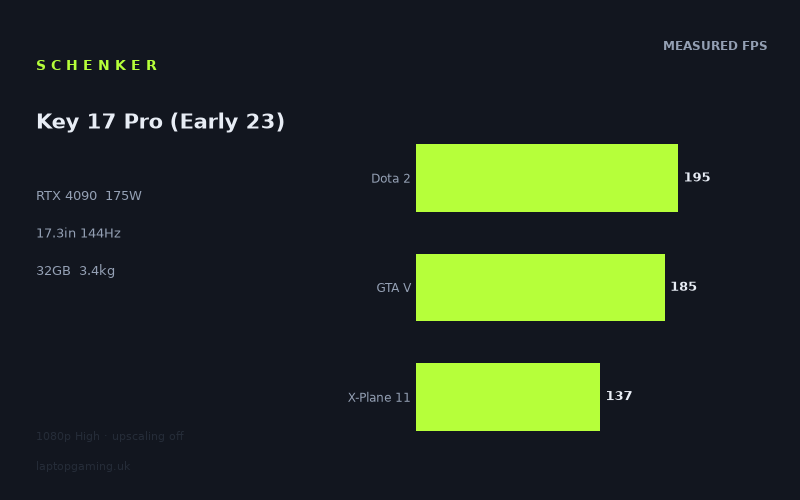
Frame rates
1920×1080, High preset, upscaling off.
Measured on this machine. Source: Notebookcheck, 2023-06-02.
Not scored: incomplete benchmark suite
Every scored laptop on this site is averaged over the same 5 games, and this one is short of Cyberpunk 2077, Baldur's Gate 3. A mean over 3 games is not comparable to a mean over 5, so we publish the figures we have and leave the score blank rather than rank it against machines tested on a different set. The numbers below are real - the suite is just incomplete.
How these numbers were produced
Frame rates here are not measured by us, and we label how each one was arrived at. A figure marked measured comes from a published run on that exact machine. A figure marked representative is derived from the GPU and its power limit (TGP) and cross-referenced against published reviews - a sound estimate of what that configuration delivers, but not a measurement of that specific laptop. Unless stated otherwise, numbers are 1920x1080, High preset, upscaling off. Where a laptop ships in several power configurations we use the wattage of the exact SKU listed, because a 140W RTX 5070 and a 115W one are not the same product.
In use
The short version
The Schenker Key 17 Pro (Early 23) is a large-format gaming laptop built around an RTX 4090 configured with a 175W GPU power limit, a Core i9-13900HX, 32GB of memory and a 17.3in 3840x2160 IPS display with a 144Hz refresh rate. On paper, that is a serious specification. The published benchmark figures support that impression at 1920x1080 on the High preset with upscaling disabled: Notebookcheck recorded anything from 94fps in Sons of the Forest to 410fps in Strange Brigade.
That range matters more than a single average. In older, lighter or exceptionally well-scaling games, the Key 17 Pro can run far beyond the display’s 144Hz refresh rate. In demanding newer games, it remains clearly playable at the tested settings but does not necessarily reach 144fps. Star Wars Jedi Survivor is recorded at 122fps, while Sons of the Forest is at 94fps. The laptop therefore has the performance to make a fast panel worthwhile, but not the universal 144fps-at-any-setting result that the RTX 4090 name might lead some buyers to expect.
The other important qualification is resolution. Notebookcheck’s figures are for 1920x1080, while this Schenker has a 3840x2160 display. Those are not interchangeable settings. The measured data demonstrates very high 1080p High-preset performance without upscaling; it does not demonstrate the frame rates this machine will deliver at the panel’s native 4K resolution. Buyers who intend to use the internal screen at 3840x2160 should treat the benchmark data as a strong indication of available hardware, not as proof of native-resolution performance.
There is also no confirmed UK price for this configuration. That prevents a proper value judgement. A laptop with this specification can make sense for someone who wants a 17.3in 4K screen, 32GB of memory and high 1080p frame rates in one system, but price is central to whether that package is sensible rather than merely powerful. We can assess the published specifications and benchmark data; we cannot say whether it is good value in the UK without a confirmed price.
As a desktop-replacement-style gaming laptop, the Key 17 Pro makes the most sense for buyers who prioritise screen size, high-end components and strong performance in a broad spread of games. It is much less convincing for anyone who wants a genuinely portable system. At 3.44kg before any consideration of other equipment, it is a substantial machine. The 99Wh battery is sizeable in capacity terms, but there is no battery-life measurement in the available data, so it should not be treated as evidence of all-day untethered use.
There is one further limitation to keep clear. The available scoring-suite data covers Dota 2, GTA V and X-Plane 11, with a measured mean of 172fps across those three games. We do not have the corresponding figures for Cyberpunk 2077 or Baldur’s Gate 3. Since scored laptops are normally averaged over the same five-game suite, this incomplete set cannot be ranked fairly against machines with the complete suite. The figures are still useful as evidence of performance in the games measured, but they are not a complete cross-market result.
Performance
What the measured figures show
Notebookcheck measured the Schenker Key 17 Pro at 1920x1080 using the High preset with upscaling disabled. That test setup is useful because it removes one major variable: the frame rates are not being lifted by an upscaling mode. They show the machine’s results at a conventional Full HD resolution and a substantial image-quality preset, rather than a result achieved by aggressively reducing rendering load.
The top result is 410fps in Strange Brigade. That is far beyond the 144Hz refresh rate of the internal display. In practical terms, the panel cannot present 410 distinct refreshes per second. The result is still valuable because it shows that this title is not meaningfully constrained by the laptop at these settings. For a buyer who plays Strange Brigade or similarly light, mature and well-scaling games, the Key 17 Pro has considerable excess performance at 1920x1080 High.
The Witcher 3 is measured at 299fps. Again, that is comfortably above the screen’s 144Hz refresh rate. It is a particularly useful second result because it confirms that Strange Brigade is not the only title in which the system runs well clear of 144fps. At the tested resolution and preset, the Key 17 Pro has enough performance headroom for the panel refresh rate in both of these games.
Dead Island 2 is measured at 212fps. That remains above 144fps and therefore sits in the same broad category: the laptop can exceed the panel’s refresh rate at the tested settings. It is not as extreme as the Strange Brigade result, but it is still a strong indication that the RTX 4090 at its listed 175W limit is not merely capable of acceptable frame rates in this game. It has the headroom to support a high-refresh experience at 1920x1080 High, assuming the game is being run under comparable conditions.
Dota 2 returns 195fps in the scoring suite. This is another result above the display’s 144Hz refresh rate. It is also relevant to the comparison data later in this review, because Dota 2 is one of the shared scoring-suite titles. The number is high, but it should not be read as a clean measure of GPU separation between every laptop. At 1920x1080, lighter titles can become constrained by factors other than raw GPU capability, including CPU performance and the game engine’s own scaling characteristics. That is why systems with very different graphics hardware can sometimes land close together in a small shared-game set.
GTA V is recorded at 185fps. Like Dota 2, it is above 144fps and is part of the scoring suite. It reinforces the point that the Key 17 Pro can drive its 144Hz screen well in several established games when running at the measured 1920x1080 High settings. It does not mean that every game will behave this way, nor does it prove that native 3840x2160 operation will provide the same result. It means exactly what the data says: GTA V recorded 185fps under Notebookcheck’s stated benchmark conditions.
Final Fantasy XV is measured at 183fps. That remains above 144fps, although by a smaller margin than GTA V or Dota 2. Even so, it is a useful result because it broadens the group of games in which the Key 17 Pro’s measured performance exceeds the internal panel refresh rate at Full HD High with upscaling off. A buyer focused on smooth high-refresh gaming at 1920x1080 has strong evidence here, rather than a conclusion based on only one unusually favourable title.
X-Plane 11 returns 137fps. This is close to the 144Hz refresh rate but falls short of it in the published measurement. That does not make it a poor result. A measured 137fps is still a high frame rate. It does, however, show why it is wrong to reduce the Key 17 Pro to a blanket claim that it “does 144fps”. The system clears 144fps in several measured games, sits just below it in X-Plane 11, records 122fps in Star Wars Jedi Survivor and reaches 94fps in Sons of the Forest.
Star Wars Jedi Survivor is measured at 122fps. That is below the display’s 144Hz refresh rate, but it remains well above the lower end of what most buyers would consider playable. More importantly, it demonstrates a different kind of workload from the 410fps Strange Brigade result. The laptop is still fast here, but the game places enough demand on the system that the available performance no longer carries it to the panel limit at the measured settings.
Sons of the Forest is the lowest result in the supplied set at 94fps. That is not a failure for the Key 17 Pro; it is a reminder that demanding games do not all respond to high-end hardware in the same way. A 175W RTX 4090 and Core i9-13900HX do not turn every title into a 144fps result, especially when the benchmark uses the High preset and leaves upscaling disabled. For buyers deciding whether they need this level of hardware, the 94fps result is arguably as informative as the 410fps result. It sets a realistic lower point within the games measured.
The benchmark spread is the story
The performance spread from 94fps to 410fps is wide. It shows that this laptop should not be judged by the mean alone, and it should not be judged by the RTX 4090 badge alone either. Games differ in graphics workload, CPU demand, engine design and how well they scale at a given resolution. The same hardware can be excessive in one title, capable of fully exploiting a 144Hz display in another, and below that refresh rate in a more demanding game.
The measured mean across Dota 2, GTA V and X-Plane 11 is 172fps. That is a useful shorthand for those three scoring-suite games, but it should not be mistaken for a universal gaming average. Dota 2 and GTA V are recorded at 195fps and 185fps respectively, while X-Plane 11 is at 137fps. The mean is therefore describing a group that already contains a notable split between the two higher results and the lower X-Plane 11 figure.
It is also only a three-game mean. Cyberpunk 2077 and Baldur’s Gate 3 are absent from the available figures. The complete scoring suite has five games, and all scored laptops are normally averaged over that same five-game set. Without those two figures, there is no honest way to place the Schenker Key 17 Pro into a complete ranking against other scored machines. Any attempt to do so would turn partial evidence into a more definite claim than the data supports.
That should not deter buyers from using the individual numbers. If Dota 2, GTA V, X-Plane 11, Star Wars Jedi Survivor, Sons of the Forest, Dead Island 2, The Witcher 3, Final Fantasy XV or Strange Brigade are relevant to your library, the measured figures are directly useful. They show the laptop’s published performance in those games at a clearly defined resolution and preset. The important discipline is not to extrapolate those figures into unmeasured games or native 4K operation.
What the 175W GPU power limit means in practice
The RTX 4090 in this machine is listed with a 175W GPU power limit. That matters because laptop GPU names do not tell the full story on their own. The same GPU class can be configured differently by different manufacturers, and the power limit is part of the performance context. Here, the Key 17 Pro is not presenting an RTX 4090 with an unspecified limit: the configuration is explicitly listed at 175W.
The available benchmark data shows what this 175W RTX 4090 configuration achieved in Notebookcheck’s tests. It delivered 410fps in Strange Brigade, 299fps in The Witcher 3, 212fps in Dead Island 2, 195fps in Dota 2, 185fps in GTA V, 183fps in Final Fantasy XV, 137fps in X-Plane 11, 122fps in Star Wars Jedi Survivor and 94fps in Sons of the Forest. Those figures are more useful than treating the 175W number as a performance guarantee by itself.
The closest hardware context in the comparison data is revealing. The Razer Blade 16 Early has an RTX 4080 at 175W, yet the Schenker averages +0fps against it across three shared games. The Razer Blade 16 Early 2023 RTX has an RTX 4090 at 175W, and the Schenker averages -0fps across three shared games. Those near-zero results do not mean RTX 4080 and RTX 4090 hardware are generally identical, nor do they establish that every 175W RTX 4090 laptop will match another one in every game. They mean that in the limited shared-game sample supplied, at 1920x1080, the results were effectively tied.
That is exactly the situation in which buyers should avoid over-reading a GPU label. The shared tests include lighter titles at 1920x1080, where CPU limits and engine limits can compress apparent graphics differences. When a title is already running at a very high frame rate, extra GPU capability may not translate into a similarly large measured gap. A near-zero difference is not a mistake to be ignored; it is evidence that the tested games and settings are not exposing a large separation between those machines.
The contrast with the Schenker XMG Apex 15 (Late 23) is much clearer. That machine uses an RTX 4050 at 140W, and the Key 17 Pro averages +117fps across five shared games. This is a meaningful gap across a larger shared set than the three-game Razer comparisons. The Key 17 Pro’s RTX 4090 at 175W is therefore not merely carrying a more prestigious specification. In the supplied five-game comparison, it produces a very large measured advantage over the 140W RTX 4050 system.
Still, the 175W limit should not be turned into claims the data does not make. We do not have measurements here for GPU clock behaviour, sustained power draw, temperatures, fan noise or performance at native 3840x2160. We also do not have a 175W RTX 4090 comparison across every game in the list. What we have is solid evidence of high 1080p High-preset performance and a clear performance advantage over one lower-tier 140W RTX 4050 rival, alongside effectively tied results against two Razer systems in a small three-game shared set.
Can it make use of 144Hz?
At the tested 1920x1080 High settings, the answer is game-dependent.
- Strange Brigade at 410fps is well beyond 144Hz.
- The Witcher 3 at 299fps is well beyond 144Hz.
- Dead Island 2 at 212fps is above 144Hz.
- Dota 2 at 195fps is above 144Hz.
- GTA V at 185fps is above 144Hz.
- Final Fantasy XV at 183fps is above 144Hz.
- X-Plane 11 at 137fps is close to, but below, 144Hz.
- Star Wars Jedi Survivor at 122fps is below 144Hz.
- Sons of the Forest at 94fps is below 144Hz.
This is a better result than simply saying the laptop is “good for 144Hz”. It tells a buyer where the evidence is strongest. In several measured games, the Key 17 Pro can exceed the display refresh rate at the benchmarked settings. In the more demanding end of this particular list, it cannot consistently do so. That is normal behaviour for a gaming laptop across a mixed game library, and it is why per-game benchmark data matters.
There is no evidence here that the laptop needs lower-than-High settings for 144fps in the titles where it already exceeds that point. Equally, there is no evidence that it reaches 144fps in X-Plane 11, Star Wars Jedi Survivor or Sons of the Forest at the tested preset. Buyers can choose to alter settings in their own games, but that would be a different test condition from the published figures and should not be represented as measured performance.
The screen
The Key 17 Pro has a 17.3in IPS display with a 3840x2160 resolution and a 144Hz refresh rate. This is an ambitious combination. A 17.3in panel provides a large gaming workspace by laptop standards, 3840x2160 gives it a high native pixel count, and 144Hz offers a refresh ceiling suited to fast-moving games when the system can supply the frame rate.
The strongest confirmed performance evidence, however, is at 1920x1080 rather than 3840x2160. That distinction should shape buying decisions. The laptop’s panel is natively 4K, but Notebookcheck’s supplied figures do not tell us what it does at 4K High. They tell us what it does at 1080p High with upscaling off. There is no responsible way to convert 410fps in Strange Brigade, 299fps in The Witcher 3 or 94fps in Sons of the Forest into a claimed native-4K result.
For buyers who want high-refresh gaming above all else, the 1080p figures make the 144Hz panel look useful in a substantial part of the measured library. Strange Brigade, The Witcher 3, Dead Island 2, Dota 2, GTA V and Final Fantasy XV all exceed 144fps under the benchmark conditions. X-Plane 11 is close at 137fps, while Star Wars Jedi Survivor and Sons of the Forest are below the refresh rate at 122fps and 94fps.
For buyers who want native-resolution image detail above all else, the specification is attractive but the performance evidence is incomplete. A 3840x2160 display is not automatically a guarantee that every game should be run at 3840x2160 with every setting unchanged. That is especially important here because even at 1920x1080 High, the measured results vary substantially by title. The safe conclusion is that this is a laptop with a 4K 144Hz IPS panel and very strong published 1080p numbers. Native 4K frame rates are not available in the supplied data.
The IPS panel type is also worth stating precisely. The specification identifies it as IPS, but we do not have measurements for brightness, contrast, colour coverage, response time, backlight behaviour or any other image-quality characteristic. It would be wrong to infer those characteristics from the panel type alone. Buyers for whom colour work, dark-room contrast, competitive response behaviour or outdoor visibility are decisive should seek panel measurements rather than relying on “IPS” as a complete assessment.
The same restraint applies to adaptive-sync support and other display features. They are not listed in the supplied specifications. The useful facts are the screen size, 3840x2160 resolution, 144Hz refresh rate and IPS panel type. Beyond that, the performance discussion must remain anchored to the measured Full HD data.
There is a practical tension in the specification, but it is not necessarily a flaw. The 4K panel gives the machine a high-resolution native display, while the measured 1080p results show that it can also produce very high frame rates in many games. The right use depends on priorities. Someone who values frame rate may be more interested in the 1080p High figures and the games that exceed 144fps. Someone who values native 4K detail needs more directly relevant benchmark data before assuming how this configuration will behave.
Build, size and portability
The clearest portability figure is the weight: 3.44kg. That places the Key 17 Pro firmly in the substantial end of the gaming-laptop market. A buyer selecting this machine should do so because they want the combination of a 17.3in display, high-end components and a 175W RTX 4090 configuration, not because they expect a light travel companion.
Weight does not tell the whole portability story, and the available data does not include dimensions. We therefore cannot say how wide, deep or thick the chassis is, how much desk area it occupies, or how it compares physically with named rivals beyond the supplied weight figure for this machine. The 17.3in screen is enough to establish that this is a large-screen laptop, but it is not a substitute for actual chassis dimensions.
The 99Wh battery is a notable specification, but there is no measured battery-life figure. It would be unsafe to claim a number of hours for gaming, web use, video playback or any other workload. Battery capacity is not battery endurance. Display resolution, refresh behaviour, game load, software configuration and many other factors affect runtime, and none of those have been measured here.
For that reason, the sensible reading is limited: the Key 17 Pro has a 99Wh battery, but the available information does not establish how long it lasts away from mains power. Buyers who expect to use a 3.44kg, 17.3in RTX 4090 laptop regularly away from a desk should treat battery-life evidence as a required part of their research, not as an assumption based on capacity.
Likewise, we do not have figures for fan noise or temperatures. A 175W GPU configuration naturally makes cooling behaviour an important subject, but importance is not evidence. The fact sheet does not provide acoustic results, surface temperatures, internal temperatures or sustained-load observations. This review therefore cannot tell you whether the Key 17 Pro is quiet, loud, cool or hot under gaming load.
That missing information matters because this is not a thin-and-light specification. The Core i9-13900HX, RTX 4090 at 175W, 32GB of memory, 17.3in 4K panel and 3.44kg weight all point toward a machine intended to deliver substantial performance. But chassis execution cannot be judged honestly without dimensions, thermal data and noise data. The specifications establish the category; they do not establish the quality of the cooling system or day-to-day ergonomics.
What can be said with confidence is that this is best approached as a system that will spend much of its time in a fixed place: on a desk, at a regular gaming position or in another setup where its size and weight are acceptable. That is an inference from the 3.44kg mass and 17.3in screen rather than a claim to have carried the machine. Buyers moving a laptop infrequently may find that trade-off entirely reasonable. Buyers travelling regularly should be more cautious.
How it compares
The comparison data covers a deliberate spread rather than only the nearest model. It includes the two effectively tied Razer results, the machine the Key 17 Pro beats by the largest supplied margin and the machine that beats it by the largest supplied margin. All comparisons are limited to games both machines hold, with preference given to scoring-suite games. That limitation is important: these are not universal rankings across every title, every setting or every resolution.
Against the Schenker XMG Apex 15 (Late 23)
The Schenker XMG Apex 15 (Late 23) uses an RTX 4050 at 140W. Across five shared games, the Key 17 Pro averages +117fps. That is the largest advantage listed for the Key 17 Pro, and it is a convincing one because it is based on five shared games rather than only three.
The hardware context is straightforward without needing to claim more than the data allows. The Key 17 Pro has an RTX 4090 at 175W, while the Apex 15 has an RTX 4050 at 140W. The measured shared-game result is a +117fps advantage for the Key 17 Pro. If your choice is specifically between these two Schenker systems and gaming performance is the priority, the available figures strongly favour the Key 17 Pro.
There is no confirmed UK price for the Apex 15 in the supplied information, and there is no confirmed UK price for the Key 17 Pro either. That means performance superiority cannot automatically become a value recommendation. The Key 17 Pro is much faster in the stated shared-game comparison, but we cannot judge how much extra a buyer would be asked to pay for that performance.
Against the Razer Blade 16 Early
The Razer Blade 16 Early has an RTX 4080 at 175W. Across three shared games, the Key 17 Pro averages +0fps. This is a real result, not a reason to force an artificial winner. In the available shared-game sample, the two machines are effectively tied.
It may seem surprising that an RTX 4090 system does not establish a visible average lead over an RTX 4080 system here. The explanation is in the testing context and sample size. The shared set contains three games, and 1920x1080 can allow lighter titles to become CPU-bound or otherwise limited by the game rather than raw GPU throughput. Once frame rates are already high, a large GPU difference can be compressed into a small or near-zero observed result.
This does not prove that the RTX 4090 and RTX 4080 are interchangeable in all circumstances. It does show that the named three-game comparison does not demonstrate a practical frame-rate advantage for the Key 17 Pro. Buyers choosing between these two should therefore not rely on the GPU label alone. They would need price, display, dimensions, battery results, thermals and broader game data to make a well-supported decision, but those details are not available here.
Neither machine has a confirmed UK price in the supplied rival data. Once again, value cannot be settled honestly. The correct conclusion is narrow: in three shared games, the Key 17 Pro and this RTX 4080 Razer are effectively level.
Against the Razer Blade 16 Early 2023 RTX
The Razer Blade 16 Early 2023 RTX also uses an RTX 4090 at 175W. Across three shared games, the Key 17 Pro averages -0fps. In practical terms, that is another tie in the available comparison set.
This is useful confirmation that the Key 17 Pro’s results are not outlying simply because it carries an RTX 4090 at 175W. Against another listed RTX 4090 at the same power limit, the shared-game average is effectively indistinguishable. That does not mean every component, cooling design or display characteristic is the same. It means the shared 1920x1080 test results do not provide a meaningful performance separation.
Here too, the sample is only three games. A three-game tie should be treated as a statement about those shared games, not an all-purpose declaration that the machines are equal in every game. It is nevertheless more useful than pretending a tiny mathematical difference decides a purchase. The supplied data says there is no meaningful average lead either way.
There is no confirmed UK price for this Razer configuration. With the Schenker price also unconfirmed, this comparison remains performance-only. A buyer should not pay a premium for an assumed benchmark advantage that the available shared-game figures do not show.
Against the Asus ROG Strix Scar 17
The Asus ROG Strix Scar 17 is the listed machine that beats the Key 17 Pro by the largest supplied margin. It uses an RTX 4090 and costs £4,864. Across three shared games, the Key 17 Pro averages -27fps.
A 27fps average deficit is more substantial than the near-zero Razer comparisons, but context remains essential. The result is based on three shared games. It establishes that the Asus was ahead in that comparison, not that it will be ahead by the same amount in every game or at every resolution. The Key 17 Pro’s wider benchmark list still includes results of 410fps, 299fps, 212fps, 195fps, 185fps, 183fps, 137fps, 122fps and 94fps depending on the game.
The Asus price is confirmed at £4,864, but the Schenker’s UK price is not confirmed. That stops us from saying whether the Asus premium performance is worth its asking price compared with the Key 17 Pro. If the Schenker were far cheaper, a 27fps deficit across three games might be an acceptable trade. If it were similarly priced, the Asus result would deserve more weight. Without the Schenker price, neither conclusion is justified.
The most useful takeaway is that the Key 17 Pro should not be assumed to be the fastest RTX 4090 laptop merely because it has a 175W limit and strong individual numbers. The Asus comparison shows that another RTX 4090 machine can be ahead in the shared set. At the same time, the Razer RTX 4090 comparison shows an effective tie, and the RTX 4080 Razer comparison also shows an effective tie. The market is more nuanced than a simple hierarchy based on GPU name.
Who it’s for
Buy it if you want a large, high-end gaming system and can verify the price
The Key 17 Pro is for the buyer who wants a 17.3in IPS screen, 3840x2160 resolution, 144Hz refresh rate, 32GB of memory, a Core i9-13900HX and an RTX 4090 at 175W in one machine. The published 1080p High-preset figures support the idea that this hardware is capable of very high frame rates across a broad range of games.
It is particularly well suited to someone whose gaming mix includes titles such as Strange Brigade, The Witcher 3, Dead Island 2, Dota 2, GTA V or Final Fantasy XV and who values high-refresh performance at 1920x1080. In those measured games, the laptop exceeds 144fps. That is meaningful for a display with a 144Hz refresh rate, even if the panel’s native resolution is 3840x2160.
It is also a sensible candidate for a buyer who accepts that demanding games will not always reach 144fps at the same settings. Star Wars Jedi Survivor at 122fps and Sons of the Forest at 94fps demonstrate that the system remains fast without delivering a universal refresh-rate lock. Buyers with realistic expectations will see that as useful information rather than a disappointment.
The machine also makes sense for someone comparing it directly with the XMG Apex 15 (Late 23) and prioritising performance. The +117fps average advantage across five shared games is the clearest comparative result in the supplied data. There may still be reasons to choose the RTX 4050 model, especially if price or portability differs substantially, but those reasons are not gaming-frame-rate performance.
Do not buy it solely for assumed native 4K gaming results
The internal display is 3840x2160, but the published frame rates are at 1920x1080. If your entire reason for considering the Key 17 Pro is native 4K gaming at High settings, the available data is not enough. Do not turn excellent 1080p figures into invented 4K figures.
This is particularly important because the 1080p results already show substantial variation. A system that records 410fps in Strange Brigade and 94fps in Sons of the Forest is clearly encountering very different workloads. Increasing resolution from 1920x1080 to 3840x2160 would be another major change in conditions, and no supplied benchmark result tells us exactly how each game responds.
Buyers focused on 4K should seek measurements at 3840x2160 for the specific games and settings that matter to them. The screen specification is promising; the benchmark evidence is simply at a different resolution.
Buy something else if portability is central
At 3.44kg, the Key 17 Pro is not aimed at buyers for whom low weight is a priority. The 17.3in screen and high-end hardware may be worthwhile trade-offs for a desk-based setup, but they do not make this an obvious choice for frequent travel.
The 99Wh battery does not change that conclusion on its own. We do not have a battery-life measurement, so there is no evidence here to support a claim about long unplugged use. A buyer who needs a laptop for regular mobile work, commuting or travel should place more weight on measured battery life, dimensions and total carry practicality than is possible from this fact sheet.
Likewise, buyers who need a quiet laptop or want assurance about temperatures should look for direct acoustic and thermal measurements. The hardware configuration makes those questions important, but there are no figures here to answer them.
Be cautious if value is your first concern
The lack of a confirmed UK price is the Key 17 Pro’s biggest unresolved issue. Performance is clearly high, and the specification is clearly premium, but neither tells us whether the final package is sensibly priced. It could be compelling if positioned well against other RTX 4090 systems; it could be difficult to justify if priced close to machines with stronger comparative results or more complete supporting data.
The Asus ROG Strix Scar 17 provides a useful warning against making assumptions. It costs £4,864 and averages 27fps ahead across three shared games. That does not establish that the Asus is better value, because the Schenker price is unknown. It does show that a buyer should compare actual UK pricing rather than assuming that similar RTX 4090 specifications deliver the same performance or the same value.
The two Razer comparisons make the same point from another direction. The Key 17 Pro is effectively tied over three shared games with both the 175W RTX 4080 Razer Blade 16 Early and the 175W RTX 4090 Razer Blade 16 Early 2023 RTX. Neither Razer has a confirmed UK price in the supplied data, so value remains unresolved there too. But the performance evidence says a buyer should not pay extra merely for an assumed decisive lead from the Schenker in those shared titles.
Final assessment
The Schenker Key 17 Pro (Early 23) has the ingredients of a serious large-screen gaming laptop: RTX 4090 graphics at a listed 175W limit, Core i9-13900HX processing, 32GB of memory, a 17.3in 3840x2160 144Hz IPS display, a 99Wh battery and a 3.44kg weight. Notebookcheck’s measured 1920x1080 High-preset results with upscaling disabled show strong performance across every game listed, from 94fps in Sons of the Forest to 410fps in Strange Brigade.
The right interpretation is not that it is automatically a 4K 144fps machine. The data does not say that. It says the Key 17 Pro can exceed its 144Hz refresh rate in Strange Brigade, The Witcher 3, Dead Island 2, Dota 2, GTA V and Final Fantasy XV at the measured settings; comes close in X-Plane 11; and remains below 144fps but still fast in Star Wars Jedi Survivor and Sons of the Forest.
Its comparative position is similarly mixed in a useful way. It is dramatically ahead of the 140W RTX 4050 XMG Apex 15 across five shared games, effectively tied with the listed Razer RTX 4080 and RTX 4090 systems across three shared games, and behind the Asus ROG Strix Scar 17 by 27fps across three shared games. That is credible, actionable information because it acknowledges both the strength of the hardware and the limits of a small shared-game sample.
The machine is best for a buyer who wants high-end gaming performance in a large 17.3in format and who will use it mainly in a stable setup rather than carrying it constantly. It is not the right choice for someone demanding proven native-4K frame rates, measured battery endurance, thermal data, noise data or a confirmed value verdict. Those things are not available in the fact sheet, and they should not be invented.
Before buying, confirm the UK price. That single missing figure determines whether the Key 17 Pro is a compelling RTX 4090 laptop with a large 4K 144Hz screen or simply an expensive one with strong but incomplete benchmark evidence.