Review
MSI GE78HX review
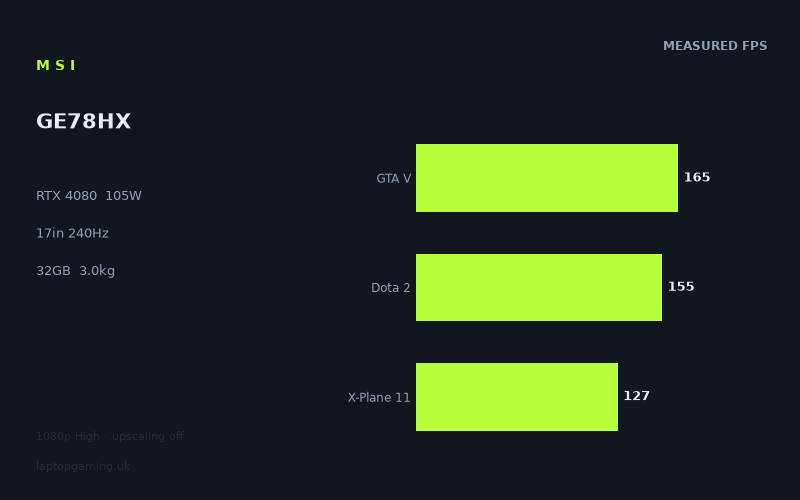
Frame rates
1920×1080, High preset, upscaling off.
Measured on this machine. Source: Notebookcheck, 2023-03-21.
Not scored: incomplete benchmark suite
Every scored laptop on this site is averaged over the same 5 games, and this one is short of Cyberpunk 2077, Baldur's Gate 3. A mean over 3 games is not comparable to a mean over 5, so we publish the figures we have and leave the score blank rather than rank it against machines tested on a different set. The numbers below are real - the suite is just incomplete.
How these numbers were produced
Frame rates here are not measured by us, and we label how each one was arrived at. A figure marked measured comes from a published run on that exact machine. A figure marked representative is derived from the GPU and its power limit (TGP) and cross-referenced against published reviews - a sound estimate of what that configuration delivers, but not a measurement of that specific laptop. Unless stated otherwise, numbers are 1920x1080, High preset, upscaling off. Where a laptop ships in several power configurations we use the wattage of the exact SKU listed, because a 140W RTX 5070 and a 115W one are not the same product.
In use
The short version
The MSI GE78HX is a large, heavy gaming laptop built around a Core i9-13950HX, 32GB of memory and an RTX 4080 limited to 105W. On the available Notebookcheck benchmark data, it is plainly capable of very high frame rates in a number of games, including figures well beyond the screen’s 240Hz refresh rate in The Witcher 3, Strange Brigade and F1 22. It also remains comfortably fast in demanding games such as Cyberpunk 2077 1.6 and Final Fantasy XV, although those results make a more realistic case for high-refresh gaming than for routinely filling every refresh cycle of a 240Hz panel.
The important qualification is the GPU power limit. This is not simply an RTX 4080 laptop in the abstract: it is an RTX 4080 configured at 105W. That matters because the laptop’s performance has to be judged from the measured figures, not from the GPU name alone. The available results show that the GE78HX can produce excellent 1080p High-preset performance, but its shared-game comparisons do not put it clearly ahead of every RTX 4070 rival listed here. Against both the Gigabyte AERO 16 OLED BSF and MSI Stealth 16 Studio, it is effectively level across the games held in common.
That does not make the GE78HX slow. Far from it. Its individual game results are strong, and the machine delivers a mean of 149fps across the available scoring-suite figures for GTA V, Dota 2 and X-Plane 11. The difficulty is that the complete scoring suite is not available. There are no supplied figures for Cyberpunk 2077 or Baldur’s Gate 3 within that suite, so this laptop cannot be ranked fairly against laptops assessed on the full five-game set. A partial average should not be presented as though it were directly comparable with a full average, particularly when the missing games can materially change the overall picture.
The GE78HX therefore makes most sense for somebody who wants a desktop-replacement style machine with a large 17in 2560x1600 display, a 240Hz refresh rate, substantial memory capacity and proven high frame rates in a broad spread of games. It is better suited to a desk, a permanent gaming space or occasional room-to-room movement than to regular commuting. At 3.004kg, portability exists in the literal sense that it can be moved, but it is not the defining reason to choose it.
It is also a machine that should be judged carefully once a UK price is confirmed. No confirmed UK price is available here, so there is no honest way to call it good value, poor value or a bargain. That missing price matters more than usual because the benchmark comparisons are mixed. The GE78HX has a major performance advantage over the RTX 4050-powered Schenker XMG Apex 15, but the very small gaps against the listed RTX 4070 laptops mean that a price premium would need to be justified by factors beyond the shared-game frame-rate data.
Buy this MSI if the appeal is a 17in high-refresh screen, a Core i9-13950HX, 32GB of memory and strong measured gaming performance in a machine intended to spend most of its time near a mains socket. Do not buy it solely because the RTX 4080 badge implies automatic separation from every RTX 4070 laptop. The available shared-game data does not support that conclusion. Equally, do not dismiss it because it does not reach 240fps in every demanding title. A 240Hz panel can still be useful below its maximum refresh rate; the benchmark data simply shows that the panel’s ceiling is realistic for lighter or older games, rather than a target the GE78HX reaches in every modern workload at the stated settings.
Performance
What the measured figures say
Notebookcheck’s figures were measured at 1920x1080, using the High preset with upscaling disabled. Those conditions are important. They give a clean view of the laptop’s performance without an upscaling mode changing the relationship between games, but they are not the same as playing at the laptop’s native 2560x1600 resolution. The GE78HX has a 2560x1600 screen, while the published frame rates are 1920x1080 results. They show what the hardware achieved under the stated benchmark conditions; they should not be relabelled as native-resolution frame rates.
At those settings, the GE78HX’s fastest listed result is 383fps in The Witcher 3. Strange Brigade follows at 267fps, while F1 22 reaches 228fps. These are not marginally high numbers. They show that, in the right games, the combination of the Core i9-13950HX and RTX 4080 at 105W can generate enough performance for very high-refresh play. The Witcher 3 and Strange Brigade exceed the panel’s 240Hz refresh rate under these conditions, and F1 22 comes close to that ceiling at 228fps.
That distinction is worth making because “high-refresh gaming” covers a wide range of outcomes. A result above 240fps means the machine is producing more frames than the screen can display as distinct refreshes at 240Hz. A result close to 240fps, such as F1 22 at 228fps, is still closely aligned with the display’s refresh capability, but it does not quite meet the panel’s maximum refresh rate. These results demonstrate that the 240Hz specification is not wasted in every game. It has a genuine practical relationship with the available benchmark results in at least part of the tested set.
The next group is still strong but less likely to make full use of a 240Hz display at the measured settings. GTA V records 165fps, Dota 2 reaches 155fps and Final Fantasy XV records 148fps. These figures remain comfortably in high-refresh territory. They are materially above a conventional frame-rate target, but they also sit some distance below 240fps. For these games, the screen can display the output smoothly at a high refresh rate, yet the benchmark data does not indicate that the GE78HX is consistently supplying a full 240 frames every second.
Cyberpunk 2077 1.6 reaches 137fps, while X-Plane 11 records 127fps. Again, these are strong numbers in isolation, especially given that upscaling was off. But they also show why a single average, a single GPU label or a single headline result cannot explain the whole laptop. The GE78HX ranges from 127fps in X-Plane 11 to 383fps in The Witcher 3. That is a very broad spread, and it is exactly why prospective buyers need to think about the games they actually play rather than assuming that a 240Hz display will be equally well utilised everywhere.
The available scoring-suite mean is 149fps across GTA V, Dota 2 and X-Plane 11. That is a useful summary of those three games only. It is not a substitute for the missing complete suite, and it should not be treated as a universal performance rating for the laptop. GTA V, Dota 2 and X-Plane 11 are different workloads with different demands. The mean says that the GE78HX is operating at a high frame-rate level across that particular trio, but the individual results remain more useful for deciding whether the machine suits a specific player.
For a GTA V player, 165fps is the relevant figure. For a Dota 2 player, 155fps is the relevant figure. For somebody interested in X-Plane 11, 127fps is the relevant figure. The 149fps mean provides context, but it does not erase the difference between the games. It would be misleading to take the mean and imply that every title will run around that level. The notebook’s own benchmark list disproves that: several games sit substantially above it, while X-Plane 11 sits below it.
The 105W RTX 4080 matters more than the name alone
The GE78HX uses an RTX 4080 with a 105W GPU power limit. That is a concrete part of this laptop’s specification and should be considered alongside the GPU model name. Buyers often compare gaming laptops by GPU tier first, but the published comparisons here underline why that approach is incomplete. The actual measured performance depends on the whole configuration and the conditions of the benchmark, not merely on whether the label says RTX 4050, RTX 4070, RTX 4080 or RTX 4090.
There is no need to speculate about what the GE78HX might do at another power limit. The relevant evidence is what this 105W configuration achieved: 383fps in The Witcher 3, 267fps in Strange Brigade, 228fps in F1 22, 165fps in GTA V, 155fps in Dota 2, 148fps in Final Fantasy XV, 137fps in Cyberpunk 2077 1.6 and 127fps in X-Plane 11. Those are the figures a buyer can attribute to this machine under Notebookcheck’s stated 1920x1080 High-preset, no-upscaling conditions.
The power limit becomes especially significant when comparing the MSI with other machines. The listed MSI Stealth 16 Studio also has an RTX 4070 at 105W. Across the three shared games used for comparison, the GE78HX averages 1fps behind it. That is a near-zero difference and should be read as one. It does not establish a meaningful gaming advantage for either laptop across that limited shared set.
The Gigabyte AERO 16 OLED BSF, another RTX 4070 laptop, produces the same result in the supplied comparison: the GE78HX averages 1fps behind across three shared games. Again, the correct interpretation is not that the MSI is broadly slower in all games, nor that the AERO is categorically the faster laptop. The result is effectively level within this limited shared-game view.
Why can that happen when the GE78HX carries an RTX 4080? The fact sheet provides the key explanation: at 1080p, lighter titles in the shared set can be CPU-bound and compress genuine GPU gaps. That means the GPU is not necessarily the only limiting factor in those games at those settings. Once a game is constrained elsewhere, a larger GPU class does not automatically produce a proportionate lead in the resulting frame rate. The result can be a compressed performance gap, even between machines with different GPU tiers.
This is why the GE78HX should neither be praised nor criticised too aggressively on the basis of the RTX 4070 comparisons alone. The near-level averages are real results, and they matter if those shared games resemble a buyer’s own library. But they are also constrained by the benchmark conditions and the titles in common. The 105W RTX 4080’s actual performance should be understood through the wider results list, not reduced to a simplistic claim that it must either dominate or fail against every RTX 4070 machine.
Which games suit the 240Hz panel?
The most obvious 240Hz matches are The Witcher 3 and Strange Brigade. At 383fps and 267fps respectively, both exceed the screen’s 240Hz refresh rate in the measured 1920x1080 High-preset configuration. A player focused on these games is not buying a 240Hz display that sits entirely beyond the capability of the hardware. The benchmark data indicates that the machine can reach and pass that display limit.
F1 22 at 228fps is a close match rather than a full match. It is near the panel’s maximum refresh rate and clearly belongs in the same high-refresh category, but the measured figure remains below 240fps. That is still a strong outcome, particularly because the benchmark uses High settings and has upscaling disabled. The sensible conclusion is that the GE78HX can drive F1 22 at a very high frame rate under these conditions, without claiming that it fills every available refresh cycle.
GTA V at 165fps, Dota 2 at 155fps and Final Fantasy XV at 148fps are all clearly suited to a fast panel, but they should not be described as 240fps experiences on the evidence available. The difference matters. There is a substantial gap between 148fps and 240fps, even though both are high frame rates. A buyer who wants the highest possible refresh utilisation in a specific game should focus on that game’s individual result, not on the panel specification alone.
Cyberpunk 2077 1.6 at 137fps and X-Plane 11 at 127fps further reinforce the point. These figures are nowhere near poor. They demonstrate that the MSI can deliver well above 100fps in both of these titles at the stated benchmark settings. But they also show the practical limit of treating a 240Hz panel as a promise of 240fps. In more demanding or differently constrained games, the laptop’s measured output is high but materially below the display’s maximum refresh rate.
This is not a defect unique to the GE78HX. It is simply what the benchmark spread says. The screen has a 240Hz refresh rate; the games vary greatly in how many frames the system can produce. The laptop is at its best for somebody who understands that a high-refresh display is a ceiling rather than a guaranteed output level. In games where the hardware reaches that ceiling, the panel has room to show it. In games where the hardware produces 127fps, 137fps, 148fps, 155fps or 165fps, the panel is still a high-refresh display, but its maximum rate is not fully occupied by the measured output.
The benchmark spread is the real story
The difference between 383fps in The Witcher 3 and 127fps in X-Plane 11 is 256fps. That spread is more revealing than any attempt to describe the GE78HX with a single adjective. It demonstrates that game engines, settings, CPU demands and graphics workloads matter enormously. A laptop can be exceptionally quick in one title and merely very quick in another without any contradiction.
The highest results are not a licence to assume that all games will behave like The Witcher 3. The lower results are not evidence that the machine is inadequate. They are evidence that different games impose different limits. The published numbers are particularly useful because they include both very high results and more restrained ones. A review that quoted only 383fps would overstate the consistency of the machine’s performance. A review that quoted only 127fps would miss how much speed the GE78HX can produce in other titles.
There are several practical groups within the data. The Witcher 3, Strange Brigade and F1 22 form the top group, from 228fps to 383fps. GTA V, Dota 2 and Final Fantasy XV form a second high-frame-rate group, from 148fps to 165fps. Cyberpunk 2077 1.6 and X-Plane 11 form a lower but still very capable group at 137fps and 127fps. None of these groupings should be mistaken for native 2560x1600 results, but they are valuable for understanding what the system can do at 1920x1080 High with upscaling off.
For competitive-minded players, this means the GE78HX’s suitability depends heavily on the title. Dota 2 at 155fps is a strong result, but it is not 240fps. F1 22 at 228fps is close to the panel’s limit. Strange Brigade at 267fps and The Witcher 3 at 383fps go beyond it. Someone choosing the laptop specifically for a 240Hz experience should identify which of these patterns most closely resembles their own games rather than assuming that the display’s advertised refresh rate is the delivered frame rate.
For single-player players, the benchmark results look reassuringly broad. Final Fantasy XV at 148fps and Cyberpunk 2077 1.6 at 137fps indicate high measured output in games that are not at the top of the list. The caveat remains resolution. The GE78HX’s panel is 2560x1600, and the figures are 1920x1080 measurements. The data supports confidence in 1080p High-preset performance without upscaling. It does not provide a specific native-resolution number, so no reviewer should invent one.
The same restraint applies to any discussion of alternate presets, ray tracing, frame generation or upscaling. The supplied data is for High settings with upscaling off. There are no figures here for other graphics modes. It would be easy to speculate that a different setting could alter the balance between image quality and frame rate, but speculation is not a substitute for attributable results. The useful buying conclusion is narrower and more reliable: at the measured settings, the GE78HX is often very fast, sometimes fast enough to exceed 240fps, and not universally capable of doing so.
What is missing from the performance picture
The benchmark data is substantial enough to form a useful view of gaming performance, but it is not complete in every respect. The scoring suite is incomplete because figures are not available for Cyberpunk 2077 and Baldur’s Gate 3 within that suite. Every scored laptop is averaged over the same five games, so a machine with results from only part of that set cannot be ranked fairly against laptops with complete data. This MSI should therefore not be assigned a ranking from the partial information.
That does not make the available 149fps mean worthless. It is a valid mean across GTA V, Dota 2 and X-Plane 11. What it cannot do is answer a broader question that requires the missing games. A partial suite may be flattering or unflattering depending on which titles are absent. The honest approach is to use the individual measured results and the three-game mean for what they are, while declining to turn them into a full-suite comparison.
There are also no supplied figures for battery life, temperatures or noise. The laptop has a 99Wh battery, but battery capacity alone is not a measured battery-life result. It would be wrong to convert that capacity into an estimated runtime. Likewise, the 3.004kg weight tells us a lot about portability, but it tells us nothing reliable about operating noise or thermals. Buyers for whom quiet operation, low surface temperatures or long unplugged use are decisive should seek measured information on those points before committing.
The screen
The GE78HX has a 17in IPS screen with a 2560x1600 resolution and a 240Hz refresh rate. On paper, that is a display specification aimed at a machine intended to do more than merely reach a conventional frame-rate target. The large panel and high refresh ceiling make sense beside a system that can record 383fps in The Witcher 3, 267fps in Strange Brigade and 228fps in F1 22 at 1920x1080 High with upscaling disabled.
The critical detail is the difference between the panel’s native resolution and the benchmark resolution. This display is 2560x1600, but the available gaming figures are at 1920x1080. The benchmark data therefore tells us that the machine is quick at 1080p under the stated settings. It does not quantify performance at 2560x1600. Buyers should not read the 1080p numbers as a promise of identical frame rates at the panel’s native resolution.
This matters particularly for a 240Hz screen. At 1920x1080, several games can reach or approach the panel’s maximum refresh rate. At the native 2560x1600 resolution, no measured figures have been supplied, so the extent to which those games would continue to do so is unknown here. A buyer interested in native-resolution gaming should treat the benchmark results as evidence of underlying performance, not as direct native-panel measurements.
The panel’s 240Hz refresh rate is most clearly justified by the games at the top of the benchmark list. The Witcher 3 exceeds 240fps by a large margin. Strange Brigade also exceeds it. F1 22 lands close at 228fps. These outcomes show a meaningful relationship between the hardware and the screen specification, rather than a display chosen solely for a marketing headline.
At the same time, the display should not be oversold. GTA V at 165fps, Dota 2 at 155fps, Final Fantasy XV at 148fps, Cyberpunk 2077 1.6 at 137fps and X-Plane 11 at 127fps all sit below 240fps. They remain high frame rates, but the maximum refresh rate is not synonymous with the frame rate the laptop produces. The GE78HX offers a high ceiling; whether it reaches that ceiling depends on the game and the settings.
The IPS panel type is specified, but no other display measurements are provided. There are no supplied figures for brightness, contrast, colour coverage, response behaviour or outdoor visibility. It would be inappropriate to claim that the screen is especially bright, colour-accurate, fast in pixel response or suited to colour-critical work without those measurements. The reliable specification case is simply that this is a 17in IPS panel at 2560x1600 and 240Hz.
That still gives a clear audience. Players who want a physically large gaming display and value high refresh rates have a plausible reason to consider the GE78HX. Players who primarily want the highest possible native-resolution frame rate need to recognise the evidence gap: the published figures are not native-resolution results. The laptop may still be appropriate, but the review should not replace absent measurements with assumption.
Build, size and portability
The MSI GE78HX weighs 3.004kg. That is the figure that should shape expectations. This is not a lightweight gaming laptop, and it should not be bought on the assumption that it will disappear into a daily routine of frequent travel. It can be transported, but it is better understood as a substantial machine intended for a stable place to play and work.
The 17in screen supports that interpretation. A larger panel is useful for somebody who wants the laptop itself to be the main display rather than a secondary screen beside an external monitor. Combined with the 2560x1600 resolution and 240Hz refresh rate, it gives the GE78HX the profile of a gaming-focused desktop replacement. The 3.004kg weight is consistent with that role: this is a machine to set down and use for extended sessions, not one chosen primarily to minimise bag weight.
No dimensions are supplied, so there is no basis for claiming how much desk space it occupies, how easily it fits into a particular bag or whether it is unusually thin or thick for its class. The weight alone is enough to make the broader point. At 3.004kg, this MSI is likely to be a deliberate carry rather than an effortless one. A buyer who takes a laptop between home, university, work and travel locations should decide whether the larger screen and gaming hardware are worth that physical commitment.
The 99Wh battery is a substantial capacity figure, but it is not a battery-life measurement. There are no published runtime figures in the supplied data, either for light use or gaming. It would be especially unwise to imply that a 99Wh battery makes the GE78HX a long-lasting portable gaming machine. Gaming battery life is not provided, and neither is general-use battery life. The safe conclusion is only that the laptop has a 99Wh battery.
The same lack of evidence applies to thermal and acoustic behaviour. A 105W RTX 4080 and Core i9-13950HX describe a powerful hardware combination, but no temperature or noise measurements are included here. A buyer sensitive to fan noise, a buyer who expects prolonged heavy use, or a buyer who needs low heat output in a quiet shared environment should not infer those qualities from the specification alone. Those questions need actual measured thermal and acoustic data.
There is also no supplied information about keyboard layout, ports, webcam, storage capacity, chassis materials or upgrade access. None of those omissions should be filled with generic assumptions about a gaming laptop of this size. The available evidence supports a focused portability judgement: the GE78HX is a 3.004kg, 17in machine with a 99Wh battery, and that makes it a more natural desk-based choice than a travel-first choice.
How it compares
Against the Schenker XMG Apex 15
The Schenker XMG Apex 15 (Late 23) uses an RTX 4050 at 140W. Across six shared games, the MSI GE78HX averages 84fps ahead. This is the clearest and largest positive comparison in the supplied rival set. It is not a marginal advantage, and it is not dependent on a single shared title: the figure is an average across six games.
For a buyer deciding between these two machines primarily on gaming speed, the GE78HX has the stronger published case. An 84fps average lead across six shared games is a substantial difference in measured output. It fits the broader impression from the MSI’s own results: this machine can deliver very high frame rates in several titles and retains high results even in the lower part of its benchmark list.
There is no confirmed UK price for the Schenker, just as there is no confirmed UK price for the GE78HX. That prevents a proper value judgement between them. The performance evidence favours the MSI decisively, but performance is not the same thing as value when the prices are unknown. If the eventual price gap is large, the purchasing conclusion could become more complicated. If the prices are close, the MSI’s shared-game lead would be much easier to justify. Without confirmed UK prices, the review should stop at the performance comparison.
Against the Gigabyte AERO 16 OLED BSF
The Gigabyte AERO 16 OLED BSF uses an RTX 4070. Across three shared games, the GE78HX averages 1fps behind. This is a near-zero difference. It should not be presented as a meaningful defeat for the MSI, nor as evidence that the Gigabyte is categorically faster.
The explanation supplied with the comparison is important: at 1080p, lighter titles in the shared set can be CPU-bound and compress genuine GPU gaps. In other words, the shared results may not expose the full effect of the different GPU classes because the games and settings can move the performance limit away from the GPU. A 1fps average gap across three games is therefore a real result, but it is not a strong basis for claiming that the AERO has a practical gaming advantage.
For a buyer, this comparison means the GE78HX should not command an unquestioned premium merely because it has an RTX 4080 label. Its own benchmark list is strong, but the shared-game evidence against the AERO is effectively level. Other factors would need to decide the choice, and the supplied facts do not provide enough information about the Gigabyte’s display behaviour, portability, battery life, noise, temperature or price to settle those factors here.
Against the MSI Stealth 16 Studio
The MSI Stealth 16 Studio uses an RTX 4070 at 105W. Against this machine, the GE78HX also averages 1fps behind across three shared games. The result mirrors the Gigabyte comparison: effectively level within the available shared-game data.
This is a particularly useful comparison because the two MSI machines are both part of the same broad brand family, yet they should not be separated purely by the RTX 4080 versus RTX 4070 naming. The GE78HX has a 17in screen, weighs 3.004kg and uses an RTX 4080 at 105W. The Stealth’s supplied comparison result nevertheless shows no meaningful shared-game advantage for the GE78HX at 1080p in the three titles available.
The sensible reading is not that the RTX 4080 is irrelevant. The GE78HX’s own figures still include 383fps, 267fps and 228fps in its fastest listed games. Rather, it is that the available shared set does not demonstrate a meaningful advantage. Buyers comparing these models should focus on their own game library, the display format they want and their tolerance for a 3.004kg 17in machine. The frame-rate comparison alone does not create clear separation in favour of the GE78HX.
Against the Asus ROG Strix Scar 17
The Asus ROG Strix Scar 17 uses an RTX 4090 at 25W. Across three shared games, the GE78HX averages 50fps behind. This is the largest negative comparison in the listed set and is large enough that it should not be dismissed as a quirk of a near-level result.
The Scar 17 therefore has the stronger shared-game performance case in the supplied data. A 50fps average lead across three shared games is materially different from the 1fps gaps seen against the Gigabyte and MSI RTX 4070 rivals. It suggests that, within this particular comparison, the GE78HX is not at the top of the group.
That does not invalidate the GE78HX’s results. The MSI remains very fast in its own benchmark list, and the comparison covers only three shared games. But if a buyer’s priority is extracting the highest measured performance among these named rivals, the Asus has the better evidence in the shared set. There is no confirmed UK price for the Scar 17, so there is still no complete value conclusion. The performance lead is clear; the price relationship is not known.
What the rival spread actually tells us
The four rival comparisons are more useful together than separately. The GE78HX is 84fps ahead of the RTX 4050 Schenker across six shared games. It is effectively level with the RTX 4070 Gigabyte and MSI rivals across three shared games, each by a 1fps deficit. It is 50fps behind the RTX 4090 Asus across three shared games.
This is a genuine spread rather than a simple ladder in which every GPU name predicts every outcome. The MSI has a major advantage over one rival, no meaningful shared-game separation against two others, and a substantial deficit against another. That is why the 105W power limit and the benchmark conditions matter. The published data supports an opinionated conclusion: the GE78HX is a strong-performing laptop, but its RTX 4080 name alone does not guarantee that it will be the obvious winner against every lower-labelled machine in 1080p shared-game comparisons.
The lighter, potentially CPU-bound titles at 1080p are central to interpreting the near-zero gaps. They compress genuine GPU differences. Buyers who play the same kinds of titles should take those near-level results seriously, because they reflect the conditions they may actually encounter. Buyers who play different games, use different settings or focus on the 2560x1600 panel should avoid treating those three-game comparisons as universal proof of equivalent performance.
The complete scoring issue adds another reason for caution. The GE78HX cannot be ranked fairly in the standard scoring framework because its suite is incomplete. There are no supplied scoring-suite figures for Cyberpunk 2077 and Baldur’s Gate 3, while scored laptops are averaged over the same five games. The correct outcome is not to force a ranking from partial data. It is to use the attributable figures that exist and be explicit about what they cannot establish.
Who it’s for
The MSI GE78HX is for the buyer who wants a large-screen gaming machine and has a realistic understanding of what that means. The 17in 2560x1600 IPS panel, 240Hz refresh rate, Core i9-13950HX, 32GB of memory and RTX 4080 at 105W create a specification aimed at high-performance desk-based use. The 3.004kg weight makes that role more convincing than any claim of frequent-travel convenience.
It is especially suitable for somebody whose game library includes titles where the published results are strongest. The Witcher 3 at 383fps and Strange Brigade at 267fps exceed the display’s 240Hz refresh rate at the measured settings. F1 22 at 228fps is close enough to make the high-refresh panel feel purposeful. Players who value high frame rates in these types of games have concrete benchmark evidence for the MSI.
It also suits players who are happy with very high frame rates that do not necessarily reach 240fps. GTA V at 165fps, Dota 2 at 155fps, Final Fantasy XV at 148fps, Cyberpunk 2077 1.6 at 137fps and X-Plane 11 at 127fps show that the GE78HX can remain fast across a varied set of games. A buyer does not need every title to hit 240fps for a 240Hz panel to have value, but they should buy with clear expectations about where the ceiling is likely to be reached.
The 32GB memory specification may also appeal to buyers who want more than the minimum memory capacity in a gaming laptop, though no productivity benchmarks are provided here. It is fair to say that the machine includes 32GB of memory. It is not fair to claim a specific advantage in a particular creation, streaming or professional workload without measured data for that workload.
The GE78HX is also for buyers who can wait for a confirmed UK price before deciding. With no price available, there is no reliable value verdict. That is not a minor omission. The laptop’s comparison position makes price particularly important. It has a compelling measured advantage over the Schenker XMG Apex 15, but it is effectively tied with the named RTX 4070 machines in the limited shared-game comparisons. If it is priced aggressively, its large screen and strong individual results could be persuasive. If it carries a significant premium, the lack of a clear shared-game lead over those RTX 4070 rivals would deserve close scrutiny.
It is not for somebody whose first requirement is low carry weight. At 3.004kg, this is not the sensible choice for a buyer who walks long distances with a laptop every day, travels constantly or wants a machine that can be used as casually as a smaller system. The 17in panel and high-performance specification may be worthwhile, but they come with a physical size-and-weight commitment that should be acknowledged before purchase.
It is not for somebody who needs confirmed battery endurance before buying. The 99Wh capacity is known, but no battery-life measurement is supplied. A buyer who needs dependable unplugged use should not make a decision from capacity alone. The same applies to buyers who need known noise or temperature behaviour: those results are not available here.
It is not for somebody who expects native 2560x1600 frame rates to match the published 1920x1080 figures. The benchmark data is useful and attributable, but it is explicitly measured at 1920x1080 with the High preset and upscaling off. The GE78HX may still be the right machine for native-resolution gaming, but the supplied figures do not quantify that use case.
It is also not the automatic choice for somebody comparing it directly with the Asus ROG Strix Scar 17 on raw shared-game performance. The Asus is 50fps ahead on average across three shared games. Conversely, it is difficult to justify choosing the GE78HX purely to gain a measurable shared-game advantage over the Gigabyte AERO 16 OLED BSF or MSI Stealth 16 Studio, because the MSI is 1fps behind each across their three shared games. Those are effectively level results, and other factors would need to decide the purchase.
The fairest conclusion is that the MSI GE78HX is a powerful but not uncomplicated gaming laptop. It has outstanding measured results in some titles, high results across the whole supplied list, a screen specification that makes sense for its fastest games, and a weight that firmly places it in the desktop-replacement category. Its RTX 4080 at 105W should be assessed as this specific configuration, not as a guarantee of universal dominance. The missing UK price and incomplete scoring suite prevent a definitive value or ranking judgement, but the attributable benchmark data is still sufficient to identify the right buyer: someone who wants a large, fast gaming machine, plays near the strengths shown in the published results, and does not need it to be a lightweight everyday travel companion.