Review
Asus ROG Zephyrus S17 review
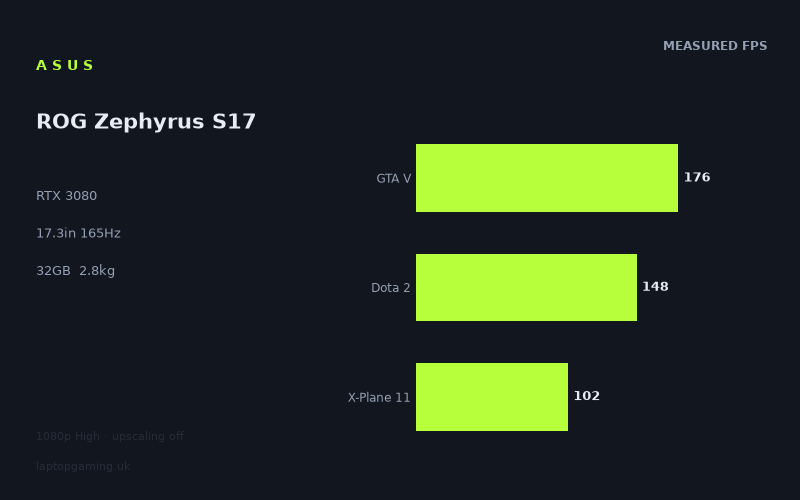
Frame rates
1920×1080, High preset, upscaling off.
Measured on this machine. Source: Notebookcheck, 2021-07-16.
Not scored: incomplete benchmark suite
Every scored laptop on this site is averaged over the same 5 games, and this one is short of Cyberpunk 2077, Baldur's Gate 3. A mean over 4 games is not comparable to a mean over 5, so we publish the figures we have and leave the score blank rather than rank it against machines tested on a different set. The numbers below are real - the suite is just incomplete.
How these numbers were produced
Frame rates here are not measured by us, and we label how each one was arrived at. A figure marked measured comes from a published run on that exact machine. A figure marked representative is derived from the GPU and its power limit (TGP) and cross-referenced against published reviews - a sound estimate of what that configuration delivers, but not a measurement of that specific laptop. Unless stated otherwise, numbers are 1920x1080, High preset, upscaling off. Where a laptop ships in several power configurations we use the wattage of the exact SKU listed, because a 140W RTX 5070 and a 115W one are not the same product.
In use
The short version
The Asus ROG Zephyrus S17 GX703HSD is a high-end gaming laptop built around an RTX 3080, Core i9-11900H, 32GB of memory, a 2TB SSD and a large 17.3in IPS display with a 2560x1440 resolution and 165Hz refresh rate. On paper, that is an ambitious combination: a sizeable high-resolution screen, a fast refresh target and hardware that was positioned firmly at the premium end of its generation.
The published benchmark data shows that it can be very fast at 1920x1080 on the High preset with upscaling disabled. Notebookcheck’s measured figures range from 102fps in X-Plane 11 to 210fps in Strange Brigade. That is a substantial spread, but it is also useful. It shows that the Zephyrus S17 is not simply a machine that produces one headline number; it is capable of very high frame rates in lighter or better-scaling games, while more demanding titles and simulation-style workloads sit well below the screen’s 165Hz ceiling.
The important limitation is that the available figures are not native-resolution results. They were recorded at 1920x1080, whereas the fitted panel is 2560x1440. The published numbers therefore establish that the laptop has strong Full HD performance, but they do not prove that every game will maintain the same frame rate at the display’s native resolution. Anyone buying this model specifically because of its 2560x1440 screen should treat the benchmark data as a useful baseline rather than a native-resolution guarantee.
There is also no confirmed UK price for this configuration. That means it would be irresponsible to make a value judgement from the specification and frame rates alone. A machine with these components may be attractive, acceptable or poor value depending on its actual selling price, and that price has not been confirmed here. The Zephyrus S17 can be judged on performance, screen specification, capacity and weight, but not honestly on pounds-per-frame.
For the right buyer, it remains a compelling sort of laptop. It suits someone who wants a large 17.3in display, substantial memory and storage, and strong 1080p gaming performance from an RTX 3080-class system. It is particularly sensible for someone who values a large panel for games where high frame rate matters, but who is also willing to adjust resolution or settings when a game proves more demanding than the lighter titles in the benchmark set.
It is less suitable for a buyer who expects the 165Hz display to be fully saturated in every modern game without compromise. The figures do not support that expectation. They show that the panel can be exceeded in some titles, approached in others and missed by a meaningful margin in several. It is also not the right machine for someone whose priority is low carry weight: 2.765kg is substantial before considering any charger or other equipment, although no charger weight is provided here.
There is no overall rating for this Zephyrus S17 because the scoring suite is incomplete. We do not have a figure for Final Fantasy XV. Every scored laptop is averaged over the same five games, so a partial set cannot be ranked fairly against machines with complete results. That is not a small technicality. A ranking built from an incomplete suite could flatter or punish this laptop depending on the missing game, so the sensible approach is to stick to the measured results that are available.
Performance
What the available benchmark data says
Notebookcheck measured the Asus ROG Zephyrus S17 at 1920x1080 using the High preset with upscaling disabled. That last point matters. These are not figures assisted by an upscaling mode, and they are not results from a lower detail preset. They show the system’s performance under a defined Full HD High workload, which makes the differences between games more revealing than a single average would be.
Across the four scoring-suite games with results available, the mean is 159fps. The individual figures are 210fps in Strange Brigade, 176fps in GTA V, 148fps in Dota 2 and 102fps in X-Plane 11. The non-scoring results add further context: The Witcher 3 runs at 197fps, Shadow of the Tomb Raider at 138fps and Far Cry 5 at 134fps.
That selection immediately tells us that the Zephyrus S17 is capable of extremely high performance, but it also warns against treating an RTX 3080 badge as a promise of a fixed level of frame rate. Strange Brigade at 210fps and The Witcher 3 at 197fps are both comfortably beyond the panel’s 165Hz refresh rate at the tested settings and resolution. GTA V at 176fps is also above that refresh ceiling. In those games, at 1920x1080 High with upscaling off, the laptop has enough performance to deliver more frames than the display can refresh each second.
Dota 2 is close but below the display’s 165Hz maximum at 148fps. That remains a high frame rate, and it is close enough to the panel’s target to make the 165Hz display relevant rather than excessive. It does not, however, reach the panel maximum in the published run. If a buyer’s aim is to see a full 165fps in that game under the exact tested conditions, the measured figure does not show that outcome.
Shadow of the Tomb Raider at 138fps and Far Cry 5 at 134fps sit in a similar category. Both are clearly fast results, both are well beyond ordinary low-refresh gaming targets, and both would benefit from a high-refresh display. But neither reaches 165fps in the available measurements. They demonstrate smooth-looking high-frame-rate territory rather than a locked match for the panel’s full refresh capability.
X-Plane 11 is the clearest reminder that game engine and workload matter. Its 102fps result is far lower than Strange Brigade’s 210fps despite the same laptop, tested resolution and stated High preset. It is still a three-figure frame rate, but it is nowhere near the 165Hz panel maximum. The spread between those two games is not evidence that one of the results is wrong; it is evidence that the S17’s experience varies sharply by title.
This is why the mean of 159fps should be read carefully. It is a useful summary of the four scoring-suite games, but it is not the frame rate to expect in every game. It sits close to the 165Hz panel refresh rate, which could tempt a reader into assuming the display is essentially matched by the hardware. The individual results show a more nuanced reality. Some games clear 165fps, some come close and some remain well below it.
The benchmark spread matters more than a headline average
The fastest published result is Strange Brigade at 210fps. The Witcher 3 follows at 197fps, then GTA V at 176fps. Those numbers establish the upper end of what the laptop can do in the measured set. If the games a buyer plays behave more like those titles under comparable settings, the Zephyrus S17 can make a 165Hz panel feel justified at 1920x1080.
The middle of the spread is represented by Dota 2 at 148fps, Shadow of the Tomb Raider at 138fps and Far Cry 5 at 134fps. This is still strong performance, but it is a different proposition from the fastest results. A screen refreshing at 165Hz is not wasted at these frame rates, yet it has more headroom than the laptop is using in the published tests. The display remains useful because the measured performance is high, but the benchmark data does not show a consistent full-refresh result.
X-Plane 11 at 102fps occupies the lower end of the available set. That figure is important precisely because it prevents an overly simple conclusion. This is not a laptop that should be described as a universal 165fps machine from the data available. It is a laptop that can be exceptionally quick in some titles and clearly less likely to reach the screen maximum in others.
The practical lesson is straightforward. Buyers should think about the games they actually play, rather than buying solely on the basis of the fastest figure. Someone focused on titles that resemble Strange Brigade, The Witcher 3 or GTA V in the measured set has evidence of excellent Full HD performance. Someone focused on titles that resemble X-Plane 11 should expect strong performance, but should not buy on the assumption that the 165Hz screen will be fully fed at the tested settings.
This matters especially for a machine with a large 2560x1440 display. A high-resolution screen makes it tempting to push games at native resolution, yet the published figures were obtained at 1920x1080. We do not have measured frame rates for 2560x1440, so there is no attributable basis for saying which of these games will reach 165fps at native resolution. The only safe conclusion is that moving from the tested 1920x1080 setting to the display’s 2560x1440 resolution is a different workload, and the data supplied does not quantify the resulting performance.
The RTX 3080 needs to be judged as configured, not merely by name
The Zephyrus S17 uses an RTX 3080, but the fact sheet does not state the GPU power limit for this particular configuration. That missing detail matters because a laptop GPU name alone does not fully describe how a system is configured. Laptop implementations can differ in the power available to the GPU, and the power limit is therefore relevant when comparing machines carrying similar graphics names.
Because no power limit is confirmed for this Zephyrus S17, there is no basis for assigning a wattage to it or for claiming that its RTX 3080 is configured at a particular level. The sensible way to assess it is through the attributed benchmark data rather than assumptions based on the badge. Notebookcheck’s figures show the outcome in the games measured: this is a fast laptop at 1920x1080 High, but its performance is title-dependent and not universally enough to hit 165fps.
The rival results reinforce the importance of looking beyond the GPU label. The S17 is level with the MSI Stealth GS77, which uses an RTX 3080 Ti at 105W, across the four shared games. It is also effectively level with the Aorus 17X XES, which uses an RTX 3070 Ti, across four shared games. Meanwhile, the Asus ROG Strix Scar 17 SE, with an RTX 3080 Ti at 150W, is ahead across four shared games. Those outcomes are more useful than assuming that every RTX 3080 Ti must automatically sit above every RTX 3080, or that an RTX 3070 Ti must necessarily sit below it.
The supplied comparison notes also explain why some of these gaps compress. At 1920x1080, lighter titles in the shared set can become CPU-bound. When that happens, genuine GPU differences may not appear as large in the final frame-rate comparison. This is particularly relevant to the near-zero differences against the MSI Stealth GS77 and Aorus 17X XES. A near-zero shared-game result is real, but it should not be treated as proof that the underlying graphics hardware is identical in every circumstance. The lighter 1080p workloads can reduce the visible separation.
That is another reason not to overread the 159fps mean. It is a useful result for the stated suite, but it is not a universal measure of the RTX 3080’s potential at every resolution, in every game or against every GPU configuration. It describes the Zephyrus S17 under one defined Full HD test setup and in a limited collection of games. That is valuable evidence, provided it is kept within those limits.
High-refresh gaming in practice
The 165Hz panel sets a demanding target. To make full use of it, a game needs to deliver frame rates at or above 165fps. In the measured set, Strange Brigade, The Witcher 3 and GTA V clear that threshold at 1920x1080 High with upscaling disabled. These are the clearest examples of the Zephyrus S17 being able to drive the fitted display at its maximum refresh rate under the benchmark conditions.
Dota 2, Shadow of the Tomb Raider and Far Cry 5 all fall below 165fps in the published results. That does not make them poor results. Their figures are still high, and a 165Hz panel can still be beneficial below its maximum. But the data does not support calling them full-refresh outcomes.
X-Plane 11 makes the distinction even clearer. At 102fps, it is well below the panel maximum but still in a performance range that can feel responsive. The key is expectation-setting: the 165Hz display does not transform a 102fps result into 165fps. The screen provides the capacity for very high refresh, while the game and hardware combination determines how much of that capacity is used.
For buyers who are willing to change settings, resolution or use upscaling where a game supports it, the S17 may offer additional routes to higher frame rates. However, no such altered results are supplied here. The available figures were recorded on High with upscaling off, and they should not be converted into claims about other presets or modes. The measured data establishes a solid Full HD High baseline, not a catalogue of optimisation outcomes.
That restraint is especially important because the laptop’s native panel resolution is higher than the test resolution. A buyer who uses 1920x1080 can point to directly attributable results. A buyer who intends to use 2560x1440 will need to accept that the published data does not confirm their expected frame rate. The machine may still be suitable, but the decision should be based on the understanding that native-resolution performance is unmeasured here.
The screen
A large 17.3in IPS panel with a demanding resolution and refresh target
The Zephyrus S17 has a 17.3in IPS display with a 2560x1440 resolution and 165Hz refresh rate. That specification is central to its appeal. A 17.3in screen provides a larger viewing area than smaller gaming laptops, while 2560x1440 gives it a higher-resolution target than the 1920x1080 benchmark setting. The 165Hz refresh rate is also properly high rather than merely conventional, making smooth motion a realistic goal in games where the system can generate enough frames.
The IPS panel type is confirmed, but no measurements for brightness, contrast, colour coverage, response behaviour or other display characteristics are provided. As a result, it would be wrong to claim that this is an exceptional IPS panel, a colour-critical panel or a particularly fast panel beyond its stated 165Hz refresh rate. The specification tells us the size, resolution, refresh rate and panel technology. It does not provide the rest of the picture-quality evidence.
For gaming, the most important relationship is between the panel’s 165Hz refresh rate and the measured frame rates. The laptop’s fastest published results exceed the screen refresh limit at 1920x1080. Strange Brigade reaches 210fps, The Witcher 3 reaches 197fps and GTA V reaches 176fps. In those games and under those test conditions, the GPU and CPU combination has enough performance to keep the panel supplied at its stated maximum refresh rate.
The other measured results show why the high refresh rate should be viewed as headroom, not as a promise. Dota 2 reaches 148fps, Shadow of the Tomb Raider 138fps, Far Cry 5 134fps and X-Plane 11 102fps. Those are all below 165fps. They are not weak results, but they make clear that a 165Hz panel is more of an upper limit than a frame-rate guarantee.
The benchmark resolution is not the panel resolution
The most important caveat about the display is that Notebookcheck’s figures were measured at 1920x1080, while the panel is 2560x1440. This means the published benchmark results are not direct evidence of how the laptop performs at the resolution the screen is designed to display natively.
That does not undermine the benchmark data. It simply defines what it can tell us. At 1920x1080 High with upscaling off, the S17 can deliver frame rates from 102fps to 210fps across the games listed. At 2560x1440, no attributed figures are available. A buyer who prefers the highest possible frame rate may find the Full HD results particularly relevant. A buyer who prioritises native 2560x1440 detail needs to recognise that this review cannot attach a measured frame rate to that use case.
There is a genuine trade-off in the specification. The 2560x1440 panel gives the laptop a higher-resolution display target, while the 165Hz refresh rate gives it a high frame-rate target. The benchmark data demonstrates that the Zephyrus S17 can satisfy the refresh target in selected games at 1920x1080. It does not demonstrate that it can satisfy both the native-resolution target and the full-refresh target in every game.
That makes the screen best suited to a buyer who values flexibility. In games where frame rate matters most, the available Full HD figures show that the machine can be exceptionally quick. In games where display resolution matters more, the native 2560x1440 option is present, but the performance consequences are not measured in the supplied data. The screen specification is strong; the uncertainty lies in native-resolution gaming performance, not in the existence of the panel features themselves.
Who will get the most from this display
The display makes the most sense for someone who plays a mixture of games rather than expecting one fixed performance profile. The high-refresh side is well supported by the fastest measured titles. Strange Brigade, The Witcher 3 and GTA V all show frame rates above 165fps at the test settings. The large 17.3in screen also gives those fast-moving games a substantial display area.
It also suits someone who understands that 165Hz does not become irrelevant when a game runs below 165fps. The results of 148fps, 138fps, 134fps and 102fps remain materially different from a low-frame-rate experience. But the buyer should be comfortable with the idea that some games will use more of the display’s refresh capacity than others.
It is less ideal for someone who wants a simple claim that every game runs at native 2560x1440 and 165fps. The data does not provide that claim, and the published Full HD results themselves show enough variation to make such a promise implausible as a general statement. The honest position is that the screen has impressive specifications and the system can drive it fully in some measured Full HD games, while native-resolution outcomes remain unconfirmed.
Build, size and portability
Weight is the firm portability fact
The Asus ROG Zephyrus S17 weighs 2.765kg. That places it firmly in the substantial-laptop category from a practical carrying perspective. It is not a machine to think of as effortless to carry around all day, particularly for someone already transporting a charger, peripherals or other work equipment. No charger weight is supplied, so the total travel load cannot be calculated, but the laptop alone is already a meaningful item in a bag.
The 17.3in display helps explain the intended role. This is a large-screen gaming laptop designed around a big IPS panel, a high-resolution display target and high-refresh gaming. Its strengths point towards a machine that works well as a powerful main system, a desk-based gaming laptop or a transportable performance machine rather than something chosen primarily for minimal weight.
That does not mean it cannot travel. The stated 2.765kg weight does not prevent portability; it defines the kind of portability on offer. Moving it between rooms, taking it to a fixed location or carrying it occasionally is a different proposition from routinely travelling with the lightest possible computer. Buyers should decide which of those use cases applies to them before being swayed by the RTX 3080 and 17.3in screen.
No chassis dimensions are provided in the fact sheet. Without length, width and thickness measurements, there is no attributable basis for judging how much desk space it occupies, how easily it fits into a particular bag or how slim it is. The weight provides a useful portability indicator, but it does not tell the whole physical-size story.
Battery capacity is known; battery life is not
The Zephyrus S17 has a 90Wh battery. That is the confirmed battery-capacity specification. No measured battery-life result is supplied, so this review cannot say how long it lasts in games, video playback, web use, idle use or any other workload.
This is especially important for a system with a 17.3in 2560x1440 display, a Core i9-11900H and an RTX 3080. Those components describe a high-performance laptop, but the fact sheet does not quantify battery endurance. Buyers who need a specific amount of time away from mains power should seek an attributable battery-life test rather than treating the 90Wh capacity as a runtime claim.
For gaming decisions, the battery capacity should therefore be considered a specification rather than an outcome. It tells us the installed battery size. It does not tell us how much gaming time, productivity time or travel time the machine delivers. No runtime should be inferred or invented from the capacity figure.
Memory and storage are generous, but not a substitute for measured performance context
The S17 is specified with 32GB of memory and a 2TB SSD. Those are substantial capacities for a gaming laptop and fit the machine’s high-end positioning. The available benchmark data does not isolate the impact of the memory or storage, so they should not be credited with a specific number of frames per second. Their importance here is practical rather than directly benchmarked: they are part of a configuration intended to handle demanding use without requiring the buyer to begin from a minimal memory or storage allocation.
There are no supplied measurements for SSD speed, memory speed, upgradeability, cooling behaviour, fan noise, keyboard quality, port selection, webcam quality or chassis materials. Those omissions matter because they affect the ownership experience, but it would be misleading to fill the gaps with assumption. The facts available support a judgement on gaming performance, display specification, core hardware capacity and weight. They do not support claims about acoustics, temperatures or physical finish.
How it compares
Against the MSI Prestige 15
The largest positive gap in the listed comparison group is against the MSI Prestige 15, which has an RTX 3050 Ti at 105W. Across three shared games, the Zephyrus S17 averages 78fps more. That is a substantial advantage and the clearest evidence in the comparison set that the S17 occupies a significantly higher gaming-performance tier than a lower-positioned RTX 3050 Ti machine in the games both systems hold.
The comparison is limited to three shared games, so it should not be expanded into a claim about every title. Even so, an average advantage of 78fps is large enough to be meaningful rather than a measurement quirk. For a buyer deciding between a machine like the Prestige 15 and the Zephyrus S17 primarily for gaming, the S17 has a strong published advantage in the overlapping benchmark data.
There is no confirmed UK price for the MSI Prestige 15, just as there is no confirmed UK price for this Zephyrus S17. That means the comparison can establish a performance gap, but not whether the S17 is worth any particular premium. It is faster in the shared games by the stated average; whether that performance is worth the price difference cannot be answered without actual UK pricing.
Against the MSI Stealth GS77
The MSI Stealth GS77 uses an RTX 3080 Ti at 105W. Across four shared games, the Zephyrus S17 averages +0fps against it. In other words, the shared-game result is effectively level.
That outcome is worth explaining rather than treating as a contradiction. The S17 has an RTX 3080, while the Stealth GS77 has an RTX 3080 Ti at 105W. It would be easy to assume that the RTX 3080 Ti name alone settles the comparison, but the published shared-game data does not show a meaningful average separation in this particular set.
The supplied comparison notes explain one reason why this can happen: at 1920x1080, lighter titles in the shared set can be CPU-bound and compress genuine GPU gaps. When games are limited more by the processor or other parts of the workload than by graphics throughput, a stronger GPU does not necessarily create a proportionally higher frame rate. That does not erase hardware differences; it means the differences may not be visible in the measured 1080p shared-game average.
The useful buying conclusion is that the Zephyrus S17 should not be dismissed simply because another machine carries an RTX 3080 Ti. In the four games both machines hold, the supplied data says they are effectively tied. Equally, the tie should not be used to claim that the two laptops will be identical at every resolution, setting or game. The result is real, but it is constrained by the shared titles and the 1920x1080 test context.
Against the Aorus 17X XES
The Aorus 17X XES uses an RTX 3070 Ti. Across four shared games, the Zephyrus S17 averages -0fps against it. That is another effectively level result. The minus sign does not indicate a meaningful defeat; the supplied comparison identifies this as a near-zero difference.
This is a useful reminder that GPU hierarchy cannot be reduced to product names alone. An RTX 3080 laptop and an RTX 3070 Ti laptop can produce near-identical results across a particular set of Full HD games. The shared result does not mean the hardware is interchangeable in all respects. It means that in these four overlapping benchmarks, neither machine establishes a useful average advantage.
Again, the explanation supplied is that lighter titles at 1920x1080 can be CPU-bound, compressing GPU differences. This is exactly the sort of scenario where a buyer should resist simplistic badge-based purchasing. If the games in question resemble the shared set and are played at 1920x1080, the Zephyrus S17’s results show that it can stand level with the Aorus 17X XES despite the different GPU designation.
There is no confirmed UK price for the Aorus 17X XES. As a result, there is no basis for a value comparison. The available evidence says performance is effectively tied over four shared games. It does not say which is the better purchase for a given budget.
Against the Asus ROG Strix Scar 17 SE
The Asus ROG Strix Scar 17 SE is the machine in the listed set that beats the Zephyrus S17 by the largest margin. It uses an RTX 3080 Ti at 150W and averages 20fps ahead across four shared games.
Unlike the near-zero comparisons with the MSI Stealth GS77 and Aorus 17X XES, this is a meaningful difference. The Scar 17 SE is ahead in the shared-game average, and the gap is large enough to matter to a buyer chasing the highest available frame rates. It does not tell us the exact difference in each individual game, because only the average across four shared games is supplied, but it establishes the overall direction clearly.
The 150W figure is also confirmed for the Scar 17 SE, while no GPU power limit is confirmed for the Zephyrus S17. That difference in available specification detail should not be converted into an unverified wattage claim for the S17. What can be said is that the 150W Scar 17 SE leads the S17 by the supplied average in the games both systems hold. The benchmark outcome is the useful fact.
This comparison is particularly relevant to buyers who want a large 17.3in gaming laptop and are willing to prioritise absolute performance over other considerations. The Scar 17 SE shows that the Zephyrus S17 is not the fastest machine in this group. The S17 remains very fast in its own measurements, but the shared-game data identifies a clearly quicker rival.
As with every rival listed, there is no confirmed UK price for the Scar 17 SE. It is therefore not possible to say whether its extra shared-game performance represents better value. The performance hierarchy is clear; the buying hierarchy is not, because price is unknown.
What the rival spread tells us overall
The four rivals create a more useful picture than a single nearest comparison. The Zephyrus S17 is far ahead of the MSI Prestige 15 across three shared games, effectively tied with the MSI Stealth GS77 across four, effectively tied with the Aorus 17X XES across four, and behind the Asus ROG Strix Scar 17 SE across four.
That spread places the S17 in a strong but not absolute-leading position among these listed machines. It has enough performance to establish a very large lead over the RTX 3050 Ti competitor. It can also match systems with an RTX 3080 Ti at 105W and an RTX 3070 Ti in the particular 1080p shared-game comparisons. But it cannot match the Strix Scar 17 SE’s result across the four common games.
The important qualification is that the comparisons are all shared-game averages, with the number of shared games stated for each rival. They are not complete reviews of every title or every workload. The near-zero results deserve the CPU-bound explanation provided in the fact sheet, while the Scar 17 SE advantage demonstrates that a faster outcome is still possible in this generation and class.
Who it’s for
Buy it if the measured strengths match your priorities
The Zephyrus S17 makes sense for a buyer who wants strong 1920x1080 High gaming performance from an RTX 3080 laptop and appreciates the benefits of a large 17.3in 165Hz display. The evidence is strongest for games where the system reaches or exceeds the panel’s refresh limit: Strange Brigade at 210fps, The Witcher 3 at 197fps and GTA V at 176fps.
It also suits someone who wants a machine with substantial core capacity: a Core i9-11900H, 32GB of memory and a 2TB SSD. Those specifications support the laptop’s role as a high-end all-round gaming system rather than a stripped-back configuration built around the GPU alone.
Buy it if you are comfortable treating 2560x1440 as an available display resolution rather than a measured gaming guarantee. The screen specification is attractive, but the attributable frame rates are at 1920x1080. If you are happy to use Full HD in games where frame rate is your priority, the published data is directly relevant. If you want to use the native panel resolution, you should accept that no measured figures are available here.
It is also a sensible choice for someone who values a 17.3in screen more than minimum travel weight. At 2.765kg, it is a substantial machine, but that may be an acceptable compromise for a buyer who wants a larger display and high-performance hardware in one system.
Buy something else if your needs are more specific
Choose something else if you need confirmed value for money today. The UK price for this Zephyrus S17 is not confirmed. Without that figure, no responsible review can tell you whether it is a bargain, fairly priced or overpriced. The performance is known; the value proposition is not.
Choose something else if you need documented native 2560x1440 gaming performance. The panel is 2560x1440, but the measured numbers are 1920x1080 High results with upscaling disabled. Buyers who require proof of a particular native-resolution frame rate need benchmark data recorded at that resolution.
Choose something else if your goal is the strongest result among the listed comparison machines. The Asus ROG Strix Scar 17 SE is ahead by an average of 20fps across four shared games and is the clear performance leader in this comparison group. Its price is also unconfirmed, so that does not automatically make it the better purchase, but it is the better choice if the sole priority is the higher shared-game frame-rate result.
Choose something else if weight is the deciding factor. The 2.765kg figure makes clear that this is not a lightweight gaming laptop. It may be transportable, but it is not aimed at the buyer who wants the least possible burden in a backpack.
Finally, choose something else if you require verified battery runtime, noise data, thermal data, dimensions or detailed display-quality measurements before buying. None of those figures are supplied here. The Zephyrus S17 can be assessed confidently on the information available, but it should not be credited with strengths that have not been measured or specified.
The Asus ROG Zephyrus S17 GX703HSD is best understood as a powerful large-screen RTX 3080 laptop with excellent measured Full HD performance in some games, strong but more variable results in others, and a 165Hz 2560x1440 IPS display that the published data can fully drive only in selected 1920x1080 benchmarks. It is a serious gaming machine, but not a machine that the evidence supports describing as universally native-resolution, full-refresh or effortlessly portable. Its final appeal depends heavily on its unconfirmed UK price and on whether your own games look more like its fastest results or its more demanding ones.