Review
MSI Vector GP76 review
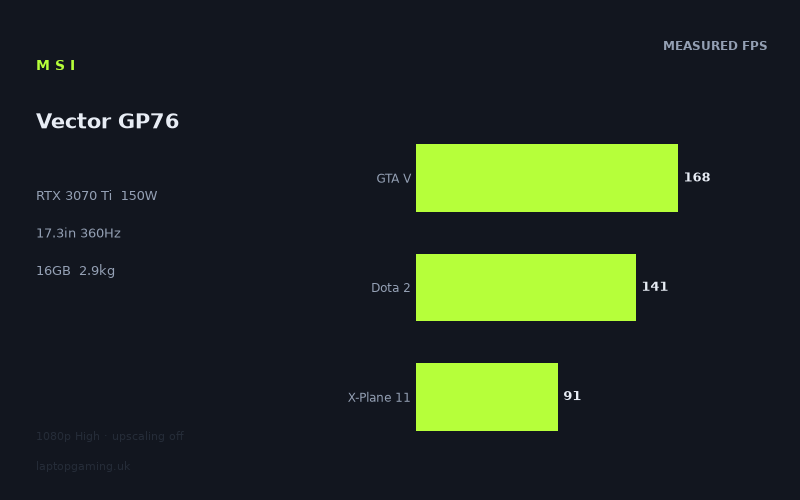
Frame rates
1920×1080, High preset, upscaling off.
Measured on this machine. Source: Notebookcheck, 2022-05-14.
Not scored: incomplete benchmark suite
Every scored laptop on this site is averaged over the same 5 games, and this one is short of Cyberpunk 2077, Baldur's Gate 3. A mean over 5 games is not comparable to a mean over 5, so we publish the figures we have and leave the score blank rather than rank it against machines tested on a different set. The numbers below are real - the suite is just incomplete.
How these numbers were produced
Frame rates here are not measured by us, and we label how each one was arrived at. A figure marked measured comes from a published run on that exact machine. A figure marked representative is derived from the GPU and its power limit (TGP) and cross-referenced against published reviews - a sound estimate of what that configuration delivers, but not a measurement of that specific laptop. Unless stated otherwise, numbers are 1920x1080, High preset, upscaling off. Where a laptop ships in several power configurations we use the wattage of the exact SKU listed, because a 140W RTX 5070 and a 115W one are not the same product.
In use
The short version
The MSI Vector GP76 (12UGS-434) is a large, performance-led gaming laptop built around an RTX 3070 Ti running at a 150W GPU power limit, a Core i7-12700H, 16GB of memory and a 17.3in 1920x1080 IPS screen with a 360Hz refresh rate. The important part is that this is not an RTX 3070 Ti configured as a thin-and-light compromise. The published benchmark data shows a machine that is consistently quick at 1080p High settings with upscaling disabled, and which can deliver genuinely high frame rates in a broad set of games.
Notebookcheck’s measured figures range from 60fps in Elden Ring to 222fps in Strange Brigade. That is a wide spread, but it is not a contradictory one. These are very different games with very different limits: some are primarily demanding on the GPU at these settings, some can become more dependent on the processor at high frame rates, and Elden Ring sits at 60fps in the published data. The five-game scoring-suite mean is 146fps, which is strong evidence that the Vector GP76 is a serious 1080p gaming machine rather than a laptop whose headline specification is doing more work than its actual results.
Buy it if your priority is high-refresh-rate gaming on a large Full HD screen, particularly if you play a mixture of competitive games, older AAA games and modern single-player releases. The panel’s 360Hz refresh rate is more ambitious than the frame rates recorded in the measured AAA titles, but the GPU does provide enough performance for the screen to make sense in lighter or more CPU-limited games. Dota 2 reaches 141fps, GTA V reaches 168fps, The Witcher 3 reaches 219fps and Strange Brigade reaches 222fps. Those are not 360fps results, but they are far beyond the levels where a high-refresh display becomes irrelevant.
It is less suitable for someone who wants a compact machine, someone who wants evidence about battery runtime before buying, or someone shopping specifically for a QHD or 4K laptop display. This Vector is defined by a 17.3in 1080p panel and a 2.85kg chassis. That combination suggests a machine intended to be moved between desks, rooms, university accommodation, offices or events rather than treated as a small everyday carry laptop. It also means the purchase decision should be based on the value of its large screen and high-refresh gaming focus, not on an assumption that it will be particularly convenient in a bag.
There is no overall score for this exact configuration because its UK price is not confirmed. The benchmark suite is complete and the machine ranks normally on frame rate, but value cannot be calculated without a confirmed price. That is not a warning about the laptop’s performance; it is simply the limit of what can responsibly be judged from the available information.
Performance
A 150W RTX 3070 Ti used for 1080p gaming
The Vector GP76’s RTX 3070 Ti has a 150W GPU power limit. In practical terms, the published figures place this laptop at the performance-oriented end of the RTX 3070 Ti laptop market rather than alongside low-power designs that use the same GPU name but are aimed at slimmer systems. The GPU designation alone is not enough to explain gaming performance across laptops. Power configuration matters, and the comparison results here make that especially clear: this 150W RTX 3070 Ti is effectively level with another RTX 3070 Ti laptop across the shared games, while also sitting almost level with a 100W RTX 3080 system.
That does not mean an RTX 3070 Ti is automatically interchangeable with an RTX 3080, or that a power limit makes every game behave the same way. It means the Vector GP76’s configuration is capable of turning its GPU into a strong 1080p performer. The benchmark results support that conclusion across games with very different demands. Strange Brigade runs at 222fps, The Witcher 3 at 219fps, GTA V at 168fps, Far Cry 5 at 147fps, Dota 2 at 141fps and Shadow of the Tomb Raider at 131fps. A laptop that delivers those figures at 1920x1080 on the High preset with upscaling off has substantial headroom for the ordinary task of playing games smoothly at its native resolution.
The result that matters most for a broad view is the 146fps mean across the five scoring-suite games. A mean is not a promise that every game will run at that level, and the full game list shows why it should not be read that way. Final Fantasy XV reaches 108fps, Elex 2 reaches 99fps and X-Plane 11 reaches 91fps. These remain solid frame rates, but they sit well below the results in Strange Brigade and The Witcher 3. There is no single frame-rate number that tells the whole story of this laptop. The right reading is that the Vector GP76 is fast, but that the degree to which it can exploit a 360Hz panel varies sharply by game.
That distinction is important for buyers who see “360Hz” and assume that every title will run close to 360fps. Notebookcheck’s figures do not show that. None of the measured games reaches the panel’s maximum refresh rate at the stated 1920x1080 High preset with upscaling disabled. Even the quickest recorded result, 222fps in Strange Brigade, remains below 360Hz. The Witcher 3 is almost as quick at 219fps, while GTA V reaches 168fps. Those are very high frame rates, and a 360Hz panel can still be useful when the game output is below its ceiling, but the available evidence does not support treating this as a laptop that fully saturates its display in the measured games.
There is a positive side to that conclusion. A 360Hz display is not only about seeing a fixed 360fps figure in a benchmark. It also gives the screen room above the performance seen in games such as Dota 2, GTA V, Strange Brigade and The Witcher 3. On a 17.3in display, the appeal is a large gaming view combined with a panel designed for high-refresh play. The GPU is clearly capable of making use of that design in a number of titles, even if it does not turn every demanding game into a 360fps experience.
The fastest measured games
Strange Brigade is the quickest recorded game in the data at 222fps. This is an excellent result at the stated High preset and native 1920x1080 resolution, especially because no upscaling is involved. It demonstrates that the Vector GP76 has the performance to deliver an extremely high frame rate when the game allows it. It is also one of the five scoring-suite titles, so it contributes to the published 146fps mean rather than being an isolated extra result.
The Witcher 3 follows closely at 219fps. Again, that is a result that puts the system firmly in high-refresh territory. It also shows why looking only at the GPU name would be insufficient. A 150W RTX 3070 Ti paired with the Core i7-12700H is not simply adequate for 1080p High gaming in this game; it produces a frame rate that makes the 360Hz panel feel like a performance-oriented choice rather than an unnecessary specification upgrade.
GTA V reaches 168fps. That is lower than the results in Strange Brigade and The Witcher 3, but it remains very strong for a laptop display running at 1920x1080. It is another scoring-suite result and therefore helps establish that the Vector GP76 is not dependent on one unusually favourable game for its overall showing. A player focused on GTA V has published evidence of high-frame-rate performance, not just an assumption based on the laptop’s component list.
Far Cry 5 reaches 147fps and Dota 2 reaches 141fps. These figures sit close to the five-game scoring-suite mean of 146fps, although Far Cry 5 is not marked as part of that suite while Dota 2 is. The pair is useful because they show the middle of the Vector GP76’s measured range. This is where the laptop looks most representative: not at a peak above 200fps, and not near a difficult title’s lower result, but comfortably into high-refresh performance.
Dota 2 deserves particular attention because it is the kind of game for which a 360Hz display can be attractive, yet the published High-preset figure is 141fps rather than anything near the panel maximum. That does not make the screen a mistake. It does mean buyers should keep expectations grounded. The display’s 360Hz capability is higher than the recorded output in Dota 2 under this benchmark setup. The screen can display at a higher refresh rate than the measured result, but the benchmark data does not show the laptop delivering 360fps here.
Strong results that are not the same as 360Hz results
Shadow of the Tomb Raider reaches 131fps. This is another very good 1080p High result and is well suited to a high-refresh panel, but it also reinforces the point that the laptop’s display specification is ahead of the frame rate delivered by many AAA games. At 131fps, the Vector GP76 is not merely scraping past a conventional gaming target; it has enough performance for responsive-looking play and for the advantages of a fast display to remain relevant. It simply is not using all 360 refresh opportunities each second according to the published number.
Final Fantasy XV reaches 108fps. That is a meaningful step down from the 141fps to 222fps group, but it remains above 100fps at 1920x1080 High with upscaling off. This matters because it shows the laptop retaining good performance when the game becomes more demanding. A 108fps result is not an argument that the GPU is weak; it is an argument for matching expectations to the game. The Vector GP76 can be described as a strong 1080p machine, but not as a machine that makes game demand disappear.
Elex 2 reaches 99fps. This is the first measured result that falls just below 100fps. It remains close enough to that mark to show that the RTX 3070 Ti at 150W has plenty to offer in the game, but it also makes the panel’s 360Hz ceiling feel distant. For single-player games where image quality and consistent responsiveness matter more than trying to approach the maximum refresh rate, the result remains convincing. For buyers whose entire aim is to see the highest possible frame-rate counter in every game, it is a reminder that 1080p and a powerful GPU do not remove every game-specific limitation.
X-Plane 11 reaches 91fps. That is still a respectable figure and indicates that the machine can run the game at the stated settings without collapsing into low-frame-rate territory. At the same time, it is far removed from the results in Strange Brigade and The Witcher 3. The reason to present both ends of the range is not to make the Vector GP76 look inconsistent. It is to show the actual pattern in the benchmark data: this laptop is capable of very high output, but the result depends heavily on the title.
The spread also illustrates why a mean of 146fps should be used carefully. The mean is valuable as a summary of the scoring suite, but a player buying for a specific game should use the result for that game where it exists. Someone mainly playing Strange Brigade should pay attention to 222fps. Someone mainly playing GTA V should pay attention to 168fps. Someone mainly playing Dota 2 should pay attention to 141fps. The average tells you that the system is broadly fast; the individual numbers tell you how that speed translates into the games actually measured.
Elden Ring and the importance of game-specific limits
Elden Ring is recorded at 60fps. That number is dramatically lower than the rest of the Vector GP76’s results, but it should not be used to dismiss the laptop’s performance as a whole. It is evidence that this specific game, under the stated benchmark conditions, produces 60fps on this machine. It does not overturn the 222fps in Strange Brigade, 219fps in The Witcher 3, 168fps in GTA V or 131fps in Shadow of the Tomb Raider.
For an Elden Ring buyer, the practical point is straightforward: the published figure is 60fps, so the 360Hz screen will not be used in the same way as it would be in the faster recorded games. If Elden Ring is the main reason for buying a laptop, this is not a result to gloss over just because the hardware is otherwise powerful. The benchmark number is the number to work from. The Vector GP76’s high-refresh display may be a major part of its gaming identity, but that identity is not equally expressed in every title.
For a mixed-library player, Elden Ring’s result is better understood as one end of the laptop’s real-world benchmark spread. The performance range begins at 60fps and extends to 222fps across the games measured by Notebookcheck. That is exactly why a sourced benchmark review should not reduce the machine to an unspecific claim such as “it runs everything brilliantly”. It runs some measured titles at exceptionally high frame rates, others at strong high-refresh figures, and Elden Ring at 60fps. Each of those statements is more useful than a blanket claim.
What the numbers say about settings choices
Every frame rate listed here was measured at 1920x1080 using the High preset with upscaling off. That is a useful baseline because it avoids mixing native-resolution results with enhanced figures generated through upscaling. The Vector GP76’s results are therefore a clean picture of how it performs at the screen’s native resolution under the stated preset.
The data does not provide alternative quality settings, alternative resolutions or upscaling results, so it would be wrong to attach invented frame-rate gains to lower settings or to claim a particular outcome from changing them. What can be said is that the existing figures leave different amounts of room depending on the game. A title at 222fps is already producing a high output at High settings. A title at 91fps is still running well, but it is much further from the display’s 360Hz maximum. The sensible approach is to use the game-by-game figures rather than assuming one setting approach makes equal sense everywhere.
The absence of upscaling in the benchmark setup matters particularly for buyers who want to understand the base capability of the hardware. The 146fps scoring-suite mean is not an upscaled headline. It is the mean from the five listed scoring-suite games at 1920x1080 High with upscaling disabled. That makes the result a solid starting point for judging the laptop’s native 1080p performance.
The screen
A large Full HD high-refresh display
The MSI Vector GP76 uses a 17.3in IPS display with a 1920x1080 resolution and a 360Hz refresh rate. This is a very clear display strategy. MSI has paired a large screen with Full HD resolution and an unusually high refresh ceiling, rather than using the hardware budget for a higher-resolution panel. For buyers who value speed over pixel count, that is a coherent choice. The RTX 3070 Ti at 150W can produce high frame rates at 1080p, and the measured results show why that pairing exists.
The size matters as much as the resolution. A 17.3in panel gives the machine a desktop-replacement character. The display is large enough that the laptop’s gaming focus is not only about frame-rate counters; it is also about having a broad screen for games, menus, strategy titles and general desktop use. The fact sheet does not provide measurements for brightness, colour coverage, response time, contrast or viewing behaviour, so those qualities cannot be judged here. The known facts are the size, IPS panel type, Full HD resolution and 360Hz refresh rate.
IPS is the supplied panel type, but the data does not include any measured panel-quality results beyond that classification. It would be irresponsible to claim exceptional colour, contrast, motion clarity or outdoor visibility without those results. Buyers with a priority such as colour-critical work, unusually dark-room gaming or use in bright environments should seek panel measurements before treating the screen as proven for those tasks. The gaming case is clearer because the refresh rate and game results are supplied.
Can the GPU drive 360Hz?
The short answer is that the panel can refresh at 360Hz, while the published game results remain below 360fps in every measured title. That is not an unusual outcome for a gaming laptop, and it does not make the screen pointless, but it should be understood before purchase.
Strange Brigade reaches 222fps and The Witcher 3 reaches 219fps. These are the nearest results to the display ceiling in the available data. They show that the Vector GP76 can deliver very high frame rates at its native resolution. Yet they also show that “very high” is not the same as “at the maximum refresh rate”. GTA V at 168fps, Far Cry 5 at 147fps and Dota 2 at 141fps take the system further from the 360Hz limit while still clearly benefiting from a display designed for high-refresh play.
In the more demanding recorded group, Shadow of the Tomb Raider reaches 131fps, Final Fantasy XV reaches 108fps, Elex 2 reaches 99fps and X-Plane 11 reaches 91fps. These figures are good for 1080p High gaming but are not an argument that the laptop was selected solely to chase 360fps in all games. The hardware and display combination makes more sense as a flexible high-frame-rate setup: it has the panel capability for very fast titles, while retaining enough GPU performance to handle heavier games at lower but still strong results.
Elden Ring at 60fps is the clearest example of the difference between panel capability and game output. A 360Hz screen cannot force a game to produce 360fps. The published figure is 60fps, and buyers should judge the experience in that title on that basis. This is why the Vector GP76 should be bought for its overall 1080p gaming performance and large high-refresh screen, not for an expectation that every game will match the number printed in the refresh-rate specification.
Why 1080p makes sense here
At 1920x1080, the RTX 3070 Ti has the conditions needed to produce the high figures seen in the benchmark list. The 146fps scoring-suite mean would be a different proposition on a higher-resolution display, but the fact sheet does not provide results at another resolution and no such conclusion should be invented. What is known is that at the laptop’s native Full HD resolution, High settings and no upscaling, the system delivers a strong average across the scoring suite.
That makes the display choice straightforward for a buyer who values frame rate first. The Vector GP76 is not trying to divide its attention between a very high-resolution panel and a high-refresh target. It is centred on Full HD, where the recorded figures can climb to 222fps and 219fps in the quickest measured titles. For a player who mostly wants sharpness from higher pixel count, the supplied specification does not offer that direction. For a player who wants a large 1080p canvas and consistently substantial gaming performance, it is a better match.
Build, size and portability
A 17.3in machine that weighs 2.85kg
The Vector GP76 weighs 2.85kg. Combined with the 17.3in screen, that places it firmly in large-laptop territory. This is not the kind of specification that suggests effortless daily carrying. It is a machine to choose when screen size and performance matter more than keeping the laptop as light as possible.
That does not mean it cannot travel. It means the likely use pattern is different from that of a smaller gaming laptop. A 2.85kg device can be moved, taken to another room, carried to a workplace, used in student accommodation or packed for an event, but it is less naturally suited to being carried all day simply because it is substantial before considering anything else a buyer may need to bring. The 17.3in screen reinforces that practical reality: the GP76 is designed around a large display experience first.
The fact sheet does not provide chassis dimensions, thickness, material details, keyboard information, port selection, webcam details or published acoustic and temperature figures. Those omissions matter. It would be wrong to claim that the chassis is thin, thick, rigid, premium, quiet or cool without evidence. The available portability judgement rests on the supplied 2.85kg weight and 17.3in display size, and those facts are enough to establish that this is not a compact-format gaming laptop.
Battery capacity without a battery-life claim
The supplied battery capacity is 65Wh. There is no measured battery-runtime figure in the fact sheet, so no claim can be made about how long the Vector GP76 lasts away from mains power. Battery capacity is a specification, not a battery-life result. Actual runtime depends on workload and conditions that are not documented here.
For a buyer considering this laptop as a frequently mobile machine, that missing information should be treated as a reason to seek battery testing rather than a reason to assume either good or poor endurance. The laptop’s 2.85kg weight and 17.3in panel already point toward a more stationary role, but the available facts do not establish battery life. The safest conclusion is simply that it has a 65Wh battery and that no sourced runtime figure is available in this data.
Memory and storage
The configuration includes 16GB of memory and a 1TB SSD. These are useful baseline specifications for a gaming laptop, but the fact sheet does not provide memory speed, storage performance, upgradeability or slot information. There is no basis for describing the SSD as particularly fast or the memory as especially well configured.
What can be said is that the benchmark results were produced with the listed Core i7-12700H, RTX 3070 Ti, 16GB of memory and 1TB SSD configuration. That matters because the frame rates belong to this exact combination rather than to a generic Vector GP76 name. Buyers should be careful when looking at similarly named models with different processors, GPUs, memory amounts or power configurations. The sourced figures here are for the MSI Vector GP76 (12UGS-434).
How it compares
Against the MSI Prestige 15 with RTX 3050 Ti at 105W
Across four shared games, the Vector GP76 averages 73fps ahead of the MSI Prestige 15 with an RTX 3050 Ti at 105W. That is the largest positive comparison in the supplied rival set, and it is a major gap rather than a marginal benchmark variation.
The comparison is useful because it shows what the GP76 is buying in performance terms: not just an RTX 3070 Ti badge, but a much stronger gaming position than a laptop using an RTX 3050 Ti at 105W. The 73fps average advantage across the shared games is substantial enough to change the type of display the system can sensibly support. The Prestige 15 comparison makes the Vector’s 17.3in 1080p 360Hz approach look more coherent, because the GP76 has much more frame-rate capacity available in the common test set.
This does not mean the Prestige 15 has no purpose. The two machines are aimed at different priorities, and the fact sheet does not provide the Prestige 15’s weight, screen or battery information here. The evidence only supports a gaming-performance conclusion: in the four shared games, the Vector GP76 is much faster. A buyer whose main criterion is frame rate should treat that difference seriously.
Against the Razer Blade Pro 17 2021 with RTX 3080 at 100W
The most revealing comparison is with the Razer Blade Pro 17 2021 (QHD Touch), which uses an RTX 3080 at 100W. Across five shared games, the Vector GP76 averages 1fps ahead. That is effectively a tie in the shared benchmark set.
The near-zero difference is a real result, not evidence that GPU names have become meaningless. At 1080p, lighter titles in the shared set can be CPU-bound and compress genuine GPU gaps. That means the higher-positioned RTX 3080 name does not automatically translate into a large measurable advantage in this particular comparison. The Vector GP76’s 150W RTX 3070 Ti is operating in a configuration that can keep pace with the 100W RTX 3080 system across the games both machines hold.
It is important not to overstate the conclusion. The Blade Pro 17 is identified as a QHD Touch model, while the Vector GP76 has a 1920x1080 360Hz IPS display. The supplied shared-game average tells us how the machines compare in the benchmark overlap; it does not establish that their screens serve the same buyer or that every game and setting would produce the same relationship. It does establish that a buyer should not assume the RTX 3080 laptop is automatically much faster simply because of the GPU label.
The Razer Blade Pro 17 2021 has a listed UK price of GBP 3,863. The Vector GP76 does not have a confirmed UK price in this configuration, so a value conclusion between the two cannot be responsibly drawn. On performance alone, the GP76’s average 1fps lead across five shared games is striking. On value, the necessary price information is incomplete for the MSI.
Against the Razer Blade 17 with RTX 3070 Ti
Against the Razer Blade 17 with the Core i7-12800H and RTX 3070 Ti, the Vector GP76 averages 0fps difference across five shared games. That is an exact tie in the supplied comparison.
Again, the correct interpretation is not that the two laptops are identical in every respect. The shared-game result says that their averaged performance is level across the five games held by both machines. At 1080p, lighter titles in the shared set can become CPU-bound and compress genuine GPU gaps, so near-zero results should not be treated as proof that all hardware configuration differences are irrelevant. They show that in the benchmark overlap, neither machine establishes a frame-rate advantage.
For a buyer choosing between these two specific systems, the performance data does not provide a reason to favour one over the other. The decision would need to turn on other confirmed facts: the Vector GP76 has a 17.3in 1920x1080 360Hz IPS screen, weighs 2.85kg, includes 16GB of memory and a 1TB SSD, and has a 65Wh battery. The Razer Blade 17’s listed UK price is GBP 2,602. Without a confirmed UK price for the Vector GP76, it is not possible to say which one represents better value.
The tie is still valuable information. It means the Vector GP76 is not trailing another RTX 3070 Ti laptop in the shared set despite its large-screen design. If the GP76’s 17.3in Full HD 360Hz format appeals more than the alternative, there is no published frame-rate penalty in this five-game comparison to deter a buyer.
Against the MSI Raider GE77 HX with RTX 3080 Ti at 175W
The MSI Raider GE77 HX is the supplied rival that beats the Vector GP76 by the most. Across five shared games, the Vector averages 23fps behind the Raider. The Raider uses an RTX 3080 Ti at 175W, so this is the comparison that shows the limit of the GP76’s RTX 3070 Ti at 150W configuration.
A 23fps average deficit is not a trivial difference. It indicates that the Raider has a meaningful advantage in the shared games, and it is the right choice from this group for a buyer whose only concern is extracting the highest available frame rate. The Vector GP76 remains strong, but it does not match the faster MSI across that benchmark overlap.
There is also useful context in the size of the deficit. The GP76 is not being left behind by an uncompetitive margin; it is behind a machine equipped with an RTX 3080 Ti at 175W. The Vector’s own 146fps scoring-suite mean, 222fps Strange Brigade result and 219fps Witcher 3 result show that it is already a high-performance laptop. The Raider comparison simply establishes that a more powerful GPU configuration can extend that performance further.
The Raider GE77 HX has no confirmed UK price in the supplied data. As with the Vector GP76, that prevents a proper value comparison. A buyer can say the Raider is faster in the shared games by 23fps on average. They cannot use the available facts to say whether that extra performance is worth a particular price difference.
What the rival set says overall
The rival results form a useful performance ladder. The Vector GP76 is far ahead of the MSI Prestige 15 with RTX 3050 Ti at 105W, effectively tied with the Razer Blade Pro 17 2021 with RTX 3080 at 100W, exactly level with the Razer Blade 17 with RTX 3070 Ti in the shared-game average, and behind the MSI Raider GE77 HX with RTX 3080 Ti at 175W.
That places the GP76 in a strong position within this specific group. It is clearly not an entry-level RTX laptop. It can match more expensive-looking GPU labels when those GPUs are configured at lower power, and it remains competitive against another RTX 3070 Ti system. Only the 175W RTX 3080 Ti Raider produces a clear shared-game advantage.
The central lesson is to look beyond the GPU model name. The Vector GP76’s 150W RTX 3070 Ti produces results that are more informative than a simple “3070 Ti versus 3080” comparison. Its performance is close to the 100W RTX 3080 Blade Pro 17 and behind the 175W RTX 3080 Ti Raider, which is exactly the kind of result that makes GPU power configuration worth considering when comparing gaming laptops.
Who it’s for
Buy the Vector GP76 if high-refresh 1080p gaming is the priority
The strongest case for the Vector GP76 is a buyer who wants high frame rates on a large 17.3in Full HD display. The published results support that use clearly. Strange Brigade at 222fps, The Witcher 3 at 219fps, GTA V at 168fps, Far Cry 5 at 147fps and Dota 2 at 141fps show that the RTX 3070 Ti at 150W has the ability to deliver the kind of performance that makes a 360Hz panel worthwhile.
It is especially suitable for someone whose game library mixes fast or lighter titles with demanding AAA releases. The faster titles can produce very high frame rates, while heavier results such as Shadow of the Tomb Raider at 131fps, Final Fantasy XV at 108fps, Elex 2 at 99fps and X-Plane 11 at 91fps remain good 1080p High figures. That mixture is more representative of real buying decisions than judging the laptop only on the quickest benchmark.
It also suits a player who prefers a large built-in screen instead of relying on an external display. The 17.3in panel is a central part of the product, not an incidental specification. If you use your gaming laptop mainly at a desk but still want the option to move the whole system, the GP76’s format has an obvious appeal.
The comparison data also supports the Vector GP76 for buyers who want strong performance without assuming they must move straight to an RTX 3080-class name. It averages 1fps ahead of the 100W RTX 3080 Razer Blade Pro 17 2021 across five shared games and ties the RTX 3070 Ti Razer Blade 17 across five shared games. Those are not abstract claims; they are the available shared-game results.
Buy something else if portability is the deciding factor
A buyer who needs a laptop to carry constantly should look carefully at the 2.85kg weight and 17.3in display. The Vector GP76 is not presented by its specifications as a compact device. It is a large gaming laptop with a large gaming screen, and that is the trade-off.
If your ideal laptop is one that disappears into a bag, is easy to carry through a full day or is chosen principally for low weight, the GP76 is unlikely to be the natural fit. The supplied facts do not include dimensions, so its physical footprint cannot be quantified here, but a 17.3in screen and 2.85kg weight are enough to establish the general category. Choose a smaller system if easy transport is more important than having a large 360Hz panel.
Buy something else if you need proven battery life
The Vector GP76 has a 65Wh battery, but there is no measured battery-life result in the available information. Anyone who needs a laptop for extended use away from power should not make a purchase based on battery capacity alone. Seek a sourced runtime figure for the workloads that matter to you.
This is not a criticism of the laptop’s battery life, because no battery-life measurement has been provided. It is a boundary on the review. The available data is strong on gaming frame rates and basic hardware specification, but it does not establish how the 65Wh battery translates into runtime.
Buy something else if maximum possible performance matters more than the rest
The MSI Raider GE77 HX is the better fit for the buyer who wants the highest performance from this rival group and is willing to choose the faster machine on that basis. The Vector GP76 averages 23fps behind it across five shared games. The Raider’s RTX 3080 Ti at 175W has the performance advantage, and the available benchmark comparison is clear.
The Vector GP76 remains the better choice only when its own combination of performance, screen format and eventual price works better for the buyer. It is already fast enough to produce a 146fps scoring-suite mean and results above 200fps in two measured games. But if the target is simply the highest shared-game output, the Raider is ahead.
Final view
The MSI Vector GP76 is a convincing large-screen 1080p gaming laptop on performance evidence. Its 150W RTX 3070 Ti is doing the work expected of a properly performance-focused configuration, producing a 146fps mean across the five scoring-suite games and reaching 222fps in Strange Brigade, 219fps in The Witcher 3 and 168fps in GTA V. It does not hit 360fps in the measured games, so the 360Hz display should be understood as a high-refresh ceiling rather than a guaranteed output. But the panel is still sensibly matched to a system that can often run well above 100fps.
The limitations are equally clear. Elden Ring is recorded at 60fps, the more demanding measured titles sit between 91fps and 131fps, the 2.85kg weight makes this a large-format machine, and no battery-runtime data is available. The GP76 is not the right answer for every gaming-laptop buyer. It is the right sort of machine for someone who wants a 17.3in Full HD gaming display, strong native-resolution frame rates and a GPU configuration that competes well against several notable laptops from the same generation.