Review
Gigabyte A7 X1 review
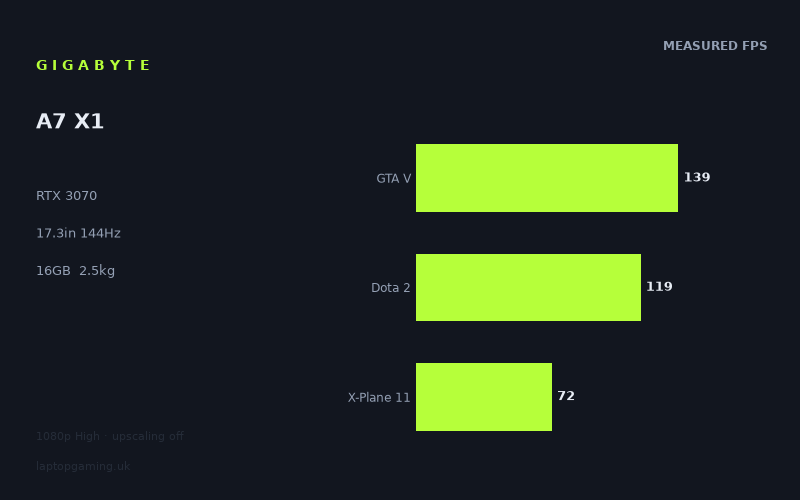
Frame rates
1920×1080, High preset, upscaling off.
Measured on this machine. Source: Notebookcheck, 2021-10-19.
Not scored: incomplete benchmark suite
Every scored laptop on this site is averaged over the same 5 games, and this one is short of Cyberpunk 2077, Baldur's Gate 3. A mean over 4 games is not comparable to a mean over 5, so we publish the figures we have and leave the score blank rather than rank it against machines tested on a different set. The numbers below are real - the suite is just incomplete.
How these numbers were produced
Frame rates here are not measured by us, and we label how each one was arrived at. A figure marked measured comes from a published run on that exact machine. A figure marked representative is derived from the GPU and its power limit (TGP) and cross-referenced against published reviews - a sound estimate of what that configuration delivers, but not a measurement of that specific laptop. Unless stated otherwise, numbers are 1920x1080, High preset, upscaling off. Where a laptop ships in several power configurations we use the wattage of the exact SKU listed, because a 140W RTX 5070 and a 115W one are not the same product.
In use
The short version
The Gigabyte A7 X1 is a large 17.3in gaming laptop built around an RTX 3070, a Ryzen 9 5900HX, 16GB of memory and a 512GB SSD. The published Notebookcheck benchmark data shows that it is capable of very high frame rates in some of the measured 1920x1080 High-preset games, while remaining comfortably playable in the more demanding titles represented here. Its 144Hz IPS display is a sensible match for the faster results, although the benchmark spread also makes clear that 144fps should not be treated as an expectation for every game at High settings with upscaling disabled.
The most important caveat is that the Gigabyte A7 X1 cannot be given a complete performance ranking in the site’s scoring system. Notebookcheck has published figures for four of the five scoring-suite games, but there is no result here for Final Fantasy XV. Every ranked laptop is averaged across the same five games, so placing this machine alongside fully measured models would create a misleading comparison. There is enough data to judge how it behaves in the games available, and enough shared-game data to compare it with the named rivals, but not enough to present it as a complete like-for-like score-table entry.
On the figures we do have, the A7 X1 is at its best when the game can exploit the RTX 3070 without turning the system into a hard GPU limit. Strange Brigade reaches 208fps, GTA V reaches 139fps and Dota 2 reaches 119fps. Those are strong results for a 144Hz 1920x1080 screen, particularly in Strange Brigade and GTA V. X-Plane 11 at 72fps and Cyberpunk 2077 1.0 at 77fps tell the other half of the story: the machine is still producing a fluid-looking result by ordinary gaming-laptop standards, but it is not close to driving the panel at its maximum refresh rate in every demanding game using the stated settings.
That makes this a convincing option for someone who wants a 17.3in Full HD laptop for competitive games, older games, less GPU-limited games and general high-refresh-rate play, while still wanting enough graphics performance for demanding single-player titles. It is less convincing for someone whose priority is keeping every new, demanding game at or near 144fps without reducing settings or using upscaling. The measured data does not support that expectation.
There is also a practical buying problem: the UK price is not confirmed. That means it is not possible to say whether the A7 X1 is good value in the UK at the time of purchase. Performance is only half the buying decision. A laptop with these specifications could be attractive if discounted appropriately, but without a confirmed price there is no responsible basis for calling it a bargain, a fair deal or overpriced. Treat this as a performance assessment rather than a final value judgement.
The weight matters too. At 2.53kg, this is a substantial laptop before considering its charger and other accessories. It is a machine for a desk, a permanent room-to-room setup, occasional travel or transport in a properly sized bag. It is not the natural choice for someone who wants to carry a gaming laptop all day. The 17.3in screen is part of the appeal, but it is also inseparable from the machine’s size and weight.
Buy the Gigabyte A7 X1 if a large 144Hz Full HD screen, RTX 3070-class gaming performance and a Ryzen 9 5900HX are the priorities, and if the eventual UK price makes sense against other available machines. Look elsewhere if portability is central, if storage capacity is a concern from day one, if you need a complete independently measured ranking, or if you want evidence that demanding games will consistently approach 144fps at High settings without upscaling.
Performance
What the Notebookcheck figures show
The benchmark figures cited here were measured by Notebookcheck on 2021-10-19 at 1920x1080, using the High preset with upscaling off. That is an important test condition. The results are not maximum-settings figures, not low-settings esports figures and not figures assisted by upscaling. They represent a straightforward Full HD High-preset view of the Gigabyte A7 X1’s performance.
Across the four available scoring-suite games, the published mean is 134fps. That is a useful summary, but it should not be read as a promise of 134fps in any particular game. The individual results range from 72fps in X-Plane 11 to 208fps in Strange Brigade. That spread is the meaningful part of the data. Averages are useful for broad comparisons, but a buyer choosing a laptop for a particular type of game needs to look at the individual titles.
- Strange Brigade: 208fps
- GTA V: 139fps
- Dota 2: 119fps
- X-Plane 11: 72fps
- Cyberpunk 2077 1.0: 77fps
Strange Brigade is the standout result at 208fps. On a 144Hz panel, that means the machine has more benchmark performance available than the screen can display as unique refreshes at its native maximum refresh rate. That is not wasted performance in the sense that high frame rates can still improve responsiveness and provide headroom against dips, but it does mean that a buyer should not select the A7 X1 simply because the headline figure exceeds 144fps. The more useful conclusion is that this game is very comfortable for the hardware at the tested settings.
GTA V at 139fps is very close to the 144Hz screen’s maximum refresh rate. This is the kind of result that makes a 144Hz Full HD panel feel well matched to the GPU: the panel is not merely a specification-sheet luxury, and the laptop is not obviously over-equipped relative to the display. It is close enough that game-to-game variation, scene variation and settings changes will matter more than the small distance between the published average and the panel refresh limit. The key point is that GTA V is one of the measured examples where the A7 X1 can make strong practical use of a high-refresh display.
Dota 2 at 119fps is below 144fps, but still firmly in high-refresh territory compared with a conventional 60Hz laptop screen. It also illustrates why it is wrong to reduce the A7 X1 to a simple “144fps laptop” label. A 144Hz display gives the system room to show more frames than a 60Hz panel, yet the benchmark result does not reach the panel’s ceiling in this title under the published settings. For a buyer who plays Dota 2, 119fps is the relevant evidence; the 208fps Strange Brigade result does not make Dota 2 run at 208fps.
X-Plane 11 is the lowest figure in the scoring-suite set, at 72fps. The result is still above the basic 60fps threshold many buyers use as a practical minimum, but it is far from the 144Hz panel’s limit. This matters because it demonstrates that the A7 X1’s RTX 3070 is not a universal answer to every performance constraint at Full HD High settings. Some games respond very differently to the same combination of CPU, GPU and memory. A large screen and a 144Hz specification do not remove the limits imposed by a particular game’s workload.
Cyberpunk 2077 1.0 sits at 77fps. It is not part of the scoring-suite mean given here, but it is highly useful evidence because it provides another demanding result under the same 1920x1080 High-preset, upscaling-off conditions. Like X-Plane 11, it shows the A7 X1 producing a playable result rather than a panel-saturating one. Anyone buying this machine chiefly for graphically demanding games should treat the 72fps and 77fps results as more informative than the 208fps headline in Strange Brigade.
The benchmark spread is the real story
The difference between the results is not a reason to distrust the data; it is exactly why publishing individual game figures matters. Gaming laptops are often described by GPU name alone, as if an RTX 3070 guaranteed one fixed level of performance. It does not. The application, the selected settings, the resolution, the CPU load and the GPU load all affect the result. The Gigabyte A7 X1 demonstrates that clearly: it produces a very high figure in Strange Brigade, nearly matches its 144Hz display in GTA V, remains high in Dota 2, then lands much lower in X-Plane 11 and Cyberpunk 2077 1.0.
For buyers, the practical distinction is between games where the A7 X1 has enough performance headroom to take full advantage of the panel and games where the screen’s 144Hz maximum is simply more capability than the measured frame rate can use. In Strange Brigade, the result is well beyond the display refresh rate. In GTA V, it is close to it. In Dota 2, the result remains high but does not reach it. In X-Plane 11 and Cyberpunk 2077 1.0, the panel is not the limiting factor in the published results; the game workload is.
This is why a mean of 134fps should be used carefully. It says that the four available scoring-suite results are, taken together, strong for a Full HD gaming laptop. It does not mean the laptop delivers a locked 134fps. It does not mean it reaches 144fps in every title. It also does not mean that the lower results are failures. A measured 72fps in X-Plane 11 and 77fps in Cyberpunk 2077 1.0 still represent a much different experience from a machine struggling below 60fps, but they set realistic expectations for demanding games at the tested settings.
The settings matter especially because upscaling was off. The data therefore describes native-resolution performance rather than a result boosted by an image-reconstruction mode. That makes the numbers easier to interpret as a baseline for 1920x1080 High gaming. It also means there is no published upscaling result here that could be used to claim how the machine would behave if a buyer chose to enable such a mode. It may be tempting to assume an outcome, but the fact sheet does not provide it, so no frame-rate claim should be made.
RTX 3070 performance without a confirmed power limit
The Gigabyte A7 X1 uses an RTX 3070, but the fact sheet does not confirm the GPU power limit for this particular laptop. That omission is important. Laptop GPUs carrying the same name can be configured differently, and the rival list itself demonstrates why power limits cannot be ignored. The MSI Katana GF66 is identified as using an RTX 3070 at 85W, while the Medion Erazer Beast X20 is identified as using an RTX 3070 at 140W. A GPU label alone does not tell a buyer how every laptop will perform.
For the A7 X1, the responsible conclusion is not to guess. The available Notebookcheck results show what this specific configuration achieved in the listed games, but they do not establish a published power limit for the Gigabyte model in this fact sheet. Therefore, it would be wrong to claim that it is a low-power RTX 3070, a high-power RTX 3070 or anything in between. The benchmark results are more useful than a guessed wattage, but a buyer comparing chassis designs or trying to understand performance limits should know that the figure is not confirmed here.
The comparison data offers a particularly interesting outcome. The A7 X1 averages +0fps against the MSI Katana GF66 across four shared games, despite the Katana being listed with an 85W RTX 3070. It also averages +0fps against the Medion Erazer Beast X20 across four shared games, despite the Medion being listed with a 140W RTX 3070. Those near-zero differences are real results, not a typo to be waved away, but they should not be misread as proof that GPU power limit never matters.
The supplied comparison context explains why such a result can happen: at 1920x1080, lighter titles in the shared set can become CPU-bound and compress genuine GPU gaps. In other words, a game may stop benefiting proportionally from additional GPU capacity because another part of the system or the game engine becomes the limiting factor. Where that happens, two RTX 3070 laptops with different stated power limits can post almost identical shared-game averages. The data does not say that the 85W and 140W configurations are equivalent in every game, every setting or every resolution. It says that the shared benchmark set produced a near-zero average difference.
This is precisely why it is risky to choose solely by a wattage figure, or solely by a GPU model number. The A7 X1 should be judged by the measured figures available for it. It has evidence of 208fps in Strange Brigade, 139fps in GTA V, 119fps in Dota 2, 72fps in X-Plane 11 and 77fps in Cyberpunk 2077 1.0 at the stated test conditions. It also has shared-game parity with two differently configured RTX 3070 rivals. That is more useful than pretending a missing power figure can be reconstructed from a product name.
The CPU, memory and storage context
The Ryzen 9 5900HX is paired with 16GB of memory. The published figures cannot separate the contribution of the CPU, memory and GPU in each game, but the system-level combination is relevant when looking at the benchmark spread and the comparison behaviour at Full HD. The provided rival-comparison note specifically flags that lighter games at 1920x1080 can be CPU-bound. That is a reminder that gaming performance is not determined by the GPU alone, even in a laptop marketed around an RTX 3070.
The 16GB memory capacity is a clear, concrete specification, but the fact sheet does not provide information about memory configuration, speed, upgradeability or the number of available slots. It would therefore be inappropriate to claim a performance advantage or disadvantage based on those details. For a buyer, the practical point is simply that the machine is specified with 16GB rather than an unspecified amount, while the benchmark data remains the evidence for actual gaming output.
The 512GB SSD is another specification that needs a sober reading. It gives the machine solid-state storage, but the fact sheet does not provide drive speed, available capacity after software installation, additional storage bays or upgrade information. It is also not possible to say from the supplied information how many games a buyer will fit comfortably. Storage needs are highly dependent on the games and files involved, and no usable-capacity measurement is provided. A buyer who keeps a large library installed should check retailer and manufacturer details before assuming the storage arrangement will suit them.
The screen
A sensible gaming specification, with game-dependent limits
The Gigabyte A7 X1 has a 17.3in IPS display with a 1920x1080 resolution and a 144Hz refresh rate. For the benchmark data available, this is a coherent screen specification. Full HD keeps the tested resolution aligned with the published performance figures, and the 144Hz refresh rate can be meaningfully used in at least some of the measured games.
Strange Brigade at 208fps is clearly beyond 144fps, so the laptop has enough measured performance in that game to exceed the panel’s maximum refresh rate. GTA V at 139fps is close to the screen’s 144Hz ceiling. Dota 2 at 119fps sits below it but still makes a stronger case for a high-refresh display than a 60Hz panel would. These three results make the 144Hz specification more than a decorative number: there are measured scenarios where the display’s refresh capability is relevant.
The other two figures are equally important. X-Plane 11 at 72fps and Cyberpunk 2077 1.0 at 77fps do not approach the 144Hz ceiling under the published conditions. The screen cannot create frames that the system is not producing. In these games, the 144Hz panel still offers a high-refresh-capable platform, but the benchmark data does not indicate that the laptop can use all of that refresh rate at 1920x1080 High with upscaling off.
This makes the panel a good fit for mixed gaming rather than a guarantee of maximum-refresh gaming. Buyers focused on games that resemble the faster benchmark behaviour have clear evidence that the A7 X1 can deliver high frame rates. Buyers focused on games that resemble Cyberpunk 2077 1.0 or X-Plane 11 should set expectations around the measured 77fps and 72fps outcomes instead. Neither use case invalidates the screen; they simply place it in context.
IPS is confirmed; other display characteristics are not
The panel type is IPS. That is all the fact sheet confirms about the display beyond size, resolution and refresh rate. There is no published brightness figure, colour-gamut figure, response-time measurement, contrast measurement, adaptive-sync information or outdoor-use assessment supplied here. Those omissions matter because a 144Hz IPS label does not by itself establish how the screen behaves in every respect.
It would be easy to turn “IPS” into a broad claim about image quality, colour work or motion handling, but the available facts do not support that. The safe conclusion is narrower: this is a 17.3in Full HD 144Hz IPS gaming panel, and the measured frame rates show that the system can make effective use of its refresh rate in some games but not all. Buyers with demanding requirements for colour-critical work, unusually bright environments or specific display behaviour should seek dedicated panel measurements before committing.
The 1920x1080 resolution is also a pragmatic choice in light of the published figures. It is exactly the resolution at which Notebookcheck measured the laptop. There is no 2560x1440 or 3840x2160 display here to increase the rendering load, and no need to infer how the RTX 3070 might perform above Full HD. The machine should be assessed as a Full HD gaming laptop because that is the panel specification and the benchmark condition.
Build, size and portability
The 17.3in format sets expectations
The A7 X1 is a 17.3in laptop weighing 2.53kg. Those two facts place it firmly in the larger gaming-laptop category. This is not a compact machine masquerading as a desktop replacement. The screen is large, the hardware is performance-focused and the weight is substantial enough that buyers should think about how often the laptop will actually move.
A 2.53kg laptop can certainly be transported, but “transportable” is not the same as “effortless to carry”. Someone moving between rooms, taking the laptop to occasional events or travelling selectively may find the format acceptable. Someone commuting daily, carrying books or equipment alongside it, or wanting a machine that disappears into a lightweight bag should look at the weight before being persuaded by the RTX 3070 badge or the 17.3in display.
The fact sheet does not provide dimensions, thickness, charger weight, battery life, battery capacity, port selection, keyboard details, chassis materials, fan noise or temperatures. Those are meaningful omissions for a machine in this class. A 17.3in laptop can vary greatly in footprint and desk presence, and cooling behaviour can shape the ownership experience. There is no basis here to claim that the A7 X1 is slim, thick, quiet, loud, cool-running or hot-running. Buyers who care about those aspects should not substitute assumption for evidence.
Best viewed as a large-screen desk machine that can travel
The strongest practical use case is a buyer who wants a large Full HD gaming screen without committing to a separate desktop tower and monitor. The 17.3in panel offers more screen area than a smaller laptop display, while the RTX 3070 and Ryzen 9 5900HX combination has published evidence of strong Full HD performance. The A7 X1 makes sense as a main machine placed on a desk most of the time, with the option to move it when necessary.
It is less naturally suited to the buyer who values physical compactness above all else. Even without dimensions, 17.3in and 2.53kg are enough to establish the broad trade-off. You are choosing a large display and substantial gaming hardware rather than minimal carry weight. That is not a flaw if the machine will mostly be used in one place. It becomes a drawback when portability is the primary requirement.
There is also no supplied evidence about battery performance, so it would be wrong to suggest that this can replace a lightweight work laptop away from a socket. The fact that it is a laptop does not itself establish useful unplugged endurance. For buyers who need long battery life, the absence of a measured figure should be treated as a reason to investigate further rather than a reason to assume either good or poor results.
How it compares
Against the MSI Prestige 15 with RTX 3050 Ti at 105W
Across three shared games, the Gigabyte A7 X1 averages +46fps against the MSI Prestige 15 with an RTX 3050 Ti at 105W. That is the largest positive comparison in the supplied rival set. It is a meaningful performance advantage, not a marginal result that can be dismissed as ordinary run-to-run variation.
The comparison also shows why the GPU tier still matters. The A7 X1’s RTX 3070 is not merely producing an attractive single-game headline; across the shared data it holds a substantial lead over the RTX 3050 Ti rival. For a buyer choosing between these particular types of machine for gaming performance, the Gigabyte’s measured advantage is clear.
However, the MSI Prestige 15 has no confirmed UK price in the fact sheet, and neither does the Gigabyte A7 X1. There is therefore no responsible price-to-performance conclusion to draw. A +46fps shared-game average is strong evidence of a gaming-performance gap. It is not evidence that one model represents better value without knowing what either model costs in the UK.
It is also important not to extend the three-game comparison into claims about every game. The supplied figure is an average across three shared games. It establishes the measured relationship in that shared set, not a universal fixed advantage in all workloads. Still, among the available comparisons, it is the clearest indication that the A7 X1 sits well above a lower-tier RTX 3050 Ti machine in gaming output.
Against the MSI Katana GF66 with RTX 3070 at 85W
The Gigabyte A7 X1 averages +0fps against the MSI Katana GF66 across four shared games. The Katana is listed with an RTX 3070 at 85W. On paper, it would be tempting to expect the GPU power description alone to settle the comparison. The shared-game result says otherwise: in this dataset, the average difference is effectively absent.
That does not mean the two machines are identical. It means that the available shared-game average is +0fps. The supplied context is crucial: at 1920x1080, lighter titles in the shared set can become CPU-bound and compress genuine GPU gaps. If a game is limited elsewhere, extra GPU capability may not translate into a visibly larger benchmark result. A near-zero comparison is therefore a real finding, but it needs interpretation rather than repetition.
For a buyer, the useful lesson is that the A7 X1 should not be assumed to pull ahead simply because one expects a particular RTX 3070 implementation to be faster. In the four shared games, it does not establish a measured average lead over the 85W Katana. That makes price, screen size, weight, storage, keyboard, ports, cooling and other unlisted characteristics potentially decisive between the two, but those details are not available in this fact sheet.
Neither machine has a confirmed UK price here. The correct conclusion is performance parity across the four shared games, not a value verdict.
Against the Medion Erazer Beast X20 with RTX 3070 at 140W
The result against the Medion Erazer Beast X20 is equally striking. The Medion is listed with an RTX 3070 at 140W, yet the Gigabyte A7 X1 averages +0fps across four shared games. Again, this is not licence to say that a 140W RTX 3070 offers no potential benefit. The supplied explanation remains the relevant one: lighter 1920x1080 shared titles can be CPU-bound, which compresses genuine GPU differences.
What the data supports is narrower and more useful. In these four shared games, the Gigabyte does not trail the Medion on average despite the Medion’s stated 140W configuration. That is a positive result for the A7 X1, especially because its own GPU power limit is not confirmed in the supplied facts. It shows that the Gigabyte’s measured gaming output is competitive with a named higher-wattage RTX 3070 rival in the available shared set.
It does not support a claim of universal equivalence. The tests are at 1920x1080 on High with upscaling off, and they cover four shared games. A buyer considering the Medion specifically should not assume identical behaviour in games outside that set, at different settings or under different workloads. The point is not that GPU limits do not matter; it is that real benchmark results can be more nuanced than specification labels suggest.
As with the other rivals, there is no confirmed UK price for the Medion in this fact sheet. The shared-game tie is a performance result, not a value conclusion.
Against the Asus ROG Strix Scar 17 SE with RTX 3080 Ti at 150W
The Asus ROG Strix Scar 17 SE is the machine that beats the Gigabyte A7 X1 by the largest amount in the supplied rival spread. Across four shared games, the Gigabyte averages -44fps against the Asus. The Asus is listed with an RTX 3080 Ti at 150W, so this is the comparison that most clearly marks the ceiling of the A7 X1’s RTX 3070-class performance.
A -44fps average is substantial. It reinforces that the A7 X1 is a capable Full HD gaming laptop, but not the performance leader represented in this comparison group. Buyers seeking the greatest available frame-rate headroom, particularly in games where the GPU is the dominant limit, should expect the RTX 3080 Ti rival to offer materially more performance across the measured shared set.
The comparison should not be turned into a blanket statement that the Asus is automatically the better purchase. There is no confirmed UK price for either machine here, and price is essential when deciding whether a larger performance lead is worth paying for. The Asus has the bigger measured shared-game average, but without UK pricing there is no way to quantify whether that lead is proportionate to the cost difference.
For the Gigabyte buyer, this comparison is useful as an expectation-setting tool. The A7 X1 can deliver 208fps in Strange Brigade and 139fps in GTA V, but it is not a substitute for a substantially more powerful RTX 3080 Ti configuration when the goal is maximum frame-rate performance across the shared benchmark set.
What the rival spread says overall
The rival set gives the A7 X1 a clear position even without a complete five-game score. It is well ahead of the MSI Prestige 15 with RTX 3050 Ti at 105W in the available three-game comparison. It is level on average across four shared games with both the MSI Katana GF66 using an RTX 3070 at 85W and the Medion Erazer Beast X20 using an RTX 3070 at 140W. It trails the Asus ROG Strix Scar 17 SE with RTX 3080 Ti at 150W by a substantial average across four shared games.
That is a sensible spread for interpreting the machine. The A7 X1 is not positioned by the data as an entry-level gaming laptop; the lead over the RTX 3050 Ti system is too large for that. Nor is it the outright fastest option in the comparison group; the RTX 3080 Ti Asus has a clear advantage. Between those poles, the A7 X1 demonstrates that measured Full HD results can converge with differently configured RTX 3070 systems, particularly where CPU limits compress GPU gaps.
The missing Final Fantasy XV figure remains important. The shared-game comparisons are valid within the game counts stated, but they do not replace a complete five-game ranking. Buyers should use the individual results and named-rival comparisons for the evidence they are, rather than treating the A7 X1 as if it had a complete score-table position.
Who it’s for
Buy it if these are your priorities
The Gigabyte A7 X1 is best suited to someone who wants a big-screen gaming laptop and expects to use it primarily in a fixed location. The 17.3in 1920x1080 IPS panel, 144Hz refresh rate and 2.53kg weight point towards a desk-first machine rather than a small portable companion. If the screen size is a major part of the appeal, the A7 X1 makes more sense than trying to force a smaller, lighter laptop into the same role.
It also suits the buyer who plays a mixture of games and understands that frame rates vary sharply by title. The published figures provide evidence of very high output in Strange Brigade, near-144Hz output in GTA V and high-frame-rate performance in Dota 2. That makes the machine attractive for players who can benefit from a 144Hz screen in games that run in that range.
It is also a reasonable choice for someone who wants demanding games to remain playable at Full HD High settings without upscaling, provided they do not demand 144fps in every title. X-Plane 11 at 72fps and Cyberpunk 2077 1.0 at 77fps show that the A7 X1 can still deliver solid published results when the workload is tougher. The right expectation is not maximum-refresh gaming in all circumstances; it is broad Full HD capability with a large range between lighter and more demanding games.
The A7 X1 may also appeal to a buyer comparing RTX 3070 laptops who wants to look beyond stated GPU wattage. In the available four-game shared comparisons, it is level on average with both an 85W RTX 3070 MSI Katana GF66 and a 140W RTX 3070 Medion Erazer Beast X20. That does not settle every possible comparison, but it is good evidence that this Gigabyte should not be dismissed merely because its own GPU power limit is not confirmed in the fact sheet.
Buy something else if these are your priorities
Choose something else if you need a genuinely portable gaming laptop. At 2.53kg with a 17.3in screen, the A7 X1 is not built around minimum weight. It can be moved, but it is not the obvious choice for daily carrying. Buyers who regularly travel with their laptop should place more importance on weight, dimensions and battery measurements than this fact sheet can provide for the Gigabyte.
Look elsewhere if you want a complete, fully comparable benchmark ranking. The A7 X1 is missing a Final Fantasy XV result, so it cannot be ranked fairly against laptops measured across the full five-game scoring suite. That does not make the existing figures useless, but it does mean a buyer who wants one directly comparable number across a full field should select a machine with a complete dataset.
Also choose something else if your goal is to run every demanding game near the 144Hz panel limit at the tested settings. The 72fps X-Plane 11 and 77fps Cyberpunk 2077 1.0 results do not support that use case. The A7 X1 has the performance to produce good results in those games, but the data does not show it turning demanding Full HD High gaming into a consistent 144fps experience with upscaling off.
Buyers seeking the highest frame rates represented by the named rivals should consider the Asus ROG Strix Scar 17 SE instead, assuming its eventual pricing and other characteristics suit them. The Asus averages 44fps ahead across four shared games and uses an RTX 3080 Ti at 150W. That is the clear performance step up in the available comparison set. Whether it is worth choosing depends on price and priorities, neither of which can be resolved here because UK prices are not confirmed.
Finally, be cautious if 512GB storage is likely to feel restrictive for your own library or files. The A7 X1 has a 512GB SSD, but the fact sheet does not confirm usable capacity, expansion options or upgradeability. A buyer who needs more storage should verify those details before purchasing rather than assuming that the internal arrangement will be easy to change.
The Gigabyte A7 X1’s case is therefore straightforward. It is a large, heavy, Full HD 144Hz gaming laptop with strong measured performance in several games and playable published results in the more demanding examples provided. It beats the RTX 3050 Ti rival by a wide shared-game margin, matches two differently powered RTX 3070 rivals on average in the available shared set, and sits below the RTX 3080 Ti Asus where raw performance is concerned. The missing complete benchmark set and unconfirmed UK price prevent a final ranking or value verdict, but the available evidence is enough to identify the right buyer: someone who values a 17.3in high-refresh screen and capable RTX 3070 gaming performance more than low carrying weight or universal 144fps results.