Review
Schenker XMG Neo 15 (Ryzen 9 6900HX, RTX 3070 Ti) review
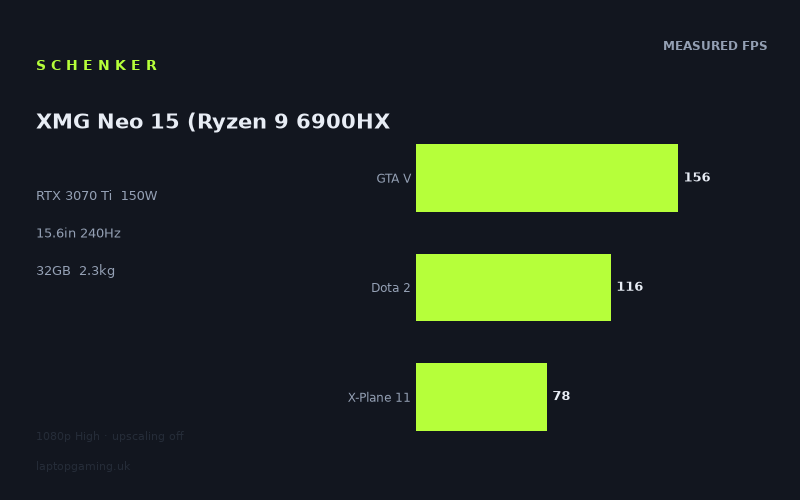
Frame rates
1920×1080, High preset, upscaling off.
Measured on this machine. Source: Notebookcheck, 2022-11-02.
Not scored: incomplete benchmark suite
Every scored laptop on this site is averaged over the same 5 games, and this one is short of Cyberpunk 2077, Baldur's Gate 3. A mean over 4 games is not comparable to a mean over 5, so we publish the figures we have and leave the score blank rather than rank it against machines tested on a different set. The numbers below are real - the suite is just incomplete.
How these numbers were produced
Frame rates here are not measured by us, and we label how each one was arrived at. A figure marked measured comes from a published run on that exact machine. A figure marked representative is derived from the GPU and its power limit (TGP) and cross-referenced against published reviews - a sound estimate of what that configuration delivers, but not a measurement of that specific laptop. Unless stated otherwise, numbers are 1920x1080, High preset, upscaling off. Where a laptop ships in several power configurations we use the wattage of the exact SKU listed, because a 140W RTX 5070 and a 115W one are not the same product.
In use
The short version
The Schenker XMG Neo 15 is a performance-led 15.6in gaming laptop built around a Ryzen 9 6900HX and an RTX 3070 Ti configured with a 150W GPU power limit. The measured data shows a machine that is very fast at 1920x1080 on the High preset with upscaling disabled, but one whose 240Hz, 2560x1440 screen sets a more ambitious target than the published frame rates can consistently meet.
That does not make the screen inappropriate. A 240Hz IPS panel is a strong fit for lighter competitive games and for users who value responsiveness above strict image-quality settings. But the benchmark data makes it clear that buyers should not assume that every demanding game will run anywhere close to the panel’s maximum refresh rate at high settings, especially at the laptop’s native 2560x1440 resolution. The published figures are at 1920x1080, not 2560x1440, so there is no basis for claiming native-resolution performance from the available results.
At the tested settings, the XMG Neo 15 ranges from 78fps in X-Plane 11 to 206fps in Strange Brigade. That is a substantial spread, and it matters more than any single average. It tells you this is not a laptop with one universal performance story. In games that run well with this hardware configuration, it can deliver frame rates that make a high-refresh display genuinely worthwhile. In heavier games, or games that lean harder on CPU performance or simulation work, the same machine is better understood as a smooth high-frame-rate laptop rather than a 240fps machine.
The strongest case for the XMG Neo 15 is therefore for a buyer who wants high frame rates in a comparatively compact 15.6in format, has a use for 32GB of memory, and accepts that the 240Hz display is a ceiling rather than a promise. Strange Brigade, The Witcher 3, GTA V and Dota 2 all produce strong measured results at 1920x1080 High. Dying Light 2 and X-Plane 11 show the other side of the machine: still playable-looking figures on paper, but far below the display’s full refresh rate.
There is no confirmed UK price in the available information. That prevents a proper value judgement. A laptop can be compelling at one price and difficult to recommend at another, especially when it sits among machines carrying RTX 3070, RTX 3080 and RTX 3080 Ti graphics. The performance data is good enough to establish what the XMG Neo 15 can do; it is not enough to say whether it represents good value in the UK without a confirmed price.
It is also important not to force this machine into a ranking that the evidence does not support. The available scoring suite is incomplete because there is no figure for Final Fantasy XV. The comparable scored laptops are averaged across the same full set of games, so this XMG Neo 15 cannot be placed fairly alongside them in that system. Instead, the useful comparison is the direct one: measured frame-rate differences in the games that both machines have results for.
Buy the XMG Neo 15 if the priority is strong 1080p High performance, a high-refresh 1440p panel, 32GB of memory and a 150W RTX 3070 Ti in a 2.268kg package. Be more cautious if the main aim is to run demanding games at the panel’s native resolution while maintaining anything close to 240Hz, if portability means all-day battery use away from mains power, or if buying value depends on a very specific UK budget. There is no confirmed UK price and no measured battery-life figure here, so those parts of the decision remain open.
Performance
A fast result, but not one simple result
Notebookcheck’s measured figures, dated 2022-11-02, use 1920x1080, the High preset and no upscaling. That test condition matters. It removes one major variable from the discussion: the frame rates are not boosted by an upscaling mode. They show the laptop’s performance under a clear, relatively demanding but not maximum-quality setting.
Across the four available scoring-suite games, the XMG Neo 15 averages 139fps. That is a strong result for the settings used, but the average should be treated as a starting point rather than the verdict. An average of 139fps does not mean every game runs around that figure. The difference between 206fps in Strange Brigade and 78fps in X-Plane 11 is large enough that the experience will vary considerably by game.
The full set of available measured frame rates is as follows:
- Strange Brigade: 206fps
- The Witcher 3: 195fps
- GTA V: 156fps
- Far Cry 5: 119fps
- Dota 2: 116fps
- Dying Light 2: 82fps
- X-Plane 11: 78fps
The first point is that this is plainly not a weak RTX 3070 Ti implementation. A 150W GPU power limit places the graphics chip in a configuration intended to prioritise performance rather than a lower-power approach. The measured figures support that interpretation. The laptop reaches 206fps in Strange Brigade and 195fps in The Witcher 3 at the stated 1080p High settings. Those are not marginal gains over basic playability; they are frame rates aimed at a high-refresh experience.
The second point is that a high GPU power limit cannot erase the different demands made by different games. The XMG Neo 15’s results vary from title to title because games do not stress a laptop in the same way. Some are more able to turn GPU power into high frame rates at 1080p. Others are limited more heavily by CPU work, simulation complexity, game-engine behaviour or a mixture of those factors. The published results demonstrate that spread directly.
That is why 206fps in Strange Brigade should not be read as evidence that the laptop is a 200fps machine in general, and 78fps in X-Plane 11 should not be read as evidence that it is struggling across the board. Both results are real and both belong in the buying decision. Someone mainly playing titles that resemble the faster end of this set has a very different reason to buy the XMG Neo 15 from someone spending most of their time in simulation-heavy games.
The 150W RTX 3070 Ti in practice
The RTX 3070 Ti is not the whole story on its own. Laptop GPUs with the same name can be configured differently, and the stated 150W GPU power limit is therefore important context. In this XMG Neo 15, the RTX 3070 Ti is given a high-performance configuration. The benchmark figures show a machine capable of producing very high frame rates in the more accommodating titles in the set.
At 1920x1080 High, Strange Brigade reaches 206fps. That is the closest of the published results to the 240Hz panel refresh rate. It is still below 240fps, so the available figure does not show the panel being fully saturated in this game at the tested settings. It does, however, show that the XMG Neo 15 can get into the kind of performance territory where a 240Hz display is relevant rather than decorative.
The Witcher 3 at 195fps tells a similar story. This is a very high result, comfortably above the frame rates usually associated with basic smoothness, but it remains below the panel’s maximum refresh rate. For a buyer looking at the screen specification and expecting 240fps as a standard outcome, the measured data argues for restraint. Even in one of the strongest results, the laptop does not reach 240fps under the stated test settings.
GTA V at 156fps is another good example of why a 240Hz display can still be useful without being fully driven. A result of 156fps leaves substantial room above a conventional 60Hz experience, yet it is not enough to match a 240Hz panel frame for frame. The benefit here is not that the laptop has demonstrated a locked 240fps result. The benefit is that the display gives the machine room to show more than 60fps or 120fps where the game and settings permit it.
Dota 2 records 116fps. That is a solid figure, but it is also a useful corrective to the assumption that a game commonly associated with competitive play will automatically run at extremely high frame rates on every high-end laptop. The result is well below 240fps and below the 139fps average across the four scoring-suite games. The XMG Neo 15 has enough performance for a high-frame-rate Dota 2 experience at the tested settings, but the published number does not support a claim that it can exploit the panel’s full refresh rate there.
Far Cry 5 sits at 119fps, close to the Dota 2 result. Again, that is a capable high-frame-rate outcome, but it is roughly half the panel’s 240Hz ceiling. For buyers who prefer higher settings and image quality over chasing the largest possible frame-rate counter, this is still an attractive result. For buyers whose buying decision is built around competitive refresh rates, it is a reminder that the screen specification is more ambitious than the measured performance in several games.
Dying Light 2 is measured at 82fps. That is not a disaster; it is a materially lower result than the faster games, but still a figure that suggests a smooth experience rather than a low-frame-rate compromise at the published settings. The important limitation is that 82fps is nowhere near 240Hz. In this type of demanding game, the XMG Neo 15’s screen is better seen as providing flexibility: the option to play at high refresh when settings and game demands allow, rather than a target that the GPU can consistently meet.
X-Plane 11 is the lowest measured result at 78fps. It is also the clearest example of why buyers should inspect individual games rather than relying on a general statement such as “the RTX 3070 Ti is fast”. The laptop is fast, but this title’s result is far removed from Strange Brigade’s 206fps. If X-Plane 11 or similar simulation-focused software is central to the purchase, 78fps is the relevant figure, not the four-game 139fps average and not the highest result in the list.
What the spread says about real buying priorities
The range from 78fps to 206fps is not a small variation that can be ignored. It affects what settings expectations are sensible and how much value the 240Hz screen has for different users. Buyers whose game library resembles Strange Brigade, The Witcher 3 and GTA V have a strong performance case. The XMG Neo 15 has measured results of 206fps, 195fps and 156fps in those games, respectively. Those are high frame rates in practical terms, even though only the first comes close to 240Hz.
Buyers whose priorities sit closer to Dying Light 2 and X-Plane 11 need to look at the machine differently. Here, the frame rates of 82fps and 78fps suggest a laptop that is capable at 1080p High but not one that makes the 240Hz display its defining performance advantage. The screen still has benefits as a high-spec panel, but the measured figures do not show those games approaching its maximum refresh rate.
The middle of the range is equally important. GTA V at 156fps, Far Cry 5 at 119fps and Dota 2 at 116fps show that there is a broad area between “near the display limit” and “well under 100fps”. This is where many gaming laptops live in practice: high frame rates, sometimes very high frame rates, but not universal 240fps operation. The XMG Neo 15 is a strong fit for that category of use.
It is tempting to compress all of this into one statement about the average. The 139fps mean across the four scoring-suite games is useful because it confirms that the laptop is capable of high frame rates overall at 1080p High. But it should not displace the title-by-title results. A buyer who mainly plays GTA V should care that Notebookcheck measured 156fps. A buyer who mainly plays X-Plane 11 should care that the measured figure is 78fps. The average is not a substitute for either.
There is also a limitation in the benchmark set. The available figures do not include Final Fantasy XV. That means the full scoring suite is incomplete and the machine cannot be ranked fairly against laptops with complete five-game averages. This is not a criticism of the XMG Neo 15’s performance; it is a limitation of the available comparison set. It would be misleading to turn a partial average into a direct overall ranking against machines assessed across a complete shared suite.
1080p results are not 1440p results
The XMG Neo 15 has a 2560x1440 display, while all available frame rates were measured at 1920x1080. That distinction should shape the entire performance discussion. The published numbers tell us what the laptop did at 1080p High with upscaling disabled. They do not tell us its measured performance at the native 1440p resolution.
It would be wrong to present the 206fps Strange Brigade result as a native-resolution figure, just as it would be wrong to assume that Dying Light 2 would remain at 82fps when moving from 1920x1080 to 2560x1440. The screen has more pixels than the benchmark resolution, and no measured 1440p figures have been provided. There is no reliable basis here for putting a number on the performance change.
What can be said is more limited but still useful. The 1080p results show that this laptop has enough performance to make resolution and settings choices meaningful. In the faster games, a buyer can reasonably expect to be choosing between prioritising frame rate and prioritising the display’s native resolution or image-quality settings, but the available figures cannot quantify that choice. In the heavier games, the 1080p results already sit well below 240fps, so native-resolution play should not be approached with the assumption that the panel’s maximum refresh will be reached.
The absence of upscaling in the tested configuration is also relevant. These figures are straightforward 1080p High results rather than results dependent on an upscaling setting. That is useful for comparing the game results presented here, but it does not create any evidence about how the laptop would perform with upscaling enabled. Buyers interested in that route should treat it as an unmeasured option rather than a guaranteed answer to native-resolution performance.
The screen
The display specification is one of the XMG Neo 15’s clearest strengths on paper: a 15.6in IPS panel with a 2560x1440 resolution and 240Hz refresh rate. It is a specification aimed at buyers who do not want to choose between a sharp higher-resolution desktop and a fast refresh rate. The complication is not the panel itself. It is matching that panel to the measured gaming performance.
A 2560x1440, 240Hz screen sets a high standard. It offers a native resolution above the 1920x1080 benchmark setting and a refresh rate above every published frame rate for this laptop. Even the best measured result, Strange Brigade at 206fps, remains below 240fps. The Witcher 3 reaches 195fps, GTA V reaches 156fps, and the other available results are lower again.
This means the screen should not be bought on the assumption that the XMG Neo 15 will routinely deliver 240fps in the tested games at High settings. The data simply does not show that. But it would be equally wrong to dismiss the panel because the laptop does not hit 240fps everywhere. High-refresh displays do not become pointless below their maximum rate. The measured results of 206fps, 195fps and 156fps are still well suited to a screen capable of displaying high frame rates.
The more exact conclusion is that the panel gives the XMG Neo 15 headroom. In the fastest games, there is room for very high frame-rate play. In the middle of the benchmark spread, the display can still show more than conventional 60Hz output, even where the machine is not approaching 240fps. In the demanding end of the set, the 240Hz figure becomes less central, because the measured frame rates of 82fps and 78fps are much lower.
The IPS panel type is another positive specification detail, but the available information does not include measured brightness, contrast, colour coverage, response behaviour, backlight behaviour or outdoor visibility. Those are all relevant display characteristics, and none should be inferred from the panel technology alone. IPS identifies the panel type; it does not provide enough information to make claims about image quality beyond that.
The screen’s 15.6in size also matters when considering the 2560x1440 resolution. It is a relatively compact gaming-laptop display rather than a larger desktop-replacement panel. That makes the combination attractive for a buyer who wants a sharper screen without moving to a bigger chassis category. But there are no dimensions in the supplied information, so the exact footprint and thickness cannot be assessed here.
For competitive players, the right interpretation depends heavily on the game. Strange Brigade at 206fps comes closest to making full use of the 240Hz refresh rate, though it still does not reach it in the published measurement. The Witcher 3 at 195fps also lands in a range where the fast panel has a clear purpose. Dota 2 at 116fps is still a high-frame-rate result, but it is not evidence of 240Hz-class performance at the tested settings.
For players of graphically demanding games, the screen gives options rather than certainty. Dying Light 2 at 82fps and X-Plane 11 at 78fps demonstrate that the GPU and game workload can set the practical limit well below 240Hz. Since those figures are already at 1920x1080, there is no measured evidence that native 2560x1440 operation would maintain the same performance. Buyers who need native-resolution figures should not substitute assumption for data.
The most sensible way to view the display is as a premium, flexible panel paired with a GPU that is strongest at 1080p High in the published tests. It is a better match for someone comfortable adjusting settings according to the game than for someone seeking one fixed “native resolution, High settings, 240fps” expectation across everything they play.
Build, size and portability
The XMG Neo 15 weighs 2.268kg. That places a clear physical condition on the purchase: this is a laptop that can be moved, but its performance specification is not packaged as an ultra-light machine. A buyer who needs a gaming laptop to travel between a desk, university, work or another regular location may find that weight manageable. A buyer whose priority is the lightest possible daily-carry machine should take the figure seriously.
There are no dimensions in the available information, so it is not possible to judge the XMG Neo 15’s footprint, thickness, bag friendliness or desk space requirements beyond its 15.6in screen size and stated weight. It would be misleading to describe it as slim, bulky, compact or oversized without those figures.
The 2.268kg weight does, however, sit logically alongside the machine’s performance orientation. This is a laptop carrying a Ryzen 9 6900HX, 32GB of memory, an RTX 3070 Ti with a 150W GPU power limit, and a 15.6in 240Hz 1440p display. The supplied specifications describe a system aimed at delivering gaming performance and a high-spec screen rather than an explicitly minimal-weight design.
The 93Wh battery is substantial in capacity terms, but there is no battery-life measurement in the fact sheet. That distinction matters. Battery capacity is not the same thing as battery runtime. Without a measured result, there is no basis for claiming how long the laptop lasts in gaming, video playback, web use, idle use or any other workload.
For gaming, the safe assumption is simply that no battery gaming frame-rate or runtime figures are available here. The Notebookcheck frame rates are published performance measurements at 1920x1080 High with upscaling disabled, but the supplied information does not specify battery operation for those tests. Buyers who need gaming performance away from mains power should seek battery-specific measurements rather than assuming that the published gaming figures apply unchanged.
The 32GB memory allocation is notable because it gives the laptop more memory than a basic gaming configuration, but the provided data does not include memory speed, memory layout or upgrade information. It is therefore reasonable to say that 32GB is part of the supplied specification, but not to make claims about upgradeability or particular memory-sensitive workloads.
In practical purchasing terms, the XMG Neo 15 makes the most sense as a laptop that may travel but is likely to spend a meaningful amount of time at a desk or mains-powered setup. That is not a criticism. It follows from the combination of 2.268kg weight, a 150W-configured RTX 3070 Ti, a 240Hz display and the lack of any measured battery-life evidence. Buyers seeking desktop-style gaming capability in a system they can move will find that proposition more appealing than buyers seeking a low-weight machine for long unplugged use.
The machine’s portability case is therefore mixed rather than universally strong or weak. The 15.6in format is smaller than a larger gaming-laptop class, while 2.268kg is still a significant weight to carry regularly. The 93Wh battery may be important to some buyers, but without runtime data it should be treated as a specification rather than a proven endurance result.
How it compares
The most useful rival comparisons are direct shared-game comparisons. The available rival data covers machines from the same GPU generation, but they do not all share every benchmark result with the XMG Neo 15. The supplied comparisons therefore use only games both machines hold, with preference given to the scoring-suite titles where possible.
That approach matters because one number cannot capture everything. A large difference against a lower-tier GPU can establish a clear performance separation. A near-zero difference against a higher-tier GPU needs more explanation, particularly at 1080p, where lighter shared titles can become CPU-bound and compress GPU gaps. The figures below should be read as evidence from the shared-game sets, not as complete all-game rankings.
Against the MSI Prestige 15 with RTX 3050 Ti
Against the MSI Prestige 15 with an RTX 3050 Ti configured at 105W, the XMG Neo 15 averages 53fps more across three shared games. That is the largest positive margin among the listed comparisons and it makes the XMG Neo 15’s performance positioning very clear.
The GPU configurations help explain why the XMG Neo 15 is the gaming-focused choice in this pairing. The Schenker uses an RTX 3070 Ti with a 150W GPU power limit, while the MSI has an RTX 3050 Ti at 105W. The XMG Neo 15’s advantage in the shared games is not a token difference. An average lead of 53fps is large enough to affect the class of display and settings target that makes sense.
For a buyer deciding between these two machines on gaming performance alone, the XMG Neo 15 has the stronger case. The measured data supports that plainly. The MSI comparison does not include a confirmed UK price, so it is not possible to say whether the performance advantage is worth any particular price difference. But absent price information, the Schenker’s shared-game lead is substantial.
The comparison also reinforces the importance of GPU power configuration. It is not enough to look only at GPU names. The XMG Neo 15’s 150W RTX 3070 Ti is paired with results ranging as high as 206fps and 195fps in its strongest measured titles. Its direct shared-game advantage over the RTX 3050 Ti system is consistent with a significantly higher gaming-performance tier.
Against the Gigabyte Aero 15 OLED XD with RTX 3070
Against the Gigabyte Aero 15 OLED XD with an RTX 3070, the XMG Neo 15 averages only 1fps more across four shared games. This is effectively a near-level result in the available shared benchmark set.
That does not mean the RTX 3070 Ti and RTX 3070 are identical in every situation, nor does it prove that the two laptops will behave the same in every game or at every resolution. It means that, in the four shared games represented by the supplied data, the XMG Neo 15’s average lead is only 1fps. For a buyer choosing between these two specific machines, there is no convincing shared-game performance advantage large enough to make the decision on its own.
The explanation supplied with the comparison data is important: at 1080p, lighter titles in the shared set can become CPU-bound and compress genuine GPU gaps. In other words, where a game is limited less by GPU throughput, moving to a theoretically stronger graphics configuration may not produce a proportionally higher frame rate. That is why an apparently tiny difference should not be treated as proof that GPU specification never matters; it is a result shaped by the games and test resolution shared between the systems.
For the XMG Neo 15, the practical takeaway is that its RTX 3070 Ti at 150W does not produce a meaningful average shared-game lead over this RTX 3070 rival in the available comparison. A buyer should therefore look beyond that 1fps difference. Screen preferences, weight, memory, battery data if available elsewhere, ports, price and non-gaming requirements would all become more important. In the supplied information, neither machine has a confirmed UK price, so value cannot resolve the comparison either.
Against the Asus ROG Zephyrus G15 with RTX 3080
Against the Asus ROG Zephyrus G15 with an RTX 3080, the XMG Neo 15 averages the same frame rate across three shared games. The listed difference is 0fps.
This is another result that needs interpretation rather than repetition. The XMG Neo 15 does not suddenly become equivalent to every RTX 3080 laptop in every game merely because the average difference in this three-game shared set is 0fps. The stated explanation applies directly: at 1080p, lighter titles in the shared set can be CPU-bound, reducing the visible difference between GPUs that might separate more clearly in other workloads or at other resolutions.
What the result does show is that the XMG Neo 15 is not embarrassed by this RTX 3080 rival in the limited shared-game data. For the games both machines have results for, the Schenker keeps pace. That is a positive performance result for the XMG Neo 15 and consistent with the significance of its 150W RTX 3070 Ti configuration.
It is also a reminder that laptop GPU naming is not a complete buying guide. The RTX 3080 label alone does not guarantee a decisive measured advantage in every comparison. The XMG Neo 15’s actual benchmark numbers, and the direct shared-game comparison, are more useful than a simple tier list based only on GPU names.
There is no confirmed UK price for the Zephyrus G15 in the supplied information, so no price-performance conclusion can be drawn. If the two machines were being considered strictly from the three shared games, the XMG Neo 15 would not be the slower choice on the available evidence. Beyond that limited set, the data does not justify broader claims.
Against the Asus ROG Strix Scar 17 SE with RTX 3080 Ti
The clearest machine above the XMG Neo 15 in the supplied comparison spread is the Asus ROG Strix Scar 17 SE with an RTX 3080 Ti configured at 150W. The Schenker averages 40fps fewer across four shared games.
This is a meaningful deficit, not a near-zero result that can be explained away by 1080p CPU limits. The XMG Neo 15 is strong, but the shared-game numbers show that the 150W RTX 3080 Ti system sits in a higher performance position across the available four-game comparison.
The fact that both machines have a stated 150W GPU power limit is useful context. It removes one obvious explanation based purely on a lower stated GPU power configuration. The RTX 3080 Ti machine still holds the average advantage of 40fps in the shared games. For buyers who want the highest possible gaming performance from this generation and are comparing these two machines specifically, the Scar 17 SE has the stronger benchmark case.
That does not erase the XMG Neo 15’s own strengths. The Schenker’s 206fps Strange Brigade result, 195fps Witcher 3 result and 156fps GTA V result remain strong. But they exist below the higher ceiling demonstrated by the RTX 3080 Ti rival in the direct shared-game comparison.
The key decision is whether the buyer needs that additional performance. For someone whose main use is high-refresh 1080p gaming in the titles where the XMG Neo 15 is already producing well above 100fps, a 40fps shared-game deficit may matter less than other aspects of the package. For someone trying to drive a 2560x1440 screen more aggressively in demanding games, the stronger RTX 3080 Ti comparison is more relevant. No native-resolution figures are available for either comparison here, so that remains a directional judgement rather than a measured 1440p claim.
Again, there is no confirmed UK price for the Scar 17 SE in the supplied information. That stops the most important final step: deciding whether the extra performance is worth the additional cost. The performance hierarchy is clear in the shared games. The value hierarchy is not.
Who it’s for
The Schenker XMG Neo 15 is for buyers who want a capable high-frame-rate gaming laptop without moving to a larger screen class, and who understand that the best evidence available is at 1920x1080 High rather than native 2560x1440. It is especially well suited to someone whose game library includes titles where the published results are strongest: Strange Brigade at 206fps, The Witcher 3 at 195fps and GTA V at 156fps.
It is also a sensible choice for a buyer who values a 240Hz panel as headroom rather than as a fixed performance guarantee. The display can make good use of the faster end of the XMG Neo 15’s measured performance, even though the published figures do not reach 240fps. The machine has enough speed to make a high-refresh panel meaningful in several games, and the IPS 2560x1440 specification offers a more ambitious screen than a basic 1080p display.
The 32GB memory specification may also appeal to buyers who want more than a minimal memory allocation in their gaming laptop. The supplied information does not provide upgrade details or workload-specific memory measurements, but 32GB is part of the configuration and should be attractive to buyers who want that capacity from the outset.
The XMG Neo 15 is less suitable for someone buying specifically to run every demanding game at the panel’s native 2560x1440 resolution and 240Hz. There are no measured 1440p frame rates, and none of the available 1080p figures reaches 240fps. The data supports a high-performance gaming laptop; it does not support a universal 1440p, 240fps claim.
It is also not the obvious choice for a buyer focused on the highest frame-rate ceiling available from this GPU generation. The ROG Strix Scar 17 SE with a 150W RTX 3080 Ti is ahead by an average of 40fps across four shared games. If raw performance is the overriding priority, that rival has the stronger evidence. Whether it is worth choosing depends on price and other factors, but the performance lead itself is clear.
Buyers who want the lightest possible laptop should also look elsewhere or at least seek more physical information before committing. At 2.268kg, the XMG Neo 15 is portable in the literal sense, but it is not a low-weight machine. There are no dimensions supplied, so the practical bulk cannot be judged in detail. Likewise, the 93Wh battery should not be mistaken for a proven battery-life result, because no runtime measurement is available.
Finally, buyers who need to make a strict value decision should wait for or obtain a confirmed UK price. The performance evidence is detailed enough to establish the XMG Neo 15 as a strong 1080p High gaming laptop with a wide title-by-title range. It is not detailed enough to say whether it is a bargain, fairly priced or expensive in the UK. With no confirmed price, the right conclusion is performance-focused rather than value-focused.
Overall, the XMG Neo 15 is best understood as a powerful 15.6in gaming laptop whose 150W RTX 3070 Ti delivers excellent results in favourable games, strong high-frame-rate performance in much of the published set, and more modest results in the most demanding examples. Its 240Hz 1440p IPS display is a premium feature with real headroom, but the benchmark data advises against treating it as a promise of 240fps gaming. Buy it for strong measured 1080p High performance and a high-spec display; buy something else if native-resolution 240Hz gaming, low carry weight, proven battery life or confirmed UK value is the non-negotiable requirement.