Review
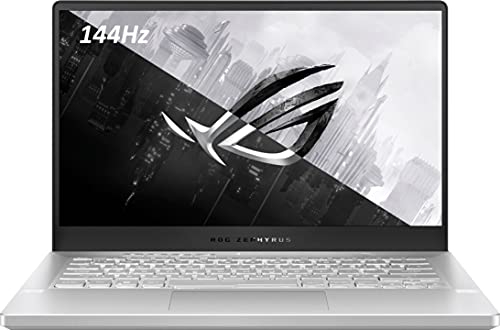
Asus Zephyrus G14 review
Frame rates
1920×1080, High preset, upscaling off.
Measured on this machine. Source: Notebookcheck, 2021-06-29.
Not scored: incomplete benchmark suite
Every scored laptop on this site is averaged over the same 5 games, and this one is short of Cyberpunk 2077, Baldur's Gate 3. A mean over 5 games is not comparable to a mean over 5, so we publish the figures we have and leave the score blank rather than rank it against machines tested on a different set. The numbers below are real - the suite is just incomplete.
How these numbers were produced
Frame rates here are not measured by us, and we label how each one was arrived at. A figure marked measured comes from a published run on that exact machine. A figure marked representative is derived from the GPU and its power limit (TGP) and cross-referenced against published reviews - a sound estimate of what that configuration delivers, but not a measurement of that specific laptop. Unless stated otherwise, numbers are 1920x1080, High preset, upscaling off. Where a laptop ships in several power configurations we use the wattage of the exact SKU listed, because a 140W RTX 5070 and a 115W one are not the same product.
In use
The short version
The Asus Zephyrus G14 (GA401QM) is an unusually portable gaming laptop built around an RTX 3060, a Ryzen 9 5900HS, 16GB of memory, a 1TB SSD and a 14in 1920x1080 IPS display. At 1.68kg, it is the sort of machine that makes sense for someone who genuinely wants to carry a gaming-capable laptop rather than leave it on a desk. That is the strongest part of its case. The problem is the UK price: GBP 2,132 is exceptionally hard to justify from the benchmark data available here.
Notebookcheck’s measured figures show that this is still a capable 1080p gaming machine. At the stated High preset with upscaling off, it reaches 138fps in Strange Brigade, 134fps in GTA V, 128fps in The Witcher 3 and 115fps in Dota 2. Those are good results for a 14in laptop with a 144Hz screen, particularly in the less demanding and older games represented by Strange Brigade, GTA V and Dota 2. The five-game scoring-suite mean is 104fps, which supports the basic claim that the G14 can deliver high-refresh-rate gaming in some titles rather than merely offering a 144Hz panel on paper.
That average should not be mistaken for a promise of 104fps in every game. Final Fantasy XV runs at 69fps and X-Plane 11 reaches 62fps under the same stated conditions. Both are comfortably playable figures, but neither is remotely close to making full use of a 144Hz panel. The gap between 138fps in Strange Brigade and 62fps in X-Plane 11 is not a flaw in the data; it is the important story. Gaming performance is game-dependent, and this G14 sits in the range where lighter titles can feel very fast while heavier or more demanding titles may call for lower settings if the owner values frame rate over image quality.
The 80W GPU power limit is central to understanding the machine. “RTX 3060” is not, by itself, enough information to predict gaming performance in a laptop. This G14’s RTX 3060 operates at an 80W limit, while the MSI GF65 Thin listed for comparison uses an RTX 3060 at 130W. A higher power limit can give a GPU more scope in workloads where graphics performance is the main limiting factor. Yet the shared-game comparison puts the Asus only 4fps ahead of that MSI across five games. That is not evidence that 80W and 130W RTX 3060 configurations are inherently equivalent. It is evidence that, in this particular shared selection of 1080p games, lighter and CPU-limited results compress the visible difference between machines.
At this price, that distinction matters. The G14 is not a bad gaming laptop because it fails to produce respectable frame rates. It is a poor purchase for a buyer whose priority is maximum gaming output per pound. The available comparison data shows that a similarly branded RTX 3060 machine with a much higher 130W limit can sit very close in shared 1080p results while costing GBP 1,737. The Zephyrus therefore needs to be bought for its 1.68kg weight, compact 14in format and balance of gaming capability with mobility, not because its price represents a rational route to the highest measured frame rate.
There is a narrower buyer for whom the G14 remains coherent. It suits someone who wants one laptop for travel, study, work or general daily use as well as gaming, values a 14in screen over a larger chassis, and is content with strong rather than class-leading gaming performance. That buyer should also understand that the 76Wh battery capacity is a specification, not a tested battery-life result: no battery runtime is provided here, so it would be wrong to promise all-day use or a particular number of hours away from mains power.
For everyone else, the price is the obstacle. If portability is secondary and gaming is the main purpose, a buyer should be looking at alternatives rather than paying GBP 2,132 for this configuration. The benchmark figures below do not suggest a machine that is inadequate. They suggest one whose performance is not sufficiently exceptional to make the asking price persuasive.
Performance
The measured results
Notebookcheck measured the Asus Zephyrus G14 at 1920x1080 using the High preset with upscaling off, with the source dated 2021-06-29. That test configuration is useful because it matches the laptop’s native 1920x1080 display resolution and avoids treating upscaling as native GPU performance. The results are as follows:
- Strange Brigade: 138fps
- GTA V: 134fps
- The Witcher 3: 128fps
- Dota 2: 115fps
- Final Fantasy XV: 69fps
- X-Plane 11: 62fps
The mean across the five scoring-suite games is 104fps. That is an encouraging number in isolation, but the individual results are more useful than the mean when deciding whether the machine fits a particular player. A laptop that averages 104fps by combining several high-frame-rate results with a couple of results in the sixties behaves very differently from one that stays close to 104fps in every title. The G14 is clearly the former.
Strange Brigade at 138fps is the closest measured result to the screen’s 144Hz refresh rate. It is not quite 144fps, but it is close enough that the 144Hz panel is relevant rather than ornamental in this game. GTA V at 134fps and The Witcher 3 at 128fps are also high-refresh results. Neither exactly matches 144Hz, but both are far above the traditional 60fps target and should appeal to players who notice the difference between a game running around 60fps and one running well above 100fps.
Dota 2 reaches 115fps. That is below the panel’s maximum refresh rate, but it is still a high frame rate and gives the screen’s 144Hz capability practical value. It would be unreasonable to describe 115fps as “full 144Hz gaming”, because it is not. It is equally unreasonable to dismiss it as ordinary 60fps performance. The distinction is worth making because gaming-laptop marketing often treats a 144Hz display as if every game will automatically run at 144fps. Notebookcheck’s figure shows a more realistic outcome: the G14 can operate in a high-refresh range in Dota 2, though the measured result does not saturate the panel.
Final Fantasy XV at 69fps changes the picture. At 69fps, the game is above 60fps, so the result is not a failure for a 1080p gaming laptop. It is, however, far from the panel’s 144Hz ceiling. A buyer interested primarily in this kind of more demanding game should think of the Zephyrus G14 as a machine that can deliver a conventional smooth 1080p experience at the measured settings, not one that guarantees very high refresh in every modern-looking game.
X-Plane 11 is measured at 62fps. Again, that is close to the familiar 60fps threshold and should not be described as poor. But it reinforces the same point: a 144Hz panel does not remove the need to be realistic about the workload. The G14 is capable of very high frame rates in some games and around-60fps results in others. A buyer choosing it on the basis of the 144Hz specification should look most closely at the games they actually play, not at the highest result in the list.
What the 80W RTX 3060 means
The RTX 3060 name tells only part of the story. The specified GPU power limit is 80W, and that specification belongs in any serious assessment of this model. Laptop graphics chips are not interchangeable simply because they carry the same GPU name. The power limit is part of the configuration, and it helps explain why a thin, light 14in machine needs to be considered differently from larger gaming laptops with the same nominal GPU.
The important practical point is not that 80W is automatically inadequate. Notebookcheck’s measured figures make clear that it is not. This G14 reaches 138fps in Strange Brigade, 134fps in GTA V, 128fps in The Witcher 3 and 115fps in Dota 2 at native 1920x1080 resolution, High settings and with upscaling disabled. An 80W RTX 3060 can therefore produce genuinely strong results in the right games. A buyer moving from integrated graphics or a lower-tier gaming laptop would not look at these figures and conclude that the G14 lacks gaming ability.
Instead, the 80W limit sets expectations around consistency and headroom. The machine is built around portability, with a 1.68kg weight and 14in display, rather than around extracting every possible frame from the GPU. That trade-off does not require speculation about cooling performance, noise or temperatures; no measured figures for those are available here. The specification alone tells us that this is not a 130W RTX 3060 configuration. It is an 80W configuration in a machine designed to be much easier to carry than a typical larger gaming laptop.
When a game is heavily GPU-limited, power configuration can matter greatly. But the shared comparisons show why it is dangerous to take one specification and turn it into a universal performance prediction. The MSI GF65 Thin has an RTX 3060 at 130W, yet the Asus averages 4fps ahead across five shared games. At first glance, that looks counter-intuitive. The supplied comparison context explains it: at 1080p, lighter titles in the shared set can be CPU-bound and compress genuine GPU differences. In other words, a faster or higher-powered graphics configuration cannot always pull away when the graphics chip is not the main limiting factor in a given game and test scenario.
This is also why the G14’s average should not be used to claim that it offers the same graphics capability as every higher-power RTX 3060 laptop. The benchmark set is a set of specific games under specific settings. It reveals the outcome in those games. It does not erase the 80W specification or demonstrate that GPU power is irrelevant. A buyer should read the 4fps lead over the 130W GF65 Thin as a reminder to compare measured games, not as a reason to assume that every RTX 3060 laptop performs alike.
The spread matters more than a single headline number
There is a 76fps gap between the highest measured result, 138fps in Strange Brigade, and the lowest, 62fps in X-Plane 11. That is a substantial spread. It is the clearest reason not to reduce the G14 to its five-game mean of 104fps. The mean is useful for broad comparison, but it cannot tell a player whether their preferred game will resemble Strange Brigade or X-Plane 11.
For competitive or fast-paced games where high frame rates are a priority, the results in Strange Brigade, GTA V, The Witcher 3 and Dota 2 are the encouraging part of the data. Strange Brigade’s 138fps is close to the panel’s 144Hz limit. GTA V at 134fps and The Witcher 3 at 128fps remain close enough to make the high-refresh display worthwhile. Dota 2 at 115fps is further below 144fps but still well above 60fps.
For games that are more demanding in the measured configuration, the laptop looks more like a conventional 60fps-class machine. Final Fantasy XV at 69fps and X-Plane 11 at 62fps are both playable results, but they leave a large portion of the display’s refresh capability unused. This is not a contradiction. A 144Hz gaming laptop does not need to reach 144fps in all games to be useful. It does mean that buyers should separate two ambitions: owning a portable laptop with a fast screen, and expecting every game to run at the screen’s maximum refresh.
The test settings matter too. These figures are for High preset, at 1920x1080, with upscaling off. They are not ultra-preset figures, and they are not figures boosted by an upscaling mode. That makes them a clean basis for comparison, but it also means that anyone demanding higher results in Final Fantasy XV or X-Plane 11 would need to make their own settings choices. No alternative-preset or upscaling results are supplied here, so there is no factual basis for claiming a particular improvement from reducing settings or enabling an upscaling method.
The Ryzen 9 5900HS is part of the configuration, and the supplied comparison notes explicitly identify CPU-bound behaviour as relevant to some shared 1080p results. That should be interpreted carefully. It does not mean every measured game is CPU-bound, and it does not mean the CPU can be credited with a known number of extra frames. It means that in lighter titles, at this resolution, the processor can become a meaningful constraint and reduce the apparent separation between otherwise different graphics configurations. That is one reason an 80W RTX 3060 G14 can compare surprisingly well with a 130W RTX 3060 laptop across a selected shared set.
What performance buyers should take from the data
The G14 is not a machine for a buyer who wants to set a game to a demanding preset and assume that the 144Hz display will always be fully utilised. Notebookcheck’s figures do not support that promise. It has one result at 138fps, one at 134fps, one at 128fps and one at 115fps, but it also has results at 69fps and 62fps. The measured data supports “high frame rates are possible in several games”; it does not support “144fps is standard”.
It is also not sensible to dismiss the laptop because its graphics power limit is 80W. The actual results are too strong for that. The correct reading is more nuanced: the G14 has enough gaming performance to be a serious 1080p gaming laptop, but it packages that performance within a portable design and charges a premium price for the package. The question is not whether 138fps or 128fps is good. They clearly are useful results. The question is whether those results, plus the 1.68kg weight, are worth GBP 2,132 to the individual buyer.
For someone who already knows that their games resemble the higher-performing end of the list, the answer may be more favourable. For someone focused on games closer to Final Fantasy XV or X-Plane 11 in demand, the price becomes much tougher to defend. Those users are paying for a 144Hz screen but may often operate well below 144fps at the supplied settings. They should prioritise a machine with stronger value or a configuration that provides more graphics headroom, even if it is heavier.
The screen
The Zephyrus G14 has a 14in, 1920x1080 IPS panel with a 144Hz refresh rate. This is a sensible specification for the performance level shown in the benchmark data. At 1920x1080, the screen does not ask the RTX 3060 to render more pixels than the measurements already cover, because Notebookcheck’s figures are also at 1920x1080. There is no need to guess how the laptop behaves at its native resolution: the benchmark data is already aligned with it.
The 14in size is a trade-off rather than an unqualified advantage. It helps create a laptop that weighs 1.68kg, which is the central portability appeal of the G14. But it also means the gaming display is physically smaller than the screens on many larger gaming laptops. Whether that is acceptable depends on how the machine will be used. A buyer who mostly plays at a desk may prefer a larger screen even if it means accepting more weight. A buyer who needs a machine that travels regularly may find the smaller panel a fair price to pay for the lighter chassis.
The 144Hz refresh rate is meaningful, but only in the games where the GPU and CPU can deliver high enough frame rates. Strange Brigade reaches 138fps, which comes close to the panel’s maximum. GTA V at 134fps and The Witcher 3 at 128fps are also in the territory where a 144Hz panel has a clear practical purpose. Dota 2 at 115fps does not fill all 144 refresh opportunities each second, but it remains a high-frame-rate result that can benefit from a fast display.
Final Fantasy XV at 69fps and X-Plane 11 at 62fps are different cases. The screen still works perfectly well at those frame rates, but its 144Hz maximum is not being exploited to the same degree. A potential buyer should not see “144Hz” and assume a universal 144fps experience. The actual measurement list shows a mixed outcome: close to the panel limit in Strange Brigade, broadly high-refresh performance in GTA V, The Witcher 3 and Dota 2, then performance nearer 60fps in Final Fantasy XV and X-Plane 11.
The IPS panel type tells us the panel technology, but it does not provide enough information to make claims about brightness, contrast, colour coverage, response times, backlight behaviour or outdoor usability. None of those measurements are included in the fact sheet. It would be especially misleading to claim that this is a display for colour-critical work, that it is especially bright, or that it has a particular response-time quality without measured evidence. The defensible conclusion is narrower: it is a 14in IPS display at 1920x1080 with a 144Hz refresh rate, and the benchmark figures show that the laptop can make meaningful use of that refresh rate in several games.
The resolution is also appropriate for the machine’s measured performance. At 1920x1080 and High settings with upscaling off, the G14 ranges from 62fps to 138fps in the listed games. A higher-resolution screen would require separate benchmark data before making any claim about expected gaming performance. The native 1080p panel therefore has a practical advantage in this review: the supplied figures directly describe how the laptop performs at its own screen resolution rather than forcing the buyer to infer a result from a different test resolution.
There is a temptation to regard 1080p as modest at a GBP 2,132 price, particularly when the laptop is sold as a premium portable model. That criticism has some force if screen resolution is a buyer’s highest priority. However, a higher resolution would not automatically improve the gaming experience if it reduced frame rates substantially. The G14’s 1080p panel aligns with its RTX 3060 and 80W power limit more realistically than a more demanding native resolution would. The issue is not that 1920x1080 is unsuitable for the hardware. The issue is that the overall price demands a very strong case elsewhere, and the screen specification alone does not create that case.
For players who value smooth motion over maximum resolution, the G14’s combination of 1080p and 144Hz is sensible. The measured figures provide genuine support for that view in Strange Brigade, GTA V, The Witcher 3 and Dota 2. For players who spend most of their time in games closer to Final Fantasy XV and X-Plane 11, the panel will still be perfectly serviceable, but the principal benefit becomes potential headroom in lighter games rather than a constant 144fps experience.
Build, size and portability
The specification that most clearly separates the Zephyrus G14 from many gaming laptops is its 1.68kg weight. That is not a minor detail in a category where performance often comes with a much larger, heavier system. The G14’s 14in display and 1.68kg weight make it fundamentally more plausible as a laptop that travels between home, work, university, meetings or other regular destinations. This is the machine’s most credible premium feature.
It is important to be precise about what the available information does and does not establish. The fact sheet gives the weight, but it does not provide dimensions. Therefore, it is fair to say that 1.68kg is comparatively easy to carry for a gaming-capable laptop; it is not fair to claim a particular bag fit, footprint or thickness. Equally, there are no published measurements here for chassis rigidity, keyboard quality, trackpad quality, fan noise or surface temperatures. Those are relevant aspects of ownership, but they cannot be filled in with assumptions simply because the machine belongs to a premium-looking product line.
The 14in screen is directly connected to the portability proposition. A smaller screen generally makes more sense for someone carrying a laptop regularly than for someone who will always use it on a desk. The Zephyrus is not trying to be a large-screen desktop replacement. Its hardware selection makes that clear: a Ryzen 9 5900HS paired with an RTX 3060 at 80W, 16GB of memory, a 1TB SSD and a 14in 144Hz screen. The result is a configuration aimed at fitting substantial gaming capability into a lighter package.
That does not mean portability should be treated as an excuse for any price. A buyer who only occasionally moves their laptop can save money by considering less portable alternatives. In this case, the price premium is substantial enough that the 1.68kg weight needs to matter in real life. If the laptop is going to sit next to an external monitor and rarely leave the desk, the G14 gives up too much value. Its benchmark performance is good, but the data does not show it beating larger or higher-power rivals by enough to make the price rational for stationary use.
The 76Wh battery capacity is another relevant mobility specification. It is useful to know that the laptop has a 76Wh battery, but capacity is not runtime. Battery life varies according to workload, display behaviour, power settings and other factors, and no measured battery result is supplied here. A buyer should therefore not make a purchase decision based on an assumed number of hours. The only supported statement is that the G14 includes a 76Wh battery.
Memory and storage fit the laptop’s broad-purpose role. It has 16GB of memory and a 1TB SSD. Those are useful specifications for a machine that is expected to handle gaming alongside general computing. But the fact sheet provides no storage-speed measurements, no upgrade information and no detailed memory configuration beyond the 16GB capacity. It would be wrong to imply a particular SSD performance level or upgrade path. The positive case is simply that the supplied configuration is not restricted to a small storage capacity or a low memory figure.
Portability also changes the way the performance results should be judged. A desktop-replacement gaming laptop may be expected to pursue the highest possible graphics output, particularly if it has a larger chassis and higher GPU power limit. The G14’s job is different. Its 80W RTX 3060 reaches 138fps in Strange Brigade, 134fps in GTA V, 128fps in The Witcher 3 and 115fps in Dota 2 while the laptop weighs 1.68kg. That combination has real appeal for an owner who refuses to choose between carrying a light laptop and playing games properly at 1080p.
The mistake would be to turn that appeal into a blanket recommendation. A light gaming laptop is valuable only to someone who benefits from it being light. If a buyer needs a larger display, wants the strongest possible graphics performance, or will mostly use the laptop in one location, the G14’s small-screen, 80W approach becomes a compromise rather than a benefit. The machine makes most sense when portability is not merely a pleasant extra but a requirement.
How it compares
Against the MSI Prestige 15
The MSI Prestige 15 is listed with an RTX 3050 Ti at 105W and no confirmed UK price. Across four shared games, the Asus Zephyrus G14 averages 41fps ahead. That is the largest positive margin among the listed rivals and gives the clearest performance evidence in favour of the G14.
A 41fps shared-game advantage is substantial. It indicates that the G14’s RTX 3060 configuration is in a materially stronger gaming position than this particular RTX 3050 Ti competitor in the available shared results. It is especially useful evidence because it prevents the G14 from being dismissed merely as an expensive lightweight laptop. The measured data shows that it has considerably more gaming output than at least one portable rival from the same GPU generation.
However, the missing UK price matters. Without a confirmed UK price for the Prestige 15, there is no defensible value comparison in pounds. The G14 may be faster across the four shared games, but the buyer cannot use the available facts to calculate whether that extra performance costs a sensible amount. The correct conclusion is performance-led: the G14 is clearly ahead in the shared benchmark selection. It is not possible to say whether it is better value than the Prestige 15.
Against the MSI GF65 Thin
The MSI GF65 Thin is the most revealing comparison because it has the same RTX 3060 GPU name but a different power limit. The GF65 Thin uses an RTX 3060 at 130W and is listed at GBP 1,737. The G14 uses an RTX 3060 at 80W and is listed at GBP 2,132. Across five shared games, the Asus averages 4fps ahead.
The 4fps result is close enough that it should not be exaggerated into a decisive performance victory. It is a real result, but it is not a margin that establishes the G14 as fundamentally faster. The supplied comparison note is important here: at 1080p, lighter titles in the shared set can be CPU-bound and compress genuine GPU gaps. That is the likely reason this 80W RTX 3060 can appear slightly ahead of a 130W RTX 3060 across this particular selection.
The practical conclusion is that buyers should not shop solely by GPU power limit, but neither should they ignore it. The shared benchmark average does not show the higher-power GF65 Thin pulling ahead in these games. Yet the G14’s small lead is not enough to justify paying GBP 2,132 on gaming performance alone when the GF65 Thin is GBP 1,737. The Asus costs GBP 395 more while the shared-game result is effectively very close.
This is where the G14’s portability argument has to carry the decision. At 1.68kg with a 14in display, the Asus is designed around a different kind of ownership than a laptop selected mainly for desktop gaming. If that lighter, smaller form is essential, the price difference may be acceptable to an individual buyer. If gaming performance and price are the priorities, the GF65 Thin comparison is damaging to the G14. The available data offers no reason to pay the Asus premium for frame rate.
Against the Acer Aspire Nitro 5
The Acer Aspire Nitro 5 is listed with an RTX 3060 and no confirmed UK price. Across five shared games, the Asus averages 2fps behind. This is another near-zero result, and it needs the same careful reading as the GF65 Thin comparison.
A 2fps deficit across five games is too small to support a broad claim that the Nitro 5 is dramatically faster. The G14 is not being comprehensively outclassed in the shared set. At 1080p, especially in lighter games, CPU limits can reduce the visible difference between machines and make GPU configuration differences less obvious. The result is useful precisely because it is so close: it shows that the G14’s 80W RTX 3060 remains competitive in a selection of shared 1080p tests.
But there is no confirmed UK price for the Nitro 5, so the comparison cannot settle value. If the Nitro 5 were dramatically more expensive, a 2fps lead would be unimportant. If it were much cheaper, the G14’s position would become harder still. The fact sheet does not permit either conclusion. What it does permit is a performance conclusion: the two are essentially in the same broad territory across the five shared games, with the Acer narrowly ahead.
For a buyer choosing between the two, non-benchmark considerations would normally matter a great deal. Here, the only directly supplied portability figure is the G14’s 1.68kg weight. No Nitro 5 weight is supplied, so it would be wrong to quantify or assert a specific portability advantage against it. The G14’s own light weight remains a strong point, but this comparison should not invent an unsupported physical comparison.
Against the MSI Raider GE77 HX
The MSI Raider GE77 HX represents the opposite end of the listed spread. It has an RTX 3080 Ti at 175W and no confirmed UK price. Across five shared games, the Asus Zephyrus G14 averages 66fps behind. This is the clearest indication of what the G14 is not: it is not a maximum-performance gaming machine intended to compete with a much higher-power RTX 3080 Ti system.
A 66fps average gap is large enough that it cannot be explained away as a minor benchmark variation or a quirk of one title. The Raider’s RTX 3080 Ti at 175W belongs to a substantially more performance-oriented configuration than the G14’s RTX 3060 at 80W. The Zephyrus can be praised for delivering 138fps in Strange Brigade and 128fps in The Witcher 3, but those figures do not put it in the same performance category as the Raider across the shared games.
This comparison is useful because it sets an honest ceiling on the G14’s ambitions. Buyers who want the greatest possible frame rates, who play demanding games at high settings and who want maximum headroom should choose a different type of laptop. The G14’s value lies in carrying gaming capability in a 1.68kg machine, not in challenging far higher-power hardware.
There is no confirmed UK price for the Raider GE77 HX, so there is no price comparison to make. It would be wrong to call the Raider better or worse value without that information. The performance case is straightforward, though: it is far ahead in the shared games. The G14 should be considered only by buyers who value portability enough to accept a much lower performance ceiling.
What the rival spread tells us
The four rivals describe the G14’s position better than a single ranking could. It is 41fps ahead of the RTX 3050 Ti MSI Prestige 15 across four shared games. It is 4fps ahead of the RTX 3060 130W MSI GF65 Thin across five shared games. It is 2fps behind the RTX 3060 Acer Aspire Nitro 5 across five shared games. It is 66fps behind the RTX 3080 Ti 175W MSI Raider GE77 HX across five shared games.
That pattern tells us that the G14 is a capable upper-mid-range portable gaming machine rather than a performance leader. It can clearly separate itself from a lower-tier RTX 3050 Ti rival. It can trade closely with other RTX 3060 laptops in shared 1080p games, even where their GPU power configurations differ. And it cannot approach the output of a 175W RTX 3080 Ti machine.
The close RTX 3060 results should also make buyers more disciplined about shopping. A GPU label alone is insufficient. The G14’s 80W RTX 3060 sits 4fps ahead of a 130W RTX 3060 GF65 Thin in the supplied five-game average, then 2fps behind an RTX 3060 Aspire Nitro 5. Those are not contradictions. They are a reminder that game selection, 1080p CPU limits and the rest of the laptop configuration affect real results. Measured shared-game data is more useful than assumptions drawn from GPU names alone.
Unfortunately for the G14, the price is the one area where the comparison is most concrete. The GF65 Thin has a confirmed UK price of GBP 1,737, while the Asus costs GBP 2,132. With only a 4fps shared-game advantage for the Asus, the G14 cannot make a performance-per-pound case against that particular rival. Its defence is portability, not benchmark dominance.
Who it’s for
Buy it if portability is the priority
The Asus Zephyrus G14 is for the buyer who wants gaming performance but refuses to carry a conventional large gaming laptop. At 1.68kg, it has a credible mobility advantage as a product category proposition. The 14in display reinforces that role, and the 76Wh battery capacity is a useful specification for a machine intended to be used away from a desk, although no battery-life claim can be made from capacity alone.
It is also for someone who plays a mixture of games and understands that performance will vary. If Strange Brigade, GTA V, The Witcher 3 or Dota 2 are representative of the buyer’s library, the measured results are appealing: 138fps, 134fps, 128fps and 115fps respectively. These are the figures that make the 144Hz screen worthwhile. The G14 can offer a high-refresh experience in several games while remaining a 1.68kg machine.
The laptop also suits a buyer who is happy with a 14in 1920x1080 display and values the direct match between native resolution and measured benchmark resolution. There is no uncertainty about whether the quoted game results require dropping below the panel’s native resolution. They do not: Notebookcheck’s numbers are at 1920x1080, the same resolution as the display.
A buyer who specifically wants a portable system with 16GB of memory and a 1TB SSD may also find the configuration sensible. The G14 is not presented here as a stripped-back portable with limited storage or minimal memory. It combines those capacities with a Ryzen 9 5900HS and RTX 3060, giving it the specifications of a serious all-round laptop rather than a machine designed only for light tasks.
Do not buy it for value-led gaming
The G14 is not for the buyer who wants the best gaming performance for GBP 2,132. The available evidence does not support that purchase. The five-game mean of 104fps is solid, but it is not extraordinary enough to overcome the price. The more revealing direct comparison is the MSI GF65 Thin: it costs GBP 1,737, uses an RTX 3060 at 130W, and the G14 averages only 4fps ahead across five shared games.
That does not mean the GF65 Thin is automatically the better laptop for every person. It means the G14’s extra cost cannot be defended by shared-game performance. A buyer who rarely carries their laptop should not pay a large premium for the G14’s 1.68kg weight. They should put the money towards better performance, a larger display, or simply spend less, depending on their priorities.
The G14 is also not for the player who expects 144fps in demanding games simply because the screen is 144Hz. Final Fantasy XV at 69fps and X-Plane 11 at 62fps are the relevant reality check. Those results are playable, but they are not high-refresh-panel-saturating results. A buyer whose main concern is maintaining the highest possible frame rates in demanding games should choose a more performance-focused configuration than an 80W RTX 3060.
It is not for someone seeking the performance class represented by the MSI Raider GE77 HX either. The Raider averages 66fps ahead across five shared games, and its RTX 3080 Ti operates at 175W rather than 80W. The two machines are aimed at different priorities. The G14 is the portable choice; the Raider comparison shows what much greater graphics emphasis can deliver. Anyone who wants that level of output should not expect a 1.68kg 14in laptop to be the right answer.
The final buying advice
The Asus Zephyrus G14 is a convincing portable 1080p gaming laptop and an unconvincing GBP 2,132 value proposition. Both statements can be true at once. Notebookcheck’s measured figures show that it can deliver excellent results in several games, including 138fps in Strange Brigade, 134fps in GTA V, 128fps in The Witcher 3 and 115fps in Dota 2. The 14in 144Hz IPS screen is therefore not wasted, especially for players whose games behave more like the higher-performing results.
At the same time, the 69fps result in Final Fantasy XV and 62fps result in X-Plane 11 show the limits of the configuration. The 80W RTX 3060 is capable, but it is not a universal route to 144fps at High settings. The 104fps mean across the five scoring-suite games is useful context, yet the wide game-to-game range is more important for a real purchase decision.
The G14 should be bought by the person for whom 1.68kg, a 14in format and gaming competence in one machine are worth paying extra for. It should not be bought by someone sitting at a desk most of the time, someone who wants the highest possible frame rates, or someone comparing only gaming performance against the GBP 1,737 MSI GF65 Thin. In those cases, the data makes the Asus look expensive rather than exceptional.
Its best argument is simple: this is a lightweight laptop that can still produce 138fps, 134fps, 128fps and 115fps in several measured 1080p games. Its worst argument is equally simple: at GBP 2,132, those results do not make it a sensible value choice. Buy the Zephyrus G14 for mobility first and gaming second. If the order is reversed, look elsewhere.