Review
Asus Strix Scar 17 review
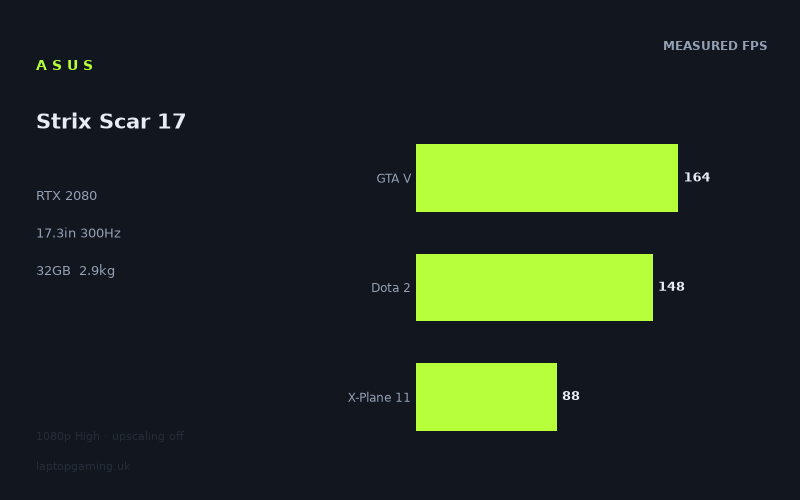
Frame rates
1920×1080, High preset, upscaling off.
Measured on this machine. Source: Notebookcheck, 2020-07-20.
Not scored: incomplete benchmark suite
Every scored laptop on this site is averaged over the same 5 games, and this one is short of Cyberpunk 2077, Baldur's Gate 3. A mean over 4 games is not comparable to a mean over 5, so we publish the figures we have and leave the score blank rather than rank it against machines tested on a different set. The numbers below are real - the suite is just incomplete.
How these numbers were produced
Frame rates here are not measured by us, and we label how each one was arrived at. A figure marked measured comes from a published run on that exact machine. A figure marked representative is derived from the GPU and its power limit (TGP) and cross-referenced against published reviews - a sound estimate of what that configuration delivers, but not a measurement of that specific laptop. Unless stated otherwise, numbers are 1920x1080, High preset, upscaling off. Where a laptop ships in several power configurations we use the wattage of the exact SKU listed, because a 140W RTX 5070 and a 115W one are not the same product.
In use
The short version
The Asus Strix Scar 17 is a large, performance-led gaming laptop built around an RTX 2080, a Core i9-10980HK, 32GB of memory and a 17.3in 1920x1080 IPS display with a 300Hz refresh rate. Notebookcheck’s measured figures show that it remains extremely quick in a broad range of games at 1920x1080 on the High preset with upscaling disabled. Its results range from 267fps in FIFA 20 to 80fps in Red Dead Redemption 2, which is a wide enough spread to make clear that the machine’s experience depends heavily on the game being played.
That range is the key to understanding the Scar 17. It has ample performance for high-refresh competitive games and lighter titles, where measured figures such as 267fps in FIFA 20, 193fps in Doom Eternal, 175fps in F1 2020 and 171fps in Fortnite make the 300Hz panel more meaningful than it would be on a slower machine. It is also strong in more demanding games, with results including 153fps in Battlefield V, 136fps in Call of Duty Modern Warfare 2019, 131fps in Monster Hunter World and 127fps in Shadow of the Tomb Raider. But the display’s 300Hz ceiling remains far beyond what the laptop can reach in many of the heavier games measured, including Borderlands 3 at 98fps, Metro Exodus at 90fps, Control at 88fps, Assassin’s Creed Odyssey at 85fps and Red Dead Redemption 2 at 80fps.
It is therefore not sensible to treat the 300Hz screen as a promise that every game will run at anything close to 300fps. The benchmark data says otherwise. The panel is an advantage for the titles in which the Scar 17 is already producing exceptionally high frame rates, but it is not a substitute for graphics performance in demanding games. In the heaviest games here, the machine is better understood as a strong 1080p laptop rather than a laptop that can fully exploit a 300Hz display without compromise.
There is no confirmed UK price for this configuration, which prevents a firm value judgement. That matters because this is not a laptop that should be assessed on specification alone. Its 32GB of memory, 1TB SSD, Core i9 processor, RTX 2080 and 300Hz panel are substantial on paper, but a sensible purchase depends on how its eventual UK price compares with alternatives that can deliver similar real-world frame rates. The performance is clearly capable; whether it is sensible to pay for it is a separate question that cannot be answered without a confirmed price.
The measured data also cannot support a formal ranking against the scored laptops in the wider database. The usual scoring suite is incomplete because there is no result for Strange Brigade. The available scoring-suite figures are still useful: GTA V runs at 164fps, Dota 2 at 148fps, Final Fantasy XV at 96fps and X-Plane 11 at 88fps, producing a listed mean of 124fps across those available games. But every scored laptop is averaged across the same five games, and this Scar 17 does not have the full set. It should not be placed into that ranking as though it had been measured on an equal basis.
Buy it if the priority is a large 1080p gaming machine with very high measured frame rates in a wide selection of games, and if the eventual UK price makes sense against other RTX 2080 laptops. It is particularly well suited to someone who genuinely values high refresh in games such as FIFA 20, Doom Eternal, F1 2020, F1 2019, Fortnite, GTA V, Dirt Rally 2.0 and Battlefield V. It is less convincing for a buyer whose primary aim is to see the panel operating near 300Hz in the most demanding games, or for anyone who needs a machine that is easy to carry regularly. At 2.89kg, before considering any accessories, it is plainly a substantial laptop.
Performance
What Notebookcheck’s figures show
The performance figures used here were measured by Notebookcheck at 1920x1080 using the High preset with upscaling disabled. That test condition matters. It gives the Scar 17 a consistent point of comparison across a large set of games, and it also matches the laptop’s native screen resolution. There is no need to speculate about how it might perform at a higher screen resolution because the supplied display is 1920x1080 and the published results are at that resolution.
At the fast end of the data, the Scar 17 produces results that are not merely adequate for high-refresh gaming but genuinely well matched to its panel. FIFA 20 reaches 267fps, the highest figure in the supplied results. Doom Eternal follows at 193fps. The F1 games are also extremely quick, with F1 2020 at 175fps and F1 2019 at 174fps. Fortnite is measured at 171fps, while GTA V reaches 164fps. Dirt Rally 2.0 produces 158fps and Battlefield V reaches 153fps.
Those are the games in which the combination of RTX 2080 hardware and a 300Hz display makes the most obvious sense. The screen has room to display far more frames than a conventional laptop panel, and the benchmark data shows that the Scar 17 can supply a large volume of frames in these titles. None of the published figures reaches 300fps, so the display’s full refresh rate is not met in the measured games. That distinction matters. A 300Hz panel is still useful below 300fps, but it would be inaccurate to suggest that the benchmark figures show the Scar 17 fully saturating the panel.
The next group remains very strong. Dota 2 reaches 148fps, while Apex Legends and Gears Tactics are both measured at 144fps. Darksiders III is close behind at 143fps. Call of Duty Modern Warfare 2019 runs at 136fps. Monster Hunter World and The Division 2 each reach 131fps. Rage 2 and Shadow of the Tomb Raider each deliver 127fps.
This band is important because it is where the Scar 17 demonstrates broad rather than selective strength. It is not reliant on a single lightweight title to look quick. The data includes games with results comfortably above 120fps as well as games around the mid-140fps region, all under the same stated 1920x1080 High-preset conditions. For someone who wants a high-refresh machine but does not only play FIFA 20 or Doom Eternal, this middle-upper portion of the results is arguably more useful than the headline 267fps result in FIFA 20.
There is another substantial group around 120fps. Escape from Tarkov reaches 121fps. GRID 2019, Hunt Showdown and Just Cause 4 are all measured at 120fps. Star Wars Jedi Fallen Order produces 117fps, while Far Cry New Dawn reaches 113fps. Kingdom Come: Deliverance comes in at 107fps.
These are still good results for 1920x1080 High settings without upscaling, but they also show the distance between a high refresh panel’s capability and the output of a demanding game. A game running at 120fps is generating many frames, yet it remains well below the display’s 300Hz maximum. This is the central limitation of the Scar 17’s screen-and-GPU pairing: the display provides considerable headroom, but the benchmark data shows that game engine demands, graphics workload and the wider system balance still decide whether that headroom can be used.
The lower end of the list is where the laptop’s real limits are easier to see. Ghost Recon Breakpoint is measured at 99fps and Borderlands 3 at 98fps. Final Fantasy XV reaches 96fps. Anno 1800 delivers 92fps, while Need for Speed Heat reaches 91fps. Metro Exodus is measured at 90fps. Control, Hitman 2 and X-Plane 11 each produce 88fps. Assassin’s Creed Odyssey is measured at 85fps, and Red Dead Redemption 2 records 80fps.
None of those results makes the Scar 17 look weak at 1920x1080 High with upscaling off. The point is not that 80fps in Red Dead Redemption 2 or 88fps in Control is poor. The point is that they are radically different from the 267fps in FIFA 20, and therefore require a different buying expectation. A buyer selecting this laptop specifically because of its 300Hz screen should understand that the display is not a performance guarantee. It is a capability that only the lighter or better-scaling games can approach.
The spread between games is more revealing than a single average
A single performance average can hide too much. The Scar 17’s available scoring-suite mean is 124fps across GTA V, Dota 2, Final Fantasy XV and X-Plane 11, but that result spans from GTA V at 164fps to X-Plane 11 at 88fps. Even within the available suite, the machine does not deliver one fixed kind of experience. It can produce very high frame rates in one game and substantially lower ones in another while using the same 1920x1080 High preset and the same RTX 2080-equipped laptop.
The full measured list makes that variation clearer. FIFA 20 at 267fps, Doom Eternal at 193fps, Fortnite at 171fps and Battlefield V at 153fps sit in a very different performance class from Red Dead Redemption 2 at 80fps, Assassin’s Creed Odyssey at 85fps, Control at 88fps and Metro Exodus at 90fps. This is why a general statement such as “it runs everything at high frame rates” is not enough. It runs everything in the supplied list at a measured frame rate, but the amount of high-refresh benefit varies sharply.
For buyers, the practical reading is simple: game selection matters more than the machine’s headline specification suggests. If most of the intended library resembles the faster end of the results, the Scar 17 is a strong fit for its panel. If the library is concentrated around titles such as Metro Exodus, Control, Assassin’s Creed Odyssey and Red Dead Redemption 2, the machine is still capable at its native resolution, but the 300Hz display becomes less central to the experience. In that situation, panel quality, screen size, keyboard preferences, price and portability may matter more than the difference between a 300Hz screen and a lower-refresh alternative. Those details are not covered by the supplied measurements, so they should not be assumed.
The same point applies to settings. These figures are specifically for the High preset with upscaling off. They should not be read as results for every possible quality setting, nor as a guarantee for a game after later patches, driver changes or different graphics options. The published figures establish a useful and clearly defined baseline. They do not establish how much performance could be gained by lowering settings, turning on upscaling, or making title-specific changes, because no such measurements are supplied here.
What the RTX 2080 power limit means here
The fact sheet identifies the graphics processor as an RTX 2080, but it does not state a GPU power limit for this particular Asus Strix Scar 17 configuration. That is an important omission, because a GPU name alone does not fully describe laptop graphics performance. Power limits can affect how much performance a laptop GPU can sustain, but there is no supplied wattage figure for this machine and no basis for attaching a specific power-limit claim to its benchmark results.
It would therefore be wrong to claim that the Scar 17 is fast because it has a particular high-wattage RTX 2080, or to claim that it is held back by a particular limit. The benchmark figures show the outcome, not the exact GPU power setting behind it. What can be said with confidence is that the machine’s RTX 2080 delivers measured results from 267fps in FIFA 20 down to 80fps in Red Dead Redemption 2 at the stated settings, and that it matches closely with other RTX 2080 systems in the supplied rival comparison.
The most useful way to interpret the absent power-limit information is to avoid over-reading the badge. Two laptops can carry the same GPU name and still land differently in measured games. That is exactly why the published frame-rate results matter more than a specification list. The Scar 17’s figures show a laptop that is exceptionally quick in several games, strong in many others, and unable to reach its panel’s full refresh in any listed title. That is a far more honest description than trying to infer performance from an unspecified power setting.
The comparison against the Alienware m17 R3 reinforces this point. Both machines use an RTX 2080, and the Scar 17 averages +0fps across the shared games. A near-zero difference is a real result, not a reason to invent a performance separation. It suggests that, in the shared set, there is no meaningful measured advantage for either machine. The supplied comparison notes that at 1080p the lighter titles in the shared set can be CPU-bound, compressing genuine GPU gaps. In other words, the shared 1920x1080 results can stop exposing a graphics difference even where the underlying systems are not identical.
That does not mean the GPU is irrelevant. The contrast with the RTX 2050-equipped Acer Aspire 17 is substantial: the Scar 17 averages +49fps across the shared games. It does mean, however, that an RTX 2080 name should not be treated as an automatic guarantee of a fixed lead over every other RTX 2080 laptop. The measured comparisons are more nuanced. The Scar 17 is level with the Alienware m17 R3 across their shared games, narrowly ahead of the Gigabyte Aero 15 OLED, and behind the MSI GT76 Titan DT. The numbers, rather than the GPU label alone, should guide the decision.
The scoring-suite results are useful but incomplete
The available scoring-suite figures provide a useful cross-section of the Scar 17’s behaviour. GTA V is measured at 164fps, Dota 2 at 148fps, Final Fantasy XV at 96fps and X-Plane 11 at 88fps. The listed mean across those available games is 124fps. This is a credible-looking result for a 1920x1080 machine, but it cannot be used to produce a formal score or ranking because the set is incomplete.
There is no Strange Brigade figure. That matters because every scored laptop is averaged over the same five games. A partial set cannot fairly be compared against full five-game averages. It would be especially misleading to use the Scar 17’s 124fps mean as though it were directly interchangeable with a figure based on the full suite, because the missing game could alter the final position. The correct conclusion is not that the Scar 17 has a bad score, a good score, or a particular place in a table. The correct conclusion is that no comparable overall score should be printed from incomplete data.
For a buyer, the individual figures are more valuable anyway. GTA V at 164fps and Dota 2 at 148fps show that the Scar 17 is very capable in those games at the stated settings. Final Fantasy XV at 96fps and X-Plane 11 at 88fps show that it has less headroom in others. That variation tells a more useful story than an all-purpose number would.
The screen
The Scar 17 has a 17.3in IPS display at 1920x1080 with a 300Hz refresh rate. On specification, that is an aggressively gaming-focused combination. The 17.3in size gives the machine a larger panel than a more compact laptop, while the 1920x1080 resolution keeps the native rendering target aligned with the supplied benchmark data. The 300Hz refresh rate is unusually high, and its usefulness depends directly on whether the graphics hardware can produce frame rates that make use of it.
The good news is that this is not a situation where a very high-refresh panel is attached to a machine that cannot benefit from it at all. FIFA 20 at 267fps is close enough to the panel’s 300Hz limit to make the screen’s capability relevant. Doom Eternal at 193fps, F1 2020 at 175fps, F1 2019 at 174fps, Fortnite at 171fps and GTA V at 164fps also provide substantially more frames than the slower end of the data. These are the games in which the Scar 17’s screen is most justified by the benchmark results.
However, none of the measured games reaches 300fps. That is not a criticism of the panel; it is an important boundary on what the available evidence supports. The Scar 17 can produce 267fps in FIFA 20, but 267fps is still below 300Hz. It can produce 193fps in Doom Eternal, but that is also below 300Hz. Every listed result remains below the display’s maximum refresh rate.
The panel therefore provides capacity beyond the measured performance rather than a level the laptop consistently achieves. That may still suit a buyer who values a high-refresh display for the faster titles in their library, but it should not be bought on the assumption that 300fps is normal. The measured figures say that it is not.
The screen pairing looks especially sensible in the range from Fortnite at 171fps through to Shadow of the Tomb Raider at 127fps. Fortnite, GTA V, Dirt Rally 2.0, Battlefield V, Dota 2, Apex Legends, Gears Tactics, Darksiders III, Call of Duty Modern Warfare 2019, Monster Hunter World, The Division 2, Rage 2 and Shadow of the Tomb Raider all deliver results that give a high-refresh panel something meaningful to work with. They do not hit 300fps, but they are clearly not constrained to the lower end of the display’s capability either.
For the games around 120fps, the panel remains capable of showing every frame generated under the published conditions, but its headline refresh rate becomes less decisive. Escape from Tarkov at 121fps, GRID 2019 at 120fps, Hunt Showdown at 120fps, Just Cause 4 at 120fps, Star Wars Jedi Fallen Order at 117fps, Far Cry New Dawn at 113fps and Kingdom Come: Deliverance at 107fps are all well below 300fps. In those titles, choosing a 300Hz display does not create more game performance. It simply ensures that the panel is not the bottleneck for the frames Notebookcheck measured.
The same is even more apparent with Ghost Recon Breakpoint at 99fps, Borderlands 3 at 98fps, Final Fantasy XV at 96fps, Anno 1800 at 92fps, Need for Speed Heat at 91fps, Metro Exodus at 90fps, Control at 88fps, Hitman 2 at 88fps, X-Plane 11 at 88fps, Assassin’s Creed Odyssey at 85fps and Red Dead Redemption 2 at 80fps. These games demonstrate that the display’s refresh rate is not the only thing a buyer should focus on. Their performance is driven by the game workload and the system’s ability to render it, not by the screen’s maximum refresh alone.
The IPS panel type is also worth treating carefully. The supplied specification confirms IPS, but it does not provide measured brightness, contrast, colour coverage, response times, backlight behaviour or any other panel-quality measurements. It is therefore not possible to make a reliable claim about image quality, colour-critical suitability or motion clarity beyond the stated 300Hz refresh rate. A 300Hz IPS panel can be attractive on paper, but the specification alone does not settle every aspect of display quality.
For a buyer who plays primarily at the laptop’s native resolution, the 1920x1080 panel is a practical match for the benchmark data. There is no need to ask the RTX 2080 to drive a higher native resolution than the one measured. That alignment gives the Scar 17 a coherent performance proposition: a large screen, a high refresh ceiling and published results at the same resolution. The remaining question is whether the buyer values extremely high refresh in selected games more than they value other characteristics not established by this fact sheet.
Build, size and portability
The Scar 17 is a 17.3in laptop weighing 2.89kg. Those two facts alone place it firmly in large-laptop territory. It is not sensible to describe a 2.89kg machine as a casual carry-everywhere option, especially when its 17.3in screen already signals a design aimed more at desk use, occasional transport and a large gaming display than at minimum luggage weight.
That does not mean it cannot be moved. It means portability is a compromise rather than a defining strength. Someone moving between a home desk and another fixed location may accept the weight in exchange for the larger screen and the performance available at 1920x1080. Someone carrying a laptop every day may reach a different conclusion, particularly if a smaller machine would better fit their routine. The fact sheet does not provide dimensions, so there is no basis for claims about its footprint, thickness or how easily it fits into a particular bag.
The supplied battery capacity is 66Wh. Capacity is not battery-life data. No measured battery runtime is provided, and no claim should be made about how long the Scar 17 lasts away from mains power. Gaming-laptop battery life can depend on workload and settings, but the fact sheet does not give a measured result for this machine. The only defensible statement is that it has a 66Wh battery.
That absence matters because the weight and battery should be considered together by a mobile buyer. The Scar 17’s 2.89kg weight is known, while its actual battery endurance is not. A buyer who needs long unplugged use should not infer it from the 66Wh figure alone. They should seek battery measurements before treating the Scar 17 as a laptop for extended travel or working away from power.
The internal specification is clearly generous for its intended role. The machine has 32GB of memory and a 1TB SSD, alongside the Core i9-10980HK and RTX 2080. These are appropriate specifications for a performance-focused gaming laptop in the sense that they avoid an obviously restricted memory or storage configuration in the supplied model. But the fact sheet does not provide storage speed measurements, upgrade information, port selection, keyboard details, speaker quality, webcam quality, chassis material, cooling measurements, fan noise, temperatures or serviceability. Those are all relevant to ownership, but they are not established here.
That leaves a straightforward purchasing judgement. The Scar 17 should be treated as a large system selected primarily for its screen size, screen refresh rate and measured 1080p gaming output. It should not be selected on an unsupported assumption that it is quiet, cool, compact, durable, easy to upgrade or especially long-lasting on battery. Those may be important questions, but the available facts do not answer them.
How it compares
Against the Acer Aspire 17 with RTX 2050 at 35W
The clearest performance gap in the supplied rival set is against the Acer Aspire 17. That machine uses an RTX 2050 at 35W and has a UK price of £899. Across the shared games, the Asus Strix Scar 17 averages +49fps. This is the comparison that most plainly demonstrates the Scar 17’s performance advantage.
A +49fps shared-game lead is not a marginal result. It means the Scar 17 belongs in a clearly different performance tier from that Acer in the games both have measured. The Scar 17’s RTX 2080, Core i9-10980HK, 32GB memory and 300Hz display are part of a much more ambitious overall configuration than the Acer’s stated RTX 2050 at 35W.
That does not automatically make the Asus the better purchase for every buyer, because the Scar 17 has no confirmed UK price. The Acer’s £899 price is known; the Asus price is not. A buyer deciding between them should not assume that a large frame-rate lead is worth any possible price difference. But if the decision is based solely on the shared-game performance data, the Scar 17 wins decisively.
The 300Hz screen also fits this comparison. The Scar 17’s measured results in titles such as FIFA 20 at 267fps, Doom Eternal at 193fps and Fortnite at 171fps give it a kind of high-refresh potential that a lower-performing system may not match. Again, the Scar 17 does not reach 300fps in the supplied data, but it has much more room to benefit from a high-refresh panel than the Acer does according to the shared-game average.
Against the Gigabyte Aero 15 OLED with RTX 2070
The Gigabyte Aero 15 OLED uses an RTX 2070 and has no confirmed UK price in the supplied information. The Scar 17 averages +3fps across the shared games. That is a very small lead, and it should be treated as such.
A +3fps average does not establish a meaningful buying advantage by itself. It says that the Scar 17 is ahead in the available shared-game comparison, but not by enough to declare a clear performance separation from these figures alone. At 1920x1080, the lighter titles in the shared set can be CPU-bound, compressing genuine GPU gaps. That is especially relevant when comparing systems with performance close enough that only a few frames separate them on average.
The practical conclusion is that the Scar 17 should not be chosen over the Aero 15 OLED merely because of this small average lead. The shared-game data does not support that confidence. The two machines are close in the published comparison, and other considerations would need to decide the purchase. For the Asus, those known considerations include the 17.3in 1920x1080 IPS 300Hz display and 2.89kg weight. For the Gigabyte, the supplied fact sheet only establishes its RTX 2070 and lack of a confirmed UK price; no wider specification comparison is provided here.
It is also a useful reminder that the RTX 2080 label does not guarantee a dramatic frame-rate advantage over every RTX 2070 laptop at 1080p. In this shared set, the Scar 17 is only slightly ahead. Buyers comparing GPU names rather than measured results could easily overestimate the gap.
Against the Alienware m17 R3 with RTX 2080
The Alienware m17 R3 also uses an RTX 2080, and there is no confirmed UK price for it in the supplied information. Across the shared games, the Scar 17 averages +0fps. This is as close as the comparison can be.
The correct reading is not that one laptop “wins” because of a nominal component advantage, nor that identical GPU names make all other factors irrelevant. It is that the shared benchmark data finds no average frame-rate separation between these machines. A +0fps result is valuable precisely because it prevents overclaiming. The Scar 17 does not have a measurable average advantage here, and the Alienware does not have one either.
The supplied comparison guidance explains why this can happen: at 1080p, lighter titles in a shared set can become CPU-bound and compress genuine GPU gaps. That does not prove the systems are identical in every game or every setting. It means the available shared results do not expose a difference. A buyer deciding between them should therefore not rely on the RTX 2080 name or expect one to be automatically faster than the other.
For the Scar 17, the known reasons to consider it remain its 17.3in 1920x1080 IPS panel, 300Hz refresh rate, 32GB of memory, 1TB SSD and the published game results. But a buyer should not claim a frame-rate advantage over the Alienware based on this data. There is none in the supplied shared-game average.
Against the MSI GT76 Titan DT with RTX 2080
The MSI GT76 Titan DT is the rival that beats the Scar 17 by the largest supplied margin. It also uses an RTX 2080, has no confirmed UK price in the fact sheet, and the Scar 17 averages -11fps across the shared games.
This is a more meaningful deficit than the near-zero result against the Alienware m17 R3 or the narrow lead over the Gigabyte Aero 15 OLED. The Scar 17 is still clearly a quick gaming machine in its own benchmark list, but the MSI has the advantage in the shared-game comparison. A buyer considering the Asus specifically because it has an RTX 2080 should recognise that another RTX 2080 laptop can produce higher measured figures.
It would be wrong to assign a cause to that difference. The supplied information does not provide the Scar 17’s GPU power limit, the MSI’s power limit, cooling data, processor configuration beyond the rival’s GPU, or other system details that might explain the gap. The data supports the performance conclusion, not a technical diagnosis. The MSI is ahead by the supplied shared-game average; why it is ahead cannot be established from this fact sheet.
The Scar 17 remains relevant because its own results are strong and its 300Hz 17.3in screen is a clear gaming-oriented specification. But if a buyer’s sole priority is extracting the highest shared-game figures among these named rivals, the MSI GT76 Titan DT has the stronger published result. If price, size, weight or display priorities matter, more information would be needed because no confirmed UK price is supplied for either machine and the rival’s wider specifications are not listed here.
Who it’s for
The Asus Strix Scar 17 is for the buyer who wants a large-screen 1080p gaming laptop and has a game library that includes titles where high frame rates are actually visible in the benchmark data. FIFA 20 at 267fps, Doom Eternal at 193fps, F1 2020 at 175fps, F1 2019 at 174fps, Fortnite at 171fps, GTA V at 164fps, Dirt Rally 2.0 at 158fps and Battlefield V at 153fps make a compelling case for the machine’s performance-led design. These are the results that justify pairing an RTX 2080 with a 300Hz display.
It also suits someone who wants strong 1920x1080 High-preset results across a broader selection than just the fastest games. Apex Legends at 144fps, Gears Tactics at 144fps, Darksiders III at 143fps, Call of Duty Modern Warfare 2019 at 136fps, Monster Hunter World at 131fps, The Division 2 at 131fps, Rage 2 at 127fps and Shadow of the Tomb Raider at 127fps show that the Scar 17 remains very capable well beyond the top of the chart.
It is especially appropriate for a buyer who will mostly use it in a fixed place. The 17.3in screen and 2.89kg weight point towards a laptop that can replace a more stationary gaming setup for someone who still wants the option of moving it when necessary. The large screen is likely to matter more to someone playing at a desk than to someone who simply needs the smallest possible computer for travel.
The 32GB of memory and 1TB SSD also make sense for someone who wants a generously specified configuration rather than a machine that immediately looks constrained by the supplied memory or storage capacity. The fact sheet does not establish upgrade options or storage speed, but the stated capacities are substantial within this configuration.
It is not the right choice for someone who expects every game to run anywhere near 300fps simply because the panel is 300Hz. None of the supplied results reaches 300fps. The Scar 17 gets closest in FIFA 20 at 267fps, but Doom Eternal at 193fps, Fortnite at 171fps and GTA V at 164fps are all below the panel limit, while the heaviest games are much further away. Red Dead Redemption 2 at 80fps, Assassin’s Creed Odyssey at 85fps, Control at 88fps and Metro Exodus at 90fps demonstrate that demanding games can make the display’s maximum refresh largely unused at the measured settings.
It is also not the obvious choice for a buyer who needs regular lightweight portability. A 2.89kg 17.3in machine is a deliberate compromise in favour of screen size and performance. The 66Wh battery capacity should not be used as a proxy for battery life because no runtime figure is supplied. Anyone needing known all-day endurance or a smaller daily-carry laptop needs further evidence before choosing this Asus.
Buyers focused only on price should wait for a confirmed UK figure. There is no Scar 17 price in the supplied information, so no honest value verdict can be attached to it. The Acer Aspire 17 is listed at £899 and is much slower across the shared games, but that alone does not tell us whether the Scar 17 represents sensible value. The Asus may be worth a substantial premium for its performance, 300Hz display, 32GB memory and 1TB SSD, or it may not; the missing price prevents the conclusion.
Buyers choosing between similarly equipped performance laptops should also avoid assuming that the Scar 17 is automatically the fastest RTX 2080 option. It is level with the Alienware m17 R3 across their shared games, only narrowly ahead of the Gigabyte Aero 15 OLED in its shared set, and behind the MSI GT76 Titan DT in its shared set. That does not undermine the Scar 17’s own results. It simply means it should be bought for its particular combination of measured performance, screen specification and physical size rather than on the belief that the RTX 2080 badge guarantees leadership over every rival.
The final judgement is conditional but clear. The Asus Strix Scar 17 has the measured gaming performance to justify serious consideration for high-refresh 1080p play. It is most persuasive when its buyer values a 17.3in 300Hz IPS display and plays games that land towards the faster end of Notebookcheck’s results. It is less persuasive as a portable machine, as an unquestioned 300fps gaming solution, or as a value purchase before its UK price is confirmed. The benchmark data is strong; the buying decision still needs the missing price and the buyer’s own priorities to make sense of it.