Review
Asus ROG Strix G15 review
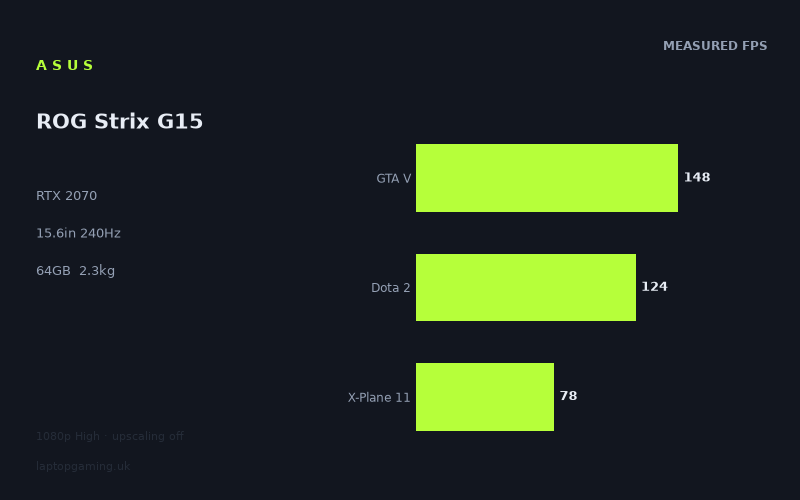
Frame rates
1920×1080, High preset, upscaling off.
Measured on this machine. Source: Notebookcheck, 2020-11-04.
Not scored: incomplete benchmark suite
Every scored laptop on this site is averaged over the same 5 games, and this one is short of Cyberpunk 2077, Baldur's Gate 3. A mean over 5 games is not comparable to a mean over 5, so we publish the figures we have and leave the score blank rather than rank it against machines tested on a different set. The numbers below are real - the suite is just incomplete.
How these numbers were produced
Frame rates here are not measured by us, and we label how each one was arrived at. A figure marked measured comes from a published run on that exact machine. A figure marked representative is derived from the GPU and its power limit (TGP) and cross-referenced against published reviews - a sound estimate of what that configuration delivers, but not a measurement of that specific laptop. Unless stated otherwise, numbers are 1920x1080, High preset, upscaling off. Where a laptop ships in several power configurations we use the wattage of the exact SKU listed, because a 140W RTX 5070 and a 115W one are not the same product.
In use
The short version
The Asus ROG Strix G15 (G512LW) is a strong 1080p gaming laptop on the evidence available, but it needs to be judged as a performance-led machine rather than a fully resolved buying recommendation. Notebookcheck’s measured figures show an RTX 2070 and Core i7-10750H combination capable of producing high frame rates in several of the games tested, including 149fps in Strange Brigade, 148fps in GTA V and 144fps in The Witcher 3. Those are useful results for a laptop with a 240Hz IPS display, even though they do not fully saturate that refresh rate in the benchmark data.
The more important point is that performance is not equally strong in every kind of game. Final Fantasy XV reaches 81fps and X-Plane 11 reaches 78fps at the stated 1920x1080 High preset with upscaling off. Those are still playable-looking figures in isolation, but they make clear that this is not a machine that will deliver the same very high frame rate in every demanding title merely because its screen refreshes at 240Hz. The benchmark spread is substantial, and a sensible buyer should treat the highest results as evidence of what the laptop can do in favourable games, not as a promise for every game installed on it.
The configuration is otherwise generous in the areas that matter to a long-lived gaming machine: it has 64GB of memory and a 1TB SSD, alongside the Core i7-10750H and RTX 2070. The available specification does not tell us anything about SSD speed, memory arrangement, cooling behaviour, keyboard quality, port selection, chassis dimensions or battery runtime, so those should not be assumed. What can be said is that the listed memory capacity and storage capacity remove two obvious specification compromises that are common in less generously configured gaming laptops.
Its 2.344kg weight makes this a machine best thought of as transportable rather than effortless to carry everywhere. It can move between home, office, university accommodation or a LAN setting, but the published weight does not suggest an ultra-light daily companion. The 66Wh battery is a meaningful specification, but there is no measured battery-life result in the available information. Buyers who need long unplugged use should not infer endurance from capacity alone.
The difficult part is value. There is no confirmed UK price for this exact configuration, so we cannot make a value judgement or calculate its overall rating; the benchmark suite is complete and the machine ranks normally on frame-rate performance, but price is required for a meaningful buying verdict.
That means the ROG Strix G15 is most compelling for a buyer who has found this exact G512LW configuration through a retailer, refurbisher or private seller and wants to assess its gaming ability before deciding whether the asking price is sensible. Its benchmark record says it remains capable at 1920x1080 High settings. It is less suitable for anyone shopping purely for the highest possible panel utilisation, anyone who needs verified battery life, or anyone who wants a recommendation that can be made without knowing the price.
Performance
Notebookcheck measured the Asus ROG Strix G15 at 1920x1080 using the High preset with upscaling off. That test condition matters. These results are not claims about every resolution, every graphics setting, every game version or every laptop mode. They are a clear snapshot of how this configuration performed in a defined set of games, and that is the right basis for judging the machine.
Across the five scoring-suite games, the published mean is 116fps. That is a useful headline because it places the laptop comfortably in high-frame-rate 1080p territory overall, but the mean should not be allowed to conceal the spread underneath it. The G15 is not producing a tightly grouped run of almost identical results. It ranges from the high figures in Strange Brigade and GTA V to much lower figures in Final Fantasy XV and X-Plane 11. A buyer choosing this laptop for one particular game should therefore look at the closest available benchmark rather than relying only on the mean.
The faster results
Strange Brigade is the highest published result at 149fps. That is an excellent figure for a 1080p laptop and shows the Strix G15 can deliver the sort of responsiveness buyers expect from a gaming machine with a high-refresh panel. It does not reach the screen’s 240Hz maximum in this measured run, but it gets considerably closer to that target than the lower-performing titles do. For someone whose game library includes titles that behave similarly in the benchmark data, the display’s high refresh rate is not wasted: there is enough performance here for visibly high frame-rate output.
GTA V follows extremely closely at 148fps. The near-match between the Strange Brigade and GTA V figures is useful because it shows that the former is not an isolated peak. In more than one game, this configuration is capable of running well above a conventional console-style frame-rate target and into the range where a fast gaming display makes practical sense. Again, the 240Hz ceiling remains above the measured output, but the laptop is producing a result that gives the panel room to show its advantage over a lower-refresh screen.
The Witcher 3 reaches 144fps. It is not part of the five-game scoring-suite mean, but it is still valuable evidence because it continues the same performance pattern. The G15 can produce a high frame rate in another major game at the stated settings. The result also reinforces an important distinction: this laptop can be very quick at 1080p High without being a universal 240fps machine. A measured 144fps is substantial, but it remains below the panel’s stated refresh rate.
Dota 2 records 124fps. That is lower than the leading results, but it is still a strong outcome in the context of the full set. It means the laptop has several measured games at well above the five-game mean’s lower end. For a buyer who values fluidity over the pursuit of a fixed panel maximum, this is encouraging. It also shows why a single “average fps” judgement is too crude: the ROG Strix G15 has a clear high-performance side that is visible in the results for Strange Brigade, GTA V, The Witcher 3 and Dota 2.
The heavier results
Final Fantasy XV is a more demanding reality check, at 81fps. This result is still materially below the display’s 240Hz refresh rate, and it changes how the screen should be understood. The panel gives the machine considerable headroom when a game runs well, but the GPU does not turn that high refresh rate into a guarantee. In a game represented by this result, the owner would be working with a much more conventional high-performance laptop frame rate rather than anything close to the panel’s upper limit.
X-Plane 11 is lower again at 78fps. It is the lowest measured figure supplied, and it matters because it prevents an overly simplistic conclusion that the RTX 2070 label alone tells the whole story. This configuration is fast, but the titles in the benchmark data respond very differently to the same laptop. Buyers focused on simulation-style workloads represented by X-Plane 11 should take this result especially seriously. It is the most relevant published number for that use case, and it is a long way from the best-case results in Strange Brigade and GTA V.
The gap between the highest and lowest figures is therefore not a defect in the data; it is the point of the data. Different games place different demands on the system, and the laptop’s measured output is shaped by those demands. The Strix G15 looks excellent when the game allows it to run into the high-frame-rate range, but it looks more restrained in Final Fantasy XV and X-Plane 11. A responsible reading is not that one group of figures is more “real” than the other. Both describe the same machine under the same stated 1920x1080 High, upscaling-off conditions.
This also explains why the 116fps scoring-suite mean should be treated as a summary rather than a prediction. It is a useful central figure for comparing machines using the same suite, but it cannot tell a buyer whether their own preferred title will resemble Strange Brigade, Dota 2, Final Fantasy XV or X-Plane 11. The individual game figures are what make the result actionable.
What the RTX 2070 means here
The RTX 2070 is the central gaming component in this configuration, but the available fact sheet does not provide a GPU power limit. That omission matters. Laptop GPUs with the same name can appear in systems with different power arrangements, and without the published power limit for this G512LW we should not attach a wattage claim to the observed performance or pretend to know how aggressively Asus configured the GPU.
What the benchmark data does establish is the practical outcome of the whole configuration: RTX 2070 graphics, the Core i7-10750H, 64GB of memory and the rest of the tested system produced the published results. It is more useful to rely on those figures than to infer performance from a missing power number. The machine runs at 149fps in Strange Brigade, 148fps in GTA V, 144fps in The Witcher 3, 124fps in Dota 2, 81fps in Final Fantasy XV and 78fps in X-Plane 11 under Notebookcheck’s stated conditions. That is the actual evidence available.
The power-limit gap also means the comparison section must be read carefully. Where this G15 comes very close to laptops carrying RTX 2080 graphics, it would be wrong to claim that the RTX 2070 is automatically equivalent to every RTX 2080 implementation. The shared-game comparisons are genuine results, but they are not a complete technical explanation of why the machines land where they do. In particular, the supplied comparison notes explain that lighter games at 1080p can become CPU-bound and compress genuine GPU gaps.
The CPU matters in that context. This laptop uses a Core i7-10750H, and the benchmark outcomes represent the interaction of that processor with the RTX 2070 rather than a pure GPU-only contest. Where a lighter title is constrained more by the CPU side of the system at 1080p, a more powerful graphics processor may not create a large frame-rate separation. That is why a near-zero result against an RTX 2080 rival should be read as evidence about the shared games and test conditions, not as proof that graphics hardware categories are interchangeable.
How much performance is actually available?
The most useful way to frame the Strix G15 is as a laptop with two distinct operating zones in the published data. The first is the high-frame-rate zone, represented by Strange Brigade, GTA V, The Witcher 3 and Dota 2. In those games, the machine is clearly capable of making a 240Hz screen feel relevant. It does not hit 240fps in the published figures, but it does produce sufficiently high output that refresh rate is no longer a purely theoretical specification.
The second zone is represented by Final Fantasy XV and X-Plane 11. Here, the laptop remains capable, but it is not using the screen in the same way. The frame rates are far below the display maximum, so the attraction becomes the general quality of a fast IPS panel rather than full use of its highest refresh mode. Buyers who chiefly play games closer to these results should not pay extra for the machine on the assumption that its 240Hz figure will be fully exploited.
There is no evidence here that the laptop is weak at 1080p. On the contrary, a scoring-suite mean of 116fps is a substantial result. The caveat is more specific: performance is highly title-dependent, and the display specification is more ambitious than the measured output in every game listed. A careful buyer should appreciate the headroom without paying for an expectation of universal 240fps gaming.
The stated use of the High preset with upscaling off is also important for buyers who may be tempted to compare these figures with numbers obtained elsewhere. Changes to graphical settings or the use of upscaling can alter performance, but this review cannot quantify that effect because the fact sheet provides only the listed benchmark condition. The sensible conclusion is simply that the results are strong at the tested setting, while any other setting should be treated as unmeasured here.
The screen
The ROG Strix G15 has a 15.6in IPS display with a 1920x1080 resolution and a 240Hz refresh rate. For gaming, that is a coherent combination with the benchmark results. The resolution keeps the machine focused on 1080p, which is exactly where Notebookcheck measured it, and the refresh rate gives the panel a high ceiling for the games where the RTX 2070 performs best.
The first thing to say about the display is that 240Hz is a capability, not a frame-rate guarantee. None of the supplied game results reaches 240fps. Strange Brigade at 149fps, GTA V at 148fps and The Witcher 3 at 144fps are the closest published examples, but each remains below the panel maximum. Dota 2 at 124fps is further away, while Final Fantasy XV at 81fps and X-Plane 11 at 78fps are much further away.
That should not be mistaken for a criticism of the panel specification. A high refresh rate can still be useful when a game runs below the maximum, provided the system is producing high frame rates. The measured results in Strange Brigade, GTA V and The Witcher 3 make the strongest case for the screen. These are the titles where the GPU output is high enough that the fast panel has clear practical relevance. The laptop is not merely displaying a low frame-rate workload on an unusually fast screen.
At the same time, the panel’s 240Hz label should not dominate the buying decision. The screen will not transform 81fps in Final Fantasy XV or 78fps in X-Plane 11 into 240fps. For those games, the display’s maximum refresh is an upper ceiling that the measured system performance does not approach. A buyer whose main interest is represented by these lower figures should prioritise the actual benchmark result over the refresh-rate number on the specification sheet.
The IPS panel type is worth noting because it is part of the published configuration, but there are no measured panel-quality figures in the fact sheet. We do not have brightness, contrast, colour coverage, response-time or outdoor-visibility measurements. It would be irresponsible to describe the panel as especially vivid, accurate, fast in pixel response or suitable for colour-critical work without that evidence. What is confirmed is the panel type, size, resolution and refresh rate.
The 15.6in size and 1920x1080 resolution also make the machine straightforward in purpose. This is not a laptop positioned around a higher-resolution display that would place more demand on the GPU in the published test. Its gaming proposition is high-frame-rate Full HD. That aligns with the RTX 2070 performance data much better than a claim of universal maximum-refresh gaming would.
The best interpretation is that the screen has more refresh capacity than the laptop can use in the supplied benchmarks, but not so much more that it becomes meaningless. In the strongest results, the Strix G15 is operating in a genuinely high-frame-rate range. In the weaker results, the machine is still gaming at 1080p High, but the display is no longer the limiting headline. The game’s own measured demand on the system is.
Build, size and portability
The published weight is 2.344kg. That places the ROG Strix G15 firmly in the category of a gaming laptop that can be moved but should not be treated as weightless. The distinction matters. A machine can be portable enough to take between locations and still be less convenient for someone who expects to carry it every day alongside other equipment.
At 2.344kg, the G15 makes most sense as a laptop that has a regular base: a desk at home, a student room, an office position, or another place where it can spend meaningful time. It is suited to users who need a single system that can travel when necessary but who will usually game while seated and connected to mains power. The available information does not include dimensions, so we cannot make a claim about how much desk area it occupies or how easily it fits into a particular bag.
The 15.6in display gives a clear indication of the class of machine: this is a conventional gaming-laptop size rather than a tiny ultra-portable. That size is a sensible match for the 1920x1080 resolution and the 240Hz refresh rate. It gives the hardware a display built around the performance level seen in the benchmarks rather than a specification that asks the GPU to target a higher resolution in the tested games.
The battery capacity is listed as 66Wh. Capacity alone is not battery life, and there is no runtime measurement in the fact sheet for browsing, video playback, office work or gaming. It would be a mistake to describe the G15 as an all-day laptop, to claim that it will last a particular journey, or to compare its endurance with another system on the basis of capacity alone.
This is particularly relevant because the laptop’s appeal rests heavily on gaming performance. Buyers should expect the published performance results to matter most when evaluating the machine as a gaming system, but they should not use the 66Wh figure as a substitute for a tested unplugged-use result. If battery operation is central to the purchase, further attributable battery-life data is needed before making a confident decision.
The available configuration includes 64GB of memory and a 1TB SSD. Those are substantial capacities on paper. For a buyer who keeps a large number of applications, game installations or files on one machine, the listed configuration avoids the immediate concern of very limited memory or storage. However, capacity is all that is confirmed. We do not have information about upgrade access, storage performance, the number of drives, memory speed, memory configuration or any component layout.
That lack of physical and serviceability information should shape the purchase decision. If the laptop is being considered as a straightforward gaming machine, the benchmark data and headline configuration are enough to establish its broad position. If the buyer needs a machine for frequent travel, quiet operation, long battery life, particular port requirements, display calibration, internal upgrades or easy servicing, the fact sheet does not provide enough evidence to recommend it confidently on those grounds.
How it compares
The comparison data is deliberately more useful than a simplistic “RTX 2070 versus RTX 2080” label contest. It compares shared games, prefers the scoring suite where possible, and includes both lower-end and higher-end rivals from the same GPU generation. That gives the Strix G15 a meaningful spread of reference points: a lower-powered RTX 2050 machine it clearly outruns, two RTX 2080 laptops it nearly matches in the shared sets, and a stronger RTX 2080 laptop that establishes the upper performance limit in this group.
Against the Acer Aspire 17 with RTX 2050
Against the Acer Aspire 17 with an RTX 2050 at 35W, the Asus ROG Strix G15 averages 43fps ahead across five shared games. The Acer is listed at GBP 899, while there is no confirmed UK price for this exact Asus configuration. That means the performance comparison is clear, but the value comparison is not. The Asus is substantially faster in the shared-game evidence; whether that makes it the better purchase depends on an asking price we do not have.
The scale of the gap is the important point. An average advantage of 43fps across five shared games is not a near tie created by one unusually favourable result. It is evidence that the G15 sits in a materially stronger gaming-performance class than the 35W RTX 2050 Aspire in this comparison. A buyer deciding between these machines primarily for gaming should expect the Asus to offer much more frame-rate headroom in the shared games.
That does not automatically make the Asus the right choice for every buyer. The Aspire has a confirmed price and the Asus does not. A lower price can change the buying calculation, particularly for someone who does not need the G15’s higher benchmark output. But if the question is purely performance at the shared settings, the Asus has a decisive advantage.
Against the Lenovo Legion Y740 with RTX 2080
The Lenovo Legion Y740-17IRHg-81UJ001VGE has RTX 2080 graphics, yet the ROG Strix G15 averages only 1fps behind across three shared games. Neither machine has a confirmed UK price in the supplied information, so this is a performance comparison rather than a value verdict.
A difference this small should not be exaggerated. It does not mean the two systems are universally identical, and it does not prove that every RTX 2070 laptop should be expected to match every RTX 2080 laptop. It means that in the three shared games used for this comparison, the published results are extremely close.
The explanation supplied with the rival data is important: at 1080p, lighter titles in the shared set can be CPU-bound and compress genuine GPU gaps. That is exactly why a near-zero comparison needs interpretation rather than repetition. The close result is real, but it may tell us as much about the shared games and the 1080p test environment as it does about a broad hierarchy between the two graphics names.
For a buyer, the practical lesson is positive but limited. The G15 should not be dismissed simply because another system carries RTX 2080 branding. In this particular shared-game comparison, it performs almost identically. But anyone choosing between these machines should seek data for the games they actually play, because the three-game overlap is not broad enough to establish a universal winner.
Against the Acer Predator Triton 500 with RTX 2080
Against the Acer Predator Triton 500 with RTX 2080 graphics, the Asus averages 2fps behind across four shared games. Again, there is no confirmed UK price for either machine in the supplied information. The conclusion is similar to the Lenovo comparison but supported by a slightly wider shared set: the ROG Strix G15 is very close in the available games.
A 2fps average gap is not a practical reason by itself to choose one of these machines over the other. The benchmark evidence says that their shared-game performance is closely matched under the comparison method used. It does not say that the RTX 2070 in the Asus is inherently the same as an RTX 2080 in every title or situation.
The CPU-bound explanation remains relevant here. At 1080p, lighter games can prevent graphics-hardware differences from translating into large measured frame-rate gaps. The result therefore supports a specific argument: this Strix G15 is competitive with the Triton 500 in the games they share. It does not support the broader and much less defensible argument that the GPU labels no longer matter.
This is where the individual G15 benchmark results become useful again. The laptop looks very strong in games such as Strange Brigade and GTA V, where it reaches 149fps and 148fps. It is less imposing in Final Fantasy XV and X-Plane 11 at 81fps and 78fps. Buyers should expect the exact game mix to determine whether the near-tie with the Triton feels representative of their own use.
Against the MSI GT76 Titan DT with RTX 2080
The MSI GT76 Titan DT provides the other end of the comparison range. The ROG Strix G15 averages 35fps behind it across five shared games. Like the Lenovo and Acer RTX 2080 rivals, the MSI has no confirmed UK price in the fact sheet, so there is no basis for a value conclusion. There is, however, a clear performance conclusion: in this broader shared-game comparison, the MSI is substantially faster.
This comparison is important because it stops the close Lenovo and Triton results from being over-read. The G15 can run very close to some RTX 2080 systems in shared 1080p games, but it is not the performance ceiling among laptops from this generation. The GT76’s advantage shows that there is a meaningful higher tier when the comparison set and the machines involved allow that difference to appear.
The 35fps deficit also gives useful context to the G15’s 116fps scoring-suite mean. The Asus is a high-performance laptop, but there is room above it for buyers whose priority is the greatest possible output rather than a more balanced 15.6in, 2.344kg system. Whether the MSI’s extra performance would be worth pursuing depends on price, physical preferences and other measurements not supplied here, but the frame-rate advantage itself is clear.
Viewed as a whole, the rival set places the G15 in a credible middle-to-upper position. It is far ahead of the 35W RTX 2050 Aspire, very close to the Legion Y740 and Predator Triton 500 in their shared games, and clearly behind the GT76 Titan DT. That is a much more informative description than treating “RTX 2070” as a complete verdict.
Who it’s for
The Asus ROG Strix G15 is for the buyer who wants a 15.6in 1080p gaming laptop with high measured frame rates in a substantial part of the benchmark data. It is particularly sensible for someone whose priorities resemble the stronger results: Strange Brigade at 149fps, GTA V at 148fps, The Witcher 3 at 144fps and Dota 2 at 124fps. In those games, the machine has enough output to make the 240Hz IPS display a meaningful part of the package.
It is also for someone who values the listed 64GB memory capacity and 1TB SSD capacity and does not want an immediately constrained configuration. Those capacities are part of the confirmed specification, and they make the laptop look more complete than a performance-focused machine that pairs a capable GPU with limited memory or storage. There is no evidence here about upgradeability or component speed, but the starting capacities themselves are generous.
The G15 suits a user who accepts a 2.344kg laptop as a practical compromise. It can be moved when needed, but it is best for someone who will mostly use it in settled locations. A buyer who wants a gaming system for a desk, room or regular base, with occasional travel rather than constant carrying, is the natural audience.
It may also appeal to a buyer considering RTX 2080-era rivals and assuming that the Strix G15 must be far behind because it has RTX 2070 graphics. The shared-game comparisons show that this is not necessarily true. It is only 1fps behind the Lenovo Legion Y740 across three shared games and 2fps behind the Acer Predator Triton 500 across four. Those are close enough that the rest of the package, including any actual price found, would matter more than the small benchmark separation.
It is not for a buyer who expects every game to approach the panel’s 240Hz ceiling. The published figures do not support that expectation. Even the highest result, 149fps in Strange Brigade, remains below 240Hz. Final Fantasy XV at 81fps and X-Plane 11 at 78fps show that some games sit in a very different performance range.
It is not the right choice for someone whose main game resembles the lower end of the benchmark spread and who is buying chiefly for extreme refresh-rate output. The panel is fast, but the measured GPU output in Final Fantasy XV and X-Plane 11 does not make full use of it. Such a buyer should place more weight on benchmarks for their specific games and may be better served by a machine that has stronger evidence in those workloads.
It is also not for the buyer who needs a verified portability or battery-life recommendation. The 2.344kg weight and 66Wh battery capacity are known, but there are no dimensions and no measured battery-life figures in the fact sheet. Anyone who regularly works away from mains power, needs a particular bag fit, or wants a machine for frequent all-day travel needs evidence that is not available here.
Finally, it is not possible to recommend the Strix G15 purely as a bargain because the UK price for this exact configuration is not confirmed. Performance can be assessed with confidence from Notebookcheck’s benchmark data. Value cannot. If the machine appears at a sensible asking price relative to the buyer’s alternatives, the frame rates give it a credible case as a high-performance 1080p gaming laptop. If it appears at an inflated price, the same frame rates do not automatically rescue the deal.
The final judgement is therefore straightforward. The Asus ROG Strix G15 (G512LW) is a capable 1080p gaming laptop with a genuinely strong set of measured results, a 240Hz IPS display that is useful in its fastest games, and a configuration that includes 64GB of memory and a 1TB SSD. Its limitations are equally clear: performance varies sharply by game, no tested title reaches the screen’s 240Hz maximum, the GPU power limit is not provided, portability evidence is limited, battery runtime is unknown, and no confirmed UK price prevents a proper value conclusion. Buy it for the demonstrated frame rates if the actual asking price makes sense; do not buy it on the assumption that every game will run at 240fps or that the unconfirmed price must represent good value.