Review
Razer Blade 15 review
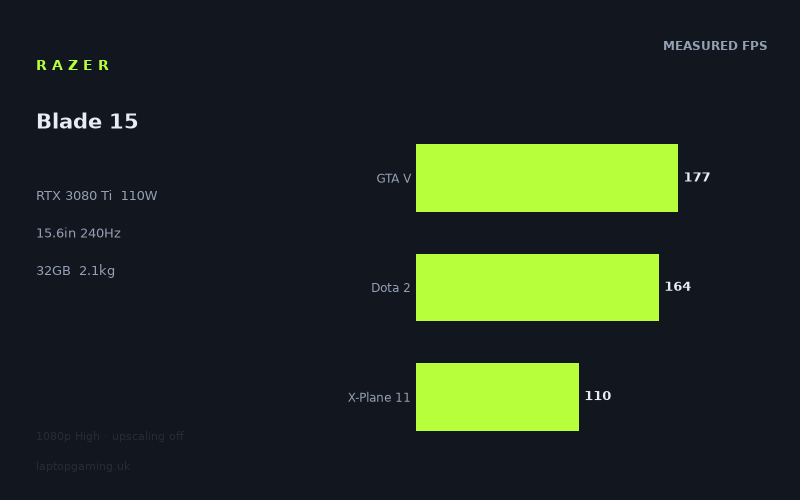
Frame rates
1920×1080, High preset, upscaling off.
Measured on this machine. Source: Notebookcheck, 2022-03-12.
Not scored: incomplete benchmark suite
Every scored laptop on this site is averaged over the same 5 games, and this one is short of Cyberpunk 2077, Baldur's Gate 3. A mean over 5 games is not comparable to a mean over 5, so we publish the figures we have and leave the score blank rather than rank it against machines tested on a different set. The numbers below are real - the suite is just incomplete.
How these numbers were produced
Frame rates here are not measured by us, and we label how each one was arrived at. A figure marked measured comes from a published run on that exact machine. A figure marked representative is derived from the GPU and its power limit (TGP) and cross-referenced against published reviews - a sound estimate of what that configuration delivers, but not a measurement of that specific laptop. Unless stated otherwise, numbers are 1920x1080, High preset, upscaling off. Where a laptop ships in several power configurations we use the wattage of the exact SKU listed, because a 140W RTX 5070 and a 115W one are not the same product.
In use
The short version
The Razer Blade 15 configuration considered here combines a Core i7-12800H, RTX 3080 Ti limited to 110W, 32GB of memory and a 15.6in 2560x1440 IPS display running at 240Hz. On paper, that is a premium gaming-laptop specification, but the useful part of the story is the measured performance rather than the component names. Notebookcheck’s figures show a machine that is extremely quick in lighter and older games at 1920x1080 using High settings with upscaling disabled, while heavier games fall well short of the screen’s 240Hz ceiling.
The strongest result is The Witcher 3 at 214fps. Strange Brigade is similarly fast at 205fps, while GTA V reaches 177fps and Dota 2 manages 164fps. These are very high frame rates for a laptop, and they make clear that the Blade 15 has enough performance for fast, responsive play in games that are not especially demanding by current standards. Far Cry 5 at 144fps is still comfortably quick, while X-Plane 11 at 110fps and Final Fantasy XV at 106fps demonstrate that the system remains capable when a game becomes more demanding, even if it is no longer close to exploiting a 240Hz panel fully.
The scoring-suite mean is 152fps across the shared benchmark set. That is a strong overall result, but it is not the same thing as saying that every game will run at 152fps, or that the Blade 15 can drive its native 2560x1440 screen at 240Hz. The benchmark data is at 1920x1080, High settings and with upscaling off. It establishes a useful performance baseline, but it does not provide measured native-resolution performance for this display. Buyers attracted specifically by the 2560x1440, 240Hz panel should understand that the evidence here supports excellent 1080p High performance, not a promise of 240fps at the panel’s native resolution.
The RTX 3080 Ti label needs some context. This is not a 175W implementation such as the RTX 3080 Ti in the MSI Raider GE77 HX. It is a 110W implementation. GPU power limits matter because the same GPU name can appear in very different laptops with very different operating limits. The Blade 15’s results are nevertheless not weak. In the shared-game comparison it is effectively level with the Eurocom Nightsky TXi317, despite that machine using an RTX 3080 Ti at 155W, and it is also effectively level with the Acer Predator Helios 300, which uses an RTX 3070 Ti at 150W. Those near-equal results should not be read as proof that power limits do not matter. At 1080p, the lighter shared games can become CPU-bound, compressing genuine GPU differences and making several very different GPU configurations look remarkably similar.
The purchase decision therefore depends heavily on what you want from the machine. If you want a relatively light 2.106kg gaming laptop with a high-refresh 2560x1440 IPS screen and measured 1080p performance that is comfortably above 100fps in every game listed, the Blade 15 is persuasive. It has a broad performance floor rather than a benchmark profile built around only one easy title. If you are shopping primarily for the highest possible GPU output from an RTX 3080 Ti, however, the MSI Raider GE77 HX’s shared-game lead matters: it averages 17fps ahead across the five shared games. The Blade 15 is fast, but the measurements do not support treating it as the fastest version of this GPU generation.
There is no confirmed UK price for this exact configuration. As a result, no value judgement can be made for it here, and there is no overall score. That is simply because price forms part of the site’s value calculation; it is not a reflection on the machine’s benchmark standing. The benchmark suite is complete, and the Blade 15 ranks normally on the frame-rate leaderboard.
Performance
What the measured figures show
Notebookcheck measured the Razer Blade 15 at 1920x1080 using High settings with upscaling disabled. That test method matters. It removes the benefit of upscaling from the result and gives the GPU a conventional 1080p workload, but it does not show the machine at the display’s native 2560x1440 resolution. The figures should therefore be used as a direct guide to 1080p High gaming and as an indication of the laptop’s general performance class, not as a substitute for measured 2560x1440 results.
The Witcher 3 is the standout result at 214fps. That is the closest of the listed games to the screen’s 240Hz refresh rate. It does not quite reach 240fps, but it is close enough to show that the Blade 15 can make strong use of the panel in a game of this type at the tested settings. A high frame rate is not merely a number to admire on a benchmark chart: it means the display has a greater chance to present fresh frames frequently rather than being held back by a low rendering rate. In this case, the measured result places The Witcher 3 firmly in the category of games where the 240Hz screen is relevant rather than decorative.
Strange Brigade follows at 205fps. That is also well below 240fps in strict terms, but it remains a very high result and clearly belongs in the same broad performance tier as The Witcher 3. The difference between the game’s measured frame rate and the panel refresh rate is important, though. A 240Hz display does not make every game run at 240fps. The display can refresh at that rate, but the GPU and CPU must render frames at a comparable pace if the game is to occupy the full refresh envelope. Strange Brigade’s 205fps gives the display plenty to work with, but it is not a native match for the panel ceiling.
GTA V reaches 177fps. That remains excellent 1080p High performance, and it is well beyond what is required for smooth play. It is also a useful reminder that the Blade 15’s frame-rate story is not limited to the two fastest results. GTA V is substantially below the 240Hz ceiling, but it still provides a high-refresh experience in the ordinary sense: there are many more frames available than in a game running near 100fps. Anyone selecting this laptop for games where responsiveness and motion clarity matter more than a literal 240fps result should regard 177fps as a very strong outcome.
Dota 2 records 164fps. Again, this is a high frame rate, although it is not close to the panel limit. For a competitive game, the important conclusion is not that the Blade 15 magically turns every match into a 240fps experience. It does not, based on the measured figure. The useful conclusion is that the laptop has substantial headroom above conventional gaming frame rates at the stated 1080p High setting. A buyer who values the screen’s refresh rate for esports-style titles can reasonably see the panel as worthwhile, while still recognising that the measured data does not show a full 240fps lock.
Far Cry 5 posts 144fps. This is a notable point in the performance spread because it is still fast, yet it sits materially below the very highest results. It shows why the mean of 152fps needs interpreting rather than repeating as a catch-all verdict. A mean is useful for ranking a laptop across a standard set of games, but individual games impose different loads and respond differently to the balance between CPU performance, GPU performance and the chosen settings. Far Cry 5 reinforces the sensible reading of this Blade 15: it is a high-frame-rate 1080p laptop, not a machine that can be assumed to drive every game near 240fps simply because its screen can refresh at 240Hz.
X-Plane 11 reaches 110fps. That is still more than 100fps, which is a strong result for a laptop game benchmark, but it is much closer to the lower end of this machine’s measured range. The result is particularly useful because it prevents an overly flattering assessment based only on The Witcher 3, Strange Brigade and GTA V. The Blade 15 does not collapse in the more difficult part of the suite; it remains above 100fps. But the screen has much more refresh capacity than this game can use at the measured settings. In X-Plane 11, the value of the panel is less about reaching 240Hz and more about providing a high-refresh display that is not being constrained by a low display limit.
Final Fantasy XV is similar at 106fps. Like X-Plane 11, it confirms a solid lower performance boundary in the available data. The Blade 15 is not shown dropping into low frame-rate territory in any of the listed games. That consistency is valuable. A laptop that produces spectacular results in easy workloads but weak numbers in demanding ones can be harder to recommend than a machine whose results remain broadly controlled across the suite. Here, the range runs from 106fps to 214fps. That is a wide spread, but every recorded result is still above 100fps at 1920x1080, High settings and with upscaling off.
The mean of 152fps across the five scoring-suite games is therefore best read as a broad gaming-performance marker rather than a target frame rate. It indicates a system that sits comfortably in high-frame-rate territory at the tested settings. It does not mean that every game will perform like GTA V, nor does it mean that X-Plane 11 and Final Fantasy XV are outliers to be ignored. They are part of the evidence. The Blade 15 is quick enough to produce extremely high frame rates in favourable games and remains convincingly fast in the less favourable results, but the gap between 214fps and 106fps is precisely why prospective buyers should match expectations to the games they actually play.
The significance of the 110W RTX 3080 Ti
The most important specification detail is not simply that this Blade 15 has an RTX 3080 Ti. It is that the RTX 3080 Ti has a 110W power limit. Within laptop GPUs, names alone are incomplete descriptions. The same GPU can be used at different power limits, and the rival list demonstrates why that matters. The Eurocom Nightsky TXi317 has an RTX 3080 Ti at 155W, while the MSI Raider GE77 HX has an RTX 3080 Ti at 175W. The Blade 15 is therefore operating with a substantially lower stated GPU power limit than both of those RTX 3080 Ti rivals.
It would be easy to look at the 110W figure and assume that the Blade 15 must trail every higher-power RTX 3080 Ti by a large margin. The shared benchmark comparison says otherwise, at least in the games and settings available. Against the Eurocom Nightsky TXi317, the Blade 15 averages 1fps ahead across five shared games. That is effectively a tie in practical terms. There is no sensible basis for declaring one machine meaningfully faster than the other from an average difference of 1fps. It is a real measured result, but it is not a meaningful lead for the Blade 15.
The comparison with the MSI Raider GE77 HX is more revealing. The Raider uses an RTX 3080 Ti at 175W and averages 17fps ahead of the Blade 15 across five shared games. Here the result is large enough to describe as a genuine performance advantage for the higher-power machine. The Blade 15 remains quick, but it does not erase the gap to the most powerful RTX 3080 Ti rival listed. If your priority is extracting the highest possible game performance from this GPU generation, the Raider’s benchmark lead is the result to pay attention to.
The 110W limit should not be treated as an automatic reason to reject the Blade 15, nor should it be ignored because the GPU name is prestigious. It places the machine in a particular design and performance position. The data suggests that the Blade 15 can still compete closely with some much higher-power systems in shared 1080p results, but it also shows a more powerful RTX 3080 Ti laptop pulling ahead when the comparison has enough separation to expose the difference. The power limit is relevant in practice because it helps explain why a Blade 15 buyer should not assume all RTX 3080 Ti laptops deliver the same result.
There is another complication: 1080p can compress GPU differences. The rival comparison explicitly notes that the lighter titles in the shared set are CPU-bound at this resolution. In a CPU-bound situation, a faster GPU cannot necessarily produce proportionately higher frame rates because the GPU is waiting on another part of the system. That is why the Blade 15 can sit effectively level with a 155W RTX 3080 Ti laptop and a 150W RTX 3070 Ti laptop in the available shared-game averages. This does not prove that the GPUs are equivalent. It shows that the shared 1080p workloads are not always exposing their full GPU-performance differences.
That point is especially important for anyone trying to use the rival averages as a simple hierarchy of GPU capability. The MSI Prestige 15, equipped with an RTX 3050 Ti at 105W, trails the Blade 15 by 86fps across four shared games. That is a decisive gap and supports the expectation that the Blade 15 belongs in a much higher performance class. By contrast, the nearly flat results against the Eurocom and Acer machines do not make the Blade 15’s 110W RTX 3080 Ti universally equivalent to their higher-power GPUs. They show that CPU limits and game behaviour are shaping the 1080p comparison.
How the performance spread should guide settings choices
The measured range is broad enough that a single settings recommendation would be unhelpful. The Witcher 3 and Strange Brigade show that the Blade 15 can get close to the 240Hz display ceiling at 1080p High without upscaling. GTA V and Dota 2 remain well into high-refresh territory, even though they do not approach 240fps. Far Cry 5 is still strong at 144fps. X-Plane 11 and Final Fantasy XV are fast by normal gaming-laptop standards at 110fps and 106fps, but they are clearly not games where the panel’s full 240Hz specification is being realised under the measured conditions.
That means the display should be viewed as capacity rather than a performance guarantee. In games where the Blade 15 delivers 214fps or 205fps, it is reasonable to value the 240Hz panel highly. In games at 110fps or 106fps, the screen remains capable of displaying more frames than the system is producing, but the machine is no longer close to filling that capacity. There is no problem with that; 110fps and 106fps are still strong figures. The distinction matters only because a buyer paying for a 240Hz display should not confuse its maximum refresh rate with a measured minimum performance level.
The benchmark method also gives a conservative kind of clarity. Upscaling was disabled. The numbers are therefore not inflated by a technology that renders at a lower internal resolution. That does not mean upscaling is bad, nor does it tell us what result the Blade 15 would achieve with it enabled. There are no such figures in the supplied data. What can be said is that the listed results were achieved without upscaling at 1920x1080 High settings. For the games measured, that makes the performance baseline straightforward to interpret.
There are no measured frame rates here for ray tracing, maximum settings, native 2560x1440, external displays or newer game releases. It would be irresponsible to fill those gaps with estimates. The proper conclusion is narrower and more useful: at the tested 1080p High setting, the Blade 15 delivers from 106fps to 214fps across the listed titles, with a 152fps scoring-suite mean. It is plainly a high-performance laptop, but the evidence does not justify saying it will run every demanding game at 2560x1440 and 240fps.
The screen
The Razer Blade 15 has a 15.6in IPS display with a native resolution of 2560x1440 and a 240Hz refresh rate. This is an ambitious screen specification for a laptop. The resolution offers more desktop space and more pixel density than a 1920x1080 panel, while the 240Hz refresh rate sets a high ceiling for games capable of producing very high frame rates. The combination is attractive because it does not force a choice between a conventional 1080p esports panel and a higher-resolution display. It offers both a 2560x1440 native resolution and a 240Hz refresh limit.
However, the measured benchmark data is at 1920x1080, not 2560x1440. That is the central limitation when judging the pairing of this screen and this GPU. The Blade 15’s results at 1080p are strong enough to make the 240Hz refresh rate meaningful in some games. The Witcher 3 at 214fps and Strange Brigade at 205fps come closest to the panel’s ceiling. GTA V at 177fps and Dota 2 at 164fps remain well suited to a high-refresh display. Far Cry 5 at 144fps is also a very good match for a panel faster than a conventional 60Hz screen.
The lower results make a different point. X-Plane 11 at 110fps and Final Fantasy XV at 106fps still look like strong outcomes, but they are not close to 240fps. In those games, buying a 240Hz screen is not about ensuring that the laptop reaches its maximum refresh rate. It is about ensuring the display does not become the limiting factor when frame rates are high, while retaining that 240Hz capability for less demanding games and settings. This is an important distinction for sensible buyers. A high-refresh panel can be worthwhile without being fully saturated in every title, but the performance data does not show universal 240fps gaming.
The native resolution complicates matters further. Rendering at 2560x1440 is more demanding than rendering at 1920x1080, but the supplied benchmark set does not quantify the effect for this machine. There are no measured native-resolution figures to cite, so no responsible review can state what frame rate The Witcher 3, Dota 2 or Final Fantasy XV will achieve at 2560x1440 High. The correct buying advice is simply that the 1080p figures should not be assumed to carry over unchanged to the native display resolution.
For a buyer who mainly values competitive play in lighter games, the screen specification is well matched to the upper end of the measured results. The Witcher 3 and Strange Brigade demonstrate that the Blade 15 can operate near 240Hz at the tested resolution. GTA V and Dota 2 reinforce the case for the panel because both exceed 160fps. For a buyer focused on visually demanding games, the appeal is different: the 2560x1440 screen gives a higher-resolution option, but the data here cannot confirm how close the GPU will come to 240Hz at native resolution.
The IPS panel type is the other confirmed display detail. Beyond that, the supplied information does not include brightness, contrast, colour coverage, response-time measurements, adaptive-sync support or outdoor visibility. Those are important qualities for a screen, especially on an expensive gaming laptop, but they cannot be assumed from the IPS label. The available evidence supports calling this a high-resolution, high-refresh IPS display. It does not support broader claims about panel quality.
In practical terms, the screen is a strength provided your expectations are accurate. It gives the Blade 15 a high ceiling for games where the laptop can render well beyond 100fps, and the benchmark data shows several such games. It also gives the machine a 2560x1440 desktop and gaming resolution, although no native-resolution gaming measurements are available. The potential mismatch is not between the screen and the laptop as such; it is between a literal expectation of 240fps in every game and the more varied reality shown by results ranging from 106fps to 214fps at 1080p.
Build, size and portability
The confirmed physical specification is a weight of 2.106kg. That places the Blade 15 firmly in laptop territory rather than suggesting a desktop-replacement machine that should only ever move between rooms. It is still a substantial object to carry alongside a charger and other equipment, but the weight is low enough that portability should be part of the buying case rather than an afterthought. A buyer who needs one machine for gaming and regular transport has a better reason to consider this Blade 15 than a buyer who intends to keep the system permanently on a desk and wants only the highest available frame rates.
The available data does not include the laptop’s dimensions, chassis materials, keyboard layout, trackpad quality, port selection, webcam, speaker performance, cooling-noise measurements or surface-temperature measurements. Those omissions matter. Weight alone does not tell us how easy a laptop is to place in a bag, how rigid the chassis is, how much desk space it needs or how it feels to use. It would be wrong to invent those details or to infer them from the Razer name.
The 15.6in screen gives some useful context to the 2.106kg weight. This is not a tiny ultraportable, but neither is it a larger gaming machine with a screen size beyond 15.6in. The Blade 15’s proposition is therefore clear from the confirmed specifications: a gaming laptop with a 15.6in 2560x1440 240Hz display, powerful components and a weight of 2.106kg. That combination is more versatile on paper than a heavier, larger performance-first system, especially for someone who has to carry it regularly.
The 80Wh battery capacity should be treated carefully. Capacity is not battery life. There is no measured battery-life result in the fact sheet, so there is no basis for claiming how long the Blade 15 lasts away from mains power, whether gaming or doing lighter work. Gaming laptops can vary considerably depending on workload, display settings and system behaviour, and none of that is quantified here. The only confirmed battery statement is that it has an 80Wh battery.
That makes the portability verdict conditional. The Blade 15 has a credible travel-friendly weight for its class at 2.106kg, and the 80Wh battery is a confirmed part of the specification. But anyone for whom unplugged endurance is a deciding factor should seek measured battery data before buying. Likewise, anyone who needs a particular port arrangement, a quiet fan profile or verified thermals should not assume those qualities from the specification list. The performance evidence is strong; the physical-use evidence is limited.
How it compares
Against the MSI Prestige 15
The MSI Prestige 15 is the clearest performance separation in the rival list. It uses an RTX 3050 Ti at 105W, while the Blade 15 uses an RTX 3080 Ti at 110W. Across four shared games, the Razer averages 86fps ahead. This is not a marginal result and does not require complicated interpretation. The Blade 15 belongs in a decisively higher gaming-performance bracket in the available comparison.
The difference matters because it changes what the high-refresh display is for. With the Blade 15 recording 214fps in The Witcher 3, 205fps in Strange Brigade, 177fps in GTA V and 164fps in Dota 2, the 240Hz screen has a meaningful relationship with actual game performance. The shared-game advantage over the Prestige makes clear that this is not just a laptop with a premium panel specification attached to middling graphics performance. It has the measured output to support high-refresh gaming in a way the lower-tier rival does not, based on the shared results.
Neither machine has a confirmed UK price in the supplied information, so there is no value comparison to make. The Blade 15 may be the stronger gaming machine by a wide margin, but price could materially affect the buying decision and must not be guessed. The valid conclusion is purely performance-based: if gaming frame rate is the priority, the Blade 15 is far ahead of the MSI Prestige 15 in the shared benchmarks.
Against the Eurocom Nightsky TXi317
The Eurocom Nightsky TXi317 is a more interesting comparison because it also has an RTX 3080 Ti, but at a 155W power limit rather than 110W. On specification alone, the Eurocom appears positioned for more GPU output. Yet across five shared games, the Blade 15 averages 1fps ahead. This is as close to a tie as benchmark comparisons get. It is a measured near-zero difference, not evidence that one system is meaningfully faster.
The explanation provided by the benchmark context is important. At 1080p, lighter games in the shared set are CPU-bound and compress genuine GPU gaps. In other words, the higher-power GPU configuration may not be able to convert all of its additional available power into higher frame rates when the game is constrained elsewhere. This is why the Blade 15 can match the Eurocom so closely in the available shared games despite the 110W versus 155W difference.
The right conclusion is not that the Blade 15’s RTX 3080 Ti is interchangeable with every 155W RTX 3080 Ti. It is that, for these shared 1080p results, it performs effectively the same. Buyers who mostly play similar lighter games at 1080p High may reasonably regard the two machines as performance peers on this evidence. Buyers interested in more GPU-limited workloads, higher resolutions or settings not included in the data should not extrapolate the 1fps difference beyond what it is: a shared-game result in a benchmark environment where CPU limits can narrow GPU gaps.
Against the Acer Predator Helios 300
The Acer Predator Helios 300 uses a Core i7-12700H and an RTX 3070 Ti at 150W. Despite the lower GPU tier in name, it averages a difference of -0fps against the Blade 15 across five shared games. In plain language, the shared average is effectively level. This is another example of why laptop GPU names and power limits cannot be converted directly into assumed frame-rate rankings.
The Blade 15 has the more prestigious RTX 3080 Ti designation, but it operates at 110W. The Acer’s RTX 3070 Ti operates at 150W. In the available 1080p shared set, the outcome is a tie rather than a clear Razer advantage. The stated benchmark context again explains why: lighter games at 1080p can be CPU-bound, suppressing the GPU difference that might emerge in a more GPU-limited test.
For a buyer choosing between these systems, the data does not support paying more for the Blade 15 merely on the assumption that RTX 3080 Ti automatically means more frames. There is no confirmed UK price for either exact configuration, so the financial question cannot be settled. But on the shared measured games, there is no frame-rate lead to use as the Blade 15’s argument. Its case would instead rest on its 15.6in 2560x1440 240Hz IPS display, 32GB of memory, 2.106kg weight, or other factors that would need to suit your use better than the Acer’s configuration.
Against the MSI Raider GE77 HX
The MSI Raider GE77 HX is the rival that most clearly beats the Blade 15. It uses an RTX 3080 Ti at 175W and averages 17fps ahead across five shared games. Unlike the 1fps edge against the Eurocom or the effectively flat Acer result, this is a meaningful deficit for the Razer. It demonstrates that the Blade 15’s 110W GPU limit is not merely an abstract specification difference. Against a substantially higher-power RTX 3080 Ti implementation, the benchmark data shows the MSI producing higher shared-game performance.
This does not make the Blade 15 slow. Its own results remain strong, from 106fps in Final Fantasy XV to 214fps in The Witcher 3. But buyers should be honest about what they are choosing. The Razer is the more portable-looking option on the confirmed weight figure of 2.106kg, while the MSI Raider’s available benchmark advantage makes it the better choice for someone who values frame-rate output above all else. There is no confirmed weight for the Raider in the supplied data, so no direct portability comparison can be made. There is also no confirmed UK price, so no value conclusion is possible.
The Raider comparison is the best warning against shopping by GPU badge alone. Both machines are RTX 3080 Ti laptops. Their power limits differ, and the measured shared-game result differs by 17fps in the Raider’s favour. A buyer who wants the fastest RTX 3080 Ti result available from these specific rivals should prefer the MSI Raider GE77 HX on performance grounds. A buyer who wants the Blade 15’s 15.6in 2560x1440 240Hz display and 2.106kg weight may still prefer the Razer, but should do so knowing that it gives up measured performance to the Raider.
Who it’s for
The Razer Blade 15 is for the buyer who wants a powerful 15.6in gaming laptop with a high-refresh 2560x1440 IPS screen and a confirmed weight of 2.106kg, without accepting weak gaming performance as the price of portability. Notebookcheck’s figures show that it is not merely adequate: it delivers 214fps in The Witcher 3, 205fps in Strange Brigade, 177fps in GTA V, 164fps in Dota 2, 144fps in Far Cry 5, 110fps in X-Plane 11 and 106fps in Final Fantasy XV at 1920x1080 High with upscaling disabled.
It suits players whose regular games resemble the faster end of the benchmark spread. The Witcher 3, Strange Brigade, GTA V and Dota 2 show why the 240Hz screen makes sense. The Blade 15 does not hit 240fps in these measured results, but 214fps and 205fps are close, while 177fps and 164fps remain convincingly high. If your aim is a responsive, high-frame-rate experience rather than a rigid demand for 240fps in every title, the Razer has a strong case.
It also suits buyers who need a laptop that can be moved regularly. At 2.106kg, it is not weightless, but it is a credible option for someone carrying a gaming system between home, work, study or travel locations. The 15.6in screen size supports that role better than a larger laptop would on paper, while the RTX 3080 Ti and Core i7-12800H ensure that portability is not being bought by dropping into entry-level performance.
The 32GB memory configuration is also appropriate for a buyer who wants a system with substantial memory capacity rather than a bare-minimum gaming setup. The fact sheet does not provide application benchmarks, so it would be wrong to make specific productivity claims from that figure alone. But it is a confirmed part of a specification that otherwise aims above the mainstream: RTX 3080 Ti graphics, Core i7-12800H processor, 32GB memory, 2560x1440 resolution and 240Hz refresh rate.
It is not the right choice for the buyer whose sole priority is maximum gaming frame rate from this GPU generation. The MSI Raider GE77 HX averages 17fps ahead across five shared games. That is the cleanest available performance comparison, and it favours the Raider. The Blade 15’s RTX 3080 Ti at 110W is powerful, but the data does not show it matching the 175W RTX 3080 Ti implementation when the benchmark gap is meaningful.
It is also not the obvious choice for someone who expects every game to run at 2560x1440 and 240fps. The screen supports 2560x1440 and 240Hz, but the benchmark data is at 1920x1080. Even there, the measured results range from 106fps to 214fps. The Blade 15 is close to the refresh ceiling in The Witcher 3 and Strange Brigade, but X-Plane 11 and Final Fantasy XV are far below it. There are no native-resolution results in the data, so anyone buying specifically for maximum-refresh 2560x1440 gaming should look for evidence at that resolution rather than assuming the answer from the panel specification.
Buyers who care most about value should wait for a confirmed UK price for this exact configuration. The lack of a price does not create a performance concern, and it does not stop the Blade 15 being ranked on frame rate. It does prevent a responsible value verdict. Without a price, there is no way to say whether the 2.106kg weight, 32GB memory, 15.6in 2560x1440 240Hz IPS display and strong measured performance represent good buying value or poor buying value.
Finally, it is not the right machine for someone whose decision rests on battery life, noise, heat, port selection or detailed panel quality. The fact sheet confirms an 80Wh battery but does not provide measured runtime. It confirms an IPS panel but does not provide brightness, contrast or colour measurements. It contains no noise or temperature data. Those are not minor details for every buyer, and they should not be guessed. The Blade 15 is easy to recommend on the strength of its confirmed 1080p High gaming figures and its 2.106kg weight; it is not possible to make a fully rounded ownership recommendation without evidence for the missing areas.
The balanced conclusion is that this Razer Blade 15 is a fast, relatively portable high-refresh gaming laptop whose measured results justify the RTX 3080 Ti branding, while also showing the limits of its 110W implementation. It is comfortably ahead of the RTX 3050 Ti-based MSI Prestige 15, effectively tied with the higher-power Eurocom Nightsky TXi317 and Acer Predator Helios 300 in the available 1080p shared results, and decisively behind the 175W RTX 3080 Ti MSI Raider GE77 HX. Buy it for strong high-frame-rate gaming in a 2.106kg 15.6in package, not because you expect the GPU badge or the 240Hz screen to guarantee the same result in every game.