Review
MSI Stealth 16 Studio review
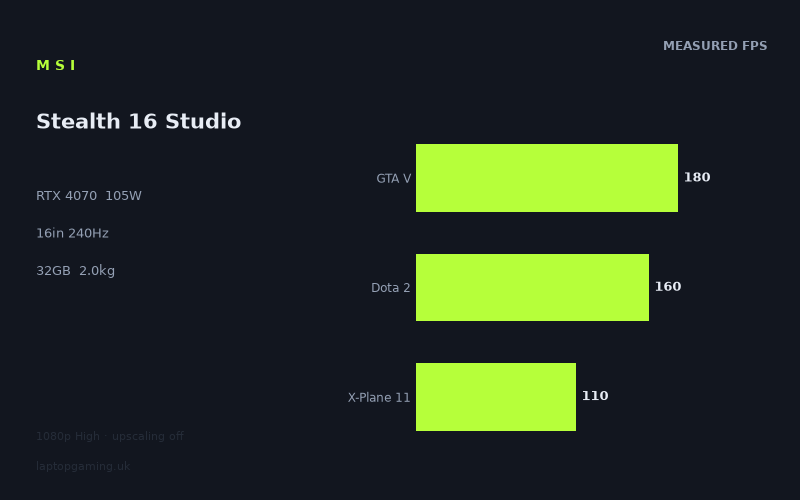
Frame rates
1920×1080, High preset, upscaling off.
Measured on this machine. Source: Notebookcheck, 2023-07-07.
Not scored: incomplete benchmark suite
Every scored laptop on this site is averaged over the same 5 games, and this one is short of Cyberpunk 2077, Baldur's Gate 3. A mean over 3 games is not comparable to a mean over 5, so we publish the figures we have and leave the score blank rather than rank it against machines tested on a different set. The numbers below are real - the suite is just incomplete.
How these numbers were produced
Frame rates here are not measured by us, and we label how each one was arrived at. A figure marked measured comes from a published run on that exact machine. A figure marked representative is derived from the GPU and its power limit (TGP) and cross-referenced against published reviews - a sound estimate of what that configuration delivers, but not a measurement of that specific laptop. Unless stated otherwise, numbers are 1920x1080, High preset, upscaling off. Where a laptop ships in several power configurations we use the wattage of the exact SKU listed, because a 140W RTX 5070 and a 115W one are not the same product.
In use
The short version
The MSI Stealth 16 Studio A13VG is a powerful RTX 4070 laptop with an unusually complete core specification: a Core i7-13700H, 32GB of memory, a 2TB SSD and a 16in 2560x1600 IPS display running at 240Hz. At 2.017kg, it is also substantially more plausible as a machine that moves between home, office, university or events than the largest gaming laptops. The published 1080p High-preset figures are strong across a broad range of games, from 238fps in F1 2021 down to 76fps in Star Wars Jedi Survivor.
Its central compromise is not difficult to identify. The screen is a high-resolution, high-refresh panel, while the measured frame rates are at 1920x1080 with upscaling disabled. The RTX 4070 runs at a 105W GPU power limit, and the benchmark data shows enough performance for very high frame rates in older, lighter or particularly well-running games. It also shows that demanding modern games can fall well below the panel’s 240Hz maximum even at the lower tested resolution. This is not a machine that can be assumed to deliver 240fps in every game simply because its display can show 240Hz.
That does not make the screen excessive. A 240Hz panel has value when a game can run at high frame rates, and Notebookcheck’s figures show several titles doing exactly that. F1 2021 reaches 238fps, F1 2020 reaches 235fps, Strange Brigade reaches 230fps and The Witcher 3 reaches 227fps. Diablo 4 is also well above 200fps at 208fps. In those games, the display’s refresh ceiling is close enough to the measured output to be meaningful rather than decorative.
The more realistic buying case is for someone who wants one laptop to cover fast esports-style games, racing games, older catalogue titles, single-player games and general high-end laptop use without accepting the bulk normally associated with the largest RTX 4090 systems. The Stealth has enough measured performance that compromises should be selective rather than universal. You can choose settings and resolution according to the game instead of beginning every new release from a position of scarcity.
It is less convincing for someone buying specifically for native 2560x1600 gaming at the highest settings in the newest demanding games. We do not have native-resolution frame rates in the supplied benchmark data, so it would be wrong to promise a particular result at that resolution. But the 1080p High figures of 87fps in Dead Space Remake, 86fps in The Last of Us, 86fps in Uncharted Legacy of Thieves Collection and 76fps in Star Wars Jedi Survivor make one conclusion reasonable: the panel’s native resolution and 240Hz refresh rate should be treated as flexibility, not as a guarantee that every demanding game will run at both native resolution and extremely high frame rates.
There is no confirmed UK price for this configuration. That matters because a laptop such as this has to be judged partly against the price of lower-powered RTX 4070 machines, RTX 4050 alternatives and much larger RTX 4090 systems. Without a confirmed price, this cannot be described responsibly as a bargain, expensive, good value or poor value. The specification is strong, and the published frame rates are strong, but whether the package is sensible financially depends on the price it actually reaches in the UK.
The other important caveat is ranking. The available scoring-suite data covers GTA V, Dota 2 and X-Plane 11, with a mean of 150fps across those three games. There are no supplied figures for Cyberpunk 2077 or Baldur’s Gate 3. Because scored laptops are normally averaged using the same five games, this incomplete set cannot be ranked fairly against machines with complete results. The Stealth’s performance case therefore rests on the individual measured games and the stated shared-game comparisons, not on an invented place in a league table.
Performance
What the measured results say
Notebookcheck measured the MSI Stealth 16 Studio A13VG at 1920x1080, using the High preset with upscaling off. That qualification should stay attached to every conclusion. These are not native 2560x1600 figures, they are not maximum-detail figures, and they do not show the impact of switching on an upscaling mode. They are, however, a clean and useful set of like-for-like results: conventional 1080p High gaming performance without upscaling doing part of the work.
At the top of the results, this RTX 4070 laptop is very quick. F1 2021 records 238fps, F1 2020 reaches 235fps, Strange Brigade delivers 230fps and The Witcher 3 reaches 227fps. Diablo 4 follows at 208fps. These are not marginally high frame rates; they are the sort of results that make the 240Hz panel relevant in actual play. F1 2021 is only 2fps below the display’s 240Hz maximum in the measured result, while F1 2020 is 5fps below it. Strange Brigade is 10fps below, and The Witcher 3 is 13fps below.
That top group is important because it demonstrates that the Stealth’s display is not merely a specification-sheet indulgence. There are measured games where the laptop can make substantial use of a 240Hz panel at the tested settings. It is particularly suitable for players who spend time in racing titles or games with similar performance characteristics and care about very high refresh output. The figures also make clear that the laptop does not need upscaling to reach those results in these specific games, because upscaling was disabled for the entire test set.
The next group remains extremely capable. F1 23 reaches 189fps, F1 22 reaches 183fps and GTA V reaches 180fps. Dota 2 is measured at 160fps, Shadow of the Tomb Raider at 158fps, and Company of Heroes 3 at 156fps. Far Cry 5 and GRID Legends both reach 150fps. This is a broad band rather than one isolated favourable result. Racing, strategy, action and older blockbuster games all appear here.
There is a practical difference between 150fps and 240fps, particularly on a 240Hz display, and buyers should not flatten that difference into a generic claim of “high frame rate”. The machine does not fully saturate the panel in these games based on the supplied figures. But 150fps, 156fps, 158fps, 160fps, 180fps, 183fps and 189fps are still high outputs. A buyer whose aim is consistently responsive 1080p High gaming has a strong case here. A buyer whose aim is to see the panel running close to 240Hz at all times does not.
The three supplied scoring-suite games produce a mean of 150fps: GTA V at 180fps, Dota 2 at 160fps and X-Plane 11 at 110fps. That average is useful as a narrow summary of those three titles, but the range inside it deserves more attention than the mean itself. GTA V is 70fps ahead of X-Plane 11, while Dota 2 sits between them at 160fps. An average can make a machine appear more uniform than it is. The actual result is a laptop that is extremely fast in some shared benchmark titles but more limited in others.
X-Plane 11 at 110fps is especially useful context. It is not a poor result, but it is much lower than the results in GTA V and Dota 2. A purchaser whose own game library resembles GTA V and Dota 2 should expect the strongest side of the published data to be more relevant. A purchaser who is interested in simulation workloads closer to X-Plane 11 should place greater weight on the lower result. The Stealth’s performance is clearly game-dependent, and choosing based on the highest single number would be a mistake.
The middle of the benchmark spread
Below the 150fps band, the MSI remains above 100fps in a sizeable selection of games. Far Cry New Dawn records 135fps, High On Life 134fps, Tiny Tina’s Wonderlands 130fps and Far Cry 6 126fps. Borderlands 3 reaches 120fps, Final Fantasy XV 115fps, Metro Exodus 110fps and X-Plane 11 also records 110fps. Returnal comes in at 102fps.
This middle range is arguably the most useful part of the data for a buyer who plays a mixture of games rather than a small number of competitive favourites. A laptop that can clear 200fps in selected titles is impressive, but a machine’s long-term usefulness is often decided by how it handles the games that do not flatter it. The Stealth is still producing triple-digit frame rates in Far Cry New Dawn, High On Life, Tiny Tina’s Wonderlands, Far Cry 6, Borderlands 3, Final Fantasy XV, Metro Exodus, X-Plane 11 and Returnal at the published settings.
There is nevertheless a significant divide inside this group. Far Cry New Dawn at 135fps is 33fps ahead of Returnal at 102fps. Borderlands 3 at 120fps is 10fps ahead of Metro Exodus and X-Plane 11 at 110fps. The fact that all of these results are above 100fps does not mean they produce identical gaming experiences on a 240Hz panel. In Far Cry New Dawn, the laptop is closer to making substantial use of the high-refresh screen. In Returnal, the measured output is less than half of the panel maximum.
This is where the 105W GPU power limit needs to be understood sensibly. The stated GPU power limit is 105W. It is an important specification because it describes the power limit assigned to the RTX 4070 in this laptop, rather than simply relying on the RTX 4070 name. Laptop GPU names do not by themselves tell a buyer everything about how a particular implementation performs. In the Stealth, the observed result of that 105W configuration is a wide benchmark spread: it can run selected games near 240fps at the tested settings, can sit around 150fps in many others, and can fall closer to 100fps in more demanding titles.
The figures do not support treating the RTX 4070 badge as a promise of one fixed level of performance. The relevant performance story is the combination of RTX 4070, 105W GPU power limit, Core i7-13700H and the particular laptop configuration. Notebookcheck’s numbers show the outcome of that combination. Buyers comparing laptops should therefore look for measured data from the exact model where possible, especially when power limits differ. The Stealth’s own figures are good, but they also show why the GPU name alone is an inadequate buying shortcut.
The 32GB memory and 2TB SSD are also part of the specified package, but there are no supplied measurements that isolate their impact on frame rates, loading, multitasking or storage performance. It would be wrong to turn their capacity into a performance claim that the available data does not establish. What can be said is simpler: this configuration avoids the need to describe it as a low-memory or low-capacity version. It is specified with 32GB of memory and 2TB of SSD storage, alongside the Core i7-13700H and RTX 4070.
Demanding games and the lower end of the results
The lower end of the measured list is where expectations need tightening. God of War records 96fps. Dead Space Remake reaches 87fps. The Last of Us and Uncharted Legacy of Thieves Collection both record 86fps. Star Wars Jedi Survivor is the lowest supplied result at 76fps. These figures are still playable-looking numbers in isolation, but the correct comparison is not only against zero; it is against the machine’s 240Hz screen and against the very high results it produces in easier-running games.
At 76fps, Star Wars Jedi Survivor is 164fps below the panel’s 240Hz maximum. At 86fps, The Last of Us and Uncharted Legacy of Thieves Collection are each 154fps below it. Dead Space Remake at 87fps is 153fps below. God of War at 96fps is 144fps below. These are not small misses that can be described as broadly equivalent to the display’s maximum refresh capability. They show clearly that a 240Hz panel does not remove the performance demands of the latest heavier games.
There is no need to overstate that limitation. The Stealth is not struggling across the board: it records 102fps in Returnal, 110fps in Metro Exodus, 120fps in Borderlands 3 and 126fps in Far Cry 6. But the slowest titles reveal the practical boundary of this configuration at 1080p High without upscaling. If your priority games resemble Dead Space Remake, The Last of Us, Uncharted Legacy of Thieves Collection and Star Wars Jedi Survivor more than they resemble F1 2021 or Strange Brigade, the laptop should be approached as a machine for careful settings choices rather than a machine that simply runs every game at the panel maximum.
The variation is large. The difference between the highest supplied result, F1 2021 at 238fps, and the lowest, Star Wars Jedi Survivor at 76fps, is 162fps. Diablo 4 at 208fps is 132fps ahead of Star Wars Jedi Survivor. GTA V at 180fps is 94fps ahead of The Last of Us and Uncharted Legacy of Thieves Collection. These spreads matter because they show why a single average or a single favourite benchmark can obscure the real ownership experience.
Game engines, graphics workloads and CPU demands do not behave identically, and the supplied data reflects that. The benchmark spread is not evidence that one result is wrong; it is evidence that “RTX 4070 laptop performance” is too broad a description for a buying decision. This machine is exceptionally well suited to some games at 1080p High, very capable in a broad middle group, and more constrained in the heaviest titles measured.
Upscaling was disabled for every supplied result. That makes the data easier to read but also sets a clear boundary on what this review can claim. We do not have figures showing how the Stealth performs with upscaling enabled. We also do not have measurements at other presets. Buyers who are willing to use different settings may find other usable operating points, but no frame-rate result should be invented for them here. The available evidence is specifically 1920x1080, High preset, upscaling off.
What 105W means in practical buying terms
The practical significance of the 105W GPU power limit is that this is not a review of an abstract RTX 4070. It is a review of an RTX 4070 configured at 105W in the MSI Stealth 16 Studio A13VG. That detail is particularly important because a buyer might otherwise compare the laptop too casually with every other RTX 4070 notebook, regardless of their configured power limits or their measured game results.
The benchmark data gives this particular 105W implementation a distinct shape. It is fast enough to put F1 2021, F1 2020, Strange Brigade, The Witcher 3 and Diablo 4 in or near the territory where a 240Hz panel can matter. It is fast enough to put a much wider set of games above 100fps. Yet it does not turn modern demanding games into 240fps titles. That is the point to retain: 105W RTX 4070 performance here is strong and versatile, not limitless.
The shared-game comparisons reinforce the need for care. The Stealth is stated to average +62fps against the MSI Thin GF63 with an RTX 4050 across three shared games. That is a substantial advantage. Yet it averages +0fps against the Lenovo LOQ 15IRH8 Core i7 with an RTX 4050 at 95W across three shared games, and -0fps against the MSI Titan 18 HX with an RTX 4090 across three shared games. Those near-zero results should not be read as proof that the GPU classes are interchangeable. The supplied comparison notes explain why: at 1080p, lighter titles in the shared set can be CPU-bound, compressing genuine GPU gaps.
That is a valuable warning against simplistic reading of shared 1080p results. In CPU-bound games, a more powerful GPU may not translate into a visibly larger measured result because the limiting factor is elsewhere. Therefore, the Stealth’s near-zero shared-game differences against the Lenovo LOQ and MSI Titan do not establish that an RTX 4050 at 95W or an RTX 4090 is generally equal to the Stealth’s RTX 4070 at 105W. They establish only that, in those three shared games at the tested conditions, the averages are essentially level.
For a buyer, the useful conclusion is to match the benchmark to the intended use. If the games you play are likely to resemble lighter 1080p titles, high-end GPU differences can be compressed and the Stealth may look unexpectedly close to more expensive or more powerful machines. If you intend to push a higher resolution, heavier settings or demanding newer games, the results from games such as Star Wars Jedi Survivor, The Last of Us and Dead Space Remake become more relevant, and the nameplate difference between GPU classes may matter more than a near-zero average in a limited shared set suggests.
The screen
A high-spec panel with a real performance caveat
The MSI Stealth 16 Studio has a 16in IPS screen with a 2560x1600 resolution and a 240Hz refresh rate. On specification alone, that is a highly ambitious display for an RTX 4070 laptop. It combines a resolution above the 1920x1080 benchmark setting with a refresh ceiling that the laptop can only approach in a portion of the measured games.
The IPS panel type, 16in size, 2560x1600 resolution and 240Hz refresh rate are all known from the supplied specification. We do not have panel measurements for brightness, contrast, colour coverage, response behaviour, adaptive refresh support or outdoor usability. Those are all relevant screen characteristics, but they should not be guessed at. The display can be described accurately as a 16in 2560x1600 240Hz IPS panel; anything further would need evidence that is not present here.
The resolution deserves particular care. Notebookcheck’s published frame rates are at 1920x1080, while the panel is 2560x1600. The screen is therefore capable of displaying more pixels than the benchmark setting uses. We do not have measured 2560x1600 results, so there is no defensible number for native-resolution gaming. It would be misleading to take a 1080p result and present it as if it were a native-panel result.
That distinction is central to whether this laptop suits a particular buyer. If you are happy to play at 1920x1080 in demanding games, the supplied results show a strong performance profile. If you specifically want to run games at 2560x1600, the available data does not tell you the frame rate. The measured 1080p figures should be treated as a performance baseline for the tested conditions, not as a promise for every resolution the screen supports.
Where 240Hz is useful
The 240Hz refresh rate is not wasted. F1 2021 at 238fps is almost aligned with the panel maximum. F1 2020 at 235fps is similarly close. Strange Brigade at 230fps and The Witcher 3 at 227fps are also near enough that the display’s high refresh capability has a clear role. Diablo 4 at 208fps, F1 23 at 189fps and F1 22 at 183fps are below 240fps but remain firmly in high-refresh territory.
GTA V at 180fps and Dota 2 at 160fps are also strong fits for a fast panel, even if neither reaches 240fps in the supplied measurements. Shadow of the Tomb Raider at 158fps, Company of Heroes 3 at 156fps, Far Cry 5 at 150fps and GRID Legends at 150fps continue that pattern. The display has headroom above the measured output, which means it is not imposing an artificial cap on these results.
The more demanding games make the opposite point. At 110fps in Metro Exodus and X-Plane 11, 102fps in Returnal, 96fps in God of War, 87fps in Dead Space Remake, 86fps in The Last of Us, 86fps in Uncharted Legacy of Thieves Collection and 76fps in Star Wars Jedi Survivor, the 240Hz ceiling is far beyond the measured frame rate. In these titles, the high-refresh panel is a capability the system does not fully exploit at the tested settings, rather than a target the machine reaches.
This is normal behaviour for a gaming laptop with a broad game library, but buyers should decide which side of the list looks more like their own use. A player focused on F1 games, Diablo 4, GTA V, Dota 2, Shadow of the Tomb Raider, Far Cry 5 or GRID Legends has direct evidence of high-frame-rate output. A player focused on The Last of Us, Uncharted Legacy of Thieves Collection, Dead Space Remake and Star Wars Jedi Survivor has direct evidence that the machine is much further from 240fps under the benchmark conditions.
Resolution versus frame rate
The Stealth’s screen specification presents a choice rather than one universally optimal mode. The native 2560x1600 resolution gives the laptop a high-resolution panel, while the published performance data is at 1920x1080. There is no measured basis for declaring that one setting is best in every game. The right choice depends on whether the priority is the panel’s native resolution, higher measured frame-rate potential at the tested 1080p setting, or a balance chosen game by game.
That flexibility is valuable, but it should not be mistaken for proof of native-resolution performance. No supplied benchmark shows F1 2021, F1 23, Diablo 4, GTA V, Returnal, The Last of Us or any other listed title at 2560x1600. The only honest conclusion is that the machine’s 1080p High performance is documented, while its native-resolution performance is not documented in the fact sheet.
For competitive or fast-moving games where high frame rate is the dominant priority, the 240Hz specification is more directly supported by the top-end 1080p results. For slower single-player games, a buyer may value the higher-resolution panel even when the published frame rate is lower, but whether that trade-off works in a specific title is not quantified here. The panel is high-spec; the GPU output is highly game-dependent; and the supplied data does not remove the need to make that choice.
Build, size and portability
The MSI Stealth 16 Studio weighs 2.017kg. That is the key portability figure available for this configuration, and it places the laptop in a different practical category from the largest desktop-replacement gaming systems. It is still a gaming laptop with a 16in screen, Core i7-13700H, RTX 4070, 32GB of memory and 2TB SSD storage. It should not be described as weightless or insignificant. But 2.017kg is a specification that makes regular transport more plausible than it would be with a much heavier machine.
For someone moving between rooms, taking a laptop to work, carrying it to university, travelling for events or simply wanting to put it away rather than leave it permanently on a desk, weight matters. The Stealth’s 2.017kg figure suggests that MSI has not pursued the largest possible chassis at any cost. That fits the broader identity implied by the name: performance that is intended to coexist with a more portable format.
There are no dimensions in the supplied fact sheet. We therefore cannot state its thickness, footprint or bag friendliness in precise terms, and should not pretend that the weight alone answers every portability question. A 16in laptop can differ substantially in shape and volume even when weight is known. Similarly, there is no supplied battery-life figure, charger weight, keyboard information, port list, thermal measurement or noise measurement. None of those should be invented.
What can be said is that the combination of 2.017kg weight, 16in screen, 32GB memory and 2TB SSD gives the Stealth a practical specification for a user who wants considerable gaming hardware in a laptop that is not defined solely by being a stationary replacement for a desktop. The 2TB SSD capacity is especially relevant to a large game library in a general sense, but there are no supplied loading or storage-speed results. It is capacity, not a measured performance guarantee.
The trade-off is visible in the GPU power limit. The machine uses an RTX 4070 at 105W rather than being described only by its GPU name. The fact sheet does not provide a direct comparison of chassis size, cooling system or power behaviour against another RTX 4070 laptop, so no causal claim should be made about why MSI selected 105W. But buyers should recognise that a laptop’s physical format and GPU configuration belong to the same purchasing decision. You are choosing this particular 2.017kg RTX 4070 system with its measured performance profile, not an unlimited version of the GPU.
This makes the Stealth most appealing to a buyer who values balance. You receive a 16in 2560x1600 240Hz IPS display, a Core i7-13700H, 32GB of memory, 2TB SSD storage and the benchmark performance listed above in a 2.017kg laptop. A buyer who is happy to prioritise maximum graphics performance over mobility may reasonably look towards much larger systems, but the available rival data shows why game choice matters before assuming those systems will look dramatically faster in every 1080p shared test.
How it compares
Against the MSI Thin GF63 with RTX 4050
Against the MSI Thin GF63 with an RTX 4050, the Stealth 16 Studio averages +62fps across three shared games. That is the largest stated positive comparison in the rival set and the clearest evidence that the Stealth is not merely a cosmetic step above an entry-level RTX 4050 option. A 62fps average advantage across shared games is meaningful. It supports the view that the Stealth belongs in a considerably stronger performance tier than that specific MSI Thin GF63 configuration.
The comparison does not include a confirmed UK price for either machine, so it cannot settle the value question. If the Stealth were priced far above the Thin GF63, the financial argument would need scrutiny; if the gap were modest, the performance advantage would be easier to justify. No price is confirmed here, so the right conclusion is limited to performance: across the three shared games, the Stealth is substantially ahead.
The Stealth also offers the stated 16in 2560x1600 240Hz IPS display, 32GB memory and 2TB SSD. The fact sheet does not provide equivalent display, memory or storage specifications for the MSI Thin GF63, so it would be wrong to claim an advantage in those areas from this information alone. The reliable comparison is the +62fps shared-game average and the Stealth’s own published specification.
Against the Lenovo LOQ 15IRH8 Core i7 with RTX 4050 at 95W
The comparison with the Lenovo LOQ 15IRH8 Core i7 is much more surprising on the surface. The MSI Stealth averages +0fps across three shared games against the Lenovo’s RTX 4050 at 95W. A near-zero difference is a real result, but it needs interpretation rather than repetition. The supplied comparison notes explain that lighter titles at 1080p can be CPU-bound, which compresses genuine GPU gaps.
That means the result should not be used to argue that an RTX 4050 at 95W is generally equivalent to this RTX 4070 at 105W. It means that in the limited three-game shared set, under the shared test conditions, the average difference is effectively zero. This is exactly why broad game coverage matters. The Stealth’s own results range from 238fps to 76fps, and performance relationships can change as game demands change.
For a buyer whose own use is dominated by lighter 1080p games, this comparison is useful. It suggests that spending for a stronger GPU may not necessarily produce a large measured advantage in every title. For a buyer interested in demanding games, higher resolution or a broader performance margin, it would be unwise to treat this narrow shared result as the whole story. The benchmark data itself warns against that conclusion.
Neither laptop has a confirmed UK price in the supplied information. The Stealth cannot be declared worse value or better value than the Lenovo on the basis of a near-zero shared-game difference without knowing the actual UK prices. It can only be said that the expected RTX 4070-versus-RTX 4050 hierarchy is compressed in this particular 1080p shared set, likely because the titles are light enough for CPU limits to matter.
Against the MSI Titan 18 HX with RTX 4090
The MSI Titan 18 HX has an RTX 4090, yet the Stealth averages -0fps across three shared games. Again, this is a real reported result, not a typo to dismiss, but it is not evidence that the Stealth’s RTX 4070 is a substitute for an RTX 4090 in general. The comparison note provides the explanation: lighter 1080p games can be CPU-bound and can compress genuine GPU gaps.
This is perhaps the clearest illustration of why GPU comparisons should not be reduced to a single average. A Titan-class RTX 4090 laptop may have a much stronger GPU designation, but in a limited set of light shared games at 1080p, the available GPU performance may not be the limiting factor. The benchmark number can therefore converge even when the systems are very different on paper.
The Stealth buyer should take encouragement from the result without overreading it. It confirms that the Stealth can be extremely quick in selected 1080p games. It does not establish equal capability at native 2560x1600, in more demanding games, at other presets, or in titles where the GPU rather than the CPU is the limiting factor. We have no confirmed UK price for either laptop, so there is no valid value judgement to add.
There is also a major practical distinction in the Stealth’s favour for buyers who care about transport: the Stealth weighs 2.017kg. No weight is provided for the Titan 18 HX in the fact sheet, so a direct weight difference cannot be stated. But the Stealth’s own published weight remains relevant to its identity as a machine that combines very high 1080p results with a 16in chassis and 2.017kg specified weight.
Against the Asus ROG Strix Scar 17 with RTX 4090
The Asus ROG Strix Scar 17 with RTX 4090 is the rival that most clearly outperforms the Stealth in the stated shared-game comparison. The Stealth averages -49fps across three shared games. Unlike the near-zero comparisons with the Lenovo LOQ and MSI Titan, this is a visible performance deficit. The Scar 17 is the machine to consider if your priority is extracting more frame rate from the shared games and you are prepared for the rest of the buying equation to depend on factors not supplied here, including price and physical design.
The 49fps shared-game gap gives proper context to the Stealth’s performance. It is strong, but it is not at the top of the available GPU-generation spread. A buyer looking at the Stealth should not expect RTX 4090-class results in every comparison. The Scar 17 result shows a meaningful advantage where the shared data does not fully compress the difference.
Even so, the Scar 17 comparison should remain bounded by the data. It is based on three shared games, and the supplied note says lighter 1080p titles can compress GPU gaps. A 49fps deficit is useful evidence of separation, but it is not a complete cross-game profile. We do not have a confirmed UK price for the Scar 17 or the Stealth, and no direct screen, weight, dimensions, battery, noise or thermal comparison is provided in the fact sheet.
The practical decision is therefore straightforward in principle. If maximum measured shared-game performance is the sole priority among these named machines, the Scar 17 has the clearest stated advantage over the Stealth. If a buyer values the Stealth’s specified 2.017kg weight, 16in 2560x1600 240Hz IPS panel, 32GB memory, 2TB SSD and strong but not class-leading measured performance, the MSI has a different appeal. Which is better value cannot be decided until real UK prices are known.
Who it’s for
Buy it if you want strong 1080p High performance in a 16in package
The MSI Stealth 16 Studio is for the buyer who wants a serious gaming laptop rather than an entry-level machine, but does not want to define the purchase only by maximum GPU class. Its measured output is strong in a wide enough range of games to support that position. F1 2021 at 238fps, F1 2020 at 235fps, Strange Brigade at 230fps, The Witcher 3 at 227fps and Diablo 4 at 208fps show exceptional performance at the published settings. F1 23 at 189fps, F1 22 at 183fps, GTA V at 180fps, Dota 2 at 160fps and Shadow of the Tomb Raider at 158fps show that the top results are not isolated.
It is particularly well suited to someone who plays a varied library and wants strong performance in fast games without giving up the ability to play demanding single-player titles. The middle and lower end of the data matters here. Far Cry 6 at 126fps, Borderlands 3 at 120fps, Metro Exodus at 110fps, Returnal at 102fps, God of War at 96fps, Dead Space Remake at 87fps, The Last of Us at 86fps, Uncharted Legacy of Thieves Collection at 86fps and Star Wars Jedi Survivor at 76fps show that it remains capable when the workload rises, even though it no longer resembles a 240fps machine.
It is also for someone who values the stated core specification. The laptop has 32GB of memory and a 2TB SSD, so the configuration is not asking the buyer to accept minimal memory or minimal storage alongside its Core i7-13700H and RTX 4070. There are no measurements in the supplied data for productivity workloads, storage speed or multitasking, so this should not be turned into an unsupported performance claim. But as a configuration, it is clearly positioned above stripped-back gaming-laptop specifications.
The 2.017kg weight is another reason to choose it. Buyers who need a laptop rather than a permanently installed desktop replacement should place real value on that figure. We do not have dimensions or battery life, so it cannot be called the best travel machine or an all-day portable computer. But it has a far more transport-conscious specification than a buyer might expect from a laptop producing 238fps in F1 2021 and 208fps in Diablo 4 at 1080p High without upscaling.
Buy something else if native-resolution certainty is essential
Do not buy the Stealth on the assumption that its RTX 4070 will provide a known frame rate at the screen’s native 2560x1600 resolution. The supplied data does not include native-resolution benchmarks. Every published game figure here is at 1920x1080, High preset, with upscaling off. If native 2560x1600 gaming is the non-negotiable priority, you need measured data at that resolution before making a decision.
This is especially important if your main games are the most demanding ones in the list. Star Wars Jedi Survivor reaches 76fps at the tested settings and resolution. The Last of Us and Uncharted Legacy of Thieves Collection each reach 86fps. Dead Space Remake reaches 87fps. These figures do not condemn the laptop; they define its limits at 1080p High without upscaling. They should make a buyer cautious about expecting higher resolution and extremely high refresh output without compromise.
Buy something else if your goal is to run every demanding game close to 240fps. The screen can refresh at 240Hz, but the benchmark evidence does not show 240fps in the heaviest games. In fact, even the best result, F1 2021 at 238fps, falls narrowly short of that ceiling. The top group comes close, but there is no basis for a universal 240fps claim.
Buy something else if maximum shared-game performance matters more than portability and the rest of the configuration. The Asus ROG Strix Scar 17 with RTX 4090 is ahead of the Stealth by 49fps on average across three shared games. That is the clearest stated performance lead among the listed rivals. There are no confirmed UK prices, so the financial trade-off cannot be assessed, but the performance direction is unambiguous in the shared data.
Be cautious if you are choosing only by GPU label
The Stealth is not the right purchase for someone who wants an easy GPU-label comparison and does not intend to look at actual game results. The rival set proves why. It is 62fps ahead of the MSI Thin GF63 with RTX 4050 across three shared games, but level on average with the Lenovo LOQ 15IRH8 Core i7 with RTX 4050 at 95W and effectively level with the MSI Titan 18 HX with RTX 4090 in their respective three-game shared sets. Meanwhile, it is 49fps behind the RTX 4090 Asus ROG Strix Scar 17.
Those outcomes are not contradictory once the benchmark conditions are considered. The supplied explanation is that lighter 1080p titles can be CPU-bound and compress genuine GPU gaps. The useful lesson is not that GPU class is irrelevant. The useful lesson is that game selection, resolution and workload matter. This Stealth should be bought because its measured results suit your games and settings, not simply because “RTX 4070” sounds like the right category.
The incomplete scoring suite adds another reason to avoid simplistic ranking. GTA V, Dota 2 and X-Plane 11 produce a 150fps mean across the available three scoring-suite games. But Cyberpunk 2077 and Baldur’s Gate 3 figures are not supplied. Since scored laptops are normally averaged over the same five games, this partial set cannot be ranked against them fairly. Anyone presenting a precise overall position for the Stealth from these data would be claiming more than the evidence permits.
The sensible conclusion
The MSI Stealth 16 Studio A13VG is a strong, well-specified RTX 4070 laptop whose performance is best understood as a broad and useful spectrum rather than one headline number. At 1080p High with upscaling disabled, it can come extremely close to 240fps in F1 2021 and F1 2020, stays above 200fps in several games, delivers around 150fps in a substantial group, remains above 100fps in many more, and falls into the 76fps to 96fps range in the heaviest titles measured.
That spectrum makes it a compelling fit for a buyer who wants a 16in 2560x1600 240Hz IPS screen, 32GB of memory, 2TB SSD storage, a Core i7-13700H and RTX 4070 performance in a laptop weighing 2.017kg. It is not the right machine to buy blindly for maximum-detail native-resolution gaming, universal 240fps output or undisputed class-leading performance. The data simply does not support those claims.
With no confirmed UK price, the final buying decision cannot yet be reduced to value. The right approach is to watch the actual price, compare it against the named alternatives at the time of purchase, and keep the benchmark conditions in view. If its UK price is sensible for a 105W RTX 4070 laptop with this display, memory, storage and weight, the Stealth 16 Studio has a credible performance-led case. If it is priced close to a machine that offers a clearly stronger measured advantage in the games you actually play, the case weakens. The frame-rate evidence is strong; the missing price means the final value judgement must wait.