Review
Lenovo Legion 9 review
Frame rates
1920×1080, High preset, upscaling off.
Measured on this machine. Source: Notebookcheck, 2023-10-15.
Not scored: incomplete benchmark suite
Every scored laptop on this site is averaged over the same 5 games, and this one is short of Cyberpunk 2077, Baldur's Gate 3. A mean over 3 games is not comparable to a mean over 5, so we publish the figures we have and leave the score blank rather than rank it against machines tested on a different set. The numbers below are real - the suite is just incomplete.
How these numbers were produced
Frame rates here are not measured by us, and we label how each one was arrived at. A figure marked measured comes from a published run on that exact machine. A figure marked representative is derived from the GPU and its power limit (TGP) and cross-referenced against published reviews - a sound estimate of what that configuration delivers, but not a measurement of that specific laptop. Unless stated otherwise, numbers are 1920x1080, High preset, upscaling off. Where a laptop ships in several power configurations we use the wattage of the exact SKU listed, because a 140W RTX 5070 and a 115W one are not the same product.
In use
The short version
The Lenovo Legion 9 (16IRX8) is a high-end gaming laptop built around an RTX 4090 running at a stated 175W GPU power limit, paired with a Core i9-13980HX, 32GB of memory and a 16in 3200x2000, 165Hz display. On the available Notebookcheck benchmark data, it is plainly very fast at 1920x1080 on the High preset with upscaling disabled. The important qualification is that its own screen is much higher resolution than the benchmark setting, so the published figures demonstrate the machine’s performance headroom rather than proving that every game will run at the panel’s native resolution and full 165Hz refresh rate.
The measured results are excellent in lighter and older games. The Witcher 3 reaches 408fps, Strange Brigade manages 390fps and F1 22 hits 286fps. Even Dota 2, GTA V, Final Fantasy XV and Far Cry 5 all exceed 165fps in the published run. That means there is enough performance at 1080p High to make meaningful use of a 165Hz panel in a substantial part of the test list.
The harder modern games tell the more useful story. Ratchet & Clank Rift Apart runs at 135fps, Cyberpunk 2077 1.6 at 130fps and Alan Wake 2 at 121fps. Those are still strong figures, particularly with no upscaling involved, but they are below the display’s refresh ceiling even at 1920x1080. They also make it clear that the Legion 9 is not a machine where the RTX 4090 badge alone guarantees 165fps in every demanding game, never mind at 3200x2000.
There is no confirmed UK price for this configuration, and that prevents a final judgement on value. At the right price, the Legion 9’s specification and measured gaming performance could make it a compelling machine for someone who wants a powerful desktop-replacement laptop without moving to an 18in chassis. At the wrong price, it becomes much harder to justify when similarly equipped RTX 4090 systems can post almost identical shared-game results. The comparison with the Razer Blade 16 2024 and Asus ROG Strix Scar 18 2023 is particularly important: the Legion is only 1fps ahead of each across the available shared games.
Buy the Legion 9 if you want an RTX 4090 laptop with a 16in high-resolution screen, do most of your gaming near a mains socket, and value very high frame rates in a wide range of games rather than expecting an unqualified 165fps at the native panel resolution. Do not buy it simply because it has a 175W RTX 4090 and a 165Hz screen. The benchmark data shows that those specifications are powerful, but they do not erase the demands of games such as Alan Wake 2, Cyberpunk 2077 1.6 and Ratchet & Clank Rift Apart.
It is also not the obvious choice for a buyer whose priority is regular travel. At 2.55kg before considering a charger or other accessories, this is a substantial laptop. That does not make it unusable away from a desk, but it places it firmly in the category of machine that is portable between locations rather than effortlessly carried everywhere.
Performance
What the published results show
Notebookcheck measured the Legion 9 at 1920x1080 using the High preset with upscaling disabled. That last point matters. Upscaling can materially change a game’s frame rate, especially in the more demanding titles, but these figures are not relying on it. The results therefore give a clean view of the laptop’s performance in the stated test setup rather than blending native rendering with a reconstruction mode.
The available list is broad enough to show both the Legion 9’s strengths and the limits of drawing conclusions from one average. The reported frame rates range from 408fps in The Witcher 3 to 121fps in Alan Wake 2. That is a very large spread, and it is entirely normal for a gaming laptop. A frame-rate figure is not a permanent property of the GPU; it is the outcome of a particular game, engine, preset, resolution, processor workload and rendering workload. The Legion 9 does not become slower or faster in isolation between those games. The games simply demand very different things from the hardware.
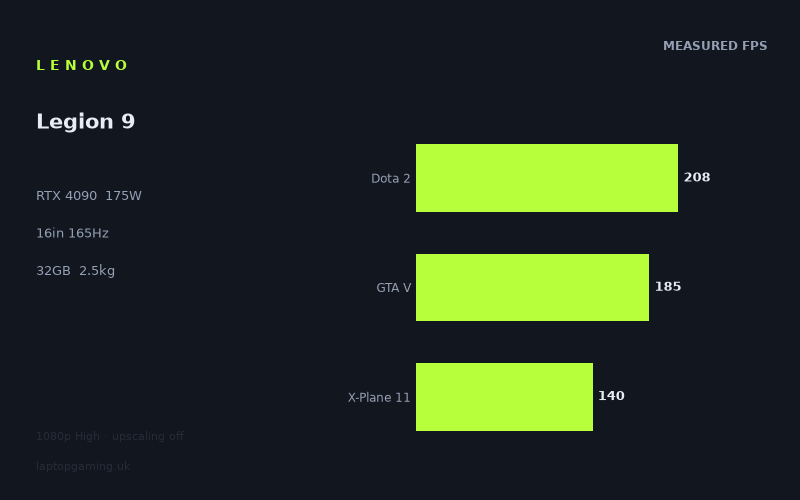
The mean across the available scoring-suite games is 178fps, based on Dota 2 at 208fps, GTA V at 185fps and X-Plane 11 at 140fps. That is useful context, but it should not be treated as a complete cross-laptop ranking figure. The available scoring suite is incomplete because there are no figures here for Cyberpunk 2077 or Baldur’s Gate 3. Every fully assessed laptop is averaged over the same five games, so a partial set cannot be placed fairly into that wider ranking. The 178fps mean is best used as a compact description of these three published results, not as a final verdict on the Legion 9 against every other laptop.
Even within those three games, the variation is instructive. Dota 2 at 208fps is comfortably above the display’s 165Hz refresh rate. GTA V at 185fps also clears it. X-Plane 11 at 140fps does not. A buyer interested mainly in competitive or older games should therefore not assume that every comparatively light-looking title will automatically produce identical results. X-Plane 11 demonstrates that game workloads can remain demanding for reasons other than the straightforward graphics load suggested by a game’s age or visual style.
The RTX 4090 at 175W
The Legion 9’s RTX 4090 has a stated 175W GPU power limit. That is a meaningful part of its specification because the same GPU name can appear in laptops with different power limits. In practical terms, the figure tells you that Lenovo has configured this RTX 4090 as a high-power implementation rather than presenting the GPU name without any indication of its intended power envelope.
However, the measured frame rates show why the power figure should be treated as context rather than a promise. A 175W RTX 4090 helps the Legion 9 reach 408fps in The Witcher 3 and 390fps in Strange Brigade under the stated benchmark conditions. It also helps it deliver 121fps in Alan Wake 2. But the gap between those results is a reminder that a GPU power limit does not flatten out the differences between games. The system may have substantial headroom in one title and still fall short of 165fps in another.
This is especially relevant when comparing premium laptops. It is easy to assume that a 175W RTX 4090 must always establish a clear lead over every lower-power RTX 4090 machine. The available shared-game comparisons do not support that simple conclusion. The Legion 9 is only 1fps ahead of the Asus ROG Strix Scar 18 2023, which has an RTX 4090 listed at 150W, across three shared games. It is also only 1fps ahead of the Razer Blade 16 2024 across three shared games. That does not mean the 175W configuration is meaningless. It means that at 1080p, in the limited shared game set available here, other limits can compress GPU differences.
At 1920x1080, especially in lighter games, the processor and the game engine can become the limiting factors before the GPU reaches a point where its higher configured power makes a large visible difference. This is why near-zero gaps should not be dismissed as bad data or repeated without explanation. The shared titles can be constrained by CPU-side work, game engine behaviour or a combination of both, leaving less room for a higher GPU power limit to create a dramatic lead. The Legion 9’s Core i9-13980HX is a high-end processor, but the key point is broader: some 1080p results are not pure measures of graphics horsepower.
The data therefore supports a sensible interpretation of the Legion’s 175W RTX 4090. It is a serious, high-power gaming configuration capable of extremely high frame rates. It is not proof that the Legion will dominate every laptop carrying the same GPU, and it is not a substitute for looking at the game results that matter to you.
Games that can make good use of 165Hz
At the stated 1080p High settings, seven of the twelve published game results exceed 165fps. Those are The Witcher 3 at 408fps, Strange Brigade at 390fps, F1 22 at 286fps, Tiny Tina’s Wonderlands at 226fps, Dota 2 at 208fps, GTA V at 185fps and Final Fantasy XV at 181fps. Far Cry 5 is also just above the line at 167fps.
For these games, the Legion 9 has enough measured performance to reach or exceed the panel’s 165Hz refresh rate at the benchmark resolution and preset. The practical implication is straightforward: where a game’s settings and resolution are comparable to the published test conditions, the display is not obviously over-specified. There is enough frame-rate capacity to justify a fast panel rather than fitting a high refresh rate solely as a marketing feature.
The Witcher 3 result is particularly striking at 408fps. It is far beyond 165Hz, which means the display cannot show every frame generated at that rate. That is not a criticism of the laptop. It is evidence of performance headroom at 1080p High in that title. A player can use that headroom to pursue higher graphical settings where available, a higher rendering resolution, or simply accept that the system is producing more frames than the screen can refresh.
Strange Brigade at 390fps tells a similar story. The Legion 9 is not merely clearing 165fps; it is doing so with a very large margin under the measured conditions. F1 22 at 286fps and Tiny Tina’s Wonderlands at 226fps are also well clear of the display refresh rate. These are the kinds of figures that make a fast panel worthwhile for players who value responsiveness and fluidity in titles that can sustain such performance.
Dota 2 at 208fps is important because it belongs to the available scoring suite and because it is the sort of game where a high-refresh display can be especially relevant. The published figure puts it above 165fps, showing that the Legion 9 has the necessary performance at the benchmark settings to feed the panel’s refresh rate. GTA V at 185fps and Final Fantasy XV at 181fps also clear the same threshold, though with less spare performance than Dota 2.
Far Cry 5 at 167fps is worth reading carefully. It technically exceeds the 165Hz figure, but only narrowly. It would be wrong to describe that result as massive headroom. It is enough to show that the Legion 9 can reach the panel limit in that test, but it does not leave the same margin seen in The Witcher 3, Strange Brigade or F1 22. Small changes to game settings or resolution can matter when a result sits close to a display refresh target.
Games below the panel refresh rate
Five published results fall below 165fps: X-Plane 11 at 140fps, Ratchet & Clank Rift Apart at 135fps, Cyberpunk 2077 1.6 at 130fps, Alan Wake 2 at 121fps and, by a wider margin than the rest, none of the listed games falls below 121fps. That is still a strong floor for this particular collection of 1080p High results, but it is also a meaningful reminder that the screen’s maximum refresh rate is not a guaranteed real-world target across every modern game.
X-Plane 11 at 140fps is below 165Hz but remains a high frame rate. The distinction matters. A result below the refresh ceiling is not automatically a disappointing result. It simply means the laptop is not producing enough frames in that test to fully saturate the panel at 165Hz. Someone looking for a smooth experience may still find 140fps entirely satisfactory; someone buying specifically to pursue a consistent 165fps target should note the difference.
Ratchet & Clank Rift Apart at 135fps, Cyberpunk 2077 1.6 at 130fps and Alan Wake 2 at 121fps form a useful cluster. They show that the Legion 9 remains powerful in difficult modern games, but not invulnerable to them. The machine is still producing well above 100fps in each published result at 1080p High without upscaling. That is clearly high-end performance. Yet none reaches the panel’s 165Hz ceiling, and all are measured below the Legion’s native 3200x2000 resolution.
Alan Wake 2 is the clearest example of why a laptop review should not reduce performance to an average. At 121fps, the Legion 9 is still delivering a frame rate many gaming laptops would struggle to approach in a demanding title. But it is 44fps short of 165fps at the stated 1080p High setting. That gap is more useful to a potential buyer than a broad statement that the laptop is “fast”. It tells you that the Legion is capable, but that demanding current games can consume the performance advantage of an RTX 4090 quickly.
Cyberpunk 2077 1.6 at 130fps tells much the same story. This is not a low result, and the lack of upscaling makes it more informative than a figure produced with a reconstruction setting enabled. But it is not evidence that the Legion 9 can deliver 165fps in Cyberpunk 2077 1.6 under the measured conditions. Buyers who consider a 165Hz screen a target rather than a ceiling should set expectations accordingly.
Why the spread matters more than one headline number
The Legion 9’s results are best understood as a range rather than a single performance label. The difference between 408fps in The Witcher 3 and 121fps in Alan Wake 2 is 287fps. That is not a contradiction. It is the central lesson of the benchmark list. Games vary enormously in their rendering demands and in the balance between graphics work and processor-side work.
Averaging can be useful for comparing broadly similar systems across the same fixed suite, but averages also conceal the experience of playing specific games. A person whose library is mostly Dota 2, GTA V, Far Cry 5 and F1 22 will see a very different practical benefit from this laptop than someone concentrating on Alan Wake 2, Cyberpunk 2077 1.6 and Ratchet & Clank Rift Apart. Both users are buying the same hardware. They are not buying the same performance experience.
For the first group, the Legion 9 offers measured frame rates from 167fps to 286fps in the cited games, with Dota 2 at 208fps and GTA V at 185fps. That is enough to make the 165Hz screen a realistic target at 1080p High. For the second group, the published figures sit from 121fps to 135fps. They remain very good, but the display refresh ceiling is no longer the relevant frame-rate expectation.
This is also why the benchmark resolution must remain front and centre. The 1080p results cannot be read as native-resolution results for a 3200x2000 display. A higher resolution asks the GPU to render more pixels, and the facts supplied here do not include frame rates at 3200x2000. There is no honest basis for printing an estimated native-resolution frame rate for any of these games. Anyone claiming a precise figure would be inventing it.
The correct conclusion is more limited but more useful: the Legion 9 has a large amount of 1080p High performance, including enough headroom to exceed 165fps in many of the tested games. In the most demanding titles listed, it is already below 165fps at 1080p High, so native 3200x2000 gaming will require realistic expectations and may involve choices about settings or upscaling. The benchmark data does not tell us exactly what those choices should be for each game, but it makes clear why they may be necessary.
The screen
The Legion 9 has a 16in display with a 3200x2000 resolution and a 165Hz refresh rate. That is a premium specification on paper: it combines a relatively high-resolution workspace with a refresh rate intended for gaming rather than a conventional lower-refresh panel.
There is no panel-type information in the supplied specification, so it would be wrong to describe it as IPS, Mini LED, OLED or any other display technology. There are also no published brightness, contrast, colour coverage or response-time measurements in the material provided here. Those omissions matter. Resolution and refresh rate describe important aspects of a screen, but they do not settle questions about image quality, motion handling, outdoor visibility or colour work.
What can be assessed from the known information is the relationship between the screen specification and the measured gaming performance. The panel’s 165Hz refresh rate is a sensible match for the Legion 9’s 1080p results in a significant proportion of the tested games. The Witcher 3, Strange Brigade, F1 22, Tiny Tina’s Wonderlands, Dota 2, GTA V, Final Fantasy XV and Far Cry 5 all meet or exceed 165fps under the published settings.
That is a strong showing, but it needs the same caveat every time: the benchmarks were run at 1920x1080, while the laptop’s own panel is 3200x2000. The native display resolution is not a small step above 1080p. It is a materially higher rendering target. The available frame-rate data therefore cannot prove that those same games will hold 165fps at the panel’s native resolution.
The distinction is especially important for buyers drawn to the screen because it appears to offer both sharpness and speed. A 3200x2000, 165Hz panel gives you those capabilities, but games may force a decision about where to spend available performance. In a lighter title with substantial 1080p headroom, there may be room to pursue more demanding settings or a higher resolution. In a game such as Alan Wake 2, where the published result is 121fps at 1080p High without upscaling, the route to 165fps at native resolution is not established by the data and should not be assumed.
This does not undermine the value of the screen. A high-resolution panel can be useful outside games, while 165Hz remains beneficial whenever the system can supply high frame rates. It does mean that buyers should avoid treating 3200x2000 and 165Hz as one combined guarantee. They are two display capabilities, and the available game results show that demanding titles can challenge one or both simultaneously.
The benchmark list also demonstrates why 165Hz is more of a ceiling than a universal target. In The Witcher 3 at 408fps and Strange Brigade at 390fps, the Legion produces far more frames than the panel can refresh. In F1 22 at 286fps and Tiny Tina’s Wonderlands at 226fps, there is still substantial room above 165fps. In Far Cry 5 at 167fps, the margin is minimal. In X-Plane 11, Ratchet & Clank Rift Apart, Cyberpunk 2077 1.6 and Alan Wake 2, the published figures are below 165fps.
For a buyer who mainly plays esports-adjacent, older or less graphically punishing games, the screen is likely to make clear sense at the 1080p benchmark target. For a buyer who mainly plays demanding current releases, its 165Hz refresh rate is still welcome, but the measured results suggest that the native resolution and maximum refresh rate should not both be treated as default targets in every game.
Build, size and portability
The confirmed portability figure is a weight of 2.55kg. That makes the Legion 9 a substantial laptop. It is not in the class of machines chosen primarily because they disappear into a bag or can be carried all day without thought. It is more accurately understood as a powerful 16in system that can move between home, work, university accommodation or events, while remaining most convincing as a machine used on a desk or other stable surface.
Weight is not the only factor in portability, but it is the only physical measurement provided here. There are no dimensions in the supplied specification, so there is no basis for claiming that the Legion 9 is thin, compact, wide, deep or unusually bulky for its class. There is also no charger weight, so the total travelling weight cannot be calculated from the available facts.
Even so, 2.55kg says enough about the intended compromise. This is a laptop designed around high-end components: RTX 4090 graphics at a 175W power limit, a Core i9-13980HX, 32GB of memory, 1TB SSD storage and a 16in 3200x2000 display. Those specifications point towards performance first. A buyer should approach it as a desktop-replacement system with portability, not as an ultraportable machine with gaming capability.
That does not mean it cannot travel. A laptop is inherently easier to relocate than a desktop PC, and a 16in form factor may suit buyers who need one powerful computer for several locations. But there is a difference between occasional transport and daily commuting. At 2.55kg, the Legion 9 is more likely to suit the former.
There is no battery-life figure in the supplied facts, so no claim can be made about unplugged endurance. There are also no noise or temperature figures. High-power gaming laptops can differ greatly in those areas, and it would be irresponsible to fill the gap with assumption. Anyone for whom quiet operation, low surface temperatures or long battery life is a deciding factor should seek measurements specifically covering those subjects before buying.
The same caution applies to materials, keyboard quality, trackpad quality, port selection and upgrade access. None is documented in the provided information. The Legion 9 can be judged here as a high-specification gaming laptop with a known weight and strong published game results, but not as a fully assessed physical product in every practical respect.
How it compares
Against the Lenovo Yoga Pro 9 16IMH9 RTX
The widest performance gap among the listed rivals is against the Lenovo Yoga Pro 9 16IMH9 RTX with an RTX 4050 at 100W. Across eight shared games, the Legion 9 averages 121fps ahead. That is a very large difference and it is exactly what the Legion’s class-leading specification is for.
This comparison is useful because it shows the Legion 9 is not merely a premium laptop that trades blows with other RTX 4090 systems. Against a much lower-tier GPU configuration, it has a substantial measured advantage across a reasonably broad eight-game overlap. The Legion’s 175W RTX 4090, Core i9-13980HX and 32GB memory configuration is aimed at buyers who want maximum gaming performance; the shared-game gap confirms that it occupies a very different performance category from the Yoga Pro 9 configuration listed here.
There is no confirmed UK price for the Yoga Pro 9 16IMH9 RTX in the supplied information, so this cannot become a value comparison. It is strictly a performance comparison. A 121fps average advantage is decisive for someone who wants high-refresh gaming, but it does not tell us which system makes more financial sense without UK pricing.
The Yoga comparison also highlights how quickly a 165Hz target changes between performance classes. The Legion’s 1080p High results include several games above 165fps, while the 121fps shared-game average advantage suggests the Yoga Pro 9 configuration is not operating in the same frame-rate territory across the common titles. If gaming performance is the priority, the Legion 9 is the clearly more appropriate machine of the two.
Against the Razer Blade 16 2024
Against the Razer Blade 16 2024 with an RTX 4090, the Legion 9 averages only 1fps ahead across three shared games. That is effectively a near-zero result, and it should be read as such. The Legion does not establish a meaningful performance lead in the available overlap.
It would be a mistake to turn this into a sweeping statement that the two laptops are identical in every game, at every resolution or in every operating mode. The comparison covers only three shared games. It is nevertheless enough to challenge the assumption that the Legion’s stated 175W RTX 4090 automatically translates into a clear performance advantage over another RTX 4090 laptop.
The likely reason near-zero results can occur in this kind of 1080p comparison is that lighter shared titles may be constrained by CPU-side limits or game-engine limits. When the GPU is no longer the dominant bottleneck, genuine GPU power differences become less visible in the resulting frame rate. That does not make the hardware specification irrelevant; it means the test scenario is not always able to expose the full potential gap between configurations.
There is no confirmed UK price for the Razer Blade 16 2024 in the provided facts. As with the Yoga comparison, that prevents a conclusion on value. A buyer choosing between these two should not assume the Legion 9 is faster simply because of the 175W power figure. The shared results are effectively tied. Price, screen preferences, weight, ports, battery life, noise and build would all matter, but those details are not available in this fact sheet.
Against the Asus ROG Strix Scar 18 2023
The Asus ROG Strix Scar 18 2023 is listed with an RTX 4090 at 150W and a UK price of £4,000. Across three shared games, the Legion 9 averages 1fps ahead. Again, this is a near-zero difference rather than a meaningful victory.
This is one of the most revealing comparisons because the Legion’s RTX 4090 has the higher stated GPU power limit: 175W against 150W. If laptop performance scaled cleanly and consistently with the power figure, a larger gap might be expected. The available 1080p results do not show one. The sensible explanation is not that GPU power limits never matter, but that the limited shared game set is likely compressing the difference through CPU-bound or game-engine-bound behaviour at this resolution.
The Scar 18’s £4,000 UK price gives at least one fixed reference point in this group. The Legion 9 has no confirmed UK price, so it is impossible to say whether it is cheaper, more expensive or better value than the Asus. What can be said is that a buyer should not pay a major premium for the Legion solely on the expectation of a clear frame-rate lead over this 150W RTX 4090 competitor. The published overlap indicates a practical tie.
The comparison is also a reminder to separate display size from raw gaming speed. The Legion 9 has a 16in display; the rival’s name identifies it as an 18in model, but no further display specification is provided here. The available shared-game performance does not suggest that the Legion is compromised merely because it uses a smaller class of screen. In the games both systems hold, it is fractionally ahead, but the difference is too small to carry a buying decision.
Against the Asus ROG Strix Scar 17
The Asus ROG Strix Scar 17, also equipped with an RTX 4090, is the listed rival that beats the Legion 9 by the largest amount. Across three shared games, the Legion averages 21fps behind. The Scar 17 has a listed UK price of £4,866.
A 21fps average deficit is substantial enough to matter, but it still needs context. The comparison spans only three shared games, not a complete uniform suite. It establishes that the Scar 17 is faster in the available overlap; it does not prove that it is faster by exactly the same amount in every game a buyer might play.
Even with that caution, this is the comparison that stops the Legion 9 being described as the automatic choice among RTX 4090 laptops. The Legion is extremely quick, but it is not the fastest machine in every published comparison. Buyers chasing the highest possible frame rate should take the Scar 17 result seriously, particularly if the games in the three-title overlap resemble the games they play most often.
Whether that performance advantage justifies the Scar 17’s £4,866 price cannot be decided without a confirmed UK price for the Legion 9. If the Legion were much less expensive, a 21fps shared-game gap could be an acceptable compromise. If it were similarly priced or higher, the argument for the Scar 17’s performance lead would become stronger. The absent Legion price is not a minor administrative detail; it is central to any buying recommendation at this level of the market.
What the rival spread says about the Legion
The four comparisons place the Legion 9 in a credible but nuanced position. It is dramatically faster than the RTX 4050-equipped Lenovo Yoga Pro 9 16IMH9 RTX, with a 121fps average lead across eight shared games. It is effectively tied with the Razer Blade 16 2024 and Asus ROG Strix Scar 18 2023 in their limited three-game overlaps, leading each by 1fps. It trails the Asus ROG Strix Scar 17 by 21fps across three shared games.
That is a healthier and more honest picture than simply saying “RTX 4090 equals best performance”. The Legion 9 belongs in the highest performance tier represented here, but performance within that tier can be closely packed or can diverge depending on the titles being compared. The 175W GPU power limit gives the Legion a strong technical foundation, yet actual frame rates remain dependent on the game and the benchmark conditions.
The near-ties with the Razer Blade 16 2024 and Scar 18 2023 are particularly relevant for a buyer who has found those machines at different prices. If one is significantly cheaper than the others, the shared-game data gives no reason to reject it on the basis that the Legion must be materially faster. Conversely, the Legion’s 1fps average lead is real in the reported figures, but not meaningful enough to justify a premium by itself.
The Scar 17 result provides the opposite lesson. If outright speed is your priority and the available shared games are relevant, there is evidence of a tangible frame-rate advantage elsewhere. The Legion remains an extremely capable option, but the data does not support calling it unbeatable.
Who it’s for
Buy it if you want a powerful 16in desktop replacement
The Legion 9 makes the most sense for someone who wants a high-end gaming laptop without stepping into the 18in category, and who accepts that 2.55kg is the price of prioritising performance. Its combination of RTX 4090 graphics at 175W, a Core i9-13980HX, 32GB memory and 1TB SSD storage is appropriately ambitious for demanding games and for buyers who do not want to compromise at the lower end of the gaming-laptop market.
The published results support that position. At 1080p High without upscaling, the Legion reaches 408fps in The Witcher 3, 390fps in Strange Brigade, 286fps in F1 22 and 226fps in Tiny Tina’s Wonderlands. It also produces 208fps in Dota 2, 185fps in GTA V, 181fps in Final Fantasy XV and 167fps in Far Cry 5. Those are not marginal gains over a typical gaming laptop; they are the kind of figures that make high-refresh gaming realistic in a broad collection of titles.
It is also a good fit for a buyer who plays a mixture of competitive, older and graphically demanding games. The benchmark list does not show a weak point where performance suddenly collapses. Even the lowest reported result, Alan Wake 2 at 121fps, is still high in absolute terms under the stated test conditions. The Legion’s strength is that it covers a wide range from extremely high frame rates in lighter titles to strong performance in far harder games.
Buy it if you understand the 165Hz target properly
The Legion 9 is suitable for buyers who see 165Hz as a maximum capability rather than a contractual minimum. At 1080p High, it can exceed 165fps in many of the measured titles. In others, it cannot. That is the normal reality of current PC gaming, even at this hardware level.
If your games resemble The Witcher 3, Strange Brigade, F1 22, Tiny Tina’s Wonderlands, Dota 2, GTA V, Final Fantasy XV or Far Cry 5, the Legion’s published numbers indicate that the 165Hz panel can be used well at the benchmark resolution. If your time is spent mainly in Alan Wake 2, Cyberpunk 2077 1.6, Ratchet & Clank Rift Apart or X-Plane 11, you should expect high frame rates rather than assume 165fps.
It is also suited to a buyer who is comfortable making per-game settings decisions. The Legion’s native display resolution is 3200x2000, while the available benchmark results are at 1920x1080. There is no published evidence here that every game will run at native resolution with the same frame rates. A knowledgeable buyer will see the high-resolution panel as flexibility, not as an instruction to run every game at the maximum possible pixel count regardless of performance.
Buy something else if you need genuine everyday portability
At 2.55kg, the Legion 9 is not the right machine for someone who carries a laptop all day, commutes extensively on foot, or needs the least burdensome option for frequent travel. It can be transported, but it is not lightweight. Buyers whose gaming needs are more modest may be better served by a less performance-focused system that reduces the physical compromise.
There is no battery-life information in the supplied material, so no conclusion can be made about how long it lasts away from mains power. That uncertainty should matter to mobile buyers. If battery use is central to how you work or study, look for measured battery data before treating this as a practical all-day machine.
Buy something else if your only goal is the highest frame rate available
The Legion 9 is exceptionally quick, but the Asus ROG Strix Scar 17 is 21fps ahead across three shared games. The comparison is limited, but it is still the clearest published evidence among the listed rivals that another RTX 4090 laptop can be faster.
For a buyer whose sole objective is maximum performance, the Scar 17 deserves attention. Its £4,866 price is known, while the Legion’s UK price is not confirmed. Without the Legion price, it is impossible to say whether the Legion represents a better performance-per-pound proposition. But the data does not support assuming that the Legion’s 175W RTX 4090 makes it the universal performance leader.
Buy something else if price is your deciding factor
There is no confirmed UK price for the Lenovo Legion 9 configuration covered here. That means there is no responsible way to call it good value, poor value, expensive or a bargain. It may be competitively priced, it may be costly, or it may sit awkwardly against alternatives. The information needed to decide is absent.
The listed rivals underline why this matters. The Asus ROG Strix Scar 18 2023 is priced at £4,000 and performs within 1fps of the Legion across three shared games. The Asus ROG Strix Scar 17 is priced at £4,866 and is 21fps ahead across three shared games. The Razer Blade 16 2024 and Lenovo Yoga Pro 9 16IMH9 RTX have no confirmed UK prices in the provided information. Until the Legion’s own UK price is confirmed, performance can be judged, but value cannot.
The final recommendation is therefore conditional. The Lenovo Legion 9 is a powerful, credible RTX 4090 gaming laptop with a high-power 175W GPU configuration, a fast 16in 3200x2000 165Hz display and very strong published 1080p High results. It is a strong choice for a buyer who wants high-end gaming performance in a 16in machine and does not mind a 2.55kg weight. It is not a machine to buy on blind faith in specifications alone. Check the UK price, compare it against the specific RTX 4090 rivals available at the time, and remember that the impressive 1080p frame rates do not automatically translate into native 3200x2000 performance at 165fps in every game.