Details
Product prices and availability are accurate as of the date/time indicated and are subject to change. Any price and availability information displayed on Amazon.co.uk at the time of purchase will apply to the purchase of this product.Review
HP Omen Max 16-ah1932nr review
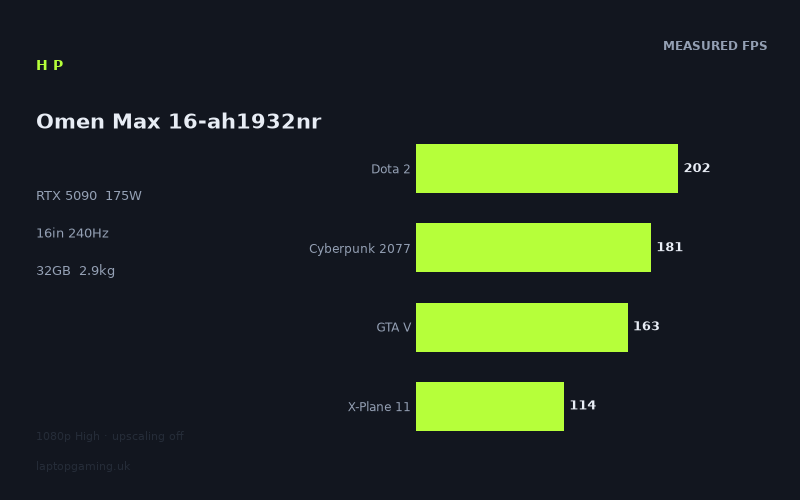
Frame rates
1920×1080, High preset, upscaling off.
Measured on this machine. Source: Notebookcheck, 2026-10-10.
Not scored: incomplete benchmark suite
Every scored laptop on this site is averaged over the same 5 games, and this one is short of Baldur's Gate 3. A mean over 4 games is not comparable to a mean over 5, so we publish the figures we have and leave the score blank rather than rank it against machines tested on a different set. The numbers below are real - the suite is just incomplete.
How these numbers were produced
Frame rates here are not measured by us, and we label how each one was arrived at. A figure marked measured comes from a published run on that exact machine. A figure marked representative is derived from the GPU and its power limit (TGP) and cross-referenced against published reviews - a sound estimate of what that configuration delivers, but not a measurement of that specific laptop. Unless stated otherwise, numbers are 1920x1080, High preset, upscaling off. Where a laptop ships in several power configurations we use the wattage of the exact SKU listed, because a 140W RTX 5070 and a 115W one are not the same product.
In use
The short version
The HP Omen Max 16-ah1932nr is a very high-end gaming laptop on paper: an RTX 5090 with a 175W GPU power limit, 24GB of VRAM, a Core Ultra 9 290HX, 32GB of memory and a 2048GB SSD are not restrained specifications. The available Notebookcheck benchmark data broadly supports that positioning. At 1920x1080 using the High preset with upscaling disabled, it delivers excellent results in demanding games as well as very high frame rates in lighter titles.
There is an important qualification before treating it as a straightforward recommendation. We do not have a confirmed UK price, and that prevents the most important part of the buying judgement: whether this configuration is sensibly priced against competing RTX 5080 and RTX 5090 systems. A laptop with this class of hardware can be compelling if it is priced close enough to strong RTX 5080 machines, but far less convincing if its price rises into territory where faster RTX 5090 alternatives are available. That is especially relevant here because the Omen is not the quickest RTX 5090 in the supplied comparison set.
The published figures are still strong. Notebookcheck measured 210fps in Final Fantasy XV, 202fps in Dota 2, 181fps in Cyberpunk 2077, 163fps in GTA V, 116fps in Assassin's Creed Black Flag Resynced and 114fps in X-Plane 11. Those are results at 1920x1080 rather than the laptop screen's 2560x1600 native resolution, so they should not be read as native-panel performance. They do, however, show a machine with substantial performance headroom for high-refresh competitive gaming in lighter workloads and comfortable results in much heavier games.
The Omen Max 16-ah1932nr makes most sense for a buyer who wants a 16in gaming system with a high-refresh 2560x1600 display, a full 175W RTX 5090 power limit and unusually large 24GB graphics memory, but who is willing to wait for a credible UK price before deciding. It also suits someone whose workloads extend beyond a single game genre. The data covers a wide range: Dota 2, Cyberpunk 2077, GTA V, Final Fantasy XV, Assassin's Creed Black Flag Resynced and X-Plane 11 do not behave alike, and the HP remains well above basic-playability territory in all of them.
It is less clearly the right choice for somebody buying purely for the maximum possible frame rate from an RTX 5090 laptop. The Schenker XMG Neo 16 A25 is ahead by a meaningful margin across the shared games, despite using the same GPU class. The HP is also effectively tied with the supplied RTX 5080 competition in the smaller shared samples. That does not make the Omen slow; it makes the price and the rest of the specification decisive. Without a UK price, the sensible verdict is that this is a powerful but not yet fully judgeable purchase.
There is also no published overall ranking for this machine in the supplied material. The normal scoring set is incomplete because there is no Baldur's Gate 3 result. The available mean of 165fps covers the supplied scoring-suite games only, while scored laptops are averaged across the same full five-game set. It would therefore be misleading to place the HP in a formal overall order against machines with complete data. The individual measured results and direct shared-game comparisons are the evidence to use instead.
Performance
What the measured figures say
Notebookcheck's figures were recorded at 1920x1080, High settings and with upscaling disabled. That matters. These are clean baseline results rather than figures inflated by a reconstruction mode, but they are also results at a lower resolution than the Omen's 2560x1600 display. The numbers establish how the laptop performs under the stated benchmark conditions; they do not establish the exact frame rate to expect after switching the panel to its native resolution, selecting another quality preset or enabling an upscaler.
Within those conditions, the spread is wide:
- Final Fantasy XV reaches 210fps.
- Dota 2 reaches 202fps.
- Cyberpunk 2077 reaches 181fps.
- GTA V reaches 163fps.
- Assassin's Creed Black Flag Resynced reaches 116fps.
- X-Plane 11 reaches 114fps.
The available scoring-suite mean is 165fps across Dota 2, Cyberpunk 2077, GTA V and X-Plane 11. That is a very high average for the stated 1920x1080 High test, but the individual figures are more useful than the average when choosing a laptop. An average conceals the difference between a game that is nearing the screen's refresh ceiling and one that sits much further below it. A buyer interested in Dota 2 will take a different lesson from this data than a buyer interested in flight simulation, even though both results contribute to the broader impression of a fast machine.
Final Fantasy XV is the fastest result at 210fps. That puts the laptop close to the 240Hz panel refresh rate in this particular game and benchmark mode, although it does not fully reach it. Dota 2 is similarly close at 202fps. These are the titles in the supplied data where the high-refresh screen has the clearest practical purpose at 1920x1080 High: the system can present a great many frames, rather than merely clearing a conventional desktop-style target.
Cyberpunk 2077 at 181fps is particularly notable because it remains well short of the display's full refresh rate while still delivering an extremely high measured figure. This is exactly why a 240Hz panel should not be treated as a promise that every modern game will run at 240fps. The panel can refresh at that rate; the game, graphics settings, resolution and rendering path determine whether the hardware can supply matching frames. On the available data, Cyberpunk 2077 is not a 240fps result under the stated conditions, but it is still a strong showing for a demanding game without upscaling.
GTA V measures 163fps. That is lower than Cyberpunk 2077 in this test set, a useful reminder that game age alone does not let a buyer predict benchmark outcomes. Different engines, game workloads and benchmark scenes can produce results that do not match a simplistic newer-versus-older expectation. For a prospective owner, the practical conclusion is that the Omen has ample performance in GTA V under these conditions, but that it does not fill the 240Hz ceiling here either.
Assassin's Creed Black Flag Resynced and X-Plane 11 sit close together at 116fps and 114fps. Both are still comfortably above basic smooth-play thresholds, but neither is remotely close to using all of the panel's 240Hz refresh capability in this benchmark configuration. These are the most useful cautionary results in the table. Buying an RTX 5090 laptop does not remove the differences between games. A title may be limited by its engine, its scene complexity, its CPU demands or a mixture of factors that do not yield simply because the laptop has a flagship GPU.
The benchmark spread therefore tells a more interesting story than “RTX 5090 equals 240fps”. The Omen can approach that level in Final Fantasy XV and Dota 2 at the tested settings. It produces a lower but still very high result in Cyberpunk 2077 and GTA V. In Assassin's Creed Black Flag Resynced and X-Plane 11, it runs at a little over one hundred frames per second instead. That is still good performance, but it is a different experience from the very high-refresh results at the top of the chart.
What a 175W RTX 5090 means here
The RTX 5090 in this HP carries a 175W GPU power limit. That is an important specification because the name of a mobile GPU does not, by itself, tell a buyer how much power a particular laptop design allows it to use. This is not a lightly powered RTX 5090 configuration. The Omen is specified with a high 175W limit, which places it firmly in the category of performance-led gaming laptops rather than thin systems built around a heavily constrained graphics implementation.
That power limit should nevertheless be treated as context, not as a substitute for benchmarks. A 175W label tells us the configured ceiling, while the published game figures show the outcome in the stated test. It does not allow a buyer to assume identical results in every RTX 5090 laptop, even when another machine lists the same limit. The comparison against the Schenker XMG Neo 16 A25 is the clearest evidence of that: both machines use an RTX 5090, yet the HP trails by 29fps across the four shared games. The reason for that gap cannot be established from the supplied facts alone, so it would be wrong to attribute it to cooling, firmware, memory configuration or any other specific cause.
Equally, the Omen's 175W limit does not automatically translate into a decisive win over every RTX 5080 system. The MSI Vector 17 HX AI is only 1fps behind across three shared games, while the Lenovo Legion Pro 7i 16 Gen 10 is 1fps ahead across three shared games. Those near-zero results are real results, not evidence that the RTX 5090 label is irrelevant. The shared samples are small, and the test is at 1920x1080, where lighter titles can become CPU-bound and compress genuine GPU differences. When a game is constrained more by processor-side work than by available GPU throughput, a more powerful GPU cannot always turn its theoretical advantage into a proportionately higher frame rate.
That is especially relevant to a laptop built around a Core Ultra 9 290HX. It is an appropriate high-end processor pairing for this graphics class, but the supplied figures still show that some 1920x1080 results are not solely a simple measure of GPU power. Dota 2 is a good example of why buyers should resist reading one high frame-rate result as a pure GPU ranking. At such high measured rates, the broader system and the game itself can become as important as the graphics processor. The same principle helps explain why direct comparisons can become tightly compressed despite different GPU tiers.
For GPU-limited gaming, the 175W RTX 5090 and 24GB of VRAM are the more important parts of the specification. The provided results cannot quantify how much of that VRAM any individual benchmark used, so there is no basis for claiming that a particular game needs it. What can be said is that 24GB is a substantial graphics-memory allocation for a gaming laptop, and it gives this model a stronger hardware position for graphics workloads than a configuration defined only by high average frame rates at 1920x1080. Buyers who keep machines for a long time, use demanding texture settings, or work with applications that can benefit from graphics memory may place more value on that capacity than someone who only plays a small number of esports titles.
The relevance of the benchmark settings
The benchmark resolution is 1920x1080. The screen resolution is 2560x1600. That difference is not a minor footnote. The Omen's panel has more pixels than the benchmark setting, and it also uses a different shape. Consequently, none of the published frame rates should be described as native-resolution figures for this laptop.
A buyer planning to use the laptop screen at 2560x1600 should read the 1920x1080 results as a performance baseline, not a direct prediction. The supplied evidence does not include 2560x1600 results, nor does it include results with upscaling enabled. We cannot responsibly fill that gap with estimated frame rates. There is enough evidence to say that the hardware is powerful and that the 1920x1080 High figures are excellent; there is not enough evidence to state what it will produce at native resolution in these same games.
This distinction is particularly important for the slower results in the data set. X-Plane 11 at 114fps and Assassin's Creed Black Flag Resynced at 116fps are comfortable at the tested resolution, but they leave much less margin beneath the panel's native resolution than Final Fantasy XV at 210fps or Dota 2 at 202fps. That does not mean either title will be poor at 2560x1600; it means the supplied measurement does not justify a native-resolution claim. A careful buyer should not purchase on the assumption that every game will remain close to the 240Hz ceiling after moving to a higher resolution.
The fact that upscaling was disabled is also valuable context. It means the listed results are not dependent on an enabled upscaling mode. But it does not tell us how a buyer should configure each game, because the data does not include an alternative upscaling result for comparison. Anyone considering this laptop should treat the benchmark figures as one defined quality and resolution point rather than a complete settings guide.
The incomplete suite and what it prevents us from saying
The Omen has measured results for four of the scoring-suite games: Dota 2, Cyberpunk 2077, GTA V and X-Plane 11. Their mean is 165fps. However, the standard scored set contains five games and there is no supplied Baldur's Gate 3 result for this machine. As every scored laptop is averaged across the same five-game set, a partial average cannot be fairly ranked alongside a full one.
That is not a criticism of the 165fps figure. It is a useful description of the four available scoring-suite measurements. It simply cannot bear more weight than it has. Baldur's Gate 3 may have raised or lowered the final full-suite position relative to other laptops, and there is no legitimate way to infer the missing result from the available games. A review that turned the partial average into a formal all-round ranking would be presenting certainty that the data does not provide.
The direct comparisons are more robust for purchase decisions because each quoted comparison is restricted to games both machines hold. They remain limited to their shared samples, but they do not pretend to include a result that is not available. That makes them the better basis for judging this HP against the named alternatives.
The screen
The HP Omen Max 16-ah1932nr has a 16in 2560x1600 display with a 240Hz refresh rate. On a machine carrying an RTX 5090 at 175W, that is an ambitious and sensible pairing. The resolution offers more desktop and game image detail than the 1920x1080 benchmark setting, while the 240Hz refresh rate gives high-frame-rate games somewhere useful to go. It is a screen specification aimed at a buyer who wants both high resolution and high refresh rather than choosing only one of them.
What the supplied data does not specify is the panel type. There is no basis here to describe it as OLED, IPS, Mini LED or anything else. There are also no supplied figures for brightness, colour coverage, response behaviour, contrast, adaptive-sync support or HDR performance. Those details matter to image-quality-focused buyers, but they are not present in the fact sheet and should not be invented from the resolution and refresh-rate specification.
The most important performance question is whether the laptop can make good use of 240Hz. The answer depends heavily on the game. At the 1920x1080 High test setting, Final Fantasy XV reaches 210fps and Dota 2 reaches 202fps. Both are close enough to the panel's refresh capability to make a 240Hz display substantially more relevant than it would be on a lower-powered system. They are not 240fps results, so the panel is not fully saturated in the measured run, but they are plainly high-refresh results.
Cyberpunk 2077 at 181fps and GTA V at 163fps also benefit from a high-refresh panel, though they do not approach its limit to the same extent. The extra refresh capacity is not wasted merely because a game sits below 240fps. It means the display is not imposing a lower ceiling beneath the measured output. Still, buyers should be precise about what they are paying for: in the supplied data, the screen's maximum refresh rate is a headroom feature rather than a rate achieved across every game.
Assassin's Creed Black Flag Resynced at 116fps and X-Plane 11 at 114fps reinforce that point. These figures are less than half of 240fps. The panel can refresh much faster than the game is delivering in those tests, and upgrading from a lower-refresh display would not turn those results into a 240fps experience. The 240Hz specification is most valuable to someone who plays a mix that includes titles like Dota 2 and other high-frame-rate games, rather than someone expecting every demanding or simulation-heavy title to meet the panel's maximum.
The mismatch between the benchmark resolution and the panel's native resolution needs repeating here because it directly affects the screen discussion. The high figures were measured at 1920x1080, not 2560x1600. At native resolution, the panel has more pixels to drive. We do not have Notebookcheck figures for the Omen at 2560x1600, so it is not possible to say which of these games will approach 240Hz on the built-in screen at its native setting. A buyer wanting the sharpest native-resolution presentation should regard the published data as encouraging but incomplete.
There is a practical upside to the combination of a high-resolution panel and these strong 1920x1080 figures: the owner has options. Competitive players may prioritise the settings that produce very high frame rates, while players who value the screen's native resolution may accept a lower frame rate in exchange for rendering more pixels. The exact balance cannot be prescribed from the available measurements, but the Omen's hardware is clearly not paired with a low-refresh display that would make its faster benchmark results irrelevant.
Build, size and portability
The Omen Max 16-ah1932nr weighs 2.927kg. That places it firmly in the substantial end of the 16in gaming-laptop category in practical terms. It is a machine to move when necessary, not one to choose primarily for carrying convenience. A buyer who expects to take it between fixed locations can reasonably regard the weight as manageable in the sense that it remains a laptop, but it is not a specification that suggests effortless daily portability.
That weight fits the rest of the configuration. A 175W RTX 5090, Core Ultra 9 290HX, 16in 240Hz screen, 32GB of memory and 2048GB SSD storage describe a system designed around performance capacity rather than minimal mass. The important point is not that 2.927kg is inherently unacceptable; it is that the buyer should make an honest assessment of how often it will travel. Someone using it mainly on a desk, occasionally moving it around a home or taking it to a different location infrequently may find the trade-off entirely reasonable. Someone carrying it throughout the day may not.
The supplied information does not include physical dimensions, chassis materials, port selection, keyboard layout, trackpad quality, speaker performance, webcam details, upgrade access, cooling noise or surface temperatures. We therefore cannot make claims about how compact it is for its class, how rigid the chassis feels, whether it is easy to service, or how loud it becomes under load. The weight is the only direct physical-use measurement provided.
Likewise, the 83Wh battery capacity tells us the size of the battery but not the battery life. There are no runtime figures in the supplied material for video playback, light work, gaming or idle use. It would be wrong to turn the 83Wh capacity into a claimed number of hours. Buyers who need long unplugged use should seek measured battery-life data before treating the Omen as a mobile work system. High-end gaming hardware and a 240Hz screen do not, by themselves, establish battery endurance in either direction.
For desk use, the 2048GB SSD and 32GB of memory are welcome parts of the configuration. A 2048GB drive provides a more generous starting point than a minimal-capacity gaming configuration, particularly for a buyer who intends to keep several large games installed. The supplied specification does not state usable formatted capacity, drive speed, whether there are additional slots, or whether memory and storage are upgradeable. It is sensible to view the listed capacity as a strength while avoiding assumptions about expansion.
The 24GB of VRAM also makes the Omen a more serious all-purpose high-performance laptop than a model selected solely for a high-refresh esports role. Again, the fact sheet provides no application benchmarks, so this is not evidence of a specific content-creation performance level. It is, however, a relevant hardware characteristic for a buyer who wants graphics memory headroom alongside gaming performance.
In short, this is best understood as a performance-first portable computer with a 2.927kg weight, rather than a lightweight 16in machine that happens to have powerful parts. If portability is a secondary concern and the laptop will spend much of its life on a desk, the specification makes coherent sense. If low mass, compact dimensions, quiet operation or proven battery life are non-negotiable, the available data is insufficient to recommend it confidently.
How it compares
The supplied comparison group is useful because it includes a much cheaper lower-tier machine, two RTX 5080 laptops that sit very close to the HP in the shared tests, and an RTX 5090 alternative that is materially faster. It makes clear that the Omen's RTX 5090 badge is only the start of the buying analysis.
Against the MSI Cyborg 15
Against the MSI Cyborg 15 with an RTX 5050, the HP averages 71fps more across four shared games. The MSI has a confirmed UK price of £1,029, while the HP's UK price is not confirmed. This is the largest stated advantage for the Omen in the comparison set, and it is the clearest performance argument for spending more on the HP if the budget permits.
A 71fps shared-game average gap is not a marginal result. It reflects a different performance category, not a small configuration adjustment. The Omen also has the more substantial GPU specification on paper: RTX 5090, 175W power limit and 24GB of VRAM. But the price gap cannot be calculated because there is no confirmed UK price for the HP. That missing price is vital. The MSI may remain the more appropriate purchase for a buyer with a strict budget, while the HP is aimed at someone who prioritises much higher performance and is prepared to pay for it.
The more interesting conclusion is not simply that the HP wins. It is that the two machines serve different buyers. The Cyborg's £1,029 confirmed UK price establishes a lower entry point. The HP's published frame-rate advantage establishes far greater gaming headroom, but there is no honest way to say whether that performance is proportionately good value until its UK price is known.
Against the MSI Vector 17 HX AI
The MSI Vector 17 HX AI uses an RTX 5080 and has no confirmed UK price in the supplied data. The HP averages only 1fps more across three shared games. That is effectively a tie in this limited direct comparison, not a meaningful real-world lead for the Omen.
The reason matters. At 1920x1080, lighter titles in a shared set can be CPU-bound, which compresses genuine GPU gaps. A more powerful GPU does not always show its full potential when the game or wider system has become the limiting factor. The near-zero result should not be misread as proof that RTX 5090 and RTX 5080 laptops are interchangeable in every game, resolution or settings combination. It says that in these three shared measurements, the HP does not create a useful separation.
Without confirmed UK pricing for either machine, this comparison cannot settle the value question. It does show that the HP should not be purchased merely on the expectation of a major benchmark lead over every RTX 5080 laptop. Buyers comparing these two should look closely at screen, storage, weight, memory, GPU power configuration and any independently measured characteristics not present here. On the evidence supplied, the frame-rate difference is too small to be a decisive reason to choose one over the other.
Against the Lenovo Legion Pro 7i 16 Gen 10
The Lenovo Legion Pro 7i 16 Gen 10 has an RTX 5080 specified at 175W and a confirmed UK price of £3,950. Across three shared games, the HP is 1fps behind. This is again a virtual draw in the available sample, but it is particularly significant because the Lenovo matches the HP's stated 175W GPU power limit despite using the lower RTX 5080 tier.
At 1920x1080, CPU limits in lighter games can compress GPU differences, so the 1fps deficit does not establish that the Lenovo is categorically faster in all situations. Nor does it establish that the HP's RTX 5090 provides no advantage. It establishes something narrower and more useful: the supplied shared-game data does not show a meaningful lead for the HP over this specific 175W RTX 5080 rival.
The Legion's £3,950 UK price gives buyers one concrete market reference point. However, because HP's UK price is unconfirmed, it cannot be used to declare either machine the better value. If the Omen appears at a materially lower price than the Lenovo, its broadly tied shared-game performance, 24GB VRAM and 2048GB SSD could make it a persuasive alternative. If it arrives at a higher price, the small available performance deficit makes the decision harder. The price is not a minor missing detail here; it is the deciding piece of information.
Against the Schenker XMG Neo 16 A25
The Schenker XMG Neo 16 A25 is the most important performance rival in the supplied set because it also uses an RTX 5090. Across four shared games, the HP trails by 29fps. That is a substantial advantage for the Schenker, and unlike the 1fps gaps against the RTX 5080 machines, it should not be explained away as a practical tie.
Both laptops being RTX 5090 systems demonstrates why buyers should compare measured results rather than assuming the GPU name settles the matter. The HP's 175W power limit is high, but the shared figures show that an RTX 5090 laptop can be materially quicker. The fact sheet does not provide the underlying configuration details needed to identify the reason for the difference, so the correct conclusion is simply that the Schenker delivers the stronger shared-game performance in the available data.
Neither machine has a confirmed UK price in the supplied facts. That leaves room for a sensible HP case if it proves significantly cheaper, or if its screen, storage, support arrangement or other real-world traits better suit the buyer. But those would need to be established separately. If the sole requirement is the highest available shared-game frame rate among these named RTX 5090 options, the Schenker is the stronger result. If price becomes the priority, neither can be judged until UK pricing is confirmed.
Who it's for
The HP Omen Max 16-ah1932nr is for the buyer who wants flagship-class mobile gaming performance without pretending that every game will run at the display's full 240Hz refresh rate. The Notebookcheck data shows a machine capable of 210fps in Final Fantasy XV and 202fps in Dota 2 at 1920x1080 High without upscaling, while also delivering 181fps in Cyberpunk 2077 and 163fps in GTA V. That is a convincing blend of high-refresh capability and strong performance in demanding games.
It is also for someone who values the 24GB VRAM allocation, 32GB system memory and 2048GB SSD capacity as part of the package rather than seeing the GPU as the only meaningful specification. This is a laptop configured for an owner who intends to use high-end hardware seriously and who does not want to begin with minimal memory or storage.
It suits desk-first use. At 2.927kg, this is a machine to transport deliberately rather than carry casually. Buyers who mostly play at a desk, have space for a substantial charger and only move the laptop occasionally are the natural audience. The 16in 2560x1600, 240Hz display also makes sense for somebody who wants one system for high-frame-rate games and higher-resolution everyday use, accepting that the published gaming results are at 1920x1080 rather than at the panel's native resolution.
It is not the obvious choice for a buyer who needs a lightweight daily-carry laptop. The stated weight alone should steer that person towards a different type of machine. It is also not the choice for someone who needs proven long battery life, because we have an 83Wh battery capacity but no battery-life measurement. Capacity is not runtime, and no responsible recommendation should pretend otherwise.
Buyers who are concerned chiefly with maximum RTX 5090 performance should also look elsewhere before committing. The Schenker XMG Neo 16 A25 is 29fps ahead across four shared games. That is the strongest direct performance result among the named alternatives. The HP may still become attractive if its eventual UK price is lower, but the performance evidence itself favours the Schenker.
Buyers focused on value should wait. The MSI Cyborg 15 provides a confirmed £1,029 reference point at the lower end, while the Lenovo Legion Pro 7i 16 Gen 10 is listed at £3,950 and is effectively tied with the HP in the limited shared-game sample. The HP's price is not confirmed, so there is no responsible basis to call it good value or poor value. The frame rates are strong; the purchase case remains incomplete.
The final judgement is therefore conditional but clear. The HP Omen Max 16-ah1932nr has the hardware and published 1920x1080 benchmark results expected of a serious high-end gaming laptop. Its 175W RTX 5090, 24GB VRAM, 32GB memory, 2048GB SSD and 240Hz 2560x1600 screen form a strong specification. It is best for buyers who want that class of performance in a largely desk-based 16in machine and who will verify the UK price before buying. It is not automatically the fastest RTX 5090 option, not demonstrably ahead of the named RTX 5080 rivals in the limited shared 1920x1080 data, and not yet possible to assess properly on value.