Review
Acer Nitro V 16 review
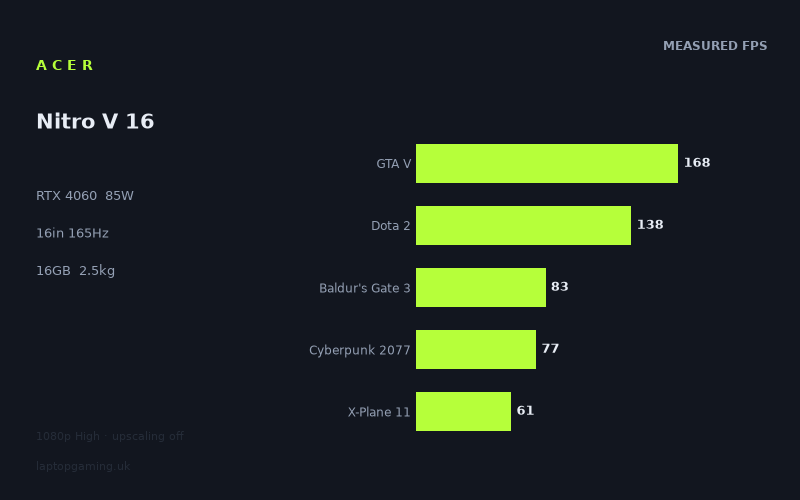
Frame rates
1920×1080, High preset, upscaling off. Averages 105fps across the 5 core benchmark games.
Measured on this machine. Source: Notebookcheck, 2024-12-06.
Not scored: no confirmed UK price
We have the full benchmark suite for this machine, so it ranks on the frame rate leaderboard like any other. What we don't have is a UK listing for this exact configuration - it's sold as a European review unit, or only in specifications that differ from the one tested. Since 30% of our score is value for money, scoring it would mean pretending price is no object, which would flatter it against every laptop you can actually buy. The frame rates below are real and comparable; there is just no buying recommendation to make yet.
How these numbers were produced
Frame rates here are not measured by us, and we label how each one was arrived at. A figure marked measured comes from a published run on that exact machine. A figure marked representative is derived from the GPU and its power limit (TGP) and cross-referenced against published reviews - a sound estimate of what that configuration delivers, but not a measurement of that specific laptop. Unless stated otherwise, numbers are 1920x1080, High preset, upscaling off. Where a laptop ships in several power configurations we use the wattage of the exact SKU listed, because a 140W RTX 5070 and a 115W one are not the same product.
In use
The short version
The Acer Nitro V 16 is the most quietly impressive machine in this part of our data, and the reason has nothing to do with its specification sheet. On paper it is unremarkable: an RTX 4060 configured at 85W, which is a middling power limit for that GPU rather than a generous one, a Ryzen 7 8845HS, 16GB of memory, a 16in IPS panel at 1920x1200 and 165Hz, and 2.5kg of chassis. Nothing there suggests a machine that punches above its class.
Notebookcheck's measured frame rates say otherwise. Across five shared games it finishes a single frame per second behind an Asus ProArt PX13 carrying an RTX 4070, and across four shared games two frames per second behind an Asus ROG Zephyrus G14 2024, also carrying an RTX 4070 — and that G14's 4070 is configured at 75W, ten watts below this machine's 4060. Those two results, read together, are a clean demonstration of the single most important fact about this GPU generation: the power limit matters more than the model number. An 85W RTX 4060 and a 75W RTX 4070 are, in the games both were measured on, the same product.
The benchmark is not simply failing to distinguish machines. Against an MSI Thin GF63 with an RTX 4050 the Nitro V 16 is 29fps ahead across five shared games, and against an Asus ROG Strix Scar 17 with an RTX 4090 it is 77fps behind across three. The instrument resolves hardware differences perfectly well when there are hardware differences to resolve. When it returns a near-tie against two 4070 laptops, that near-tie is the result.
The measured set is complete and it is a hard one. The five scoring-suite games average 105fps: GTA V at 168fps, Dota 2 at 138fps, Baldur's Gate 3 at 83fps, Cyberpunk 2077 at 77fps and X-Plane 11 at 61fps. The wider set runs from Prince of Persia The Lost Crown at 340fps down to Star Wars Outlaws at 36fps. That bottom figure is worth registering early — it is a genuine limit, not a rounding error, and it is what an 85W GPU looks like when a late-2024 release asks it a serious question.
Two things stand against it. The first is a 57Wh battery, which is small by the standards of the category and small in absolute terms for a 16in machine. The second is not the machine's fault at all: this page carries no score, because our record holds no confirmed UK price for this exact configuration. Value is 30% of our score and cannot be computed without a price. The benchmark suite here is complete, all five scoring games are present, and the machine ranks normally on the frame rate leaderboard. We simply cannot score it, and we are not going to guess at what it costs.
Buy it if you want a 16in gaming laptop that performs like a more expensive one in the games we have data for, and you can find it at a price that reflects a 4060 rather than a 4070. Look elsewhere if you play the heaviest recent releases at high settings, or if you need meaningful battery endurance away from a socket.
Performance
What 85W means for an RTX 4060
Nvidia sells its laptop GPUs to manufacturers with a configurable power limit rather than a fixed one. The manufacturer picks a point in that band according to what the chassis can cool, how much fan noise they will tolerate and what the machine is meant to cost. This is the most consequential and least advertised variable in laptop gaming, because the performance spread within a single GPU model across its configuration band regularly exceeds the spread between adjacent models.
Our record puts this machine's RTX 4060 at 85W. That is a moderate configuration — clearly above the starved settings used in genuinely thin machines, clearly below the aggressive settings a large chassis can sustain. It is the sensible middle, and it is consistent with the physical machine: 2.5kg in a 16in shell is a fair amount of cooling volume, but not a great deal, and 85W is about what you would expect a manufacturer to commit to there.
The interesting part is what that moderate configuration achieves. The comparison data below has this machine level with two RTX 4070 laptops, one of which we know is running its 4070 at 75W. That is not a fluke or a measurement artefact; it is the direct, predictable consequence of the configuration band overlapping between tiers. A well-fed 4060 and a starved 4070 land in the same place because the thing that determines performance — sustained power delivered to the silicon — is nearly the same in both cases. Anyone shopping this generation on model numbers alone is buying a label rather than a result.
The shape of the measured results
Fourteen games, all at 1920x1080 on the High preset with upscaling off, running from 340fps to 36fps. That is a spread of better than nine to one, and it is by some distance the widest range in this part of our data. The width is not noise. It reflects a test set that spans from a stylised 2D-plane action game to the heaviest open-world releases of late 2024, and the machine's character genuinely changes depending on which end of that range your library sits in.
The top of the table — Prince of Persia The Lost Crown at 340fps, Strange Brigade at 200fps, GTA V at 168fps — tells you the machine has no structural problem. Prince of Persia is not a GPU test in any meaningful sense; a figure that high mostly demonstrates that nothing in the pipeline is broken and that the processor is quick. Strange Brigade is a well-behaved Vulkan title used in benchmark suites for years because it scales cleanly, and a result of that order is what a healthy modern GPU produces. GTA V at 168fps is the first genuinely informative number: GTA V leans on single-thread processor performance and stopped being GPU-limited on hardware of this class long ago, so 168fps is largely a statement about the Ryzen 7 8845HS. It is a good one.
The upper middle — Dota 2 at 138fps, Final Fantasy XV at 96fps, God of War Ragnarök at 88fps, Baldur's Gate 3 at 83fps — is where a lot of real playing happens, and every one of those figures is comfortable. Dota 2 at 138fps is another processor-bound result rather than a GPU one; Dota 2 does not trouble any RTX 40-series card and the number reflects how quickly the processor can feed it. God of War Ragnarök at 88fps and Baldur's Gate 3 at 83fps are more useful signals, because both are properly demanding and both sit well clear of any threshold where the experience degrades.
The lower middle — Cyberpunk 2077 at 77fps, Space Marine 2 at 76fps, X-Plane 11 at 61fps — is where the 85W configuration starts to be the binding constraint. Cyberpunk 2077 at 77fps on High with upscaling off is a genuinely good result for this GPU tier and it is the number most worth quoting, because Cyberpunk is the closest thing in the suite to a pure graphics test. X-Plane 11 at 61fps looks low against the rest but is the least GPU-dependent title in the set — its simulation loop is processor-heavy and largely indifferent to graphics hardware, and 61fps there is not a criticism of the 4060.
The bottom — Until Dawn at 57fps, Final Fantasy XVI at 55fps, Stalker 2 at 48fps, Star Wars Outlaws at 36fps — is the part of the table that should shape a buying decision. These are the heaviest releases in the set and the 85W RTX 4060 does not have the headroom for them at High with upscaling off. Star Wars Outlaws at 36fps is below what most people would accept, and Stalker 2 at 48fps is marginal. Neither is unplayable, and both would be transformed by DLSS, which this GPU generation supports and which exists precisely for this situation. But a buyer should go in knowing that the newest and heaviest titles will require compromises on this machine, and that this was already true when the measurements were taken.
The scoring five, and why the average understates the machine
Our scoring suite is GTA V, Dota 2, Baldur's Gate 3, Cyberpunk 2077 and X-Plane 11, and unusually we hold all five here. They average 105fps. That average is directly comparable with every other machine in our data measured on the same five games, which is exactly what it is for.
It is worth understanding what that number is made of, because two of the five are not really GPU tests at 1080p. GTA V at 168fps and Dota 2 at 138fps are processor-bound; X-Plane 11 at 61fps is processor-bound in the other direction. Only Baldur's Gate 3 and Cyberpunk 2077 are asking the graphics card a hard question. A five-game mean that includes three titles where the GPU is waiting on something else will always compress differences between graphics hardware — which is the mechanism behind the near-ties in the comparison section, and the reason those near-ties should be read carefully rather than taken as proof that a 4060 equals a 4070 in general.
The date on the test set is part of the analysis
These measurements were published in December 2024, and the game selection reflects it: Star Wars Outlaws, Stalker 2, Space Marine 2, Until Dawn, Final Fantasy XVI and God of War Ragnarök are all recent releases at the time of testing. That matters when reading raw averages across our database, because a machine measured against a 2023 test set was asked easier questions than one measured against a late-2024 set. It is the specific reason our comparisons are restricted to games both machines actually hold, rather than comparing overall averages — an overall-average comparison would systematically flatter older machines.
For this laptop the effect is real. Its wider set includes four titles that fall short of a comfortable sixty frames a second, which looks unflattering next to machines whose test sets ended before those games existed. Judged on the shared games, it does very well indeed.
The screen
1920x1200, and why that makes these numbers unusually trustworthy
The panel is a 16in IPS unit at 1920x1200 with a 165Hz refresh rate. The resolution is the most useful thing about it for our purposes, and it deserves more attention than it normally gets.
Every frame rate in this review was measured at 1920x1080. This machine's native resolution is 1920x1200 — the same width, with 16:10 proportions adding a strip of vertical pixels. The difference in total pixel count is around a tenth. That is close to nothing in GPU terms, and it means the measured figures in this review are, unusually, a good approximation of what the machine will do on its own screen.
This is not a small point. A great many gaming laptops in this generation pair a mid-tier GPU with a 1440p or 1600p panel, and every 1080p benchmark figure published for them requires the reader to mentally discount for a resolution they will actually be running. A 2560x1600 panel carries well over twice the pixels of 1920x1080, and the heavy titles lose accordingly. Here, that correction is barely needed. When this review says Cyberpunk 2077 runs at 77fps, that is close to what the machine will do on the screen fitted to it.
The 16:10 aspect ratio is also a genuine quality-of-life improvement over 16:9 for anything that is not a game — more visible lines of text, more timeline in a video editor, less scrolling. It has become the sensible default for good reason.
165Hz against what the GPU produces
Three of the fourteen measured games exceed 165fps at 1080p: Prince of Persia The Lost Crown at 340fps, Strange Brigade at 200fps and GTA V at 168fps. Everything else sits below the panel's refresh rate, and nine of the fourteen fall short of a hundred frames a second.
So the refresh rate has real headroom in light and older titles and no headroom at all in demanding ones. That is the honest position and it is entirely normal for this GPU tier. It should not be read as the panel being wasted. A high-refresh panel does two separate jobs: it displays frames faster than a conventional panel can when the GPU produces them, and — more relevant here — it lowers the persistence blur and latency floor at any frame rate. A game running at 88fps on a 165Hz panel with variable refresh is visibly smoother and more responsive than the same 88fps on a conventional sixty-hertz panel, where it would either tear or be capped. Most of these results sit in exactly that band, and the panel is earning its place there.
What the refresh rate does not do is make this a competitive-shooter machine in any title heavier than the two at the top of the table. If that is the use case, the panel supports it and the GPU will be the limit.
IPS, and the gaps in our record
Our record identifies the panel as IPS. That rules out the poor viewing angles and contrast shift of TN, and it rules out OLED, which by this point had begun appearing in gaming laptops with contrast an IPS panel cannot structurally match.
It does not tell us how bright the panel gets, how much of any colour gamut it covers, or how fast its pixel response is. Those are significant unknowns — 165Hz on a slow panel produces visible smearing that partly defeats the purpose, and Acer's Nitro line sits at a price point where corner-cutting on panel quality is common. We hold no measurements for any of them and we are not going to guess. If colour work or outdoor use matters to you, treat those as open questions.
Build, size and portability
2.5kg in a 16in chassis
2.5kg is a reasonable middle for a 16in gaming laptop of this generation. It is not a machine you forget about in a bag, and it is not one that has to live permanently on a desk either. Combined with the 16in footprint it will fit most backpacks and most desks, and it can plausibly commute a few times a week without becoming an ordeal. That is a meaningfully different proposition from the 17in and 18in machines elsewhere in this generation, which move between rooms rather than between places.
The weight is also directly connected to the 85W power limit. There is a straightforward physical chain here: chassis volume determines cooling capacity, cooling capacity determines the power limit a manufacturer can commit to, and the power limit determines sustained performance. 2.5kg buys enough cooling for 85W and not much more. A buyer wanting a substantially higher-powered GPU has to accept a substantially heavier machine, and that trade is not negotiable at any price.
The adapter is not in our record and will add to the carrying weight. A machine of this class needs a proper power brick, and while it will be smaller than the ones fitted to the heavily configured machines at the top of this generation, it is not a phone charger.
57Wh — the specification that stands out
The battery is 57Wh, and it is the number in this specification most likely to cause regret. For context on why it matters rather than what it delivers: many gaming laptops in this generation carry batteries approaching the practical ceiling that aviation rules impose on lithium cells in cabin baggage. A 57Wh pack is well short of that. Acer has fitted a modest battery to a 16in machine.
Our record holds no measured runtime figure for this laptop, so we will not state one. What can be said without measurements is structural. Battery capacity sets the ceiling on unplugged use, and this machine's ceiling is low relative to its class. Gaming on battery is not a serious proposition on any laptop of this type — no reasonable battery sustains a GPU at anything like its plugged-in power draw — but the ordinary uses that make a laptop a laptop, browsing and video and document work, all scale with capacity. This is a machine that expects to be near a socket.
Whether that matters depends entirely on how it will be used. As a desk machine that occasionally moves, it is a non-issue. As a laptop you take to a library or a lecture hall for a day, it is the specification most likely to disappoint, and it is the clearest concession Acer has made to the price bracket.
Memory and storage
16GB of memory and a 1024GB SSD are the category standard and are adequate rather than generous. 16GB is enough for gaming now and is the specification most likely to feel constrained first as titles get heavier; a handful of recent releases already press against it. Whether the memory can be upgraded is not something our record establishes, and it is worth confirming before purchase, because the answer varies by model and it is the cheapest meaningful upgrade a machine of this class can receive.
1024GB sounds like a lot until two or three large modern installs are on it. Whether there is a second drive bay is again not in our record. For a machine at this size and price the answer is often yes, but "often" is not a fact about this specific configuration and we are not going to assert it.
How it compares
Four rivals from the same GPU generation, compared only on games both machines hold, with the scoring suite preferred. One of the four — the Asus ProArt PX13 at £1,999 — has a confirmed UK price in our record. The other three do not, so those comparisons are about performance alone.
MSI Thin GF63 (RTX 4050) — 29fps ahead across five games
The control result. The GF63 carries an RTX 4050, one tier down, and loses by an average of 29fps across five shared games. That is a wide, unambiguous margin — not within-run variation, not a matter of which games were chosen, but a clear separation across the full scoring suite.
Its function in this analysis is to establish that the instrument works. Any suggestion that these shared games simply cannot tell graphics hardware apart is refuted here: they tell these two machines apart decisively. That makes the near-ties against the two 4070 laptops considerably more meaningful, because it rules out the blunt-instrument explanation.
For a buyer the practical reading is simple. Against the entry tier of this GPU generation, the Nitro V 16 is clearly and consistently the faster machine by an amount you would notice in play, not just in a table.
Asus ProArt PX13 (RTX 4070, £1,999) — one frame behind across five games
This is the headline comparison. The PX13 carries an RTX 4070 — a full tier above this machine's 4060 — and across the complete five-game scoring suite the gap is a single frame per second in the PX13's favour. That is as close to identical as two different machines get.
Part of the explanation is the suite composition discussed above: three of the five games are limited by something other than the graphics card at 1080p, which compresses the gap between any two competent GPUs. But that explanation only goes so far, because the same five games separated this machine from a 4050 by 29fps. The compression is real and it is not total.
The rest of the explanation is almost certainly configuration. Our record holds no power limit for the PX13's RTX 4070. What we can say is what the PX13 is: a 13in creator-oriented machine, which is to say a small chassis with limited cooling volume, of exactly the sort where manufacturers configure GPUs conservatively. An 85W 4060 in a 2.5kg 16in shell matching a 4070 in a 13in shell is entirely consistent with that, and it is the same physics that runs through this whole generation.
The price makes this comparison unusually pointed. The PX13 has a confirmed price of £1,999 in our record. We do not know what the Nitro V 16 costs, and we will not speculate — but the Nitro V line does not compete in that bracket, and a machine that matches a £1,999 laptop's frame rates across the full scoring suite has a strong claim on anyone's shortlist. The PX13 is a different product with a different purpose, and a buyer may want its portability, its display or its creator credentials. What they are not getting for the difference is frames.
Asus ROG Zephyrus G14 2024 (RTX 4070 at 75W) — two frames behind across four games
The cleanest demonstration in this data of why model numbers mislead. The G14 carries an RTX 4070 configured at 75W. This machine carries an RTX 4060 configured at 85W. Across four shared games, the 4070 wins by two frames per second.
Here we have both power limits, so no inference is required. A 4070 given less power than a 4060 performs, in practice, like a 4060 — slightly ahead, because the underlying silicon is better and some of that survives the power deficit, but nowhere near a tier's worth ahead. The gap between the top and bottom of a single GPU's configuration band swallows the gap between adjacent tiers. That is the central fact of this GPU generation and it is sitting right here in two rows of a table.
The sample is four games rather than five, which is worth noting though it does not change the reading; a two-frame gap is not going to become a large one with a fifth title unless that title is unusually GPU-bound.
For a buyer, this is not an argument against the G14, which is a very different machine — a 14in ultraportable with priorities this laptop does not share, and its low power limit is the price of that form factor rather than an oversight. It is an argument against paying a 4070 premium without knowing the power limit. The G14's compact chassis buys portability; it does not buy frames over an 85W 4060.
Asus ROG Strix Scar 17 (RTX 4090) — 77fps behind across three games
The Scar 17 carries an RTX 4090 and beats this machine by an average of 77fps across three shared games. Our record holds no power limit for the Scar 17's GPU, so we cannot characterise how aggressively it is configured, and we are not going to invent a figure for a field that is empty.
Two observations. The sample is three games, narrower than the others, which is worth stating plainly — though a 77fps average gap is far too large to be an artefact of game selection. And this is the second piece of evidence that the shared-game set separates hardware properly when the hardware differs enough. A 4090 is fast enough that it stops being the limiting component in almost anything at 1080p, so it runs away from the field even in the titles that compress differences elsewhere.
Both wide margins in this comparison set — 29fps ahead of a 4050, 77fps behind a 4090 — bracket the two near-ties and give them their meaning. The instrument has enormous dynamic range. It found no meaningful difference between this machine and two RTX 4070 laptops because there is no meaningful difference to find in those games.
What the set says together
Decisive win against the tier below. Decisive loss against the top of the stack. Statistical dead heat against two machines a tier above. That is the profile of a laptop that is punching one tier up in the games we can compare, and it is a genuinely good result for an 85W RTX 4060.
The caveat is the same one that applies to every comparison in this generation: the shared games are measured at 1080p and several of them are limited by the processor rather than the GPU, so the near-ties would likely widen at higher resolutions or in more GPU-bound titles. This machine's own results table shows what happens when a game does ask the GPU a hard question — Star Wars Outlaws at 36fps, Stalker 2 at 48fps. A better-configured 4070 would pull ahead there. In the games we can actually compare, it does not.
The missing price, and what it costs this page
There is no score on this page, and it is worth being precise about why, because the reason is unusually benign. Our score weights value at 30%, and value cannot be computed without a price. Our record holds no confirmed UK price for this exact configuration — the ANV16-41-R5AT with an RTX 4060 at 85W and a Ryzen 7 8845HS.
Nothing else is missing. The benchmark suite is complete: all five scoring games are present and the machine ranks normally on the frame rate leaderboard. This is not a case of incomplete data or a machine we cannot assess. It is a case of one field being empty, and that field being worth a third of the total.
We will not estimate the price. Speculating about what a laptop probably costs, and then scoring it on that speculation, would produce a number that looks authoritative and is not. Prices in this category move weekly, configurations are near-identical under different model codes, and the sort of guess that would fill the gap is exactly the sort of guess that misleads someone about to spend a substantial sum.
What this means for a reader is that the performance analysis above stands on its own, and the value judgement is yours to make once you have found a price. Given the comparison data — level with two 4070 machines, one of which lists at £1,999 — the arithmetic is likely to be favourable. But that is a conditional statement, and it stays conditional until the price is known.
Who it's for
The case for buying it
This machine suits someone who wants 16in gaming performance without paying for a badge. The comparison data is the argument: across the full five-game scoring suite it is level with an RTX 4070 laptop priced at £1,999, and across four games it is level with another 4070 laptop whose GPU is configured below this one's. If your shortlist contains a 4070 machine chosen on the model number alone, this laptop is the reason to check that machine's power limit before committing.
It suits someone who plays the mainstream rather than the bleeding edge. GTA V at 168fps, Dota 2 at 138fps, Baldur's Gate 3 at 83fps, God of War Ragnarök at 88fps, Cyberpunk 2077 at 77fps — that is a comfortable, high-refresh experience across a broad and genuinely demanding library, and at a resolution that is nearly the panel's native one.
And it suits someone who values the screen ratio and the honesty of the numbers. A 1920x1200 panel means the benchmark figures in this review need almost no mental discount, which is not true of most machines in this class. What you read is close to what you get.
The case against
Do not buy it if your library is the heaviest recent releases and you want to run them at High with upscaling off. Star Wars Outlaws at 36fps and Stalker 2 at 48fps are the honest measurements, and an 85W RTX 4060 is not going to improve on them. DLSS makes both perfectly playable, and that is a legitimate answer — but it should be a choice you make knowingly rather than a surprise.
Do not buy it if you need endurance away from a socket. The 57Wh battery is small for a 16in machine and it is the clearest cost-saving in the specification. We hold no runtime measurement, but capacity sets the ceiling and this ceiling is low for the class.
Do not buy it expecting the near-ties above to hold everywhere. Level with two 4070 laptops in shared games at 1080p is a real and well-evidenced result, but it is a result about those games at that resolution. In a genuinely GPU-bound title, a properly configured 4070 will pull ahead, and this machine's own bottom four results show where its limits are.
And do not buy it without establishing the price. That sounds obvious, but it is the specific thing our record cannot tell you and it is the thing that determines whether the performance case above translates into a good purchase. Everything in this review says the machine performs well for its tier. Whether it is priced for its tier is the one question we cannot answer.