Review
HP Omen 16-b0085ng review
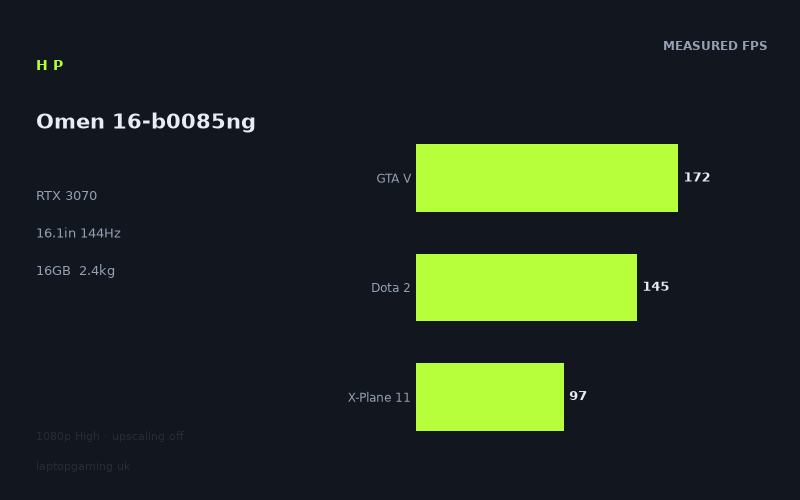
Frame rates
1920×1080, High preset, upscaling off.
Measured on this machine. Source: Notebookcheck, 2021-10-08.
Not scored: incomplete benchmark suite
Every scored laptop on this site is averaged over the same 5 games, and this one is short of Cyberpunk 2077, Baldur's Gate 3. A mean over 4 games is not comparable to a mean over 5, so we publish the figures we have and leave the score blank rather than rank it against machines tested on a different set. The numbers below are real - the suite is just incomplete.
How these numbers were produced
Frame rates here are not measured by us, and we label how each one was arrived at. A figure marked measured comes from a published run on that exact machine. A figure marked representative is derived from the GPU and its power limit (TGP) and cross-referenced against published reviews - a sound estimate of what that configuration delivers, but not a measurement of that specific laptop. Unless stated otherwise, numbers are 1920x1080, High preset, upscaling off. Where a laptop ships in several power configurations we use the wattage of the exact SKU listed, because a 140W RTX 5070 and a 115W one are not the same product.
In use
The short version
The HP Omen 16-b0085ng is a straightforward high-refresh-rate Full HD gaming laptop built around an RTX 3070, a Core i7-11800H and 16GB of memory. The published benchmark data paints a clear picture: it is very quick in a number of older, lighter or especially well-optimised games, but it does not hold the screen’s 144Hz refresh rate across every demanding title in the measured set. That is not a failure of the machine; it is a reminder that a 144Hz panel is a capability, not a guarantee that every game will run at 144fps with high settings and upscaling disabled.
Notebookcheck’s measured figures at 1920x1080, High preset and with upscaling off range from 205fps in Strange Brigade to 95fps in New World. The four-game scoring-suite mean is 155fps, but that figure needs reading carefully. It is made up of a mix of games that vary greatly in how heavily they lean on the processor, graphics card and game engine. Strange Brigade, GTA V and Dota 2 run at or beyond the panel refresh rate in the published figures. The Witcher 3 is also comfortably above 144fps. More demanding or differently balanced games such as Shadow of the Tomb Raider, Far Cry 5, X-Plane 11 and New World sit below that level, although none of the measured results suggests an obviously weak 1080p gaming machine.
The important caveat is that the supplied specification does not confirm the RTX 3070’s graphics power limit in this particular Omen. That matters because laptop RTX 3070 implementations can behave differently depending on their configured power allowance and cooling design. It would be wrong to infer a power figure from the badge alone, or to pretend that the benchmark results reveal a precise wattage. What can be said is that the measured numbers place this configuration in a strong position for Full HD high-preset gaming, while also showing that its advantage is much larger in some games than in others.
This is therefore a machine to consider if the appeal is a conventional 16.1in IPS gaming laptop with a 144Hz Full HD screen and enough graphics performance to make good use of it in a substantial part of the measured game list. It is less compelling for someone who expects 144fps to be a universal baseline in every newer, heavier or more CPU-sensitive game without adjusting settings, using upscaling, or accepting a lower frame rate.
There is no confirmed UK price in the supplied information. That prevents a proper value judgement. A laptop with these specifications and frame rates could be sensible at one price and difficult to recommend at another. Until a confirmed UK price is available, the sensible conclusion is about capability rather than value: the Omen has strong measured Full HD performance, but no price-based buying case can honestly be made yet.
It also cannot be given a site ranking from the available scoring data. The scoring suite is incomplete because there is no figure for Final Fantasy XV. Every ranked laptop is averaged across the same five games, so a partial result cannot fairly be placed against machines with complete data. The available four-game mean of 155fps is useful as a description of the published results, but it is not enough for a like-for-like ranking.
Performance
What the published figures show
The benchmark data comes from Notebookcheck and was recorded at 1920x1080 using the High preset with upscaling disabled. Those details are important. They describe conventional native-resolution gaming rather than performance inflated by an upscaling mode, and they avoid the misleading situation where a laptop appears extremely quick only because a lower internal render resolution has been used.
Notebookcheck’s figures are as follows:
- Strange Brigade: 205fps
- The Witcher 3: 184fps
- GTA V: 172fps
- Dota 2: 145fps
- Shadow of the Tomb Raider: 135fps
- Far Cry 5: 123fps
- X-Plane 11: 97fps
- New World: 95fps
The first thing to note is the range. The difference between 205fps in Strange Brigade and 95fps in New World is substantial, despite both results being taken at the same resolution and preset level. That spread is normal in laptop gaming, because games do not make the same demands of hardware. Some scale strongly with graphics performance; others place more weight on processor performance, simulation work, engine overhead or areas of the game that are not represented by a graphics card’s core specification.
The second point is that this is not a machine that simply produces one broadly similar result in every game. It can run far beyond the panel refresh rate in Strange Brigade, while New World is much closer to a conventional high-frame-rate experience than to a screen-saturating 144fps result. A buyer should therefore avoid reading “RTX 3070” as a promise of one universal performance level. The game matters, the chosen settings matter, and the specific laptop implementation matters.
The supplied scoring-suite mean is 155fps across Strange Brigade, GTA V, Dota 2 and X-Plane 11. That is a healthy figure for Full HD gaming, but it is not an average of all the published games and should not be treated as one. It also cannot be used for the site’s normal ranked comparison because Final Fantasy XV is missing. The missing result is not a trivial technicality: a comparable ranking requires every laptop to be calculated from the same five-game set. Leaving out one game could flatter or penalise a machine depending on how it performs in that absent title.
Games that can exploit the 144Hz panel
Strange Brigade is the clearest case for the Omen’s 144Hz display. At 205fps, the measured result is well above 144fps. The panel cannot display more than its 144Hz refresh rate, but the excess performance still has practical meaning. It gives the machine headroom for more demanding scenes, minor variation in game load, or settings experimentation. It also means that the screen is not the limiting factor in this particular benchmark result; the laptop is capable of feeding it frames faster than the panel can refresh.
The Witcher 3 is also above the panel’s refresh rate at 184fps. Again, that does not mean the display suddenly becomes a 184Hz screen. It means the measured game performance exceeds the maximum refresh capacity of the installed panel. For a player who values smooth motion and quick frame delivery, this is exactly the sort of result that makes a 144Hz Full HD panel worthwhile. The graphics hardware has enough available performance in this title and configuration to keep the display well supplied.
GTA V reaches 172fps in the published data. That is another result above the panel limit and another example of the laptop being able to make full use of the 144Hz screen in suitable games. GTA V remains an important data point because it is in the scoring suite, but it should not be treated as proof that all games will behave similarly. Its result says something useful about this Omen under the stated conditions, yet it does not erase the lower results in X-Plane 11 or New World.
Dota 2 is the closest measured result to the 144Hz threshold, at 145fps. The one-frame margin is not something to overstate. Real game performance varies according to scene complexity and many other factors, and a benchmark figure close to a refresh limit should be read as “around the panel’s full refresh capability”, not as an unconditional promise that every moment of play will always sit beyond it. Still, it is a meaningful result. The Omen can broadly match the screen’s 144Hz capability in the published Dota 2 measurement.
These four games demonstrate the upper side of the Omen’s performance envelope. In some cases it has ample room beyond 144fps; in another it essentially meets the target. For players whose regular games resemble these lighter, older or especially high-frame-rate-friendly workloads, the 144Hz display is not wasted. The machine has enough published performance to take advantage of it.
Games below the screen refresh rate
Shadow of the Tomb Raider is measured at 135fps. That is below the panel’s 144Hz ceiling, but it is not far below it. It is best understood as a strong high-refresh-rate result that does not quite reach the screen’s maximum refresh in the stated test configuration. A player focused on the difference between a conventional 60Hz experience and a substantially higher frame rate would still find 135fps meaningful. A buyer whose only aim is to see every measured title reach 144fps without altering the High preset would need to look elsewhere or accept that settings choices may be required.
Far Cry 5 reaches 123fps. This is further from 144fps than Shadow of the Tomb Raider, yet it remains well within the territory where a 144Hz display has value. The panel does not need to be fully saturated to improve motion relative to lower-refresh displays. The key point is not whether the published result exactly equals 144fps; it is that the result is distinctly high while still illustrating the limit of the machine’s ability to hold its display maximum in every game.
X-Plane 11 is measured at 97fps. This is one of the more revealing results in the set because it shows why a simple average can mislead. The four-game scoring-suite mean is 155fps, but X-Plane 11 sits materially below that number. A shopper who plays simulation-heavy titles should pay particular attention to this rather than assuming the headline mean describes every game type. The result is still close to triple figures, but it is nowhere near the 144Hz screen limit under the stated conditions.
New World, at 95fps, is the lowest figure in the published list. It confirms that the Omen’s RTX 3070 configuration is not a blanket 144fps machine at Full HD High with upscaling off. That is the honest interpretation of the evidence. New World is playable according to the benchmark data, but anyone buying specifically for consistently maximised high-refresh performance in games with similar demands should not use the stronger Strange Brigade or GTA V figures as their main expectation.
This is the right way to read the performance spread: the Omen is quick, often very quick, but the display’s 144Hz maximum is an achievable outcome in some games rather than a fixed performance floor. The difference is especially important for buyers moving from desktop hardware or from a laptop with a lower-refresh screen. A 144Hz specification can sound like a promise, whereas the data shows it is a target that depends on the game.
The RTX 3070 and the missing power-limit detail
The machine is specified with an RTX 3070, but the supplied information does not state its graphics power limit. That missing figure matters because laptop graphics chips are not interchangeable in the simple way their names suggest. The same GPU model can appear in laptops designed around different priorities, including portability, cooling capacity and electrical limits. A higher configured graphics power can allow more performance in suitable workloads, while a lower configured power may be chosen for a different chassis balance. Without the Omen’s confirmed figure, it would be speculation to describe this as a high-power or low-power RTX 3070 implementation.
The measured frame rates are therefore more useful than guesswork about the specification label. They show the actual published outcome for this laptop in the listed games, at the stated resolution and preset. That is more valuable than assuming it must perform like every other RTX 3070 laptop. The data says the machine can produce 205fps in Strange Brigade, 184fps in The Witcher 3 and 172fps in GTA V, while X-Plane 11 and New World sit at 97fps and 95fps. Those results are concrete. The unconfirmed power limit is not.
There is another reason not to overread the GPU name: the processor is a Core i7-11800H, and some games at 1080p can become limited by factors other than raw graphics throughput. This is particularly relevant when comparing results with faster nominal graphics hardware. At 1920x1080, lighter titles in a shared benchmark set can become CPU-bound and compress genuine differences between graphics cards. That does not mean the graphics card has stopped mattering. It means that, in those cases, the game’s performance is constrained elsewhere before the stronger GPU can show its full potential.
The Omen’s comparison results against RTX 3080 and RTX 3080 Ti systems make this point especially well. It matches two more expensive nominal GPU tiers in the supplied shared-game comparisons, but that should not be misread as proof that an RTX 3070 is universally equal to those chips. The near-zero differences are real results in the games held in common, but the supplied comparison notes explain why those gaps can be compressed at 1080p. The shared titles include lighter workloads where processor limits reduce the visible separation between graphics solutions.
What the processor and memory configuration mean in context
The Omen pairs the RTX 3070 with a Core i7-11800H and 16GB of memory. The benchmark results show a system that is not obviously held back from producing high frame rates in several games, including results above 144fps in Strange Brigade, The Witcher 3 and GTA V. However, the supplied information does not include memory speed, memory layout, storage configuration or any measurements of processor performance outside the game figures. It would therefore be inappropriate to make detailed claims about how the memory configuration affects specific games.
What can be said is that the platform is capable of high frame rates where a game allows it. Dota 2 reaches 145fps, and the Omen matches the 144Hz panel in that result. At the same time, the lower outcomes in X-Plane 11 and New World demonstrate why processor-sensitive or engine-sensitive workloads deserve separate attention. Buying on the basis of one average alone would hide that distinction.
For buyers who spend most of their time in a varied library rather than one single title, the published results suggest a sensible expectation: strong Full HD High performance, often capable of high-refresh play, but with some games operating below the display’s limit. That is a much more useful expectation than either extreme. It is not accurate to call the Omen a laptop that will always pin a 144Hz screen at high settings, and it is equally inaccurate to describe 95fps to 205fps results as inadequate for Full HD gaming.
The screen
The HP Omen 16-b0085ng has a 16.1in IPS display with a 1920x1080 resolution and a 144Hz refresh rate. On the information available, its screen specification is well matched to the benchmark resolution. Notebookcheck’s measured figures were recorded at 1920x1080, so the available gaming data directly corresponds to the panel’s native resolution rather than requiring assumptions about a higher-resolution screen or an external display.
Full HD is the practical choice for this particular performance profile. The Omen has enough published speed to exceed 144fps in several games at this resolution with the High preset and upscaling off. Moving to a higher native resolution would normally demand more from the graphics card, but no measured figures have been supplied for any other resolution. There is no basis here for claiming what performance would look like at QHD or on an external monitor. The useful point is simply that the installed 1920x1080 panel aligns directly with the available performance evidence.
The 144Hz refresh rate is a good fit for the top end of the benchmark spread. Strange Brigade at 205fps, The Witcher 3 at 184fps and GTA V at 172fps all exceed the panel’s maximum refresh. Dota 2 at 145fps essentially reaches it. These results give the display a clear purpose: the laptop is not paired with a high-refresh screen that its hardware can never use.
Equally, the screen should not be judged only by whether every result reaches 144fps. Shadow of the Tomb Raider at 135fps and Far Cry 5 at 123fps still sit in a range where a 144Hz panel remains relevant. They are below the panel maximum, but they are not low-frame-rate results. The lower X-Plane 11 and New World measurements, at 97fps and 95fps, reinforce the point that a 144Hz display is a ceiling available to games that can reach it, not a level that all titles automatically attain.
The IPS panel type is also specified, but the supplied information does not include brightness, contrast, colour coverage, response-time measurements, backlight behaviour or any assessment of how the panel handles motion. Those are important display characteristics, particularly for gaming. A 144Hz IPS panel can be appealing on paper, but refresh rate and panel type alone do not establish image quality or pixel response. No such claims should be made without supporting measurements.
There is also no supplied information about adaptive refresh support. That means no conclusion can be drawn about how the panel handles frame rates that fall below 144fps. This matters because several measured games do exactly that. Without confirmation, it would be wrong to promise a particular synchronisation feature or describe how it behaves.
For a buyer, the practical conclusion is uncomplicated. The panel’s resolution is appropriate for the measured performance. The refresh rate is fully usable in several games and broadly relevant in others. But the evidence does not support a claim that the screen is exceptional in every other respect, because the necessary panel measurements are not present.
Build, size and portability
The available physical specification gives a weight of 2.37kg, a 16.1in display and an 83Wh battery. No dimensions are supplied, so there is no factual basis for describing the Omen as thin, compact, deep, wide or unusually large for its class. The screen size and weight are enough to place it broadly as a substantial gaming laptop rather than a tiny ultraportable, but they do not support detailed claims about its footprint in a bag or on a desk.
At 2.37kg, this is not a machine defined by minimal carry weight. It is a laptop that can be moved between places, but a buyer who travels frequently with their computer should take the figure seriously. The difference between occasionally carrying a gaming laptop and carrying it every day can matter more than a specification sheet suggests. The Omen’s weight is likely to be acceptable for someone whose priority is having a proper 16.1in gaming machine available at different locations, but it is not the obvious choice for anyone trying to minimise what they carry.
That assessment should not be exaggerated into a claim that it is difficult to transport. No bag size, charger weight, dimensions or travel use measurements are supplied. The responsible conclusion is narrower: 2.37kg is a meaningful amount of laptop to carry, and buyers prioritising portability should compare that figure directly with alternatives before deciding.
The 16.1in screen also indicates the intended balance. This is not a small-screen gaming system built solely around compactness. A display of this size makes sense for the laptop’s Full HD high-refresh focus, offering more space than a smaller gaming notebook without moving into a desktop-replacement screen category based on the facts provided. Beyond that, physical impressions would be speculation. There is no information here about keyboard layout, trackpad quality, port selection, speaker performance, chassis materials, hinge behaviour or cooling noise.
The battery is rated at 83Wh, but there is no measured battery-life figure. Battery capacity is not battery endurance. Actual runtime depends on workload, display settings, power mode and many other variables, none of which are provided. It would be misleading to convert 83Wh into an estimated number of hours or to suggest that the Omen will last through a particular kind of day away from mains power. The only justified statement is that it has an 83Wh battery.
That absence matters for the audience most likely to consider a 2.37kg machine. Someone using it mainly at a desk, then occasionally moving it between rooms or locations, may care more about its plugged-in gaming performance than unplugged endurance. Someone buying one computer for study, work, travel and gaming needs battery evidence that is not available in this fact sheet. In that case, the Omen should not be chosen on an assumed endurance advantage.
There are also no supplied temperature or noise figures. Gaming laptops can differ sharply in fan behaviour and surface temperatures, especially where graphics performance is involved. Since the Omen’s GPU power limit is also unconfirmed, there is no credible route to detailed claims about thermal tuning. Buyers sensitive to fan noise or heat should treat those topics as unresolved rather than accept an unsupported assurance.
In short, the portability story is defined by what is known and what is not. Known: a 16.1in gaming laptop weighing 2.37kg with an 83Wh battery. Unknown: its dimensions, battery runtime, charger burden, noise, temperatures and physical ergonomics. It is better to be clear about those gaps than to turn a bare specification into a lifestyle claim.
How it compares
The supplied rival set is useful because it does not only compare the Omen with one nearby configuration. It includes a lower-tier RTX 3050 Ti machine, two systems with RTX 3080-class graphics, and an RTX 3080 Ti laptop configured at 150W. The results are calculated only from games both machines hold in common, with preference given to scoring-suite games. This is the right approach because comparing unrelated game lists would create false precision.
There is a broader lesson in these comparisons. A GPU name establishes a likely performance class, but it does not by itself tell the full story of an individual laptop’s game results. Power configuration, processor limits, game engines and the chosen resolution all affect what appears in a benchmark table. At 1080p, especially in lighter shared titles, games can become CPU-bound and compress genuine graphics differences. The Omen’s comparisons are an example of that effect, not evidence that all RTX 3070, RTX 3080 and RTX 3080 Ti laptops are interchangeable.
Against the MSI Prestige 15
Against the MSI Prestige 15 with an RTX 3050 Ti at 105W, the Omen averages 74fps ahead across three shared games. That is the largest advantage the Omen holds within the supplied rival group, and it is a substantial one. It gives the RTX 3070 Omen a much stronger case for buyers whose main concern is gaming performance rather than simply owning a laptop with a dedicated graphics card.
The comparison also shows why it is risky to shop only by broad product category. The Prestige 15 has an RTX 3050 Ti at 105W, while the Omen has an RTX 3070, and the shared-game gap is large. The Omen’s benchmark data includes results beyond 144fps in several titles, whereas the comparison advantage suggests that the MSI sits in a distinctly lower gaming-performance tier across the shared set.
There is no confirmed UK price for the MSI Prestige 15 in the supplied information. That means it cannot be used to make a value argument. It may be cheaper, similarly priced or unavailable at a comparable price; the facts do not say. The conclusion is performance-only: if the choice is driven by the shared-game frame-rate data, the Omen is clearly ahead.
Against the Razer Blade Pro 17 2021
The Razer Blade Pro 17 2021 with a QHD Touch display and an RTX 3080 at 100W costs £4,500 in the supplied information. Against that machine, the Omen averages +0fps across four shared games. A zero difference is not a typo and should not be waved away just because the Razer carries a higher nominal GPU designation. It is a real outcome in the shared benchmark selection.
However, the correct interpretation is not that the Omen’s RTX 3070 is generally equivalent to every RTX 3080 laptop. The comparison is at 1080p in the shared games, and the supplied notes make clear that lighter titles can become CPU-bound at this resolution. Once that happens, a graphics advantage may not translate into a large measured lead. The Omen’s matching result is meaningful, but it is context-dependent.
The Razer’s QHD Touch screen is also a different display proposition from the Omen’s 1920x1080 144Hz IPS panel. No cross-resolution gaming measurements are supplied here, so there is no basis for declaring one screen better for a particular game or for predicting performance at the Razer’s native resolution. What can be said is that the Omen matches the Razer in the supplied shared-game comparison while the Razer’s listed price is £4,500 and the Omen has no confirmed UK price.
For a buyer looking strictly at the shared 1080p game figures, the Omen’s result against a £4,500 RTX 3080 laptop is impressive. For a buyer selecting between the actual machines, that single comparison is not enough to settle the choice. Screen resolution, touch capability, physical design, battery behaviour and other factors may matter, but those details are not supplied for a complete direct assessment. The defensible takeaway is that the Omen does not trail the Razer in the four shared measured games, despite the Razer’s higher-tier GPU label.
Against the Acer Predator Triton 500 SE
The Acer Predator Triton 500 SE PT516-52s-70KX is listed with an RTX 3080 Ti and a UK price of £2,450. The Omen again averages +0fps across four shared games. As with the Razer comparison, that is a genuine near-zero result in the common benchmark set, but it is not a licence to erase the distinction between the machines’ graphics hardware.
The practical explanation is the same: at 1080p, especially in lighter titles, shared results can become constrained by processor or game-engine limits before a faster graphics card can establish the kind of lead its specification might suggest. This compresses the difference. It does not make the GPU hierarchy meaningless; it means the benchmark selection and resolution have limited the visible gap.
The Omen’s result is nonetheless valuable for a Full HD buyer. It suggests that in the games shared with the Acer, the Omen’s RTX 3070 configuration is already capable of reaching the performance ceiling imposed by those workloads to a similar extent. That aligns with its own figures above 144fps in Strange Brigade, The Witcher 3 and GTA V. Where the game is light enough or otherwise constrained away from the GPU, paying for a much higher nominal graphics tier may not create a proportional frame-rate gain.
The Acer’s £2,450 price provides context, but not a final value verdict. The Omen has no confirmed UK price, so it is impossible to say whether the HP undercuts the Acer substantially, matches it, or is unavailable at a sensible level. The performance evidence says the Omen does not give ground in the four shared games. The value evidence is incomplete.
Against the Asus ROG Strix Scar 17 SE
The Asus ROG Strix Scar 17 SE, with an RTX 3080 Ti at 150W, is the machine that beats the Omen by the most in the supplied group. The Omen averages 24fps behind across four shared games. Unlike the zero-difference comparisons against the Razer and Acer, this is a visible advantage for the Asus in the selected titles.
The 150W graphics power figure is supplied for the Asus, while no corresponding power limit is confirmed for the Omen. That makes the comparison particularly instructive. The Scar combines a higher-tier RTX 3080 Ti with a stated 150W configuration and establishes a 24fps shared-game lead. It is the clearest evidence in the rival group that the Omen’s strong performance should not be mistaken for top-end dominance.
Even here, the gap needs sensible interpretation. A 24fps average difference does not tell a buyer the exact gap in every individual game, because only the shared-game average is provided. It does tell them that, over the four games in common, the Asus is ahead by a meaningful amount. Anyone who wants the highest available frame rates from this group, especially where the graphics card can stretch its legs, should regard the Asus as the stronger performance option.
There is no confirmed UK price for the Asus in the supplied data, so once again the value question cannot be completed. The Omen may still be the better purchase if it is available at a substantially lower price, but no such conclusion can be made without the actual UK figure. Performance-wise, the Asus leads. Price-wise, the comparison is unresolved.
What the rival spread really means
The four rival comparisons produce a useful hierarchy of conclusions. The Omen is decisively ahead of the RTX 3050 Ti MSI in the shared games. It matches the supplied shared-game averages of the RTX 3080 Razer and RTX 3080 Ti Acer. It trails the 150W RTX 3080 Ti Asus. That is an unusually clear demonstration of why laptop gaming performance cannot be reduced to a chip name.
The Omen is neither a bargain-bin RTX 3070 result nor an all-conquering replacement for every higher-tier GPU laptop. It is a fast Full HD machine whose measured results can overlap with more expensive hardware when the games and resolution compress the available GPU gap, while still falling behind a more powerful RTX 3080 Ti configuration when that performance advantage appears in the shared data.
That is the most useful comparison outcome for a buyer: judge the Omen by the games and settings that resemble your own use. If your main games behave more like the titles in which it reaches or exceeds 144fps, the Omen looks highly capable. If you are chasing the widest possible margin in demanding games, the Scar’s shared-game lead shows what stronger graphics hardware and a stated 150W configuration can deliver. If you are considering a lower-tier RTX 3050 Ti alternative primarily for gaming, the Omen’s 74fps shared-game advantage is the more important result.
Who it’s for
The HP Omen 16-b0085ng suits the buyer who wants a 16.1in Full HD gaming laptop and values published evidence over assumptions. The benchmark data supports a confident claim that it is strong at 1920x1080 on the High preset with upscaling off. It is especially well suited to players whose regular games are capable of taking advantage of a 144Hz screen: Strange Brigade at 205fps, The Witcher 3 at 184fps, GTA V at 172fps and Dota 2 at 145fps all show the display being properly used rather than merely advertised.
It also suits someone happy with high frame rates that do not always equal the panel maximum. Shadow of the Tomb Raider at 135fps and Far Cry 5 at 123fps are below 144fps, but they remain high-frame-rate results. A buyer who understands that a 144Hz display improves the experience across a range of frame rates, rather than only at exactly 144fps, will find the Omen’s performance profile sensible.
It is a particularly reasonable option for someone choosing between this machine and a lower-tier RTX 3050 Ti laptop where gaming is the main job. The 74fps average advantage over the MSI Prestige 15 across three shared games is hard to ignore. The Prestige may have reasons to appeal that are outside this fact sheet, but the supplied game data gives the Omen a decisive performance case.
The Omen may also appeal to a buyer who has looked at expensive RTX 3080 or RTX 3080 Ti systems and wants to know whether higher-tier branding always translates into better Full HD gaming results. The answer from the shared data is no. It matches the Razer Blade Pro 17 2021 and Acer Predator Triton 500 SE across their respective four-game shared comparisons. That does not make those laptops pointless, but it does show that the Omen can deliver comparable results in some 1080p workloads.
It is not the right choice for a buyer who wants a verified all-game 144fps machine at High settings with upscaling disabled. New World reaches 95fps and X-Plane 11 reaches 97fps in the published results. Those are not bad figures, but they are clear evidence that the laptop cannot be described as universally 144fps-capable in the measured set. Anyone for whom the 144Hz number is a minimum target rather than a maximum display capability should shop with that limitation in mind.
It is also not the obvious choice for someone who wants the strongest benchmark lead among the listed alternatives. The Asus ROG Strix Scar 17 SE is 24fps ahead on average across four shared games and has an RTX 3080 Ti at 150W. The Omen remains competitive, but the Asus is the performance leader in that direct comparison. Whether that lead justifies choosing the Asus depends on price, and no confirmed UK price is available for the Scar.
Buyers who need a firm value recommendation should wait for a confirmed UK price for the Omen. There is no honest way around that. The Razer is listed at £4,500 and the Acer at £2,450, but those figures do not establish the HP’s value without knowing what the HP costs. Its performance may make it attractive, but performance and value are different questions.
Portable-use buyers should also be cautious rather than optimistic by default. The Omen weighs 2.37kg and has an 83Wh battery, but there is no battery-life measurement, no chassis dimension data, no charger information and no noise or temperature data. A buyer intending to carry it frequently should not assume that battery capacity alone answers the practical question. Likewise, someone requiring quiet gaming or verified cool operation needs evidence not present here.
Finally, this laptop is for the buyer who is comfortable with a Full HD screen. The 1920x1080 resolution is directly supported by the available benchmark data and is a sensible match for the published frame rates. But anyone specifically seeking a higher-resolution laptop display, touch capability, or measured panel-quality data beyond IPS and 144Hz should look elsewhere or obtain further specifications before buying.
The final judgement is therefore conditional but clear. The HP Omen 16-b0085ng is a strong Full HD gaming laptop on the evidence available. Its RTX 3070, Core i7-11800H and 16GB configuration produces high frame rates across the measured set, with several games meeting or exceeding the 144Hz screen limit. Its weaker results remain around the high-frame-rate range rather than collapsing into poor performance, but they show that not every game will reach 144fps at the stated settings. It beats the lower-tier MSI convincingly, matches two higher-tier rivals in selected shared 1080p games, and falls behind the more powerful 150W RTX 3080 Ti Asus. The missing GPU power limit, battery-life data, physical dimensions and confirmed UK price stop this from being a complete buying recommendation, but the frame-rate evidence itself is strong and properly grounded.