Review
Dell G15 5530, i5-13450HX RTX review
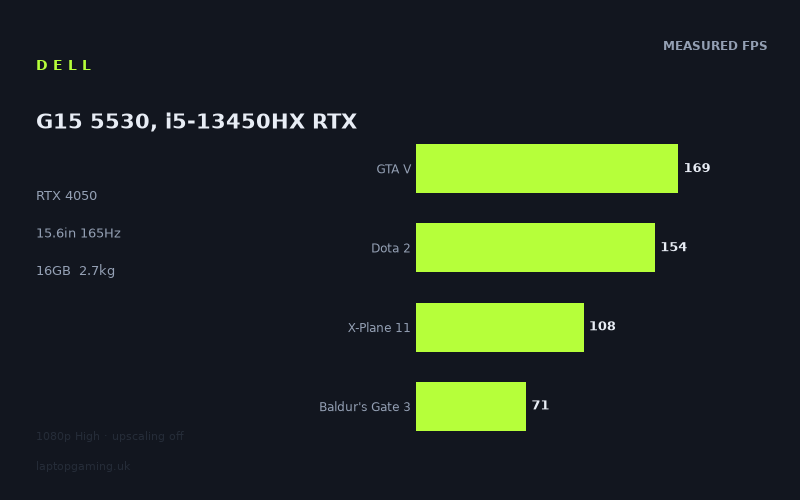
Frame rates
1920×1080, High preset, upscaling off.
Measured on this machine. Source: Notebookcheck, 2024-01-26.
Not scored: incomplete benchmark suite
Every scored laptop on this site is averaged over the same 5 games, and this one is short of Cyberpunk 2077. A mean over 4 games is not comparable to a mean over 5, so we publish the figures we have and leave the score blank rather than rank it against machines tested on a different set. The numbers below are real - the suite is just incomplete.
How these numbers were produced
Frame rates here are not measured by us, and we label how each one was arrived at. A figure marked measured comes from a published run on that exact machine. A figure marked representative is derived from the GPU and its power limit (TGP) and cross-referenced against published reviews - a sound estimate of what that configuration delivers, but not a measurement of that specific laptop. Unless stated otherwise, numbers are 1920x1080, High preset, upscaling off. Where a laptop ships in several power configurations we use the wattage of the exact SKU listed, because a 140W RTX 5070 and a 115W one are not the same product.
In use
The short version
The Dell G15 5530 in this configuration is the entry point to modern gaming laptops: a Core i5-13450HX, an RTX 4050, 16GB of memory, and a 15.6in 1920x1080 IPS panel running at 165Hz. It is built to a price and it makes no pretence otherwise. What matters is whether the frame rates justify it, and the honest answer is that they do for one specific kind of buyer and clearly do not for another.
Notebookcheck's numbers put it at 126fps averaged across the four scoring-suite games we hold for it, which sounds strong until you look at the distribution behind that average. The record spans thirteen games and runs from 171fps in Strange Brigade down to 40fps in Ratchet & Clank: Rift Apart. That is a spread of more than four to one, and it is the widest range across a single machine that we have on record in this class. The average is real but it is not representative; it is the arithmetic result of a handful of very fast old games sitting alongside a handful of genuinely demanding new ones.
The single most useful fact about this laptop is that the panel is 1920x1080 and every frame rate above was measured at 1920x1080. Unlike the high-resolution machines that carry the same generation of GPU, there is no gap here between the test conditions and the way you would actually use it. What you read is what you get, at native resolution, on High, with upscaling off. That is a rarer thing than it should be and it makes this record unusually easy to trust.
Buy it if you play mostly older, competitive or mid-weight titles and want to spend as little as possible on a machine that will run them properly at 1080p. Look elsewhere if your list includes 2023-and-later showcase titles at High settings, because the bottom of this record — Starfield at 44fps, Ratchet & Clank at 40fps — is where an RTX 4050 stops being enough.
Why there is no score on this page
Our scoring suite is five games, and every scored laptop on the site is averaged over the same five so that the leaderboard compares like with like. For this machine we have four of them: GTA V, Dota 2, X-Plane 11 and Baldur's Gate 3. We have no Cyberpunk 2077 figure, and Cyberpunk is the heaviest title in the suite — the one that most separates GPU tiers.
Averaging the four we do hold and calling it comparable would flatter this machine, because the missing game is precisely the game an RTX 4050 would score worst on. So there is no score. That is a limitation of our data, not a judgement on the laptop, and the thirteen measured titles below give you far more to work with than a single number would. If a Cyberpunk 2077 figure appears for this configuration, the score follows.
Performance
The figures are Notebookcheck's, dated 26 January 2024, all taken at 1920x1080 on the High preset with upscaling switched off. Thirteen games is a broad record by any standard, and — importantly — it is a modern one. Alongside the usual long-running benchmark titles it includes Starfield, Armored Core 6, Lies of P, Atlas Fallen, The Crew Motorfest and Ratchet & Clank: Rift Apart, all of which shipped in or around 2023. Most laptop benchmark sets are dominated by games from 2015-2018 and quietly overstate how a modern machine handles modern software. This one does not, and the difference between the old titles and the new ones in this record is stark.
What an RTX 4050 is, and what our record does not tell us about this one
The RTX 4050 is the bottom rung of Nvidia's RTX 40 mobile range. It is a genuinely capable part by the standards of what it replaced, and it brings the whole RTX 40 feature set with it — DLSS, frame generation, hardware ray tracing, the improved encoder. What it does not bring is a large amount of raw rasterisation throughput or a generous memory configuration, and both of those become visible the moment a game is written for hardware more recent than the card is aimed at.
Our record does not list a GPU power limit for this configuration, and we are not going to invent one. That is a genuine gap and it matters, because the mobile RTX 40 series is configurable across a wide power band and the same GPU name can describe meaningfully different levels of performance depending on how much power the manufacturer allows it. Two laptops with an RTX 4050 sticker are not necessarily the same laptop. Without a confirmed figure, the only honest approach is to read the measured frame rates as the definitive statement about this machine's performance and to treat the wattage as unknown. The frame rates are what you are buying; the wattage is only interesting because it predicts them, and here we have the prediction's output without the input.
What the numbers themselves show is a GPU that handles anything undemanding with ease and runs out of headroom sharply in modern, GPU-bound work. That is the expected shape for an entry-tier card, and the fact that the shape is so clearly visible across thirteen games is what makes this record valuable.
The top of the record: Strange Brigade, GTA V and Dota 2
Strange Brigade returns 171fps, GTA V returns 169fps and Dota 2 returns 154fps. Those three sit clearly above everything else and they have something in common: none of them is a serious test of a 2024 graphics card.
Strange Brigade is a well-optimised Vulkan title used across the industry precisely because it establishes an upper bound — it tells you what the hardware can do when the software is not in the way. 171fps is a good number and it is also, in a real sense, the least informative one on the list.
GTA V at 169fps is more interesting because of what limits it. GTA V has been bounded by single-thread CPU performance and driver overhead rather than by the graphics card for most of a decade now, which means 169fps here is substantially a statement about the Core i5-13450HX. That is worth knowing: the i5 in this machine is an HX-series part with a desktop-derived design, and it is a considerably stronger processor than the "i5" label suggests to anyone used to thin-and-light naming. It is not the bottleneck in this laptop. The GPU is.
Dota 2 at 154fps is the most practically useful of the three. MOBAs live or die on consistency during teamfights rather than on peak throughput, and a 154fps average on a 165Hz panel means the game is effectively refresh-rate-limited in ordinary play. If you are a Dota, League, CS or Valorant player who also wants to play single-player games occasionally, this machine handles the competitive half of that brief without qualification.
The middle band: 113 down to 84
Lies of P at 113fps, X-Plane 11 at 108fps, Atlas Fallen at 104fps, Armored Core 6 at 97fps and Final Fantasy XV at 84fps make up the middle of the record, and this is the band that most people will actually spend most of their time in.
Lies of P at 113fps is a genuinely good result and worth calling out, because it is a 2023 title with high visual production values that many people assume would punish an entry-tier GPU. It does not — Neowiz's engine is efficient, and 113fps at High gives real headroom. Souls-likes reward consistent frame delivery more than peak numbers, and a 113fps average means the low points stay well above anything that would affect your timing.
Armored Core 6 at 97fps and Atlas Fallen at 104fps tell a similar story. Both are recent, both look modern, and both run comfortably. FromSoftware's engine is not especially demanding and Armored Core 6 in particular is a fast game where 97fps is more than adequate.
Final Fantasy XV at 84fps is the weakest of this band and it is the expected result — the PC port is inefficient in ways that have never been fixed, and it leans on the GPU harder than its visuals justify. 84fps is fine.
X-Plane 11 at 108fps is not a GPU result and should not be read as one. Flight simulators are dominated by single-threaded scenery and physics work, and 108fps here is another data point on the i5-13450HX being a stronger processor than its badge implies. If flight simulation is your primary use, note also that X-Plane 11 is an older build and the current generation of simulators behaves quite differently on the same hardware.
Baldur's Gate 3 at 71fps, and what the scoring four actually mean
Baldur's Gate 3 returns 71fps, and it is the lowest of the four scoring-suite games we hold. This deserves careful reading because the average of the four — 126fps — is dragged upwards by GTA V and Dota 2, both of which are CPU-bound titles that tell you relatively little about the GPU.
71fps in Baldur's Gate 3 at 1080p High is a comfortable playing figure. It is a turn-based RPG; it does not need a high frame rate, it needs to not stutter, and 71fps average gives adequate margin for that in most of the game. But Act 3 is substantially heavier than the earlier acts, and a 71fps average across a benchmark run implies lower figures in the densest city scenes. If you are planning a full playthrough on this machine, expect to drop a setting or two by the end rather than to sail through at High throughout.
The broader point is about how to read the 126fps suite average. Two of the four contributing games are CPU-limited. One is a flight simulator that is also CPU-limited. Only Baldur's Gate 3 is a genuine modern GPU test, and it is the lowest of the four by a wide margin. The average is a leaderboard position, and a defensible one, but it is not a prediction of how this machine handles a modern game. The prediction lives at the bottom of the record.
The floor: The Crew Motorfest at 60, Starfield at 44, Ratchet & Clank at 40
Three games sit at or below 60fps, and these are the numbers that should decide your purchase.
The Crew Motorfest at 60fps is exactly on the line. 60fps in a racing game is playable and always has been, but racing is the genre that most benefits from more than 60 — the perception of speed, the fidelity of small steering corrections, and input latency all improve measurably above it. On a 165Hz panel, running a racing game at 60fps is leaving most of the display's capability unused. It works. It is not what the panel was bought for.
Starfield at 44fps is a clear warning. Bethesda's engine is demanding and was poorly optimised at launch, and 44fps at 1080p High with upscaling off means an RTX 4050 is under real pressure. You would play this game on this machine by turning settings down, enabling upscaling, or both — and to be fair, that is a perfectly normal thing to do and DLSS at 1080p on this title would recover a lot. But the raw figure is what it is: below the threshold where most people are comfortable, in a headline release, at the resolution the panel actually runs.
Ratchet & Clank: Rift Apart at 40fps is the lowest number on the record and the most instructive. Insomniac's port is a good one — it is not a badly optimised game — and it is heavy in ways that specifically stress an entry-tier card: high-quality assets, aggressive streaming, and a rendering workload built around hardware more capable than this. 40fps is not a playable target for an action game at High settings. You would be reducing settings substantially or relying on upscaling.
Taken together, these three define the machine's limit honestly. An RTX 4050 in 2024 runs modern showcase titles at somewhere between 40 and 60fps at 1080p High without upscaling. That is the finding. Everything above it in the record is a game that either predates that class of workload or is unusually efficient.
Where the spread comes from
171fps at the top and 40fps at the bottom is a range of more than four to one, and three distinct mechanisms produce it.
The first is straightforward rendering cost. Ratchet & Clank and Starfield ask the GPU to do far more work per frame than Strange Brigade does, and no amount of processor speed changes that. This is the dominant mechanism at the bottom of the list.
The second is CPU-boundedness. GTA V, Dota 2 and X-Plane 11 are all limited by processor throughput and API overhead well before the graphics card is saturated. Their high figures reflect the i5-13450HX, and they would look broadly similar on a machine with a much faster GPU. This is the dominant mechanism at the top of the list, and it is the reason the average sits so much higher than the modern-game figures.
The third is engine efficiency independent of visual quality. Lies of P looks as good as Atlas Fallen and runs faster. Final Fantasy XV looks worse than both and runs slower. Optimisation quality is a real variable and it is not predictable from screenshots.
The practical implication is that you should not use the average to predict an unmeasured game. Instead, identify which mechanism dominates the game you care about. Competitive shooter or strategy title? Look at Dota 2 and GTA V. Recent single-player showcase release? Look at Starfield and Ratchet & Clank. Well-optimised mid-weight action game? Look at Lies of P. The record is broad enough to support that kind of reasoning, which is exactly why a thirteen-game set is more valuable than a five-game one.
16GB of memory, and why it is the right amount here
16GB is the correct specification for this machine and will be for a while. Modern games are increasingly happy to use more than 8GB of system memory, and 16GB provides adequate margin for a game plus a browser plus a voice client. It is not generous — 32GB machines exist in adjacent price brackets — but on a laptop whose GPU runs out of capability before its memory does, spending on more RAM would be spending in the wrong place.
Our record does not list the storage configuration for this machine. Dell's G-series is normally reasonable on serviceability, but we are not going to make claims about upgrade paths we have not verified, and you should check the specific SKU you are buying rather than assuming.
The screen
15.6in, 1920x1080, IPS, 165Hz. There is nothing exotic here and that is entirely to the machine's credit.
1080p is the correct resolution for this GPU, and it is not a compromise
The most important thing this panel does is match the hardware behind it. An RTX 4050 that is producing 40fps in Ratchet & Clank at 1080p would produce something unusable at 1600p, and a laptop that pairs an entry-tier GPU with a high-resolution panel is selling a screen its graphics card cannot feed. Dell has not done that. The panel resolution and the GPU tier are matched, which means every figure in the record above is a native-resolution figure and the machine will never be asked to do something it fundamentally cannot.
It also means the pixel-density criticism largely misses the point. 1920x1080 across 15.6in is not a sharp display by 2024 standards and text will not look as crisp as it does on a high-resolution creator panel. If you spend eight hours a day reading documents, you will notice. If you are buying a budget gaming laptop to play games on, the resolution is doing exactly the job it should.
165Hz, and how much of it the GPU can actually use
165Hz is a genuine high-refresh specification and on paper it is well above what most machines in this bracket offer. The question is how often the GPU can supply frames fast enough to make it count, and the record gives a precise answer: two of the thirteen measured games run at or above 165fps. Strange Brigade at 171fps clears it. GTA V at 169fps clears it. Dota 2 at 154fps comes close enough that a small settings reduction would get there.
Everything else falls short, and the modern titles fall a very long way short. That is not a failure of the panel, and it is not an argument that the panel is wasted. High refresh matters below its ceiling too: with variable refresh, a game running at 97fps on a 165Hz panel is displayed with far less judder and tearing than the same 97fps on a 60Hz panel, and the improvement is immediately visible. The refresh headroom is doing useful work even in the games that never approach it.
But be clear-eyed about the marketing. A 165Hz panel on an RTX 4050 machine is a competitive-gaming specification, and it pays off in competitive games. It is not a promise that you will see 165fps in a 2023 release, and the numbers say plainly that you will not.
What we do not know about this panel
IPS is on record and that is a meaningful statement about viewing angles and colour consistency relative to the cheaper TN panels that used to populate this price bracket. What we do not have is brightness, colour gamut coverage, contrast or response time. Those are exactly the specifications where budget laptop panels vary most, and where a manufacturer can put "165Hz IPS" on the box while shipping something dim and undersaturated. We have no measurements, so we are not going to characterise it either way. If panel quality matters to you, this is the specification to check independently before buying.
Build, size and portability
The G15 5530 weighs 2.728kg, and that is the number in this section that will decide whether the machine suits you.
2.728kg for a 15.6in laptop is heavy. For scale within our own data, there are 16in machines with far more powerful GPUs that weigh only marginally more, and premium 16in laptops carrying an RTX 4070 that weigh considerably less. Dell has not built this machine to be light, and the reasons are structural: a budget chassis uses plastics and thicker sections rather than the machined aluminium that saves weight at cost, and the cooling system for a discrete GPU takes up volume regardless of how much the GPU draws.
What that means in practice is that this is a laptop that lives on a desk. You can move it — from bedroom to living room, home to university halls at the start of term, desk to sofa — and 2.728kg is entirely manageable for that. What it is not is a laptop you carry daily on a commute alongside a change of clothes and a lunch. It is at the weight where a bag stops being comfortable, and the power brick a gaming laptop requires adds meaningfully on top of the figure quoted.
If that sounds like criticism, it is only partly. A large proportion of gaming laptops are bought precisely as desktop replacements: they sit in one place, plugged in, and the portability is occasional rather than daily. For that buyer the weight is close to irrelevant and the money saved by not paying for a thin chassis is real. Know which buyer you are before you let the figure put you off.
The 86Wh battery
86Wh is a large battery, close to the practical maximum for a machine of this type, and it is a genuinely good specification at this price. We have no measured runtime on record for this laptop and we are not going to estimate one — battery life depends heavily on screen brightness, workload and power profile, and quoting a number we do not have would be exactly the kind of thing this site exists not to do.
What can be said structurally is that gaming unplugged on any machine with a discrete GPU is a short and compromised experience, because the GPU will be power-limited away from the mains and the frame rates above will not apply. The 86Wh cell is there for productivity work, browsing and video, and its size suggests Dell expected the machine to be used that way.
What the chassis buys you
A thicker, heavier machine is not purely a cost saving. More internal volume means larger heatsinks, longer fan blades running at lower speeds for the same airflow, and more thermal mass to absorb a sustained load. Everything else being equal, a 2.728kg 15.6in chassis will hold a given power level more comfortably than a 2kg one.
Whether that translates into good behaviour here we cannot say — we have no temperature or noise measurements on record for this machine, and anyone characterising how hot or loud it gets without measurements is guessing. But the physics is in the machine's favour, and it is the compensation for the weight.
How it compares
The comparisons below are all against machines of the same GPU generation, computed only on games both machines have on record, and preferring the scoring suite. The spread is chosen deliberately — the two closest rivals, the machine this one beats by the widest margin, and the machine that beats it by the widest — because a single nearest-competitor comparison tells you nothing about whether the differences you are reading are meaningful.
Against the MSI Thin GF63 (RTX 4050): +44fps across 4 shared games
This is the widest margin on record, and it is instructive that it comes against a machine with the same GPU. An RTX 4050 against an RTX 4050, and the G15 wins by an average of 44fps across four shared games.
That result is the single strongest piece of evidence in this review for a claim made earlier: the GPU name on the box does not determine performance. The Thin GF63 is a very thin, very light budget machine, and it demonstrates what happens when the same silicon is fitted into a chassis with far less thermal and electrical headroom. The G15's extra bulk — the 2.728kg that costs it portability — is buying something measurable, and 44fps is a large amount of something.
There is a CPU component too. The Thin GF63 sits at a lower level of the market and the shared games include CPU-bound titles where the i5-13450HX's desktop-derived HX design has a substantial advantage. Both factors point the same way.
The comparison also establishes the yardstick for everything that follows. A four-game shared average detected a 44fps gap here. So when the same method reports a 1fps difference elsewhere in this section, that near-tie is a genuine finding rather than a measurement failure. The method separates machines when machines are separable.
Against the Acer Predator Helios Neo 14 (2024), RTX 4070 at 125W: +1fps across 4 shared games
The G15 is 1fps ahead, on average, of a machine with a 125W RTX 4070 — a GPU two full tiers above its own, running at a high power limit. On the face of it that is absurd, and it needs explaining rather than celebrating.
The explanation is the test resolution. Every figure here is 1920x1080, and at 1080p a large fraction of any shared game set is not GPU-bound at all. GTA V, Dota 2 and X-Plane 11 are limited by processor throughput and driver overhead, not by the graphics card, and in those titles a 125W RTX 4070 and an RTX 4050 will return similar numbers because neither is the constraint. A four-game average weighted towards such titles compresses a genuine two-tier GPU gap towards zero.
That is not a flaw in the comparison so much as a fact about 1080p. It is also a genuinely useful fact for a buyer: if you only ever play CPU-bound competitive titles at 1080p, a much more expensive GPU buys you very little. That is the honest conclusion and it favours the cheaper machine.
Where it stops being true is exactly where this record shows the G15 struggling. Starfield at 44fps and Ratchet & Clank at 40fps are GPU-bound results, and a 125W RTX 4070 would be dramatically faster in both. The +1fps average does not survive contact with modern GPU-heavy games; it is a statement about a particular set of shared titles at a particular resolution. Read it as "at 1080p in the lighter shared games these machines are level" — which is true, specific and useful — and not as "these machines are equivalent", which is not.
Against the Asus TUF Gaming A15 (RTX 4060): −1fps across 4 shared games
A 1fps deficit against a machine one GPU tier up is a tie by any reasonable reading, and the mechanism is the same as above: at 1080p, in the shared set, the CPU-bound titles dominate the average and the GPU difference has little room to express itself.
This pairing is the most practically relevant in the section, because the TUF A15 and the G15 5530 compete directly. They are both mainstream gaming laptops from large manufacturers aimed at broadly the same buyer. And the data says that at 1080p, in the four games both hold, there is nothing between them.
The correct response to that is not to declare them interchangeable but to shop on everything else. Weight, panel quality, keyboard, build, warranty, serviceability and — above all — price. When two machines deliver the same frame rates, the cheaper one is the better one, and a difference of a hundred pounds matters far more than a difference of 1fps. We have no confirmed UK price for either configuration on record, so we cannot make that call for you. But the performance question is settled: it is a draw, and you should stop thinking about it.
The caveat, again, is the modern-title caveat. An RTX 4060 has more GPU headroom than an RTX 4050 and that headroom shows up in exactly the games where this machine's record is weakest. The four-game shared average does not capture it. If Starfield-class titles are your priority, do not treat the tie as the last word.
Against the Schenker XMG Neo 16 (Early 24), RTX 4090 at 175W: −56fps across 4 shared games
And here is the ceiling, and the proof that the benchmark set is not simply insensitive. A machine with a 175W RTX 4090 averages 56fps more than the G15 across the four games they share. That is a very large gap, produced by the same four-game shared-average method that reported a 1fps difference against the Helios Neo 14.
The two results are not in conflict. They are the method behaving correctly. At 1080p, a two-tier GPU difference at moderate power gets compressed by CPU-bound titles into near-invisibility. A four-tier difference at 175W is large enough to overwhelm that compression and show through even in the lighter games — and it also, presumably, dominates the heavier ones outright.
The buying implication is not that you should consider the XMG Neo 16. These are not competing products; a 175W RTX 4090 machine occupies a completely different price bracket and a completely different physical class. The implication is about how to read the rest of this review. When the data shows a tie, that tie is real, because the same data shows a 56fps chasm when a chasm exists. And when the data shows this machine 44fps ahead of another RTX 4050 laptop, that is real too.
What the four comparisons say together
Against another RTX 4050 machine: +44fps. Against a 125W RTX 4070 machine: +1fps. Against an RTX 4060 machine: −1fps. Against a 175W RTX 4090 machine: −56fps.
The pattern that emerges is that at 1080p there is a broad middle band containing the RTX 4050, the RTX 4060 and even a 125W RTX 4070, within which machines are separated by chassis quality, cooling and CPU far more than by GPU tier. This laptop sits comfortably inside that band — not at its bottom, as its GPU name would suggest, but in the middle of it, because Dell's chassis and processor choices are doing real work.
Below the band sit poorly cooled implementations of the same silicon, and the G15 is 44fps clear of one. Above the band, at a great distance, sit the top-tier high-power machines.
The practical conclusion for a buyer on a budget is genuinely encouraging: at 1080p, in a wide range of games, you are not giving up much by buying at the bottom of the GPU range, provided the machine you buy is a well-cooled one. The G15 5530 appears to be a well-cooled one. What you are giving up shows in the modern GPU-bound titles at the bottom of the record, and how much that matters depends entirely on what you play.
Who it's for
Buy it if
You mostly play competitive, older or mid-weight games. This is the strongest case by a distance. Dota 2 at 154fps, GTA V at 169fps, Strange Brigade at 171fps, Lies of P at 113fps, Armored Core 6 at 97fps — for a very large fraction of what people actually play, this machine is comfortably fast at native resolution on High. If your library looks like that, spending more buys you very little, and the +1fps result against a 125W RTX 4070 machine is the evidence.
The laptop will mostly stay in one place. 2.728kg is a desk-and-occasional-move weight. If that describes how you will use it, the weight costs you nothing and the thicker chassis is buying you cooling headroom that a thinner machine at the same price would not have.
You want your measured frame rates to match your actual resolution. The panel is 1920x1080 and every figure above was measured at 1920x1080. There is no interpretation required and no upscaling assumed. That is a real advantage over high-resolution machines where the published benchmark numbers describe a resolution you would not normally run.
You are budget-constrained and want the RTX 40 feature set. DLSS and frame generation are genuinely transformative on an entry-tier card, and they are the reason the sub-60fps results at the bottom of this record are less alarming than they look. An RTX 4050 with DLSS available is a much better proposition than raw rasterisation figures alone suggest.
Buy something else if
You play new showcase titles at High settings without upscaling. Starfield at 44fps and Ratchet & Clank: Rift Apart at 40fps are the record, and they are native-resolution figures on the machine's own panel. This is not a machine for playing the biggest releases at maximum fidelity, and it will get less comfortable in that role each year.
You want to use the 165Hz panel in more than a handful of games. Two of thirteen measured titles clear 165fps. If a high-refresh experience across your whole library is what you are buying, the GPU cannot deliver it.
You carry a laptop daily. 2.728kg plus a gaming power brick is a genuine burden on a commute. Lighter machines with comparable 1080p performance exist and the weight difference is worth paying for if you will feel it five days a week.
You want a score-backed recommendation from us today. We are missing the Cyberpunk 2077 figure and will not fudge the suite to produce a number. The thirteen games above are more informative than a score would be, but if you specifically want this machine's position on our leaderboard, we cannot give it yet.
The honest summary
The Dell G15 5530 with an i5-13450HX and an RTX 4050 does the job it was built for. It runs a broad range of games well at its native 1080p, its processor is stronger than the i5 badge implies, and its chassis appears to be cooling the GPU properly — 44fps clear of another laptop with the same GPU is the evidence for that, and it is not a small margin.
Its limits are equally clear and sit in exactly the place an entry-tier GPU's limits belong: modern, heavy, GPU-bound releases, where 40-44fps at native resolution means turning things down or turning DLSS on. It is 2.728kg, which is heavy, and its 165Hz panel outruns its graphics card in all but a couple of titles.
None of that is a criticism of the machine so much as a description of what an RTX 4050 laptop is in 2024. Judged against that, this is a good one. Judged against what a buyer wants when they see "165Hz gaming laptop" on a shelf, it will disappoint anyone who did not read the frame rates first. You have now read them.