Review
Eurocom Nightsky review
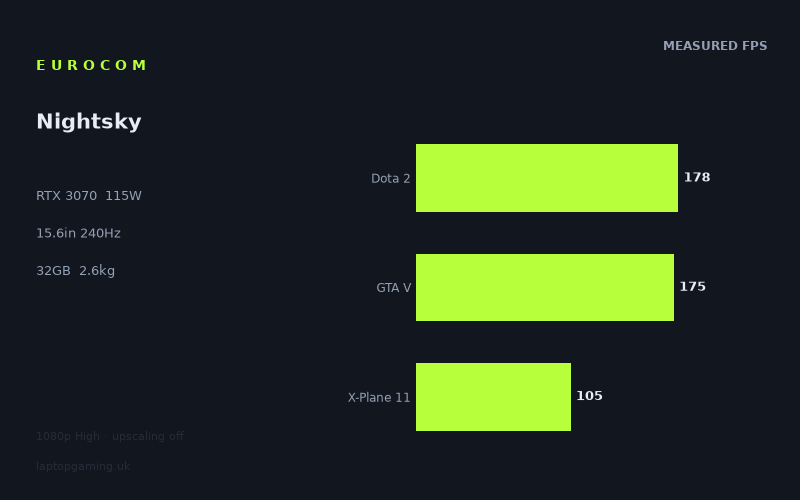
Frame rates
1920×1080, High preset, upscaling off.
Measured on this machine. Source: Notebookcheck, 2022-01-06.
Not scored: incomplete benchmark suite
Every scored laptop on this site is averaged over the same 5 games, and this one is short of Cyberpunk 2077, Baldur's Gate 3. A mean over 5 games is not comparable to a mean over 5, so we publish the figures we have and leave the score blank rather than rank it against machines tested on a different set. The numbers below are real - the suite is just incomplete.
How these numbers were produced
Frame rates here are not measured by us, and we label how each one was arrived at. A figure marked measured comes from a published run on that exact machine. A figure marked representative is derived from the GPU and its power limit (TGP) and cross-referenced against published reviews - a sound estimate of what that configuration delivers, but not a measurement of that specific laptop. Unless stated otherwise, numbers are 1920x1080, High preset, upscaling off. Where a laptop ships in several power configurations we use the wattage of the exact SKU listed, because a 140W RTX 5070 and a 115W one are not the same product.
In use
The short version
The Eurocom Nightsky is an unusually strong 1080p gaming laptop on the benchmark data available. Its RTX 3070 runs at a stated 115W power limit, paired with a Ryzen 9 5900X and 32GB of memory, and Notebookcheck’s measured figures show that this combination remains highly capable in a wide range of games at the machine’s native 1920x1080 resolution, using the High preset with upscaling disabled.
The headline result is a mean of 157fps across the five-game scoring suite. That is not a promise that every game will run at the screen’s 240Hz maximum, and the individual results make that clear. But it does mean the Nightsky has enough performance for genuinely high-refresh 1080p gaming rather than merely reaching a conventional 60Hz target. Strange Brigade reaches 221fps, The Witcher 3 records 199fps, Dota 2 manages 178fps and GTA V reaches 175fps. Those are substantial results for a laptop using an RTX 3070 rather than a later-generation part or a nominally higher-tier GPU.
The performance is less spectacular in the more demanding or less easily accelerated titles in the set. Far Cry 5 records 135fps, Final Fantasy XV reaches 107fps and X-Plane 11 returns 105fps. Those are still strong High-preset 1080p figures, but they are also a reminder that a 240Hz panel is an upper limit, not a frame-rate guarantee. The Nightsky can make good use of that fast display in lighter and older games, competitive games, and titles that respond well to its CPU and GPU combination. It cannot be assumed to feed the panel at 240fps in every modern game without compromises to settings or the use of upscaling, neither of which is represented by these figures.
There is no site score for this exact Eurocom Nightsky configuration because a confirmed UK price is not available, and value cannot be calculated without it. That is a pricing-data limitation rather than a performance concern: the benchmark suite is complete and the machine ranks normally on the frame-rate leaderboard.
The central buying case is therefore performance-led. If the priority is a 15.6in IPS laptop with a 240Hz 1080p screen and measured frame rates that routinely sit well above 100fps, the Nightsky makes a convincing technical case. It looks especially suitable for someone who values high frame rates in games such as Strange Brigade, Dota 2 and GTA V, while also wanting demanding games such as Final Fantasy XV and X-Plane 11 to remain comfortably above 100fps at the tested settings.
The reasons to hesitate are not hidden by the performance data. At 2.64kg, this is not an especially light interpretation of a 15.6in gaming laptop. The 62Wh battery is also a relatively modest capacity beside the performance hardware and 240Hz display, although the available information does not include measured battery-life results and no endurance claim should be inferred from capacity alone. Buyers looking for a machine to carry frequently should take its mass seriously. Buyers looking for proven 240fps performance in every game should do the same with the benchmark spread.
Performance
What the benchmark data says
Notebookcheck measured the Eurocom Nightsky at 1920x1080, using the High preset with upscaling off. That test condition matters. It shows what the laptop can do at its screen’s native resolution without relying on a scaling technique to inflate the result. It is a useful representation of the machine’s straightforward 1080p gaming capability: set a game to High, use the display’s native resolution, and assess the frame rate without an upscaling mode changing the picture.
The strongest individual result is 221fps in Strange Brigade. That is the closest the measured set comes to the 240Hz panel ceiling. It does not quite reach 240fps, but it is close enough to show that the screen is not an absurd match for the hardware. In this kind of lighter, very high-frame-rate-friendly workload, the Nightsky has enough performance to make a high-refresh panel meaningful. It should not be viewed as a laptop whose display is built solely for the specification sheet while the GPU is incapable of approaching it.
The Witcher 3 follows at 199fps. That is another very high result, and it sits close enough to 240Hz that the panel’s extra refresh capacity has practical value. The figure is below the display maximum, so it should not be described as full 240Hz operation. Yet 199fps is far beyond the level at which a conventional 60Hz display could show every rendered frame. For a player who prioritises responsiveness and motion clarity in games where the system can produce this kind of output, the Nightsky’s screen specification and measured performance are aligned.
Dota 2 reaches 178fps, while GTA V reaches 175fps. Both figures remain firmly in high-refresh territory. Neither fills every refresh opportunity on a 240Hz panel, but both make better use of it than a laptop constrained to lower frame rates. Dota 2 in particular is important because it represents the sort of game for which buyers commonly choose a 240Hz display: competitive play benefits from a high and sustained frame rate, even when the measured result is below the panel’s stated maximum. GTA V, meanwhile, remains a useful indication that the Nightsky can produce high output in a major open-world game at the stated settings.
Far Cry 5 records 135fps. That is a clear step down from the results in Strange Brigade, The Witcher 3, Dota 2 and GTA V, but it is not a weak outcome. At 135fps, the Nightsky is still well beyond a basic 60Hz experience and has enough output to benefit from the 240Hz screen, though it is no longer close to fully exploiting it. This distinction matters because “high refresh” is not a single category. A game at 135fps and a game at 221fps are both fast, but they place very different demands on the display and offer very different amounts of frame-rate headroom.
Final Fantasy XV reaches 107fps, and X-Plane 11 records 105fps. These are the lowest figures in the available data, and they are valuable precisely because they stop the review becoming a list of headline-grabbing highs. The Nightsky is clearly not a universal 200fps machine at High settings. In the more demanding end of this set, it delivers around the 100fps mark rather than anything approaching the panel maximum. That is still a capable outcome for 1920x1080 High-preset gaming with upscaling disabled, but it changes how the 240Hz screen should be understood. In Final Fantasy XV and X-Plane 11, the display is providing refresh-rate capacity beyond what the measured output can use.
The five scoring-suite results produce a mean of 157fps. The mean is useful as a broad description of the Nightsky’s position, but it should not replace the individual game figures. A mean can conceal a great deal. Here, it combines the 221fps result in Strange Brigade with the 105fps result in X-Plane 11. Someone buying for Dota 2, GTA V or Strange Brigade will see a different practical experience from someone buying primarily for Final Fantasy XV or X-Plane 11, even though both are covered by the same overall performance average.
That spread is why the Nightsky should be described as a very capable high-refresh 1080p machine, not as a laptop that simply “does 240Hz gaming”. The display supports refresh rates up to 240Hz. The measured output ranges from 105fps to 221fps in the available set. The machine comes closest to the panel limit in Strange Brigade, is not far away in The Witcher 3, remains fast in Dota 2 and GTA V, and is much further from 240fps in Final Fantasy XV and X-Plane 11. A sensible purchase decision should be based on the games a buyer actually plays, not on the highest single result or the display specification alone.
The importance of the 115W GPU power limit
The RTX 3070 in this Eurocom is specified at 115W. That number is important because laptop GPU names do not tell the whole performance story. The same GPU family can appear in systems with different power limits, cooling arrangements and overall platform behaviour. The Nightsky’s 115W figure defines the version of the RTX 3070 under discussion here. It is not enough to see “RTX 3070” in isolation and assume that every laptop carrying that name will deliver the same result.
In practical terms, the 115W limit means the correct way to assess this Nightsky is through its measured outputs, not by expecting it to behave like every other RTX 3070 laptop. Notebookcheck’s figures show a system that is capable of very high 1080p frame rates despite not carrying a GPU with a higher stated power limit in the supplied specification. Strange Brigade at 221fps, The Witcher 3 at 199fps and the 157fps scoring-suite mean show that the configuration is not held back to ordinary mainstream levels of performance.
At the same time, the 115W figure provides useful context for the limits shown by the results. The Nightsky is powerful enough to drive many games far beyond 100fps, but it does not erase the difference between titles with different graphics demands or different CPU demands. The drop from 221fps in Strange Brigade to 105fps in X-Plane 11 is not a minor variation. It is evidence that the laptop’s real-world position depends heavily on the game. A power limit is part of that equation, but it is not the only part, and the benchmark data should not be used to claim that the GPU power limit alone explains every gap.
The Nightsky’s CPU also matters here. It uses a Ryzen 9 5900X, and at 1920x1080 some games can become more constrained by the CPU side of the system than by raw GPU capability. The supplied rival comparison explicitly notes that lighter shared titles at 1080p can be CPU-bound and can compress genuine GPU differences. That warning applies directly to reading very close results between this machine and laptops with apparently more powerful graphics hardware. A small difference in a light 1080p game is not proof that the GPUs are equivalent; it can mean that the game is no longer asking enough of the GPU for the hardware difference to appear fully in the frame-rate result.
This is also why it would be wrong to treat the 115W RTX 3070 as either automatically disadvantaged or automatically sufficient based on its label. The numbers show where it stands. In the available tests, it is fast enough to make a 240Hz 1080p screen credible, but not fast enough to treat 240fps as a standard result across the set. It is competitive with several ostensibly stronger MSI machines in shared-game averages, but it falls behind the highest-performing rival in the supplied comparison. The power limit is meaningful context; the frame-rate results are the evidence of how that context turns into gaming performance.
High-refresh performance is not the same as reaching 240fps
The Nightsky’s 240Hz screen creates a temptation to reduce the analysis to a simple question of whether games reach 240fps. That would be too blunt. None of the listed results reaches 240fps, but several come close enough that the display specification remains useful. Strange Brigade at 221fps is clearly a better fit for a 240Hz panel than X-Plane 11 at 105fps. The Witcher 3 at 199fps, Dota 2 at 178fps and GTA V at 175fps likewise give the panel far more work to do than a 60Hz display would.
The more useful conclusion is that the Nightsky can operate across several levels of high-refresh gaming. In Strange Brigade, it gets very close to the screen maximum. In The Witcher 3, it remains near the top end of what the display can show. In Dota 2 and GTA V, it provides a high frame rate that does not saturate the panel but still justifies a fast display. In Far Cry 5, it is still substantially above conventional refresh targets, though the gap to 240Hz is much larger. In Final Fantasy XV and X-Plane 11, the panel has considerable unused refresh capacity, but the machine still returns more than 100fps under the tested conditions.
This makes the 240Hz panel best understood as headroom. In the games where the Nightsky is light on its feet, the panel can display a very large number of frames. In games where the laptop is nearer 100fps, the panel is not a performance multiplier; it simply has more refresh capacity than the game is using. There is nothing inherently wrong with that. A high-refresh panel does not require every title to hit its maximum before it becomes worthwhile. But buyers should not pay for the specification under the assumption that it guarantees 240fps in demanding games.
There is also no measured result here for lower graphics settings, higher graphics settings, ray tracing, or upscaling. The available figures are deliberately straightforward: 1920x1080, High, with upscaling off. That makes them useful for comparing the listed games on a consistent basis, but it means the review cannot responsibly claim what will happen after changing settings. A buyer focused on maximum frame rate may choose to alter settings in particular games, but that would be a separate scenario from the published data.
Why the results vary so much between games
The difference between 221fps in Strange Brigade and 105fps in X-Plane 11 is the key to understanding this laptop. Gaming performance is not a fixed attribute expressed by a single number. Each game places a different mix of demands on the GPU, CPU, memory and game engine. At 1080p, especially in lighter titles, a powerful enough GPU can stop being the sole limiter. The supplied comparison notes that CPU-bound behaviour in lighter shared games can compress GPU gaps, and the Nightsky’s own results show why that observation matters.
Strange Brigade, The Witcher 3, Dota 2 and GTA V all deliver very high figures on this configuration. That does not mean they are identical workloads, but they demonstrate that the machine can produce a great deal of frame-rate output when the game and the hardware align favourably. Far Cry 5 sits lower at 135fps, while Final Fantasy XV and X-Plane 11 sit close to each other at 107fps and 105fps. The difference is large enough that a prospective owner should avoid basing an expectation on any single game.
For buyers, the practical lesson is simple. If the games you care about resemble the lighter or more high-frame-rate-friendly end of this set, the Nightsky has the potential to make excellent use of its 240Hz panel. If the games you care about resemble the most demanding end, expect a strong 100fps-class experience in the measured examples rather than near-240fps gaming. Both are good outcomes at 1080p High with upscaling off, but they are not the same reason to buy a laptop.
The benchmark source is Notebookcheck, with the listed results dated 2022-01-06. These are measured figures, not estimates, and they should be read as evidence for the tested configuration and settings. They are more useful than a generic claim that an RTX 3070 “should be enough” for 1080p gaming, because they show both the Nightsky’s strengths and its limits across recognisably different games.
The screen
A fast 15.6in 1080p IPS display
The Eurocom Nightsky has a 15.6in 1920x1080 IPS display with a 240Hz refresh rate. This is a purposeful gaming screen specification. The 1080p resolution keeps the rendering target aligned with the level of performance shown by the RTX 3070 at 115W, while the 240Hz refresh rate gives the machine room to show the very high frame rates it achieves in several measured games.
For this hardware, 1920x1080 is a sensible native resolution. The benchmark data is at that exact resolution, so there is no need to infer how the system might perform after scaling to a different panel resolution. The Nightsky delivers 221fps in Strange Brigade, 199fps in The Witcher 3, 178fps in Dota 2, 175fps in GTA V, 135fps in Far Cry 5, 107fps in Final Fantasy XV and 105fps in X-Plane 11 at its own native resolution. That direct alignment between display resolution and benchmark resolution is valuable: the numbers describe the experience the built-in panel is intended to provide.
The IPS panel type is also relevant for a gaming laptop intended to serve both fast games and general desktop use. The fact sheet identifies the panel as IPS, but does not provide measured brightness, contrast, colour coverage, response times, adaptive-sync support or any assessment of backlight behaviour. Those omissions matter. It would be wrong to treat “IPS” as proof of any particular image-quality standard beyond the panel technology stated. The display’s gaming case is supported by its resolution and refresh rate; detailed image-quality claims would need measurements that are not available here.
Can the RTX 3070 actually use 240Hz?
It can use the panel well in parts of the benchmark set, but the answer depends on the game. The strongest result, Strange Brigade at 221fps, comes close to the display maximum without reaching it. The Witcher 3 at 199fps also sits close enough to 240Hz that the panel has a clear practical role. Dota 2 at 178fps and GTA V at 175fps are further away, but still provide enough frames for a 240Hz display to show more temporal detail than a lower-refresh alternative could.
Far Cry 5 at 135fps illustrates the middle ground. The screen remains a good match in the sense that it has ample refresh capacity for the game’s output, but it is not being filled. Final Fantasy XV at 107fps and X-Plane 11 at 105fps are further from the 240Hz limit again. In those games, the advantage of the panel is not that the Nightsky is reaching its full rated refresh rate. Rather, the laptop has a capable display that does not impose a low ceiling on the frame rate the system can deliver.
That distinction should influence buying priorities. A player shopping for a laptop mainly for esports-oriented or lighter games may see the 240Hz display as central to the Nightsky’s appeal. The measured Dota 2 result of 178fps supports that position, even though it is below 240fps. A player focused mainly on heavier games should think of the panel as a premium ceiling rather than a target the machine regularly meets. The 105fps and 107fps results are still high frame rates, but they do not turn the Nightsky into a full-240fps machine under the stated High-preset conditions.
The screen therefore suits the machine better than a substantially higher-resolution panel would necessarily do, based on the information available. The laptop is measured at 1080p and produces high frame rates there. That is the combination its hardware demonstrably supports. There is no supplied evidence for performance at another resolution, so the review should not claim that the Nightsky would be equally well suited to a different native target.
Build, size and portability
Weight matters more than the screen size alone suggests
The Nightsky is a 15.6in laptop weighing 2.64kg. That is the most important portability fact available. A 15.6in screen often suggests a laptop that can move between home, work, study and travel without much thought, but 2.64kg is substantial enough that prospective buyers should assess portability realistically. This is better described as a machine that can be transported than as a machine that disappears into a bag.
That does not make the weight unreasonable for a gaming laptop with an RTX 3070, Ryzen 9 5900X, 32GB of memory and a 240Hz display. It does, however, define the sort of ownership experience the specification is likely to suit. The Nightsky makes most sense for someone who expects it to spend much of its time on a desk, then occasionally move to another room, another home, a workplace or an event. It is less naturally suited to somebody who expects to carry it every day over long distances and wants the lightest possible machine.
The fact sheet does not provide the laptop’s physical dimensions, so there is no basis for claiming that it has a compact footprint, a particularly thin chassis, or a large one for its screen size. Weight alone cannot answer every question about bag space or desk space. It can answer the more fundamental question of whether this is a lightweight portable: at 2.64kg, it is not.
Battery capacity without unsupported endurance claims
The Nightsky has a 62Wh battery. Battery capacity is useful context, but it is not battery-life evidence. The available information contains no measured battery-life result, no charging result and no indication of the conditions under which any endurance figure might have been recorded. It would therefore be irresponsible to turn 62Wh into a claim about how long the laptop will last away from mains power.
What can be said is that this is a performance-focused configuration with a Ryzen 9 5900X, RTX 3070, 32GB of memory and a 240Hz display, while the stated battery capacity is 62Wh. Buyers whose main requirement is long unplugged use should seek measured battery data before treating the Nightsky as a travel-first machine. Buyers whose main requirement is desktop gaming performance have much clearer evidence to work with, because the benchmark data is complete.
Gaming laptops are often bought with two conflicting expectations: high performance at a desk and easy all-day mobility away from it. The Nightsky’s available specifications support the former much more clearly than the latter. Its mass points towards desk-led use, and the absence of measured battery-life data means there is no evidence to make a strong portability claim. That is not a criticism of the performance hardware. It is a reason to match the machine to the right kind of owner.
How it compares
Against the MSI Prestige 15
The largest stated advantage for the Eurocom Nightsky is against the MSI Prestige 15 with an RTX 3050 Ti at 105W. Across four shared games, the Nightsky averages 88fps ahead. That is a major gap, not a marginal lead that needs careful qualification. It reinforces what the Nightsky’s own results already show: this is a high-frame-rate 1080p machine, and it sits in a substantially stronger performance position than the Prestige 15 in the shared data.
The comparison should still be read correctly. It covers four shared games, not every title in either laptop’s benchmark history, and the fact sheet does not provide a confirmed UK price for either configuration. It is therefore a performance comparison rather than a value judgement. But as a performance-only result, the Nightsky’s advantage is decisive. Someone choosing primarily on measured gaming output would have a clear reason to prefer the Eurocom over this particular MSI.
The difference also helps put the Nightsky’s 115W RTX 3070 into perspective. A laptop GPU name and power limit should always be considered in context, but the shared-game gap indicates that the Eurocom is operating in a notably different performance class from the RTX 3050 Ti-equipped Prestige 15 in the supplied comparison. The Nightsky’s 240Hz screen is correspondingly easier to justify from a frame-rate standpoint.
Against the MSI GE67 HX
The MSI GE67 HX carries an RTX 3070 Ti at 150W, yet the Nightsky averages only 2fps behind across five shared games. On the face of it, that is a remarkably close result given the different GPU label and the higher stated power limit of the MSI. It would be a mistake, however, to turn this near tie into a claim that the two graphics configurations are universally equivalent.
The supplied comparison gives the reason for restraint: at 1080p, lighter titles in the shared set can be CPU-bound and can compress genuine GPU gaps. In other words, when a game is no longer asking enough of the GPU to expose the difference fully, a more powerful graphics subsystem may not show its expected advantage in the resulting frame rate. That is especially relevant when the average separation is only 2fps.
For a buyer, the sensible conclusion is that the Nightsky is extremely competitive with the GE67 HX in the specific shared 1080p game set. It is not proof that every game will behave the same way, nor proof that the 115W RTX 3070 and 150W RTX 3070 Ti should be treated as interchangeable in every workload. The near-zero gap is still a meaningful outcome. It shows that the Eurocom’s complete platform, including its Ryzen 9 5900X, is delivering performance close to this rival where the two systems overlap.
Against the MSI Raider GE66
The MSI Raider GE66 is listed with an RTX 3080 Ti, and the Nightsky averages 3fps behind across five shared games. Again, the result is much closer than a simple reading of the GPU names might suggest. The Eurocom does not win this comparison, but a 3fps shared-game average deficit is a near tie in practical terms within this particular data set.
The same 1080p CPU-bound caution applies. Lighter games can compress the visible gap between GPUs, especially where the rest of the platform becomes the limiting factor. The Raider GE66’s RTX 3080 Ti designation should not be ignored, but neither should the actual shared-game outcome. In the games both machines hold, the Nightsky remains close enough that it should not be dismissed as clearly slower on the basis of GPU branding alone.
This comparison is particularly useful for buyers who might otherwise assume that moving from an RTX 3070 label to an RTX 3080 Ti label automatically transforms the 1080p High-preset experience. The supplied results do not show a large average separation in the shared set. That does not make the systems identical, and it does not settle how they compare in every game. It does show that at 1080p, the Nightsky’s measured performance is strong enough to stay close to a rival with a higher-tier GPU name.
Against the MSI Raider GE77 HX
The MSI Raider GE77 HX with an RTX 3080 Ti at 175W is the rival that pulls furthest ahead of the Nightsky in the supplied comparisons. Across five shared games, the Eurocom averages 12fps behind. This is still not an enormous gap relative to the Nightsky’s own 157fps scoring-suite mean, but it is the clearest indication here that the Eurocom does not sit at the absolute top of this group.
The GE77 HX’s stated 175W GPU power limit is also notably above the Nightsky’s 115W figure. The benchmark comparison does not justify a claim that power limit alone accounts for the difference, but the result is consistent with the broader point that GPU configuration matters beyond the product name. Where the more powerful MSI shows an advantage in the shared games, the Eurocom is not able to erase it entirely.
Even so, the Nightsky’s position remains respectable. Being 12fps behind across five shared games is very different from the 88fps advantage it holds over the Prestige 15, but it does not undermine the Eurocom’s own high-frame-rate results. It simply clarifies the hierarchy within this rival set: the Nightsky can run very close to the GE67 HX and Raider GE66 in the shared data, while the Raider GE77 HX establishes the more meaningful lead.
What the rival spread means
The rival list is more informative as a group than any single comparison would be. The Nightsky is far ahead of the MSI Prestige 15, nearly level with the MSI GE67 HX and MSI Raider GE66, and behind the MSI Raider GE77 HX. That spread places the Eurocom in a strong performance position without pretending that it is unbeatable.
It also shows why product names are inadequate shorthand for laptop performance. The Eurocom has an RTX 3070 at 115W. The listed MSI rivals range from an RTX 3050 Ti at 105W through an RTX 3070 Ti at 150W to RTX 3080 Ti configurations, including one at 175W. Yet the shared-game results are not arranged into a simple, evenly spaced ladder. The closest comparisons are separated by only 2fps and 3fps, while the machine it beats by most trails by 88fps, and the machine that beats it by most leads by 12fps.
The explanation supplied for those close results is important: at 1080p, lighter shared games can be CPU-bound and can compress real GPU differences. That does not invalidate the comparisons. It explains why they must be read as benchmark outcomes for shared games at the tested resolution rather than as universal declarations of GPU equivalence. The Nightsky’s performance is best judged from the evidence available: very strong in its own results, extremely competitive with some more highly specified rivals in the shared set, and clearly behind the highest-performing listed rival.
Who it’s for
Buy it for measured 1080p frame-rate performance
The Eurocom Nightsky is for the buyer whose main priority is fast native-resolution 1080p gaming and who values evidence over broad GPU-label assumptions. The combination of a 15.6in 240Hz IPS display, RTX 3070 at 115W, Ryzen 9 5900X and 32GB of memory is backed up by benchmark data that ranges from 105fps to 221fps under consistent High-preset conditions with upscaling disabled.
It is particularly well suited to someone who plays games closer to the high-output side of the supplied set. Strange Brigade at 221fps, The Witcher 3 at 199fps, Dota 2 at 178fps and GTA V at 175fps all show a laptop capable of exploiting much of what a 240Hz screen offers. A buyer who spends significant time in Dota 2 should see the 178fps result as a strong match for a high-refresh panel, even though it is not a claim of full 240fps operation.
It also suits someone who wants demanding games to run at high frame rates without upscaling. Final Fantasy XV at 107fps and X-Plane 11 at 105fps show that the Nightsky does not fall back to basic performance levels when the workload becomes less favourable. The machine is not reaching the 240Hz ceiling in those games, but it is still providing a high-frame-rate experience at the tested settings.
It is a sensible option for a desk-first owner. At 2.64kg, the Nightsky is portable in the sense that it can be moved and transported, but its weight makes most sense for a buyer who will not be carrying it constantly. Someone who wants a powerful laptop for a fixed gaming space, with the flexibility to take it elsewhere when needed, is a better fit than someone seeking an ultralight daily companion.
Buy something else if portability is the priority
Buy something else if low weight is central to the purchase. The Nightsky’s 2.64kg mass is not a minor detail. It is fundamental to how the machine will fit into daily use. The fact sheet provides no dimensions, so there is no basis for qualifying the weight with a claim about an unusually compact chassis. If regular travel, long commutes or constant carrying are part of the plan, a lighter machine would be the more natural category to investigate.
Buy something else if battery life is the deciding criterion and you need proof before purchase. The stated battery capacity is 62Wh, but there is no measured endurance figure in the available information. It would be wrong to tell a buyer that the Nightsky will last for a particular amount of time away from the mains. A buyer who needs proven unplugged runtime should look for a laptop with published battery testing that matches their use case.
Buy something else if the aim is to run every game at 240fps at High settings without relying on changed settings or upscaling. The measured figures do not support that expectation. None of the listed games reaches 240fps. Strange Brigade comes close at 221fps, but Final Fantasy XV and X-Plane 11 are at 107fps and 105fps respectively. The Nightsky is a high-refresh machine, not an all-games-at-panel-maximum machine.
Buy something else if the preference is for the strongest performance result among the specific rivals listed. The MSI Raider GE77 HX is ahead by 12fps across five shared games. That does not make the Nightsky slow; it makes the Raider the faster machine in that direct shared-game comparison. Buyers who simply want the leading result in this particular group should recognise that distinction.
The final buying judgement
The Eurocom Nightsky earns attention because its published frame rates are strong enough to justify its 240Hz 1080p display. The key evidence is not a single headline result but the breadth of the numbers: 221fps in Strange Brigade, 199fps in The Witcher 3, 178fps in Dota 2, 175fps in GTA V, 135fps in Far Cry 5, 107fps in Final Fantasy XV and 105fps in X-Plane 11. That is a convincing set of results for a laptop with an RTX 3070 at 115W.
Its best use case is clear: a buyer who wants a 15.6in high-refresh gaming laptop for native 1080p play, expects to use it mainly near mains power, and values measured performance across both lighter and more demanding games. The Nightsky has the frame-rate evidence to support that role.
Its limitations are equally clear. It is not lightweight at 2.64kg, its 62Wh battery cannot be translated into an endurance claim without testing, and the 240Hz panel should be viewed as a high ceiling rather than a universal frame-rate outcome. If those limits match your priorities, the Eurocom Nightsky is a serious 1080p performance machine. If portability, proven battery endurance, or guaranteed 240fps in demanding games matter more, the available data points towards choosing a different type of laptop.