Review
Lenovo Legion 5 review
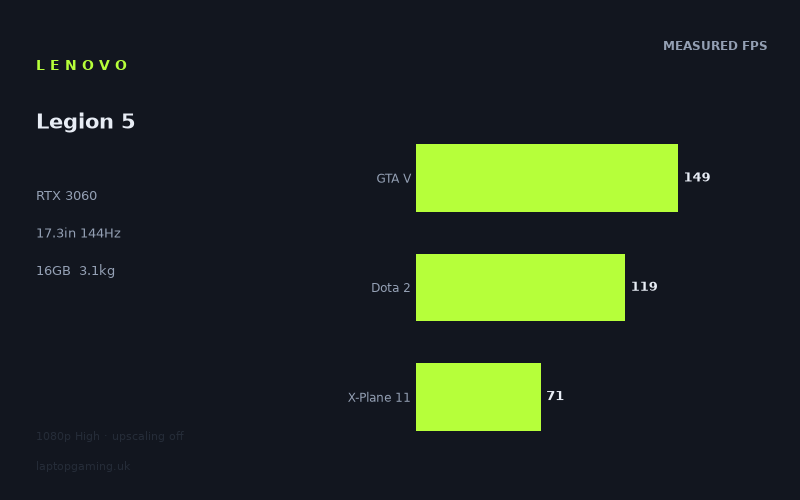
Frame rates
1920×1080, High preset, upscaling off.
Measured on this machine. Source: Notebookcheck, 2022-02-23.
Not scored: incomplete benchmark suite
Every scored laptop on this site is averaged over the same 5 games, and this one is short of Cyberpunk 2077, Baldur's Gate 3. A mean over 5 games is not comparable to a mean over 5, so we publish the figures we have and leave the score blank rather than rank it against machines tested on a different set. The numbers below are real - the suite is just incomplete.
How these numbers were produced
Frame rates here are not measured by us, and we label how each one was arrived at. A figure marked measured comes from a published run on that exact machine. A figure marked representative is derived from the GPU and its power limit (TGP) and cross-referenced against published reviews - a sound estimate of what that configuration delivers, but not a measurement of that specific laptop. Unless stated otherwise, numbers are 1920x1080, High preset, upscaling off. Where a laptop ships in several power configurations we use the wattage of the exact SKU listed, because a 140W RTX 5070 and a 115W one are not the same product.
In use
The short version
The Lenovo Legion 5 (17ACH6H-82JY0003GE) is a large-screen RTX 3060 gaming laptop with a straightforward strength: the published benchmark data shows that it delivers consistently strong 1920x1080 performance across a broad spread of games. Notebookcheck’s measured figures range from 71fps in X-Plane 11 to 198fps in F1 2021, with a 121fps mean across the scoring-suite games. That is enough performance for high-refresh gaming in the lighter and better-scaling titles, while still giving demanding games such as Far Cry 6 and Metro Exodus playable figures at the stated High preset with upscaling off.
The important qualification is that this is not a compact machine. At 3.067kg, with a 17.3in screen, it is a laptop for a desk, a spare room, student accommodation, or occasional transport between places. It is not the sort of system to treat like a lightweight everyday bag companion. The 80Wh battery is a respectable specification on paper, but there are no measured battery-life figures in the available data, so it would be wrong to make promises about unplugged gaming or working time.
The screen is sensibly matched to the performance available. Its 1920x1080 resolution is not an excessive burden for the RTX 3060, and its 144Hz refresh rate is genuinely relevant in several of the measured games. F1 2021 at 198fps, F1 2020 at 193fps, Strange Brigade at 180fps and GTA V at 149fps all exceed the panel refresh rate at the specified settings. The Legion will not deliver 144fps in everything, though. Modern and heavier games in the measured set sit much lower: Far Cry 6 reaches 81fps, Metro Exodus 80fps, Final Fantasy XV 85fps and X-Plane 11 71fps. That is still useful gaming performance, but it is a different experience from maximising a 144Hz panel.
There is no confirmed UK price for this exact configuration. That means its value cannot be judged responsibly here, because price is central to whether a Ryzen 5 5600H and RTX 3060 laptop is a sensible buy rather than merely a capable one. The benchmark suite is complete and the machine can be compared normally on frame rates; the missing price is the only reason for withholding a value judgement. Do not assume that strong performance automatically makes it a strong purchase. The right answer depends on the actual asking price when buying.
Buy this Legion 5 if you want a 17.3in 1080p gaming system whose measured results show strong performance across both older high-frame-rate games and heavier titles, and if the size and 3.067kg weight suit the way you use a laptop. It makes particular sense for someone who wants F1, GTA V, Strange Brigade, Dota 2 or similar games to run well above the basic 60fps threshold without needing upscaling at the stated preset.
Look elsewhere if portability is the first priority, if a machine must be regularly carried all day, if you specifically want 144fps-class performance in demanding games rather than selected lighter titles, or if the eventual UK price does not reflect the fact that stronger RTX 3080 Ti-class performance exists in the same generation at the high end. It is also not the obvious choice for buyers who want performance headroom for the most demanding games at the same settings. The benchmark data is good, but it is not universal 144fps data.
Performance
What the measured results say
Notebookcheck measured the Lenovo Legion 5 at 1920x1080 using the High preset with upscaling off. That matters because these are directly useful results for the laptop’s own 1920x1080 display. There is no need to translate results from a higher-resolution test into an estimate of native-screen performance, and no hidden contribution from upscaling is involved in the listed figures.
The broad result is a machine with substantial 1080p capability rather than one with a single flattering benchmark. The measured figures are as follows:
- F1 2021: 198fps
- F1 2020: 193fps
- Strange Brigade: 180fps
- GTA V: 149fps
- The Witcher 3: 125fps
- Dota 2: 119fps
- Far Cry 5: 106fps
- Far Cry New Dawn: 94fps
- Borderlands 3: 90fps
- Final Fantasy XV: 85fps
- Far Cry 6: 81fps
- Metro Exodus: 80fps
- X-Plane 11: 71fps
Those figures are not simply a list of wins and losses. They describe the type of gaming experience this laptop is likely to offer at its native resolution and the stated settings. At the top end, the Legion is comfortably beyond the display’s 144Hz refresh rate. In the middle, it is firmly in the high-frame-rate territory that makes a 144Hz screen worthwhile even without fully reaching 144fps. At the lower end, it remains above 60fps in every listed game, but some titles are much closer to conventional 60fps-class performance than to the display’s ceiling.
The 121fps mean across the scoring-suite games is useful as a summary, but it should not be mistaken for a promise that every game will run near 121fps. The individual results are too widely spread for that interpretation. X-Plane 11 records 71fps, while Strange Brigade records 180fps. A buyer interested mainly in flight simulation will experience this laptop very differently from a buyer interested mainly in F1 2021, even though both are looking at the same RTX 3060 system.
That spread is exactly why the individual game figures matter more than a single average. A gaming laptop should be judged against the games someone actually plays. The Legion 5 looks very strong for the titles at the top of this list, good for the group around 90fps to 125fps, and merely solid rather than high-refresh-class for the games around 71fps to 85fps. None of those descriptions is a criticism in isolation. The problem only arises if a buyer expects the 144Hz screen to be fully utilised in every demanding game at High settings with upscaling off.
Games that can make real use of 144Hz
F1 2021 is the standout result at 198fps. F1 2020 follows closely at 193fps. Both are well above 144fps, so in these measured conditions the Legion has more rendering performance than the panel can present at one time. That does not make the extra performance meaningless. It provides a substantial margin above the screen refresh rate, and it means that the 144Hz panel is not merely a specification-sheet feature for these games.
Strange Brigade, at 180fps, is also clearly in this category. It exceeds 144fps by a large enough margin that the result should not be described as borderline. GTA V is closer at 149fps, but still clears the panel’s refresh rate. It is the least emphatic of the games above 144fps, yet it still shows that this Legion can meet the screen’s maximum refresh in a demanding mainstream game from the measured selection.
For a buyer whose library centres on these games, this is the most attractive part of the data. The laptop’s 144Hz display has a practical performance partner rather than being paired with a GPU that can only occasionally approach it. At 1920x1080, High settings and with upscaling off, the published results demonstrate that the system can generate more than 144 frames per second in F1 2021, F1 2020, Strange Brigade and GTA V.
It is worth being precise about what this does and does not establish. It establishes measured frame rates for those specific games, settings and test conditions. It does not establish that every racing game, every open-world game, every future release or every user configuration will behave in the same way. The sensible conclusion is narrower and more useful: players focused on the games represented by these results have good reason to value the 144Hz panel, while players with a very different library should look at the lower figures too.
Strong high-frame-rate performance without a full 144fps result
The Witcher 3 at 125fps is below the display’s maximum refresh, but it is still a strong result. The gap between 125fps and 144fps should not be exaggerated into a failure to suit the panel. A 144Hz screen is not useful only at exactly 144fps. It also provides room for games that run below that ceiling but well above 60fps. The important distinction is between a laptop that spends its time around 60fps and one that can run a game at 125fps under the stated settings. The Legion is clearly in the latter camp here.
Dota 2 records 119fps. That is another result where the machine does not hit 144fps but still delivers substantially more than a basic 60fps target. For players of games in this performance range, the 144Hz panel remains a credible pairing. It may not be fully saturated by the benchmark figure, but the available frame rate is high enough that a fast panel is not out of place.
Far Cry 5 reaches 106fps. This is an especially useful result because it sits in the middle of the data rather than at either extreme. It shows the Legion producing a convincingly high frame rate in a game that does not join the 144fps group. A buyer should read 106fps not as “missing the point of a 144Hz screen”, but as evidence that the laptop has room beyond 60fps in a more demanding workload.
The pattern across these three games is encouraging. The Legion is not dependent on a handful of very light titles to look competent. There is a meaningful group of results between 100fps and 125fps: The Witcher 3 at 125fps, Dota 2 at 119fps and Far Cry 5 at 106fps. That middle range matters more for many buyers than the headline 198fps result in F1 2021 because it is closer to what a broad library of games can feel like on a 1080p RTX 3060 laptop.
Where the 144Hz target stops being realistic
Far Cry New Dawn at 94fps and Borderlands 3 at 90fps form the next group. These are still comfortably above 60fps in the benchmark data, and a buyer should not dismiss them as poor results. However, they are far enough from 144fps that the machine should not be bought on the assumption that High settings with upscaling off will routinely turn demanding games into full-refresh experiences.
Final Fantasy XV reaches 85fps, Far Cry 6 reaches 81fps and Metro Exodus reaches 80fps. Those are closely grouped results, and they illustrate the Legion’s practical limit more clearly than the very high results in F1 2021. In games of this weight, the RTX 3060 is delivering a strong conventional frame rate rather than a 144Hz-class frame rate. The 144Hz panel is still not wasted; a screen does not cease to function below its maximum refresh. But the GPU does not have the measured headroom to make a confident 144fps claim in these games at the listed settings.
X-Plane 11 is the lowest measured result at 71fps. It remains above 60fps, which is important, but it is only just into the territory where a high-refresh display becomes an enhancement rather than the defining part of the experience. Anyone buying primarily for X-Plane 11 should give this figure much more weight than the F1 2021 figure. The same laptop can be exceptional for one set of games and simply adequate for another.
This is not a weakness unique to the Legion 5. It is the normal consequence of benchmarking a broad game spread. Different games place different demands on the system, and their results are not interchangeable. The useful takeaway is that the Lenovo has no listed result below 71fps at 1920x1080 High with upscaling off, but its performance varies enough that buyers should set expectations by the heavier titles, not only by the fastest ones.
The GPU power limit: what can and cannot be concluded
The available fact sheet identifies the GPU as an RTX 3060, but it does not state a GPU power limit for this Legion 5 configuration. That missing specification matters because laptop GPUs with the same name can produce different results depending on their implementation. It would be wrong to assign this machine a particular wattage, or to claim that a stated power limit is the reason for any individual result, when that figure is not published here.
What can be assessed is the outcome. Notebookcheck’s results show how this specific Lenovo Legion 5 performed in the stated benchmark conditions. That is more useful than treating “RTX 3060” as a complete performance description. The Legion records 198fps in F1 2021, 180fps in Strange Brigade, 149fps in GTA V, 125fps in The Witcher 3 and 80fps in Metro Exodus. Those numbers are the practical evidence of this configuration’s delivered 1080p performance.
The comparison data also shows why GPU labels alone should not decide a purchase. This Legion is only 1fps ahead on average across five shared games of the Razer Blade 15 Base Edition 2021 with an RTX 3060 at 95W. It is level on average across five shared games with the Asus ZenBook Pro Duo UX582, despite that machine using an RTX 3070 at 85W. Those results do not permit a simple conclusion about one laptop’s internal design or GPU power setting beyond the details provided, but they do show that the badge on the GPU is not the whole story.
At 1080p, the lighter titles in the shared set can be CPU-bound, which compresses genuine GPU gaps. That is particularly relevant when interpreting the near-zero results against the Razer and Asus machines. A 1fps average lead or a 0fps average difference does not mean the hardware is identical. It means that, in the shared games and measured conditions, the systems produced effectively the same average outcome. Where a game is limited elsewhere in the system rather than purely by graphics performance, adding or changing GPU capability may not produce a proportionate frame-rate change.
The right way to read the Legion 5 is therefore not “an RTX 3060 must perform like this”, but “this RTX 3060 Legion 5 has published figures that put it in this performance range”. That is a more cautious conclusion, but it is also the one supported by attributable benchmark data.
CPU, memory and storage in context
The machine uses a Ryzen 5 5600H, 16GB of memory and a 1TB SSD. These are important parts of the configuration, but the available figures do not isolate their individual impact. It would be speculative to claim that the CPU causes a particular result in F1 2021, or that the memory amount explains the gap between Borderlands 3 and Metro Exodus. The benchmark data reports the finished laptop’s performance, not a component-by-component breakdown.
There is still a useful practical point in the listed specification. This is not an RTX 3060 paired with an unspecified memory capacity or tiny storage allocation in the fact sheet. The configuration is clearly stated as 16GB of memory and a 1TB SSD. For a buyer comparing exact model numbers, that matters: performance data should be tied to the tested configuration rather than assumed to apply to every Legion 5 with a similar name.
The Ryzen 5 5600H also helps explain why the near-equal rival comparisons should not be reduced to graphics-card names. The Legion is a complete platform, and the shared-game results are outcomes from complete machines. In the lighter shared games at 1080p, CPU limits can compress GPU gaps. This makes it particularly important to look at measured data instead of assuming that an RTX 3070 must always be clearly ahead of an RTX 3060, or that two RTX 3060 systems must necessarily match.
The screen
A sensible 1920x1080 target
The Legion 5 has a 17.3in IPS display with a 1920x1080 resolution and 144Hz refresh rate. From a gaming-performance perspective, 1920x1080 is a sensible match for the published results. The RTX 3060 is not being asked to drive a higher-resolution panel in the listed tests, and the figures demonstrate why that matters. The machine can reach very high frame rates in several games and remains above 60fps in every game listed.
There is a practical coherence between the panel specification and the benchmark data. A 144Hz display can be disappointing when the GPU rarely exceeds 60fps. That is not the situation here. Four measured games clear 144fps: F1 2021 at 198fps, F1 2020 at 193fps, Strange Brigade at 180fps and GTA V at 149fps. Several more sit well above 90fps. The screen has a credible performance reason to exist.
At the same time, the display should not be treated as a guarantee of 144fps gaming. The Witcher 3 at 125fps, Dota 2 at 119fps and Far Cry 5 at 106fps do not meet the panel’s maximum refresh, although they are still high-frame-rate results. Far Cry New Dawn at 94fps, Borderlands 3 at 90fps, Final Fantasy XV at 85fps, Far Cry 6 at 81fps, Metro Exodus at 80fps and X-Plane 11 at 71fps sit further from 144fps.
That is not an argument against the screen. It is an argument for setting the right expectation. The 144Hz specification is most valuable for games that can reach or approach that level. On this Legion, that includes several titles in the measured selection, but not the entire selection. Buyers who spend most of their time in F1 2021, F1 2020, Strange Brigade or GTA V have a clear reason to prioritise the 144Hz panel. Buyers focused on Metro Exodus, Far Cry 6 or X-Plane 11 should expect the panel to offer headroom rather than a constantly full-refresh output at the stated settings.
High refresh is a range, not a switch
It is easy to treat 144Hz as an all-or-nothing target: either a laptop reaches 144fps or the panel is supposedly wasted. The Legion’s benchmark spread shows why that is too simplistic. A result of 125fps in The Witcher 3 or 119fps in Dota 2 is below 144fps, but it is still far removed from 60fps-class performance. The display is not only for games that exceed 144fps; it also accommodates games that run substantially faster than 60fps without requiring the system to stop at a lower refresh limit.
Equally, it would be misleading to say that every result below 144fps makes a 144Hz display equally useful. There is a meaningful practical difference between 125fps and 71fps. The former is near the panel ceiling; the latter is around half of it. The benchmark list gives buyers the information needed to make that distinction. This Lenovo is not a one-speed machine. It is a laptop whose screen is fully exploited in some games, well used in others, and underused in the heaviest measured titles at High settings with upscaling off.
The fact that upscaling was off is especially worth retaining when reading the screen results. The figures describe native 1920x1080 rendering under the listed test conditions. They are not results achieved by lowering the rendering burden through upscaling. That makes the figures a clean baseline for this display. It does not tell us what any optional settings changes would achieve, because there are no such measurements in the fact sheet. It simply establishes that the listed performance was achieved without upscaling.
What is known about the panel, and what is not
The panel is specified as IPS, measures 17.3in, runs at 1920x1080 and has a 144Hz refresh rate. Those are the panel facts available. There are no published figures here for brightness, colour coverage, response behaviour, contrast, outdoor visibility or calibration. Those characteristics should not be invented from the IPS label or inferred from the laptop’s gaming credentials.
That leaves a narrower but still useful conclusion. The panel’s size gives the Legion a distinctly large-screen format, its resolution keeps the GPU workload aligned with the tested frame rates, and its refresh rate has real support from the game results. Beyond that, a buyer who places high priority on image quality for colour-critical work or has a specific brightness requirement will need panel data that is not present here.
Build, size and portability
A 3.067kg laptop is a deliberate commitment
The Legion 5 weighs 3.067kg. That figure should shape the buying decision before any discussion of frame rates. A 17.3in gaming laptop at this weight is best understood as a transportable gaming system, not a light portable computer. It can be moved between locations, but the specification does not suggest a machine chosen for minimal carrying burden.
This makes the Legion most natural for a stable setup: a desk at home, a room in shared accommodation, a regular place of work or study, or a situation where it is carried occasionally rather than continuously. The large 17.3in screen reinforces that impression. The attraction is having a large display integrated into the system, along with the measured 1080p gaming performance. The trade-off is that 3.067kg is substantial for anyone who expects to carry the laptop daily.
The available information does not include dimensions, chassis materials, port selection, keyboard details, trackpad behaviour, upgrade access, cooling noise or operating temperatures. It would be wrong to fill those gaps with assumptions based on the Legion name, the screen size or the RTX 3060. There is no basis here for calling it slim, thick, quiet, loud, rigid, premium, upgradeable or easy to service.
What can be said is that its physical role follows directly from the confirmed weight and display size. This is a machine for users willing to exchange portability for a 17.3in screen and the performance demonstrated in the benchmark data. That exchange can be sensible. A buyer who mostly games in one place may value the larger panel far more than a lower carrying weight. A buyer who commutes with their laptop every day may reach the opposite conclusion before even considering the GPU.
Battery capacity without invented battery-life claims
The Lenovo has an 80Wh battery. Battery capacity is not the same thing as measured battery life. There are no battery runtime figures in the fact sheet, whether for gaming, video playback, browsing or idle use. It would therefore be irresponsible to claim that the Legion lasts a full day, handles a commute, offers a certain number of hours away from mains power or provides useful unplugged gaming time.
The practical advice is simply to treat the 80Wh figure as a specification rather than a promise. Buyers who need dependable unplugged use should seek measured battery data for this exact configuration. For buyers using the Legion mainly at a desk, the absence of a battery-runtime claim is less central than the 3.067kg weight, 17.3in display and measured gaming performance. For buyers who intend to work away from a plug frequently, it is an unresolved question rather than a point in the laptop’s favour.
How the form factor affects the buying decision
There is a clear split in the Legion’s appeal. The RTX 3060 performance, 17.3in display and 144Hz refresh rate point towards gaming use where visual space and sustained frame rate matter. The 3.067kg weight points away from casual daily mobility. Neither side cancels the other out. It simply means the machine suits a particular style of ownership.
If the laptop will spend most of its time on a desk, the weight is likely to matter only when it is first set up and occasionally moved. In that case, the larger screen and strong 1080p figures may be the defining qualities. If it will be packed every morning, used across campus or carried through a long working day, the same 3.067kg becomes much more consequential. The specification supports a firm conclusion on that point without needing unsupported claims about dimensions or chassis design.
How it compares
Against the MSI Prestige 15 with RTX 3050 Ti at 105W
Against the MSI Prestige 15 with an RTX 3050 Ti at 105W, the Legion 5 averages 52fps more across four shared games. That is the largest positive gap among the listed comparisons, and it is substantial enough that it should influence a buyer deciding between the two performance classes.
A 52fps shared-game advantage is not a minor benchmark variation or a result that needs elaborate interpretation. It indicates that, in the shared measured games, the Lenovo is meaningfully faster. The Legion’s own figures also show why this matters in practice. Its performance ranges from 71fps to 198fps across the full listed set. Starting from a stronger position gives more room for games that are already demanding and more potential to exploit the 144Hz display in lighter titles.
That does not settle the entire comparison, because there is no confirmed UK price for either machine in the supplied information and no other physical or display-quality data for the MSI is provided here. But on attributable game performance, the Legion has a clear advantage. Buyers prioritising frame rate over compactness or other unmeasured characteristics should regard the MSI result as evidence that the RTX 3050 Ti alternative is in a lower performance tier in the shared set.
Against the Razer Blade 15 Base Edition 2021 with RTX 3060 at 95W
The Razer Blade 15 Base Edition 2021 uses an i7-10750H and an RTX 3060 at 95W. Across five shared games, the Legion averages only 1fps more. This is effectively a tie in the available comparison data. The Lenovo has the numerical edge, but 1fps is not a meaningful basis on which to declare one machine categorically faster for gaming.
The useful lesson is not that the two machines are necessarily identical in every respect. They are not the same listed configurations: the Lenovo uses a Ryzen 5 5600H, while the Razer uses an i7-10750H, and the Razer’s GPU is specified at 95W. The lesson is that the frame-rate outcome across the five shared games is near identical. Buyers should not expect a clear gaming-performance win from choosing the Legion over this Razer based solely on those shared results.
At 1080p, the lighter titles in the shared set can be CPU-bound and compress genuine GPU gaps. That explains why near-zero differences are real results rather than proof that GPU specifications never matter. When the game is constrained away from the GPU, differences in graphics hardware can have less visible effect on the final frame rate. The 1fps average result should therefore be read as a practical tie in that benchmark set, not as a claim that every workload or every game will always match.
For a buyer choosing between these two, other factors would need to decide the purchase: confirmed price, weight, screen preference, battery evidence, ports, keyboard, noise or other verified data. Those details are not available for a full comparison here. On the evidence supplied, gaming performance does not create a decisive separation.
Against the Asus ZenBook Pro Duo UX582 with RTX 3070 at 85W
The Asus ZenBook Pro Duo UX582 is the comparison that best demonstrates why laptop GPU names should not be used as a shortcut to actual game performance. It has an RTX 3070 at 85W, while the Legion has an RTX 3060. Yet across five shared games, the Lenovo averages a 0fps difference. In the available shared-game data, they are level.
This does not mean an RTX 3060 is universally equal to an RTX 3070. It means these particular laptops produced the same average result in the five games they share. The stated context is important: at 1080p the lighter titles in the shared set can be CPU-bound, compressing genuine GPU gaps. A zero average difference is therefore a real result, but it is not a universal hierarchy for all games and all resolutions.
For the Legion, this is a favourable comparison. The measured data says it does not give away performance to this RTX 3070 Asus in the shared set. That supports confidence in the Lenovo’s delivered 1080p results. It also reinforces the need to judge laptops by attributable benchmark figures rather than treating a higher-numbered GPU as an automatic guarantee of a higher frame rate.
There is no confirmed UK price for the Asus in the supplied information, so no value conclusion can be made. There is also no basis here to compare the machines on their displays, physical designs or battery life. The performance conclusion is specific and limited: across the five shared games, the published average difference is zero.
Against the MSI Raider GE77 HX with RTX 3080 Ti at 175W
The MSI Raider GE77 HX with an RTX 3080 Ti at 175W is the other end of the comparison spread. Across five shared games, the Legion averages 48fps fewer. This is the largest negative gap in the supplied rival set, and unlike the Razer and Asus comparisons, it is not close enough to describe as a tie.
The result puts the Legion’s performance in perspective. The Lenovo is a capable 1080p gaming laptop, but it is not positioned to match a machine delivering a 48fps average advantage across the shared games. Buyers who want the strongest available frame rates in this generation, especially in heavier titles or where the 144Hz screen is expected to be approached more often, should recognise that the Raider sits in a clearly higher performance class in the comparison data.
The Legion’s own results make that gap easy to understand in practical terms. It reaches 81fps in Far Cry 6, 80fps in Metro Exodus and 71fps in X-Plane 11. Those are playable figures at the stated settings, but they leave limited room before the display’s 144Hz ceiling. A substantially faster rival has more scope to turn demanding games into high-refresh experiences, assuming comparable settings and titles.
That does not make the Legion a poor machine. It means it should be bought for what it demonstrably is: a strong RTX 3060 laptop, not a substitute for an RTX 3080 Ti system. There is no confirmed UK price for the Raider in the given information, so it is not possible to say whether its performance lead is worth its cost. Performance and value are separate questions, and only the former can be answered from these figures.
What the rival spread really tells us
The four comparisons form a useful range. The Legion is far ahead of the MSI Prestige 15 with RTX 3050 Ti at 105W, effectively tied with the Razer Blade 15 Base Edition 2021 with RTX 3060 at 95W, level with the Asus ZenBook Pro Duo UX582 with RTX 3070 at 85W in the shared games, and clearly behind the MSI Raider GE77 HX with RTX 3080 Ti at 175W.
That range is more informative than comparing only the closest competitor. It shows that the Legion is not merely trading tiny differences with similarly specified laptops. It can open a large gap over a lower-performing alternative, while also being meaningfully outpaced by a much stronger machine. It occupies the middle of this spread in a way that fits its own benchmark list: capable of very high frame rates in some games, strong results in many others, and solid rather than exceptional results in the heaviest titles.
The near-ties are equally important. A buyer should not assume that every higher GPU model number translates neatly into a higher frame rate at 1080p. The Asus result shows why. The large Raider deficit then shows the opposite: when the performance difference is substantial, it remains visible in the shared games. The correct approach is neither “specifications do not matter” nor “specifications tell the whole story”. The correct approach is to use the specifications as context and the measured figures as the evidence.
Who it’s for
Buy it if the large-screen 1080p format suits your use
The Legion 5 is best suited to a buyer who wants a 17.3in gaming laptop used mainly in a fixed location. The 3.067kg weight makes that recommendation concrete. This is not vague advice about whether someone “minds” a heavier laptop. It is a machine whose confirmed mass should push regular travellers and daily commuters towards lighter alternatives, while being much less important to someone who mostly leaves the laptop on a desk.
It is also a good fit for players whose game library overlaps with the stronger benchmark results. F1 2021 at 198fps, F1 2020 at 193fps, Strange Brigade at 180fps and GTA V at 149fps all demonstrate that the system can exceed its 144Hz refresh rate at 1920x1080 High with upscaling off. The Witcher 3 at 125fps, Dota 2 at 119fps and Far Cry 5 at 106fps make it suitable for users who value high frame rates even when they do not need every game to reach 144fps.
It is also sensible for a buyer who wants a machine with credible performance across more than just lighter games. Borderlands 3 at 90fps, Final Fantasy XV at 85fps, Far Cry 6 at 81fps and Metro Exodus at 80fps show that the Legion is not dependent on reducing every demanding title to a 60fps-class experience. The results are below the panel maximum, but they remain firmly playable under the stated test conditions.
The 16GB memory and 1TB SSD are part of the exact listed configuration, which is useful for buyers who want a complete gaming machine rather than a model description with crucial capacity details left unclear. The fact sheet does not provide upgrade information, so buyers should not assume future expansion options. But the supplied configuration is unambiguous.
Choose something else if portability comes first
Anyone who carries a laptop every day should be cautious. At 3.067kg, the Legion is not the natural choice for someone prioritising minimal weight. The 17.3in display is likely to be a benefit when gaming or working in one place, but it is part of the same trade-off: this is a large system.
This does not mean it cannot be transported. It means transport should be occasional or accepted as part of the ownership experience. Buyers who need a laptop to disappear into a bag, travel frequently or serve as a light general-purpose machine should place the weight above the appeal of the 144Hz display and RTX 3060. The frame-rate data is strong, but it cannot make 3.067kg irrelevant.
Buyers who need verified battery endurance should also wait for relevant measurements. The 80Wh battery capacity is known, but capacity is not runtime. There is no basis in the supplied information for claiming good or poor battery life. That uncertainty matters most to people who expect regular use away from mains power.
Choose something else if your goal is 144fps in demanding games
The Legion can fully drive its 144Hz screen in several measured games, but it cannot be honestly described as a universal 144fps laptop at High settings with upscaling off. The data is explicit: Far Cry 6 is 81fps, Metro Exodus is 80fps and X-Plane 11 is 71fps. Those results are good in a conventional sense, but they are not close to 144fps.
If the main goal is to run demanding games near the screen’s maximum refresh rate rather than simply above 60fps, a faster class of machine is the more appropriate target. The MSI Raider GE77 HX comparison makes that point with measured evidence. It is 48fps ahead on average across the five shared games. That does not establish whether it is better value, because no price is confirmed, but it establishes that the Legion is not the final word in same-generation laptop gaming performance.
Conversely, do not reject the Legion merely because it does not produce 144fps in every title. That would ignore the 198fps, 193fps, 180fps and 149fps results, as well as the strong middle range from 106fps to 125fps. The right decision depends on whether your priority is occasional full-refresh gaming across suitable titles or consistent maximum-refresh performance in the heaviest games.
Choose something else if price is not right
This is the unresolved part of the review. There is no confirmed UK price for this exact Lenovo Legion 5 configuration. Without that, there is no responsible way to call it good value, poor value, expensive or a bargain. The benchmark data establishes performance. It does not establish whether a buyer should pay a particular amount for that performance.
The lack of a confirmed price should not be interpreted as a problem with the machine or its benchmark position. The benchmark suite is complete and it ranks normally on frame rates. It simply means that value cannot be computed without an actual UK price. Anyone considering this exact model should compare the asking price at the time of purchase against alternatives with similarly attributable performance data.
Final view
The Lenovo Legion 5 (17ACH6H-82JY0003GE) is a convincing 1080p gaming laptop on measured performance. Notebookcheck’s figures show a machine that can exceed 144fps in F1 2021, F1 2020, Strange Brigade and GTA V, remain well above 100fps in The Witcher 3, Dota 2 and Far Cry 5, and still stay above 60fps in the heavier games listed. The 17.3in, 1920x1080, 144Hz IPS display is therefore a sensible match for the GPU in many games, even if it is not fully exploited in all of them.
Its limitations are equally clear. At 3.067kg, it is for desk-first use rather than frequent carrying. The 80Wh battery capacity cannot be turned into a battery-life verdict without measurements. The unspecified GPU power limit should not be invented, and the RTX 3060 label alone should not be used as a substitute for the actual game results. The performance comparison data shows why: it is essentially level with the listed Razer RTX 3060 and Asus RTX 3070 systems in their shared games, far ahead of the MSI Prestige 15 RTX 3050 Ti, and clearly behind the MSI Raider GE77 HX RTX 3080 Ti.
For the right buyer, the appeal is uncomplicated: a large 144Hz 1080p screen and strong measured frame rates across a varied game selection. For the wrong buyer, the same characteristics become compromises: too heavy for regular carrying, not fast enough for a universal 144fps target in demanding games, and impossible to judge on value until a confirmed UK price is available. The benchmark evidence supports buying it for strong mainstream 1080p gaming, not for assumptions beyond what the data proves.