Review
MSI GT76 Titan DT review
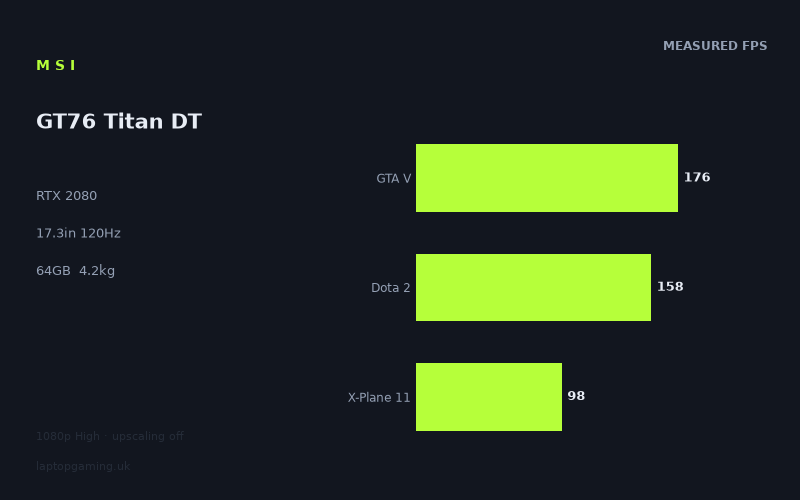
Frame rates
1920×1080, High preset, upscaling off.
Measured on this machine. Source: Notebookcheck, 2020-10-05.
Not scored: incomplete benchmark suite
Every scored laptop on this site is averaged over the same 5 games, and this one is short of Cyberpunk 2077, Baldur's Gate 3. A mean over 5 games is not comparable to a mean over 5, so we publish the figures we have and leave the score blank rather than rank it against machines tested on a different set. The numbers below are real - the suite is just incomplete.
How these numbers were produced
Frame rates here are not measured by us, and we label how each one was arrived at. A figure marked measured comes from a published run on that exact machine. A figure marked representative is derived from the GPU and its power limit (TGP) and cross-referenced against published reviews - a sound estimate of what that configuration delivers, but not a measurement of that specific laptop. Unless stated otherwise, numbers are 1920x1080, High preset, upscaling off. Where a laptop ships in several power configurations we use the wattage of the exact SKU listed, because a 140W RTX 5070 and a 115W one are not the same product.
In use
The short version
The MSI GT76 Titan DT is a very fast gaming laptop in the benchmark data supplied, but it is not a machine to choose casually. Its Core i9-10900K, RTX 2080, 64GB of memory and 17.3in 4K 120Hz IPS display describe a specification aimed at buyers who value outright performance and a large, high-resolution screen more than portability. At 4.188kg, this is a large machine in practical terms even before considering its charger, cables and peripherals. It is best understood as a system that can be moved when necessary rather than one intended to travel lightly every day.
Notebookcheck’s 1080p High-preset figures are strong. The GT76 records 223fps in The Witcher 3, 217fps in Strange Brigade, 176fps in GTA V, 158fps in Dota 2, 107fps in Final Fantasy XV and 98fps in X-Plane 11. Across the five scoring-suite games, it averages 151fps. That is enough to make the machine highly capable for high-refresh gaming at 1080p, particularly in the lighter and more scalable titles in the set. Strange Brigade, GTA V and Dota 2 all clear the screen’s 120Hz refresh rate in the published figures, while The Witcher 3 does so comfortably too.
The important qualification is the display resolution. The GT76 has a 3840x2160 panel, while the supplied benchmark results are measured at 1920x1080 with the High preset and upscaling disabled. Those are useful, attributable performance figures, but they are not native-4K results. A game running at 4K has far more pixels to render than it does at 1080p, so it would be wrong to treat the published 1080p results as a promise of matching performance at the panel’s native resolution. The data says this is a strong 1080p High machine. It does not provide a measured answer for every game at 4K.
That distinction matters particularly for the two demanding titles in the set. Final Fantasy XV reaches 107fps and X-Plane 11 reaches 98fps at 1080p High. Both are good results, but neither reaches 120fps in the supplied measurements. They also show that a powerful laptop can still be limited by the demands of a game engine, a scene or the processor-side work that sits alongside graphics rendering. The GT76’s headline specification is powerful, but its results are not a guarantee that every game will fill a 120Hz panel at every resolution and setting.
The lack of a confirmed UK price for this exact configuration means value cannot be calculated, and the machine therefore has no overall score here. That is a pricing-data limitation rather than a problem with the laptop’s benchmark coverage: the benchmark suite is complete and the GT76 ranks normally on the frame-rate leaderboard.
Buy this model if you specifically want a very fast, very large gaming laptop with a 4K 120Hz IPS screen and are comfortable treating 4.188kg as the starting point for a transportable setup. It is especially compelling for someone who will play a mixture of high-frame-rate games at 1080p and visually led games where the 4K screen can be used selectively. It is not the obvious choice for a buyer who wants an easy daily carry, needs measured battery-life evidence before committing, or expects native 4K gaming at 120fps to be demonstrated rather than inferred.
Performance
What the published figures show
Notebookcheck measured the MSI GT76 Titan DT at 1920x1080, using the High preset with upscaling disabled. This is a useful test configuration because it removes an important source of ambiguity. There is no upscaling mode contributing extra frames, so the results describe conventional rendering at the selected resolution and preset. The figures are also old enough to be treated as a snapshot of this configuration rather than a claim about performance in later patches, driver releases or newer games. The measurement date supplied is 2020-10-05.
The headline result is the 151fps mean across the five scoring-suite games: Strange Brigade, GTA V, Dota 2, Final Fantasy XV and X-Plane 11. A mean is helpful for positioning the machine, but it should not be mistaken for the experience in every game. The spread is substantial. Strange Brigade reaches 217fps, while X-Plane 11 reaches 98fps. That difference is not a flaw in the data. It is exactly why relying on a single average can be misleading when choosing a gaming laptop.
At the quicker end of the results, Strange Brigade runs at 217fps. That comfortably exceeds the GT76’s 120Hz screen refresh rate at the measured 1080p High settings. The Witcher 3 is even faster at 223fps, although it is not one of the five games used for the scoring-suite mean. GTA V follows at 176fps, and Dota 2 records 158fps. These results give the GT76 plenty of performance for games that can take advantage of a high-refresh display at 1080p. They also leave room for frame-rate variation during more demanding scenes, although the supplied figures are averages or benchmark outcomes rather than a guarantee for every scene, mod, server or game update.
Final Fantasy XV at 107fps and X-Plane 11 at 98fps tell a different but equally useful story. Neither result is poor. Both are well beyond the point at which games feel obviously sluggish, but they sit below the panel’s 120Hz refresh rate in the supplied testing. That is a reminder that the display’s maximum refresh rate is a capability, not a minimum frame rate the system will always produce. In demanding games, the GT76 may offer a smoother result than lower-performing hardware without necessarily reaching the screen’s ceiling.
The benchmark spread is also a reason to avoid simplistic statements about an RTX 2080 laptop being “a 120fps machine” or “a 4K machine”. The same hardware produces 223fps in The Witcher 3 and 98fps in X-Plane 11 under the stated test conditions. The game engine matters. The balance between graphics work and processor work matters. Scene complexity matters. Some games are more able to turn additional graphics throughput into extra frames, while others encounter limits elsewhere. The GT76’s figures should therefore be read title by title, not reduced to one label.
The 120Hz target at 1080p
For a buyer thinking primarily about 1080p gaming, the GT76 has a clear advantage in much of this data set. The Witcher 3 at 223fps, Strange Brigade at 217fps, GTA V at 176fps and Dota 2 at 158fps all exceed 120fps. In those four games, the system has enough measured performance at 1080p High to provide more frames than the built-in panel can refresh each second. That is useful even if the displayed output is capped by the refresh rate, because it shows the system is not merely brushing against the 120Hz target.
There is, however, no reason to assume that every game will behave like the faster results. Final Fantasy XV and X-Plane 11 are the corrective. At 107fps and 98fps respectively, they demonstrate that the GT76 is capable of high frame rates without being universally locked to 120fps. A buyer whose priority is competitive or high-refresh gaming should pay closer attention to the kinds of games they actually play than to the machine’s average alone. The data is particularly encouraging for the titles represented by Strange Brigade, GTA V and Dota 2. It is less conclusive for heavier games and simulation-style workloads represented here by X-Plane 11.
The 151fps scoring-suite mean is above the screen refresh rate, but that does not mean the screen will always be fully utilised. A mean can sit above 120fps while individual games fall below it, as this set does. Equally, a game that averages above 120fps can still vary from one scene to another. The useful conclusion is narrower and more defensible: at 1080p High, this GT76 has enough measured speed to make the 120Hz panel meaningful in several games, rather than pairing a high-refresh screen with hardware that cannot approach it.
There is another practical implication. A high-refresh 4K screen does not force every game to be played at 4K. The published 1080p results show what the GT76 can do when frame rate is the priority. A buyer who values fast response and smoother motion in the games represented here has evidence that 1080p High is a sensible operating point. A buyer who values pixel density and image detail instead can use the native-resolution panel where the game and settings allow it, but should not assume the 1080p numbers transfer directly.
What the RTX 2080 label does and does not tell us
The GT76 is specified with an RTX 2080, but the supplied fact sheet does not state a GPU power limit for this exact configuration. That matters because the GPU name alone is not a full performance specification in a laptop. Power limits, cooling capacity, firmware choices and processor behaviour can affect how similar-looking systems perform. It would be inaccurate to attach a wattage figure to this MSI when none is supplied, or to claim that its RTX 2080 operates at a particular power level.
What can be said is that the measured results place this implementation ahead of the Acer Aspire 17 with its RTX 2050 at 35W by 78fps on average across five shared games. That is a large real-world separation in the common benchmark set. It is evidence that the GT76’s performance package is in a different class from a lower-power RTX 2050 laptop in those games. It is not necessary to invent a power limit for the MSI to see the effect in the benchmark data.
The comparison with other RTX 2080 systems is more nuanced. The GT76 averages 11fps ahead of both the Asus Strix Scar 17 and the Alienware m17 R3 in their available shared-game comparisons. That is an advantage, but it is not a result that supports grand claims of domination. It shows the MSI is quicker in those matched samples. It does not establish that every RTX 2080 laptop will always trail it by the same amount in every game, especially when the shared sets contain different numbers of titles.
The wider lesson is that buyers should use attributable results rather than assuming a GPU badge settles the question. In the GT76’s case, the absolute figures are excellent at 1080p High, and the matched rival data shows that it is not merely relying on a familiar RTX 2080 name. At the same time, the small gap to the other RTX 2080 machines is a useful warning against paying for a larger chassis on the assumption that every game will show a dramatic lead.
Why the slower games matter
X-Plane 11 is the lowest result in the supplied list at 98fps. It is still a high frame rate, but its place at the bottom of the set is important. A flight simulation can place different demands on a system from those of a more conventional action game. The GT76’s Core i9-10900K is a high-end desktop processor, but the benchmark result remains the relevant evidence: in this title and this test configuration, the system does not reach 120fps.
Final Fantasy XV at 107fps offers a similar warning in a different kind of game. The system remains comfortably capable at the measured settings, yet the 120Hz target is not automatically met. Together, these two results prevent the faster figures from being over-read. They show why “average 151fps” is not a complete buying guide. Someone who spends most of their time in games that behave more like Strange Brigade or Dota 2 can reasonably expect the display refresh rate to be useful at 1080p High. Someone whose favourite games are unusually demanding, heavily simulated or less responsive to available graphics performance should focus on the lower end of the range instead.
This is also where the GT76’s large screen becomes a choice rather than an automatic benefit. A 17.3in 4K panel gives the owner the option of prioritising image detail, but the frame-rate data suggests there will be times when prioritising speed is the more sensible decision. The published figures make a good case for 1080p High gaming, particularly when high refresh matters. They do not show that the machine should always be run at its native resolution simply because that resolution is available.
The screen
A 4K 120Hz IPS panel is ambitious hardware
The GT76 Titan DT has a 17.3in IPS display with a 3840x2160 resolution and a 120Hz refresh rate. On paper, that is an unusually demanding combination. The 4K resolution is suited to buyers who value a dense image and a large working area, while the 120Hz refresh rate is aimed at smoother motion than a conventional lower-refresh display. IPS identifies the panel type, but the supplied facts do not include brightness, contrast, colour coverage, response-time measurements, adaptive-sync information or any assessment of backlight behaviour. Those qualities should not be assumed from the IPS label alone.
The screen specification presents two distinct gaming goals. The first is native 4K presentation, where the priority is detail and use of the panel’s full resolution. The second is high-refresh play, where the priority is supplying frames rapidly enough to take advantage of 120Hz. The GT76 has the screen hardware to pursue either, but the supplied benchmark data is only measured at 1080p High. It supports the second case directly in several titles. It does not provide native-4K results from which to judge the first.
That is not a minor technicality. Resolution changes graphics workload materially, and it is not reliable to estimate native-4K frame rates from a 1080p benchmark by applying a simple mathematical rule. Games do not all scale in the same way as resolution rises. Some can become much more graphics-limited; others retain a processor-side limit; settings can change the balance again. The honest conclusion is that the GT76’s 1080p figures demonstrate strong performance, while native-4K gaming needs game-specific measured evidence that is not present in this fact sheet.
Which measured games suit the refresh rate
At 1080p High, four of the six supplied games exceed the screen’s 120Hz refresh rate. The Witcher 3 reaches 223fps, Strange Brigade reaches 217fps, GTA V reaches 176fps and Dota 2 reaches 158fps. For these games, the GT76 has the measured headroom to make a 120Hz screen worthwhile. The panel is not simply a specification feature that the GPU cannot use.
Final Fantasy XV at 107fps and X-Plane 11 at 98fps fall short of 120fps under the same conditions. That does not undermine the value of the display. A 120Hz panel can still show output below its maximum refresh rate, and both figures remain high. It does mean that the system’s relationship with the display is game-dependent. Some titles will make the most obvious case for 120Hz. Others will be smoother than on lower-performing hardware without fully reaching the screen’s ceiling.
The important buying point is that 120Hz should be viewed as available headroom, not as a performance promise. The GT76 is fast enough to exploit that headroom in several measured games at 1080p High. It is not shown to do so in every game, even before considering native 4K. Buyers who mainly play Dota 2, GTA V, Strange Brigade or similarly scalable games have stronger evidence for the panel’s high-refresh value than buyers whose time is dominated by games that behave like X-Plane 11.
Resolution choice will be part of ownership
A 4K panel on a gaming laptop gives the owner flexibility, but it also demands judgement. The GT76’s benchmark data suggests that 1080p High can be the performance-focused mode: the results are strong, the fastest titles clear 120fps, and upscaling was disabled for the supplied measurements. This is the setting to consider when smoothness is more important than using every pixel of the display.
Native 4K is the image-quality-focused mode, but there are no measured results here for The Witcher 3, Strange Brigade, GTA V, Dota 2, Final Fantasy XV or X-Plane 11 at that resolution. It would be irresponsible to tell a buyer that the GT76 will run those games at a particular native-4K frame rate. The RTX 2080 and the system’s strong 1080p results make 4K gaming a reasonable subject for investigation, not a quantified guarantee from this data.
The best fit is therefore a buyer comfortable making per-game choices. Use the display’s resolution when visual detail matters and the game runs as desired. Use 1080p High when frame rate is the priority. The GT76’s hardware gives that choice more credibility than a low-performance system would, but the benchmark evidence points much more firmly to 1080p than it does to native 4K.
Build, size and portability
This is a 4.188kg laptop
The GT76 weighs 4.188kg. That single figure says more about its intended use than the word “laptop” does. It can be transported, but it is not a light machine to put in a bag every morning without noticing. A buyer should approach it as a large performance system that can move between locations, not as a machine designed around effortless commuting or frequent one-handed carrying.
The 17.3in display reinforces that point. A larger screen can be genuinely useful for gaming and general desktop-style use, especially at 3840x2160, but it also makes the system inherently less compact than a smaller-screen laptop. The supplied facts do not include physical dimensions, so there is no basis for claiming a particular footprint, thickness or bag compatibility. What is clear is that the combination of a 17.3in display and 4.188kg weight places the GT76 firmly on the substantial end of the portable-computing spectrum.
That trade-off is not automatically negative. Some buyers want a machine that feels closer to a fixed gaming setup, with a large screen and performance that does not need to be squeezed into the lightest possible chassis. For that buyer, the weight may be acceptable because it is exchanged for a specification built around a Core i9-10900K, RTX 2080 and 64GB of memory. For a buyer who carries their computer through a working day, across campus or between frequent meetings, 4.188kg is likely to be the defining characteristic long before the frame-rate numbers become relevant.
Battery capacity is not battery life
The GT76 has a 90Wh battery. That is a capacity figure, not a measured endurance result. The fact sheet does not include browsing time, video-playback time, idle time, gaming time or any other battery-life measurement. It would therefore be wrong to turn the 90Wh specification into an estimate of how long the machine lasts away from mains power.
For gaming-laptop buyers, that distinction matters. Gaming performance figures are measured under a stated benchmark configuration, while battery life depends heavily on use, settings, display behaviour and power mode. The GT76’s 90Wh battery is useful information about the hardware, but it should not be treated as evidence that the machine is suitable for a full day away from a charger. There is no published battery-life figure in the supplied material to support that claim.
The sensible expectation is not a specific runtime but a specific use case: this is a machine whose 4.188kg weight, 17.3in screen and high-performance internal specification make most sense when it has a regular place to sit and access to mains power when performance is required. That could be a desk, a home setup, a studio or a location where the computer is moved occasionally rather than carried continuously. The GT76 can still be useful away from a permanent desk, but the data does not support presenting portability as its central strength.
Memory and storage suit a high-end configuration
The supplied specification includes 64GB of memory and a 1TB SSD. These are substantial capacities for a gaming system, particularly alongside the Core i9-10900K and RTX 2080. The memory allocation should appeal to buyers who keep demanding applications open alongside games or want a system configured for more than a minimal gaming workload. The SSD capacity gives the machine a meaningful internal storage allocation, although the fact sheet does not state the drive model, interface, read speed, write speed or whether additional storage bays are available.
It is important not to overstate what those capacities prove. The benchmark figures supplied are game frame rates, not application benchmarks or storage-speed measurements. The 64GB memory figure does not establish a particular productivity result, and the 1TB SSD specification does not establish loading times. They are still relevant to the GT76’s character: this is not configured as a stripped-back entry-level gaming laptop. It is a large, high-spec machine whose component list aligns with the performance orientation of the published gaming data.
How it compares
Against the Acer Aspire 17 with RTX 2050 at 35W
The clearest separation is against the Acer Aspire 17 with an RTX 2050 at 35W. Across five shared games, the GT76 averages 78fps more. That is a decisive benchmark gap, not a rounding difference. It supports the obvious practical conclusion that the MSI is in a substantially higher performance tier in the matched sample.
The Acer’s RTX 2050 is explicitly identified as a 35W implementation, while no GPU power limit is supplied for the GT76. There is no need to guess at the MSI’s power figure to understand the comparison. The attributable shared-game result already shows the outcome: the GT76 delivers a markedly higher average frame rate across the available common set.
For a buyer deciding between these broad classes of machine, the difference is likely to be felt most clearly when aiming for high-refresh 1080p play, using more demanding settings, or trying to preserve performance headroom as games become heavier. The GT76’s own figures show several games above 120fps at 1080p High, whereas the shared-game comparison establishes a large aggregate lead over the Acer. This does not tell us every individual game result for both machines, but it does make the overall hierarchy unambiguous.
The comparison should not be misunderstood as proof that the GT76 is automatically the better purchase for every person. The machines belong to different performance categories, and the GT76 is also a 4.188kg model with a 17.3in 4K 120Hz display. Someone seeking a lower-performance, lower-power class of system may have different priorities. But if gaming frame rate is the deciding factor, the 78fps shared-game advantage is the strongest comparative evidence in the data provided.
Against the Asus Strix Scar 17 with RTX 2080
Against the Asus Strix Scar 17, also equipped with an RTX 2080, the GT76 averages 11fps ahead across four shared games. This is a genuine lead, but it is a much narrower one than the advantage over the RTX 2050 Acer. That makes sense as a pattern even without inventing explanations about power limits or cooling designs that are not included in the facts: systems built around the same GPU generation and model can land closer together than systems from clearly different GPU classes.
The key point is proportion. An 11fps advantage can matter when a game is near a refresh-rate target, but it is not enough to justify a claim that the MSI transforms the experience relative to the Asus in every circumstance. The shared-game set contains four titles, not the full GT76 suite, so the comparison is informative but bounded. It tells us that the GT76 is quicker in those common games on average. It does not prove an identical margin in titles not shared by the comparison.
Buyers should also be careful not to turn this result into an argument based solely on chassis size. The GT76 is unquestionably heavy at 4.188kg, but the published evidence does not show that its size delivers an overwhelming frame-rate advantage over this particular RTX 2080 rival. The benefit is measurable, yet modest. A buyer choosing between these two categories should therefore consider the GT76’s large 4K 120Hz screen, 64GB memory, 1TB SSD and desktop-class Core i9-10900K alongside the gaming lead, rather than treating 11fps as the whole decision.
Against the Alienware m17 R3 with RTX 2080
The GT76 also averages 11fps ahead of the Alienware m17 R3 with RTX 2080 graphics, although this comparison is based on three shared games. The numerical advantage matches the result against the Asus Strix Scar 17, but the evidence base is not identical because the number of common games differs. That is why it is better to describe the MSI as ahead in the available matched sample than to pretend it has been comprehensively proven superior in every game.
Three shared games can still provide useful evidence, especially when the result is read with appropriate caution. The MSI is not tied with the Alienware in the available figures; it is faster on average. But a buyer should not infer a universal outcome from a narrower shared set. Individual game engines can favour different processor, graphics and cooling characteristics, and the GT76’s own spread from 223fps in The Witcher 3 to 98fps in X-Plane 11 shows how much game choice can influence the final number.
This is where the nature of the GT76 becomes especially clear. It is not simply a machine that wins on a specification checklist. It has a demonstrated but moderate lead over other RTX 2080 laptops in the shared data, and a much larger lead over the lower-power RTX 2050 Acer. Its position is therefore credible: clearly high performance, but not magically separate from every other RTX 2080 system.
Why small rival gaps can still be real
The near-zero or small differences between similarly specified high-end laptops deserve explanation rather than repetition. At 1080p, lighter titles in a shared benchmark set can become CPU-bound. When that happens, a genuine graphics-performance gap can be compressed because the GPU is no longer the only limiting factor. A faster GPU cannot necessarily produce a proportionately faster result if the game is waiting on processor-side work or another part of the system.
That is relevant to the GT76 because its comparisons against the Asus Strix Scar 17 and Alienware m17 R3 are both 11fps average leads, while the larger separation comes against the RTX 2050 Acer. The close RTX 2080 results do not mean the hardware is identical in every respect, nor do they prove that the MSI’s performance advantage is meaningless. They show that at 1080p, particularly in a limited shared game set, the available headroom can make the final numbers converge.
For buyers, the practical message is straightforward. If choosing between the GT76 and an RTX 2050 35W machine, the frame-rate difference is large enough to be central to the decision. If choosing between the GT76 and another RTX 2080 laptop, factors beyond the average shared-game gap become more important: screen specification, weight, memory capacity, storage capacity, processor configuration and the intended place of use. The GT76 wins those matched frame-rate comparisons, but the data does not support pretending the lead alone settles every buying decision.
Who it’s for
Buy it for a large-screen, high-performance setup
The MSI GT76 Titan DT is best suited to a buyer who wants laptop hardware without wanting a small laptop experience. The 17.3in 3840x2160 IPS panel, 120Hz refresh rate, Core i9-10900K, RTX 2080, 64GB memory and 1TB SSD make it a substantial all-in-one performance system. The 4.188kg weight makes most sense when the machine has a regular home on a desk or table and is moved occasionally rather than carried as part of a daily routine.
It is a particularly good fit for someone who values high frame rates at 1080p but also wants the option of a 4K screen for games and general use. The measured data is persuasive in that role. The Witcher 3, Strange Brigade, GTA V and Dota 2 all exceed 120fps at 1080p High with upscaling off. That is enough performance to support a high-refresh gaming use case rather than merely advertise one.
It also suits buyers who understand that games should be configured individually. In the faster titles, the GT76 can chase high frame rates. In Final Fantasy XV and X-Plane 11, the measured 107fps and 98fps show that the sensible balance may be different. A buyer who is happy to choose between maximum image detail and maximum frame rate depending on the game will get more from the screen and hardware combination than someone who expects one setting to be ideal for everything.
The 64GB memory allocation also makes this machine more suitable for someone who wants capacity rather than the minimum viable specification. The data does not include productivity measurements, so no specific workload performance claim should be attached to it, but the capacity aligns with the GT76’s broader identity as a high-end, large-format system.
Do not buy it for everyday mobility
This is not the right machine for a buyer whose first requirement is low carry weight. At 4.188kg, the GT76 is not designed around light travel. The fact sheet does not provide dimensions, so no claim can be made about its thickness or exact bag fit, but the weight alone is sufficient reason for many buyers to look elsewhere.
It is also not the right choice for someone who needs a measured battery-life figure before buying. The machine has a 90Wh battery, but no endurance result is supplied. Capacity is not the same as runtime, and there is no attributable evidence here for how long the GT76 lasts in gaming, video playback, browsing or other use away from mains power.
Buyers who want a compact machine for frequent commuting, travel or use in places where charging is uncertain should treat those omissions seriously. The GT76 may still be transportable, but the published facts support a desk-oriented, power-available usage pattern much more strongly than an all-day mobile one.
Do not buy it solely for native-4K 120Hz gaming
The 4K 120Hz screen is attractive, but the benchmark evidence does not establish native-4K 120fps gaming. All supplied frame rates were measured at 1920x1080 High with upscaling disabled. The GT76 is demonstrably strong at that setting, and several games exceed 120fps there. That is not the same as demonstrating equivalent results at 3840x2160.
A buyer whose non-negotiable requirement is a measured native-4K result in a particular game should seek a benchmark conducted at that resolution and in that game. The supplied data cannot answer that question. It would be wrong to use the 223fps Witcher 3 figure, 217fps Strange Brigade figure or 176fps GTA V figure as if they were 4K results. They are not.
The GT76 is better viewed as a flexible system with a high-resolution screen and strong measured 1080p gaming performance. Its panel can serve different purposes, but the evidence is strongest when the machine is asked to deliver fast 1080p High gaming. Buyers who accept that trade-off have a clear case for it. Buyers who insist on native-resolution, refresh-rate-filling results in every game do not have sufficient proof from the published figures.
The final buying judgement
The GT76 Titan DT earns its place through measured performance rather than vague “Titan” branding. Notebookcheck’s figures show a laptop that is exceptionally quick in several 1080p High games, with results above 120fps in The Witcher 3, Strange Brigade, GTA V and Dota 2. The 151fps mean across the five scoring-suite titles is strong, while the lower outcomes in Final Fantasy XV and X-Plane 11 give the review a necessary dose of realism.
Its comparative position is equally clear. The GT76 is far ahead of the RTX 2050 35W Acer Aspire 17 in the five-game shared comparison, while holding smaller but real average advantages over the RTX 2080 Asus Strix Scar 17 and Alienware m17 R3. That makes it a credible high-performance option, but not one that should be purchased under the illusion that all RTX 2080 rivals are dramatically slower.
The real compromise is physical rather than benchmark-related. A 4.188kg, 17.3in system is a deliberate choice. If that weight suits the way the machine will be used, the GT76 offers strong attributable 1080p results, a large 4K 120Hz IPS display and generous memory and storage capacity. If portability, measured battery life or proven native-4K performance are the priorities, the available facts point towards looking for a different kind of laptop or more targeted benchmark evidence.