Review
Aorus 15X ASF review
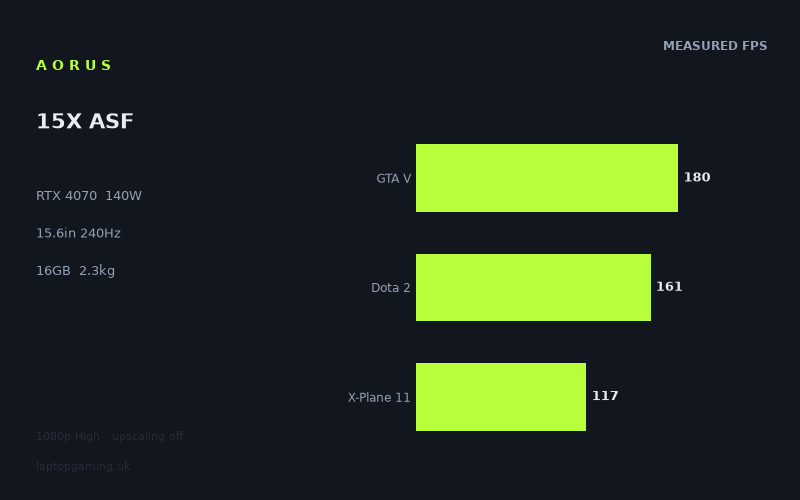
Frame rates
1920×1080, High preset, upscaling off.
Measured on this machine. Source: Notebookcheck, 2023-04-06.
Not scored: incomplete benchmark suite
Every scored laptop on this site is averaged over the same 5 games, and this one is short of Cyberpunk 2077, Baldur's Gate 3. A mean over 3 games is not comparable to a mean over 5, so we publish the figures we have and leave the score blank rather than rank it against machines tested on a different set. The numbers below are real - the suite is just incomplete.
How these numbers were produced
Frame rates here are not measured by us, and we label how each one was arrived at. A figure marked measured comes from a published run on that exact machine. A figure marked representative is derived from the GPU and its power limit (TGP) and cross-referenced against published reviews - a sound estimate of what that configuration delivers, but not a measurement of that specific laptop. Unless stated otherwise, numbers are 1920x1080, High preset, upscaling off. Where a laptop ships in several power configurations we use the wattage of the exact SKU listed, because a 140W RTX 5070 and a 115W one are not the same product.
In use
The short version
The Aorus 15X ASF has the most thoroughly documented benchmark record of any machine in this class that we hold, and that alone makes it easier to judge than most of its competition. Eighteen games were measured at 1920x1080 on the High preset with upscaling switched off, covering everything from Strange Brigade to The Last of Us, and the resulting picture is unusually complete. What it describes is a well-configured, well-balanced RTX 4070 laptop that does not have a weak spot — and a 240Hz panel that nothing it plays can actually saturate.
Our record lists an RTX 4070 at a 140W power limit, a Core i7-13700HX, 16GB of memory, a 15.6in 2560x1440 IPS panel at 240Hz, a 99Wh battery and a 2.276kg chassis. There is no confirmed UK price in our record, which means this review can tell you what the machine does but not whether it is worth the money. That limitation is stated here rather than glossed over, and it recurs below wherever value would otherwise be the natural conclusion.
The two specifications that matter most are the power limit and the processor. 140W is the top of the band this graphics card is sold in, and in a generation where the same GPU model appears at radically different power budgets, that is a more informative number than the model name. The 13700HX is a desktop-derived HX part rather than an H-series chip, which matters because a large fraction of the measured titles at 1080p are limited by the processor rather than the graphics card. Together those two choices describe a machine built to remove bottlenecks rather than to hit a price.
The measured results bear that out. Strange Brigade at 235fps and The Witcher 3 at 228fps head the table; GTA V at 180fps, Dota 2 at 161fps and Company of Heroes 3 at 160fps follow; the demanding end runs Atomic Heart at 96fps, Dead Space Remake at 85fps, Uncharted Legacy of Thieves Collection at 84fps, Sons of the Forest at 83fps, Flight Simulator 2020 at 82fps and, at the floor, The Last of Us at 57fps. Only one title in eighteen falls below the 60-frame mark. That is a strong record.
The comparisons need reading carefully, because the sample sizes vary a great deal. Against an Alienware m16 R2, also carrying an RTX 4070 at 140W, the two machines are level across seven shared games — the largest and most trustworthy of the four comparisons, and exactly the result matched hardware should produce. Against a Schenker XMG Pro 15 (E23) with an RTX 4060 they are also level, but across only three shared games, which is far too small a sample to conclude anything about the hardware. Against an MSI Thin GF63 with an RTX 4050 the Aorus is 65fps ahead across three. Against an Asus ROG Strix Scar 17 with an RTX 4090 it is 46fps behind, also across three.
There is no score on this page. Our scoring suite is five games and we hold three: GTA V at 180fps, Dota 2 at 161fps and X-Plane 11 at 117fps, averaging 153fps. Cyberpunk 2077 and Baldur's Gate 3 are both missing, and those are the two titles in the suite that ask the graphics card the hardest questions. A three-game average cannot honestly be ranked against machines averaged over all five, so we do not publish one.
Buy the 15X ASF if you want a 15.6in machine with no obvious bottleneck — full-power graphics card, desktop-class processor, large battery, under 2.3kg — and you can establish what it costs. Look elsewhere if you are buying for the 240Hz panel specifically, because nothing in eighteen measured games reaches it, or if you need this generation's top-tier performance, which is a different and considerably more expensive class of machine.
Performance
140W, and why it is the number to read first
Nvidia's laptop graphics cards are configurable products rather than fixed ones. The same silicon is sold to manufacturers within a defined power band, and each manufacturer picks a point in that band according to what the chassis can cool, how loud the fans are allowed to get, and what the machine has to cost. The consequence is the single most important fact about buying a laptop in this generation: the performance difference between a restrained example of a GPU and a fully fed one of the same model is routinely larger than the difference between adjacent model numbers. A well-configured RTX 4060 beating a starved RTX 4070 is not an anomaly. It is a predictable outcome of how these parts are sold.
Our record puts the 15X ASF's RTX 4070 at 140W, which is the ceiling for this card. That is the difference between buying the badge and buying the hardware. It is also consistent with the physical machine: a 15.6in chassis at 2.276kg has the internal volume for the fan diameter, heat pipe cross-section and exhaust area a 140W graphics card needs, particularly sitting alongside an HX-class processor which brings its own thermal demands.
Where does that power actually show up? Not in the light titles. Strange Brigade at 235fps and The Witcher 3 at 228fps would be fast on any card in this generation; those results tell you the machine is healthy, not that it is powerful. The power limit expresses itself at the bottom of the table, in the titles that will consume everything you give them. Atomic Heart at 96fps, Dead Space Remake at 85fps, Uncharted at 84fps, Sons of the Forest at 83fps and The Last of Us at 57fps are the results a conservatively configured machine would not produce. Those five numbers are the evidence that the 140W figure is real rather than nominal.
The Core i7-13700HX matters more than it looks
The processor is a Core i7-13700HX — an HX part, derived from desktop silicon, with a higher core count and a larger sustained power budget than the H-series chips used in slimmer machines. In a benchmark set measured at 1920x1080, that is not a footnote. It is half the explanation for the numbers.
At 1080p on High, a large fraction of games stop being limited by how fast the graphics card can draw and start being limited by how fast the processor can feed it. Which games those are is well established. GTA V at 180fps is the clearest example in this table: an old engine that leans heavily on single-thread processor performance, and one that ceased to be graphics-limited on hardware of this class years ago. That 180fps result is very largely a statement about the 13700HX. Dota 2 at 161fps is the same story — nothing about Dota 2's visuals troubles an RTX 4070 at 140W, and the ceiling is set elsewhere. X-Plane 11 at 117fps is the most extreme case of all: its simulation loop is famously processor-bound and famously indifferent to graphics hardware. Flight Simulator 2020 at 82fps belongs in the same category for the same reason.
This machine's HX processor is therefore doing a great deal of work in exactly the titles that dominate its scoring-suite average and several of its comparisons. That is a genuine strength — a machine with a weaker processor would produce lower numbers in those games regardless of its graphics card — but it also means the suite average should not be read as a measure of graphics performance, and the comparison figures below should not be read that way either.
Eighteen games, and what the shape of the table tells you
The breadth of this record deserves comment before the detail. Eighteen measured titles is far more than most machines in our database carry, and it changes what can be said about the machine. With four or five results you are describing a sample; with eighteen you are describing a distribution, and outliers can be identified as outliers rather than mistaken for the general picture.
The distribution runs from 235fps at the top to 57fps at the bottom — a spread of more than four to one. The top band is Strange Brigade at 235fps, The Witcher 3 at 228fps and F1 22 at 194fps: well-optimised engines at settings that do not stress modern hardware. The upper-middle band is GTA V at 180fps, Dota 2 at 161fps, Company of Heroes 3 at 160fps, Far Cry 5 at 151fps and High On Life at 142fps — a mix of processor-limited older titles and modern games running comfortably.
The middle band is where most of the practical experience lives: Final Fantasy XV at 118fps, X-Plane 11 at 117fps, Returnal at 106fps and Need for Speed Unbound at 101fps. Every one of those is far above any threshold where responsiveness becomes a question, and every one is producing more frames than most players can distinguish in the games concerned.
The lower band is the interesting one, because it is where this machine's configuration earns its money. Atomic Heart at 96fps is a strong result for a demanding 2023 release with heavy effects work. Dead Space Remake at 85fps and Uncharted Legacy of Thieves Collection at 84fps are both graphically expensive console ports. Sons of the Forest at 83fps combines dense vegetation with an early-access engine that was not kind to hardware. Flight Simulator 2020 at 82fps is the processor-bound outlier in this group rather than a graphics result.
The Last of Us at 57fps is the single title in eighteen to fall below the 60-frame mark, and its position needs context rather than alarm. That port arrived in a notoriously poor state, with memory demands and shader compilation behaviour that punished every machine it ran on regardless of tier. Reading 57fps as a verdict on the Aorus would be wrong; reading it as the worst case across an unusually broad and unusually demanding test set is fair. Seventeen of eighteen games above the 60-frame mark is a strong record by any standard for this generation.
Three suite games, and the two that are missing
Our scoring suite exists so that machines can be compared on identical software rather than on whichever titles happened to be current when each was reviewed. For the 15X ASF we hold three of the five: GTA V at 180fps, Dota 2 at 161fps and X-Plane 11 at 117fps, giving a mean of 153fps. Cyberpunk 2077 and Baldur's Gate 3 are both absent.
That is an unfortunate pair to be missing, and the reason is specific. Of the five suite titles, GTA V, Dota 2 and X-Plane 11 are the three most heavily influenced by processor performance at 1080p. Cyberpunk 2077 and Baldur's Gate 3 are the two that ask the graphics card the most. The three games we hold are precisely the three least able to demonstrate what a 140W RTX 4070 can do, and the two we lack are the ones that would have shown it.
The mean of 153fps is therefore a high number that says more about the Core i7-13700HX than about the graphics card. It is a real result and it is not misleading in itself — those are the frame rates the machine produces in those games — but anyone using it to reason about graphics performance is reasoning about the wrong component.
The procedural consequence is no score. A three-game average benchmarked against five-game averages introduces a systematic bias whose direction depends on which titles are missing, and in this case the direction is knowable: the missing games are the harder ones, so the partial average flatters the machine relative to laptops with a complete set. Publishing it as a ranking would be misleading in a way we can specifically identify, which is the strongest possible reason not to.
What it feels like to play on
Take the comparisons away and the practical picture is excellent. Seventeen of eighteen measured games run above the 60-frame mark. Thirteen run at 101fps or better. Eight run at 151fps or better. If your library consists of competitive shooters, strategy, racing or anything that is not at the bleeding edge of graphical demand, this machine will produce more frames than you can use and will have headroom left for raising settings or resolution.
If your library is the heavy end, the relevant band is 57 to 96fps at 1080p on High with upscaling switched off — and that last clause matters. These figures were measured without DLSS, which means upscaling remains available as spare capacity rather than as a requirement. For a machine measured in April 2023 and expected to keep working through several years of increasingly demanding releases, that reserve is what determines whether it ages well.
Our record contains no measurements at the panel's native 2560x1440. That resolution carries roughly 78 per cent more pixels than the 1920x1080 used for the benchmarks, and almost all of that additional work falls on the graphics card rather than the processor. A machine running its RTX 4070 at the top of its power band is better placed than most to absorb the increase — that is precisely what the extra power is for — and in the processor-bound titles identified above, the drop would be smaller than the pixel count suggests because the graphics card had spare capacity to begin with. But those are structural expectations, not measurements, and this review will not put numbers on them.
The screen
15.6in at 2560x1440
The panel is a 15.6in 2560x1440 IPS at 240Hz. The resolution is the right one for this hardware. An RTX 4070 at 140W is over-specified for 1920x1080 — the 235fps and 228fps results at the top of the table make that obvious — and would be under-specified for 4K in anything demanding. QHD is the band where the card is meaningfully loaded without being overwhelmed, which is where a native resolution should sit.
On a 15.6in diagonal, 2560x1440 gives a pixel density high enough that the improvement over 1080p is visible in normal use rather than only in still comparisons, and high enough that text is crisp without display scaling being mandatory. The aspect ratio is 16:9, which matches full-screen video exactly and gives away some vertical working space relative to the 16:10 panels that became more common later in this generation.
240Hz, and the awkward fact that nothing reaches it
This is the specification worth being blunt about. Across all eighteen measured games at 1920x1080 — the resolution at which frame rates are highest — not one title reaches 240fps. The closest is Strange Brigade at 235fps, and it falls short. The Witcher 3 at 228fps is next. Everything else is well below: F1 22 at 194fps, GTA V at 180fps, Dota 2 at 161fps, and downwards from there.
At the panel's native 2560x1440 those figures would all be lower still. The honest conclusion is that the 240Hz refresh rate is not something this machine's hardware can exercise in any game our record covers, and a buyer choosing this laptop specifically for its 240Hz panel is paying for a capability the rest of the machine cannot supply.
That is a narrower criticism than it sounds, and it is worth explaining why rather than leaving it as a complaint. The practical value of a high refresh rate is not that games hit the ceiling. It is that the panel stops being the limiting factor at every frame rate below it: whatever the machine produces is displayed without tearing or judder, motion clarity improves progressively across the whole range rather than only at the top, and a player who deliberately lowers settings in a competitive title has somewhere for the extra frames to go. A machine that reaches 235fps in Strange Brigade and 161fps in Dota 2 genuinely benefits from a panel that is not capping it at a lower number.
What it does mean is that the difference between this panel and a well-made lower-refresh one is smaller in practice than the specification gap implies, and it should not be the reason you choose this machine over an alternative with a better display in other respects.
IPS, and the measurements we do not have
The panel technology is listed as IPS. That is the pragmatic choice for a gaming laptop: predictable behaviour over years of ownership, no image retention risk, no aggressive automatic dimming on static content, good viewing-angle stability. What it cannot deliver is the black level and contrast of an OLED, which by 2023 had begun appearing in competing machines.
Our record holds no brightness, contrast, colour coverage or response time measurements for this display. The gap between a good 240Hz IPS gaming panel and a mediocre one is substantial — particularly on response time, where a fast panel is the whole justification for a high refresh rate and a slow one wastes it. This review can say the resolution is well matched to the hardware and the refresh rate is not; it cannot say whether the panel itself is well made. That is worth establishing before purchase.
Build, size and portability
2.276kg
At 2.276kg the 15X ASF is at the lighter end of the properly built 15.6in gaming laptops of its generation. It is not an ultraportable and nobody should pretend otherwise — with the charger required to feed a 140W graphics card and an HX processor simultaneously, the travelling weight is substantially higher than the machine alone — but among laptops that run their hardware this hard, it is a genuinely manageable size.
The weight is also the precondition for the performance rather than a separate consideration. Cooling capacity scales with internal volume: fan diameter, heat pipe cross-section, fin stack surface area, exhaust aperture, and the sheer thermal mass available to absorb transient loads. Running an RTX 4070 at 140W alongside a desktop-derived HX processor requires all of that, and 2.276kg is approximately what it weighs. A lighter machine carrying the same GPU model would very probably run it at a lower power budget, and the difference would appear exactly where this machine is strongest — Atomic Heart, Dead Space Remake, The Last of Us.
Set against the 17in and 18in machines that occupy the top of this generation's performance charts, 2.276kg is a real advantage. It fits in ordinary bags, sits on ordinary desks, and does not require its own travel arrangements. Buyers who have carried both know that difference is larger in daily life than the numbers make it sound.
The 99Wh battery
Our record lists a 99Wh cell, which is effectively the largest capacity a laptop can carry and remain airline-compliant. Its presence signals design intent: this is a machine expected to be used away from a socket, not a desktop replacement with a token battery to survive being unplugged from one desk and carried to another.
Our record contains no battery runtime measurement and this review will not invent one. What can be said structurally is that no laptop of this generation runs a 140W graphics card at full power from a battery — the draw exceeds what any cell can supply — so unplugged gaming means reduced performance on any machine, and a large cell does not change that. Where 99Wh earns its keep is in the ordinary hours: browsing, video, documents, development, the work that occupies most of the time a machine like this is switched on. Paired with a chassis under 2.3kg, it describes a laptop that is usable as a laptop, which is not true of every machine at this performance level.
16GB of memory
The configuration in our record carries 16GB. That was the standard allocation for machines at this level when these measurements were taken in April 2023, and it is adequate for the settings used in the benchmarks. It is worth being direct that it has aged into a constraint rather than a comfortable default: several of the heavier titles in this very test set — The Last of Us most notoriously — were memory-hungry on release, and running a game alongside streaming software, a browser and communication tools consumes the allocation quickly. 32GB is the more comfortable figure for anyone doing more than playing one thing at a time. Whether the memory in this chassis is upgradeable is not covered by our record, and it is worth checking.
How it compares
Four machines from the same graphics generation are set against the 15X ASF, chosen to give a spread rather than only the nearest neighbours: the two closest results, the machine it beats by the widest margin, and the machine that beats it by the widest margin. Each comparison uses only the games both machines hold, preferring scoring-suite titles.
Before the detail, a warning about sample size that applies to three of the four. The comparison against the Alienware m16 R2 covers seven shared games. The other three cover three each. Those are not equivalent pieces of evidence, and this review will not treat them as such.
Alienware m16 R2 — level, and the comparison that counts
The m16 R2 carries an RTX 4070 at a 140W power limit — the same graphics card at the same power as the Aorus — and across seven shared games the two machines are level to within less than a frame per second. Our record puts the m16 R2 at £2,395, and it is the only one of the four rivals with a confirmed UK price.
This is the most valuable comparison in the set for three reasons. It has the largest sample. It is between matched graphics configurations, so the result is interpretable. And it is the only one that provides a price anchor.
The result itself is exactly what it should be. Two machines running the same GPU at the same power budget, with processors of comparable class, produce the same frame rates across seven games. That is not a disappointing outcome for either machine — it is the control experiment that validates the whole comparison method. Matched hardware producing matched results is the sign of a measurement working correctly.
The buying implication follows directly. When two machines are indistinguishable on graphics performance, the graphics card has stopped being a reason to choose between them, and everything else becomes decisive: screen, chassis, keyboard, cooling noise, battery, memory configuration, upgradeability, warranty and price. Since our record holds £2,395 for the m16 R2 and no confirmed figure for the Aorus, the practical advice is that a buyer should establish the Aorus's price and compare it directly against that number, because on frame rates there is nothing to choose.
Schenker XMG Pro 15 (E23) — level, but on far too little evidence
The XMG Pro 15 (E23) carries an RTX 4060, and across three shared games the two machines are level. Our record holds no power limit for the Schenker's graphics card.
Taken at face value this looks like a striking result: a 140W RTX 4070 unable to separate itself from an RTX 4060. It should not be taken at face value, and the reason is the sample. Three shared games is a very small basis for a conclusion, and the identity of those games matters enormously. If they are drawn from the processor-bound end of the set — and the scoring-suite titles this machine holds are GTA V, Dota 2 and X-Plane 11, all three of which are heavily processor-limited at 1080p — then a tie is close to inevitable regardless of what graphics hardware each machine carries.
This is the mechanism the wide comparisons below make plain. At 1920x1080 the lighter and older titles in any shared set are limited by the processor, and a processor-limited game will report the same frame rate whether the graphics card is a 4060 or a 4070 or something considerably faster. A tie in three processor-bound games is not evidence that the hardware is equivalent; it is evidence that those three games did not ask the question.
The honest position is that this comparison tells us very little about the graphics hardware in either machine, and a buyer should not conclude from it that the XMG Pro 15 is a substitute for the Aorus. It might be. These three games cannot show it either way.
MSI Thin GF63 — the widest win
The Thin GF63 carries an RTX 4050 and the Aorus averages 65fps ahead of it across three shared games. That is a large margin from the same three-game sample size that produced a tie against the RTX 4060 machine, which is itself informative: the comparison method is not incapable of detecting differences at this sample size — it detects them when they are large enough.
Two tiers of graphics hardware separate these machines, and our record holds no power limit for the MSI's card, so the configuration side of the comparison cannot be examined. The Thin GF63 is a slim, price-led design whose whole proposition is being lighter and cheaper, and 65fps is roughly what that costs in games. For a buyer weighing a thin budget machine against a properly cooled one, that is the size of the decision.
Asus ROG Strix Scar 17 — the widest loss, and a compressed one
The Scar 17 carries an RTX 4090 and the Aorus averages 46fps behind it across three shared games. Our record holds no power limit for that machine's graphics card.
Forty-six frames per second is a decisive margin, and it establishes what this generation's top tier buys over a well-configured mid-upper machine. But the three-game sample means this figure should be read as a floor rather than a full accounting. If those three shared titles are drawn from the processor-bound end — and the suite games this machine holds all are — then the comparison is being conducted precisely where an RTX 4090's advantage is smallest. In genuinely graphics-limited titles the gap would be wider, potentially much wider.
That reading is consistent with the machine's own table. In Strange Brigade, GTA V, Dota 2 and X-Plane 11 the Aorus is already producing frame rates constrained by something other than its graphics card; an RTX 4090 in those same games would be constrained by the same thing. In Atomic Heart, Dead Space Remake, Sons of the Forest and The Last of Us the graphics card is doing all the work, and that is where a 4090 would pull away.
What the spread proves, and what it does not
The four results in order: 65fps ahead of a 4050, level with a 4060, level with a matched 4070, 46fps behind a 4090. The two wide margins confirm the measurement can discriminate. The tie against the matched 4070 is a genuine, well-evidenced null result across seven games and should be trusted. The tie against the 4060 rests on three games and should not be trusted as a statement about hardware.
The unifying explanation is the one this review has returned to throughout: at 1920x1080, on hardware of this class, a large fraction of the games in any shared set are limited by the processor rather than the graphics card, and processor-limited games compress genuine graphics differences towards zero. The Aorus's own record demonstrates the mechanism internally — GTA V at 180fps and X-Plane 11 at 117fps are results about the Core i7-13700HX, not about the RTX 4070 — and the comparison table demonstrates it externally, by producing ties in small processor-weighted samples and large gaps when the hardware difference is big enough to survive the compression.
For a buyer, the practical conclusion is clear. This machine is not distinguishable from other well-configured RTX 4070 laptops in the games our record holds in common, so the choice between them should be made on everything else. It is comfortably faster than the entry tier of this generation. It is meaningfully slower than the top, by an amount the available data probably understates.
Who it's for
Buy it if
You want a machine with no obvious bottleneck. A 140W RTX 4070 paired with a desktop-derived HX processor is a coherent pairing — neither component is being held back by the other, and it shows in a test set of eighteen games where only one result falls below the 60-frame mark. That balance is the machine's strongest single argument.
You want the performance in something under 2.3kg. Among laptops running their graphics card at full power, 2.276kg is at the manageable end. Combined with a 99Wh battery, it is a machine that can genuinely be used away from a desk.
Your library is broad. The eighteen measured titles cover light competitive games, older single-player work, simulators, racing and the heaviest 2023 releases, and the machine handles all of them. Very few machines in our records have this much evidence behind them, and that itself is worth something when you are spending real money.
You can establish the price and it compares well to £2,395. That is what our record holds for the Alienware m16 R2, the machine the Aorus is level with across seven games. If the Aorus can be had for meaningfully less than a laptop it matches on frame rates, the case for it is straightforward.
Buy something else if
You are buying for the 240Hz panel. No game in eighteen reaches 240fps at 1080p, and at the panel's native resolution none would come close. The refresh rate is not useless — it means the display is never the constraint — but it is not a capability this machine's hardware can exercise, and paying a premium for it would be paying for something you will not see.
You want this generation's top performance. The Scar 17 comparison shows 46fps of separation across three shared games, and the analysis above suggests that figure understates the gap in graphics-limited titles. Buyers whose priority is maximum frame rate should be shopping in that class and accepting the weight, heat, noise and cost.
16GB of memory is not enough for you. If you stream while playing, keep heavy applications open alongside games, or work in memory-hungry software, this configuration is the first thing you will notice. Establish whether it can be upgraded, or buy a machine specified with more.
You want a published score to compare against the rest of the site. There is not one, because Cyberpunk 2077 and Baldur's Gate 3 are missing from our figures. The three suite games we do hold average 153fps, but that is a processor-weighted number and it cannot be honestly ranked against machines measured across all five titles.
Contrast matters more to you than motion. The panel is IPS and our record holds no measurements of its quality. OLED alternatives existed in this generation, and if black level in dark games is what you care about, an IPS panel will not deliver it however fast it refreshes.
The gaps in the record
Nothing in this machine's specification looks internally inconsistent. A 140W RTX 4070 alongside a Core i7-13700HX in a 2.276kg 15.6in chassis is a coherent design, the measured frame rates are consistent with that configuration across an unusually broad test set, and the tie against a matched-configuration rival across seven games is the result that combination should produce.
What is missing is a confirmed UK price, any battery runtime figure, any display measurement, and the two hardest games in the scoring suite. The price is the one that prevents a value judgement, and the two absent suite titles are the ones that prevent a ranking. On everything else — what the machine does, how consistently it does it, and where it sits relative to its peers — the record here is fuller and more trustworthy than most, and a buyer can decide with more confidence than usual.