Review
Asus ROG Zephyrus M16 review
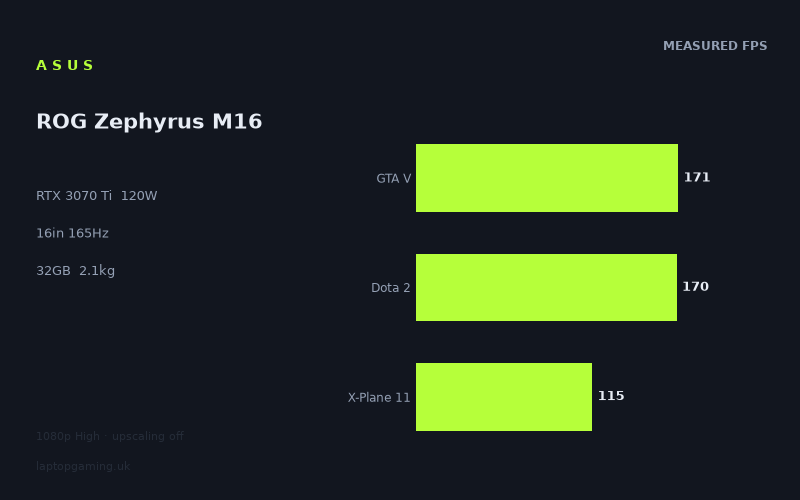
Frame rates
1920×1080, High preset, upscaling off.
Measured on this machine. Source: Notebookcheck, 2023-02-17.
Not scored: incomplete benchmark suite
Every scored laptop on this site is averaged over the same 5 games, and this one is short of Cyberpunk 2077, Baldur's Gate 3. A mean over 5 games is not comparable to a mean over 5, so we publish the figures we have and leave the score blank rather than rank it against machines tested on a different set. The numbers below are real - the suite is just incomplete.
How these numbers were produced
Frame rates here are not measured by us, and we label how each one was arrived at. A figure marked measured comes from a published run on that exact machine. A figure marked representative is derived from the GPU and its power limit (TGP) and cross-referenced against published reviews - a sound estimate of what that configuration delivers, but not a measurement of that specific laptop. Unless stated otherwise, numbers are 1920x1080, High preset, upscaling off. Where a laptop ships in several power configurations we use the wattage of the exact SKU listed, because a 140W RTX 5070 and a 115W one are not the same product.
In use
The short version
The Asus ROG Zephyrus M16 GU603Z is a powerful 16in gaming laptop built around an Intel Core i9-12900H, 32GB of memory and an Nvidia GeForce RTX 3070 Ti running at a 120W GPU power limit. Its benchmark data shows a machine that is very capable at 1920x1080 on High settings, particularly in lighter and older games, but not one that can simply be assumed to run every modern game at the full 165Hz refresh rate of its native 2560x1600 display.
Notebookcheck’s measured figures are strong where a game is light enough to let the CPU and GPU run freely. Strange Brigade reaches 188fps, GTA V reaches 171fps, The Witcher 3 reaches 171fps and Dota 2 reaches 170fps. Those results matter because they show that the Zephyrus has no difficulty making practical use of a high-refresh panel in esports-friendly games and older big-budget titles. It is not a laptop that merely posts acceptable triple-digit figures in easy benchmarks; in several games it gets close to or exceeds the screen’s 165Hz refresh rate.
The other half of the picture is more important for a buyer considering this as a long-term gaming machine. Far Cry 5 records 128fps, X-Plane 11 records 115fps and Final Fantasy XV records 95fps. Dying Light 2 falls to 66fps. Those are still playable figures at the benchmark settings, but they show that the 165Hz panel is an aspiration rather than a universal target. In demanding games, especially newer ones, the RTX 3070 Ti at 120W is better understood as a GPU for good high-settings performance than as a guarantee of very high-refresh gaming.
The 120W power limit is central to that conclusion. An RTX 3070 Ti badge alone does not describe the whole gaming experience in a laptop. Nvidia laptop GPUs are configured at different power levels, and the amount of power available affects sustained performance. Here, the 120W configuration sits in a meaningful middle ground: it is far more convincing than the lower-tier RTX 3050 Ti configuration in the MSI Prestige 15, but it does not have the headroom of the RTX 3080 Ti at 175W in the MSI Raider GE77 HX. The benchmark spread supports that reading. It is not a low-power ultraportable implementation, but neither is it a maximum-power desktop-replacement approach.
The Zephyrus M16’s appeal is therefore quite specific. It suits someone who wants a relatively portable 16in machine, with a 2560x1600 IPS display, 32GB of memory and substantial gaming capability, but who understands that native-resolution high-refresh performance will require sensible settings choices in demanding games. It also suits players of Dota 2 and similar lighter games particularly well, because the measured figures show enough performance to take real advantage of the 165Hz panel.
It is less persuasive for someone whose priority is extracting the highest possible frame rate in heavy modern games, or for someone buying primarily around the screen’s native resolution and expecting High settings without compromise. Dying Light 2 at 66fps at 1920x1080 High is the clearest warning against that assumption. Raising resolution from 1920x1080 to the panel’s 2560x1600 native resolution asks more of the GPU, not less. The published figures do not include native-resolution results, so it would be wrong to promise a particular performance level there.
There is no price-based value judgement for this exact configuration because its UK price is not confirmed. That does not undermine the performance data: the benchmark suite is complete, and the machine can still be assessed on its measured frame rates and its position among comparable laptops. It does mean that a final buying decision should wait until an actual UK retailer price can be compared with alternatives.
Performance
A 120W RTX 3070 Ti is the important specification, not just an RTX 3070 Ti
The Zephyrus M16 combines an RTX 3070 Ti with a 120W GPU power limit. That power figure should not be treated as a footnote. It is a large part of what determines how a gaming laptop performs in practice. Laptop graphics chips share names across many machines, but the laptop around the GPU determines how much power the GPU can use. A higher-power implementation can hold higher performance in demanding work, while a lower-power implementation may trade some speed for a thinner design, lower weight or a different thermal target.
In this Asus, 120W places the RTX 3070 Ti in a reasonably assertive configuration. It is not being presented as a lightly powered graphics chip designed only to add occasional gaming capability to an otherwise productivity-led laptop. The results support that. The machine produces 188fps in Strange Brigade, 171fps in GTA V, 171fps in The Witcher 3 and 170fps in Dota 2. These are figures associated with a laptop that has enough CPU and GPU performance to move well beyond basic 60fps gaming when the game engine permits it.
At the same time, 120W is not the highest GPU power figure among the relevant comparison machines. The MSI Raider GE77 HX pairs an RTX 3080 Ti with a 175W limit. That machine holds an advantage across the shared games, and this is exactly the sort of result a buyer should expect when comparing a substantial 175W configuration with a 120W configuration. The point is not that the Zephyrus is weak; it clearly is not. The point is that a portable 16in laptop with this configuration should be chosen for its balance rather than bought under the belief that an RTX 3070 Ti name alone makes it equivalent to every larger, higher-power gaming machine.
The Core i9-12900H and 32GB of memory also matter to the results. At 1920x1080, especially in lighter games, laptop gaming results can become limited by the CPU, the game engine or other parts of the platform rather than by raw GPU capability alone. That effect is visible in the comparisons with some seemingly more powerful GPUs. It is also visible in the M16’s own results, where several lighter titles cluster around the panel’s 165Hz refresh rate while more graphically demanding games sit much lower.
The measured frame-rate spread
Notebookcheck’s figures were measured at 1920x1080, using the High preset with upscaling off. That is an important test condition. It gives a clean view of conventional rasterised gaming performance without leaning on upscaling to lift the result, but it is not the Zephyrus display’s native 2560x1600 resolution. The numbers are therefore excellent for assessing relative gaming strength and for judging whether 1080p-class performance is available. They should not be republished as native-resolution expectations.
Across the five scoring-suite games, the Zephyrus averages 148fps. That is a strong average, but an average is not the same thing as a guaranteed experience. The individual results range from 115fps in X-Plane 11 to 188fps in Strange Brigade within that scoring group. Add the other measured games and the full range becomes broader, from 66fps in Dying Light 2 to 188fps in Strange Brigade. A prospective buyer should pay attention to that spread rather than only the average.
Strange Brigade is the fastest measured result at 188fps. At the stated 1920x1080 High settings, that is above the panel’s 165Hz refresh rate. It means the screen has enough refresh capacity to display the benefit of the laptop’s output rather than becoming a hard 60Hz ceiling. It also demonstrates the kind of game in which this M16 can feel genuinely high-refresh rather than simply smooth.
GTA V records 171fps, while The Witcher 3 also records 171fps. These results are just above 165Hz at the stated benchmark settings. In those particular games and conditions, the M16 can feed the display at a rate that matches or exceeds its refresh ceiling. That is an excellent fit between panel and hardware. It does not mean every moment in either game will necessarily remain at that level, because the published data is a benchmark figure rather than a complete account of every scene, setting variation and background workload. It does mean there is substantial performance available.
Dota 2 comes in at 170fps, another result close to the display’s refresh rate. For a player focused on competitive games, this is one of the most encouraging figures in the set. Dota 2 is the sort of title where high refresh can be meaningful, not because it changes the game’s art assets or replaces skill, but because a higher frame rate can make motion and input response feel more immediate when the rest of the system is configured appropriately. The measured result indicates that the M16 has the performance to use its 165Hz panel well in this category of game.
Far Cry 5 at 128fps is lower, but still firmly in high-frame-rate territory. It sits below 165Hz, so the screen cannot be fully saturated by the benchmark result. That should not be read as a failure. A measured 128fps at 1920x1080 High is a strong result for a single-player action game. It simply reinforces the difference between “high refresh capable” and “always running at the panel maximum”. Those are not the same claim, and the benchmark data makes the distinction clear.
X-Plane 11 records 115fps. That remains comfortably above 60fps and should be regarded as a good result, particularly because simulation workloads often behave differently from conventional action games. The performance is still well short of 165Hz, however. Buyers interested primarily in simulation should not choose this laptop on the assumption that a high-refresh screen automatically means high-refresh simulation performance. The published number instead points to a machine with substantial headroom over basic smoothness, but not necessarily a system that reaches the display maximum in every simulation scenario.
Final Fantasy XV records 95fps. Again, that is a sound result at the stated test settings, but it is a reminder that the M16’s average figure should not be interpreted as the frame rate in every game. At 95fps, the Zephyrus is delivering considerably more than a 60fps target, while remaining far from 165fps. For players who value image quality and are content with a smooth result rather than chasing the highest available refresh rate, that is a reasonable performance position. For players who bought the laptop specifically to run every game close to 165fps, it is evidence that expectations need to be more realistic.
Dying Light 2 is the most demanding measured result here, at 66fps. It is also the most useful figure for setting expectations. The Zephyrus remains above 60fps at 1920x1080 High with upscaling off, which is meaningful. But 66fps is a long way from the results in Strange Brigade, GTA V, The Witcher 3 and Dota 2. This is not a contradiction in the data; it is the normal consequence of games placing very different demands on the hardware.
That 66fps result tells a prospective owner that difficult games will require priorities. Someone may choose to favour visual quality and accept a frame rate in this area. Someone else may lower some settings to pursue a higher result. Someone using the native 2560x1600 panel may need to make further decisions around resolution or detail settings. The fact sheet does not provide alternative-settings results, so no specific gain should be assumed from such changes. The relevant point is simply that the M16 has a broad performance envelope: it can be a near-165Hz laptop in some games, a 100fps-class laptop in others and a roughly 60fps-class laptop in the hardest title measured.
Why the results vary so much
The difference between 188fps in Strange Brigade and 66fps in Dying Light 2 is not an anomaly. It illustrates why a single average cannot describe a gaming laptop adequately. Games vary in graphics complexity, engine behaviour, CPU demand, scene design and their response to a given resolution and settings preset. A machine can appear almost limited by the display refresh rate in one title, then become clearly GPU-limited in another.
At 1920x1080, lighter titles can be constrained less by the graphics chip and more by the CPU and game engine. The Core i9-12900H is relevant here. When the GPU is no longer the sole restriction, differences between laptops with different GPUs can narrow dramatically. That is why an RTX 3070 Ti at 120W can land almost level with an RTX 3080 Ti at 105W in the shared benchmark set, and why it can also sit level with an RTX 3070 at 105W in another comparison. Those results do not mean all these GPUs are interchangeable in every workload. They mean that the selected shared 1920x1080 tests contain games where the platform is not exposing the entire theoretical GPU gap.
In heavier games, GPU power and GPU class become more visible. Dying Light 2 at 66fps is the clearest example in the Zephyrus results because it is far below the figures from the lighter titles. In a game where rendering demand rises, the RTX 3070 Ti’s 120W limit becomes more important. The GPU has less spare capacity to push the result towards the panel’s 165Hz ceiling, and the display’s native 2560x1600 resolution would demand still more performance than the benchmark resolution.
This is why buyers should avoid interpreting the 148fps mean across the scoring suite as a literal promise of 148fps in the games they care about. It is a useful leaderboard measure, and it says the machine is broadly fast. It is not a substitute for looking at Dying Light 2, X-Plane 11 and Final Fantasy XV alongside Strange Brigade and Dota 2. The individual results show the actual personality of the laptop far better than the mean alone.
What the performance means in practical terms
For esports and lighter competitive games, the M16 has a convincing case. Dota 2 at 170fps is close to the 165Hz panel maximum, while GTA V, The Witcher 3 and Strange Brigade all sit at or above that refresh rate under the stated conditions. A buyer whose regular games behave more like these titles should see the benefit of the screen’s high refresh rate rather than paying for a panel that the hardware rarely reaches.
For mainstream single-player gaming, the machine is still capable, but the appropriate target changes. Far Cry 5 at 128fps and Final Fantasy XV at 95fps indicate plenty of smoothness, though not a full 165Hz result. This is where the M16 looks most balanced: a high-refresh display is available when a game is light enough, but the laptop also has enough performance to run more demanding games at strong frame rates without pretending that every title will become an esports-style workload.
For graphically hard games, the data says to be more selective. Dying Light 2 at 66fps is playable at the published 1920x1080 High test conditions, but it should stop a buyer from expecting native 2560x1600 High performance to resemble the lighter results. A player committed to demanding new releases should regard the 165Hz panel as useful flexibility, not as a performance promise. The display can show high frame rates when the game permits them; it cannot create them.
The 32GB memory allocation is a reassuring part of the configuration, particularly for someone who uses the laptop for more than a single game at a time. The fact sheet does not provide workload measurements beyond the gaming suite, so it would be wrong to make broad productivity performance claims from the memory figure alone. Still, it is a substantial memory specification alongside the Core i9-12900H, and it fits the machine’s position as a high-end portable system rather than an entry-level gaming laptop.
The screen
A 16in 2560x1600 IPS display with a 165Hz refresh rate
The Zephyrus M16 has a 16in IPS screen with a 2560x1600 resolution and a 165Hz refresh rate. On paper, that is an appealing combination for a laptop intended to cover gaming and general premium use. The 2560x1600 resolution offers more workspace than a 1920x1080 panel, while the 165Hz refresh rate gives the system scope to show smoother motion when the game can produce enough frames.
The IPS panel type is worth noting because it identifies the display technology, but the fact sheet does not include measured brightness, contrast, colour coverage, response-time, HDR or outdoor-visibility data. Those are important display qualities, and they should not be guessed from the panel type alone. The available information supports a discussion of resolution, size and refresh rate, but not claims about image quality beyond those stated characteristics.
The main issue for gamers is the relationship between the screen’s native 2560x1600 resolution and the available benchmark figures at 1920x1080. Notebookcheck’s numbers were measured at 1920x1080 High with upscaling off. The test demonstrates the M16’s performance at that resolution, not its native-panel frame rate. A buyer should therefore resist two opposite mistakes.
The first mistake would be to dismiss the screen because the published figures are at a lower resolution. The 165Hz panel is still valuable. It gives the laptop room to display the 188fps result in Strange Brigade, the 171fps results in GTA V and The Witcher 3, and the 170fps result in Dota 2. It also supports games that may run below 165fps but well above 60fps, such as Far Cry 5 at 128fps and X-Plane 11 at 115fps.
The second mistake would be to assume that a game which reaches 165fps-class results at 1920x1080 will necessarily do the same at 2560x1600. The native panel has a higher resolution than the benchmark setting, so native rendering asks more from the GPU. The fact sheet does not include native-resolution results, and there is no basis for attaching a specific expected frame rate to that change.
Can the GPU drive the 165Hz panel?
The honest answer is: sometimes, clearly; always, no. The measured figures give a detailed enough answer without resorting to vague claims. At 1920x1080 High, Strange Brigade reaches 188fps, GTA V reaches 171fps, The Witcher 3 reaches 171fps and Dota 2 reaches 170fps. In those games, the M16 has the performance required to meet or exceed the 165Hz panel refresh rate at the tested resolution.
Far Cry 5 at 128fps, X-Plane 11 at 115fps and Final Fantasy XV at 95fps show a different but still positive relationship with the screen. Each result is high enough to benefit from a high-refresh display relative to a basic 60Hz target, but none reaches the panel maximum. This is where a 165Hz screen remains useful without being fully utilised. Motion can still be smoother at 95fps, 115fps or 128fps than at 60fps, but the panel’s full refresh capacity is not being filled by the game.
Dying Light 2 at 66fps is the boundary case. It is only slightly above 60fps in the published test. A 165Hz panel does not turn 66fps into 165fps, and buyers should not confuse screen specification with gaming performance. The high refresh rate is an advantage in lighter games and a useful ceiling in general, but the hard limit in demanding games remains the ability of the RTX 3070 Ti at 120W to render the workload.
This makes the screen a good match for mixed gaming rather than a perfect match for every game. A player moving between Dota 2, GTA V, strategy games, older releases and demanding modern action games can use the panel’s strengths across that range. A player whose library consists almost entirely of the most demanding titles should not buy it solely because 165Hz sounds like a universal performance target.
Resolution choices require judgement
The native 2560x1600 resolution is a selling point, but it imposes a practical choice. Running a game at native resolution prioritises desktop space and image detail. Running at the measured 1920x1080 test resolution prioritises the performance level represented by Notebookcheck’s published numbers. Neither choice is inherently right for every player.
For a lighter game where the M16 produces 170fps or more at 1920x1080 High, a player may have enough performance to explore higher-resolution settings while still retaining a responsive experience. The fact sheet does not supply the resulting native-resolution frame rate, so that possibility should not be presented as a promise. For a demanding game such as Dying Light 2, where the result is 66fps at the benchmark resolution, the trade-off is more obvious: native resolution and High settings are likely to require more compromise than in a lighter title.
Upscaling was off in the published test. That makes the supplied figures especially useful as a straightforward baseline, because the result is not dependent on a particular upscaling mode. However, the fact sheet contains no upscaling-on results. It would be inappropriate to claim what performance mode, image-quality mode or any other reconstruction setting would do on this machine. Buyers should assess the published figures as conventional 1920x1080 High results and treat any alternative rendering strategy as unmeasured here.
Build, size and portability
The Zephyrus M16 weighs 2.075kg. That is a meaningful figure for a gaming laptop with a 16in display, a Core i9-12900H, 32GB of memory and an RTX 3070 Ti configured at 120W. It is not a featherweight machine in the way a small productivity laptop is, but it is also not automatically in the same category as the largest gaming systems designed chiefly to sit on a desk.
A weight of 2.075kg suggests a laptop that can be moved between home, work, study and travel locations more realistically than a very large desktop replacement. It still needs to be viewed honestly: the machine itself is over 2kg, and gaming use normally also involves carrying a charger and any peripherals a buyer requires. The fact sheet does not list charger weight, dimensions or the size of the power supply, so a total travel-weight figure should not be invented.
The stated specifications support the idea of a portable performance machine rather than a tiny ultraportable. A 16in 2560x1600 display gives the user a larger working area than a smaller-screen design, while the 120W RTX 3070 Ti provides gaming performance that is clearly well beyond basic integrated-graphics expectations. The trade-off is that this is still a substantial piece of equipment. Someone whose highest priority is the smallest and lightest possible laptop should not treat 2.075kg as negligible.
No physical dimensions are provided in the fact sheet. That means there is no reliable basis for claims about whether it fits a particular bag, how much desk depth it occupies or whether it is thinner than the listed rivals. Weight is the available portability measurement, and it should be used carefully rather than expanded into unsupported claims about chassis size.
The laptop has a 90Wh battery. That is a substantial battery capacity on paper, but battery capacity is not battery life. The fact sheet does not include a measured runtime for web use, video playback, office work, idle use or gaming. It would therefore be misleading to call it an all-day machine, to state a number of hours, or to make claims about gaming away from mains power. Gaming laptops can behave very differently depending on power mode, brightness, display refresh setting, workload and whether the dedicated GPU is active. None of those outcomes can be established from battery capacity alone.
What can be said is that a 90Wh battery provides a specified power reserve larger than a token battery, which is useful in a machine intended to be moved around. But the buyer should treat the battery figure as a specification to investigate further, not as proof of a particular runtime. For gaming, the 120W GPU specification also makes mains use the sensible expectation when performance matters. The benchmark data is useful for comparing gaming output, but it should not be assumed to describe unplugged performance.
The combination of 2.075kg weight and a 16in display makes this M16 potentially attractive to someone who wants one computer for several locations. It can be a sensible choice for a student, professional or enthusiast who needs a proper screen and high gaming performance without committing to a larger machine like the Raider category. It is less suitable for someone who will carry a laptop continuously throughout the day and values minimum mass above gaming capability. The machine’s specifications point towards mobility with compromises, not effortless portability.
How it compares
Against the MSI Prestige 15
Against the MSI Prestige 15 with an RTX 3050 Ti at 105W, the Zephyrus M16 averages 84fps ahead across four shared games. That is the largest positive comparison margin supplied for the M16, and it is substantial enough to make the practical message straightforward: these are not equivalent gaming propositions.
The Asus has an RTX 3070 Ti at 120W, while the Prestige has an RTX 3050 Ti at 105W. The M16 also pairs its GPU with a Core i9-12900H and 32GB of memory. The shared-game advantage is not a tiny benchmark fluctuation or an artefact of one title; it is a large average lead across the available common results. Someone choosing mainly around gaming performance should strongly prefer the M16 over that Prestige configuration.
This comparison also helps establish where the Zephyrus sits in the wider same-generation market. It is not merely a stylish 16in laptop with gaming hardware attached. Its measured output is materially ahead of a system based on the lower-tier RTX 3050 Ti. The difference will matter most in games that put real pressure on the graphics hardware and in situations where a buyer wants more room to raise settings, pursue higher frame rates or cope with more demanding releases.
That does not mean the Prestige 15 has no purpose. The fact sheet provides no weight, screen or battery information for the rival, so there is no basis for a complete portability or display comparison. But if the decision is framed around the shared gaming benchmarks, the M16 is the clear stronger machine. A buyer trying to save money would need an actual confirmed price before deciding whether the performance difference is worth paying for; neither machine has a confirmed UK price in the supplied comparison data.
Against the MSI Stealth GS77
The MSI Stealth GS77 uses an RTX 3080 Ti at 105W, yet the Zephyrus M16 averages 1fps ahead across five shared games. On the surface, that can look surprising. The RTX 3080 Ti name suggests a higher tier than the RTX 3070 Ti. The result is a useful reminder that laptop GPU labels do not settle the performance question by themselves.
The Stealth’s RTX 3080 Ti is configured at 105W, while the Zephyrus RTX 3070 Ti is configured at 120W. That difference in available GPU power matters. It does not prove that an RTX 3070 Ti is generally equal to or faster than an RTX 3080 Ti; the Raider comparison shows why that would be the wrong conclusion. It does show that this particular 120W RTX 3070 Ti implementation can compete extremely closely with this particular 105W RTX 3080 Ti system in the shared games.
The 1fps lead should not be exaggerated. It is effectively a near-tie across the five shared games. For a buyer, the useful conclusion is not that the M16 decisively defeats the Stealth GS77. The useful conclusion is that the GPU badge difference is not translating into a meaningful shared-game advantage for the Stealth in these 1920x1080 High results.
The reason is likely to include the nature of the shared test set. At 1920x1080, lighter titles can become CPU-bound or engine-bound. Once that happens, a bigger GPU cannot necessarily convert its theoretical capability into a proportionally bigger frame-rate lead. The M16’s Core i9-12900H and its 120W RTX 3070 Ti have enough performance that the shared games compress the expected gap. This is a real result, not an error to dismiss, but it needs the right interpretation.
A buyer should not take the near-tie as proof that the two machines would remain equal at every resolution, every quality setting or every difficult game. The published comparison covers five shared games, not every possible workload. It does, however, argue strongly against paying attention only to the RTX 3080 Ti badge. In this shared benchmark context, the M16 performs at the same level.
Against the MSI Crosshair 15 R6E
The MSI Crosshair 15 R6E uses an RTX 3070 at 105W. Across five shared games, the Zephyrus M16 averages 0fps ahead. That is another near-zero comparison, and it deserves the same careful reading as the Stealth result. It does not mean there is no technical difference between an RTX 3070 Ti at 120W and an RTX 3070 at 105W. It means the published shared-game results are level on average.
This comparison is particularly useful for buyers tempted to treat the “Ti” suffix as an automatic practical advantage. In the right workload, a higher-tier chip and a higher power limit may matter. But these five shared 1920x1080 High tests do not show a meaningful overall lead for the Zephyrus. The common games are likely compressing the GPU difference because lighter titles at this resolution can be restricted by CPU performance or the game engine rather than entirely by the GPU.
The M16’s own results give context. Strange Brigade at 188fps, GTA V at 171fps, The Witcher 3 at 171fps and Dota 2 at 170fps are already close to or above the 165Hz screen refresh rate. In that territory, additional GPU capability has limited room to become visibly useful in an average frame-rate comparison. If a game is already pressing into a CPU or engine limit, more graphics horsepower cannot necessarily produce a large benchmark separation.
The sensible takeaway is that a buyer comparing these two machines should not assume the M16’s RTX 3070 Ti at 120W guarantees a clear gaming lead over the Crosshair’s RTX 3070 at 105W in ordinary 1920x1080 High gaming. The available shared data says they are level. Other buying factors would need to decide the choice, but the fact sheet does not provide the rival’s weight, display specifications, memory configuration or battery information, so those should not be invented.
Against the MSI Raider GE77 HX
The MSI Raider GE77 HX is the most powerful listed comparison in the shared results. It uses an RTX 3080 Ti at 175W, and the Zephyrus M16 averages 21fps behind it across five shared games. This is the comparison that most clearly shows the cost of the Asus’s more balanced 120W configuration.
A 21fps shared-game deficit is meaningful. Unlike the 1fps lead over the Stealth GS77 or the 0fps result against the Crosshair 15 R6E, this is not a near-tie that can be explained away as an effectively level outcome. The Raider has a higher-tier GPU and a much higher 175W power limit. The benchmark data shows that the additional hardware and power budget translate into a genuine average advantage.
This does not make the M16 poor. It establishes the expected hierarchy between a portable-oriented 16in machine with an RTX 3070 Ti at 120W and a larger high-power gaming approach built around an RTX 3080 Ti at 175W. If maximum frame rate is the overriding goal, the Raider’s result is the more appealing one. It is the better fit for someone who wants more performance in the shared titles and is prepared to accept the implications of choosing a machine from a more aggressive performance class.
However, the M16’s 2.075kg weight is still relevant to the decision. The fact sheet does not provide the Raider’s weight, so a direct mass comparison cannot be made. But the Zephyrus is plainly specified as a 16in, 2.075kg laptop rather than being judged only as a frame-rate appliance. For some buyers, the M16’s balance of screen size, specified weight and strong gaming results will be more appropriate than chasing the highest possible benchmark outcome. For others, especially those who play demanding games mainly at a desk, the 21fps shared-game gap gives a concrete reason to seek the higher-power alternative.
What the rival spread tells us
The rivals create a useful performance map. The M16 is dramatically ahead of the RTX 3050 Ti at 105W in the Prestige 15. It is effectively level with the RTX 3080 Ti at 105W in the Stealth GS77 and with the RTX 3070 at 105W in the Crosshair 15 R6E across their shared games. It trails the RTX 3080 Ti at 175W in the Raider GE77 HX by a meaningful amount.
That pattern is more informative than a simple GPU-name ranking. It shows that the 120W RTX 3070 Ti is a capable configuration that can perform extremely well in 1920x1080 shared tests, especially where titles are lighter or limited by CPU and engine behaviour. It also shows that power headroom and GPU class reassert themselves when comparing against a 175W RTX 3080 Ti system.
For a buyer, the lesson is clear: compare actual measurements, not just graphics branding. The Zephyrus is neither an automatic winner over every lower-wattage rival nor an automatic loser to every laptop carrying a more expensive GPU name. The supplied data gives it a strong middle-to-upper position, but also identifies the type of machine that can move clearly beyond it: a higher-power RTX 3080 Ti design.
Who it’s for
Buy it if you want a balanced high-performance 16in laptop
The Zephyrus M16 is for the buyer who wants a serious gaming laptop without choosing solely around maximum GPU wattage. The combination of a 16in 2560x1600 IPS display, 165Hz refresh rate, Core i9-12900H, 32GB of memory, RTX 3070 Ti at 120W and 2.075kg weight is aimed at someone who wants one laptop to cover high-performance gaming and broader everyday use.
It is particularly well suited to a player whose library includes esports titles, older demanding games and mainstream single-player releases. Dota 2 at 170fps, GTA V at 171fps, The Witcher 3 at 171fps and Strange Brigade at 188fps show that the machine can make meaningful use of the 165Hz screen where a game is light enough. Far Cry 5 at 128fps, X-Plane 11 at 115fps and Final Fantasy XV at 95fps show that it remains strong in games that do not reach the refresh ceiling.
It is also suitable for someone who values a larger screen but does not want to regard portability as irrelevant. At 2.075kg, it is not a lightweight commuting laptop, but it is a more plausible machine to move around than a system chosen exclusively for the highest possible GPU power limit. The 90Wh battery is a meaningful specification, although no runtime has been provided and it should not be converted into promises about battery life.
The M16 makes particular sense for a buyer who understands settings management. A person willing to choose between native 2560x1600 presentation and the 1920x1080 performance level represented by the benchmark data can use the laptop intelligently. In lighter games, the high-refresh panel has clear value. In demanding games, the player may need to decide whether image quality, native resolution or frame rate matters most. The benchmark data does not make that decision for the buyer, but it provides enough evidence to show why the decision exists.
Buy something else if maximum demanding-game performance is the priority
Someone buying primarily for the highest possible performance in demanding games should look beyond the M16. Dying Light 2 at 66fps at 1920x1080 High with upscaling off is not poor, but it is not a result that supports a universal 165Hz expectation. The MSI Raider GE77 HX, with an RTX 3080 Ti at 175W, holds a 21fps average advantage across five shared games. For a desk-based player who wants more performance headroom and is less concerned with the Zephyrus’s 2.075kg portability figure, that type of higher-power machine is the more logical direction.
Likewise, someone who intends to treat 2560x1600 native resolution as mandatory in every game should be cautious. The M16’s screen is native 2560x1600, but the available benchmarks are at 1920x1080. There are no published native-resolution figures in the fact sheet. Since Dying Light 2 is already at 66fps at the tested resolution, there is no responsible basis for claiming that native-resolution High settings will maintain any particular frame rate in that game or similar demanding releases.
A buyer who wants a laptop mainly for the most demanding modern games may prefer a model with a more powerful GPU configuration, even if that means accepting a larger or less portable design. The M16’s strength is balance, not brute-force dominance over every alternative.
Buy something else if portability means very low weight
The M16 is portable in the context of performance gaming hardware, but 2.075kg remains a substantial weight for regular travel. Someone who carries a laptop all day, uses public transport frequently, works from very small spaces or wants the least possible burden in a bag should consider a lighter category of device. The fact sheet does not list dimensions, charger weight or rival weights, so it is not possible to identify a specific lighter alternative from the supplied data. The decision can still be made in principle: if low mass matters more than RTX 3070 Ti gaming performance, this is not the natural class of laptop.
The same caution applies to battery expectations. A 90Wh battery capacity is specified, but no measured runtime is available. Anyone whose purchase depends on a known number of hours away from mains power should seek tested battery data before committing. Gaming performance figures should not be confused with unplugged endurance figures.
Buy something else if price is the deciding factor
Without a confirmed UK price for this exact configuration, the Zephyrus cannot be judged properly on value against the listed rivals. Its performance is known. Its place in the performance spread is known. What is not known is how much a UK buyer would actually have to pay for it. That matters because the M16 is clearly strong enough to justify consideration, but a sensible purchase depends on whether the asking price reflects its performance position rather than merely its premium branding.
If it appears at a price close to materially faster high-power machines, the Raider-style alternative deserves serious attention because the benchmark data identifies a real performance advantage. If it appears at a price close to much weaker RTX 3050 Ti systems, the M16’s 84fps shared-game lead over the MSI Prestige 15 would become very compelling. Until a confirmed UK price exists, neither conclusion should be assumed.
Final recommendation
The Asus ROG Zephyrus M16 GU603Z is a capable, well-balanced gaming laptop whose published data supports confidence in 1920x1080 High gaming. The RTX 3070 Ti at 120W, Core i9-12900H and 32GB of memory produce excellent results in lighter games, with several measurements at or above the 165Hz display refresh rate. It also remains strong in more demanding titles, though Dying Light 2 at 66fps makes clear that the laptop is not a universal native-resolution, maximum-refresh machine.
Its best audience is someone who wants a 16in high-refresh display, substantial gaming capability and a 2.075kg chassis, while accepting that demanding games will not always match the panel’s maximum refresh rate. It is a much stronger gaming choice than the RTX 3050 Ti Prestige 15 in the shared results, effectively level with the lower-power RTX 3080 Ti Stealth GS77 and RTX 3070 Crosshair 15 R6E in their shared games, and clearly behind the 175W RTX 3080 Ti Raider GE77 HX.
That is a coherent position in the market. The Zephyrus M16 is not the outright frame-rate champion, and the available data does not support presenting it as one. It is a serious portable gaming system with a powerful middle-ground GPU configuration, a high-resolution 165Hz screen and benchmark results that are excellent in the right games and appropriately more restrained in the hardest one measured.