Review
MSI Katana GF76 review
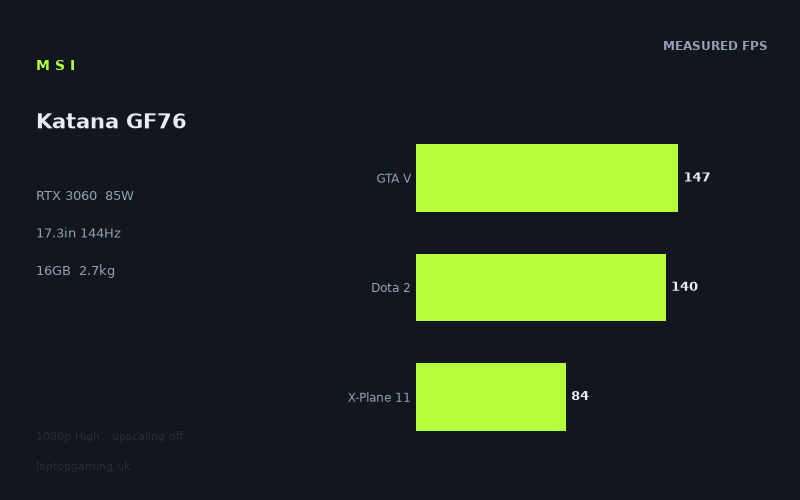
Frame rates
1920×1080, High preset, upscaling off.
Measured on this machine. Source: Notebookcheck, 2021-06-30.
Not scored: incomplete benchmark suite
Every scored laptop on this site is averaged over the same 5 games, and this one is short of Cyberpunk 2077, Baldur's Gate 3. A mean over 5 games is not comparable to a mean over 5, so we publish the figures we have and leave the score blank rather than rank it against machines tested on a different set. The numbers below are real - the suite is just incomplete.
How these numbers were produced
Frame rates here are not measured by us, and we label how each one was arrived at. A figure marked measured comes from a published run on that exact machine. A figure marked representative is derived from the GPU and its power limit (TGP) and cross-referenced against published reviews - a sound estimate of what that configuration delivers, but not a measurement of that specific laptop. Unless stated otherwise, numbers are 1920x1080, High preset, upscaling off. Where a laptop ships in several power configurations we use the wattage of the exact SKU listed, because a 140W RTX 5070 and a 115W one are not the same product.
In use
The short version
The MSI Katana GF76 (11UE) is a large-screen gaming laptop built around an RTX 3060 running at an 85W GPU power limit, a Core i7-11800H, 16GB of memory and a 1TB SSD. Its strongest case is straightforward: it delivers consistently capable 1920x1080 gaming results on a 17.3in 144Hz IPS display, with several lighter or better-scaling games reaching, or effectively reaching, the screen’s full refresh rate.
The benchmark data is particularly good for players whose library includes F1 2020, GTA V, Strange Brigade, Dota 2, The Witcher 3 or Rise of the Tomb Raider. Notebookcheck’s measured figures put the Katana at 148fps in F1 2020, 147fps in GTA V, 144fps in Strange Brigade, 140fps in Dota 2, 134fps in The Witcher 3 and 133fps in Rise of the Tomb Raider. That is the sort of performance that makes a 144Hz panel feel justified rather than decorative in a meaningful share of the tested games.
It is less convincing as a universal 144fps machine. Far Cry 5 reaches 97fps, Days Gone manages 95fps, X-Plane 11 records 84fps, Dirt 5 comes in at 77fps and Final Fantasy XV reaches 74fps. Those are still playable-looking results for a high-preset 1080p test with upscaling disabled, but they are clearly below the display’s maximum refresh rate. Buyers should therefore view the 144Hz panel as useful headroom for selected games, not as a promise that every demanding title will run at 144fps on high settings.
The five-game scoring-suite mean is 118fps. That is a healthy average, but the average conceals a meaningful spread between the best and worst results. The difference between 148fps in F1 2020 and 74fps in Final Fantasy XV is not a minor fluctuation: it changes how well the panel can be used, how much room there is to prioritise image quality, and how sensible it is to expect high-refresh gaming from every title.
This is a machine for someone who wants a 17.3in Full HD gaming laptop and values strong conventional 1080p performance more than compactness. At 2.718kg, it is not a casual carry-around device. The 53Wh battery is also a specification to treat cautiously: no battery-life figure is available here, so there is no evidence for claims about how long it lasts away from the mains. The Katana makes most sense as a laptop that can move between rooms, homes, study spaces or events when necessary, while spending much of its gaming life plugged in.
There is no confirmed UK price for this exact configuration, so its value cannot be assessed properly and no overall score is available. That is simply a price-data limitation, not a problem with the benchmark coverage: the measured suite is complete and the machine ranks normally on the frame-rate leaderboard. Without a price, though, it would be wrong to tell a buyer whether these results represent a bargain, a fair deal or poor value.
The clearest buying recommendation is therefore conditional. If the Katana GF76 is available at a sensible price for an RTX 3060 laptop with this specification, the measured performance supports it as a strong 1080p gaming option with a genuinely useful 144Hz screen in lighter games. If portability, battery endurance, guaranteed high-refresh results in demanding games or known value are the priority, there are important reasons to look elsewhere or wait for a confirmed price.
Performance
An RTX 3060 result that needs to be read as an 85W result
The RTX 3060 name alone does not tell the whole performance story. This Katana GF76 uses an RTX 3060 with an 85W GPU power limit, and that specific implementation is what the measured figures describe. Buyers comparing listings should not assume that every laptop carrying the same RTX 3060 label will deliver the same frame rates, because the configuration matters. Here, the relevant combination is the RTX 3060, the 85W power limit, the Core i7-11800H, 16GB of memory and the tested 1920x1080 high-preset setup with upscaling disabled.
That matters especially because the Katana produces two apparently different stories depending on the game. In the faster part of the test set, it looks very close to a 144Hz gaming laptop in practice. In the more demanding part, it looks more like a machine intended to provide solid high-preset 1080p performance rather than a locked high-refresh experience. Both interpretations are supported by the same data. The important job is not to pick whichever one sounds better, but to identify which group of games resembles the buyer’s own library.
Notebookcheck’s results were recorded at 1920x1080 using the High preset with upscaling off. That is a useful test condition for this laptop because it matches the native resolution of the 17.3in panel and avoids disguising native rendering performance with an upscaling mode. The numbers therefore tell a clear story about how the GF76 performs when asked to drive its own display conventionally.
The five scoring-suite games produce a mean of 118fps. That figure is useful as a broad indication that this is not a marginal 1080p gaming configuration. It is not, however, a substitute for the individual results. A mean can make a machine look closer to a 144Hz experience than it is in the more demanding games, while also making it seem less capable than it is in the titles where it runs near the panel limit. The individual figures deserve more attention than the headline average.
Games that make the 144Hz panel count
F1 2020 is the strongest measured result at 148fps. That is above the panel’s 144Hz refresh rate, so the game has enough measured performance to fully occupy the display’s maximum refresh capability under the stated test conditions. A result above 144fps does not make the panel faster than 144Hz, but it does show that the screen is not the immediate performance limit in this game. The display has appropriate headroom for the result.
GTA V is nearly identical at 147fps. It is also above 144fps and again supports the case for the 144Hz panel. GTA V is part of the scoring suite, so it contributes to the 118fps mean, but its main importance here is that it demonstrates what the Katana can do in a game where the tested configuration is able to run at very high frame rates without upscaling.
Strange Brigade reaches 144fps exactly. This is the cleanest possible match for the screen specification. At the stated High preset and native 1920x1080 resolution, the measured figure aligns with the display’s 144Hz refresh rate. For someone playing Strange Brigade under comparable settings, the screen is not an over-specification. It is being used as intended.
Dota 2 follows closely at 140fps. That is just below 144fps, but it is still close enough to the display limit to count as a high-refresh result in practical terms. There is no reason to describe 140fps as a failure to utilise a 144Hz screen. It is evidence that the Katana can deliver the kind of motion output that makes a high-refresh panel worthwhile, even if the measured number is not exactly at the headline refresh rate.
The Witcher 3 records 134fps and Rise of the Tomb Raider records 133fps. Neither reaches 144fps, but both are firmly in the same performance neighbourhood. These figures support a more realistic version of the Katana’s high-refresh claim: it is often close to the screen’s maximum in games that suit the configuration, rather than being restricted to one unusually light title.
There is a useful distinction between saying the Katana “does 144Hz gaming” and saying it can “use a 144Hz panel well”. The first statement would be too broad if it is intended to cover all measured games. The second is supported by the data. F1 2020, GTA V and Strange Brigade are at or above 144fps, while Dota 2, The Witcher 3 and Rise of the Tomb Raider are close enough that the 144Hz panel remains relevant rather than excessive.
For players who spend most of their time in games with results in this upper group, the configuration makes coherent sense. The GPU is not being paired with a screen that it can only rarely exploit. The benchmark data shows several games in the 133fps to 148fps range, which is a strong match for the display. It also shows why looking only at the 118fps mean would miss part of the story: a mean below 144fps does not prevent many individual games from approaching or reaching the panel’s maximum refresh rate.
Games where the panel has headroom rather than full use
The other half of the test results is more restrained. Far Cry 5 records 97fps and Days Gone records 95fps. These are not weak results in isolation. Both are close to 100fps at 1920x1080 on the High preset with upscaling disabled, which remains well above the frame rates associated with a basic 60Hz gaming target. But they are also far enough below 144fps that a buyer should not expect the display’s full refresh rate to be filled in these games under the measured settings.
X-Plane 11 lands at 84fps. This is the scoring-suite figure that pulls the average down most visibly when compared with GTA V, Strange Brigade and Dota 2. An 84fps result is still materially above 60fps, but it is not high-refresh gaming in the same sense as 133fps or 148fps. It is a reminder that a 144Hz panel and an 85W RTX 3060 do not establish a fixed relationship across every game engine and workload.
Dirt 5 records 77fps, while Final Fantasy XV reaches 74fps. These are the lowest measured results in the supplied set. They are especially important because they show the lower boundary of what this configuration can deliver at the stated native resolution and High preset without upscaling. Buyers whose main games behave more like Dirt 5 or Final Fantasy XV should not purchase the Katana expecting 144fps at these settings simply because the panel is rated at 144Hz.
There is still a difference between not reaching 144fps and being unsuitable for a 144Hz laptop. The display does not become a liability because a game runs below its maximum refresh rate. A 144Hz panel can still display lower frame rates; the relevant point is that the laptop is not extracting the panel’s full potential in every measured title. At 97fps, 95fps, 84fps, 77fps and 74fps, the GF76 has more screen refresh capacity available than the GPU is supplying in those workloads.
The sensible interpretation is not that the screen is mismatched, but that it is aspirational headroom. In lighter games, that headroom is used. In heavier games, the display gives the laptop room to benefit if settings are reduced, if a game is less demanding than those measured, or if the player simply values the screen specification across a mixed library. The available measurements do not provide alternative setting results, so it would be wrong to claim exactly what frame rate a lower preset would produce. What can be said is that the native high-preset results do not put every title at 144fps.
The benchmark spread is the main performance characteristic
The single most useful fact about this Katana is not the 118fps mean. It is the spread from 148fps in F1 2020 to 74fps in Final Fantasy XV. That range explains why simplistic verdicts do not fit this machine. Calling it a 144fps laptop is too optimistic for the slower titles. Calling it merely a 60fps-class laptop would ignore the results in F1 2020, GTA V, Strange Brigade, Dota 2, The Witcher 3 and Rise of the Tomb Raider.
The difference across titles is also why buyers should start with their own games rather than the GPU badge. The same laptop records 147fps in GTA V and 84fps in X-Plane 11. It delivers 144fps in Strange Brigade and 77fps in Dirt 5. It reaches 134fps in The Witcher 3 but 74fps in Final Fantasy XV. The hardware has not changed between those results; the demands of the games and their interaction with the tested configuration have.
The Core i7-11800H is part of that picture. The supplied comparison data explicitly notes that at 1080p, lighter titles in the shared set can be CPU-bound and compress genuine GPU gaps. That observation is valuable when reading the Katana’s results near the top of the chart. A near-equal result against a more powerful rival in a small shared-game sample does not necessarily mean that the RTX 3060 at 85W is delivering the same GPU performance in every type of workload. It can mean that the shared lighter games are limiting the ability of GPU differences to show through at 1080p.
This is not an argument against the Katana’s frame rates. The measured figures are the figures a player receives in the tested setup. It is instead an argument against over-reading them. When the Katana produces 147fps in GTA V or 144fps in Strange Brigade, the experience indicated by those numbers is strong. But when those games are used to compare the Katana with machines carrying an RTX 3070 or RTX 3080, the tiny differences need context. The GPU label alone does not explain every observed result, and a shared set dominated by lighter 1080p titles can reduce visible separation.
What the 85W GPU limit means in practice here
The practical consequence of the 85W specification is that buyers should judge this as a particular RTX 3060 implementation, not an abstract RTX 3060. The benchmark results are neither a generic promise for every RTX 3060 machine nor an interchangeable result for every gaming laptop with the same processor. They describe the GPU power limit MSI used in this Katana configuration.
In practice, this measured configuration is strong enough to create two distinct use cases. The first is high-refresh 1080p gaming in titles where the data sits from 133fps to 148fps. The second is conventional high-preset 1080p gaming in titles where the data falls from 74fps to 97fps. The first use case makes the 144Hz display feel central to the product. The second makes the panel a useful capability ceiling that the hardware does not always reach.
There is no support in the supplied data for claiming that this laptop can maintain a fixed frame-rate target across all games. The evidence points the other way: the results vary substantially. Anyone requiring every game to remain at or near 144fps should treat the 74fps, 77fps, 84fps, 95fps and 97fps results as the more relevant evidence. Anyone mainly playing games resembling F1 2020, GTA V, Strange Brigade or Dota 2 can reasonably place more weight on the 140fps to 148fps group.
The absence of upscaling in the test is important for buyers who want a clean baseline. The results do not rely on an upscaling mode to reach the reported frame rates. That gives the figures direct relevance to the Full HD screen. It does not mean every future title will perform similarly, and it does not tell us what performance would be available with other settings or modes. It simply means the numbers are native 1920x1080 High-preset results with upscaling disabled.
The 16GB memory and 1TB SSD complete a specification that is appropriate to a gaming machine, but the supplied data does not provide memory speed, storage performance, upgrade information or application-performance measurements. It would be inappropriate to make claims about loading performance, multitasking behaviour or upgrade flexibility from the capacity figures alone. For this review, gaming performance should remain anchored to the attributed Notebookcheck frame rates rather than expanded into unsupported assumptions.
The screen
A sensible native resolution for the measured performance
The Katana GF76 uses a 17.3in IPS panel with a 1920x1080 resolution and a 144Hz refresh rate. On the evidence available, Full HD is the right resolution for this GPU configuration. The benchmarks were measured at the panel’s native 1920x1080 resolution, and that is where the machine produces its strongest gaming case.
A higher resolution would require more rendering work, but there is no higher-resolution benchmark data supplied here, so there is no basis for claiming exactly how this machine would perform at any other resolution. What is clear is that at 1920x1080, the RTX 3060 at 85W can range from 74fps to 148fps across the measured games. That is enough to support a good gaming display choice: it gives the hardware a realistic chance of producing high frame rates without requiring the buyer to choose between native resolution and playable performance.
The screen’s 144Hz refresh rate is not merely a specification-sheet flourish. F1 2020 at 148fps, GTA V at 147fps and Strange Brigade at 144fps directly demonstrate workloads where the panel can be driven to its stated maximum refresh rate. Dota 2 at 140fps is close, while The Witcher 3 at 134fps and Rise of the Tomb Raider at 133fps remain sufficiently high that the display’s refresh rate is still relevant.
That is a better outcome than a high-refresh panel attached to a configuration that rarely rises much beyond 60fps. The Katana does not have that problem. It has several measured results well above 100fps and several at or around 144fps. The limitation is not whether the display can ever be used properly. The limitation is consistency across a varied game library.
Do not buy it on the assumption of universal 144fps
Far Cry 5 at 97fps, Days Gone at 95fps, X-Plane 11 at 84fps, Dirt 5 at 77fps and Final Fantasy XV at 74fps are the necessary counterweight to the stronger results. These games demonstrate that the 144Hz label should not be read as a guaranteed performance target. The panel is capable of 144Hz; the system does not produce 144fps in every measured game at 1920x1080, High settings and upscaling off.
That distinction is especially relevant for buyers attracted by the large screen. A 17.3in 144Hz display invites the expectation of expansive, fast-moving gaming, and the Katana can provide that in the best-performing titles. But in the slower group, the experience indicated by the frame-rate figures is better described as solid high-preset Full HD gaming than as full-refresh gaming.
There are no supplied measurements for brightness, colour coverage, response time, contrast, HDR behaviour, adaptive-sync support or outdoor visibility. The IPS panel type tells us the panel technology, but it does not justify claims about image quality beyond that. A buyer choosing between machines primarily for creative colour work, HDR content or exceptionally fast pixel response should seek measured display data before deciding. The gaming evidence here is about resolution, refresh rate and the frame rates available to feed them.
The large panel changes the appeal of Full HD
At 17.3in, the screen is a central part of the Katana’s proposition rather than a small compromise made for portability. The 1920x1080 resolution is matched directly by the benchmark suite, and the 144Hz refresh rate is supported by a meaningful portion of the results. This is a more coherent combination than an oversized high-resolution display whose native pixel count would place a much heavier burden on the GPU without evidence that the GPU could meet it.
Buyers should nevertheless be realistic about what the screen cannot do on its own. A 144Hz panel does not turn 74fps into 144fps, nor does it make the lower benchmark group equivalent to the upper group. The display provides the capacity; the game and hardware determine how much of that capacity is used. On this Katana, the match is excellent in some games, good in others, and incomplete in the slowest measured titles.
Build, size and portability
The confirmed portability figure is the weight: 2.718kg. That places the Katana GF76 firmly in the large-laptop category from a practical buyer’s perspective. The 17.3in display already signals that this is not intended to be a minimal-bag machine, and the weight reinforces that conclusion. It can be moved, but it should not be approached as a lightweight laptop for people who expect to carry it constantly.
There are no dimensions in the supplied specification, so it would be wrong to state its width, depth, thickness or bag footprint. The screen size and weight are enough to establish the broad usage pattern, but not enough to make precise claims about whether it fits a particular sleeve, backpack compartment or desk layout.
The 53Wh battery is another area where restraint matters. The capacity is known; battery life is not. Capacity alone cannot establish how long the laptop lasts in gaming, web use, video playback, office work or standby, so no endurance estimate should be inferred from it. Anyone planning to use the Katana regularly away from mains power should treat the absence of a measured battery-life figure as an information gap rather than assume that the battery capacity will meet their needs.
The likely strength of this form factor is not effortless mobility but screen space. A 17.3in panel is attractive for someone who wants the laptop itself to provide a large gaming view without relying on an external display. Combined with the 144Hz refresh rate and the higher frame-rate results, that creates a clear desktop-replacement style of appeal. The trade-off is the 2.718kg weight and the lack of evidence for battery endurance.
No facts are supplied about chassis materials, keyboard layout, port selection, webcam quality, speakers, cooling noise or temperatures. These are important purchase considerations, especially on a gaming laptop, but they cannot be filled in with assumption. The available evidence supports conclusions about weight, screen size, battery capacity and gaming performance. It does not support claims about how quiet, hot, rigid, premium or convenient the machine is in everyday use.
How it compares
Against the MSI Prestige 15 with RTX 3050 Ti at 105W
Against the MSI Prestige 15 with an RTX 3050 Ti at 105W, the Katana GF76 averages 58fps more across four shared games. That is the largest positive gap among the listed rivals and it is not a trivial result. The Katana’s RTX 3060 configuration is meaningfully ahead in this comparison, despite the Prestige 15 being listed with a 105W GPU power figure.
The useful conclusion is not that every RTX 3050 Ti laptop will trail by exactly 58fps in every game. The comparison is based on four shared games, and the result belongs to that shared set. But it does establish that, on the published data available for these machines, the Katana has a substantial performance advantage over this specific Prestige 15 configuration.
For a buyer whose priority is gaming frame rate rather than a different type of laptop design, the Katana has the stronger evidence. A 58fps average lead across four shared games is large enough to affect how closely a system can approach a 144Hz display target. It reinforces the view that the Katana is not merely adequate for Full HD gaming; it is materially more capable than this RTX 3050 Ti rival in the games both machines hold.
Against the Gigabyte Aero 17 HDR YC with RTX 3080
The comparison with the Gigabyte Aero 17 HDR YC is much more surprising on the surface. Across three shared games, the Katana averages 1fps more than the RTX 3080-equipped Aero 17 HDR YC. Read without context, that might suggest the two laptops are essentially equal in gaming performance. The supplied comparison guidance makes clear why that would be too strong a conclusion.
A near-zero difference is a real result in the shared games, and it should not be ignored or rewritten into a larger gap. The Katana is indeed 1fps ahead on average across those three common titles. But at 1080p, lighter titles in the shared set can be CPU-bound and compress genuine GPU gaps. In other words, the small difference can reflect the fact that the shared games are no longer showing a clean GPU-only separation at this resolution.
The correct reading is that the Katana matches the Aero 17 HDR YC extremely closely in that limited three-game overlap. It is not evidence that an RTX 3060 at 85W and an RTX 3080 are universally equivalent. The Katana’s own full benchmark set shows it can vary from 74fps to 148fps depending on the title, which is already enough reason not to universalise a tiny shared-sample result.
This is still a favourable result for the Katana in one important respect: it shows that GPU hierarchy does not automatically predict every 1080p result. If a buyer plays games resembling the shared set, the measured gap is effectively absent. If the buyer is trying to assess broader GPU capability beyond those three games, this comparison should be treated as inconclusive rather than as proof of parity.
Against the Schenker XMG Neo 17 with RTX 3070 and Ryzen 7 5800H
The Katana averages the same frame rate across three shared games as the Schenker XMG Neo 17, which uses an RTX 3070 and a Ryzen 7 5800H. Again, the near-zero result is genuine within the stated comparison: the average difference is 0fps across the shared games.
It would be easy to turn that into an overblown claim that the Katana performs like an RTX 3070 laptop. The benchmark guidance explicitly warns against doing that. At 1080p, lighter shared titles can be CPU-bound and compress real GPU differences. A 0fps average across three games does not erase the hardware differences named in the specifications. It tells us that, in those three common benchmark results, neither machine establishes a measurable average lead.
For a buyer, the practical lesson is useful. The Katana can be very competitive in the right 1080p games, even against a machine with an RTX 3070. That supports confidence in its upper-range results such as 148fps in F1 2020, 147fps in GTA V and 144fps in Strange Brigade. It does not eliminate the need to consider the Katana’s slower results in X-Plane 11, Dirt 5 and Final Fantasy XV, where the full-refresh picture is less convincing.
The Schenker comparison also shows why a frame-rate leaderboard should be read game by game where possible. An average across three shared titles is useful, but it cannot capture the whole personality of a gaming laptop. The Katana’s main personality remains its spread: excellent high-refresh figures in some games, solid but lower figures in others.
Against the MSI Raider GE77 HX with RTX 3080 Ti at 175W
The MSI Raider GE77 HX is the rival that beats the Katana by the greatest margin in the supplied comparisons. Across five shared games, the Katana averages 51fps less than the Raider, which uses an RTX 3080 Ti at 175W. This is a substantial deficit and a much clearer indication of GPU separation than the near-equal three-game comparisons with the Aero 17 HDR YC and XMG Neo 17.
The comparison is particularly instructive because it covers five shared games rather than three. A 51fps average gap across that set is too large to dismiss as a tiny benchmark fluctuation or a quirk of a single title. The Raider is operating in a different performance class in the shared data.
That does not make the Katana’s results poor. It means the Katana should not be purchased by someone trying to obtain the highest possible 1080p frame rates regardless of machine class. The Raider’s RTX 3080 Ti at 175W has a large advantage in the listed comparison, and the Katana’s 85W RTX 3060 is not positioned to compete with it across that broader shared set.
This is also where the Katana’s 144Hz screen deserves the most careful interpretation. The Raider comparison shows that there are machines capable of delivering substantially more performance in the shared games. For the buyer whose goal is to push high frame rates in demanding titles as aggressively as possible, the Katana is not the final word. For the buyer who wants a 17.3in Full HD laptop that can reach the panel limit in selected games and deliver 74fps to 97fps in the slower tested group, it remains a credible option.
Who it’s for
Buy it if your priorities match the measured strengths
The MSI Katana GF76 suits a buyer who specifically wants a 17.3in Full HD gaming laptop and understands that the 144Hz screen will be fully used in some games rather than all games. The strongest fit is someone playing titles closer to F1 2020, GTA V, Strange Brigade, Dota 2, The Witcher 3 and Rise of the Tomb Raider. The measured results from 133fps to 148fps make the screen’s refresh rate genuinely worthwhile in that group.
It also suits someone who values a large native-1080p panel more than low carry weight. At 2.718kg, this is better thought of as a system that can be transported when needed than one intended to disappear into a bag every day. A buyer using it mostly at a desk, in a fixed room, or as a moveable alternative to a desktop monitor will find the 17.3in screen more central to the appeal than someone who travels constantly.
The Katana is also a sensible performance choice for a buyer comparing it with the MSI Prestige 15 RTX 3050 Ti configuration. The published shared-game advantage of 58fps is substantial. If gaming performance is the deciding factor between those two machines, the Katana has clearly stronger benchmark evidence.
It is worth considering for buyers who see the RTX 3060 label and worry that it cannot produce high-refresh results at all. The data directly counters that concern. F1 2020 at 148fps, GTA V at 147fps and Strange Brigade at 144fps show that this configuration can deliver a proper 144Hz-class result in the right games. Dota 2 at 140fps, The Witcher 3 at 134fps and Rise of the Tomb Raider at 133fps extend that strength beyond a single isolated benchmark.
Buy something else if portability or universal high-refresh performance matters more
Someone who carries a laptop daily should look carefully at the 2.718kg weight before deciding. The Katana’s 17.3in screen is an advantage for gaming space, but it comes with a form factor that is fundamentally less portable than a smaller, lighter machine. No dimensions are supplied, so exact bag compatibility cannot be judged here, but the weight alone is enough to make this a poor fit for buyers who prioritise minimal load.
Buyers who need known battery endurance should also look elsewhere until proper battery-life measurements are available. The Katana has a 53Wh battery, but there is no runtime figure in the supplied data. That does not prove poor endurance, and it does not prove good endurance. It means there is no evidence-based reason to recommend it for long use away from mains power.
Players who expect every demanding game to run at 144fps on high settings should buy something else. The results in Far Cry 5, Days Gone, X-Plane 11, Dirt 5 and Final Fantasy XV do not support that expectation. The Katana reaches 97fps, 95fps, 84fps, 77fps and 74fps in those games respectively. Those figures are not failures, but they are clearly below the display maximum.
Buyers chasing the greatest available performance should also look beyond this machine. The MSI Raider GE77 HX, with its RTX 3080 Ti at 175W, holds a 51fps average advantage across five shared games. That is a meaningful gap, not a cosmetic one. The Katana is capable, but it is not the right choice for a buyer whose main objective is maximum frame-rate headroom in the more demanding gaming workloads.
Finally, anyone making a value-led purchase should wait for a confirmed UK price for this exact Katana configuration. The performance evidence is complete enough to judge what it can do, but no price means there is no sound basis for judging whether it is competitively priced. A buyer can decide whether the frame rates, screen size, 144Hz refresh rate, 2.718kg weight, 53Wh battery capacity, 16GB memory and 1TB SSD suit their needs. They cannot responsibly decide whether the package is good value without knowing the actual UK asking price.