Review
Gigabyte Aero 15 OLED review
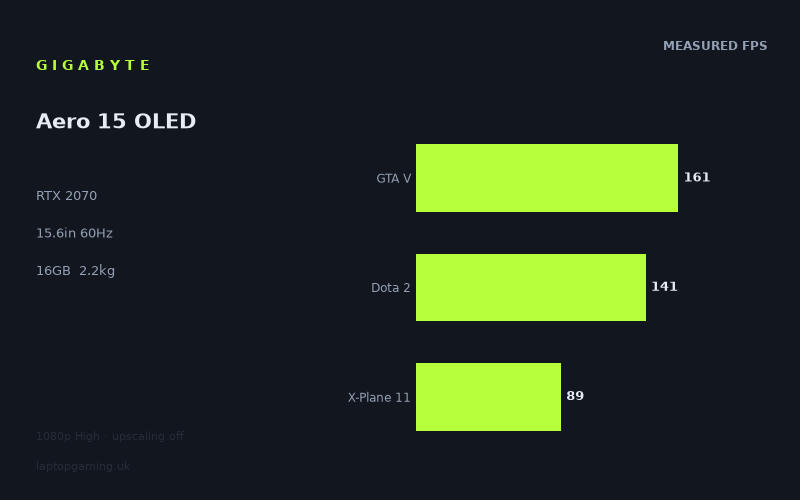
Frame rates
1920×1080, High preset, upscaling off.
Measured on this machine. Source: Notebookcheck, 2020-05-14.
Not scored: incomplete benchmark suite
Every scored laptop on this site is averaged over the same 5 games, and this one is short of Cyberpunk 2077, Baldur's Gate 3. A mean over 3 games is not comparable to a mean over 5, so we publish the figures we have and leave the score blank rather than rank it against machines tested on a different set. The numbers below are real - the suite is just incomplete.
How these numbers were produced
Frame rates here are not measured by us, and we label how each one was arrived at. A figure marked measured comes from a published run on that exact machine. A figure marked representative is derived from the GPU and its power limit (TGP) and cross-referenced against published reviews - a sound estimate of what that configuration delivers, but not a measurement of that specific laptop. Unless stated otherwise, numbers are 1920x1080, High preset, upscaling off. Where a laptop ships in several power configurations we use the wattage of the exact SKU listed, because a 140W RTX 5070 and a 115W one are not the same product.
In use
The short version
The Gigabyte Aero 15 OLED is a capable RTX 2070 laptop whose published 1080p results remain strong across a broad selection of games, but it is also a machine with a very clear mismatch between its display specification and the benchmark conditions we can verify. Notebookcheck’s figures are all at 1920x1080, High preset, with upscaling off. The Aero’s own OLED panel is 15.6in and 3840x2160 at 60Hz. That means the measured data tells us a useful amount about its gaming performance, but it does not prove that the laptop can deliver the same experience at the panel’s native resolution.
At the tested settings, it is plainly quick enough for conventional 60Hz gaming in every game listed. GTA V reaches 161fps, The Witcher 3 manages 152fps, Dota 2 records 141fps and Battlefield V reaches 139fps. Even the more demanding end of the test list stays above the panel’s refresh ceiling or meets it directly: Metro Exodus is at 75fps, Red Dead Redemption 2 at 66fps and Control at 60fps.
That is the good news. The less convenient part is that this is not a laptop that can be judged as a straightforward high-refresh gaming machine. The screen is limited to 60Hz, so the very high results in GTA V, The Witcher 3, Dota 2 and Battlefield V cannot be displayed as more than 60 distinct refreshes per second on the built-in panel. Those results still matter. They show substantial performance headroom at the tested 1080p High settings, and they suggest that less demanding games should not be a problem at that setting. But a buyer who mainly wants to exploit frame rates far above 60fps on the internal display should not pay for this laptop on the assumption that its OLED panel is a high-refresh gaming display. It is not.
The Aero 15 OLED makes most sense for someone who values a 3840x2160 OLED display as part of the purchase, accepts that game settings and resolution may need managing, and wants RTX 2070-class results when playing at 1920x1080. It also makes sense for a buyer whose preferred games resemble the lighter or better-performing end of Notebookcheck’s list. GTA V, The Witcher 3, Dota 2 and Battlefield V are all well beyond 60fps in the published numbers. Far Cry New Dawn and Shadow of the Tomb Raider both reach 110fps, while The Division 2 is at 105fps. Those are reassuring figures for a 60Hz laptop when the benchmark conditions are a match for the way it will be used.
It is less compelling for someone who expects native-3840x2160 gaming without compromises, because there are no published figures here for that resolution. It is also not the obvious choice for a buyer who wants a screen that can visibly use the 141fps in Dota 2 or the 161fps in GTA V. The graphics hardware is producing more performance than the integrated panel can show in those games at the measured settings.
There is another important limitation: the laptop has no confirmed UK price in the supplied information. That prevents a proper value judgement. Strong frame rates do not automatically make a laptop good value, and a premium OLED display does not automatically justify an unknown price. Until there is a confirmed UK price, the Aero 15 OLED should be judged as a specification-and-performance proposition rather than as a buying recommendation based on value.
The available comparison data is encouraging but should be read carefully. Across the shared games, the Aero 15 OLED is ahead of the Acer Aspire 17 with an RTX 2050 at 35W by 42fps. That is a substantial practical lead. It is effectively level with the MSI GE66 Raider and Gigabyte Aero 17 HDR XB, both with RTX 2070 graphics, separated by only 3fps and 1fps respectively across their shared-game results. It trails the RTX 2080-equipped MSI GT76 Titan DT by 14fps across shared games. That is a respectable position in this particular group, but none of those results can settle the value question because none of the machines has a confirmed UK price in the supplied data.
Performance
What the published figures show
Notebookcheck measured the Gigabyte Aero 15 OLED at 1920x1080, using the High preset with upscaling disabled. Those conditions matter as much as the results themselves. They represent a sensible baseline for comparing the games in the list, but they are not the native resolution of the 3840x2160 OLED display. The figures should therefore be read as verified 1080p High results, not as a promise of native-resolution performance.
The Aero’s RTX 2070 produces a wide range of results across the tested games. That is normal for a game list containing titles with very different demands, but the spread is useful because it shows where the laptop has room to spare and where it is approaching the display’s 60Hz limit.
- GTA V: 161fps
- The Witcher 3: 152fps
- Dota 2: 141fps
- Battlefield V: 139fps
- Far Cry New Dawn: 110fps
- Shadow of the Tomb Raider: 110fps
- The Division 2: 105fps
- Ghost Recon Breakpoint: 92fps
- X-Plane 11: 89fps
- Anno 1800: 84fps
- Borderlands 3: 84fps
- Metro Exodus: 75fps
- Red Dead Redemption 2: 66fps
- Control: 60fps
The three scoring-suite games available for this laptop are GTA V, Dota 2 and X-Plane 11. Their mean is 130fps. That is a useful summary of the Aero’s results in those particular games, but it should not be used as an overall gaming ranking. The scoring suite is incomplete because there are no supplied figures for Final Fantasy XV or Strange Brigade. Since scored laptops are normally averaged across the same five games, this partial result cannot be ranked fairly against laptops with complete results.
The strongest result is GTA V at 161fps. The Witcher 3 at 152fps and Dota 2 at 141fps sit close enough to establish a clear high-performing group. Battlefield V at 139fps belongs in the same broad category. On a 60Hz screen, all of these games exceed the panel refresh rate by a large margin under the tested conditions. That does not make the extra performance meaningless. It gives room for heavier moments than a simple average result might imply, and it can matter if the laptop is used with a display other than the built-in 60Hz panel. What it does mean is that the internal display is the limiting factor for how much of that performance can be visibly presented at once.
Far Cry New Dawn and Shadow of the Tomb Raider both achieve 110fps. The Division 2 is close behind at 105fps. These are still strong 1080p High results, and all are well above 60fps. The Aero is not merely scraping past its display refresh rate in this part of the list; it has a meaningful gap above it. For somebody playing these games at the measured 1920x1080 High setting on the internal panel, the published numbers support the expectation that the laptop has more than enough average frame-rate performance for a 60Hz target.
Ghost Recon Breakpoint, X-Plane 11, Anno 1800 and Borderlands 3 make up a middle group. Breakpoint is at 92fps, X-Plane 11 reaches 89fps, and both Anno 1800 and Borderlands 3 record 84fps. These figures are lower than the Aero’s results in GTA V or The Witcher 3, but they remain above the screen’s 60Hz refresh rate. The distinction matters because it shows that “RTX 2070 performance” is not one fixed level. The same laptop can produce 161fps in one game and 84fps in another at the same stated benchmark resolution and preset.
That spread is precisely why a buyer should not make a decision from the mean of 130fps in the partial scoring suite alone. A mean can be useful for broad comparisons where the game set is identical, but it obscures the actual experience in the games a person intends to play. Someone whose regular games are close to GTA V, Dota 2 or Battlefield V will see a very different performance profile from someone focused on Borderlands 3, Metro Exodus, Red Dead Redemption 2 or Control.
Metro Exodus at 75fps and Red Dead Redemption 2 at 66fps are still above 60fps, but they are much closer to the panel limit. This is where the Aero’s performance becomes more dependent on the exact game and settings rather than on the headline fact that it has an RTX 2070. At the tested settings, both results clear the 60Hz target. They do not, however, have the same headroom as GTA V at 161fps or Far Cry New Dawn at 110fps. A buyer deciding between this laptop and a higher-performing option should pay attention to this lower end of the list, not just the titles where every machine in the class is likely to look fast.
Control is the lowest result at 60fps. It exactly matches the OLED panel’s 60Hz refresh rate under Notebookcheck’s tested 1920x1080 High conditions. That is a significant result because it describes the point at which the Aero’s measured average performance no longer sits above the display target. It is not a poor result in isolation: matching the panel’s refresh rate is a viable outcome for a 60Hz laptop. But there is no average frame-rate margin above that target in the published figure. A buyer who regards a locked or near-locked 60fps experience as sufficient may be satisfied; a buyer who wants substantial spare performance in demanding games should recognise that the data does not show it here.
The meaning of the range from 161fps to 60fps
The difference between GTA V at 161fps and Control at 60fps is not a contradiction in the benchmark data. It is the practical reality of gaming performance across different titles at a shared resolution and preset. The Aero can be extremely quick in some games while being much closer to a 60fps target in others. The sensible conclusion is not that one result is more “real” than another. It is that game choice determines whether this laptop feels like a machine with abundant frame-rate headroom or a machine that is working close to its panel’s refresh limit.
There are several distinct performance tiers in the results. The first is the group comfortably above 100fps: GTA V, The Witcher 3, Dota 2, Battlefield V, Far Cry New Dawn, Shadow of the Tomb Raider and The Division 2. The next contains Ghost Recon Breakpoint, X-Plane 11, Anno 1800 and Borderlands 3, where the measured figures remain above 60fps but are materially lower. The final group is Metro Exodus, Red Dead Redemption 2 and Control, where the figures are 75fps, 66fps and 60fps.
For the built-in display, that division is more useful than treating every frame-rate difference as equally important. There is a major practical difference between moving from 60fps to 75fps, because it creates some margin above the 60Hz refresh limit. There is less immediate benefit from moving from 141fps to 161fps if gaming takes place only on the laptop’s own 60Hz panel. Both are beyond what that panel can refresh in a second. The latter still indicates a lighter workload under the benchmark conditions, but it does not transform the internal display into a high-refresh screen.
The 1080p High test conditions also mean that the results are directly relevant to a buyer willing to run games below the panel’s 3840x2160 native resolution. That is not an unusual compromise on a laptop with a very high-resolution screen, but it remains a compromise. The benchmark data confirms what happens at 1920x1080 High with no upscaling. It does not tell us whether an individual game will be enjoyable, acceptable or satisfactory at 3840x2160, because no frame-rate figures at that resolution are supplied.
It would be wrong to turn the 1080p figures into invented 3840x2160 estimates. The games themselves differ too much for a simple conversion to be trustworthy, and the purpose of this review is to keep every published frame rate attributable. The only defensible conclusion is that the Aero’s verified gaming performance is strong at the tested 1080p High setting, while native-resolution gaming performance remains unconfirmed by the available benchmark data.
GPU power limit: what we can and cannot conclude
The supplied information identifies the graphics processor as an RTX 2070, but it does not provide a GPU power limit for this Gigabyte Aero 15 OLED. That absence matters. A GPU name alone is not enough to tell us precisely how a particular laptop configuration is set up, and no power figure should be assumed from the model name.
As a result, there is no basis here for claiming that the Aero’s RTX 2070 is configured at a particular wattage, nor for attributing its performance to a particular power setting. The Notebookcheck results are the evidence available: 161fps in GTA V, 152fps in The Witcher 3, 141fps in Dota 2, 139fps in Battlefield V and 60fps in Control, all at 1920x1080 High with upscaling off. Those numbers show the outcome of this configuration. They do not reveal the GPU power limit.
This is particularly important when comparing it with other laptops using the same GPU generation. The Aero 15 OLED is within 3fps of the MSI GE66 Raider across three shared games and within 1fps of the Gigabyte Aero 17 HDR XB across three shared games. It would be tempting to explain those tiny gaps by referring to power settings, but the supplied facts do not support that explanation. The valid conclusion is narrower: in the shared-game comparison, their measured results are extremely close.
Likewise, the Aero’s 14fps deficit to the RTX 2080-equipped MSI GT76 Titan DT across the shared games should not be converted into a claim about why that gap exists. We have the aggregate shared-game difference, not a complete technical explanation for it. The GTX-era and RTX-era laptop market is full of configurations where the badge alone does not settle the practical result, which is exactly why attributable benchmark figures matter. Here, the attributable result is that the Aero trails that particular RTX 2080 rival by 14fps across the shared games.
The responsible way to use the GPU information is therefore straightforward. Treat the RTX 2070 as an identifier of the graphics class, but make buying decisions from the listed game results and the known display limitation. The frame rates are specific. The power limit is not. Any review that presents a precise power figure for this Aero configuration would be adding information that is not in the supplied record.
What 60Hz changes in practice
The 60Hz refresh rate is central to the Aero 15 OLED’s gaming identity. It turns several excellent benchmark results into evidence of headroom rather than into directly visible high-refresh gaming on the built-in screen. GTA V at 161fps, The Witcher 3 at 152fps, Dota 2 at 141fps and Battlefield V at 139fps all exceed 60fps by a wide margin. Far Cry New Dawn and Shadow of the Tomb Raider at 110fps, plus The Division 2 at 105fps, do the same.
For a buyer who plays on the laptop display and is content with a 60Hz experience, this can be a positive. At the measured 1080p High setting, every listed game reaches at least the screen refresh rate. The lower results do not fall beneath the panel’s stated limit in the published averages: Metro Exodus is 75fps, Red Dead Redemption 2 is 66fps and Control is 60fps.
For a buyer who prioritises fast competitive gaming, however, the same data points in another direction. Dota 2 at 141fps is a very high measured result, but the panel remains 60Hz. The machine may be producing far more frames than the internal display refreshes. That does not make the game unplayable or the performance irrelevant; it means the built-in screen does not make full visible use of the result. A laptop with a higher-refresh display would be the more natural fit for someone buying primarily around frame-rate responsiveness rather than around a 3840x2160 OLED panel.
The screen and GPU are therefore not a universally balanced pairing. They are balanced for a buyer who values the OLED specification and accepts a 60Hz display target. They are less balanced for someone who sees the RTX 2070 mainly as a route to high-refresh 1080p gaming. The published data strongly supports the latter use case in terms of raw 1080p frame rates, but the panel itself does not.
The screen
The defining display specification is a 15.6in OLED panel with a 3840x2160 resolution and a 60Hz refresh rate. Those facts give the Aero 15 OLED a different character from a conventional 1920x1080 high-refresh gaming laptop. The screen specification is clearly ambitious in resolution and panel type, while the refresh rate is firmly aimed at a 60Hz experience.
The immediate issue is that Notebookcheck’s published game figures are not at the panel’s native 3840x2160 resolution. They are measured at 1920x1080, High preset, with upscaling off. That distinction should be treated as a buying warning rather than hidden beneath a headline result. The laptop has verified 1080p High performance; it does not have verified native-3840x2160 frame rates in the supplied material.
At 1920x1080 High, the GPU can drive every measured title to the panel’s 60Hz level or beyond. Control is exactly at 60fps. Red Dead Redemption 2 is at 66fps. Metro Exodus reaches 75fps. Borderlands 3 and Anno 1800 are both at 84fps, X-Plane 11 records 89fps, and Ghost Recon Breakpoint is at 92fps. These are the results that matter for a buyer intending to use a 1080p gaming setting on the laptop’s screen.
Above that lower group, the Aero produces 105fps in The Division 2, 110fps in Far Cry New Dawn and Shadow of the Tomb Raider, 139fps in Battlefield V, 141fps in Dota 2, 152fps in The Witcher 3 and 161fps in GTA V. The panel cannot refresh at those rates because its stated limit is 60Hz. The benchmark figures therefore show performance reserve rather than a matching display capability.
It is important not to confuse resolution with an automatic gaming recommendation. A 3840x2160 panel may be a major attraction for a buyer, but the numbers available here do not demonstrate 3840x2160 gaming. No published 3840x2160 figures are supplied for GTA V, The Witcher 3, Dota 2, Battlefield V, Control or any of the other games. A buyer who specifically wants to run modern demanding games at native resolution should seek benchmark evidence at that resolution before committing.
The panel is also not a reason to dismiss the 1080p results. The test conditions are clear and useful. They show that at 1920x1080 High, with upscaling off, this RTX 2070 configuration has enough measured performance for the laptop’s 60Hz ceiling across the entire list. That is a stronger conclusion than merely saying it “can game”. It tells us that the slower listed result is Control at 60fps and that everything else supplied is above that threshold under the same stated conditions.
The best interpretation is that the Aero’s screen is a feature a buyer must actively choose, not a universally superior option. Choose it for the 15.6in OLED panel and the 3840x2160 specification, while accepting a 60Hz limit and unconfirmed native-resolution game performance. Do not choose it on the assumption that its screen is designed to show the full 141fps in Dota 2 or 152fps in The Witcher 3.
Build, size and portability
The supplied physical information confirms a weight of 2.175kg. That places a real constraint on how the Gigabyte Aero 15 OLED should be considered. It is not weightless, and prospective buyers should treat it as a laptop that will have a noticeable presence in a bag. At the same time, the available information does not give dimensions, so there is no basis for claiming that it is especially thin, especially compact or unusually large for its class.
The 15.6in display tells us the general screen class, while the 2.175kg weight gives the only confirmed portability figure. It is enough to say that this is a 15.6in machine weighing 2.175kg. It is not enough to make confident claims about bag fit, footprint, thickness, charger size, battery life or travel endurance. None of those details is included in the supplied facts.
That limited physical record is worth stating plainly because build and mobility claims are often where reviews drift into assumption. We do not have published figures here for battery life, temperatures, fan noise, chassis dimensions or ports. We also do not have handling impressions. This review is based on published specifications and Notebookcheck’s benchmark results, not on personal use of the machine.
For a buyer comparing the Aero with a desktop-replacement laptop, the known 2.175kg figure may be useful simply as a starting point. For a buyer planning frequent travel, it is not enough on its own to establish whether the laptop is suitable. Weight is only one part of portability, and the missing dimensions and battery information prevent a fuller conclusion.
The more meaningful practical link between the physical specification and the gaming proposition is the 15.6in 3840x2160 OLED display. This is a laptop intended to put a very high-resolution panel into a portable chassis, but the benchmark evidence remains at 1920x1080. Buyers should think of the machine as a 2.175kg 15.6in OLED laptop with verified 1080p High gaming performance, rather than making assumptions about either native-resolution gaming or day-long mobility.
How it compares
The comparison group is useful because it includes machines close to the Aero 15 OLED, a lower-performing option that the Aero beats decisively, and a faster machine that establishes the upper end of the spread. These are not full-system rankings. They are shared-game comparisons, using the games both machines hold and preferring the scoring suite where possible. That is the correct basis for comparison when the available benchmark sets are incomplete or differ between laptops.
Against the Acer Aspire 17 with RTX 2050 at 35W
The Gigabyte Aero 15 OLED averages 42fps more than the Acer Aspire 17 across their three shared games. This is the clearest performance separation in the supplied rival set. A 42fps advantage is not a rounding difference and not something that can be dismissed as measurement noise in the context of the information provided. It establishes the Aero as materially faster in the shared results.
The Acer is identified as using an RTX 2050 at 35W, while the Aero uses an RTX 2070. The Aero’s own GPU power limit is not supplied, so the comparison should not be turned into a power-limit explanation. The evidence supports the simpler conclusion: in the shared games, the Aero’s measured performance is substantially ahead.
For a buyer choosing between these two machines on gaming speed, the Aero has the stronger case. Whether it is the better purchase overall cannot be determined from the supplied facts because neither laptop has a confirmed UK price. The Aero also has a 15.6in 3840x2160 60Hz OLED screen, but there is no supplied screen specification for the Acer in this comparison. The defensible recommendation is limited to the frame-rate evidence: the Aero offers a substantial shared-game advantage.
Against the MSI GE66 Raider with RTX 2070
Against the MSI GE66 Raider, also equipped with an RTX 2070, the Aero 15 OLED averages 3fps more across three shared games. That is a very small difference. It is real in the stated comparison, but it is not enough to treat one laptop as meaningfully faster in ordinary buying advice.
This is where the details of the shared game set matter. At 1920x1080, lighter titles in the shared selection can be CPU-bound and can compress genuine GPU gaps. A near-zero result does not mean the laptops are necessarily identical in every game, at every setting or at every resolution. It means the shared measured evidence does not establish a practical performance advantage for either one.
The Aero’s 3fps lead should therefore be read as parity, not as a victory worth paying extra for. If both machines were otherwise under consideration, the decision should turn on their confirmed display, weight, price and other specifications. In this supplied comparison, however, there is no confirmed UK price for either model, and only the Aero’s 15.6in 3840x2160 60Hz OLED display and 2.175kg weight are specified. The frame-rate data does not provide a reason to choose the Aero solely because it is faster than the GE66 Raider.
Against the Gigabyte Aero 17 HDR XB with RTX 2070
The Aero 15 OLED is ahead of the Gigabyte Aero 17 HDR XB by 1fps across three shared games. This is effectively a tie in practical terms. It is still a useful result because it shows that the smaller Aero is not obviously giving away gaming speed to that RTX 2070 sibling in the available common tests. But 1fps is not a buying advantage.
As with the MSI comparison, the near-zero difference should not be overinterpreted. The shared games at 1920x1080 can compress underlying differences, particularly where lighter workloads are CPU-bound. It would be irresponsible to use a 1fps shared-game edge as proof that the Aero 15 OLED is universally faster, better cooled, more powerful or otherwise superior. None of those conclusions is supported by the data supplied.
What the result does support is a narrow, useful statement: on the games both Aero models have been compared in, their performance is essentially the same. The decision between them would need to rest on specifications beyond that shared-game average. The current information does not include a confirmed UK price for either, and it does not provide the Aero 17 HDR XB’s full display or physical specification here. Performance alone cannot separate them.
Against the MSI GT76 Titan DT with RTX 2080
The MSI GT76 Titan DT is the faster end of this rival group. It uses an RTX 2080 and averages 14fps more than the Aero 15 OLED across their shared games. The Aero is therefore 14fps behind in that comparison.
That gap is substantial enough to matter more than the 3fps and 1fps differences against the two RTX 2070 rivals, but it should still be kept in context. It is an average across shared games, not a claim that the GT76 is ahead by the same amount in every title. The Aero’s own results range from 161fps in GTA V to 60fps in Control. Game-by-game variation is already large within the Aero’s own data, so an aggregate rival difference should be treated as a broad performance direction rather than as a fixed promise for each game.
For a buyer whose priority is maximum shared-game frame-rate performance among these named machines, the GT76 Titan DT has the advantage. For a buyer who values the Aero’s 15.6in 3840x2160 OLED display, the comparison is less simple because no equivalent display information for the GT76 is supplied here. There is also no confirmed UK price for either machine. The data tells us which is faster in the shared games; it does not establish which is the better value or which has the better overall configuration for a particular buyer.
What the rival set says overall
The Aero 15 OLED sits in a credible position within this group. It is far ahead of the RTX 2050-equipped Acer Aspire 17 in the shared results, effectively tied with the RTX 2070 MSI GE66 Raider and RTX 2070 Gigabyte Aero 17 HDR XB, and behind the RTX 2080 MSI GT76 Titan DT.
That is a more useful conclusion than simply repeating that the Aero has RTX 2070 graphics. The rival data gives context to the individual game figures. The Aero is not an isolated benchmark result: it has a substantial advantage over the lower-performing machine listed, near-parity with the closest RTX 2070 options, and a measured deficit to the faster RTX 2080 machine.
There is no valid overall ranking from the partial scoring-suite figures, however. The Aero has results only for GTA V, Dota 2 and X-Plane 11 within that suite, with a mean of 130fps. It lacks supplied figures for Final Fantasy XV and Strange Brigade. Because scored laptops are averaged over the same five games, a partial set cannot be ranked against complete sets fairly. The comparison averages supplied for the named rivals are useful precisely because they are based on games both machines hold, rather than pretending that an incomplete suite can deliver a definitive table position.
Who it’s for
The Gigabyte Aero 15 OLED is for the buyer who wants a 15.6in 3840x2160 OLED laptop and is prepared to approach gaming settings realistically. The published evidence supports 1920x1080 High gaming with upscaling off very well. Every game in Notebookcheck’s supplied list reaches 60fps or more. The standout results are GTA V at 161fps, The Witcher 3 at 152fps, Dota 2 at 141fps and Battlefield V at 139fps. Far Cry New Dawn and Shadow of the Tomb Raider both reach 110fps, while The Division 2 is at 105fps.
It is a sensible option for someone happy with a 60Hz target on the built-in display. The lower end of the results remains viable for that use: Metro Exodus at 75fps, Red Dead Redemption 2 at 66fps and Control at 60fps all meet or exceed the screen’s refresh rate at the tested 1080p High setting. A buyer who wants a laptop where the available data shows no listed game falling beneath 60fps at those conditions has a clear piece of evidence in the Aero’s favour.
It is also for someone whose game library includes titles that perform near the top of this list. GTA V, The Witcher 3, Dota 2 and Battlefield V all show that the laptop can generate considerably more performance than its 60Hz panel can display under the benchmark conditions. The same is true, though to a lesser extent, of Far Cry New Dawn, Shadow of the Tomb Raider and The Division 2.
The Aero is not the right choice for a buyer whose main goal is visibly high-refresh gaming on the laptop’s internal display. The 60Hz panel is the reason. The GPU produces 141fps in Dota 2 and 139fps in Battlefield V in the published data, but the built-in screen remains 60Hz. Anyone prioritising the direct visible benefit of those higher frame rates should look for a laptop with a display specification that matches that priority.
It is also not the machine to buy solely on the assumption of native 3840x2160 gaming. The screen has that resolution, but the benchmark figures do not. There are no supplied native-resolution frame rates for any game in the list. The responsible expectation is excellent verified 1080p High performance, not unverified 3840x2160 performance.
Buyers focused on the most demanding games should be especially clear-eyed. Control at 60fps, Red Dead Redemption 2 at 66fps and Metro Exodus at 75fps show that the Aero can meet the 60Hz target at the tested settings, but they do not show the huge reserve seen in GTA V or The Witcher 3. Someone who wants substantial frame-rate headroom in every demanding title should not use the 161fps GTA V result as a proxy for the whole game library.
It is not possible to recommend or reject the Aero on value because the UK price is not confirmed. That is not a minor omission. Price determines whether a 15.6in 3840x2160 OLED screen, RTX 2070 graphics, Core i7-10875H processor, 16GB of memory and 500GB SSD storage form an attractive package or an overpriced one. Without the price, the correct advice is conditional: assess the confirmed selling price against the 1080p High results, the 60Hz display limit and the fact that native-resolution gaming performance is not supplied.
The laptop may appeal to a buyer who wants the OLED display specification alongside gaming capability, rather than a pure gaming-first configuration. The data supports that framing. The screen is 3840x2160 OLED, while the GPU provides at least 60fps in every listed game at 1920x1080 High with upscaling off. That is a coherent proposition for someone who sees the display and gaming performance as separate strengths that must be managed together.
It is a weaker fit for someone who wants a simple answer to “can it run everything at native resolution?” The available evidence does not answer that question, so no responsible review should pretend otherwise. It is also a weaker fit for someone who wants definitive portability advice. The laptop weighs 2.175kg, but no dimensions, battery figures or other mobility data are supplied.
Ultimately, the Gigabyte Aero 15 OLED is best understood as a laptop with strong attributable 1080p High gaming results and a premium-specified 3840x2160 60Hz OLED display that asks the buyer to choose priorities carefully. Its RTX 2070 performance is demonstrably competitive with the MSI GE66 Raider and Gigabyte Aero 17 HDR XB in the shared results, clearly ahead of the Acer Aspire 17 with RTX 2050 at 35W, and behind the RTX 2080 MSI GT76 Titan DT. Its own game results are strong enough for 60Hz gaming throughout the supplied list.
The final buying decision should come down to whether the buyer wants that particular screen specification, whether 60Hz is acceptable, whether 1920x1080 High is an acceptable gaming target, and what the confirmed UK price turns out to be. The benchmark data gives the Aero a solid performance case. It does not provide evidence for native-3840x2160 gaming, a GPU power limit, battery life, thermal behaviour, noise, dimensions or value for money. Those unknowns should remain unknown rather than being filled with guesswork.