Review
MSI Katana 17 review
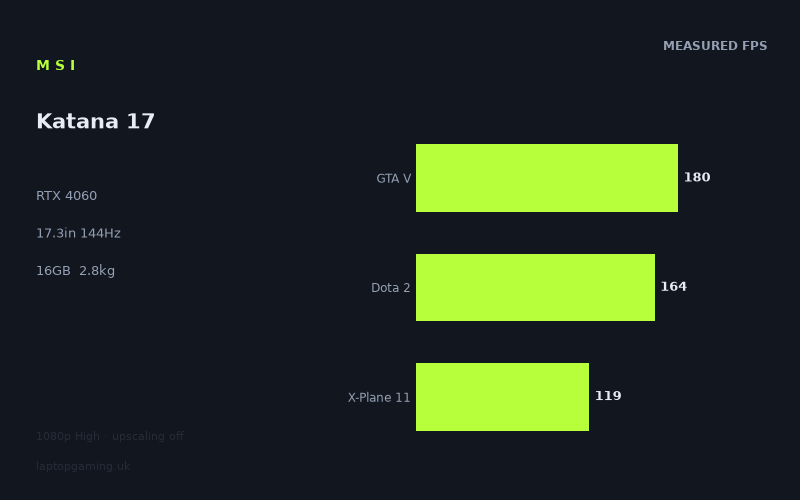
Frame rates
1920×1080, High preset, upscaling off.
Measured on this machine. Source: Notebookcheck, 2023-02-23.
Not scored: incomplete benchmark suite
Every scored laptop on this site is averaged over the same 5 games, and this one is short of Cyberpunk 2077, Baldur's Gate 3. A mean over 3 games is not comparable to a mean over 5, so we publish the figures we have and leave the score blank rather than rank it against machines tested on a different set. The numbers below are real - the suite is just incomplete.
How these numbers were produced
Frame rates here are not measured by us, and we label how each one was arrived at. A figure marked measured comes from a published run on that exact machine. A figure marked representative is derived from the GPU and its power limit (TGP) and cross-referenced against published reviews - a sound estimate of what that configuration delivers, but not a measurement of that specific laptop. Unless stated otherwise, numbers are 1920x1080, High preset, upscaling off. Where a laptop ships in several power configurations we use the wattage of the exact SKU listed, because a 140W RTX 5070 and a 115W one are not the same product.
In use
The short version
The MSI Katana 17 B13VFK is a straightforward proposition on the evidence available: it is a large 17.3in Full HD gaming laptop with an RTX 4060, a Core i7-13620H, 16GB of memory and a 144Hz IPS display, and Notebookcheck’s benchmark data shows that it is capable of very high frame rates in a broad range of games at 1920x1080 using the High preset with upscaling disabled.
That matters because the Katana’s measured performance is not confined to older or lightweight games. F1 2021 reaches 244fps, Strange Brigade 216fps, The Witcher 3 206fps, Vampire Bloodhunt 201fps and Back 4 Blood 198fps. Even when the benchmark list moves into more demanding games, the figures remain healthy: Hogwarts Legacy runs at 127fps, Battlefield 2042 at 123fps, Halo Infinite at 124fps, Forza Horizon 5 at 125fps and Company of Heroes 3 at 133fps. The machine does not sustain the screen’s 144Hz maximum in every title, but it is frequently close enough that the panel specification is more than decorative.
There is an important limitation to the verdict: the UK price is not confirmed. That means there is no honest way to call the Katana 17 good value, poor value or fairly priced. Hardware and benchmark numbers can establish what the laptop delivers; they cannot establish whether it is worth buying without knowing what it costs in the UK. A laptop with this performance could make sense at one price and look uncompetitive at another. Anyone considering it should therefore treat the Katana 17 as a performance candidate first and a purchase recommendation only once a confirmed price is available.
There is also no overall ranking for this model because the available scoring suite is incomplete. The comparable set normally includes the same games for every scored laptop, but figures are not available here for Cyberpunk 2077 or Baldur’s Gate 3. The available average across GTA V, Dota 2 and X-Plane 11 is 154fps, but that partial result cannot be used to rank the Katana fairly against laptops with a complete five-game average. It would be misleading to turn a strong-looking partial result into a definitive league-table position.
What can be said with confidence is that this is a laptop for someone who wants a 17.3in gaming machine primarily for 1080p play, values a large high-refresh display, and plays a mixture of competitive games, racing games, action games and major single-player releases. The measured figures support that use case very well. It is less obviously suitable for someone who wants a compact laptop, because the stated weight is 2.759kg, or for someone who needs a price-led recommendation, because there is no confirmed UK price to assess.
The Katana 17’s performance profile is also more useful than a single average might suggest. It can reach or exceed 144fps in a substantial portion of the list, including F1 2021, Strange Brigade, The Witcher 3, Vampire Bloodhunt, Back 4 Blood, GTA V, F1 22, Hitman 3, Dota 2, Shadow of the Tomb Raider, Death Stranding and Alan Wake Remastered. That is the part of its results that best matches its 144Hz screen. At the other end, demanding games such as Dying Light 2 at 65fps, Flight Simulator 2020 at 69fps, Ghostwire Tokyo at 69fps, A Plague Tale Requiem at 73fps, Sons of the Forest at 73fps, Spider-Man Miles Morales at 77fps and Uncharted Legacy of Thieves Collection at 79fps show the limit of this configuration when running at High settings without upscaling.
That spread is not a contradiction. It is the normal result of testing a wide variety of games with very different graphics workloads. The important point is that the Katana 17 does not collapse in those harder games. The lower figures are still usable frame rates by the standards of the benchmark data, but they do not make full use of the 144Hz panel. Buyers should therefore think of this as a laptop that can often deliver very high-refresh 1080p gaming, rather than one that will make every new demanding game run at 144fps or beyond with High settings and upscaling switched off.
Performance
What the benchmark data says
Notebookcheck measured the MSI Katana 17 B13VFK at 1920x1080 using the High preset with upscaling off. Those settings are especially relevant because they match the laptop’s native 1920x1080 screen resolution and avoid treating performance-enhancing upscaling as if it were raw rendering performance. The published figures therefore give a clear view of what this RTX 4060 and Core i7-13620H combination can produce at the panel’s intended resolution without relying on an upscaling mode.
At the fast end of the list, the Katana 17 has no difficulty generating frame rates well beyond 144Hz. F1 2021 leads at 244fps. Strange Brigade follows at 216fps, while The Witcher 3 reaches 206fps. Vampire Bloodhunt is measured at 201fps and Back 4 Blood at 198fps. These are not marginal results around the screen’s refresh limit: they are comfortably above it. In these games, the machine has enough performance that the 144Hz panel can be properly exercised rather than merely advertised as a premium specification.
GTA V reaches 180fps, F1 22 179fps and Hitman 3 173fps. Dota 2 is measured at 164fps, while Shadow of the Tomb Raider reaches 156fps. Death Stranding records 147fps and Alan Wake Remastered 145fps. These figures are especially useful because they sit around the point at which a 144Hz display becomes a practical target. The Katana is not simply producing acceptable performance in these games; it is producing enough frames to align closely with the display refresh rate under the stated benchmark conditions.
The result is strongest in games where the measured performance is clearly higher than 144fps. A 244fps result in F1 2021 or 216fps in Strange Brigade does not mean the display suddenly becomes a 244Hz or 216Hz panel; its refresh rate remains 144Hz. What it does mean is that the GPU and CPU are not the immediate limiting factor for delivering a consistently high frame rate to this screen under these settings. There is performance headroom in the benchmark result, and that is preferable to a result that only narrowly reaches the display’s maximum refresh rate.
The Katana remains close to that territory in another group of games. Guardians of the Galaxy is measured at 135fps, Company of Heroes 3 at 133fps, Days Gone at 131fps, Hogwarts Legacy at 127fps, High On Life at 126fps and Forza Horizon 5 at 125fps. Halo Infinite reaches 124fps and Battlefield 2042 123fps, while Riders Republic measures 122fps and X-Plane 11 119fps. These are below 144fps, so they do not fully saturate the panel according to the published averages, but they still indicate high-frame-rate gaming rather than a system struggling to maintain ordinary playability.
There is a difference between a laptop that fails to meet 144fps because it is hovering around a low frame rate and one that falls short while still producing well over 100fps. The Katana 17 is often in the latter category. A measured 135fps in Guardians of the Galaxy, 133fps in Company of Heroes 3 or 127fps in Hogwarts Legacy is not identical to 144fps, but it is close enough that the 144Hz panel remains sensible. The gap is most relevant to buyers who specifically want a machine that reaches the panel limit in every game at High settings without upscaling. The data does not support that expectation. It does support the expectation of quick, responsive-looking performance in a wide middle portion of the benchmark list.
Yakuza Like a Dragon measures 117fps, Dirt 5 116fps, Elex 2 114fps and Assassin’s Creed Valhalla 111fps. Tiny Tina’s Wonderlands reaches 110fps, while Borderlands 3 records 106fps. These figures sit below the display’s 144Hz ceiling but remain firmly in high-refresh territory. In practical buying terms, this is where the Katana’s 144Hz display looks like a sensible pairing rather than an overreach. The laptop is not being asked to turn every game into an esports title; it has the performance to deliver more than conventional 60fps-class gaming across these demanding releases at the tested settings.
The next group is more mixed. The Quarry reaches 100fps and Need for Speed Unbound is measured at 99fps. Final Fantasy XV records 96fps, Control 89fps and Crysis Remastered 86fps. Atomic Heart reaches 82fps. These figures show the point at which the benchmark conditions become more demanding for the hardware. There is still a substantial distance between 82fps and 65fps, and another between 100fps and 144fps. It would be wrong to flatten all of those outcomes into a single verdict. The Katana 17 can be very fast, moderately fast or merely solid depending on the game.
Uncharted Legacy of Thieves Collection measures 79fps, Spider-Man Miles Morales 77fps, A Plague Tale Requiem 73fps and Sons of the Forest 73fps. Flight Simulator 2020 and Ghostwire Tokyo both record 69fps. Dying Light 2 is the lowest result in the list at 65fps. These are the titles that should temper expectations. The laptop can run them at the stated 1920x1080 High settings with upscaling off, but the benchmark data does not show 144Hz-class results. Anyone whose main interest is this kind of demanding game should buy the Katana 17 because its 65fps to 79fps figures are acceptable to them, not because they assume the 144Hz panel will be fully driven in every release.
The performance range is the real story
The 244fps result in F1 2021 and the 65fps result in Dying Light 2 are both genuine parts of the Katana 17’s performance profile. Neither should be used in isolation. Quoting only F1 2021 would make the laptop look like a universal high-refresh powerhouse. Quoting only Dying Light 2 would make it appear much slower than it is in the majority of the published list. The useful conclusion comes from looking at the whole spread.
At one end, the Katana delivers frame rates above 200fps in F1 2021, Strange Brigade, The Witcher 3 and Vampire Bloodhunt. At the other, it records 65fps to 79fps in Dying Light 2, Flight Simulator 2020, Ghostwire Tokyo, A Plague Tale Requiem, Sons of the Forest, Spider-Man Miles Morales and Uncharted Legacy of Thieves Collection. Between those groups is a broad middle where the machine delivers anything from 82fps in Atomic Heart to 147fps in Death Stranding. That is a broad enough span that buyers should match their expectations to the games they actually play rather than relying on the RTX 4060 name alone.
The benchmark list also shows why a display refresh rate should not be mistaken for a performance guarantee. The screen is 144Hz, but the GPU does not deliver 144fps in every game under the stated settings. Conversely, the fact that some games are below 144fps does not make the display pointless. A 144Hz panel is still an appropriate match for frame rates such as 125fps in Forza Horizon 5, 124fps in Halo Infinite, 123fps in Battlefield 2042 or 119fps in X-Plane 11. The panel gives the machine room to show its faster results without forcing buyers into a much higher-refresh specification that the benchmark data would not consistently justify.
There is no measured GPU power limit in the fact sheet. That is worth stating directly because GPU power limits can matter greatly to gaming-laptop performance, and the question of “what wattage is this RTX 4060?” cannot be answered from the supplied information. It would be irresponsible to infer a power limit from the frame rates alone, or to describe the Katana 17 as a particular wattage configuration without published evidence. The benchmark figures tell us what this reviewed configuration achieved. They do not tell us the GPU power limit used to achieve it.
That absence also limits comparisons with other RTX 4060 laptops not listed here. Laptop GPUs with the same name can perform differently depending on their power configuration and the wider machine design, but the fact sheet does not provide another RTX 4060 laptop for a like-for-like power analysis. The proper conclusion is not that all RTX 4060 machines will match the Katana 17. The proper conclusion is that this Katana 17 produced the listed figures in Notebookcheck’s measurements at 1920x1080, High settings and with upscaling disabled.
The partial scoring-suite result
The available mean across GTA V, Dota 2 and X-Plane 11 is 154fps. Those component results are 180fps in GTA V, 164fps in Dota 2 and 119fps in X-Plane 11. As a quick summary of the laptop’s speed in those three titles, that is a strong result and it lines up with the wider list: the Katana can comfortably exceed 144fps in GTA V and Dota 2, while X-Plane 11 is still measured at a high 119fps.
However, this should not be presented as a full cross-laptop ranking. The scoring suite is incomplete because there are no figures for Cyberpunk 2077 or Baldur’s Gate 3. Every scored laptop normally uses the same five games, so a three-game mean cannot be fairly placed beside a five-game mean. The missing titles matter precisely because they could change the balance of the result. A laptop that looks excellent in GTA V, Dota 2 and X-Plane 11 may look different once the missing games are included.
This is not a weakness in the Katana itself; it is a limit on what can be claimed from the evidence. The published frame-rate list is extensive and useful. It demonstrates that the laptop can be very fast at 1080p High settings. But an incomplete standardised score is still incomplete, and buyers should be wary of any review that converts a partial benchmark set into a definitive rank.
The screen
The MSI Katana 17 B13VFK has a 17.3in IPS screen with a 1920x1080 resolution and a 144Hz refresh rate. On the available data, that is a coherent display choice for this hardware. The resolution is exactly the one used for Notebookcheck’s gaming measurements, so the benchmark numbers are directly relevant to the panel rather than being results taken at a different resolution and then extrapolated.
The 1920x1080 resolution is important because it keeps the performance target focused. The Katana’s measured figures should be read as Full HD results, not as evidence of performance at another resolution. At this screen resolution and at the High preset with upscaling off, the laptop reaches 244fps in F1 2021, 216fps in Strange Brigade, 206fps in The Witcher 3 and 201fps in Vampire Bloodhunt. Those games can make clear use of the 144Hz display, because the measured frame rates exceed the screen’s refresh ceiling.
Back 4 Blood at 198fps, GTA V at 180fps, F1 22 at 179fps, Hitman 3 at 173fps, Dota 2 at 164fps and Shadow of the Tomb Raider at 156fps also sit above the panel’s 144Hz refresh rate. Death Stranding at 147fps and Alan Wake Remastered at 145fps are narrowly above it. This is a meaningful run of results. It shows that the 144Hz specification is not only for a narrow set of lightweight esports games; several varied titles reach or exceed it under the stated settings.
Other games land just below the panel maximum. Guardians of the Galaxy reaches 135fps, Company of Heroes 3 133fps, Days Gone 131fps and Hogwarts Legacy 127fps. High On Life records 126fps, Forza Horizon 5 125fps, Halo Infinite 124fps and Battlefield 2042 123fps. Riders Republic at 122fps and X-Plane 11 at 119fps follow the same pattern. These games do not reach 144fps in the published data, but they are close enough that a 144Hz screen remains well matched to the results. A lower-refresh display would leave less room for this class of performance.
The screen becomes less fully exploited in games such as Yakuza Like a Dragon at 117fps, Dirt 5 at 116fps, Elex 2 at 114fps, Assassin’s Creed Valhalla at 111fps, Tiny Tina’s Wonderlands at 110fps and Borderlands 3 at 106fps. Those are still higher-than-60fps outcomes, but they are no longer near the panel’s maximum. The same is true of The Quarry at 100fps, Need for Speed Unbound at 99fps and Final Fantasy XV at 96fps. The display is not the bottleneck in these titles; the measured game performance is below the refresh limit.
Control at 89fps, Crysis Remastered at 86fps, Atomic Heart at 82fps, Uncharted Legacy of Thieves Collection at 79fps and Spider-Man Miles Morales at 77fps make the same point more clearly. The Katana’s screen can refresh at 144Hz, but the benchmark data does not indicate that these games will run at 144fps with the stated settings. A Plague Tale Requiem and Sons of the Forest at 73fps, Flight Simulator 2020 and Ghostwire Tokyo at 69fps, and Dying Light 2 at 65fps are further from the refresh ceiling again.
That does not make the panel a poor choice. It means buyers should distinguish between a screen’s maximum refresh rate and the frame rate a laptop can achieve in a given game. The Katana 17’s display is appropriately ambitious for its fastest results and leaves headroom in a large number of titles. It is not evidence that every demanding release will hit 144fps at High settings without upscaling.
The IPS panel type is confirmed, but the fact sheet does not provide measurements for brightness, contrast, colour coverage, response times, adaptive-sync behaviour or outdoor visibility. Those are all relevant qualities when judging a screen, but they cannot be filled in with assumptions. The available evidence supports a judgement about resolution, size and refresh rate, and about how well the benchmarked games can use that refresh rate. It does not support a broader verdict on image quality.
Build, size and portability
The Katana 17 is a 17.3in laptop weighing 2.759kg. That immediately places it in a different category from a compact gaming laptop. The large screen is central to the appeal: it gives the machine a bigger Full HD canvas for games, and the 144Hz refresh rate is easier to appreciate when the laptop is being used as a primary gaming system rather than as something carried everywhere.
At 2.759kg, this is not the model to choose if low carrying weight is the priority. The figure does not prevent it from being transported, but it is substantial enough that portability should be considered a compromise rather than a selling point. Someone moving a laptop occasionally between rooms or locations may reasonably accept that trade-off for a 17.3in screen. Someone who needs a machine that is regularly carried for long periods should take the stated weight seriously before buying.
The fact sheet does not provide dimensions, so there is no basis for claiming a particular footprint, thickness or bag compatibility. It would be easy to assume that a 17.3in gaming laptop occupies more space than a smaller model, but this review should not replace missing measurements with invented ones. The reliable facts are the 17.3in display size and the 2.759kg weight. Those are enough to establish that this is a large, relatively heavy gaming laptop rather than an ultralight machine.
There are also no published figures here for battery life, fan noise, surface temperatures, keyboard quality, chassis materials, port selection, webcam quality or upgrade access. None of those should be guessed. Buyers deciding between the Katana 17 and another laptop should seek confirmed information on those areas, especially if the machine will be used away from mains power or in shared spaces where acoustics matter.
The known specification gives the machine a conventional gaming-laptop hardware base: a Core i7-13620H, RTX 4060, 16GB of memory and a 512GB SSD. The review data does not provide separate CPU productivity benchmarks, SSD speeds or memory configuration details, so there is no evidence to support claims about workstation performance, storage speed or upgradeability. For gaming, the important point is simpler: this configuration produced the listed Full HD High-preset frame rates with upscaling off.
The 512GB SSD capacity is a confirmed specification, but capacity alone does not reveal speed, drive quality or the amount of space available after software installation. It is therefore best treated as part of the standard specification rather than as a reason to declare the laptop generous or restrictive. The same applies to the 16GB memory figure. It is known, but the fact sheet does not include memory speed, channel configuration or workload testing that would justify stronger conclusions.
The practical appeal of the Katana’s size is therefore tied closely to its screen and gaming focus. A 17.3in 1920x1080 display is a sensible partner for the benchmark results because the machine is being asked to drive its own native resolution rather than a higher-resolution panel. The trade-off is weight. Buyers who want the largest confirmed screen here and who mostly use the laptop in fixed places will see the stronger side of the design. Buyers who prioritise low weight should look elsewhere rather than pretending that 2.759kg is a minor detail.
How it compares
The available rival comparisons need careful handling. They are based only on games both machines hold, with the scoring suite preferred where possible. That is the correct way to avoid comparing results from different games as though they were interchangeable. It also means the figures are not complete general performance rankings. They are shared-game comparisons, and they should be read as such.
Against the MSI Thin GF63 with RTX 4050
Against the MSI Thin GF63 with an RTX 4050, the Katana 17 averages 67fps more across three shared games. That is the largest positive difference among the listed rivals and the clearest evidence that the Katana has a meaningful performance advantage over a lower-positioned machine from the same GPU generation.
An average advantage of 67fps across the shared set is large enough to matter in the way the laptop is used. It is not a minor difference that only appears in a spreadsheet. The Katana’s own results include 180fps in GTA V, 164fps in Dota 2 and 119fps in X-Plane 11, which together form its available scoring-suite subset. Those figures illustrate why the machine is attractive for Full HD high-refresh gaming: there is considerable performance available in the titles where it performs best.
The Thin GF63 comparison does not tell us the Katana will be 67fps faster in every game. It specifically says the average advantage is across three shared games. Different game engines and settings can produce different gaps. But it does establish the broad direction of travel clearly: if the choice is between these two configurations and the prices are acceptable, the Katana’s published gaming performance is materially stronger.
There is no confirmed UK price for the MSI Thin GF63, and no confirmed UK price for the Katana 17. That prevents a value conclusion. The Katana is faster on the supplied shared-game comparison, but a performance advantage alone cannot settle which is the better purchase without knowing the amount of money required for each.
Against the HP Omen 17-ck2097ng with RTX 4080 at 175W
The HP Omen 17-ck2097ng is listed with an RTX 4080 at 175W, yet the Katana 17 averages the same result across three shared games: a difference of 0fps. On the face of it, that is surprising. It should not be read as proof that an RTX 4060 is generally equivalent to an RTX 4080 at 175W. The supplied comparison notes explain why this can happen: at 1080p, lighter titles in the shared set can be CPU-bound and compress genuine GPU gaps.
That explanation is important. When games are limited more by the CPU or other parts of the system than by graphics power, adding GPU capability does not necessarily create a proportionate frame-rate increase. The shared set can therefore produce a near-zero result even where there are real differences in GPU capability that would emerge in more demanding games or under different conditions.
The Katana’s 0fps average difference against the HP Omen should be treated as a result about this narrow shared-game comparison, not as a universal declaration of parity. The fact that the Omen is identified as an RTX 4080 at 175W is itself a reminder that the machines are not directly comparable on GPU label alone. The Katana’s own GPU power limit is not given, while the Omen’s is. The available data cannot support a full technical explanation beyond the supplied note about CPU-bound 1080p results.
Still, the comparison does demonstrate something favourable for the Katana: in those particular shared games, at the conditions used for the comparison, it kept pace on average. That makes it a useful warning against shopping only by GPU name. It does not make the larger-GPU machine irrelevant, and it does not mean the Katana will match it in every demanding title.
Neither the Katana 17 nor the HP Omen 17-ck2097ng has a confirmed UK price in the supplied information. Again, that stops the comparison at performance. A buyer cannot responsibly decide which represents better value from a 0fps shared-game average when the purchase prices are unknown.
Against the MSI Sword 16 HX with RTX 4070
The MSI Sword 16 HX with an RTX 4070 also records a 0fps average difference against the Katana 17 across three shared games. The same caveat applies. This is not evidence that every RTX 4060 and RTX 4070 laptop are interchangeable. It is evidence that, in the selected shared titles at 1080p, the measured averages are effectively identical.
The supplied explanation is again the key one: lighter shared games at 1080p can become CPU-bound, compressing genuine GPU differences. This is why a near-zero result must be interpreted rather than merely repeated. A 0fps shared-game average is real, but it is not the same thing as a full gaming-performance equivalence across every title and setting.
The Katana’s own figures help place the result in context. GTA V at 180fps and Dota 2 at 164fps are both high enough that a system can encounter limits beyond straightforward GPU throughput. X-Plane 11 at 119fps is lower, but still well into high-frame-rate territory. In that context, it is plausible that a shared set built around such titles does not expose the whole gap that might appear in more GPU-heavy games. The supplied comparison note explicitly supports that interpretation.
For a buyer comparing the Katana 17 and Sword 16 HX, the useful message is not “the RTX 4070 brings nothing”. It is “the available three-game comparison does not show an average advantage for the Sword”. If the choice depends on performance in the shared games, the data offers no reason to expect the Katana to be slower on average. If the choice depends on broader gaming behaviour, more comparable benchmark data would be needed.
There is no confirmed UK price for either machine in the fact sheet. The absence of pricing matters especially here because a 0fps shared-game difference does not establish how much, if anything, a buyer should pay for the alternate configuration.
Against the Asus ROG Strix Scar 17 with RTX 4090
The Asus ROG Strix Scar 17 with an RTX 4090 is the listed machine that beats the Katana 17 by the largest margin: the Katana averages 45fps less across three shared games. Unlike the comparisons with the HP Omen and MSI Sword, this is a clear negative gap for the Katana. It is also the comparison that most clearly shows where the Katana sits as a capable but not maximum-performance gaming laptop.
The Scar 17 costs £4,866 according to the fact sheet. That is the only confirmed UK price among the listed machines, and it underlines why raw performance leadership is not the whole buying decision. The Scar is faster by the stated shared-game average, but it also belongs to a dramatically different spending conversation from a laptop whose UK price is not confirmed. The Katana cannot be called better value without its price, but neither should the Scar’s faster result be treated as automatically relevant to every buyer regardless of budget.
The 45fps deficit is meaningful. It is not a near-zero comparison that can be explained away by a CPU-bound shared set. Even allowing for the limitations of a three-game average, it shows that the Scar has a substantial advantage in the available matched results. Buyers who want the strongest available performance and are prepared to consider a £4,866 laptop have a clear reason to look at the Asus rather than expecting the Katana’s RTX 4060 to deliver the same level of speed.
At the same time, the Katana’s published results remain respectable in their own right. It achieves 244fps in F1 2021, 216fps in Strange Brigade, 206fps in The Witcher 3, 180fps in GTA V and 164fps in Dota 2. The Scar’s lead does not erase those figures. It simply places them in context: the Katana is not the top-end option in this comparison group, but it does offer strong Full HD performance across a broad game list.
Who it’s for
The MSI Katana 17 B13VFK is for the buyer who wants a large-screen Full HD gaming laptop and has a game library that can benefit from high frame rates. The strongest case for it is someone playing games such as F1 2021, Strange Brigade, The Witcher 3, Vampire Bloodhunt, Back 4 Blood, GTA V, F1 22, Hitman 3, Dota 2 or Shadow of the Tomb Raider. In these titles, the published figures are at or above the screen’s 144Hz refresh rate. The machine is not merely capable of running them; it can make meaningful use of the high-refresh IPS panel.
It is also a sensible candidate for players whose games sit somewhat below 144fps but well above conventional frame-rate targets. Hogwarts Legacy at 127fps, Forza Horizon 5 at 125fps, Halo Infinite at 124fps, Battlefield 2042 at 123fps, Riders Republic at 122fps and X-Plane 11 at 119fps are all evidence that the Katana can deliver quick 1080p performance without needing upscaling in the tested conditions.
The laptop suits buyers who value a 17.3in screen enough to accept a 2.759kg machine. That is an explicit trade-off. The larger panel is part of the gaming experience, but the weight means this is better suited to use where a larger laptop is welcome than to a lifestyle built around carrying it constantly. It is a more natural fit for a buyer who wants one main portable gaming system than for a buyer who wants the least burdensome machine possible.
It is not the right choice for someone who insists on seeing 144fps in every demanding game at High settings with upscaling off. The benchmark data plainly does not support that. Dying Light 2 is 65fps, Flight Simulator 2020 and Ghostwire Tokyo are 69fps, A Plague Tale Requiem and Sons of the Forest are 73fps, Spider-Man Miles Morales is 77fps and Uncharted Legacy of Thieves Collection is 79fps. Those results are not failures, but they are far below the screen’s maximum refresh rate.
It is also not the right choice for buyers who need a proven value recommendation immediately. There is no confirmed UK price, so there is no responsible way to say whether the Katana is a bargain, fairly priced or overpriced. The correct approach is to use this review to understand the performance level, then compare a confirmed retailer price against alternatives when it becomes available.
Buyers who want the highest available performance should look towards the Asus ROG Strix Scar 17 if its £4,866 price is within reach. The Katana trails it by 45fps on average across the three shared games. That is the clearest performance gap in the rival data. It does not mean everyone should buy the Scar; it means buyers with a maximum-performance brief should not expect the Katana to occupy that role.
Buyers considering the MSI Thin GF63 should recognise that the Katana has a substantial published advantage of 67fps on average across three shared games. If the two machines are being considered for gaming performance rather than size or price, the Katana is the stronger option on the supplied evidence. Pricing remains essential, though, because neither machine has a confirmed UK price here.
Buyers deciding between the Katana and the HP Omen 17-ck2097ng or MSI Sword 16 HX should not overinterpret the 0fps average shared-game differences. Those results are real, but the shared 1080p titles can be CPU-bound and therefore compress GPU differences. The Katana has demonstrated that it can keep pace in those particular comparisons. It has not demonstrated universal parity with an RTX 4080 at 175W or an RTX 4070 in every game.
Ultimately, the Katana 17 B13VFK earns attention because its published benchmark list is broad and consistently useful at its native Full HD resolution. It is particularly convincing where the figures reach the 144Hz display’s limit or come close to it, and it remains capable in the more demanding games even when it cannot fully exploit the screen refresh rate. The unresolved question is price. Until that is confirmed in the UK, the best verdict is performance-led: this is a strong 1080p, 17.3in gaming laptop configuration with clear strengths, clear limits, and no basis yet for a final value judgement.