Review
HP Victus 15 fa0020nr review
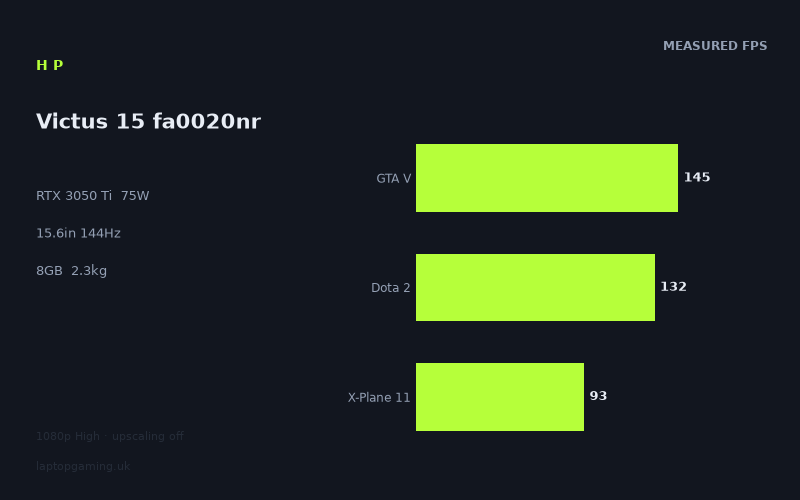
Frame rates
1920×1080, High preset, upscaling off.
Measured on this machine. Source: Notebookcheck, 2022-12-31.
Not scored: incomplete benchmark suite
Every scored laptop on this site is averaged over the same 5 games, and this one is short of Cyberpunk 2077, Baldur's Gate 3. A mean over 5 games is not comparable to a mean over 5, so we publish the figures we have and leave the score blank rather than rank it against machines tested on a different set. The numbers below are real - the suite is just incomplete.
How these numbers were produced
Frame rates here are not measured by us, and we label how each one was arrived at. A figure marked measured comes from a published run on that exact machine. A figure marked representative is derived from the GPU and its power limit (TGP) and cross-referenced against published reviews - a sound estimate of what that configuration delivers, but not a measurement of that specific laptop. Unless stated otherwise, numbers are 1920x1080, High preset, upscaling off. Where a laptop ships in several power configurations we use the wattage of the exact SKU listed, because a 140W RTX 5070 and a 115W one are not the same product.
In use
The short version
The HP Victus 15 fa0020nr is a clear-cut 1080p gaming laptop built around an Intel Core i7-12700H and an Nvidia GeForce RTX 3050 Ti running at a 75W GPU power limit. Notebookcheck’s measured results show a machine that is genuinely quick in lighter and well-established games, with excellent results in GTA V, Dota 2, Strange Brigade, The Witcher 3 and X-Plane 11. It is much less convincing in the more demanding end of the suite, where Final Fantasy XV reaches 55fps and Cyberpunk 2077 1.6 reaches 47fps at the stated 1920x1080 High settings with upscaling off.
That makes the Victus a better fit for someone whose library is centred on competitive games, older blockbuster titles, strategy games, simulation games and less graphically punishing single-player releases than for someone buying specifically to run every new demanding game at high settings. The important distinction is not whether it can play games at all. It plainly can. The question is how consistently it can exploit its 144Hz screen at the settings used for the published figures. In the lighter games, it can. In the heaviest games here, the panel has considerably more refresh headroom than the GPU can fill.
The measured mean across the five scoring-suite games is 107fps. That is a strong-looking average, but it needs reading in context rather than treated as a promise of broadly similar performance in every game. The average is lifted by 145fps in GTA V, 132fps in Dota 2 and 112fps in Strange Brigade. Those are very useful results, particularly for a 144Hz display, but they sit alongside 93fps in X-Plane 11 and 55fps in Final Fantasy XV. Cyberpunk 2077 1.6, outside the scoring suite, is lower again at 47fps. This is not a laptop with a flat, predictable frame-rate profile across very different workloads. It is one that rewards sensible settings choices and an honest view of what RTX 3050 Ti-class graphics can do at 1080p.
The 75W GPU limit is central to that judgement. An RTX 3050 Ti name does not by itself tell a buyer how a laptop will behave, because the GPU is deployed at different power limits in different systems. Here, the published results indicate that HP’s configuration can produce high frame rates in suitable games despite that 75W limit, but it is still not a machine that should be bought on the assumption that the 144Hz panel means 144fps in all modern games at High settings. The measurements make the distinction very plainly.
The 8GB memory allocation is also a specification to notice. It is not possible to establish from the supplied data how it affects any individual benchmark result, and it would be wrong to claim a measured penalty without evidence. Still, 8GB is an unusually tight amount to pair with a Core i7-12700H and a gaming GPU in a machine intended for current games. Buyers who keep multiple applications open while gaming, or who play more demanding games, should treat the memory specification as a point to investigate carefully rather than assuming the CPU and GPU tell the whole story.
There is no confirmed UK price for this exact configuration, so this page cannot assign a score: value is dependent on price, while the benchmark suite itself is complete and the machine ranks normally on the frame-rate leaderboard.
As a specification-led purchase, then, the Victus 15 fa0020nr makes most sense for a buyer who values a 15.6in 1080p IPS display, a 144Hz refresh rate and strong results in lighter games, while accepting that demanding modern releases will require lower expectations or settings changes beyond the High preset used here. It is not the laptop to choose purely because it carries an RTX badge, and it is not the laptop to choose if the main aim is to run every graphically intensive title close to the display’s maximum refresh rate. Its strengths are real, but they are specific.
Performance
What the benchmark data says
Notebookcheck measured the HP Victus 15 fa0020nr at 1920x1080 using the High preset with upscaling off. That test method matters. These are native-resolution figures for the laptop’s screen resolution, not results aided by an upscaling mode, and the same settings give a useful view of how the RTX 3050 Ti at 75W copes when asked to render a conventional 1080p High image.
- GTA V: 145fps
- Dota 2: 132fps
- Strange Brigade: 112fps
- The Witcher 3: 106fps
- X-Plane 11: 93fps
- Final Fantasy XV: 55fps
- Cyberpunk 2077 1.6: 47fps
The five-game scoring-suite mean is 107fps. The first lesson from that number is positive: this is not a weak 1080p gaming result in every respect. The Victus clears 100fps in four of the listed games, and it reaches the display’s 144Hz refresh rate in GTA V by a very small margin. Dota 2 is close enough at 132fps that it should still make effective use of a high-refresh screen, while Strange Brigade and The Witcher 3 remain well above the conventional 60fps target at 112fps and 106fps respectively.
The second lesson is that a mean can hide the games where performance is more constrained. Final Fantasy XV at 55fps is a notably different experience from GTA V at 145fps. Cyberpunk 2077 1.6 at 47fps is further from the panel’s refresh ceiling again. Neither figure means the laptop is incapable of playing those games, but neither supports describing the Victus as a 144fps High-settings machine in demanding modern titles. A buyer concentrating on the mean alone would miss the most important part of the story: the laptop is fast where the workload permits it, rather than universally fast.
The 75W RTX 3050 Ti in context
This Victus uses an RTX 3050 Ti with a 75W GPU power limit. That specification needs more attention than the model name alone. Laptop GPU names are shared across systems with different power limits, different cooling arrangements and different overall platform choices. The performance that matters is the measured result from this particular configuration, not a theoretical expectation based on the GPU label.
At 75W, the Victus produces a mixed but intelligible benchmark spread. It is fast enough to hit 145fps in GTA V and 132fps in Dota 2 at the stated settings. It is also capable of 112fps in Strange Brigade and 106fps in The Witcher 3. These are not token results that merely make a high-refresh panel look good on paper; they are substantial frame rates that should matter to people who play those kinds of games regularly.
But the 75W limit does not turn the RTX 3050 Ti into a high-end GPU. The demanding results make that clear. Final Fantasy XV at 55fps falls below 60fps, while Cyberpunk 2077 1.6 at 47fps falls further short. The fact that those results are measured at 1920x1080, at High settings and without upscaling is useful because it shows exactly where the laptop stands under a demanding native-rendering scenario. The Victus is not relying on a reduced render resolution to generate its published frame rates, but equally it has not reached the performance level where High settings at native 1080p can be assumed to be comfortable in every heavyweight game.
There is an important practical difference between a laptop that is held back by one especially demanding game and one that is broadly underpowered. The Victus is not broadly underpowered in this data. Its results in GTA V, Dota 2, Strange Brigade, The Witcher 3 and X-Plane 11 establish that. The limitation is the width of the gap between the lighter titles and the heaviest ones. A buyer whose regular games resemble GTA V, Dota 2 or Strange Brigade will see a very different side of this laptop from a buyer whose priority is Cyberpunk 2077 1.6-like workload intensity.
The Core i7-12700H should also not be ignored simply because this is a gaming review. The supplied benchmarks do not separate CPU and GPU contribution, so it would be wrong to assign a precise cause to any one result. However, the comparison data later in this review shows why platform balance matters at 1080p. In lighter shared games, CPU limits can compress GPU differences. A laptop’s frame rate is not determined by its graphics chip in isolation, especially when the target resolution is 1920x1080 and frame rates are already high.
Games that suit the Victus well
GTA V is the clearest case for the Victus 15’s combination of hardware and screen. The measured 145fps is effectively aligned with the 144Hz refresh rate. It does not mean every moment of every gameplay scenario will necessarily appear at a fixed rate, because the supplied figure is a benchmark result rather than a guarantee of all possible conditions. What it does show is that the laptop has enough performance at the stated High settings to make the display’s refresh capability relevant rather than ornamental in this game.
Dota 2 at 132fps is similarly well matched to a 144Hz panel. It is below the refresh maximum, but it remains close enough that high-refresh gaming is a meaningful part of the package. For a player who spends much of their time in games of this type, the Victus has a stronger case than the RTX 3050 Ti branding might initially suggest. This is exactly why citing individual measured results matters more than making a blanket judgement from a specification sheet.
Strange Brigade at 112fps and The Witcher 3 at 106fps land in a useful middle ground. Neither fully reaches 144fps, yet both are substantially above 60fps. These figures show a machine that can offer smooth 1080p High gaming in a broad category of established single-player and action games, even if it does not extract every possible refresh cycle from the panel. That is a respectable result for the class of hardware involved, provided the buyer understands that the heavier side of the market looks different.
X-Plane 11 at 93fps reinforces that point. It is not a 144fps result, but it is comfortably above 60fps and gives the laptop a credible result in a simulation title from the scoring suite. The gap from GTA V is significant, and that gap is useful information rather than an inconsistency to dismiss. Different games place different demands on a system. The Victus should be judged by how it behaves across those demands, not by its best number alone.
Games that expose the limits
Final Fantasy XV is where the Victus moves from high-refresh performance into a more conventional 1080p gaming position. At 55fps, the measured figure is close to 60fps but does not reach it at the stated High preset. That makes it an important counterweight to the 107fps scoring-suite mean. A buyer seeking a laptop that can maintain a consistently high frame rate without compromising settings in every demanding game should not treat the mean as sufficient evidence. The individual result is the more relevant one here.
Cyberpunk 2077 1.6 at 47fps is the most demanding result supplied for the Victus. Again, the conditions matter: 1920x1080, High preset and upscaling off. The laptop is rendering at its native screen resolution rather than using an upscaled image, but 47fps is not close to a 144Hz target and is also below the conventional 60fps reference point. For buyers whose most-played games are similarly demanding, this is the number to prioritise over the much higher GTA V or Dota 2 figures.
The sensible conclusion is not that the Victus is unsuitable for demanding games full stop. The supplied data does not justify that. It is that demanding games require more realistic expectations. The benchmark data establishes what the system delivers under one clear set of settings. It does not provide measured results for alternative presets, alternative resolutions or upscaling modes, so none should be promised here. Buyers should therefore approach the laptop as a system whose strongest evidence is for native 1080p High gaming in lighter titles, not as one with demonstrated headroom in the most demanding releases.
This is also why the 144Hz display should not be used as shorthand for the laptop’s performance tier. A high-refresh screen is valuable when the game and settings allow the GPU to provide the frames. The Victus has several measured examples where that happens, and several where it does not. The screen is more capable than the GPU in the heaviest tests; in the lighter tests, the pairing is much better balanced.
Understanding the benchmark spread
The difference from 145fps in GTA V to 47fps in Cyberpunk 2077 1.6 is not a flaw in the benchmark data. It is the most informative feature of it. A gaming laptop should not be assessed as though every game imposes the same rendering workload. The Victus gives excellent results in some titles and much lower results in others because games vary enormously in their graphics demands and in how they use the wider system.
For the buyer, this means game selection should drive the purchase decision. Someone playing Dota 2, GTA V and other titles with comparable demands has evidence that the Victus can be a high-frame-rate 1080p machine. Someone playing mostly newer, graphically intensive games should look first at Final Fantasy XV and Cyberpunk 2077 1.6 rather than assuming the higher results will transfer. There is no honest way to turn 145fps in one game into a claim of 145fps across a library.
The benchmark suite was measured by Notebookcheck on 2022-12-31. That attribution matters. These are published external measurements, not figures generated by Laptop Gaming, and they should be read as such. The useful thing about having them is not the opportunity to make vague claims about “gaming performance”; it is the ability to show exactly where the Victus is comfortable, where it is merely adequate, and where the screen’s potential is beyond what the GPU can demonstrate at the stated settings.
The screen
The Victus 15 fa0020nr has a 15.6in IPS display with a 1920x1080 resolution and a 144Hz refresh rate. On paper, that is the correct kind of panel specification for a gaming laptop built around an RTX 3050 Ti: 1080p is a sensible target resolution for this level of graphics hardware, while 144Hz gives lighter games room to run beyond a basic 60Hz experience.
The key point is that the screen and the measured performance are only partially aligned. In GTA V, the 145fps result reaches the panel’s 144Hz refresh rate. This is the strongest demonstration that the display specification is not wasted. Dota 2 at 132fps comes close, and the 112fps and 106fps results in Strange Brigade and The Witcher 3 respectively still make clear use of a high-refresh panel even though they do not reach its maximum.
X-Plane 11 at 93fps sits further below 144Hz but remains well above 60fps. The screen therefore still has room to display the output the laptop can produce, rather than imposing a low-refresh ceiling. That is a worthwhile match for users who play a mix of simulation, action and older blockbuster games. The Victus does not need to hit 144fps in every title for the 144Hz panel to have a practical role.
In Final Fantasy XV and Cyberpunk 2077 1.6, the relationship changes. At 55fps and 47fps, respectively, the GPU is not supplying anything close to the panel’s maximum refresh rate at the published settings. The 144Hz specification remains a feature of the display, but it should not be mistaken for proof that the laptop will provide 144fps in graphically intensive games. The measurements specifically contradict that assumption.
The 1920x1080 resolution is a more consistently sensible part of the pairing. The benchmark figures supplied are all at that native resolution, and they show why 1080p remains appropriate here. A higher-resolution panel would demand more graphics performance, while the existing screen allows the Victus to deliver more than 100fps in several titles. There is no need to claim that 1080p is universally preferable for every buyer; screen preferences vary. But for this GPU and these results, it is a coherent choice.
The IPS panel type is worth noting because it distinguishes the screen specification, but the supplied information does not include measured brightness, colour coverage, contrast, response behaviour or any assessment of backlight behaviour. Those omissions matter for buyers who want the laptop for colour-sensitive work, film viewing or particularly demanding competitive use. It would be misleading to infer display quality from the IPS label alone. The facts available establish panel type, size, resolution and refresh rate, not the full quality of the panel.
For gaming specifically, the screen is best thought of as a flexible 1080p 144Hz display rather than a promise of constant maximum-refresh gaming. It can be fully exercised in GTA V, closely approached in Dota 2, and used effectively in Strange Brigade and The Witcher 3. In the heaviest measured games, it provides headroom the hardware does not fill at High settings with upscaling off. That is not an unusual arrangement in a gaming laptop, but the distinction should be explicit before purchase.
Build, size and portability
The supplied physical specification confirms a weight of 2.331kg. That places the Victus in a category where portability should be considered in practical terms rather than assumed from the 15.6in screen size. A 15.6in laptop can still be a sensible machine for moving between rooms, taking to study or work locations, or packing for occasional travel. At 2.331kg, however, the weight is substantial enough that a buyer planning to carry it regularly should treat it as an important part of the decision.
It is better described as a laptop that can travel than as one whose main appeal is minimal carry weight. That is not criticism for its own sake. Gaming hardware, a 15.6in display and a 70Wh battery are all part of this model’s stated specification, and buyers have different priorities. For someone who mainly wants a system used in one location but occasionally moved, 2.331kg may be entirely acceptable. For someone who expects to carry it every day, it deserves closer consideration than the gaming results alone.
No dimensions are provided in the fact sheet, so there is no basis here to claim that the Victus is thin, compact, unusually deep or particularly easy to fit into a particular bag. Weight is the only supplied portability measurement. The same restraint applies to chassis materials, keyboard quality, trackpad behaviour, port selection, upgrade access and cooling design: none is established by the available facts, so none should be invented to fill out a specification-led review.
The 70Wh battery is another figure that should be interpreted carefully. Battery capacity is given, but no measured battery-life result is supplied. It is therefore possible to say that the Victus has a 70Wh battery, but not to claim how long it lasts for browsing, video, work or gaming. Those outcomes depend on workload and system behaviour, and no attributable endurance measurement appears in the facts provided. Buyers for whom unplugged use is central should seek a battery-life test for this exact configuration rather than drawing conclusions from capacity alone.
The combination of a 15.6in screen, 2.331kg weight and 70Wh battery points to a machine intended to balance gaming capability with some mobility, but that is a broad use-case reading rather than a claim about everyday handling. What can be stated confidently is that the Victus is not an ultra-light device according to the supplied weight, and that it has more battery capacity information available than battery-life evidence. The distinction is worth preserving because portability claims often become more confident than the data allows.
For a buyer choosing between gaming laptops, the weight may matter as much as a small benchmark difference if the machine will be carried often. Conversely, someone using the Victus mainly at a desk may reasonably put far more emphasis on the 1080p gaming figures, the 144Hz IPS screen and the CPU-GPU pairing. The right interpretation depends on use, but the specification does not support presenting the laptop as either effortlessly portable or immovable. It is a 2.331kg 15.6in gaming laptop, and that is the useful starting point.
How it compares
The comparison figures below are based only on games held in common with each rival, with preference given to the scoring suite. That limitation is important. A shared-game average is not a universal measure of total system performance, and it should not be treated as one. It is a controlled way of showing how the Victus’s published results sit among laptops from the same GPU generation when the game overlap permits a like-for-like comparison.
Against the MSI Prestige 15
Against the MSI Prestige 15 with an RTX 3050 Ti at 105W, the HP Victus 15 fa0020nr averages 52fps ahead across four shared games. This is the largest positive comparison supplied for the Victus, and it is striking precisely because both machines are described as RTX 3050 Ti systems.
The difference is a useful warning against buying from the GPU label alone. The MSI is listed with a 105W RTX 3050 Ti, while the HP is listed with a 75W RTX 3050 Ti, yet the shared-game comparison favours the Victus by a substantial amount. The supplied data does not explain every technical reason for that outcome, and it would be inappropriate to invent one. What it does establish is that a higher stated GPU power limit on a rival is not enough, by itself, to predict the published game results.
For the buyer, the takeaway is simple. Do not assume that the Prestige’s 105W figure guarantees it will outperform this 75W Victus in the games that matter to you. The shared benchmark data says the opposite across the games available for comparison. That does not prove the Victus will be ahead in every unmeasured game, but it is much stronger evidence than a generic power-limit argument.
Against the Schenker XMG Neo 17
Against the Schenker XMG Neo 17, an early 2021 machine with an RTX 3070 and Ryzen 7 5800H, the Victus averages 0fps difference across three shared games. A near-zero result is a real result, not an error to gloss over. It does not mean the RTX 3050 Ti and RTX 3070 are interchangeable graphics products, nor does it mean the machines are identical in every workload. It means that, in the limited shared-game set available here, the published average is level.
The reason such a result can occur is provided by the comparison context: at 1080p, lighter titles in the shared set can be CPU-bound and can compress genuine GPU differences. Once the limiting factor is no longer solely graphics performance, a more powerful GPU cannot necessarily create a proportionate advantage. That is especially relevant when frame rates are already high and the game is not placing the same kind of pressure on the graphics hardware as a demanding modern title.
This is exactly why benchmark comparison needs care. A buyer who sees an RTX 3070 might reasonably expect a broad graphics advantage, but the three shared games do not show it in their average. That does not overturn the GPU hierarchy in all circumstances; it describes these particular shared 1080p results. The Victus should receive credit for matching the Neo 17 in this comparison, but not credit for claims the limited overlap cannot support.
Against the Alienware m15 R5 Ryzen Edition
The Alienware m15 R5 Ryzen Edition uses an RTX 3060 at 125W. Across five shared games, the HP Victus averages 1fps behind. Like the draw against the XMG Neo 17, this is a near-zero outcome that needs explanation rather than repetition.
The Alienware’s RTX 3060 and 125W GPU power limit might lead a buyer to predict a straightforward, meaningful lead over the Victus’s RTX 3050 Ti at 75W. In this specific shared-game average, that lead does not materialise. The result is effectively level, with the Victus only 1fps behind. The supplied comparison context again matters: lighter games at 1080p can become CPU-bound, compressing genuine GPU differences. A shared average dominated by such games can make systems with materially different graphics specifications look far closer than a demanding GPU-limited title would.
The correct conclusion is not that the Victus has the same gaming headroom as every RTX 3060 laptop. It is that its measured performance is highly competitive with this particular Alienware in the five shared games. For someone choosing based on those games, the Victus’s result is encouraging. For someone choosing for demanding newer games, the Victus’s own 55fps Final Fantasy XV and 47fps Cyberpunk 2077 1.6 results remain the more useful evidence of where its limits lie.
Against the MSI Raider GE77 HX
The MSI Raider GE77 HX, with an RTX 3080 Ti at 175W, is the strongest rival in the supplied spread. Across five shared games, the Victus averages 62fps behind. Unlike the near-level comparisons with the XMG Neo 17 and Alienware m15 R5 Ryzen Edition, this is a large separation and a reminder that the Victus is not competing at the top end of the same GPU generation.
That 62fps deficit is valuable context for the 107fps scoring-suite mean. The Victus can post high figures in lighter titles, but a much more powerful 175W RTX 3080 Ti system creates a substantial advantage across the shared selection. Buyers who want more performance margin for demanding games, higher frame rates across a broader range of titles, or greater likelihood of using a 144Hz panel fully should understand that the Victus’s impressive best results do not make it a substitute for a high-power top-tier gaming laptop.
At the same time, the comparison does not diminish what the Victus does well. It shows the expected performance gulf between a 75W RTX 3050 Ti laptop and a 175W RTX 3080 Ti laptop in the games where the higher-tier system can demonstrate its advantage. The Victus is not trying to occupy that class. Its strongest case is efficient targeting of 1080p gaming in the games its measured results suit, not pursuit of the highest available frame rates in every workload.
What the rival spread actually tells us
Taken together, these comparisons are more informative than a single nearest-rival matchup. The Victus is 52fps ahead of the MSI Prestige 15 across four shared games, level with the Schenker XMG Neo 17 across three, 1fps behind the Alienware m15 R5 Ryzen Edition across five, and 62fps behind the MSI Raider GE77 HX across five.
That range shows two things at once. First, laptop gaming performance is not reliably predicted by GPU naming or one stated GPU power limit. The Victus can outperform another RTX 3050 Ti system that lists a higher power limit, and it can match or nearly match systems carrying RTX 3070 and RTX 3060 graphics in the specific lighter 1080p shared sets. Second, there remains a substantial gap to a high-power RTX 3080 Ti machine when the comparison has enough room for that difference to appear.
The CPU-bound explanation is especially important for the close comparisons. At 1080p in lighter titles, performance can become limited by the processor side of the system rather than by raw GPU capability, which compresses real graphics differences. That is why a 0fps average difference or 1fps deficit should not be read as proof that all these GPUs are functionally the same. It is evidence about the games shared, at the tested resolution and settings, and nothing more.
For a buyer, the most useful approach is to match the comparison to the intended library. If your games resemble the lighter shared titles, the Victus’s close results against stronger-labelled rivals are meaningful. If your priorities resemble the demanding titles in the Victus’s own list, the lower Final Fantasy XV and Cyberpunk 2077 1.6 results, plus the large deficit to the Raider, are more relevant. The data supports both observations. A good purchase decision depends on knowing which one applies to you.
Who it’s for
The HP Victus 15 fa0020nr is for the buyer who wants a 15.6in 1080p gaming laptop and has a game library that allows its RTX 3050 Ti at 75W to show its stronger side. GTA V at 145fps, Dota 2 at 132fps, Strange Brigade at 112fps, The Witcher 3 at 106fps and X-Plane 11 at 93fps give it a credible case for players who value frame rate in lighter, established or less graphically punishing games. Those figures are not vague potential; they are attributable Notebookcheck measurements at 1920x1080 High with upscaling off.
It is also for someone who specifically wants a 144Hz screen but understands what that means in practice. In GTA V, the laptop can meet the refresh rate. In Dota 2, it comes close. In Strange Brigade and The Witcher 3, it remains well above 100fps. That is enough evidence to say the display is useful rather than excessive for a substantial part of the measured library.
The Victus is a plausible fit for users who divide time between gaming and processor-heavy general work, given the Core i7-12700H, but the supplied facts do not include application benchmarks, so no specific productivity performance claim should be made. The same buyer should pay attention to the 8GB memory specification, particularly if they expect to run demanding software alongside games. There is no measured memory analysis in the available data, but the capacity itself is clear and should not be overlooked.
It can also suit someone who needs some mobility without requiring an ultra-light machine. The 2.331kg weight does not prevent transport, but it should be accepted as part of the ownership proposition rather than treated as negligible. The 70Wh battery is a known capacity, though not a known battery-life result. Buyers who mainly use the machine near mains power may find that entirely workable; buyers whose decision depends on measured unplugged endurance need further evidence.
The Victus is not for the buyer whose main goal is to run demanding modern games at High settings near 144fps. Final Fantasy XV at 55fps and Cyberpunk 2077 1.6 at 47fps are decisive evidence against that expectation under the published test conditions. The laptop may still be usable in those games, but the figures do not support buying it as a no-compromise high-refresh machine.
It is not for someone who expects an RTX 3050 Ti name to guarantee a consistent performance level across all titles. The Victus’s 75W configuration delivers a wide spread, from 145fps in GTA V to 47fps in Cyberpunk 2077 1.6. That spread is normal information about differing workloads, but it means the buyer needs to choose according to actual games rather than a single headline average.
It is also not the obvious choice for someone who wants maximum graphics headroom from this GPU generation. The MSI Raider GE77 HX’s 175W RTX 3080 Ti is 62fps ahead across five shared games, demonstrating the scale of performance available in a much higher tier. The Victus can look remarkably close to some stronger-labelled rivals in lighter shared 1080p titles, but the comparison data explains why those gaps can be compressed by CPU limits. It would be a mistake to turn those close averages into a claim that the Victus offers the same margin in demanding GPU-limited games.
Finally, it is not for anyone who needs a purchase decision based on confirmed UK value. There is no confirmed UK price for this exact configuration. Without that, the laptop can be assessed on its measured performance and stated specifications, but not judged honestly as cheap, expensive, good value or poor value in the UK market.
The strongest argument for the HP Victus 15 fa0020nr is therefore focused rather than universal: it is a 1080p, 144Hz gaming laptop with strong attributable results in several popular and relatively lighter games, a capable Core i7-12700H, and a performance profile that is far more attractive when your regular games resemble GTA V, Dota 2, Strange Brigade, The Witcher 3 or X-Plane 11 than when they resemble Final Fantasy XV or Cyberpunk 2077 1.6. Buy it for that measured reality, not for an imagined version of what an RTX 3050 Ti laptop ought to deliver.