Review
MSI GS66 Stealth review
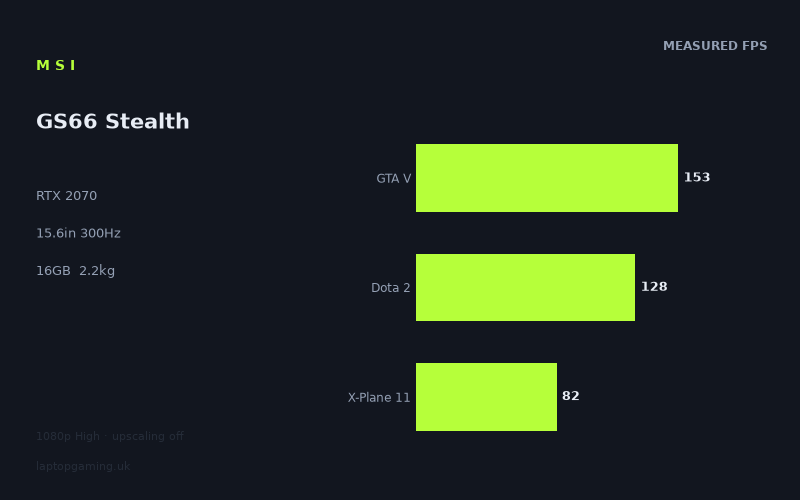
Frame rates
1920×1080, High preset, upscaling off.
Measured on this machine. Source: Notebookcheck, 2020-05-02.
Not scored: incomplete benchmark suite
Every scored laptop on this site is averaged over the same 5 games, and this one is short of Cyberpunk 2077, Baldur's Gate 3. A mean over 3 games is not comparable to a mean over 5, so we publish the figures we have and leave the score blank rather than rank it against machines tested on a different set. The numbers below are real - the suite is just incomplete.
How these numbers were produced
Frame rates here are not measured by us, and we label how each one was arrived at. A figure marked measured comes from a published run on that exact machine. A figure marked representative is derived from the GPU and its power limit (TGP) and cross-referenced against published reviews - a sound estimate of what that configuration delivers, but not a measurement of that specific laptop. Unless stated otherwise, numbers are 1920x1080, High preset, upscaling off. Where a laptop ships in several power configurations we use the wattage of the exact SKU listed, because a 140W RTX 5070 and a 115W one are not the same product.
In use
The short version
The MSI GS66 Stealth (10SFS) is a capable 1080p gaming laptop whose measured results show strong performance across a broad range of titles, but it is not a machine that can routinely make full use of its 300Hz screen at the stated High preset. Notebookcheck’s figures show it reaching 196fps in FIFA 20, 153fps in GTA V and 141fps in Doom Eternal, which is excellent performance for a laptop with an RTX 2070. The same data also shows a much more demanding side to the picture: Shadow of the Tomb Raider runs at 102fps, Star Wars Jedi Fallen Order at 95fps, Need for Speed Heat at 88fps and Borderlands 3 at 76fps.
That makes the GS66 easier to recommend as a generally fast gaming machine than as a laptop bought specifically to justify a 300Hz panel. The display is a real advantage in the lighter games where the measured frame rates get nearer to its refresh ceiling, but the GPU cannot reach 300fps in any of the supplied results. That is not a failure of the laptop: 300Hz is an exceptionally high refresh target, and even a fast RTX 2070 system will only get close in favourable workloads or with settings reduced from the High preset used in the benchmark data. What matters is that buyers should not confuse a 300Hz screen with a guarantee of 300fps.
The strongest practical argument for this configuration is consistency. Notebookcheck recorded more than 100fps in FIFA 20, GTA V, Doom Eternal, Apex Legends, The Witcher 3, Dota 2, Battlefield V, Escape from Tarkov, Gears Tactics and Shadow of the Tomb Raider. That is a substantial run of games, and it means the GS66 is not relying on one unusually flattering result. Its measured mean across the available scoring-suite titles, GTA V, Dota 2 and X-Plane 11, is 121fps. That is useful context, but it must not be treated as a complete ranking result: there are no supplied figures for Final Fantasy XV or Strange Brigade, so this laptop cannot be fairly ranked against systems measured across the full scoring suite.
The missing UK price is a major limitation for any buying verdict. Without a confirmed GBP price, it is not possible to call the GS66 good value, poor value or fairly priced. The specification is clearly substantial for its class: Core i9-10980HK processor, RTX 2070 graphics, 16GB of memory, 2000GB SSD storage and a 15.6in 1080p IPS panel with a 300Hz refresh rate. But a specification does not establish value on its own. The same measured frame rates could look compelling beside one price and difficult to justify beside another.
Buy this model if the priority is a 15.6in 1080p laptop with a very high-refresh IPS display and measured High-preset performance that is usually well into three figures, while accepting that the display has more headroom than the GPU can exploit in most of the supplied games. It is also a reasonable fit for someone who wants 2000GB of SSD capacity without immediately needing to think about storage expansion. Do not buy it simply because it says 300Hz, and do not assume that the Core i9 name guarantees a major lead over every competing RTX 2080 laptop. The rival data makes that last point especially clear.
Performance
What the measured figures show
The performance data comes from Notebookcheck, dated 2020-05-02, using 1920x1080 resolution, the High preset and upscaling disabled. That configuration matters. These are not maximum-frame-rate figures obtained by reducing visual settings to chase the panel refresh rate, and they are not results at a higher-resolution external display. They show how the GS66 performs in a demanding but still sensible 1080p gaming configuration.
The highest supplied result is FIFA 20 at 196fps. That is the clearest example of the GS66 operating in the territory where a 300Hz screen can offer a visible practical benefit over a conventional high-refresh panel, even if 196fps remains below the display’s full refresh ceiling. GTA V follows at 153fps, while Doom Eternal reaches 141fps and Apex Legends reaches 140fps. Those results establish that the RTX 2070 configuration is capable of very high frame rates in some games at the stated settings.
The next group is only slightly lower, and it is important not to dismiss it as a weak result merely because it does not approach 300fps. The Witcher 3 records 131fps, Dota 2 records 128fps, Battlefield V records 121fps and Escape from Tarkov also records 121fps. Gears Tactics is measured at 116fps. These are all substantial outputs for High-preset 1080p gaming, and they place the GS66 in a very usable range for a 300Hz panel even where it cannot saturate the panel. A display does not become irrelevant below its maximum refresh rate; it simply has capacity that the system is not fully using in that particular game and setting.
Shadow of the Tomb Raider at 102fps is a useful dividing line in the data. It remains above the three-figure mark, but it shows how quickly a game can move the GS66 away from the screen’s upper range. Star Wars Jedi Fallen Order at 95fps, Hunt Showdown at 92fps, Need for Speed Heat at 88fps and X-Plane 11 at 82fps continue that pattern. Borderlands 3, at 76fps, is the lowest result supplied. The span from 196fps in FIFA 20 to 76fps in Borderlands 3 is wide enough that the GS66 should be judged as a machine with title-dependent performance rather than as a laptop that delivers one predictable frame-rate class across everything.
That spread is normal for gaming benchmarks because games do not make identical demands of a laptop. The important buying point is not to look only at the best result, or only at the mean. Someone primarily interested in the games near the top of this list will have a materially different experience from someone whose library resembles the lower end of the list. The GS66 is fast in both cases, but the display relationship changes. At 196fps, 153fps, 141fps and 140fps, the 300Hz panel has clear headroom to present a very rapid stream of frames. At 95fps, 92fps, 88fps, 82fps and 76fps, the machine is still producing strong results, but the panel’s headline refresh rate is far less central to the buying decision.
The available scoring-suite data
GTA V, Dota 2 and X-Plane 11 are the supplied scoring-suite results. They return 153fps, 128fps and 82fps respectively, for a mean of 121fps. This is a useful snapshot because it contains a broad internal spread rather than three nearly identical results. GTA V is the most favourable of the available scoring games, Dota 2 is close behind, and X-Plane 11 is markedly lower. A buyer should take that variation seriously: averaging can be useful, but it can also conceal the fact that some games are much closer to the 300Hz target than others.
The 121fps mean should also be handled carefully. It does not mean every game will run around 121fps, as the rest of the measured list plainly demonstrates. It also does not mean the GS66 can be placed in a complete scored ranking. The scoring suite is incomplete because Final Fantasy XV and Strange Brigade figures are not available. Every fully scored laptop is averaged over the same five games, so comparing a partial three-game mean with a complete five-game average would give a false impression of precision. The honest conclusion is that the available suite data is encouraging but incomplete.
There is another reason not to over-read a single average: the GS66’s practical appeal rests partly on its ability to deliver high frame rates in a broad selection of titles, not merely on one combined figure. Doom Eternal at 141fps, Apex Legends at 140fps, The Witcher 3 at 131fps, Battlefield V at 121fps and Escape from Tarkov at 121fps all support the view that this is a genuinely fast 1080p machine. At the same time, Borderlands 3 at 76fps and X-Plane 11 at 82fps show that the hardware has limits at the chosen quality setting. Both parts of the story need to be present.
GPU power limit: what can and cannot be concluded
The fact sheet identifies the graphics processor as an RTX 2070, but it does not state a GPU power limit. That means there is no reliable basis here for claiming a particular wattage, describing the GPU as a lower-power or higher-power RTX 2070 implementation, or attributing the frame-rate results to a specific graphics power setting. Laptop GPU names alone are not enough to establish that. The measured results are the evidence available, and they are more useful to a buyer than an unsupported assumption about the configuration.
What can be said is that this RTX 2070 implementation produces a result profile ranging from 76fps to 196fps in the supplied High-preset 1080p tests. It is strong enough to maintain three-figure results in a large portion of the list, but it does not produce the same outcome in every game. If a buyer is trying to decide whether the GS66 has enough graphics performance for a particular target, the named game results are more dependable than a broad claim based on the RTX 2070 label.
The absence of a stated power limit also makes the comparison section more important. The GS66 is compared with several RTX 2080 laptops, and its results do not map neatly onto the expectation that a higher GPU name must always lead. The GS66 is ahead of the Lenovo Legion Y740-17IRHg-81UJ001VGE by 4fps across three shared games and ahead of the Acer Predator Triton 500 by 2fps across three shared games. It trails the Alienware m17 R3 by 24fps across three shared games. Those results are not contradictory. They show that the laptop implementation, the shared game set and the balance between processor and graphics limits all matter.
How close is it to the 300Hz display target?
The simplest answer is that the GS66 gets closest in FIFA 20, where Notebookcheck recorded 196fps. That is still below 300Hz, but it is the strongest supplied result and it uses a meaningful proportion of the panel’s refresh capability. GTA V at 153fps, Doom Eternal at 141fps and Apex Legends at 140fps are lower again, but they remain clearly in the high-frame-rate category. These are the games in which the screen specification feels most relevant.
The Witcher 3 at 131fps and Dota 2 at 128fps are also good matches for a high-refresh display, even though they are much closer to 100fps than to 300fps. Battlefield V and Escape from Tarkov, both at 121fps, reinforce the point. A 300Hz panel is not a binary feature that only matters at 300fps. Its practical value varies with the game output, and these results show the GS66 using a meaningful amount of that capability across several titles.
At 102fps in Shadow of the Tomb Raider, the machine remains in three-figure territory, but the gap to the display ceiling is large. Below that point, Star Wars Jedi Fallen Order at 95fps, Hunt Showdown at 92fps, Need for Speed Heat at 88fps, X-Plane 11 at 82fps and Borderlands 3 at 76fps make the panel’s 300Hz headline less relevant than the underlying game performance. These are not poor results in isolation. They are simply not results that justify buying the GS66 specifically for the ability to feed every available panel refresh.
That distinction should shape expectations. Buyers who want a laptop for titles resembling FIFA 20, GTA V, Doom Eternal and Apex Legends can reasonably view the 300Hz display as a useful part of the package. Buyers focused on titles resembling Borderlands 3, X-Plane 11, Need for Speed Heat or Star Wars Jedi Fallen Order should judge the GS66 primarily as a fast 1080p laptop rather than a 300fps machine. The measured data supports both descriptions, depending on the workload.
The screen
The GS66 uses a 15.6in IPS display with a 1920x1080 resolution and a 300Hz refresh rate. On paper, this is a focused gaming display specification. The resolution keeps the GPU workload at 1080p rather than asking the RTX 2070 to drive a higher-resolution panel, while the 300Hz refresh rate leaves considerable room for games that can produce exceptionally high frame rates.
The IPS panel type is significant because it identifies the display technology, but the fact sheet does not provide brightness, contrast, colour coverage, response-time or calibration measurements. Those details should not be assumed. There is no published information here to support a verdict on outdoor visibility, creative-work colour accuracy, black levels or motion response beyond the stated refresh rate. The safe conclusion is narrower: this is a 15.6in 1080p IPS panel with an unusually high 300Hz refresh specification.
The performance data gives the screen context that a specification table cannot. FIFA 20 at 196fps is the closest result to the display’s ceiling, followed by GTA V at 153fps. Doom Eternal at 141fps and Apex Legends at 140fps also make effective use of a panel built for high frame rates. In these titles, the screen is not a decorative specification. The machine is delivering enough frames for the high refresh capability to matter.
However, the GS66 does not reach 300fps in any measured game. That needs saying plainly because a 300Hz display can create an unrealistic expectation that games will routinely operate at that level. Notebookcheck’s results show no such outcome at 1920x1080, High settings and upscaling off. The closest supplied result, 196fps in FIFA 20, is well short of the panel’s maximum refresh rate. Therefore, the 300Hz screen should be understood as headroom rather than a target that this configuration consistently meets.
There is still a practical argument for the panel even when the measured figure is below 300fps. A display can show frame rates below its maximum refresh rate, and the results between 121fps and 196fps are substantial. The GS66 spends much of the supplied test list in that range: FIFA 20 at 196fps, GTA V at 153fps, Doom Eternal at 141fps, Apex Legends at 140fps, The Witcher 3 at 131fps, Dota 2 at 128fps, Battlefield V at 121fps and Escape from Tarkov at 121fps. For a buyer who values high frame-rate play across several games, that is a persuasive group of results.
The caveat is value, and it cannot be resolved without a UK price. A 300Hz IPS panel is a premium-oriented specification. If the GS66 were priced aggressively, the panel would be a welcome advantage even for games that do not approach its ceiling. If it carried a substantial premium over alternatives with lower-refresh screens, the buyer would need to decide whether the games they actually play justify that premium. Because no confirmed GBP price is supplied, that judgement cannot be made here.
The 1080p resolution is also the sensible match for the available GPU performance. The benchmark figures are all at the panel’s native stated resolution, so there is no need to infer how the machine might behave at a different resolution. The data already shows a broad spread at 1080p, from 196fps to 76fps. Moving to a higher-resolution target would be a different workload and there are no figures here to quantify it. For this review, the relevant conclusion is that the GS66 is designed around 1080p high-refresh gaming, and the supplied results support that design more strongly in some games than in others.
Build, size and portability
The GS66 weighs 2.167kg. That is the only supplied physical measurement, so it is the only firm basis for discussing portability. At 2.167kg, this is a laptop that can be moved between places, but the weight should be considered part of the buying decision rather than ignored because the model name includes “Stealth”. It is not possible from the fact sheet to describe its chassis thickness, footprint, materials, hinge behaviour, keyboard feel, trackpad quality, port selection or construction quality. None of those details are provided.
The important practical point is that the GS66 combines a 15.6in display, RTX 2070 graphics, Core i9-10980HK processor, 16GB of memory and 2000GB of SSD storage in a system weighing 2.167kg. That is a substantial performance-and-storage package to carry, but potential buyers should judge that figure against their own routine rather than assume it is either effortlessly portable or unreasonably heavy. The fact sheet does not include the weight of a charger, so the complete travel load cannot be calculated.
The lack of dimensions matters. A 2.167kg laptop can have a very different bag fit depending on its width, depth and thickness, and those measurements are not available. It would be wrong to claim that the GS66 is compact, slim, large or bulky without them. It would also be wrong to make a thermal or acoustic judgement from the weight alone. There are no supplied temperature figures and no noise figures, so there is no evidence here for saying how the machine behaves under sustained load in those areas.
Storage is one area where the configuration is straightforwardly useful. The 2000GB SSD capacity is generous within the stated specification and reduces the immediate pressure to choose between installed games. This is particularly relevant to a laptop intended for a wide mix of titles, because the benchmark list itself spans FIFA 20, GTA V, Doom Eternal, Apex Legends, The Witcher 3, Dota 2, Battlefield V, Escape from Tarkov, Gears Tactics, Shadow of the Tomb Raider, Star Wars Jedi Fallen Order, Hunt Showdown, Need for Speed Heat, X-Plane 11 and Borderlands 3. The point is not that every buyer will install those particular games, but that this is a configuration intended for varied use rather than a narrow single-game setup.
The 16GB memory allocation is part of the stated configuration, but the fact sheet offers no memory-upgrade information, memory speed or channel arrangement. It is enough to identify what is included, not enough to make claims about upgradeability or explain individual benchmark outcomes. Similarly, the Core i9-10980HK is named, but no processor benchmark results are supplied. The gaming figures demonstrate the behaviour of the complete laptop configuration, not isolated processor performance.
Battery life is not provided. Buyers considering the GS66 as a travel machine should not assume endurance from the 2.167kg figure, the 15.6in screen size or the Stealth branding. The same applies to charging behaviour and battery performance while gaming. There are no supplied measurements, so those questions remain open rather than negative or positive.
How it compares
The rival set is unusually useful because it includes lower-tier graphics, nominally higher-tier graphics and more than one RTX 2080 implementation. The comparisons are only across games both machines hold, with preference given to the scoring suite. That shared-game limitation is important. These are not broad claims that one laptop is universally faster in every title; they are attributable comparisons over the available common results.
Against the Acer Aspire 17
The Acer Aspire 17 uses an RTX 2050 at 35W and is listed at GBP 1,099. Across three shared games, the GS66 averages 32fps more. This is the clearest performance separation among the listed rivals in the GS66’s favour. The MSI has an RTX 2070 rather than an RTX 2050, and the shared-game result indicates a material real-world advantage rather than a tiny benchmark difference that could disappear in normal variation.
That does not automatically make the GS66 the better purchase, because its UK price is not confirmed. The Aspire’s GBP 1,099 price gives a concrete value reference, while the GS66 cannot be placed against it financially. What can be said is that a buyer choosing between the two would be trading a measurable performance deficit in the Aspire for whatever price difference existed at the point of purchase. The GS66’s 32fps shared-game lead is large enough that it should not be dismissed, particularly for someone buying around the high-refresh 1080p experience.
The screen specification also differs in practical ambition, though only the GS66 display details are supplied here. The MSI has a 15.6in 1920x1080 300Hz IPS panel. The benchmark data shows why the stronger GPU matters to such a panel: the GS66 reaches 196fps in FIFA 20, 153fps in GTA V, 141fps in Doom Eternal and 140fps in Apex Legends. There is no basis in this fact sheet for making a direct display comparison with the Aspire, but the GS66’s own display and performance combination is clearly aimed at high frame rates.
Against the Lenovo Legion Y740-17IRHg-81UJ001VGE
The Lenovo Legion Y740-17IRHg-81UJ001VGE has an RTX 2080, yet the GS66 averages 4fps more across three shared games. That is a near-zero difference in the context of a buying decision, and it should not be presented as evidence that the GS66’s RTX 2070 is broadly superior to every RTX 2080 laptop. The supplied comparison guidance explains why such small gaps can occur: at 1080p, lighter titles in the shared set can become CPU-bound, compressing genuine GPU differences.
That explanation matters because the comparison is otherwise counterintuitive. Buyers often expect a simple hierarchy from the GPU label. The shared-game result says the two machines are effectively very close in that limited selection, not that their graphics hardware should be considered interchangeable under every workload. The GS66’s 4fps advantage may be real in the measured shared games, but it is too small to serve as a reason on its own to select the MSI over the Lenovo.
There is no confirmed UK price for the Lenovo, so this comparison cannot be turned into a value verdict either. A buyer deciding between them would need current pricing, screen details, physical measurements, battery data, noise data and other missing information before making a complete choice. Based on the attributable benchmark comparison alone, the sensible conclusion is that the GS66 is not outclassed by this RTX 2080 rival in the available shared games.
Against the Acer Predator Triton 500
The Acer Predator Triton 500 is another RTX 2080 rival with no confirmed UK price. The GS66 averages 2fps more across three shared games. This is even closer than the Lenovo result and should be treated as a practical tie in the narrow shared-game context, rather than inflated into a major win for the RTX 2070 machine.
The same 1080p CPU-bound effect is relevant here. The lighter shared titles can compress genuine graphics differences, which means a very small lead should not be interpreted as proof that the graphics performance is identical across a wider game library. It does, however, tell buyers something valuable: they should not reject the GS66 merely because another option has an RTX 2080 badge. In the available common data, the MSI is not behind the Predator Triton 500.
For the GS66, this is a reassuring result rather than a decisive one. The MSI’s own measured list remains more useful for setting expectations: it reaches 153fps in GTA V, 128fps in Dota 2 and 82fps in X-Plane 11, giving the available scoring-suite mean of 121fps. But because the full suite is incomplete, there is no complete score-based ranking to claim. The direct shared-game comparison is the proper evidence, and it says the two systems are extremely close in the games available.
Against the Alienware m17 R3
The Alienware m17 R3 is the rival that beats the GS66 by the largest supplied margin. It uses an RTX 2080 and the GS66 averages 24fps less across three shared games. Unlike the 4fps and 2fps gaps against the Lenovo and Acer RTX 2080 laptops, 24fps is a meaningful separation. It suggests that buyers whose priority is extracting the highest available performance from the shared games should treat the Alienware as the stronger option.
That does not mean the GS66 is slow. Its own figures remain strong: 196fps in FIFA 20, 153fps in GTA V, 141fps in Doom Eternal, 140fps in Apex Legends and 131fps in The Witcher 3. It means that the Alienware’s shared-game lead is large enough to matter, especially for buyers trying to push high-refresh displays harder in the games they play. If the goal is simply the highest frame rate and the machines are otherwise viable options, the GS66 does not have the benchmark advantage over this rival.
Again, there is no confirmed UK price for the Alienware m17 R3, so the performance lead cannot be weighed against a price premium. It may be justified, it may not be, and the fact sheet does not establish that. The correct conclusion is limited but useful: the Alienware is faster by 24fps on average across the available shared games, while the GS66 offers its own 15.6in 1080p 300Hz IPS display, 2.167kg weight and 2000GB SSD configuration. Which matters more depends on current pricing and the buyer’s priorities.
Who it’s for
The GS66 Stealth is for the buyer who wants strong measured 1080p performance across a varied game list and values the headroom of a 300Hz IPS panel. It is particularly suited to someone who plays titles where the Notebookcheck figures are at the upper end of the supplied range: FIFA 20 at 196fps, GTA V at 153fps, Doom Eternal at 141fps and Apex Legends at 140fps. In those games, the machine produces the kind of frame rates that make a very high-refresh display feel like a relevant feature rather than a line on a specification sheet.
It also suits someone who wants broad rather than narrowly targeted performance. The GS66 does not only produce high results in one or two titles. The Witcher 3 at 131fps, Dota 2 at 128fps, Battlefield V at 121fps, Escape from Tarkov at 121fps, Gears Tactics at 116fps and Shadow of the Tomb Raider at 102fps demonstrate substantial capability across the rest of the upper and middle range. The 2000GB SSD is a meaningful practical benefit for someone maintaining a larger installed library, while the 16GB memory and Core i9-10980HK form part of a clearly high-end overall configuration.
It is also a credible choice for the buyer who wants to carry a gaming laptop between locations but is prepared to account for a 2.167kg machine. The available data supports describing it as a laptop rather than a desktop replacement in the literal sense that it has a stated portable form factor and weight, but it does not support stronger claims about convenience, bag fit or travel endurance. Buyers for whom portability is paramount should seek dimensions, charger weight and battery measurements before deciding.
The GS66 is not the right purchase for someone expecting High-preset 1080p gaming at 300fps across the supplied list. No Notebookcheck result reaches the panel’s 300Hz ceiling. FIFA 20 at 196fps is the nearest, and even that remains below the maximum refresh rate. The games lower in the list, including Borderlands 3 at 76fps, X-Plane 11 at 82fps, Need for Speed Heat at 88fps and Star Wars Jedi Fallen Order at 95fps, demonstrate that the laptop’s real position is fast high-refresh 1080p gaming, not universal 300fps gaming.
It is also not the right machine for a buyer who needs confirmed value before purchasing. There is no confirmed UK price, and without one there is no responsible way to judge whether the Core i9, RTX 2070, 300Hz IPS screen and 2000GB SSD are competitively priced. The Acer Aspire 17 provides a useful lower-priced comparison point at GBP 1,099, but the GS66’s 32fps shared-game advantage cannot be converted into a value recommendation without knowing what the MSI costs.
Buy something else if the priority is the strongest available shared-game performance among the named rivals and the Alienware m17 R3 is available on acceptable terms. The GS66 trails that RTX 2080 system by 24fps on average across three shared games. That is a material gap, unlike the near-ties against the Lenovo Legion Y740-17IRHg-81UJ001VGE and Acer Predator Triton 500. Conversely, do not assume that an RTX 2080 laptop is automatically a better choice: the GS66 is 4fps ahead of the Lenovo and 2fps ahead of the Predator in their respective three-game comparisons, with the small differences explained by the way lighter 1080p games can become CPU-bound.
Overall, the evidence supports a measured verdict. The MSI GS66 Stealth is a strong 1080p performer with a genuinely premium screen specification, extensive SSD capacity and a wide set of attractive Notebookcheck results. Its weakness is not that it performs badly; it is that the 300Hz panel can imply a level of frame-rate delivery that the measured High-preset results do not consistently reach. Its other unresolved issue is price. If the confirmed UK price is sensible, the GS66’s combination of 196fps in FIFA 20, 153fps in GTA V, 141fps in Doom Eternal, 140fps in Apex Legends and a long run of results above 100fps gives it a persuasive gaming case. Until that price is known, performance is the part of the purchase that can be judged with confidence, while value remains unconfirmed.