Review
Acer Nitro 5 review
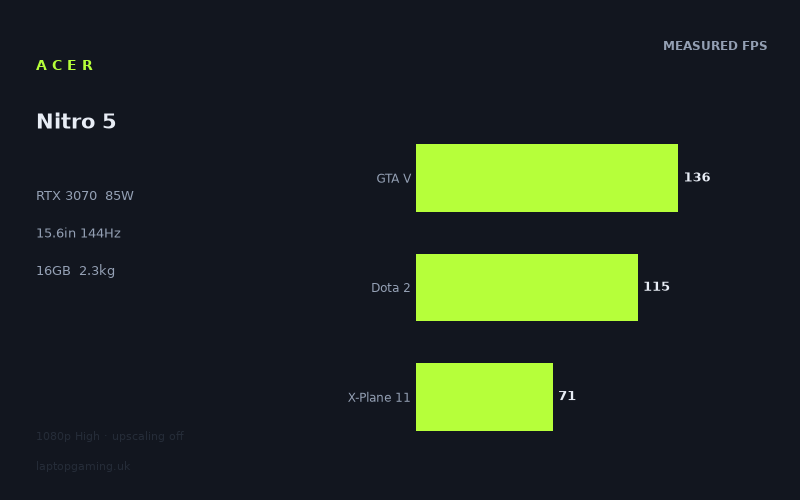
Frame rates
1920×1080, High preset, upscaling off.
Measured on this machine. Source: Notebookcheck, 2021-08-20.
Not scored: incomplete benchmark suite
Every scored laptop on this site is averaged over the same 5 games, and this one is short of Cyberpunk 2077, Baldur's Gate 3. A mean over 5 games is not comparable to a mean over 5, so we publish the figures we have and leave the score blank rather than rank it against machines tested on a different set. The numbers below are real - the suite is just incomplete.
How these numbers were produced
Frame rates here are not measured by us, and we label how each one was arrived at. A figure marked measured comes from a published run on that exact machine. A figure marked representative is derived from the GPU and its power limit (TGP) and cross-referenced against published reviews - a sound estimate of what that configuration delivers, but not a measurement of that specific laptop. Unless stated otherwise, numbers are 1920x1080, High preset, upscaling off. Where a laptop ships in several power configurations we use the wattage of the exact SKU listed, because a 140W RTX 5070 and a 115W one are not the same product.
In use
The short version
The Acer Nitro 5 AN515-45-R1JH is a performance-led gaming laptop with a clear strength and a clear limitation. Its Ryzen 7 5800H, RTX 3070, 16GB of memory and 1TB SSD form a credible gaming specification, while the 15.6in IPS display gives it a sharper-than-standard 2560x1440 resolution and a 144Hz refresh rate. The problem is not that the RTX 3070 is incapable; the measured figures show that it is often very quick at 1920x1080 on the High preset. The issue is that this particular RTX 3070 is configured at an 85W GPU power limit, and the display asks more of the GPU than the benchmark setting used for the published numbers.
Notebookcheck’s measured figures, recorded at 1920x1080 on the High preset with upscaling disabled, range from 157fps in Strange Brigade to 71fps in X-Plane 11. The scoring-suite mean is 112fps. That is a strong 1080p result, but it should not be confused with evidence that every game will run near the panel’s 144Hz refresh rate at the laptop’s native 2560x1440 resolution. We do not have native-resolution benchmark results in the supplied data, so it would be wrong to promise that.
What the data does support is a more measured conclusion. The Nitro 5 has enough performance for very enjoyable gaming, particularly where frame rate matters more than rendering at the panel’s full resolution. Strange Brigade, The Witcher 3 and GTA V all post figures close to or above the display refresh rate at the measured setting. Dota 2 is also fast at 115fps. More demanding or differently limited games, however, pull the average down: Dirt 5 reaches 86fps, Final Fantasy XV records 79fps and X-Plane 11 reaches 71fps. Those are still usable figures, but they are well below 144fps.
This makes the Nitro 5 a sensible choice for someone who wants a 15.6in gaming laptop with a high-resolution IPS screen, 1TB of storage and measured 1080p performance that remains strong across a varied set of games. It is less convincing for someone buying specifically to run every game at 2560x1440 while keeping the panel fully fed at 144Hz. The screen is better suited to a user who is comfortable choosing settings according to the game, rather than expecting a single resolution and preset to fit everything.
There is no overall value judgement to make for this exact configuration because no confirmed UK price is available. The benchmark suite is complete and the machine can be compared normally for frame-rate performance, but value cannot be assessed without a confirmed price.
The most important comparison is not simply “RTX 3070 versus RTX 3070”. The 85W power limit matters. It places this Nitro 5 in a different performance context from laptops using the same GPU name at higher power limits, and it also means that a rival with a technically lower-tier GPU can sometimes land close in shared-game averages. The supplied rival data illustrates that unusually well: the Nitro 5 is far ahead of one RTX 3050 Ti rival, level with a 100W RTX 3070 rival, almost level with another RTX 3050 Ti system, and clearly behind a 175W RTX 3080 Ti laptop.
Buy it for the combination of a sharp IPS panel and good measured 1080p gaming performance, provided the eventual UK price makes sense beside alternatives. Do not buy it on the assumption that the RTX 3070 label alone guarantees the same result as every other RTX 3070 laptop, or that the 144Hz, 2560x1440 display will be driven at its maximum refresh rate in every game.
Performance
What the published benchmark data says
Notebookcheck’s figures were measured on 2021-08-20 at 1920x1080, using the High preset and with upscaling turned off. That setting matters. It provides a clean look at conventional gaming performance without an upscaling mode changing the result, but it is not the Nitro 5’s native screen resolution. The laptop’s panel is 2560x1440, so the numbers below should be read as measured 1080p results rather than as guaranteed native-panel performance.
- Strange Brigade: 157fps
- The Witcher 3: 141fps
- GTA V: 136fps
- Dota 2: 115fps
- Far Cry 5: 101fps
- Dirt 5: 86fps
- Final Fantasy XV: 79fps
- X-Plane 11: 71fps
The scoring-suite mean across Strange Brigade, GTA V, Dota 2, Final Fantasy XV and X-Plane 11 is 112fps. That is useful as a broad indicator, but the game-by-game spread is more useful when deciding whether this is the right laptop. A mean can conceal the difference between a title that is comfortably beyond the panel refresh rate and one that is operating at roughly half of it. Here, the range from 157fps to 71fps is wide enough that the individual figures deserve more attention than any single headline average.
At the top end, Strange Brigade reaches 157fps. At the measured settings, that is above the 144Hz panel refresh rate. This is exactly the sort of result that makes the display specification meaningful: the system has enough published performance in this game to reach the screen’s maximum refresh rate and go beyond it. The Witcher 3 is close behind at 141fps, narrowly below 144Hz but close enough to show that the Nitro 5 is operating in high-refresh territory at 1080p High. GTA V follows at 136fps, again below the full refresh rate but sufficiently close that the difference between the game’s result and the panel maximum is small in the context of the wider benchmark spread.
Dota 2 records 115fps. That is not a full 144fps result, but it remains a high frame rate and is above the 112fps scoring-suite mean. It also helps show why a blanket statement such as “the Nitro 5 is a 144Hz gaming laptop” needs qualification. The panel can refresh at 144Hz; the measured performance varies by game. A 144Hz screen is not a promise that every title will produce 144 frames each second at the chosen settings.
Far Cry 5 posts 101fps. That is still above 100fps at the measured settings, but it is a more obvious step down from the panel maximum. It is also a useful middle-ground result. It demonstrates that the Nitro 5 is not confined to either extreme of the chart: it is not only fast in the lightest games, nor does it only produce the lower results seen in the heaviest or differently limited titles. Instead, there is a substantial middle of the benchmark set where performance remains clearly above traditional low-refresh gaming targets but does not fully exploit 144Hz.
Dirt 5 records 86fps, Final Fantasy XV reaches 79fps and X-Plane 11 produces 71fps. These results are the reason to avoid overselling the RTX 3070 in this chassis. None suggests that the laptop is unable to play the game at the measured 1080p High setting. But all sit well short of 144fps, and X-Plane 11 is less than half of the panel’s maximum refresh rate. The difference between 157fps in Strange Brigade and 71fps in X-Plane 11 is not a minor fluctuation. It is the central practical message of the benchmark data: the Nitro 5 is fast, but game choice and settings remain important.
The 85W RTX 3070 matters
The GPU is an RTX 3070, but it is an RTX 3070 with an 85W power limit. That power figure should be treated as part of the specification, not as an obscure detail to be ignored once the GPU name has been read. Mobile graphics chips with the same name can appear in machines with different power limits, and the rival data supplied for this comparison makes the consequences visible.
The Nitro 5 does not behave as though every laptop carrying an RTX 3070 badge must sit in the same performance tier. Against the Razer Blade 14 Ryzen 9 RTX, which uses an RTX 3070 at 100W, the shared-game average difference is +0fps across the shared set. That is a genuine near-tie in the supplied comparison, despite the difference in stated GPU power limits. Against the MSI Prestige 15, which has an RTX 3050 Ti at 105W, the Nitro 5 is ahead by 46fps across shared games. Against the Schenker XMG Focus 15, another RTX 3050 Ti machine but at 75W, the Nitro 5 averages 1fps behind across shared games. Finally, the MSI Raider GE77 HX with an RTX 3080 Ti at 175W is ahead by 58fps across shared games.
That spread is a useful warning against judging a gaming laptop from its GPU label alone. The 85W RTX 3070 has substantial performance in the published Nitro 5 results, yet it is not automatically clear of every lower-tier GPU laptop in every shared benchmark. Equally, it is not automatically behind a higher-power RTX 3070 system. Performance depends on the machine, the game set and the degree to which a given test is limited by the GPU or by other parts of the platform.
The supplied comparison notes identify an important reason for compressed gaps: at 1080p, lighter titles in the shared set are CPU-bound. In a CPU-bound result, the graphics processor is not the sole factor determining the frame rate. The processor becomes a limiting factor, reducing the visible benefit of a more powerful GPU. This is why a near-zero average difference can be a real and informative result rather than an error or a contradiction.
That does not make GPU power irrelevant. The contrast with the 175W RTX 3080 Ti in the MSI Raider GE77 HX is too large to dismiss. The Raider is ahead by 58fps across shared games, which is a substantial performance advantage. The Nitro 5’s 85W RTX 3070 is therefore best understood as a capable but constrained implementation: good enough to deliver high frame rates at the measured settings, but not configured to compete with the highest-power gaming laptops in the supplied generation spread.
Which games suit the 144Hz panel?
The Nitro 5’s 144Hz display is most fully justified by the results in Strange Brigade, The Witcher 3 and GTA V. Strange Brigade at 157fps exceeds the refresh rate, while The Witcher 3 at 141fps and GTA V at 136fps sit close to it. These are the published figures most likely to appeal to someone who specifically wants a high-refresh panel rather than merely a sharper display.
Dota 2 at 115fps also makes practical use of a 144Hz panel, even though it does not reach the maximum refresh rate in the recorded figure. A display does not become pointless simply because the benchmark number is below its stated refresh rate. The more relevant point is that 115fps is materially different from the lower end of this result set and gives the screen more work to do than a game at 71fps or 79fps.
Far Cry 5 at 101fps occupies a different category. It is plainly fast enough to benefit from a high-refresh display compared with a low-refresh gaming target, but it does not make a case for expecting the panel to be fully saturated. Dirt 5, Final Fantasy XV and X-Plane 11 make the limitation clearer still. At 86fps, 79fps and 71fps respectively, the measured figures show a laptop that can offer fluid performance without reaching the display’s maximum refresh rate.
There is no contradiction in a laptop having a 144Hz screen while some games fall short of 144fps. The panel is a capability, not a fixed performance result. The buyer’s job is to decide whether they value the headroom available in faster games and the flexibility of a high-refresh screen, knowing that demanding games will require a different expectation.
The key thing is to separate the measured setting from the native panel setting. The results were captured at 1920x1080, while the display is 2560x1440. The supplied data does not include measured results at 2560x1440. It is therefore not possible to state the frame rates that Strange Brigade, The Witcher 3, GTA V, Dota 2, Far Cry 5, Dirt 5, Final Fantasy XV or X-Plane 11 would achieve at the panel’s native resolution. Higher display resolution asks more of the graphics hardware, but this review should not turn that general principle into invented native-resolution benchmark figures.
The benchmark spread is the real story
It would be easy to focus on the 112fps scoring-suite mean and call the Nitro 5 a high-refresh gaming machine. That would be directionally fair, but incomplete. The average is supported by especially high results in Strange Brigade, GTA V and Dota 2, while Final Fantasy XV and X-Plane 11 bring the mean down. A buyer planning to play games similar to the faster end of the set can reasonably be encouraged by the published data. A buyer whose priorities resemble the lower end should be more cautious about buying primarily for 144Hz gaming.
The Witcher 3 and Far Cry 5 are useful additional context because they sit between the most extreme results. The Witcher 3 at 141fps is near the top of the chart and almost reaches the 144Hz panel limit. Far Cry 5 at 101fps is still fast but belongs to a different level of performance. Together, they reinforce the point that the Nitro 5 is not defined by a single result. It can be near 144fps in one major game and much closer to 100fps in another at the same measured resolution and preset.
Dirt 5, Final Fantasy XV and X-Plane 11 are particularly important because they stop the review becoming a list of best-case results. Dirt 5 at 86fps is below the scoring-suite mean, Final Fantasy XV at 79fps is lower again, and X-Plane 11 at 71fps is the slowest published figure. If your aim is a laptop that can maintain high frame rates regardless of title, the Nitro 5’s own benchmark spread says you need to temper that expectation.
That is not a criticism unique to this laptop. Different games place different demands on a system, and the supplied notes specifically point out that lighter shared titles can become CPU-bound at 1080p. What matters here is not pretending that an average eliminates those differences. The Nitro 5’s data is useful precisely because it shows both the headline strength of the RTX 3070 configuration and the limits of what an 85W GPU implementation can be expected to do.
The screen
A sharp, high-refresh specification with a performance trade-off
The Acer Nitro 5 has a 15.6in IPS display with a 2560x1440 resolution and a 144Hz refresh rate. On paper, that is a more ambitious screen specification than a basic 1920x1080 panel. The higher resolution gives the machine a sharper native display target, while the 144Hz refresh rate gives it a high ceiling for games able to produce sufficiently high frame rates.
The IPS panel type is also worth noting because it identifies the display technology used. Beyond that specification, however, the supplied information does not include measurements for brightness, colour coverage, contrast, response time, backlight behaviour or outdoor visibility. Those are areas where it would be easy to fill a review with assumptions, but they are not supported by the fact sheet. The safe conclusion is limited to what is known: this is a 15.6in IPS panel with 2560x1440 resolution and 144Hz refresh.
The screen and the GPU are a slightly more complicated pairing than the specification list initially suggests. The RTX 3070 produces strong measured results at 1920x1080 High with upscaling off. Yet the panel’s native resolution is 2560x1440, and no benchmark data has been supplied for that native resolution. The laptop should therefore be viewed as offering a choice rather than a guaranteed single best mode for every game.
For games where the priority is high frame rate, the 1920x1080 benchmark results are the evidence available. Strange Brigade reaches 157fps, The Witcher 3 reaches 141fps, GTA V reaches 136fps and Dota 2 reaches 115fps. Those are figures that justify caring about a 144Hz display. In slower results, including Dirt 5 at 86fps, Final Fantasy XV at 79fps and X-Plane 11 at 71fps, the high-refresh panel remains available, but the benchmark data does not indicate that it will be fully used at the measured setting.
For games where native 2560x1440 resolution is the priority, the appropriate response is uncertainty rather than a made-up prediction. The display can run at that resolution. The supplied benchmark results do not tell us what the frame rates will be there. A buyer who regards native-resolution performance as non-negotiable should seek benchmark evidence at 2560x1440 before treating this specific Nitro 5 as a confirmed fit.
Do not read the 144Hz figure as a promise
The 144Hz specification is meaningful, but only when interpreted correctly. It describes the display’s refresh capability. It does not convert a 71fps result into 144fps, and it does not mean that every title in the library will approach the maximum refresh rate. The Nitro 5’s measured results make that distinction unusually easy to see because the set contains both 157fps and 71fps.
Someone playing Strange Brigade at the measured settings has published evidence of performance beyond 144fps. Someone playing The Witcher 3 has a 141fps result, close to the panel maximum. GTA V at 136fps is also close enough to make the high-refresh display relevant. These are the most convincing results for the screen specification.
At the same time, the lower figures deserve equal weight. X-Plane 11 at 71fps is not evidence of a 144fps experience, and it would be misleading to imply otherwise. Final Fantasy XV at 79fps and Dirt 5 at 86fps fall into the same broad category: usable measured performance, but not frame rates that fill the screen’s full refresh capability. The result is a display that has genuine potential, but whose value varies strongly by game and chosen settings.
This is why the Nitro 5 is best suited to a buyer comfortable with adjusting expectations from title to title. The machine offers the screen hardware for high-refresh gaming. The benchmark data shows that it can take advantage of that hardware in some games at 1920x1080 High. It does not show uniform 144fps performance, and it does not establish native 2560x1440 performance.
Build, size and portability
The facts available for portability are straightforward: this is a 15.6in laptop weighing 2.3kg. That places the Nitro 5 firmly in the category of a machine intended to combine a reasonably substantial screen with gaming hardware, rather than an ultra-light portable system. The 2.3kg figure is not something to ignore if the laptop will move frequently between home, work, study or travel locations.
A 15.6in screen has obvious appeal for gaming because it gives more display area than a smaller machine, and this one adds 2560x1440 resolution and 144Hz refresh. The cost of that approach is that the laptop itself is not presented as a minimal-weight design. At 2.3kg, it is a laptop that can be carried, but its weight should be part of the buying decision rather than an afterthought.
We do not have dimensions for this exact configuration, so no claim should be made about its footprint, thickness, bag fit or desk space requirement. Likewise, the supplied information does not include details of chassis materials, keyboard layout, trackpad quality, port selection, webcam quality, speakers, cooling noise, surface temperatures or battery life. These are all important aspects of ownership, but they cannot be assessed from the available fact sheet.
What can be said is that the Nitro 5’s specification points towards a machine designed around gaming capability rather than maximum portability. The RTX 3070, Ryzen 7 5800H, 16GB memory, 1TB SSD, 15.6in display and 2.3kg weight describe a conventional gaming-laptop balance: a reasonably large screen and dedicated graphics performance, with enough mass that buyers should be realistic about how often they want to transport it.
The 1TB SSD is a practical positive in that balance. Modern gaming libraries can demand significant storage, and a 1TB SSD avoids the feeling of buying a performance laptop with immediately restrictive capacity. The supplied information does not state storage speed, additional drive bays or upgrade options, so it would be wrong to go further than that. The useful point is simply that the listed storage capacity is 1TB rather than a smaller allocation.
The 16GB memory allocation is similarly sensible for a gaming configuration of this class. We do not have information on memory speed, channel arrangement or upgradeability, so there is no basis for claims about tuning or expansion. But the specified capacity is clear, and it sits alongside the Ryzen 7 5800H and RTX 3070 as part of a balanced gaming specification.
Who should care most about the 2.3kg weight?
The 2.3kg weight matters most to buyers who expect the Nitro 5 to be a daily travelling machine rather than a laptop that occasionally changes location. A buyer primarily using it at one desk, with occasional movement, may consider the weight an acceptable exchange for the 15.6in display and gaming hardware. A buyer who wants the lightest possible system for frequent carrying should look closely at lighter alternatives rather than assuming that all 15.6in gaming laptops are equally convenient to move.
It is also worth separating portability from screen quality. A 15.6in 2560x1440, 144Hz IPS display is a significant part of the appeal here, but it does not make the laptop physically smaller or lighter. The Nitro 5 is a machine for someone who values the built-in display enough to accept a 2.3kg system. If the display will rarely be used because gaming happens mainly through another screen, the weight and screen specification may be less compelling than they are for a buyer intending to use the laptop itself as the main gaming display.
How it compares
Against the MSI Prestige 15 with RTX 3050 Ti at 105W
The MSI Prestige 15 uses an RTX 3050 Ti at 105W. Across the shared games, the Acer Nitro 5 averages 46fps ahead. That is the Nitro 5’s clearest positive comparison in the supplied rival set, and it is the result that most strongly supports the argument for the RTX 3070 configuration.
The difference is especially notable because the MSI’s RTX 3050 Ti has a stated 105W power limit, higher than the Nitro 5’s 85W RTX 3070 limit. The Nitro 5’s advantage therefore cannot be reduced to power limit alone. GPU tier still matters, and the supplied shared-game average indicates that the RTX 3070-based Nitro 5 has a substantial performance lead over this particular RTX 3050 Ti laptop.
There is no confirmed UK price for the MSI Prestige 15 configuration in the supplied information, so this is strictly a performance comparison rather than a value comparison. It would be wrong to suggest which one offers better value without prices for both exact machines. On frame rates alone, though, the Nitro 5 is the much stronger option in this pairing.
Against the Razer Blade 14 Ryzen 9 RTX with RTX 3070 at 100W
The Razer Blade 14 Ryzen 9 RTX uses an RTX 3070 at 100W and is listed at £860. Across the shared games, the Nitro 5 averages +0fps. That is a genuine near-zero result. It should not be rewritten into a claim that the laptops are identical, because the shared-game average does not describe every possible game or every other aspect of the machines. But it does mean that the supplied comparison does not show a meaningful aggregate frame-rate advantage for either laptop across that shared set.
This is where the supplied note about CPU-bound lighter titles becomes important. At 1080p, lighter games in the shared set can be CPU-bound, compressing the differences that might otherwise emerge from GPU power limits. The Razer’s 100W RTX 3070 has a higher stated power limit than the Nitro 5’s 85W RTX 3070, but the shared-game average remains level. That does not invalidate the relevance of the power limit; it shows that the game selection and performance bottleneck matter as much as the GPU specification label.
The Razer’s confirmed £860 price is useful information about that specific rival, but it cannot produce a direct value conclusion because the Nitro 5’s exact UK price is not confirmed. The performance result is the safer takeaway: in the shared games, the Nitro 5 keeps pace with this higher-power RTX 3070 competitor.
Against the Schenker XMG Focus 15 with RTX 3050 Ti at 75W
The Schenker XMG Focus 15 is the surprising comparison. It uses an RTX 3050 Ti at 75W, yet the Nitro 5 averages 1fps behind across the shared games. That is a very small difference, and it should not be treated as proof that the RTX 3050 Ti is generally the faster GPU. The supplied context explicitly explains why close results can occur: lighter shared games at 1080p can be CPU-bound, compressing genuine GPU differences.
This comparison is valuable because it demonstrates the limits of relying on a single average. The Nitro 5’s own wider benchmark list includes 157fps in Strange Brigade, 141fps in The Witcher 3 and 136fps in GTA V, alongside much lower results in Final Fantasy XV and X-Plane 11. A shared-game average can be affected heavily by which games overlap and where the bottlenecks lie. Here, the 1fps deficit should be read as a tie-like outcome in that particular shared set, not as a broad reversal of the RTX 3070 and RTX 3050 Ti hierarchy.
No confirmed UK price is provided for the Schenker configuration, so again there is no grounds for a value judgement. The useful buying lesson is more technical: laptop GPU names, power limits and benchmark context all need to be read together. This Nitro 5 is not automatically far ahead of every lower-tier GPU laptop in every 1080p shared-game average.
Against the MSI Raider GE77 HX with RTX 3080 Ti at 175W
The MSI Raider GE77 HX uses an RTX 3080 Ti at 175W and averages 58fps ahead of the Nitro 5 across the shared games. This is the rival that beats the Nitro 5 by the largest margin in the supplied set, and the gap is large enough that there is no need to overcomplicate the conclusion. The Raider is in a much higher-performance class in these shared results.
The comparison also gives useful context for the Nitro 5’s 85W RTX 3070. It is capable of delivering a 112fps scoring-suite mean at the measured settings, but it is not a substitute for a much higher-power flagship GPU configuration. Buyers who know they want the highest available frame rates, especially across demanding games, should not expect this Nitro 5 to match the Raider’s published shared-game performance.
There is no confirmed UK price for the MSI Raider configuration, so the comparison remains about speed rather than value. It does, however, define the Nitro 5’s position clearly. The Acer is not the performance extreme of this GPU generation. It is the more moderate configuration: still fast at 1080p High, but meaningfully behind the 175W RTX 3080 Ti system.
What the rival set tells us overall
The rival spread is more informative than a comparison against a single similar laptop. The Nitro 5 is 46fps ahead of the MSI Prestige 15, level with the Razer Blade 14 Ryzen 9 RTX, 1fps behind the Schenker XMG Focus 15 and 58fps behind the MSI Raider GE77 HX. Those results show a laptop with strong performance but a variable relative position depending on the comparison target and shared game selection.
The largest win confirms that the Nitro 5 can make a substantial step up from at least one RTX 3050 Ti rival. The near-tie with the Razer confirms that the 85W RTX 3070 can remain competitive with a 100W RTX 3070 in a shared 1080p game set. The 1fps deficit to the Schenker is a reminder that CPU-bound lighter titles can flatten GPU differences. The deficit to the Raider shows the clear limit of this configuration against a far higher-power RTX 3080 Ti laptop.
That is a more honest reading than declaring the Nitro 5 either “RTX 3070 fast” or “85W limited” and stopping there. Both statements have truth in them, but neither is enough by itself. The measured results show a laptop that can be very fast in the right games and settings, while the rival data shows that it does not occupy a fixed position based on GPU name alone.
Who it’s for
Buy the Nitro 5 if measured 1080p performance is your priority
The strongest case for the Acer Nitro 5 is a buyer who wants published evidence of high frame rates at 1920x1080 High with upscaling off. The benchmark data supports that case. Strange Brigade reaches 157fps, The Witcher 3 reaches 141fps, GTA V reaches 136fps, Dota 2 reaches 115fps and Far Cry 5 reaches 101fps. The scoring-suite mean is 112fps. Those are substantial results for a laptop with an 85W RTX 3070.
It is especially appropriate for someone who plays a mix of titles rather than expecting every game to behave the same way. The Nitro 5 has enough performance to produce very high frame rates in parts of the suite, but the lower results in Dirt 5, Final Fantasy XV and X-Plane 11 make it important to set expectations game by game. If that flexibility suits your approach, this is a sensible specification.
The laptop also suits someone who values a 15.6in IPS screen with 2560x1440 resolution and 144Hz refresh, but understands that the published frame rates are at 1920x1080 rather than the display’s native resolution. The screen offers both sharpness and high-refresh potential. The data supports the high-refresh side most clearly in Strange Brigade, The Witcher 3 and GTA V at the measured settings.
The 1TB SSD is another reason it makes sense as a main gaming machine rather than a narrowly specified budget device. Combined with 16GB of memory, the Ryzen 7 5800H and RTX 3070, it is a balanced gaming specification on paper. The available facts do not establish upgradeability, storage speed or memory configuration, so those should be checked separately if they matter to you.
Buy something else if native 2560x1440 results are essential
Do not choose this exact Nitro 5 solely because it has a 2560x1440 panel if your real requirement is confirmed native-resolution frame rates. The supplied measurements are at 1920x1080 High with upscaling off. There are no published figures here for gaming at 2560x1440. The display can operate at that resolution, but the fact sheet does not provide the evidence needed to state how each measured game performs there.
A buyer who wants to play every game at the panel’s native resolution and remain close to 144Hz should look for a system with benchmark data at that resolution. The Nitro 5’s results are promising at 1080p, but promising is not the same as measured proof at 2560x1440. The distinction matters because the panel is a central part of the laptop’s appeal.
Buy something else if you require consistently maximum-refresh gaming
The Nitro 5 should also be avoided by anyone whose minimum expectation is 144fps in every game at the tested setting. The published results do not support that. Strange Brigade exceeds 144fps, while The Witcher 3 and GTA V come close at 141fps and 136fps. But Dota 2 is at 115fps, Far Cry 5 at 101fps, Dirt 5 at 86fps, Final Fantasy XV at 79fps and X-Plane 11 at 71fps.
The machine is therefore capable of exploiting the 144Hz display in some games, but not uniformly across the supplied suite. A buyer focused on competitive high-refresh play in titles resembling the faster results may be well served. A buyer who expects the same outcome from every demanding game will need to consider a more powerful configuration, particularly one closer to the MSI Raider GE77 HX’s 175W RTX 3080 Ti class.
Buy something else if portability is the overriding concern
At 2.3kg, the Nitro 5 is not the obvious choice for someone who puts minimum carry weight above gaming performance and a 15.6in display. It can certainly be moved, but the supplied weight makes clear that this is not a lightweight-first design. Buyers carrying a laptop frequently should decide whether the larger screen, RTX 3070 and 1TB SSD justify that mass for their own routine.
There is not enough information here to compare its physical dimensions, battery life or charger size with alternatives, so no stronger portability verdict is justified. But the weight alone is enough to say that anyone seeking a particularly light machine should investigate other options rather than treating the Nitro 5 as a portable-first laptop.
The final buying judgement
The Acer Nitro 5 AN515-45-R1JH is a good performance proposition in measured 1080p gaming terms. Notebookcheck’s figures show a system capable of 157fps in Strange Brigade, 141fps in The Witcher 3, 136fps in GTA V and 115fps in Dota 2, while maintaining a 112fps scoring-suite mean. That is real evidence of strong gaming performance, not an assumption based on the RTX 3070 name.
Its limitations are equally clear. The GPU runs at 85W, its game results vary substantially, and the supplied benchmarks do not establish native 2560x1440 performance on the built-in 144Hz panel. The 2.3kg weight also makes it a more substantial laptop than a lightweight portable.
If the eventual confirmed UK price is sensible, the Nitro 5 deserves consideration from buyers who want a sharp 15.6in IPS display, generous 1TB SSD capacity and high measured frame rates at 1920x1080 High. If your requirements are fixed around native 2560x1440 gaming, consistent 144fps results, maximum portability or flagship-class performance, the available data points elsewhere.