Review
Lenovo Legion Pro 5 16IAX10, RTX review
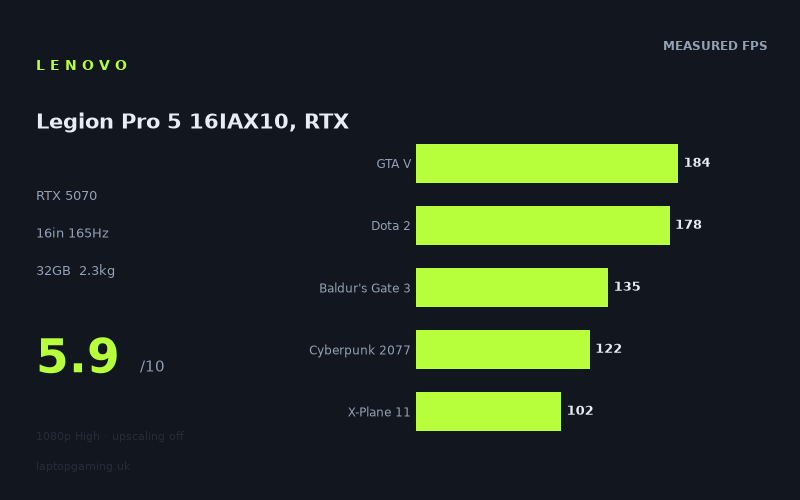
Frame rates
1920×1080, High preset, upscaling off. Averages 144fps across the 5 core benchmark games.
Measured on this machine. Source: Notebookcheck, 2025-10-24.
Not scored: no confirmed UK price
We have the full benchmark suite for this machine, so it ranks on the frame rate leaderboard like any other. What we don't have is a UK listing for this exact configuration - it's sold as a European review unit, or only in specifications that differ from the one tested. Since 30% of our score is value for money, scoring it would mean pretending price is no object, which would flatter it against every laptop you can actually buy. The frame rates below are real and comparable; there is just no buying recommendation to make yet.
How these numbers were produced
Frame rates here are not measured by us, and we label how each one was arrived at. A figure marked measured comes from a published run on that exact machine. A figure marked representative is derived from the GPU and its power limit (TGP) and cross-referenced against published reviews - a sound estimate of what that configuration delivers, but not a measurement of that specific laptop. Unless stated otherwise, numbers are 1920x1080, High preset, upscaling off. Where a laptop ships in several power configurations we use the wattage of the exact SKU listed, because a 140W RTX 5070 and a 115W one are not the same product.
In use
The short version
The Lenovo Legion Pro 5 16IAX10 is a powerful gaming laptop with a difficult price argument. Its RTX 5070, Core Ultra 7 255HX, 32GB of memory and 1024GB SSD give it a high-end specification, while the 16in 2650x1600 OLED panel is clearly a premium part of the package. Notebookcheck’s measured figures also show that it is genuinely quick at 1920x1080 on the High preset with upscaling off. The problem is not that the Legion Pro 5 lacks performance. The problem is that £2,173 is a demanding price for an RTX 5070 machine when several listed rivals deliver almost identical results in shared games, including machines with RTX 5070 Ti graphics.
The benchmark data is strong in older, lighter and well-optimised games. Strange Brigade reaches 295fps, F1 25 reaches 192fps, GTA V reaches 184fps and Dota 2 reaches 178fps. Those are excellent figures for players who care about a responsive feel in competitive, racing or less graphically punishing games. At the tested settings, those results can make use of the panel’s 165Hz refresh rate, at least where the game itself and its frame pacing allow it.
The more demanding end of the suite tells a more cautious story. Baldur’s Gate 3 reaches 135fps, Cyberpunk 2077 reaches 122fps and X-Plane 11 reaches 102fps. These are still good results at the stated 1920x1080 High settings with upscaling disabled, but they do not keep the display fed at its full 165Hz capability. Doom: The Dark Ages reaches 74fps, while Assassin’s Creed Shadows reaches 60fps. Those results matter because they show the gap between owning a 165Hz OLED display and actually being able to approach 165fps in demanding recent games without changing settings or using upscaling.
The measured average across the scoring-suite games is 144fps. That is a strong average, but it should not be read as a promise that every game will run near the display refresh rate. The suite ranges from GTA V at 184fps and Dota 2 at 178fps to X-Plane 11 at 102fps, Cyberpunk 2077 at 122fps and Baldur’s Gate 3 at 135fps. The average is useful as a broad indication of the Legion’s pace, but the spread is more useful when deciding whether the laptop suits the games you actually play.
This is therefore a machine for someone who specifically wants the combination of a 16in OLED screen, 32GB of memory, 1024GB of storage and high measured frame rates at 1920x1080 High. It is less convincing for a buyer who is focused purely on frames per pound. The Lenovo is almost level with every named rival in shared-game testing, including the Asus ROG Zephyrus G14 with RTX 5070 Ti graphics, yet its price remains substantial. The evidence does not show it being meaningfully slower than those alternatives. It also does not show it having a meaningful performance lead that would make £2,173 easy to justify on frame rate alone.
Buy it if the OLED panel and the specified memory and storage configuration matter as much as gaming speed, and if the games you play resemble F1 25, GTA V, Dota 2, Strange Brigade or Final Fantasy XV more than Assassin’s Creed Shadows and Doom: The Dark Ages. Look harder at alternatives if you are paying primarily for the RTX badge, if you want the most convincing performance return for the money, or if you expect demanding modern games to run near 165fps at the panel’s native 2650x1600 resolution. Notebookcheck’s published figures do not establish that last expectation, because all listed results are from 1920x1080 rather than the screen’s native resolution.
Performance
What the measured figures say
The Legion Pro 5’s performance is best understood as high-end 1920x1080 gaming performance with clear game-by-game variation. Notebookcheck measured all the listed results at 1920x1080, using the High preset with upscaling off. That combination is important. These are not figures assisted by upscaling, and they are not native-resolution results for the 2650x1600 display. They demonstrate the RTX 5070’s capability under a sensible benchmark setting, but they should not be used as a direct prediction of performance at the laptop’s full panel resolution.
At the upper end of the results, Strange Brigade reaches 295fps. That is far beyond the 165Hz refresh rate of the display. F1 25 reaches 192fps, GTA V reaches 184fps and Dota 2 reaches 178fps. Again, each of these is above 165fps at the stated benchmark settings. For a buyer whose main interest is games where high frame rates matter, this is the clearest good news in the data. The machine has enough measured performance to exceed the panel refresh rate in several games without relying on upscaling.
The fact that the Legion can exceed 165fps in these titles does not mean it will always display a perfect 165fps experience. The panel refresh rate is 165Hz, while the benchmark results are average measured figures for particular games and settings. A result above 165fps means there is enough average output to reach the display’s ceiling in principle, not that every moment of gameplay will stay above that threshold. Still, there is a practical distinction between a result such as 295fps in Strange Brigade and one such as 74fps in Doom: The Dark Ages. The former gives substantial headroom at the tested settings. The latter does not.
Final Fantasy XV reaches 144fps. That sits just below the panel refresh rate, but it is still a high result and close enough to 165Hz that the display specification is not wasted in the way it would be on a machine producing far lower figures. Baldur’s Gate 3 reaches 135fps and Cyberpunk 2077 reaches 122fps. These are good numbers for the stated settings, particularly because upscaling was off, but they are materially below 165fps. A buyer should view the 165Hz panel as useful headroom and as a benefit in the games where the Legion is faster, rather than as a target this hardware reaches in every title.
X-Plane 11 reaches 102fps. That is a clear step down from the racing, older-action and competitive-game results, but it remains above the kind of frame rate that would make a high-refresh panel irrelevant. It is also a reminder that game engine behaviour and workload type matter. The RTX 5070 is not producing a fixed level of performance across every game. Notebookcheck’s figures show a machine that can produce extremely high frame rates in certain titles, strong high-refresh results in others, and more conventional gaming-laptop performance in demanding or differently limited workloads.
The two hardest results in the supplied data are Doom: The Dark Ages at 74fps and Assassin’s Creed Shadows at 60fps. Neither number is poor in isolation for a High preset result with upscaling off, but both are far from the display’s 165Hz ceiling. They are the figures that should temper any assumption that an RTX 5070 laptop automatically turns a 165Hz OLED panel into a 165fps machine in current demanding games. In these titles, the Legion’s screen will still be a 165Hz panel, but the measured frame rate is substantially lower than that refresh rate under the stated benchmark conditions.
The key point is that the Legion Pro 5 has performance range rather than uniform performance. It is not unusual for different games to produce different results, but the range here is wide enough that it should influence a purchase decision. Strange Brigade at 295fps and Assassin’s Creed Shadows at 60fps are not different expressions of the same experience. One suggests abundant frame-rate headroom at 1920x1080 High. The other suggests that a buyer who prioritises the latest demanding games should expect to make deliberate settings choices if chasing much higher frame rates is important.
The scoring-suite average is useful, but the spread matters more
The supplied scoring-suite average is 144fps across GTA V, Dota 2, Baldur’s Gate 3, Cyberpunk 2077 and X-Plane 11. That is a good overall result. It places the Legion in a performance tier where high-refresh gaming is realistic in a broad selection of games, rather than being restricted to lightweight esports titles. However, the average also masks a meaningful divide within those games.
GTA V reaches 184fps and Dota 2 reaches 178fps, both above the panel’s 165Hz refresh rate. Baldur’s Gate 3 reaches 135fps, Cyberpunk 2077 reaches 122fps and X-Plane 11 reaches 102fps. The difference between the highest and lowest results in that group is substantial. For a player whose library is dominated by GTA V and Dota 2, the Legion’s 165Hz screen has obvious practical relevance at the measured settings. For a player centred on X-Plane 11, the same screen still has headroom, but the benchmark result is much further from its limit.
This is why the 144fps mean should be treated as a summary rather than a buying recommendation by itself. It tells you that the Legion is fast across a varied selection of games. It does not tell you whether it is the right laptop for a particular game. A buyer deciding between this machine and another should look first at the shared games they actually play, then at the display and price. The Legion’s strongest evidence is not simply that it averages 144fps. It is that it reaches 184fps in GTA V, 178fps in Dota 2, 135fps in Baldur’s Gate 3 and 122fps in Cyberpunk 2077 with upscaling off. Its most important limitation is not simply that it falls short of a round performance target. It is that Doom: The Dark Ages reaches 74fps and Assassin’s Creed Shadows reaches 60fps under the same broad test conditions.
There is also a useful distinction between games where the Legion exceeds the screen refresh rate and games where it does not. In F1 25, GTA V, Dota 2 and Strange Brigade, the display refresh rate is the limiting ceiling at the measured settings more often than the GPU’s average output. In Final Fantasy XV, the result is near the display refresh rate. In Baldur’s Gate 3, Cyberpunk 2077 and X-Plane 11, the GPU output remains high but does not reach 165fps. In Doom: The Dark Ages and Assassin’s Creed Shadows, the measured output is much lower, so the display’s refresh capability is no longer the relevant performance limit.
That is a more useful way to interpret the screen-and-GPU combination than simply saying the laptop has a 165Hz display. A high-refresh display is only as useful as the games and settings being used. The Legion has several benchmarked titles where it can take advantage of 165Hz at 1920x1080 High. It also has several where it cannot. Both facts are true, and both should be part of the buying decision.
GPU power limit: what is known and what is not
The supplied specification identifies the graphics processor as an RTX 5070 with 8GB of VRAM. It does not provide a GPU power-limit figure. That omission matters because the power limit is part of how laptop graphics hardware can differ between models using the same GPU name. Without the actual limit, it would be speculation to claim that Lenovo has configured the RTX 5070 more aggressively or more conservatively than another RTX 5070 laptop.
For that reason, the measured figures should take priority over assumptions based on the RTX 5070 label. Notebookcheck’s data shows what this particular Legion Pro 5 achieves at 1920x1080 High with upscaling off. In shared-game comparisons, it is effectively level with the MSI Crosshair 16 HX AI and Asus ROG Strix G18 2025, both using RTX 5070 graphics, and it is also effectively level with several listed RTX 5070 Ti competitors. That performance positioning is more useful than guessing at an undisclosed power setting.
What can be said is that the Legion’s output does not show a clear weakness against the named comparison machines. It averages the same result as the Asus ROG Zephyrus G14 across shared games, trails the MSI Crosshair 16 HX AI by only 1fps across shared games, trails the Asus ROG Strix G18 2025 by only 1fps, trails the Acer Predator Helios Neo 16S AI by only 1fps, and trails the Alienware 16X Aurora by only 2fps. These differences are small in the context of the measured frame rates. They do not support an argument that the Lenovo is substantially behind the closest alternatives in game performance.
At the same time, the lack of a supplied power-limit figure means there is no factual basis for explaining why the Legion performs as it does. It may be tempting to attribute a result to GPU wattage, cooling policy, processor behaviour, memory configuration or chassis design, but none of those explanations is contained in the supplied evidence. The responsible conclusion is narrower: this RTX 5070 implementation delivers strong 1920x1080 High performance, but no supplied figure allows a direct technical judgement on its configured GPU power limit.
What 8GB of VRAM means in this review
The Legion Pro 5 has 8GB of VRAM. That is a specification worth noting because it is part of the graphics configuration a buyer is paying for at £2,173. However, the supplied figures do not identify VRAM use, texture settings, memory limits, stutter behaviour or any game-specific capacity issue. It would therefore be wrong to claim from this data that the 8GB allocation is either a problem or a non-issue in a particular title.
What the benchmark data does show is that the laptop can achieve 122fps in Cyberpunk 2077, 74fps in Doom: The Dark Ages and 60fps in Assassin’s Creed Shadows at the specified 1920x1080 High preset with upscaling off. Those results are evidence of delivered performance at those settings. They are not evidence that VRAM capacity will remain sufficient for every future game, every texture option, every resolution or every workload outside the test conditions.
That distinction is important because the screen is 2650x1600. There are no supplied native-resolution benchmark results, and there are no supplied results using upscaling. Buyers considering this Lenovo for native-panel gaming should not assume that the 1920x1080 figures translate directly to 2650x1600, nor should they assume that a particular VRAM outcome follows from the available data. The review evidence supports a confident judgement on the published 1920x1080 High results and a cautious judgement everywhere else.
The screen
A premium panel specification, with a resolution-performance mismatch to consider
The Legion Pro 5 has a 16in OLED screen with a 2650x1600 resolution and 165Hz refresh rate. On specification alone, that is a strong display package for a gaming laptop. The size gives the machine a larger screen than compact gaming models, the 2650x1600 resolution is higher than the 1920x1080 benchmark resolution, the 165Hz refresh rate is well above a basic display refresh rate, and OLED is a premium panel technology. Those facts help explain why the Legion is positioned as more than a simple budget gaming machine.
The most important practical caveat is that the available frame-rate data is not native-resolution data. Every supplied result was measured at 1920x1080, while the panel is 2650x1600. The displayed benchmark figures are therefore useful for judging the laptop’s performance at the benchmark resolution, but they do not prove that the machine can produce the same frame rates at the panel’s full resolution. This is not a minor technicality. The screen is one of the machine’s defining features, and buyers should separate what is known from what is assumed.
At 1920x1080 High with upscaling off, the Legion can exceed 165fps in Strange Brigade, F1 25, GTA V and Dota 2. It reaches 144fps in Final Fantasy XV, 135fps in Baldur’s Gate 3, 122fps in Cyberpunk 2077 and 102fps in X-Plane 11. In these games, the 165Hz panel has varying degrees of relevance. In the fastest titles, it can be used fully at the measured settings. In the middle group, it provides headroom beyond the measured average frame rate. In the most demanding pair, Doom: The Dark Ages at 74fps and Assassin’s Creed Shadows at 60fps, the panel refresh rate is not the bottleneck at the stated test conditions.
This makes the OLED screen a meaningful attraction, but not an automatic reason to pay the asking price. A buyer who values the panel specification itself may decide that the screen, 32GB of memory and 1024GB SSD are enough to justify paying more than they would for a more basic RTX 5070 laptop. A buyer who is interested only in gaming frame rates should be more sceptical. The measured data shows that the RTX 5070 can take advantage of 165Hz in selected games at 1920x1080 High. It does not show a consistent 165fps result across the suite, and it does not show 165fps at 2650x1600.
When the 165Hz refresh rate is useful
The display refresh rate is most relevant in the games where the Legion has enough measured output to meet or exceed it. Strange Brigade at 295fps is the clearest example. At the stated settings, the GPU has far more average frame-rate output than the 165Hz panel can display in a single second. F1 25 at 192fps, GTA V at 184fps and Dota 2 at 178fps also exceed 165fps. For players concentrated on those games or games with comparable demands, the display is an appropriate match for the performance available.
Final Fantasy XV at 144fps sits close enough to 165Hz that the panel still makes sense, even if the measured result does not reach its maximum refresh rate. Baldur’s Gate 3 at 135fps and Cyberpunk 2077 at 122fps remain high-frame-rate experiences by the published numbers, but the panel specification is ahead of the GPU’s measured average output. That is not necessarily a flaw. A 165Hz panel does not become useless when a game runs below 165fps. It simply means that the display is offering more refresh capacity than that particular benchmark result uses.
X-Plane 11 at 102fps makes the same point more clearly. The game is above a basic frame-rate level, but it is not close to 165fps. Doom: The Dark Ages at 74fps and Assassin’s Creed Shadows at 60fps show the other end of the spectrum. Here, the performance question is not whether the panel could have an even higher refresh rate. It is whether the buyer is comfortable with the measured output at the selected High preset and with upscaling disabled. The 165Hz panel remains part of the laptop, but it does not change the fact that these games run much lower than its maximum refresh rate in the published tests.
For someone buying this machine primarily for Dota 2, GTA V or F1 25, the display and the measured figures align well. For someone buying it primarily for Assassin’s Creed Shadows or Doom: The Dark Ages, the screen remains a premium feature but it should not be interpreted as evidence of matching gaming performance. The benchmark data is clear enough to make that distinction without needing invented native-resolution estimates.
Native resolution needs a cautious approach
The Legion’s 2650x1600 screen is not a 1920x1080 screen. That sounds obvious, but it is central to interpreting the benchmarks. The published figures are all at 1920x1080, High preset, upscaling off. There are no measured figures in the fact sheet for 2650x1600. There are also no measured figures for alternative presets or for upscaling enabled. A buyer should therefore not take 192fps in F1 25 or 122fps in Cyberpunk 2077 as a native-resolution prediction.
This does not make the benchmark data less valuable. It makes it more specific. The figures establish a clear baseline for how the laptop performs under a defined workload. They show that the Legion is fast at 1920x1080 High. They show which games can exceed 165fps under those conditions and which cannot. They also show that newer demanding games can sit at 74fps or 60fps even before moving to the higher native panel resolution.
The sensible buying interpretation is to treat the 2650x1600 OLED panel as a feature you are paying for, while treating the published gaming data as evidence for 1920x1080 High rather than as proof of native-resolution performance. If native-resolution gaming is central to your purchase, the fact sheet does not provide enough measured evidence to make a firm frame-rate claim. That uncertainty should be acknowledged, especially at £2,173.
Build, size and portability
The Legion Pro 5 weighs 2.282kg. That places it firmly in the category of a substantial gaming laptop rather than a machine chosen primarily for low carrying weight. It is not impossible to transport, but the specification does not suggest a casual ultra-portable role. A buyer should think of it as a laptop that can move between a desk, a home setup, a workplace or occasional travel, rather than one where weight is likely to disappear into the background.
The supplied data does not include dimensions, thickness, charger weight, battery-life results, fan-noise figures or temperatures. Those omissions matter. Weight alone tells us that the machine is not especially light, but it does not tell us its footprint in a backpack, how much desk space it occupies, how much total travel weight the charger adds, how long the 80Wh battery lasts, or how loud it becomes under gaming load. It would be irresponsible to fill those gaps with assumptions based on the Legion name or on other gaming laptops.
What can be stated is that the machine combines a 16in 2650x1600 OLED display with a 2.282kg weight and an 80Wh battery. That combination points towards a laptop designed around a larger-screen gaming role rather than maximum portability. The 16in panel is likely to be a more important attraction for someone who spends meaningful time gaming or working at the laptop itself than for someone who almost always uses an external display. Conversely, the 2.282kg weight is more likely to matter to someone carrying it frequently than to someone who mainly moves it from room to room.
The Core Ultra 7 255HX, RTX 5070, 32GB memory and 1024GB SSD also make this feel like a system intended to be a main gaming machine rather than a stripped-back travel companion. That is a judgement about the role suggested by the configuration, not a claim about physical construction or battery endurance. The fact sheet provides no measured evidence for either of those areas.
For a buyer who wants a laptop to sit at a desk most of the time but remain movable when needed, the stated weight is not automatically a problem. For someone who takes a laptop to university, work or regular travel and prioritises low load above all else, 2.282kg should be treated as a meaningful consideration. The Asus ROG Zephyrus G14 is a named rival, but the supplied comparison data does not include its weight, so there is no basis here for a direct portability claim between the two.
The 80Wh battery is another specification that needs careful treatment. Battery capacity is known. Battery life is not. The fact sheet contains no measured runtime for gaming, video playback, web use or idle use. It is therefore not possible to describe the Legion Pro 5 as long-lasting or short-lived away from a mains socket. Buyers who need dependable unplugged operation should seek battery-life measurements before committing, rather than treating the 80Wh figure as an answer on its own.
How it compares
Against the Asus ROG Zephyrus G14
The Asus ROG Zephyrus G14 is listed with an RTX 5070 Ti and a UK price of £2,900. Across 9 shared games, the Legion Pro 5 averages the same frame rate as the Asus. That is a significant comparison because the Asus carries the higher RTX 5070 Ti designation, yet the supplied shared-game result does not show it pulling ahead of the Lenovo.
The Lenovo is also cheaper than the £2,900 Asus. That does not automatically make it a bargain, because the Legion’s own £2,173 price remains high, but it does make the Zephyrus G14 difficult to justify on the supplied shared-game performance alone. If the priority is measured gaming speed in the games both machines have been tested in, the evidence says they are level. The fact sheet does not provide enough information to judge whether the Asus offers a different display, weight, battery result, build or feature set that might explain its higher price. It would be speculation to invent one.
For a buyer comparing only these two machines, the Lenovo has the stronger performance-price argument from the available evidence. It matches the RTX 5070 Ti Asus across the shared-game average while costing less than £2,900. The caveat is that the comparison covers 9 shared games rather than every possible game and that no other hardware characteristics are supplied for the Asus beyond GPU and price.
Against the MSI Crosshair 16 HX AI and Asus ROG Strix G18 2025
The MSI Crosshair 16 HX AI is an RTX 5070 rival with no confirmed UK price in the supplied data. Across 8 shared games, the Legion averages 1fps less than the MSI. That is effectively a dead heat in practical terms. The available comparison does not support an argument that the Lenovo is clearly faster, but neither does it support an argument that it is meaningfully slower.
The lack of a confirmed UK price is crucial. Without it, there is no responsible way to decide whether the MSI offers better value than the Legion at £2,173. The performance evidence says the two are extremely close. The value argument cannot be finished until there is a confirmed UK price for the Crosshair.
The Asus ROG Strix G18 2025 is another RTX 5070 rival with no confirmed UK price. Across 9 shared games, the Legion averages 1fps less than the Asus. Again, that is too small a difference to make a meaningful performance case for either machine. The Lenovo is not demonstrably ahead, but it is not meaningfully behind either. The choice between them cannot be resolved through frame rates alone.
There is also no supplied screen, weight, battery or storage comparison for the Strix G18. The model name suggests a different size class, but no specification beyond its RTX 5070 status and shared-game result is provided here, so a direct claim about size, portability or display experience would exceed the facts. The safe conclusion is straightforward: the Legion sits essentially level with both RTX 5070 rivals in the available gaming data, and their missing UK prices prevent a proper value comparison.
Against the Acer Predator Helios Neo 16S AI
The Acer Predator Helios Neo 16S AI uses an RTX 5070 Ti and has a UK price of £2,679. Across 5 shared games, the Legion Pro 5 averages 1fps less than the Acer. That is another close result, and another example of the Lenovo staying near an RTX 5070 Ti competitor in measured game performance.
The Acer costs more than the Legion’s £2,173 price, while the supplied shared-game data gives it only a 1fps average advantage. On the evidence available, that is not a compelling gaming-performance reason to pay the Acer’s higher price. The Acer may have other strengths, but the fact sheet does not list them. It would be wrong to assume a screen, chassis, cooling or battery advantage in order to explain the pricing difference.
This comparison reinforces the wider theme of the Legion review. Its problem is not weak performance relative to its closest rivals. It is that its own price is high enough that it needs more than broadly equal frame rates to feel like outstanding value. Against the Acer, it at least has a clean argument: it is cheaper and only 1fps behind across the available shared games. That is a better position than the Lenovo’s overall price impression might initially suggest.
Against the Alienware 16X Aurora
The Alienware 16X Aurora uses an RTX 5070 and is priced at £2,569. Across 6 shared games, the Legion averages 2fps less than the Alienware. This is still a narrow gap. A 2fps shared-game difference does not establish a meaningful gaming-performance tier between the two machines, particularly when the Legion’s individual benchmark results range from 60fps to 295fps depending on the game.
The price difference is more meaningful than the frame-rate difference, because the Lenovo is cheaper than the £2,569 Alienware. If these are the two machines being considered and the decision rests mainly on the provided gaming data and confirmed UK pricing, the Lenovo is the more rational choice. It is only slightly behind in the shared-game average while costing less.
As with the other rivals, the fact sheet does not include the Alienware’s display, memory, storage, weight, battery or other specifications. The review cannot claim that the Lenovo is better equipped overall. It can say that the published shared-game result is extremely close and that the Lenovo has the lower confirmed UK price.
The wider comparison conclusion
The Legion Pro 5 is remarkably consistent against the named rivals. It matches the Asus ROG Zephyrus G14 across 9 shared games. It trails the MSI Crosshair 16 HX AI by 1fps across 8 shared games, the Asus ROG Strix G18 2025 by 1fps across 9 shared games, the Acer Predator Helios Neo 16S AI by 1fps across 5 shared games, and the Alienware 16X Aurora by 2fps across 6 shared games.
That pattern matters more than any single comparison. The Lenovo is not separated from the closest alternatives by gaming performance. It is in the same broad performance group, including against RTX 5070 Ti machines. The practical purchase decision therefore comes down to price where one is confirmed, and to the supplied configuration and screen where it matters to the buyer.
Against the Asus ROG Zephyrus G14 and Acer Predator Helios Neo 16S AI, the Lenovo is cheaper while being essentially level in shared-game performance. Against the Alienware 16X Aurora, it is also cheaper while only slightly behind. Against the MSI Crosshair 16 HX AI and Asus ROG Strix G18 2025, no confirmed UK price is provided, so it is impossible to state which is better value.
The Legion’s own £2,173 price remains the central issue. It is not disproven by these rival comparisons; rather, the comparisons show that its gaming output is competitive. The concern is that the RTX 5070 performance level is shared by other machines, and the measured results do not give the Lenovo a clear frame-rate lead. Its premium OLED panel, 32GB memory and 1024GB SSD are therefore doing a large part of the work in justifying the asking price.
Who it’s for
Buy the Legion Pro 5 if the whole configuration suits you
The strongest buyer for the Legion Pro 5 is someone who wants a 16in 2650x1600 OLED gaming laptop with 32GB of memory, a 1024GB SSD and strong published 1920x1080 gaming figures. That buyer should value the full configuration, not only the RTX 5070 name. The machine is easier to recommend when the OLED panel is a major priority and when the memory and storage specification avoids the need to seek a lower-spec alternative.
It is also a good fit for someone whose main games resemble the Legion’s stronger benchmark results. Dota 2 at 178fps, GTA V at 184fps, F1 25 at 192fps and Strange Brigade at 295fps show that the machine can use its 165Hz panel well at 1920x1080 High with upscaling off. Final Fantasy XV at 144fps remains close to the display refresh rate. These results suit a player who values a high-refresh experience in games where the RTX 5070 has sufficient headroom.
Players who spend time in Baldur’s Gate 3, Cyberpunk 2077 or X-Plane 11 can also make a reasonable case for the Lenovo. The results of 135fps, 122fps and 102fps are strong at the stated settings, even if they do not fully reach the panel’s 165Hz maximum. The important thing is to buy with the right expectation: the laptop delivers high frame rates in those games under the measured conditions, but not necessarily the full refresh rate of the display.
The Legion also makes sense for a buyer comparing it directly with the Asus ROG Zephyrus G14, Acer Predator Helios Neo 16S AI or Alienware 16X Aurora on the supplied facts. It is cheaper than each of those confirmed-price rivals. It matches the Asus across shared games, trails the Acer by 1fps and trails the Alienware by 2fps. If the buyer does not have a separate reason to prefer those machines, the Lenovo has a sensible comparative case.
Buy something else if price-to-performance is your priority
The Legion is not the obvious choice for a buyer whose main question is how much gaming performance £2,173 buys. Its measured results are strong, but its closest rivals are essentially level in shared-game testing. The data does not show the Lenovo delivering a clear performance lead over the RTX 5070 machines, and it does not show it falling far behind RTX 5070 Ti machines. That makes it competent, but not uniquely compelling.
If the OLED panel, 32GB memory and 1024GB SSD are not important to you, the price becomes harder to defend. A buyer who simply wants an RTX 5070 laptop capable of high 1920x1080 frame rates should not assume the Legion is the only route to this performance level. The MSI Crosshair 16 HX AI and Asus ROG Strix G18 2025 are effectively tied with it in the available shared-game results. Their UK prices are not confirmed in the supplied data, so no value verdict can be made, but they are relevant alternatives rather than clearly weaker ones.
It is also not the right purchase for someone who expects the 165Hz display to be fully utilised in every modern demanding game. Doom: The Dark Ages at 74fps and Assassin’s Creed Shadows at 60fps are the evidence against that expectation. Those are measured results at 1920x1080 High with upscaling off, not at the higher 2650x1600 native screen resolution. Buyers focused on the most demanding current games should be especially careful not to mistake the display refresh rate for a guaranteed frame-rate result.
Someone who needs a highly portable machine should think carefully about the 2.282kg weight. The Legion is a laptop, but it is not specified as a lightweight one. There are no dimensions or charger-weight figures in the fact sheet, so the full travel burden cannot be quantified. There is also no battery-life result, so the 80Wh battery should not be treated as evidence of all-day unplugged use.
The final buying judgement
The Lenovo Legion Pro 5 16IAX10 is a capable, premium-spec gaming laptop whose performance is better than its value proposition. Notebookcheck’s figures show excellent results in Strange Brigade, F1 25, GTA V and Dota 2; strong results in Final Fantasy XV, Baldur’s Gate 3, Cyberpunk 2077 and X-Plane 11; and more restrained results in Doom: The Dark Ages and Assassin’s Creed Shadows. That is a credible performance profile for an RTX 5070 laptop, especially with upscaling off at 1920x1080 High.
Its 16in 2650x1600 OLED display and 165Hz refresh rate are major attractions, but the benchmark evidence should be read carefully. The fastest games can exceed the panel refresh rate at 1920x1080. Several others cannot, and there are no supplied results at the screen’s native resolution. The Legion therefore offers a premium screen with strong gaming potential, not proof of universal native-resolution 165fps gaming.
At £2,173, this Lenovo is best bought by someone who wants this exact blend of screen, memory, storage and measured performance. It is not a bad performer in a poorly priced market position; it is a strong performer whose asking price demands that you care about more than frame rate alone. If the OLED panel and specified configuration are central to your requirements, the Legion Pro 5 is a serious option. If your priority is the sharpest possible value case, keep comparing, because the shared-game figures show that several rivals are close enough to make price and the rest of the specification decisive.