Review
MSI Stealth GS77 review
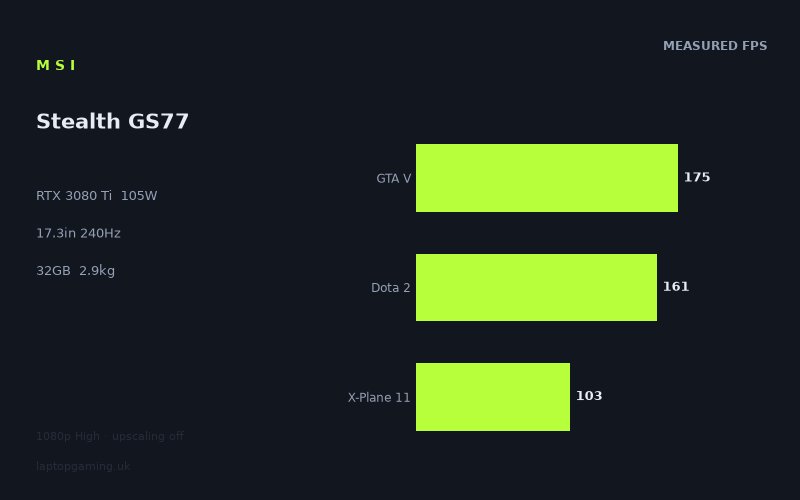
Frame rates
1920×1080, High preset, upscaling off.
Measured on this machine. Source: Notebookcheck, 2022-04-07.
Not scored: incomplete benchmark suite
Every scored laptop on this site is averaged over the same 5 games, and this one is short of Cyberpunk 2077, Baldur's Gate 3. A mean over 5 games is not comparable to a mean over 5, so we publish the figures we have and leave the score blank rather than rank it against machines tested on a different set. The numbers below are real - the suite is just incomplete.
How these numbers were produced
Frame rates here are not measured by us, and we label how each one was arrived at. A figure marked measured comes from a published run on that exact machine. A figure marked representative is derived from the GPU and its power limit (TGP) and cross-referenced against published reviews - a sound estimate of what that configuration delivers, but not a measurement of that specific laptop. Unless stated otherwise, numbers are 1920x1080, High preset, upscaling off. Where a laptop ships in several power configurations we use the wattage of the exact SKU listed, because a 140W RTX 5070 and a 115W one are not the same product.
In use
The short version
The MSI Stealth GS77 (12UHS-083US) is a powerful large-screen gaming laptop whose measured performance is better understood as well-balanced high-end performance with a restrained GPU power limit, rather than as the full expression of what an RTX 3080 Ti laptop GPU can do. Its RTX 3080 Ti is configured at 105W, while the machine combines that GPU with a Core i7-12700H, 32GB of memory, a 1TB SSD and a 17.3in 2560x1440 IPS display running at 240Hz.
Notebookcheck’s 1080p High-preset figures are strong in every game supplied. The Stealth GS77 reaches 207fps in The Witcher 3, 196fps in Strange Brigade, 175fps in GTA V, 161fps in Dota 2, 136fps in Far Cry 5, 103fps in X-Plane 11, 101fps in Final Fantasy XV and 93fps in Cyberpunk 2077 1.6. Across the five scoring-suite games, the mean is 147fps. That is a high average, and it means the machine has no problem producing smooth results in the demanding games represented here. It also has enough speed in lighter or older games to make meaningful use of a high-refresh panel, although it cannot reach the display’s maximum refresh rate in every title.
The important qualification is the 105W GPU limit. The RTX 3080 Ti name alone does not tell the whole story in a laptop. This GS77 is not configured like MSI’s much more heavily powered Raider GE77 HX, which uses an RTX 3080 Ti at 175W and is faster by an average of 22fps across their shared games. The Stealth is therefore not the right choice for a buyer whose only aim is extracting the highest possible frame rate from this generation of GPU. The benchmark data shows that there is performance left on the table compared with a higher-power implementation.
That does not make the Stealth GS77 slow, nor does it make the RTX 3080 Ti label misleading. It means this is a laptop where the complete configuration matters more than the headline GPU tier. A 105W RTX 3080 Ti can still produce 207fps in The Witcher 3 and 196fps in Strange Brigade at the stated benchmark settings. It can also hold 93fps in Cyberpunk 2077 1.6 and just over 100fps in both X-Plane 11 and Final Fantasy XV. Those are serious results. But buyers considering it beside bulkier RTX 3080 Ti machines should read the power limit and the benchmark spread before assuming identical GPU names will deliver identical results.
The Stealth GS77 makes most sense for someone who wants a 17.3in QHD screen, substantial memory, a large battery and high-end gaming capability in a machine weighing 2.903kg, but who does not need every game to run at 240fps. It is particularly suitable for players whose game library includes esports titles, older games, less GPU-intensive games and broadly well-optimised releases. The measured figures indicate that such games are where the 240Hz display can be used most effectively.
It is less compelling for someone shopping specifically for maximum native-resolution performance in the most demanding games, or for someone who sees “RTX 3080 Ti” and expects the same output as the highest-power versions of that GPU. The panel is 2560x1440, while the supplied measurements are at 1920x1080 with High settings and upscaling disabled. The data therefore proves strong 1080p performance, but it does not provide a measured 1440p frame-rate result. It would be wrong to turn the available figures into invented native-resolution claims.
There is no overall score for this exact configuration because its UK price is not confirmed. The benchmark suite is complete and the machine ranks normally on the frame-rate leaderboard; the missing price only prevents a value calculation. That is worth keeping in mind because this is not a laptop to judge solely on component names. Its eventual UK price would matter greatly to the final buying case.
Performance
A high-end GPU, configured for a different balance from the fastest RTX 3080 Ti laptops
The central performance fact is simple: the Stealth GS77 has an RTX 3080 Ti laptop GPU limited to 105W. That is the specification that puts its benchmark results in context. Laptop GPUs with the same product name are not automatically equivalent when they operate with different power limits. The measured figures show that this machine is very fast, but they also show why it should not be treated as interchangeable with a 175W RTX 3080 Ti implementation.
The supplied comparison with the MSI Raider GE77 HX is the clearest evidence. That rival also has an RTX 3080 Ti, but at 175W. Across five shared games, the Stealth GS77 averages 22fps behind it. That is not a trivial separation when buying at the high end. It is the difference between a machine that is already fast and one that has more performance headroom in the same broad GPU class. The Stealth’s numbers remain good in isolation, but the Raider comparison demonstrates that the 105W setting has practical consequences.
There is another useful lesson in the comparison data. The GS77 matches the Razer Blade 17 RTX with its RTX 3070 at 130W across five shared games, and it also matches the Schenker XMG Neo 15 Tiger Lake with its RTX 3080 at 165W across five shared games. In both cases the recorded average difference is +0fps. That result is not a reason to dismiss the Stealth, but it is a reason to look beyond the GPU badge. The GS77 has the higher-tier RTX 3080 Ti name, yet the shared-game averages do not separate it from those lower-named or differently configured rivals.
The explanation supplied with the comparison data matters here. At 1080p, lighter titles in the shared set can become CPU-bound, compressing genuine GPU gaps. In other words, a near-zero result does not necessarily mean the GPUs are equally capable under every possible workload. It means that in the games and settings being compared, the surrounding system and the game engine can limit the extent to which a faster GPU can show its advantage. This is exactly why a one-line comparison based only on GPU naming would be less useful than the actual measured figures.
The GS77 should therefore be viewed as a machine that has enough performance to compete strongly in the benchmark set, while not always converting its RTX 3080 Ti specification into a clear margin over every rival. That is a nuanced conclusion, but it is the conclusion the data supports. Buyers seeking evidence rather than branding should value that distinction.
The benchmark spread
Notebookcheck’s figures were measured at 1920x1080, using the High preset with upscaling disabled. Those settings are important. They give a consistent view of how the system performs without using upscaling to alter the result, but they are not the screen’s native 2560x1440 resolution. The numbers should therefore be read as a direct measure of 1080p High performance, not as a promise of what the laptop will deliver on its own panel in every game.
At the top of the supplied list is The Witcher 3 at 207fps. That result places the GS77 comfortably into high-refresh territory at the measured settings. It is below the screen’s 240Hz maximum, so the benchmark does not show the game fully saturating the panel, but 207fps is still a very high result. For a player focused on responsiveness and smooth animation rather than on hitting a particular display limit, this is excellent performance.
Strange Brigade follows at 196fps. This is another result that makes the 240Hz panel relevant rather than decorative. The Stealth does not reach the display’s quoted maximum refresh in the measured result, but it is close enough to show that the system can take advantage of a high-refresh screen in the right games. A 196fps result also leaves little room for any claim that the 105W GPU configuration makes the GS77 merely mid-range. It plainly does not.
GTA V reaches 175fps. Again, this is not 240fps, but it is well into a performance range where a high-refresh display is useful. Dota 2 is measured at 161fps, which continues the same pattern. These results suggest that the GS77 can deliver frame rates substantially above conventional gaming targets in titles that are less punishing than the most demanding modern releases. The panel’s 240Hz capability is not fully exploited by these particular figures, but it is far more relevant here than it is in the games near the lower end of the list.
Far Cry 5 records 136fps. That remains a strong result and sits only slightly below the 147fps mean across the scoring-suite titles. It is another example of the GS77 delivering smooth high-frame-rate performance without reaching the display’s maximum refresh. The distinction between “high frame rate” and “full 240Hz saturation” is worth making. A gaming laptop does not need to produce 240fps in every game for a 240Hz panel to be useful, but buyers should not assume that the refresh-rate specification guarantees that outcome.
X-Plane 11 is measured at 103fps. This is a notably different result from the figures in The Witcher 3, Strange Brigade, GTA V and Dota 2. It remains above 100fps, which is strong, but it illustrates how much game choice affects the output even when the laptop and test settings remain the same. The GS77 is not a machine that produces one uniform level of performance across all games. No laptop does, and the provided results show a wide spread from the fastest title to the most demanding one in this set.
Final Fantasy XV is measured at 101fps. It sits very close to X-Plane 11, and again it is a good result that falls well short of 240fps. This is an important reality check for buyers who are attracted to the screen specification. The Stealth GS77 has a 240Hz panel, but in some of the supplied games the available benchmark data places it around the 100fps mark at 1080p High with no upscaling. That is still smooth, high-end gaming performance. It is simply not the same thing as driving the panel to its stated maximum refresh.
Cyberpunk 2077 1.6 is the lowest supplied figure at 93fps. That result is still respectable given the game’s reputation as a demanding benchmark title, but it provides the clearest example of why the machine should not be bought solely on the expectation of 240fps gaming. The GS77 delivers a frame rate comfortably above a basic smooth-playability threshold in the supplied result, but it is nowhere near the panel’s maximum refresh rate. Buyers who mostly play demanding modern games should focus on this part of the benchmark spread, not only on the 207fps headline from The Witcher 3.
What the mean tells us, and what it does not
The mean across the five scoring-suite games is 147fps. This is a healthy average and accurately describes the GS77 as a fast gaming laptop at the stated benchmark settings. It also places the machine in an interesting position relative to the screen. A 147fps mean is well below 240Hz, but it is high enough to make a 240Hz display more than a paper specification. It means that, across the suite, the laptop is regularly producing frame rates that benefit from a display built for fast updates.
However, an average is not a substitute for looking at the individual games. The difference between 196fps in Strange Brigade and 101fps in Final Fantasy XV is substantial. The difference between 207fps in The Witcher 3 and 93fps in Cyberpunk 2077 1.6 is larger still. Someone who spends most of their time in games closer to the top of this range will experience the GS77 very differently from someone whose library is dominated by games closer to the bottom.
This is why the mean should be treated as a summary rather than a buying recommendation by itself. The mean says the machine is fast. The individual results say the extent to which it can approach the panel’s maximum refresh depends heavily on the game. Both statements are true, and neither should be omitted.
The benchmark range also makes the GPU power limit more meaningful in practice. In games where the result is already high and where the comparison data indicates a possible CPU limit at 1080p, extra GPU power may not translate cleanly into an equally dramatic gain. In games where GPU load is a stronger constraint, a more heavily powered RTX 3080 Ti can create more separation. The 22fps deficit to the 175W Raider GE77 HX across shared games demonstrates that the latter situation exists in the available comparison data.
The GS77 is consequently best described as fast enough to make high-refresh gaming worthwhile, but not configured to be the outright frame-rate maximiser of its GPU generation. That is a better guide for a buyer than either extreme. It would be inaccurate to call it compromised to the point of being unsuitable for demanding gaming, because its measured results are strong. It would also be inaccurate to call it an unrestricted RTX 3080 Ti machine, because the power limit and Raider comparison show otherwise.
What cannot be concluded from the published results
There are several things the supplied data does not establish. There is no measured frame-rate set at the laptop’s native 2560x1440 resolution. There is no supplied result using upscaling. There are no figures for ray tracing. There are no thermal measurements, no acoustic measurements and no battery-life results. There is also no provided information about sustained performance behaviour over a long gaming session.
Those omissions do not weaken the available benchmark data; they simply define its scope. Notebookcheck’s numbers give a clear view of performance at 1920x1080, High settings and no upscaling. They do not allow a responsible review to claim a particular native-QHD frame rate, a particular fan-noise level or a particular battery duration. Buyers who need those specific answers should not accept invented estimates in their place.
The screen
A good specification, but one that asks more of the GPU than the benchmark resolution
The Stealth GS77 has a 17.3in IPS screen with a 2560x1440 resolution and a 240Hz refresh rate. On specification alone, that is a very appropriate display for a high-end gaming laptop. The resolution offers more desktop and game detail than the 1920x1080 benchmark setting, while the refresh rate gives the panel the capacity to display very high frame rates when the game and hardware can supply them.
The necessary caveat is that the measured frame rates were not recorded at 2560x1440. They were recorded at 1920x1080, High preset, with upscaling off. Native-resolution gaming will require the GPU to render more than the benchmark setting, so the published 1080p figures should not be presented as if they were native-panel results. There is no measured evidence here to say exactly where The Witcher 3, Strange Brigade, GTA V, Dota 2, Far Cry 5, X-Plane 11, Final Fantasy XV or Cyberpunk 2077 1.6 will land at 2560x1440 on this machine.
That does not mean the QHD display is mismatched with the hardware. The benchmark data is strong enough to show that the GS77 has substantial gaming capability. It does mean that buyers should distinguish between a display’s specification and a game’s actual frame rate at native resolution. A 240Hz panel can display up to 240 updates per second, but the laptop does not automatically produce 240fps merely because the panel is capable of it.
Where 240Hz is likely to matter most in the supplied data
The 240Hz refresh rate is best matched to the upper end of the benchmark list. At 1080p High, The Witcher 3 reaches 207fps and Strange Brigade reaches 196fps. GTA V at 175fps and Dota 2 at 161fps also sit in a range where the panel’s high refresh capability is relevant. None of those measured results reaches 240fps, so the data does not show full saturation of the display. But they are all far enough above lower refresh rates that a 240Hz panel is not excessive on paper.
Far Cry 5 at 136fps occupies a middle ground. It is still a high frame rate, and the display has ample headroom for it, but the gap to 240Hz is clear. X-Plane 11 at 103fps and Final Fantasy XV at 101fps move further away from the display ceiling. Cyberpunk 2077 1.6 at 93fps is further away again. These results do not make the screen a bad fit; they show that a broad mix of games will use a broad portion of its available refresh range.
For a buyer who primarily plays competitive or lighter titles, the panel’s refresh rate is a significant advantage. For a buyer focused on graphically demanding games, the resolution may be the more important specification, while the full 240Hz ceiling becomes less central. That is not a criticism of the display. It is a practical way to align the screen with the kind of games the owner actually plays.
IPS, size and practical use
The panel type is IPS. Beyond that classification, the provided specifications do not include brightness, colour coverage, contrast, response-time measurements or any assessment of backlight behaviour. It would therefore be inappropriate to make claims about image quality beyond identifying the panel technology, resolution, size and refresh rate.
The 17.3in size is a major part of the GS77’s identity. This is not a compact gaming laptop with a small display attached to an unusually powerful GPU. It is a large-screen machine designed around a 17.3in panel. That gives the QHD resolution a more natural role than it would have on a much smaller screen, particularly for users who want more room for games, multitasking or general desktop work. The specification points toward a laptop intended to serve as a primary computer for some buyers rather than only as an occasional travel machine.
The display is also one reason the 105W GPU setting deserves close attention. A 17.3in 2560x1440 240Hz panel is an ambitious screen specification. The GS77’s measured 1080p performance is strong, but native QHD and a 240Hz target are separate demands. The machine may be best used with expectations that vary by game: high refresh in lighter titles, high-resolution visual quality where frame rates are lower, and settings choices determined by the player’s priorities. The supplied data does not justify prescribing exact settings for individual games at native resolution, but it clearly supports the principle that one setting choice will not suit every title.
Build, size and portability
A 17.3in machine that can travel, but is not defined by effortless portability
The MSI Stealth GS77 weighs 2.903kg. That figure needs to be considered alongside the 17.3in display, the 99Wh battery, the RTX 3080 Ti GPU, the Core i7-12700H and the 32GB memory configuration. This is a substantial laptop with substantial components. It is portable in the literal sense that it is a laptop, but the weight makes it more realistic to think of it as a machine that can be moved between locations than as one intended to disappear into a bag without being noticed.
For many buyers, 2.903kg will be acceptable if the laptop primarily lives on a desk, moves between rooms, travels occasionally, or serves as a main system that is not permanently fixed in one place. For someone who carries their laptop through a long day, commutes with it frequently or values the lightest possible travel load, this weight should be treated as a serious consideration. A 17.3in gaming laptop with an RTX 3080 Ti is not automatically unsuitable for travel, but it is not the obvious choice for buyers whose first requirement is minimum mass.
The supplied specification does not include the chassis dimensions, so there is no basis for claiming that the GS77 is especially thin, especially compact for its screen size, or especially easy to fit into a particular bag. The name “Stealth” should not be used as evidence of physical size or portability. The only published physical measure provided here is the 2.903kg weight, and that is enough to place it firmly in the large-laptop category.
The battery specification is generous, but endurance is not measured here
The GS77 has a 99Wh battery. That is a substantial battery capacity on the specification sheet and makes sense in a machine with a large display and high-end internal hardware. But battery capacity is not battery life. The supplied material does not include measured runtime for web use, video playback, light work, gaming or any other activity.
It would be irresponsible to turn 99Wh into a claimed number of hours. Gaming workloads, screen settings, software, background activity and system power behaviour all affect battery endurance, and none of that is measured in the fact sheet. The correct conclusion is narrower: the laptop has a 99Wh battery, but we do not have a battery-life figure for this configuration.
For gaming buyers, this uncertainty matters because the GS77’s core appeal is its combination of a high-refresh QHD screen and an RTX 3080 Ti. Those are demanding components. A buyer who needs long unplugged use should seek measured endurance data rather than infer it from battery capacity alone. A buyer who mostly uses the machine near mains power may find the 99Wh specification reassuring, but should still avoid treating it as a tested runtime result.
Memory and storage are appropriate for the class
The machine is specified with 32GB of memory and a 1TB SSD. That is a fitting configuration for a large high-end gaming laptop. The 32GB memory allocation avoids the impression of a premium GPU and screen paired with an unusually restricted memory specification. The 1TB SSD also gives the machine a sensible baseline for a gaming library and general use, although the supplied data does not include storage speed measurements or upgrade information.
The point is not to repeat the specification table for its own sake. It is that the rest of the configuration does not obviously undermine the GPU and display. A machine with an RTX 3080 Ti, Core i7-12700H and 17.3in QHD 240Hz screen needs enough memory and storage to feel coherent as a complete system. On the stated configuration, 32GB and 1TB are sensible supporting specifications.
There is no supplied information about ports, keyboard, touchpad, speakers, webcam, chassis materials, cooling design, upgrade access or build quality. Those are all relevant to the ownership experience, especially in a laptop this size, but they cannot be assessed responsibly from the information available. The performance case can be analysed in detail because measured figures are supplied. The physical and usability case must remain limited to what is actually specified: a 17.3in display, 2.903kg weight, 99Wh battery, 32GB memory and 1TB SSD.
How it compares
Against the MSI Prestige 15: a clear class difference
The MSI Prestige 15 is the rival the Stealth GS77 beats by the greatest supplied margin. The Prestige 15 uses an RTX 3050 Ti at 105W, while the Stealth has an RTX 3080 Ti at 105W. Across four shared games, the GS77 averages 81fps ahead.
That is a clear and meaningful gap. It shows that the GS77 is not merely benefiting from a higher product name while delivering only a marginal advantage. Against the RTX 3050 Ti-equipped Prestige 15, the Stealth establishes a decisively different level of gaming performance. The fact that both GPUs are listed at 105W is also instructive: power limit matters, but GPU tier still matters greatly. The same listed power figure does not make two entirely different GPUs equivalent.
For a buyer deciding between these machines on gaming capability, the benchmark comparison is straightforward. The Stealth GS77 is the stronger option by a wide margin in the shared data. The Prestige 15 may serve different priorities, but the supplied game figures do not support treating it as a close gaming-performance alternative.
There is no confirmed UK price for the listed Prestige 15 configuration, so this comparison should remain about performance rather than value. Without a confirmed price for either machine, there is no sound basis for declaring one a better purchase financially. The performance separation, however, is clear.
Against the Razer Blade 17 RTX: the GPU names do not create separation in the shared set
The Razer Blade 17 RTX uses an RTX 3070 at 130W and is listed at GBP 2,623. Across five shared games, the Stealth GS77 averages +0fps against it. The immediate reaction might be surprise: the GS77 has an RTX 3080 Ti, while the Razer has an RTX 3070. But the comparison data specifically warns that 1080p lighter titles in the shared set can become CPU-bound, compressing GPU differences.
That explanation should be taken seriously. A +0fps shared-game average does not prove that the RTX 3080 Ti and RTX 3070 are identical, nor does it prove that the 105W GS77 cannot show a lead in other games or at other settings. It does prove something narrower and useful: in the selected shared games at the measured conditions, the GS77 does not establish an average frame-rate advantage over this 130W RTX 3070 system.
For the buyer, that means the GS77 needs to be judged on the whole package rather than on an assumed performance lead. Its 17.3in QHD 240Hz IPS display, 32GB memory, 1TB SSD, 99Wh battery and 2.903kg weight may suit some users more or less than the Razer’s unspecified characteristics, but those aspects cannot be compared here because they are not supplied for the rival. The benchmark conclusion alone is that the GS77 does not pull ahead in the shared data despite its more prestigious GPU name.
The Razer’s listed GBP 2,623 price is a concrete reference point for that rival, but it cannot be used to calculate whether the GS77 is better value because the GS77’s UK price is unconfirmed. The right conclusion is not that the MSI is cheap or expensive. It is that its eventual price must be persuasive, because the available shared-game figures do not give it a performance advantage over this particular RTX 3070 rival.
Against the Schenker XMG Neo 15 Tiger Lake: another reminder that power and workload matter
The Schenker XMG Neo 15 Tiger Lake has an RTX 3080 at 165W. Across five shared games, the Stealth GS77 again averages +0fps. As with the Razer comparison, this is a near-zero result that should be explained rather than simply repeated. The GS77’s RTX 3080 Ti at 105W does not show an average advantage over the Schenker’s RTX 3080 at 165W in the available shared set.
This comparison is especially useful because it highlights the role of GPU power limit. The Schenker’s RTX 3080 has a lower-numbered GPU designation but a markedly higher listed power limit than the GS77’s RTX 3080 Ti. The supplied average result indicates that those differences can cancel out, at least in a 1080p shared-game comparison where CPU-bound behaviour may compress GPU gaps.
For someone considering the Stealth specifically because it has an RTX 3080 Ti, this is the comparison to remember. The GPU name is an important piece of information, but it is not enough. The implementation and the games being played determine the practical result. The GS77 is capable of excellent frame rates, as its individual results show, but it does not automatically outrun a higher-power RTX 3080 system in the shared data.
There is no confirmed UK price for the listed Schenker configuration. As with the Prestige comparison, this leaves performance as the only defensible basis for discussion. On that basis, the two machines are tied in the shared-game average. Buyers would need additional verified information about their specific priorities to separate them beyond the published frame-rate comparison.
Against the MSI Raider GE77 HX: the cost of the lower-power RTX 3080 Ti configuration
The MSI Raider GE77 HX is the most important rival for understanding what the Stealth GS77 gives up in pursuit of its own configuration. Both machines use an RTX 3080 Ti. The key difference supplied is GPU power: the Stealth is rated at 105W and the Raider at 175W. Across five shared games, the Stealth averages 22fps behind.
This is the comparison that makes the Stealth’s positioning clearest. If the sole objective is the highest frame rate available from an RTX 3080 Ti laptop of this generation, the Raider’s result is stronger. A 22fps shared-game deficit is meaningful, and it cannot be dismissed as statistical noise or a naming quirk. The Raider has the more aggressive GPU configuration and the available benchmark comparison shows it delivering a tangible advantage.
That does not mean every buyer should choose the Raider. The fact sheet does not provide its weight, screen, battery, memory or storage specification, so no broader ownership comparison can be made here. It does mean that the GS77 should not be selected by someone who is unwilling to accept lower performance than a 175W RTX 3080 Ti can offer. The benchmark data states the trade-off plainly.
The Stealth’s response is not to beat the Raider in raw output; it is to remain very fast despite its lower power limit. A machine that records 207fps in The Witcher 3, 196fps in Strange Brigade, 175fps in GTA V and 161fps in Dota 2 is not short of gaming performance. But the Raider result places those numbers in their correct market context. The GS77 is a high-end performance laptop, not the highest-performing RTX 3080 Ti configuration represented by the supplied rival set.
Who it’s for
Buy it if the overall configuration matches the way you play
The Stealth GS77 is for the buyer who wants a large 17.3in gaming laptop with a QHD 240Hz IPS display, 32GB of memory, a 1TB SSD and an RTX 3080 Ti, while accepting that this GPU operates at 105W rather than at the higher power level seen in the Raider GE77 HX comparison. That buyer should value strong real benchmark results over headline positioning alone.
It is particularly suitable for someone whose games resemble the higher-frame-rate end of the supplied data. The Witcher 3 at 207fps, Strange Brigade at 196fps, GTA V at 175fps and Dota 2 at 161fps all show the GS77 operating in a range where the 240Hz panel has a genuine purpose. A player who values smoothness in those types of games can reasonably see the screen and GPU combination as well matched, even if the display is not fully saturated in the published figures.
It also suits someone who wants a laptop capable of handling more demanding games without falling into low frame-rate territory at the benchmark settings. Far Cry 5 at 136fps, X-Plane 11 at 103fps, Final Fantasy XV at 101fps and Cyberpunk 2077 1.6 at 93fps show that the GS77 remains strong when the workload becomes harder. The laptop does not turn every game into a 240fps experience, but it maintains performance that is clearly in high-end territory across the supplied list.
It is a sensible choice for a buyer who uses their laptop mainly as a transportable main system rather than as an ultra-light daily travel machine. The 17.3in display, 2.903kg weight and 99Wh battery specification point toward that role. It can be moved, but the weight should be accepted as part of the proposition rather than ignored. Someone with a fixed desk setup, occasional travel, or a need to move between a limited number of locations may find the size a reasonable trade for the larger screen.
The 32GB memory and 1TB SSD also make it more attractive to someone who wants a broadly capable system rather than a bare gaming configuration. There are no storage performance or upgrade figures in the supplied information, so it would be wrong to make stronger claims than that. But the stated memory and storage capacities are appropriate to a high-end gaming machine with a large QHD display.
Buy something else if maximum performance is the only priority
The clearest reason to choose another machine is a simple one: you want the fastest available RTX 3080 Ti performance and are not interested in accepting a lower-power implementation. The Raider GE77 HX comparison is decisive on that point. With its 175W RTX 3080 Ti, it averages 22fps ahead of the Stealth GS77 across five shared games. If raw output is the main criterion, the available evidence favours the Raider.
This is especially relevant for someone who spends most of their gaming time in demanding releases closer to Cyberpunk 2077 1.6, where the GS77 records 93fps at 1080p High with upscaling off. That is a good result, but it is far from the display’s 240Hz maximum. Buyers who want the greatest possible headroom in demanding games should not overlook the difference between a 105W and 175W RTX 3080 Ti configuration.
You should also look elsewhere if you expect the 240Hz screen specification to mean that every game will run at 240fps. The benchmark data does not support that expectation. None of the supplied results reaches 240fps. The closest are The Witcher 3 at 207fps and Strange Brigade at 196fps. Several games are much lower, including X-Plane 11 at 103fps, Final Fantasy XV at 101fps and Cyberpunk 2077 1.6 at 93fps.
A different machine may also suit you better if low weight is your defining requirement. At 2.903kg, the GS77 is not a natural fit for someone who carries a laptop constantly and wants the smallest possible burden. The fact sheet does not provide dimensions, so its footprint cannot be judged here, but the weight alone makes clear that this is a substantial system.
Finally, buyers who need a confirmed purchase decision based on value should wait for a verified UK price for this exact configuration. The GS77 has enough measured performance to deserve consideration, but no responsible value verdict can be made without a price. Its nearest performance comparisons are mixed: it is decisively ahead of the RTX 3050 Ti Prestige 15, tied on the supplied shared averages with the RTX 3070 Razer Blade 17 RTX and the RTX 3080 Schenker XMG Neo 15 Tiger Lake, and behind the higher-power RTX 3080 Ti Raider GE77 HX. Where the GS77 eventually sits financially will determine how persuasive those results are in the real market.
The best way to approach the Stealth GS77 is therefore with clear priorities. If you want a 17.3in QHD 240Hz IPS laptop with strong measured 1080p gaming results, 32GB memory, a 1TB SSD, a 99Wh battery and an RTX 3080 Ti that remains fast even at a 105W limit, it is a credible option. If you want the absolute strongest RTX 3080 Ti result, guaranteed native-QHD benchmark numbers, proven battery life, or the lightest possible gaming laptop, the supplied information points you toward a different kind of machine or toward further verified data before buying.