Review
Acer Predator Helios 300 review
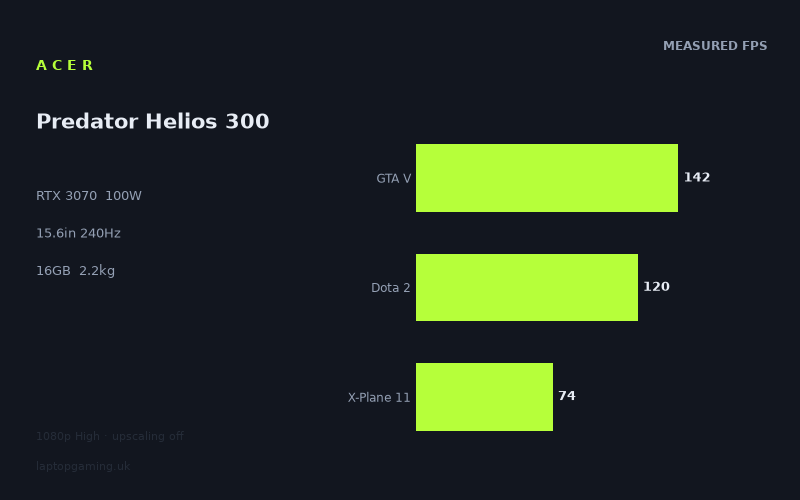
Frame rates
1920×1080, High preset, upscaling off.
Measured on this machine. Source: Notebookcheck, 2021-07-21.
Not scored: incomplete benchmark suite
Every scored laptop on this site is averaged over the same 5 games, and this one is short of Cyberpunk 2077, Baldur's Gate 3. A mean over 5 games is not comparable to a mean over 5, so we publish the figures we have and leave the score blank rather than rank it against machines tested on a different set. The numbers below are real - the suite is just incomplete.
How these numbers were produced
Frame rates here are not measured by us, and we label how each one was arrived at. A figure marked measured comes from a published run on that exact machine. A figure marked representative is derived from the GPU and its power limit (TGP) and cross-referenced against published reviews - a sound estimate of what that configuration delivers, but not a measurement of that specific laptop. Unless stated otherwise, numbers are 1920x1080, High preset, upscaling off. Where a laptop ships in several power configurations we use the wattage of the exact SKU listed, because a 140W RTX 5070 and a 115W one are not the same product.
In use
The short version
The Acer Predator Helios 300 PH315-53-786B is a straightforward proposition on the evidence available: it is a 15.6in Full HD gaming laptop with an RTX 3070 limited to 100W, a Core i7-10750H, 16GB of memory, a 512GB SSD and a 240Hz IPS display. Notebookcheck’s measured figures show that it remains a strong 1080p High-preset machine in a broad set of games, but its results also make clear that a 240Hz screen is more aspirational than consistently usable in demanding modern games.
The important point is not that it can produce high frame rates in selected titles; plenty of gaming laptops can do that. The useful distinction is how often it does so, where it falls short, and what that tells a buyer about the sort of games the Helios 300 suits. Notebookcheck’s benchmark data ranges from 179fps in Strange Brigade to 68fps in Watch Dogs Legion. That is a healthy range for a 100W RTX 3070 laptop, but it is also a reminder that the RTX 3070 name alone does not determine gaming performance. The 100W power limit, the processor, the game engine and the demands of the selected High preset all matter.
The measured mean across the scoring-suite games is 120fps. That is enough performance to make this a very capable Full HD gaming machine for players who want smooth motion rather than an obsession with a fixed 240fps target. It is particularly convincing in the lighter or older games in the data set, where Strange Brigade reaches 179fps, The Witcher 3 reaches 154fps, F1 2021 reaches 149fps and GTA V reaches 142fps. These are results that can make real use of a fast panel, even though they do not all fully saturate 240Hz.
The picture is less clear-cut in heavier games. Dirt 5 and Outriders both measure 94fps, Final Fantasy XV measures 85fps, Serious Sam 4 measures 79fps, X-Plane 11 measures 74fps and Watch Dogs Legion measures 68fps. Those are still playable-looking figures for a laptop at 1920x1080 on the High preset with upscaling disabled, but they are nowhere near the display’s maximum refresh rate. Buyers should therefore see this as a laptop that can provide a high-refresh experience in suitable games, rather than one that guarantees a 240fps result merely because it has a 240Hz panel.
There is no confirmed UK price for this exact configuration. That means value cannot be assessed properly, and no overall value judgement should be made without inventing a price that has not been established. The performance data is complete and the machine can be considered normally on gaming speed; the missing element is simply the price needed to decide whether those results represent a good deal.
For the right buyer, the Helios 300 makes most sense as a gaming-first laptop for playing at its native 1920x1080 resolution, using High settings, and accepting that different games will land in very different performance bands. It looks best for people playing titles closer to Strange Brigade, The Witcher 3, F1 2021, GTA V, Dota 2 and Death Stranding, where the measured figures are comfortably above 100fps or close to it. It is still credible for more demanding games, but it is not the machine to choose on the assumption that every game will run at 240fps or that every high-refresh display will be driven to its limit.
It is also important not to over-read the rival comparisons. Against some machines, the Helios 300 holds a near-zero average difference despite having different graphics hardware or a different GPU power limit. That does not mean all the GPUs are interchangeable. The shared games include lighter 1080p titles where CPU limits can compress the differences between graphics chips. Conversely, the large deficit against a much more powerful RTX 3080 Ti laptop shows that the 100W RTX 3070 has a clear ceiling when compared with a substantially higher-power gaming system.
Performance
What the measured figures show
Notebookcheck measured the Acer Predator Helios 300 at 1920x1080 using the High preset with upscaling off. That matters. These are not figures inflated by a lower rendering resolution or by enabled upscaling, and they are also not results from an unknown settings mix. They represent a useful Full HD High-preset picture of what this exact RTX 3070 and Core i7-10750H configuration can do.
At the top end of the data, Strange Brigade reaches 179fps. That is the fastest result in the available set and it is the clearest demonstration of what the Helios 300 can achieve when a game is relatively accommodating at 1080p. The Witcher 3 follows at 154fps, F1 2021 measures 149fps and GTA V measures 142fps. These are not marginally high results; they sit well above the 100fps mark and give the 240Hz screen meaningful work to do, even if none reaches its full refresh ceiling.
Dota 2 measures 120fps, matching the mean across the scoring-suite games. That makes it a useful middle marker for the laptop rather than simply another high number. A buyer whose main games resemble Dota 2 in their demands can reasonably expect a fast-feeling Full HD experience from the available benchmark evidence. It is not proof of performance in every competitive game, because no unmeasured title should be treated as identical, but it does show that the Helios 300 is not restricted to cinematic single-player titles at modest frame rates.
Death Stranding measures 115fps and Days Gone measures 112fps. Both sit just above the 100fps line. That is a particularly attractive range for a 240Hz laptop because it does not claim the impossible: the screen can refresh faster than the game is producing frames, but the frame rate is still high enough for the panel’s high-refresh character to be relevant. The display is not wasted simply because a game does not hit 240fps. A result above 100fps remains substantially different in practical terms from a result near 60fps, especially for players who value fluid motion and reduced frame-time gaps.
Far Cry 5 measures 103fps and Yakuza Like a Dragon measures 100fps. These results reinforce the same point. The Helios 300 does not deliver a universal 120fps-plus result, but it reaches or approaches 100fps in a useful section of the benchmark list. That is strong evidence for buyers who want to play at the native Full HD resolution without immediately treating High settings as an unrealistic target.
The lower half of the results deserves as much attention as the headline figures. Dirt 5 measures 94fps and Outriders also measures 94fps. Final Fantasy XV is lower at 85fps. Serious Sam 4 comes in at 79fps, X-Plane 11 reaches 74fps and Watch Dogs Legion is the lowest measured title at 68fps. Nothing in that group supports a claim that the Helios 300 is a 240fps gaming laptop in every sense. Rather, it is a laptop with a 240Hz screen whose actual gaming output can range from well below 100fps to well above it, depending on the title.
That spread is not a weakness in the benchmark process. It is exactly why a broad game list is more useful than a single average. The mean of 120fps across the scoring-suite games is a helpful summary, but it is not a promise that every game will perform around that level. Watch Dogs Legion at 68fps is a long way from Strange Brigade at 179fps. A buyer interested primarily in the more demanding end of the library should pay more attention to the lower group than to the mean. A buyer playing the lighter or older games should take the opposite view and recognise that the machine can deliver much higher frame rates than the mean suggests.
The 100W RTX 3070 in context
This Helios 300 uses an RTX 3070 with a 100W GPU power limit. That specification should be treated as central to the identity of the machine, not as a footnote. Laptop GPUs sharing the same product name can operate with different power limits, and the benchmark results here belong specifically to this 100W implementation. It would be misleading to take a result from another RTX 3070 laptop and assume this Acer will necessarily match it.
The available numbers show a GPU configuration that is clearly capable at 1920x1080 High settings, but not one that overpowers every game to the point where the processor or display is the only meaningful limit. In lighter titles, the results climb into the 140fps to 179fps region. In more demanding games, the figures retreat into the 68fps to 94fps range. This is what makes the 100W specification useful in practice: it is part of the reason to judge the laptop by its measured results rather than by the RTX 3070 badge alone.
There is no need to invent an unsupported comparison against every possible RTX 3070 power limit. The data already gives enough evidence to make a practical judgement. At Full HD High settings, the Helios 300 is fast enough to run a substantial number of games well above 100fps. At the same time, it is not so fast that a demanding game such as Watch Dogs Legion becomes a high-refresh showcase at 240fps. The GPU has enough performance for strong 1080p gaming, but the display specification sets a target that only selected games in the measured list approach.
The processor is a Core i7-10750H, and the system has 16GB of memory. The supplied data does not include individual CPU benchmarks, memory speed, storage performance or thermal measurements, so there is no basis for claiming that any one component is a bottleneck in a particular game. What can be said is that the laptop’s gaming results are produced by this complete configuration, not by the graphics chip in isolation. That is relevant when comparing it with other machines carrying similar GPU labels.
The rival data makes this especially clear. The Helios 300 averages a near-zero difference against the Razer Blade 15 Base Edition 2021 with an RTX 3060 at 95W across the shared games. It also averages a near-zero difference against the Asus ZenBook Pro Duo UX582 with an RTX 3070 at 85W across the shared games. On paper, those comparisons might look surprising if viewed only as graphics-tier comparisons. In the shared 1080p set, however, lighter games can become CPU-bound and compress genuine GPU differences. The result is real, but it should not be turned into a broad claim that the three GPU configurations are identical.
Understanding the benchmark bands
The quickest way to understand the Helios 300 is to divide the results into practical bands rather than treating every figure as a separate verdict.
- High-refresh territory: Strange Brigade at 179fps, The Witcher 3 at 154fps, F1 2021 at 149fps and GTA V at 142fps show the machine operating at a level where the 240Hz display has obvious value.
- Fast and convincing: Dota 2 at 120fps, Death Stranding at 115fps, Days Gone at 112fps, Far Cry 5 at 103fps and Yakuza Like a Dragon at 100fps demonstrate consistently quick Full HD gaming even without reaching the panel’s maximum refresh rate.
- Smooth rather than panel-saturating: Dirt 5 and Outriders at 94fps, plus Final Fantasy XV at 85fps, are still substantial results but sit well short of a 240fps objective.
- Demanding-game territory: Serious Sam 4 at 79fps, X-Plane 11 at 74fps and Watch Dogs Legion at 68fps show where the laptop’s available graphics performance is more clearly constrained by the workload.
This grouping is more useful than pretending there is one universal answer to the question of whether the laptop is “fast enough”. It is fast enough for different things in different ways. A player whose time is dominated by Dota 2, F1 2021, GTA V and Strange Brigade can see a machine that produces high frame rates at its native resolution. Someone buying it mainly for Watch Dogs Legion, X-Plane 11 or Serious Sam 4 should see a machine that still delivers measured performance above 60fps, but not one that exploits a 240Hz panel in the same way.
The gap between 179fps in Strange Brigade and 68fps in Watch Dogs Legion is also why settings expectations matter. The measurements are all at High with upscaling off. The data does not tell us what would happen with altered settings, a different preset or upscaling enabled, so those outcomes should not be promised. What it does show is that High is a realistic starting point at 1920x1080 for this machine. Buyers who are content with the measured range have a clear reason to consider it; buyers who need every game to meet a much higher fixed frame-rate target should not assume the specification alone guarantees that outcome.
The scoring-suite mean and its limits
The mean across the scoring-suite games is 120fps. That is a good headline for the Helios 300’s gaming ability, but it should be used carefully. A mean is valuable because it reduces the influence of one unusually easy or unusually punishing game. It is not valuable if it causes the buyer to overlook the individual results. Here, the underlying scoring-suite figures include Strange Brigade at 179fps, GTA V at 142fps, Dota 2 at 120fps, Final Fantasy XV at 85fps and X-Plane 11 at 74fps. The 120fps mean sits between very different gaming experiences.
For someone choosing between laptops for a mixed library, that mean supports the argument that the Helios 300 is broadly strong at Full HD. It has no catastrophic result in the supplied set, and its lowest figure is 68fps in Watch Dogs Legion. For someone choosing specifically for flight simulation or the heaviest titles in this list, the mean is less relevant than X-Plane 11 at 74fps and Watch Dogs Legion at 68fps. The laptop remains usable by the evidence available, but its result profile is not uniform.
That distinction is particularly important because the screen refresh rate is 240Hz. A 120fps mean is exactly half of the display’s stated refresh rate, but that arithmetic should not be mistaken for a universal conclusion. The measured games do not all run at the mean, and the display cannot make a 68fps result behave like a 240fps result. What the high-refresh panel does offer is headroom for games where the laptop can produce more frames, along with a display specification that is not itself the immediate ceiling in any of the recorded results.
The screen
The Predator Helios 300 has a 15.6in IPS display with a 1920x1080 resolution and a 240Hz refresh rate. For the gaming performance shown here, Full HD is the sensible resolution choice. The laptop’s measured figures are already taken at 1920x1080 High with upscaling off, so there is no uncertainty about whether the RTX 3070 can operate at the panel’s native resolution. It can, and it does so across a varied list of games.
The more nuanced question is whether the GPU can genuinely make use of 240Hz. The answer is yes in part, but not consistently across the measured list. Strange Brigade at 179fps is the closest result to the panel’s maximum refresh rate, followed by The Witcher 3 at 154fps, F1 2021 at 149fps and GTA V at 142fps. These games do not reach 240fps in the published data, but they are high enough that a 240Hz screen is not an absurd pairing. The display has substantial headroom above the measured output.
Dota 2 at 120fps is a good example of the distinction between a fast display and a fully saturated display. The game reaches a frame rate that is plainly high, but it does not reach 240fps. That does not make the panel pointless. It does mean buyers should not confuse a 240Hz specification with a 240fps guarantee. The same applies to Death Stranding at 115fps, Days Gone at 112fps, Far Cry 5 at 103fps and Yakuza Like a Dragon at 100fps. These are all results that suit a high-refresh gaming laptop more naturally than a conventional low-refresh machine, while still falling well short of the panel’s maximum stated rate.
In the lower measured group, the difference is more pronounced. Dirt 5 and Outriders reach 94fps, Final Fantasy XV reaches 85fps, Serious Sam 4 reaches 79fps, X-Plane 11 reaches 74fps and Watch Dogs Legion reaches 68fps. A 240Hz display remains capable of showing those outputs, but the performance evidence says the GPU is not delivering 240 frames each second in those titles at the tested settings. Anyone buying largely for visually demanding games should frame the screen as a high-quality target for lighter games and a source of headroom, not as a panel that the laptop will always fill.
The IPS panel type is another useful part of the specification, but the fact sheet does not provide measured brightness, contrast, colour coverage, response times, backlight behaviour or outdoor visibility. Those are all important display characteristics, especially on a gaming laptop with such a high refresh rate, but they cannot be filled in from the panel label alone. IPS tells us the stated panel technology; it does not justify claims about colour quality or motion performance without supporting measurements.
There is also no supplied information about adaptive synchronisation support, so it should not be assumed. Likewise, there is no basis for discussing pixel response behaviour, screen calibration or whether the display’s full refresh rate is available under every operating condition. The known facts are narrower but still useful: it is a 15.6in IPS Full HD panel with a 240Hz refresh rate, paired with a GPU that produces anything from 68fps to 179fps in the available Notebookcheck measurements.
For a buyer, the practical conclusion is clear. This display is well matched to a Full HD gaming strategy. It avoids asking the RTX 3070 to drive a higher native resolution, and it gives lighter and moderately demanding games room to run fast. The mismatch appears only if a buyer interprets the 240Hz label as a promise of 240fps in every game. The benchmark list directly disproves that expectation. It also shows why the screen is still sensible: many games land at or above 100fps, and several are well above 140fps.
Build, size and portability
The Acer Predator Helios 300 weighs 2.218kg. That places it firmly in the category of a laptop that can be moved, transported and used away from a fixed desk, but it should not be described as an ultralight machine. A buyer choosing it needs to be realistic about the intended pattern of use. This is a gaming laptop with a dedicated RTX 3070, a 15.6in screen and a 240Hz panel; the weight aligns more naturally with regular transport between places than with minimal-bag portability.
At 2.218kg, the Helios 300 is likely to make most sense as a machine that has a primary location but is moved when needed: between rooms, between home and another regular destination, or as a portable system for users who accept the weight in exchange for stronger gaming hardware. The supplied information does not include charger weight, battery capacity, battery-life measurements or chassis dimensions. Those omissions matter. A laptop’s practical travel burden is not defined by the chassis weight alone, and battery life can substantially affect how useful it is away from mains power. Since those figures are not available, they should not be guessed.
The absence of dimensions also means there is no reliable basis for claiming that it is especially thin, compact or easy to fit into a particular bag. A 15.6in laptop can vary substantially in footprint and thickness depending on the chassis design, cooling arrangement and display surround. The only supported physical measure here is 2.218kg, so that is the figure a buyer should use when deciding whether it belongs in their daily routine.
There is similarly no supplied information about materials, keyboard layout, trackpad quality, port selection, webcam, speakers, fan noise or surface temperatures. Those are all areas where a traditional hands-on review would normally offer a verdict, but they cannot be responsibly recreated from specifications and gaming figures. The available evidence supports a performance analysis and a weight-based portability judgement, not a claim about how the chassis feels or sounds.
What can be said is that the 15.6in form factor fits the screen and performance profile. The Full HD 240Hz display is directed at gaming, and the RTX 3070 results show that the machine can deliver high frame rates at the screen’s native resolution. That makes the laptop more coherent as a portable gaming system than a hypothetical higher-resolution model would be on the same performance evidence. It is not trying to push an unsupported resolution target; it is built around Full HD, where its benchmark data is strongest.
Buyers who travel frequently with a laptop should be careful not to reduce the decision to the 2.218kg figure alone. It is a meaningful number, but the fact sheet does not say how long the system runs away from mains power, what the charging hardware adds, or how much physical space the chassis occupies. Buyers who mainly use the machine near a mains socket can focus more comfortably on the gaming evidence. Buyers who need an all-day travel computer should look for the missing portability measurements before treating this as a complete answer to that use case.
How it compares
Against the MSI Prestige 15
The MSI Prestige 15 listed here uses an RTX 3050 Ti at 105W. Across four shared games, the Acer Predator Helios 300 averages 52fps more than the MSI. That is the biggest advantage the Helios 300 holds among the specified rivals, and it is the clearest evidence that this Acer belongs in a materially stronger gaming-performance class than that particular Prestige 15 configuration.
The fact that the MSI’s RTX 3050 Ti has a stated 105W power limit, slightly above the Acer RTX 3070’s 100W limit, is a useful warning against treating power limit alone as a ranking. The Helios 300’s RTX 3070 still holds the substantial shared-game advantage. GPU model, system configuration and the games being compared all matter. A buyer looking primarily at gaming performance should take the 52fps average lead seriously, because it is not a marginal difference produced by a single frame or an uncertain interpretation.
The comparison covers four shared games rather than the full benchmark list, so it should not be overstated into a universal claim about every game. But the direction of travel is unambiguous. If the choice is between these exact configurations and gaming speed is the priority, the Helios 300 has the stronger published evidence. Both machines lack a confirmed UK price in the supplied information, so there is no responsible way to decide whether that performance lead is worth any potential price difference. The performance argument is clear; the value argument is unavailable.
Against the Razer Blade 15 Base Edition 2021
The Razer Blade 15 Base Edition 2021 listed here combines the same Core i7-10750H processor with an RTX 3060 at 95W. Across five shared games, the Predator Helios 300 averages a near-zero difference. That is a real result, not an error to be rounded away, but it needs explanation rather than a simplistic declaration that RTX 3060 and RTX 3070 laptop configurations are always equal.
At 1080p, the lighter titles in the shared set can be CPU-bound. When that happens, genuine graphics differences are compressed because the GPU is not the only limiting factor. The shared-game average therefore says that, in this particular comparison set, the Helios 300 and the Razer produced effectively the same average frame rate. It does not establish that the two graphics configurations will match in every title, at every setting, or under every rendering workload.
For a prospective buyer, the useful conclusion is narrower. If the games they care about resemble the shared benchmark selection, the Acer does not show a meaningful average speed advantage over this Razer despite using an RTX 3070 at 100W against the Razer’s RTX 3060 at 95W. That makes non-performance factors potentially important between the two, but the necessary evidence to judge build quality, screen behaviour, portability beyond the Acer’s stated weight, battery life, noise and price is not supplied here. Neither exact configuration has a confirmed UK price, so value cannot settle the comparison either.
The near-zero result is still useful because it prevents an overconfident purchase decision based only on product names. An RTX 3070 label might lead someone to expect a clear and automatic win over an RTX 3060 laptop. The shared data does not show that. For these games at 1080p, the difference is effectively absent on average, and the supplied explanation is that CPU-bound lighter titles can compress GPU gaps.
Against the Asus ZenBook Pro Duo UX582
The Asus ZenBook Pro Duo UX582 carries an RTX 3070 at 85W, compared with the Acer’s RTX 3070 at 100W. Across five shared games, the average difference is again near zero. This is another comparison where it would be wrong to assume that a higher stated power limit must produce a visible advantage in every game.
The explanation is the same important one: at 1080p, lighter titles in the shared set can be CPU-bound and compress genuine GPU differences. That does not erase the fact that the Acer has the higher stated GPU power limit. It simply means the selected shared workloads do not reveal a meaningful average gap between these exact machines. The performance outcome is compressed by the circumstances of the test rather than proving that the power-limit difference is irrelevant everywhere.
For a buyer, this comparison argues against paying attention only to the 100W figure. The Helios 300’s individual results remain strong, and its GPU limit is part of its specification, but the shared-game data does not show it separating itself from the 85W RTX 3070 Asus on average. If your intended games are similar to those shared titles, there is no published average-frame-rate reason to expect the Acer to be clearly faster. If your intended games are different, the supplied data does not provide a basis for a stronger claim.
Again, there is no confirmed UK price for either exact configuration in this comparison. It would be tempting to fill that gap with assumptions about the market position of the two product lines, but that would not be useful or supportable. The correct conclusion is simply that the gaming averages are effectively level in the five shared games, while the broader purchasing decision cannot be completed from the available price information.
Against the MSI Raider GE77 HX
The MSI Raider GE77 HX is the rival that beats the Helios 300 by the greatest margin in the supplied list. It uses an RTX 3080 Ti at 175W, and across five shared games the Acer averages 49fps less. This is the comparison that best reveals the limits of the Helios 300’s 100W RTX 3070 configuration.
A 49fps average deficit is substantial. Unlike the near-zero gaps against the Razer and Asus, it is too large to dismiss as shared-set compression. The Raider’s RTX 3080 Ti operates at 175W, and the published numbers show a clearly higher level of gaming performance over the shared games. Buyers who need the highest available frame rates, particularly in games that place heavier demands on the graphics hardware, should recognise that the Helios 300 is not competing at this level.
That is not an argument that every buyer should choose the Raider. The supplied data gives no confirmed UK price for the MSI Raider GE77 HX, and it does not provide its weight, display specification, battery information or other practical characteristics. It only establishes the performance relationship. On that evidence, the Raider is the faster machine by a large shared-game margin. Whether that speed difference is worth the wider trade-offs cannot be decided without facts that are not present.
The comparison is still useful for setting expectations. The Helios 300 performs well at Full HD High settings, with multiple figures above 100fps and a scoring-suite mean of 120fps. But it is not a substitute for a much higher-power RTX 3080 Ti laptop where maximum frame rate is the priority. A buyer stepping down from that class of machine to the Acer should expect a real reduction in shared-game performance, not merely a change in specifications on paper.
Who it’s for
The Acer Predator Helios 300 PH315-53-786B is for the buyer who wants a capable Full HD gaming laptop and judges it by published frame-rate evidence rather than by the RTX 3070 label alone. The strongest case is for someone whose games include titles that resemble the higher-scoring half of the Notebookcheck list: Strange Brigade at 179fps, The Witcher 3 at 154fps, F1 2021 at 149fps, GTA V at 142fps, Dota 2 at 120fps, Death Stranding at 115fps and Days Gone at 112fps. In that part of the data, the laptop offers the sort of performance that suits a 240Hz display well, even where it does not fully reach 240fps.
It also suits players who want High settings at 1920x1080 with upscaling off, because that is exactly the test condition under which the measured figures were produced. The data supports a confident Full HD High-preset use case. Far Cry 5 reaches 103fps and Yakuza Like a Dragon reaches 100fps, reinforcing that the machine is not dependent on only the easiest games to hit a high frame rate. The scoring-suite mean of 120fps further supports the view that this is a broadly quick 1080p gaming system.
It is a reasonable choice for someone who accepts variation between games. That buyer understands that Dirt 5 and Outriders at 94fps, Final Fantasy XV at 85fps, Serious Sam 4 at 79fps, X-Plane 11 at 74fps and Watch Dogs Legion at 68fps are not failures of the laptop but part of the reality of gaming workloads. They are buying a machine that can be very fast in some titles and more conventionally smooth in others.
It is also for someone who can live with a 2.218kg laptop. That does not make it immobile, but it does point toward a user who wants transportability rather than extreme lightness. The fact sheet does not provide battery life, charger weight or dimensions, so the best fit is a buyer who expects gaming near mains power and who does not need unverified claims about all-day portability.
The Helios 300 is not for the buyer who sees “240Hz” and requires a 240fps result in every game. The available evidence does not support that expectation. Strange Brigade reaches 179fps, which is the highest measured result, while demanding titles are much lower. It is also not for someone who needs the strongest possible gaming performance regardless of other considerations. The MSI Raider GE77 HX’s 175W RTX 3080 Ti leads the Acer by 49fps on average across their shared games, making the performance ceiling clear.
It is not automatically the best answer for a buyer comparing it with the Razer Blade 15 Base Edition 2021 or the Asus ZenBook Pro Duo UX582. The Acer holds a near-zero average difference against both in the listed shared games. The explanation is that lighter 1080p titles can be CPU-bound and compress GPU gaps, but the practical consequence remains: the available shared-game data does not show a meaningful average gaming lead for the Acer over either machine. A buyer deciding between those laptops needs information beyond the frame-rate averages, and that information is not supplied here.
It is clearly more appropriate than the listed MSI Prestige 15 for a buyer focused on gaming speed, as the Helios 300 averages 52fps more across their four shared games. That is the most decisive comparison in the Acer’s favour. But it is still not possible to call it better value because there is no confirmed UK price for either exact configuration. Performance and value are different questions, and only the former can be answered here.
The final judgement is therefore performance-led and appropriately conditional. The Predator Helios 300 is a strong Full HD gaming laptop on Notebookcheck’s measured data. Its 100W RTX 3070 delivers results ranging from 68fps to 179fps at 1920x1080 High with upscaling off, with a 120fps mean across the scoring-suite games. Its 240Hz IPS screen is a good fit for the games where it reaches high frame rates, but it should be treated as headroom rather than a universal frame-rate target. Buy it for well-supported 1080p gaming performance, a 15.6in high-refresh screen and a portable-but-not-lightweight 2.218kg form factor. Buy something else if your priority is guaranteed 240fps gaming, the highest available performance tier, or a value verdict that requires a confirmed UK price.