Review
HP Omen 17-db0079ng review
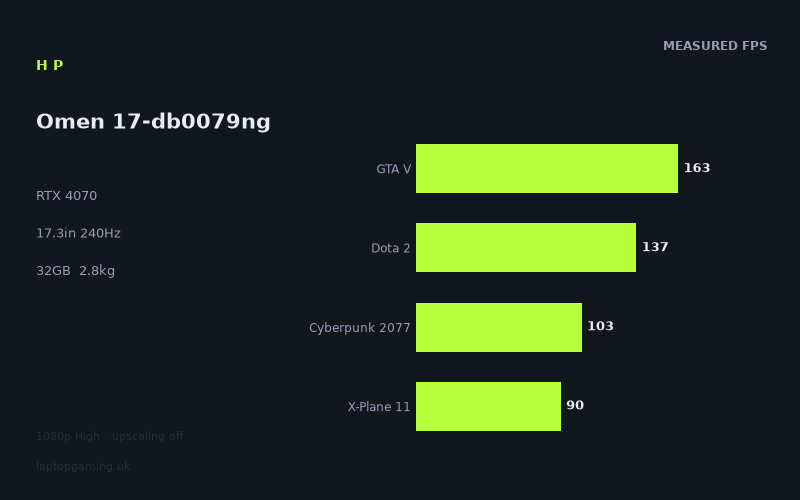
Frame rates
1920×1080, High preset, upscaling off.
Measured on this machine. Source: Notebookcheck, 2024-07-25.
Not scored: incomplete benchmark suite
Every scored laptop on this site is averaged over the same 5 games, and this one is short of Baldur's Gate 3. A mean over 4 games is not comparable to a mean over 5, so we publish the figures we have and leave the score blank rather than rank it against machines tested on a different set. The numbers below are real - the suite is just incomplete.
How these numbers were produced
Frame rates here are not measured by us, and we label how each one was arrived at. A figure marked measured comes from a published run on that exact machine. A figure marked representative is derived from the GPU and its power limit (TGP) and cross-referenced against published reviews - a sound estimate of what that configuration delivers, but not a measurement of that specific laptop. Unless stated otherwise, numbers are 1920x1080, High preset, upscaling off. Where a laptop ships in several power configurations we use the wattage of the exact SKU listed, because a 140W RTX 5070 and a 115W one are not the same product.
In use
The short version
The HP Omen 17-db0079ng is a 17.3in machine weighing 2.833kg, built around an RTX 4070 and a Ryzen 7 8845HS, with 32GB of memory, an 83Wh battery and a 2560x1440 IPS panel running at 240Hz. Notebookcheck's measured figures, dated 25 July 2024, cover ten titles at 1920x1080 on the High preset with upscaling switched off. They run from 240fps in Strange Brigade down to 90fps in X-Plane 11.
The number that matters most is the one at the bottom. Nothing in the measured set falls below 90fps, and the three slowest results are X-Plane 11 at 90fps, Hogwarts Legacy at 92fps and Cyberpunk 2077 at 103fps. A machine whose worst measured result is 90fps at native 1080p, with upscaling off, is a machine that will not embarrass itself in anything. That floor is the single most useful thing on this page.
Cyberpunk 2077 at 103fps is the individual result that carries the most weight. It is the heaviest genuine graphics workload in our scoring suite, it is untagged — the current build rather than a version-locked benchmark from an older release — and 103fps at native 1080p on High without upscaling is a serious number. It says the RTX 4070 in this chassis is being run properly rather than throttled to fit a thin body, which is what a 2.833kg 17.3in machine ought to allow.
The comparisons complicate the picture in a way worth understanding before you read them. Against an Asus TUF Gaming A15 with an RTX 4060, this machine averages level across four shared games. Against a Lenovo Legion Slim 5 with an RTX 4060 at just 60W, also level, across three. Against an Asus ROG Strix Scar 17 with an RTX 4090, it is 69 frames per second behind across three. Two of those results look like they contradict the Cyberpunk figure, and the comparison section explains at length why they do not.
There is no score on this page. Our scoring suite is five games, identical for every laptop we rank, and this machine holds four of them: GTA V at 163fps, Dota 2 at 137fps, Cyberpunk 2077 at 103fps and X-Plane 11 at 90fps, averaging 123fps across those four. The missing title is Baldur's Gate 3. Four out of five is the closest a laptop can get without qualifying, and it is genuinely frustrating — but the whole value of a fixed suite is that every ranked machine is averaged over the same games, and a four-game average is not comparable to a five-game one. We do not publish partial rankings.
We also hold no confirmed UK price for this configuration, and no confirmed price for any of the four rivals it is compared against. That means this entire page is about capability, not value. We can tell you what the machine does relative to specific alternatives; we cannot tell you whether it is worth the money, because we do not know what the money is.
Buy it if you want a large-screen machine with an unusually high performance floor and a genuinely premium display, and you are content for it to live mostly in one place. Look elsewhere if the laptop has to travel — 2.833kg on a 17.3in footprint is a commitment — or if you were expecting the 240Hz panel to be filled by the games in this set, because with one exception it is not.
Performance
The power limit our record does not hold
The most predictive figure for any laptop graphics card in this generation is the power limit the manufacturer set for it. Nvidia sells the same silicon to every laptop maker with a configurable ceiling, and each maker chooses a point in that band according to how much heat the chassis can move, how much fan noise they will ship and what price bracket they are targeting. The result is a stack in which the gap between a well-fed GPU and a starved one of the same model routinely exceeds the gap between adjacent model numbers. This is not an exception in this generation. It is the rule, and every page on this site is written with it in mind.
Our record does not hold a power limit for the Omen 17's RTX 4070. That is a real gap, and it removes the most useful single predictor available. We are not going to guess at a number.
What we can do is reason from what the record does contain, and here the reasoning is unusually supportive. The chassis is 17.3in and weighs 2.833kg. That is a substantial machine by any measure — well beyond the thin-and-light territory where GPU power limits are typically cut hard to fit a chassis that cannot cool them. A body of this size and mass has the internal volume for a serious heatsink and fan assembly, the surface area to shed heat into the room, and the thermal mass to absorb transients. Everything about the physical specification points towards a machine that can afford to run its graphics card properly.
The measured figures back that up, which is the important part — the reasoning above would be speculation on its own. A 90fps floor across ten titles, and 103fps in Cyberpunk 2077 specifically, are not what a power-limited RTX 4070 produces. Whatever ceiling HP has chosen, the results do not describe a graphics card being held back by the chassis. That is a genuinely useful conclusion to be able to draw from measurement rather than assumption, and it is the strongest argument in the machine's favour.
One caveat belongs here. The processor is a Ryzen 7 8845HS — an eight-core H-class part, and a capable one, but not one of the high-power HX-class desktop-derived chips that appear in the fastest machines of this generation. In workloads that are limited by the processor rather than the graphics card, that distinction sets a ceiling, and it becomes the explanation for two of the four comparisons further down this page. It is not a weakness in a machine of this positioning; it is a fact about where the limit sits.
The top of the set: 240fps and 197fps
Strange Brigade at 240fps is the highest result in the record and it lands exactly on the panel's refresh rate. That is almost certainly a coincidence of measurement rather than a frame cap, but it is a neat illustration: this is the one title in the set where the display is the limiting factor rather than the hardware.
Strange Brigade is a well-optimised title that has produced generous numbers on modest hardware for years, so 240fps is more a demonstration of headroom than a hard test. It does establish something worth knowing, though — the platform as a whole, processor included, can reach 240fps in a favourable workload. That rules out any suggestion that the machine is bottlenecked in some structural way that would cap it lower.
F1 24 at 197fps is a far more meaningful high-end result. It is a current racing title with a demanding lighting model, and 197fps at native 1080p on High is genuinely strong. Racing is one of the genres where high frame rates translate into control feel rather than just visual smoothness, and a machine holding close to 200fps here with a 240Hz display in front of it is well matched for that use.
Both results are, at these frame rates, substantially limited by the processor rather than the graphics card. When a game runs at 197fps at 1080p, the GPU is completing frames faster than the CPU can prepare work for it, and the number you are reading is largely a measure of the Ryzen 7 8845HS with the RTX 4070 waiting. That observation is the key to the whole comparison section and it is worth carrying forward.
The middle: 105 to 163fps
Six of the ten results sit between 105fps and 163fps, and this band is the most representative description of what the machine does day to day.
GTA V at 163fps and Dota 2 at 137fps are two of the four scoring-suite titles we hold. Both are older and comparatively light, and both are firmly in processor-limited territory at these frame rates. They are real results — someone who plays Dota 2 cares that this machine delivers 137fps — but they are weak instruments for separating one graphics configuration from another.
Final Fantasy XV at 117fps and Far Cry 5 at 115fps land almost together, which is a reasonable sanity check: two titles of broadly comparable graphical ambition producing broadly comparable numbers. Both are comfortably above any threshold that matters for smoothness.
God of War at 105fps is one of the more useful numbers in the set. It is a well-made modern console port with a heavy but efficient renderer, and 105fps at native 1080p on High describes a machine handling a genuinely current workload with room to spare. Unlike the results above 150fps, this one is telling you about the graphics card rather than the processor.
The seven-title span from 240fps down to 105fps is wide, but the shape of it is instructive. It is not a gradual decline across increasing graphical difficulty — it is a cluster of very high results in titles where the CPU is the constraint, then a compression into the 105 to 137fps range once the graphics card starts doing the deciding. That compression is the signature of a GPU with sufficient headroom: the numbers stop spreading out because nothing is being starved.
The floor: Cyberpunk 2077, Hogwarts Legacy and X-Plane 11
The three lowest results are Cyberpunk 2077 at 103fps, Hogwarts Legacy at 92fps and X-Plane 11 at 90fps, and they are the most important part of the record.
Cyberpunk 2077 is the heaviest genuine graphics workload in our scoring suite and one of the most demanding titles in general circulation. It is worth being explicit that this is the untagged result — the game as it currently stands, not a version-locked benchmark from an older build. We treat version-tagged entries as separate workloads entirely and never merge them with the untagged title, because they are not the same test. This figure needs no such caveat. 103fps at native 1080p on High with upscaling off is a strong result, and it is the clearest evidence on the page that the graphics card in this chassis is properly configured.
Hogwarts Legacy at 92fps is a similarly demanding open-world title with a known appetite for graphics memory and heavy streaming behaviour. 92fps is a comfortable number for it. We hold an average and nothing about frame-time consistency, so we are not going to characterise how it feels in the worst moments — averages hide stutter — but as an average it is well clear of any concern.
X-Plane 11 at 90fps is the lowest result in the set and it is a different kind of load again. Flight simulation leans heavily on the processor for world streaming and physics, and it is one of the workloads where a Ryzen 7 8845HS rather than an HX-class chip is most likely to be the thing setting the ceiling. 90fps is a perfectly good result; it is simply a result that is telling you about the CPU rather than the GPU.
Taken together, the bottom of this record is unusually strong. A machine that does not fall below 90fps in any of ten measured titles, including two of the most demanding games available, is not a machine with a weak spot. It is closer to the opposite: consistent, well-configured and with no obvious failure mode at the benchmark resolution.
Why there is no score
Our scoring suite is five games and every ranked laptop is averaged across the same five, so that any two machines can be compared like for like. This one holds four: GTA V at 163fps, Dota 2 at 137fps, Cyberpunk 2077 at 103fps and X-Plane 11 at 90fps, averaging 123fps.
The missing title is Baldur's Gate 3. Four out of five is as close as a machine can come without qualifying, and the temptation to publish the four-game average as though it were comparable is real. We do not, for a reason that goes to the point of having a fixed suite at all: the average is only meaningful because every machine is averaged over the same games. Swap one title out and the resulting number is no longer on the same scale — it is a different measurement wearing the same units. A reader comparing a four-game average against a five-game average would be misled, and would have no way of knowing it.
It is worth noting that this machine's record is unusually complete in the way that matters most. It holds Cyberpunk 2077 — the suite title that most reliably separates strong graphics configurations from weak ones, and the one most often missing. What it lacks is the title we would expect to hurt it least. That is bad luck rather than a hidden weakness, and it is why the performance analysis above can be more confident than it usually would be on an unscored machine.
The screen
The display is a 17.3in IPS panel at 2560x1440, refreshing at 240Hz, and it is a properly premium specification — the sort of panel that would headline a machine costing considerably more in a different generation.
2560x1440 against a 1080p benchmark
All the measured figures on this page were taken at 1920x1080. The panel is 2560x1440, which is 3.69 million pixels against the benchmark's 2.07 million — a ratio of about 1.8 to 1.
That is a far more modest gap than high-resolution panels typically impose, and it matters. Games do not scale linearly with pixel count and we are not going to construct native-resolution estimates from 1080p measurements, because that would mean publishing figures we do not hold. But the qualitative position is clear: a machine with a 90fps floor at 1080p, facing a resolution step of under twice the pixels, is in a completely different position from a machine facing four times the pixels. There is real headroom here, and the panel's native resolution is a realistic target rather than an aspiration.
The two resolutions also share a 16:9 aspect ratio, so running at 1080p on this display scales cleanly across the full panel without letterboxing — a small practical convenience, but a real one on a machine where dropping resolution is a legitimate strategy for the heaviest titles.
1440p is arguably the correct resolution for a 17.3in gaming panel. 1080p on a screen this large is visibly coarse at normal viewing distance; 4K would demand far more from the graphics card than an RTX 4070 has to give at high frame rates. HP has chosen the setting that this class of hardware can actually drive, which is a more sensible decision than the specification-sheet alternatives.
240Hz, and the gap between panel and measured set
The refresh rate is where the display and the measured figures diverge, and it needs stating honestly.
Of the ten measured titles, exactly one reaches 240fps: Strange Brigade, which lands on the number precisely. F1 24 at 197fps is the only other result above 150fps apart from GTA V at 163fps. The remaining seven titles sit between 90fps and 137fps. At the benchmark resolution — which is below the panel's native resolution — the hardware fills the display's refresh rate in one game out of ten. At 1440p it would fill it in fewer.
There are two ways to read that and both are partly right.
The unflattering reading is that the panel is over-specified for the hardware behind it, and that a 165Hz display would have been filled far more often for less money. There is something in this. A 240Hz panel is a genuine cost, and if the machine's price reflects it, a buyer whose games look like the ones in this set is paying for refresh headroom they will rarely reach.
The more useful reading starts from what the measured set does not contain. It has no competitive first-person shooters in it at all — no titles from the genre that 240Hz displays exist to serve. Those games are, as a category, built to run at very high frame rates on modest hardware, and it is precisely there that the difference between 165Hz and 240Hz is felt in aim and reaction rather than admired in motion. We hold no measurements in that genre and will not extrapolate into it. But a buyer who plays competitive shooters is the buyer this panel is for, and judging it against a set of single-player and simulation titles misses its purpose.
The honest position is this: if your games look like the ones measured here, the 240Hz specification will mostly go unused, and you should not pay a premium for it. If you play competitively, it is exactly the right panel and the rest of this machine's specification supports it well.
IPS
The panel technology is IPS, which is the mainstream choice for gaming displays and the right one for a machine positioned like this. IPS offers wide viewing angles and good colour consistency, and unlike OLED it carries no risk of permanent image retention from static interface elements — a genuine consideration on a machine that will spend hours displaying the same heads-up display or the same desktop.
Our record holds the panel type, resolution and refresh rate. It does not hold brightness, contrast, colour gamut coverage, colour accuracy or measured response times, so we are not going to characterise them. IPS at 240Hz implies a fast panel by construction — that refresh rate is not achievable with slow pixel transitions — but the specific figures are not ours to give.
What the combination establishes is intent. 2560x1440 IPS at 240Hz on a 17.3in chassis is a gaming display, chosen without compromise towards creative work, and it is well matched to a machine of this size and mass.
Build, size and portability
2.833kg on a 17.3in footprint is the specification that determines how this machine gets used, and it is worth being blunt about what it means.
This is not a portable computer in any meaningful sense. Nearly three kilograms is more than twice what a thin-and-light laptop weighs, and the 17.3in footprint is the harder constraint — a machine this size does not fit comfortably in most bags, does not fit on an aeroplane tray table, and does not work on a lap. Add the power supply a machine of this class requires, which our record does not specify but which will not be small, and the practical carrying weight is higher still.
The correct way to think about the Omen 17 is as a desktop replacement: a machine that lives on a desk, is used at a desk, and moves occasionally rather than daily. Judged against that use, the weight is not a flaw at all — it is a feature, and it is the reason the performance section reads the way it does.
That link is the important one. The mass and the volume are what allow the cooling assembly to be large, and the cooling is what allows the graphics card to be run at a ceiling that produces 103fps in Cyberpunk 2077 and a 90fps floor across ten titles. A 1.4kg machine cannot do that, and a 2.1kg machine will struggle to. The weight is not a cost imposed on the buyer for nothing; it is the mechanism by which the frame rates on this page are achieved. Anyone who wants comparable results in a lighter chassis is asking for a trade that this generation's thermals do not currently permit.
A 17.3in display has its own advantages beyond the cooling it enables. It is a substantially larger canvas than the 15in and 16in machines that dominate this category — better for games, better for anything involving multiple windows, and reducing the case for an external monitor. For a buyer who wants one machine that does everything from one position, the size is the point.
The battery is 83Wh. Our record holds no measured runtime for this configuration and we are not going to estimate one, because runtime depends on panel behaviour, platform power management and workload in ways capacity alone cannot predict. What is structurally true is that 83Wh is a reasonable capacity in absolute terms and a modest one relative to what a 17.3in machine with a 240Hz panel and an RTX 4070 draws. No laptop of this class games meaningfully away from mains power, and this one has more display to light than most.
The memory configuration is 32GB, which is generous, comfortably beyond what any title in the measured set requires, and appropriate for a machine likely to be asked to do work as well as play. It is one fewer thing for a buyer to worry about upgrading.
How it compares
The four machines below all carry graphics cards from this same generation, and they are a deliberate spread rather than a list of nearest neighbours: the two closest results, the machine this one beats by the widest margin, and the machine that beats it by the widest. Each comparison uses only games both machines hold, drawing preferentially on our scoring-suite titles.
One thing has to be said before the individual comparisons. We hold no confirmed UK price for this machine or for any of the four rivals. That means nothing in this section can be a value judgement. Every conclusion below is about capability alone, and a buyer will have to supply the prices themselves and redo the reasoning. We would rather say that plainly than imply a verdict the data cannot support.
MSI Thin GF63 — an RTX 4050, and 44 frames per second
The MSI Thin GF63 carries an RTX 4050. Across four shared games, the Omen 17 averages 44 frames per second more.
This is the widest winning margin in the set and the least surprising. A properly cooled RTX 4070 in a 2.833kg 17.3in chassis with 32GB of memory is a substantially more capable platform than an RTX 4050 in a thin budget 15in one, and the measurement says so.
The detail worth noticing is the depth of the overlap. Four shared games is the deepest comparison this machine has, and four games drawn preferentially from our scoring suite means the set includes the heavier titles as well as the light ones. That matters, because the near-zero comparisons below rest on shallower or lighter overlaps. When the comparison reaches into workloads that genuinely test a graphics card, the Omen 17 is 44fps clear.
It also establishes the floor of what the RTX 4070 configuration in this machine is worth. Two tiers of separation in the product stack, and a 44fps average gap across four games including demanding ones, is a coherent result. Nothing about it suggests the Omen's graphics card is being held back.
Asus TUF Gaming A15 — an RTX 4060, and a gap of nothing
The Asus TUF Gaming A15 carries an RTX 4060. Across four shared games, the Omen 17 averages level with it: the difference rounds to zero.
This is the result that will surprise readers most, and it needs unpicking rather than repeating.
The comparison is built preferentially from our scoring-suite titles, of which this machine holds four: GTA V at 163fps, Dota 2 at 137fps, Cyberpunk 2077 at 103fps and X-Plane 11 at 90fps. Three of those four are workloads where the constraint sits with the processor and the platform rather than the graphics card. GTA V at 163fps and Dota 2 at 137fps are firmly in that territory, and X-Plane 11 leans heavily on the CPU by design. In all three, a more capable graphics card has nothing to contribute — it finishes each frame early and waits.
The arithmetic consequence is easy to miss and it is the whole explanation. If three of four shared titles produce near-identical numbers on both machines because both processors can reach the same ceiling, then even a substantial advantage in the fourth title is divided by four before it reaches the average. A 40fps gap in one game becomes a 10fps gap in the four-game mean; a 20fps gap becomes 5fps. Averaging across a set dominated by CPU-limited titles does not just fail to reveal a graphics difference — it actively suppresses one that exists.
So what should a buyer conclude? Not that an RTX 4060 and this RTX 4070 are equivalent — the machine's own record argues against that, with 103fps in Cyberpunk 2077 being precisely the kind of result a lesser card would struggle to match. The correct conclusion is narrower and still useful: in the specific mix of titles this comparison covers, at 1080p, the two machines deliver comparable frame rates, and a buyer whose games look like that mix would not perceive a difference. Move to heavier workloads, or to the panel's native 1440p where the graphics card carries more of the load, and expect the Omen to pull ahead.
Lenovo Legion Slim 5 — an RTX 4060 at 60W, and also a gap of nothing
The Lenovo Legion Slim 5 carries an RTX 4060 at 60W. Across three shared games, the Omen 17 averages level with it.
This one is more striking than the TUF result, because we hold a power figure for it and that figure is low. 60W is towards the conservative end of what this generation's RTX 4060 can be configured at, in a chassis whose name announces that it is thin. On paper this is a considerably weaker graphics configuration than the Omen's, and the three-game comparison finds no difference at all.
The explanation is the same as above, and this result strengthens it rather than complicating it. Three shared games rather than four means an even shallower overlap and an even heavier weighting towards the CPU-limited end of the record. In titles where the graphics card is not the constraint, a 60W RTX 4060 and a well-configured RTX 4070 both wait on the processor and both produce the same numbers. The Legion Slim 5 is not matching the Omen's graphics capability; it is matching its performance in games that do not test graphics capability.
The proof is available in this machine's own record. Cyberpunk 2077 at 103fps and Hogwarts Legacy at 92fps are results that describe a graphics card working hard and delivering. A 60W RTX 4060 in a thin chassis is not a plausible candidate to match those, and the three-game comparison does not claim it is — it simply does not ask.
For a buyer, the practical reading is the same as for the TUF: light and older titles at 1080p do not separate these machines. Everything else will.
Asus ROG Strix Scar 17 — an RTX 4090, and 69 frames per second
The Asus ROG Strix Scar 17 carries an RTX 4090. Across three shared games, the Omen 17 averages 69 frames per second behind it.
This is the result that demonstrates the benchmark can separate machines, and it is more informative than the margin alone suggests — because it is measured on the same shallow, CPU-weighted three-game overlap in which a 60W RTX 4060 matched the Omen exactly.
Think about what that means. In three titles where a substantially weaker graphics configuration produced identical numbers, the Strix Scar is 69fps clear. If those games were purely a test of the graphics card, the Legion Slim 5 could not have kept pace. If they were purely a test of the processor, the Strix Scar could not have pulled away. What the pair of results shows is that these titles have a platform ceiling — set by processor, memory and system throughput acting together — and that machines cluster at that ceiling until one of them has a materially faster platform overall.
The Strix Scar has one. It carries the fastest graphics card of the generation, and a 69fps advantage in exactly the workloads least suited to revealing graphics advantages indicates that its whole platform is faster, not just its GPU. Our record for this comparison holds its graphics card and no confirmed UK price; we do not hold its processor here, so we will not attribute the margin to a specific component.
This is also where the Omen's Ryzen 7 8845HS becomes relevant. It is a capable eight-core H-class part, but it is not one of the high-power HX-class chips that appear in the fastest machines of this generation, and in processor-limited titles that difference sets a ceiling the Omen cannot exceed regardless of what its graphics card could do. The 69fps gap is at least partly a story about the processor, and in a shared set weighted towards heavier graphics workloads it might well look different — though almost certainly still in the Strix Scar's favour.
What the four say together
Against an RTX 4050 across four shared games: 44fps ahead. Against an RTX 4060 across four: level. Against a 60W RTX 4060 across three: level. Against an RTX 4090 across three: 69fps behind.
Read carelessly, that set says the Omen 17 is comfortably better than an RTX 4050 machine, no better than an RTX 4060 machine, and far worse than an RTX 4090 machine. Read properly, it says something more useful.
The two comparisons that produce a margin are the ones where the platforms differ substantially — a weak budget machine below, a top-end machine above. The two that produce nothing are the ones where the other machine's platform is competent enough to reach the same processor-limited ceiling in the shared titles. The pattern is not about graphics cards at all; it is about which comparisons contain a workload capable of asking the graphics card a question.
The Omen's own record answers that question directly, and it is the evidence the comparisons cannot supply: 103fps in Cyberpunk 2077, 92fps in Hogwarts Legacy, 105fps in God of War, and nothing in ten titles below 90fps. That is a well-configured RTX 4070 doing what a well-configured RTX 4070 should. The near-zero comparisons do not contradict it. They simply do not reach it.
Who it's for
Buy it if the machine lives on a desk. This is the primary qualifier and everything else follows from it. 2.833kg on a 17.3in footprint is a desktop replacement, and if that is what you want — one large machine, one position, no external monitor required — then the weight buys you the cooling that produces the frame rates on this page. That trade is a good one and it is not available in a lighter chassis.
Buy it if you want a high floor rather than a high ceiling. The most valuable characteristic of this machine's record is not any individual result but the fact that nothing falls below 90fps across ten titles including Cyberpunk 2077 and Hogwarts Legacy. A buyer who plays a wide range of games and does not want to think about settings each time is well served by that consistency.
Buy it if you play competitive shooters. The 240Hz panel is the specification that would otherwise look over-ambitious, and it is exactly right for that genre. Our measured set contains no such titles and we will not extrapolate into it, but the display, the memory and the graphics configuration together describe a machine built for high-frame-rate competitive play, and the panel would be wasted on anyone else.
Do not buy it if it has to travel. Nearly three kilograms, a 17.3in footprint and a substantial power supply make this an awkward machine to move regularly. If the laptop goes into a bag every day, this is the wrong shape of product and no amount of performance compensates for it.
Do not buy it expecting the 240Hz panel to be filled by games like these. One title in ten reaches 240fps at 1080p, and the panel's native resolution is higher than that. If you play single-player and simulation titles and were attracted by the refresh rate on the specification sheet, you are paying for something the games in this record will not use.
Look hard at the RTX 4060 machines before committing. Two of them come out level with this laptop in the shared-game comparisons, and while this page argues at length that those comparisons understate the difference, the argument is a reasoned one rather than a measured one. If your library genuinely looks like the light end of this record — older titles, esports, simulation — then a cheaper RTX 4060 machine may deliver what you actually need, and the honest position is that our data cannot separate them in those games.
Be careful about what we do not hold. There is no confirmed UK price for this machine or for any of its four comparisons, which removes value from the discussion entirely. We hold no power limit for the RTX 4070, no measured battery runtime, no noise or temperature figures, and no result for Baldur's Gate 3 — the one title standing between this machine and a score. What we do hold is ten measured frame rates from a single source on a single date, and they describe one of the more consistently strong records in this class: a machine with no weak spot in the games measured, whose limits sit with its processor and its size rather than with its graphics card.