Review
Lenovo Legion 9 16IRX9, RTX review
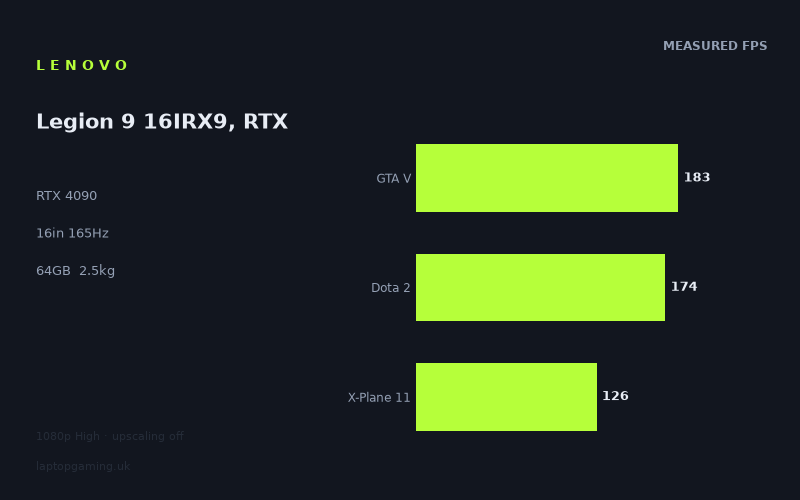
Frame rates
1920×1080, High preset, upscaling off.
Measured on this machine. Source: Notebookcheck, 2024-06-26.
Not scored: incomplete benchmark suite
Every scored laptop on this site is averaged over the same 5 games, and this one is short of Cyberpunk 2077, Baldur's Gate 3. A mean over 3 games is not comparable to a mean over 5, so we publish the figures we have and leave the score blank rather than rank it against machines tested on a different set. The numbers below are real - the suite is just incomplete.
How these numbers were produced
Frame rates here are not measured by us, and we label how each one was arrived at. A figure marked measured comes from a published run on that exact machine. A figure marked representative is derived from the GPU and its power limit (TGP) and cross-referenced against published reviews - a sound estimate of what that configuration delivers, but not a measurement of that specific laptop. Unless stated otherwise, numbers are 1920x1080, High preset, upscaling off. Where a laptop ships in several power configurations we use the wattage of the exact SKU listed, because a 140W RTX 5070 and a 115W one are not the same product.
In use
The short version
The Lenovo Legion 9 16IRX9 is an exceptionally fast gaming laptop on the published 1920x1080 High-preset data, but it is not a machine to buy on the assumption that its RTX 4090 badge guarantees a clear lead over every other RTX 4090 laptop. Notebookcheck’s figures show enormous performance in several games, including 387fps in Strange Brigade, 370fps in The Witcher 3 and 304fps in F1 24. They also show more ordinary-looking results in heavier or differently limited titles, with 149fps in Skull & Bones and 126fps in X-Plane 11.
That spread is the important part of the story. The Legion can deliver frame rates far beyond the 165Hz refresh ceiling of its 16in Mini LED display in lighter titles, older engines and games that respond well to the processor. In other games it remains fast, but it is not automatically producing enough frames to fill the panel at every moment. That is normal for a high-end laptop running a broad set of games, especially when the measurements are taken with upscaling disabled. It also means buyers should not treat a single headline frame rate as a description of the whole machine.
There is a second caveat. The screen is a 3200x2000 panel, while the published game figures are measured at 1920x1080 with the High preset and no upscaling. Those results are useful for comparing this laptop with other machines measured in the same way, and they establish that the Legion has formidable performance headroom at 1080p. They do not show how it performs at the display’s native resolution. A buyer intending to play every game at 3200x2000 should not assume that the 1080p figures transfer directly.
There is also no confirmed UK price. That matters more here than it does for a modestly specified model. A 64GB configuration with a Core i9-14900HX, RTX 4090 and Mini LED display is clearly positioned as a premium machine, but premium hardware does not automatically equal good value. Without a confirmed price, it is not possible to make a responsible value judgement. The practical question is therefore not whether the specification is ambitious; it plainly is. The question is whether a retailer’s eventual UK price makes sense against similarly quick RTX 4090 systems and against less expensive configurations that may produce much the same experience in the games a buyer actually plays.
The Legion 9 16IRX9 makes most sense for someone who wants a 16in laptop with a high-resolution Mini LED panel, very substantial memory capacity and extremely high measured 1080p frame rates in a wide selection of games. It is especially persuasive for players who mix esports-style titles, racing games, older AAA games and demanding modern releases, rather than judging a laptop purely on one game engine. It is less persuasive for somebody shopping solely for the highest possible native-resolution performance, because the supplied benchmark data does not include native 3200x2000 figures. It is also not the obvious choice for someone needing a genuinely easy-to-carry machine: at 2.541kg, this is portable in the technical sense, but it is still a substantial gaming laptop.
Most importantly, the benchmark data does not support presenting this Lenovo as an uncomplicated class leader. It is effectively level with the Schenker XMG Pro 16 Studio in the shared games, fractionally behind the Acer Predator Helios 18 in another shared set, and well behind the Asus ROG Strix Scar 17 in its shared comparison. At the same time, it is dramatically faster than the Lenovo Yoga Pro 9 16IMH9 RTX with its RTX 4050. That is a useful reminder that model names and GPU labels alone do not explain laptop gaming performance. Cooling, power configuration, processor limits, game engine behaviour and the games chosen all matter.
Performance
What the measured figures say
Notebookcheck measured the Legion 9 16IRX9 at 1920x1080, using the High preset with upscaling disabled. This is a clean and useful basis for analysing raw gaming performance because the figures are not being lifted by an upscaling mode. At that setting, the laptop produced 387fps in Strange Brigade, 370fps in The Witcher 3 and 304fps in F1 24. Those are extremely high results. In all of those games, the GPU and processor combination has enough performance to exceed the 165Hz panel refresh rate by a wide margin.
That does not mean every frame above 165fps is pointless. Higher performance can still matter where frame delivery varies, where a player uses an external display, or where game settings are increased beyond the benchmark configuration. But for the built-in 165Hz display, these figures mean the panel rather than the raw average frame rate becomes the visible limit in the measured configuration. A game averaging 387fps cannot display 387 distinct refreshes each second on a 165Hz panel. The practical benefit is performance reserve, not a direct one-for-one visual increase on the internal screen.
F1 24 at 304fps is particularly strong because racing games can benefit from high refresh rates and consistent responsiveness. At the stated benchmark settings, the Legion has ample room above 165Hz. That does not prove it will remain at that level at native 3200x2000, with more demanding visual settings, or in every circuit and weather condition. It does establish that 1080p High is not a difficult target for this machine in the measured run. Buyers who value high-refresh racing performance should read that as a positive result, while remembering the test resolution.
The next part of the results remains very fast but is closer to the panel’s refresh ceiling. GTA V reached 183fps, Dota 2 reached 174fps, Far Cry 5 reached 166fps and Final Fantasy XV reached 165fps. These are all strong outcomes for a 165Hz laptop screen. Final Fantasy XV lands exactly at the panel refresh rate in the measured result, while Far Cry 5 is effectively there. GTA V and Dota 2 have a little more headroom. In practical terms, all of these games are well matched to the display at the stated 1080p High configuration.
The distinction between “above 165fps” and “at 165fps” deserves some restraint. An average result does not tell us the lowest frame rate, frame-time consistency, scene-to-scene variation or whether a game spends every moment at the average. The available data gives an average-style performance figure, not a complete smoothness analysis. It would be wrong to infer that Final Fantasy XV holds the display limit permanently merely because the published number is 165fps. Equally, it would be wrong to dismiss 165fps as merely adequate: it is exactly where the internal panel’s stated refresh rate sits.
F1 23 delivered 152fps, Skull & Bones delivered 149fps and X-Plane 11 delivered 126fps. These are still high frame rates by normal gaming-laptop standards, but they are below the display’s 165Hz maximum. Here the Legion’s high-refresh panel is not completely saturated by the reported result. That does not make these games poor experiences; 152fps, 149fps and 126fps are all substantial figures. It does mean that the internal display’s full refresh capability is not achieved by the average measured performance in these titles at the benchmark settings.
The measured mean across the available scoring-suite games is 161fps. The included scoring-suite titles are GTA V at 183fps, Dota 2 at 174fps and X-Plane 11 at 126fps. That mean is useful as a summary of those particular games, but it should not be treated as a complete gaming-performance rating. The scoring suite is incomplete because there are no supplied figures for Cyberpunk 2077 or Baldur’s Gate 3. Since scored laptops are normally averaged over the same five games, this partial result cannot be ranked fairly against them. The honest conclusion is that the Legion’s available scoring-suite data is strong, but incomplete.
The range between games matters
The difference between 387fps in Strange Brigade and 126fps in X-Plane 11 is not evidence of inconsistent hardware. It is evidence that games stress laptops in very different ways. Some titles are more constrained by graphics throughput, some by processor performance, some by simulation work, some by memory behaviour and some by the specific locations and workloads present in a benchmark. A laptop can be outstanding in every one of those categories and still show a broad frame-rate spread because the games are not asking the same question of it.
Strange Brigade, The Witcher 3 and F1 24 provide the standout numbers. They show that the combination of the Core i9-14900HX and RTX 4090 can push exceptionally high rates at 1920x1080 High without upscaling. The figures for GTA V, Dota 2, Far Cry 5 and Final Fantasy XV show another useful characteristic: even when the average is not hundreds of frames above the display’s refresh limit, the Legion remains around or above the 165Hz target. This is the part of the result that matters most to somebody buying the laptop for its internal panel rather than for an external monitor.
F1 23, Skull & Bones and X-Plane 11 are the corrective to any simplistic reading of the specification. The RTX 4090 label does not make every game a 165fps proposition. F1 23 at 152fps is close, Skull & Bones at 149fps is still very fast, and X-Plane 11 at 126fps is comfortably playable, but none reaches the 165Hz screen limit in the published result. This is why a broad benchmark list is more valuable than an isolated result. It prevents a buyer from mistaking one favourable engine for the whole gaming library.
The fact that upscaling was off is important when considering those lower figures. The results show what the laptop did without relying on an upscaling mode at the stated resolution and preset. That gives a more direct indication of conventional rendered performance. However, the available information does not provide results with upscaling enabled, so no numerical claim can be made about what such a mode would add. Buyers should not fill that gap with assumptions. The useful conclusion is simply that the Legion was already fast without upscaling in every listed game, although not every listed game reached 165fps.
Likewise, the data does not provide low-frame results, percentile results, frame-time graphs or extended-session behaviour. Those omissions do not invalidate the published averages, but they set limits on what can be concluded. The numbers tell us that the laptop is capable of very high average frame rates in the measured configuration. They do not establish how flat the performance curve is during a long gaming session, how performance changes on battery, how loud the cooling system becomes or what temperatures are reached. None of those figures should be invented to make the review feel more complete.
GPU power limit: what is known and what is not
The specification identifies an RTX 4090, but it does not provide the GPU power limit for this Legion configuration. That omission is significant because laptop RTX 4090 implementations are not all configured identically. A GPU name tells a buyer the class of graphics processor, but it does not by itself reveal the power target, cooling allowance or sustained behaviour of the individual laptop. Those details can help explain why similarly specified machines sometimes produce unexpectedly close results, or why one RTX 4090 laptop can trail another.
Because no specific power limit is supplied here, it would be irresponsible to state one or to claim that the Legion is running the RTX 4090 at a particular wattage. The benchmark results are the evidence available. They show that the Legion can produce 387fps in Strange Brigade, 370fps in The Witcher 3 and 304fps in F1 24 at 1920x1080 High without upscaling. They also show that it is not clearly ahead of every rival with a similar graphics label. The performance data is real; the exact power configuration behind it is not confirmed in the supplied facts.
In practical buying terms, this means the published frame rates should carry more weight than a theoretical reading of the RTX 4090 badge. The Legion has no trouble demonstrating that it belongs in the high-end category. It also demonstrates why buyers should compare actual shared-game results rather than assume a nominal GPU tier determines the finishing order. In the supplied comparison, it matches one RTX 4070 laptop across the available shared games, sits just behind one RTX 4090 rival, and is substantially behind another RTX 4090 rival. A power-limit discussion without a confirmed power limit has to end there.
The processor also matters at 1080p. The Core i9-14900HX is a high-end laptop processor, and the very high rates in the lighter measured titles suggest that the platform is capable of feeding the GPU effectively in those conditions. But 1080p is also the resolution at which CPU limits can become more visible, especially in lighter games. The supplied rival notes make this explicit: at 1080p, lighter titles in the shared set can be CPU-bound and compress genuine GPU gaps. That is why a near-zero comparison result is meaningful, but not proof that every underlying hardware difference has disappeared.
What performance headroom is actually useful for
The Legion’s best results give it headroom for several sensible uses. One is maintaining high frame rates on the internal 165Hz panel at the measured settings. Another is raising some settings beyond the benchmark’s High preset, although the exact performance effect is not supplied and will vary by game. A further use is connecting an external high-refresh display, though the available information does not state which external display connections are present or what display modes they support. The benchmark figures indicate the performance potential; they do not document the laptop’s connectivity.
For a buyer playing mostly Dota 2, GTA V, Far Cry 5 or Final Fantasy XV, the measured data suggests the internal panel is well chosen. Those titles return 174fps, 183fps, 166fps and 165fps respectively. The laptop is not merely able to run them; it is operating at or around the screen’s maximum refresh rate at 1080p High. That is a stronger argument for the 165Hz display than a specification-sheet claim alone. It links the panel capability to actual published game numbers.
For someone focused on X-Plane 11, expectations should be different. The 126fps result is strong, but it is not a 165fps result. That still leaves plenty of performance for smooth play, but it means the display’s maximum refresh rate is not the central benefit in the published benchmark. In a simulation-oriented buying decision, the processor, display resolution, display size, control setup and workload matters at least as much as chasing a panel-refresh match. The available data only directly addresses the game performance result; it does not provide information on ports, controls or simulator-specific features.
Skull & Bones at 149fps occupies a similar middle ground. It is below the panel maximum but remains a high frame rate. It would be misleading to frame that result as a failure simply because it does not reach 165fps. A laptop that delivers 149fps at 1920x1080 High with upscaling disabled is clearly not struggling. The more useful interpretation is that the Legion’s display has capacity beyond the measured average in that game, while the machine still provides strong raw performance. Buyers who demand the screen limit in every title need to accept that the supplied data does not support that expectation.
The screen
A high-resolution Mini LED panel with a clear benchmark caveat
The Legion 9 16IRX9 has a 16in Mini LED display with a 3200x2000 resolution and a 165Hz refresh rate. That is an ambitious screen specification for a gaming laptop. The 3200x2000 resolution gives the machine a much denser desktop and game canvas than the 1920x1080 benchmark resolution, while 165Hz gives it a high refresh ceiling for games that can make use of it. The Mini LED panel type is also a notable part of the specification. However, no measured brightness, colour, contrast, response-time or HDR figures are supplied, so those are not areas where this review can make a quantitative judgement.
The main issue is the mismatch between the panel’s native resolution and the available game data. Notebookcheck measured games at 1920x1080 High with upscaling off. That is a valid comparison setting, but it is not the display’s native 3200x2000. The published results therefore establish how quickly the laptop runs the benchmark configuration, not how quickly it drives every pixel of its built-in panel. The difference matters because rendering at a higher resolution normally requires more graphics work. No native-resolution frame rates are supplied, so there is no basis for claiming that Strange Brigade, F1 24, Skull & Bones or any other listed game will produce a particular result at 3200x2000.
For buyers, this means the screen should be viewed as both an advantage and a demand. It offers a high-resolution working area and a 165Hz refresh ceiling, but it asks more of the GPU when games are run at its native resolution. The RTX 4090 is the right class of GPU to pair with such a display, and the 1080p results show considerable performance strength. Still, “the right class” is not the same as a measured native-resolution verdict. Anyone whose priority is maximum native-resolution frame rate needs data that is not present here.
There is a practical upside to the 1080p data. In the games where the Legion produces 387fps, 370fps or 304fps, there is clearly substantial performance reserve at the benchmark resolution. Those figures suggest that 1080p High is not using all of the platform’s available capability in those titles. They do not tell us exactly how far a buyer can raise resolution or settings before reaching a preferred frame rate, but they show why the machine is a credible candidate for a high-resolution panel rather than an obviously mismatched pairing.
The results nearer the screen limit need a more careful reading. GTA V at 183fps, Dota 2 at 174fps, Far Cry 5 at 166fps and Final Fantasy XV at 165fps make excellent use of the 165Hz screen at 1080p High. But they leave less headroom than the results in Strange Brigade, The Witcher 3 and F1 24. If a buyer treats 165fps as a target, these games are already using most or all of the available performance at the measured configuration. There is no evidence here that they retain the same relationship to the panel at 3200x2000.
Is 165Hz justified by the game results?
Yes, but not universally. The 165Hz panel is justified by the published results because several games meet or exceed it. Strange Brigade, The Witcher 3, F1 24, GTA V, Dota 2 and Far Cry 5 all exceed 165fps, while Final Fantasy XV reaches 165fps exactly. That is a substantial portion of the measured list. A slower screen would leave some of the Legion’s 1080p High performance unused in those games.
At the same time, the screen should not be sold as though it is always fully utilised. F1 23 reaches 152fps, Skull & Bones reaches 149fps and X-Plane 11 reaches 126fps. The benchmark data therefore supports a more balanced conclusion: the panel is an appropriate match for the laptop’s performance in many games, but it has more refresh capacity than the measured average performance in others. That is what a sensible high-end gaming laptop display should be: enough capability for the easier-to-run titles, without pretending that demanding games become effortless merely because the specification is expensive.
The high resolution introduces another buying consideration. A buyer who mainly plays competitive games may value refresh rate more than pixel count, particularly if they use settings and resolutions intended to maximise performance. A buyer who divides time between games, creative work, media and general desktop use may place greater value on the 3200x2000 panel. The supplied facts establish the resolution, size, panel type and refresh rate, but they do not establish which use case the display is best calibrated for. That choice depends on the buyer rather than a claim that cannot be supported by measurements.
There is no confirmed information here about variable refresh support, touchscreen capability, panel response time, brightness, colour coverage or display finish. These are all details that can materially affect a display purchase. The correct position is not to assume their presence or absence. The Legion’s screen is impressive on the known specifications alone, but a buyer for whom colour work, HDR performance or motion clarity is central should seek the relevant measured panel information before treating the Mini LED label as a complete answer.
Build, size and portability
The known physical figure is a weight of 2.541kg. That places the Legion firmly in substantial gaming-laptop territory. It is not a machine that disappears into a bag or feels like a light general-purpose 16in notebook. Buyers considering regular commuting, frequent train travel, campus use or repeated movement between home and work should take that figure seriously. A 2.541kg laptop can certainly be transported, but portability is not the same thing as convenience.
The practical consequence is that this Lenovo is best understood as a movable performance system rather than an ultralight everyday machine. It can move between rooms, homes, offices or events, and it consolidates high-end gaming hardware, a 16in Mini LED display, 64GB of memory and a Core i9-14900HX into one machine. But the weight means that a buyer should want that consolidation enough to accept the burden. Someone whose priority is carrying a laptop all day should not assume that a premium chassis changes what 2.541kg feels like in a bag.
No dimensions are supplied. That means there is no responsible way to describe the Legion as slim, thick, compact or unusually large for its class. Weight is only part of how a laptop travels; footprint and thickness affect bag choice, desk space and how easily it fits into daily routines. Without those measurements, the review can say that it is heavy enough to be a deliberate carry, but it cannot make precise claims about its shape or volume.
There is also no battery-life figure, charger weight, thermal result or noise result in the facts provided. Those omissions matter particularly for a machine using an RTX 4090 and Core i9-14900HX. A buyer should not infer battery endurance, fan behaviour or sustained thermal characteristics from the component list. High-performance hardware may create expectations, but expectations are not measurements. The available evidence is strong on plugged-in 1080p gaming performance and limited on the experience of using the laptop away from mains power or under prolonged load.
The 16in format is potentially a sensible compromise for a gaming laptop this powerful. It offers a large enough screen for the 3200x2000 resolution and the 165Hz refresh rate, while avoiding the larger format of some desktop-replacement machines. But “sensible compromise” is a judgement about the stated size and weight, not a claim that the Legion is easy to carry. A buyer moving the laptop occasionally may find the combination of screen and performance compelling. A buyer moving it constantly should look for a lighter system, even if that means accepting lower gaming performance or fewer premium display features.
The 64GB memory configuration reinforces the impression that this is intended for more than occasional gaming. That amount of memory is substantial for a gaming laptop, and it may appeal to people who keep demanding applications open alongside games or who use the machine for memory-heavy workloads. However, no application benchmarks are supplied. It would be wrong to claim a particular content-creation, development or professional-workload advantage beyond the obvious fact that 64GB is a large installed memory capacity. The safe conclusion is that the configuration is unlikely to be constrained by modest multitasking demands, not that it has been proven in a specific non-gaming workload.
How it compares
Against the Lenovo Yoga Pro 9 16IMH9 RTX
The Lenovo Yoga Pro 9 16IMH9 RTX is the comparison that most clearly shows what the Legion’s RTX 4090-class gaming hardware buys. The Yoga uses an RTX 4050 at 100W, and the Legion averages 102fps more across six shared games. That is a very large gap. It is not a marginal difference that only appears in a chart; it is the sort of spread that can change whether a game is merely running quickly or is capable of using a high-refresh display effectively.
There is no confirmed UK price for the Yoga Pro 9 16IMH9 RTX, so the comparison cannot become a value verdict. It is also not useful to pretend the two machines serve exactly the same buyer. The Legion is a 2.541kg gaming laptop with an RTX 4090, 64GB of memory, a Core i9-14900HX and a 16in 3200x2000 165Hz Mini LED panel. The Yoga’s supplied facts in this comparison establish an RTX 4050 at 100W, but not a full like-for-like configuration. What can be said firmly is that the Legion has a decisive measured gaming-performance advantage across the shared games.
For somebody whose priority is gaming frame rate, the Legion is the clear choice between these two based on the available data. For someone who values a different balance of weight, price, battery behaviour or design, the facts supplied here do not permit a complete comparison. The Legion should not be chosen simply because “RTX 4090” sounds bigger; it should be chosen because the shared-game result is 102fps ahead on average, which is direct evidence of a major performance separation.
Against the Schenker XMG Pro 16 Studio
The Schenker XMG Pro 16 Studio is the most instructive comparison for anyone who assumes that an RTX 4090 must always establish a visible lead over an RTX 4070 laptop. The Schenker uses an RTX 4070 at 140W, yet the Legion averages +0fps across three shared games. In other words, the available shared-game result is effectively level. That is not a typo to be brushed aside; it is a real outcome in the supplied data.
The explanation matters. At 1080p, lighter titles in the shared set can be CPU-bound and compress genuine GPU gaps. When the processor or game engine becomes the limiting factor, adding graphics capability does not necessarily translate into a higher average frame rate. That does not mean an RTX 4090 and RTX 4070 are equivalent in every game, at every resolution or with every setting. It means that the shared 1080p data does not show a Legion advantage in this particular comparison.
This is precisely why the Legion’s native 3200x2000 performance remains an open question rather than something to infer from the GPU label. Higher rendering demands can change the balance between processor and GPU limits, but no native-resolution shared figures are supplied. The available evidence only says that, across the three games both laptops hold, the average difference is zero. A buyer choosing between these systems should not pay for the Legion on the assumption that its RTX 4090 automatically delivers a measurable 1080p advantage in the games represented here.
There is no confirmed UK price for the Schenker either. That prevents the comparison from becoming a purchasing recommendation based on value. If the Legion were close in price, its larger memory capacity and screen specification might matter greatly to a buyer. If it were much more expensive, an effectively level shared-game result would demand careful scrutiny. The data supports neither price scenario, so the responsible conclusion is narrower: in the available common games, the Legion does not pull away from this 140W RTX 4070 system.
Against the Acer Predator Helios 18
The Acer Predator Helios 18 uses an RTX 4090, and the Legion averages 1fps behind across three shared games. This is a near-zero gap in practice. It should not be exaggerated into a meaningful performance defeat, but it also should not be rewritten as a Legion win. The available result says the two laptops are effectively tied in their shared 1080p benchmark sample, with the Acer holding a negligible average advantage.
Near-equality is useful information. It indicates that buyers comparing these two systems should not expect the Legion’s published 1080p High performance to establish a clear frame-rate lead. The result is consistent with the broader lesson from the Schenker comparison: shared games at 1080p can compress hardware differences, particularly where titles are lighter or CPU-bound. The fact that both systems carry RTX 4090 graphics does not tell us why the difference is so small, because the supplied facts do not include the Acer’s full configuration, power behaviour or game-by-game values.
There is no confirmed UK price for the Acer Predator Helios 18. There is also no need to invent a conclusion about screen quality, portability or build differences, because the facts supplied for this comparison do not establish them. The performance takeaway is simple and worthwhile: the Legion and Acer are essentially level on the available shared games. A buyer deciding between them should look beyond a 1fps average difference and examine confirmed price, screen requirements, size preferences and any additional measured data available at the point of purchase.
Against the Asus ROG Strix Scar 17
The Asus ROG Strix Scar 17 is the rival that beats the Legion by the largest stated margin. Both are RTX 4090 laptops, but the Legion averages 38fps behind across three shared games. That is a substantial gap, especially compared with the tie against the Schenker and the 1fps deficit to the Acer. It demonstrates clearly that RTX 4090 branding does not make all laptops interchangeable.
The correct response is not to claim that the Legion is slow. Its own figures remain excellent: 387fps in Strange Brigade, 370fps in The Witcher 3, 304fps in F1 24, and strong results across the rest of the published list. But a buyer selecting between these specific RTX 4090 systems on the basis of the shared-game data should recognise that the Asus has the stronger result. A 38fps average difference cannot be dismissed as measurement noise or a trivial rounding effect.
As with the other rivals, no confirmed UK price is available. That means the Asus cannot automatically be called the better buy. A faster laptop can still be the wrong purchase if it commands an unjustifiable premium, has an unsuitable display, is too large for the buyer or makes compromises the buyer dislikes. None of those questions can be resolved from the supplied facts. What can be resolved is performance: in their three shared games, the Legion trails the ROG Strix Scar 17 by 38fps on average.
This comparison should shape expectations for the Legion. It is a very fast premium laptop, not a guaranteed benchmark champion. That is not a criticism of the frame rates themselves. It is a criticism of the lazy buying logic that treats every RTX 4090 laptop as equivalent. The data instead shows a wide competitive spread: a major Legion lead over the RTX 4050 Yoga, a dead heat with the RTX 4070 Schenker, practical parity with the RTX 4090 Acer, and a clear deficit to the RTX 4090 Asus.
Who it is for
Buy it if the known strengths match your use
The Legion 9 16IRX9 is for the buyer who wants very high measured gaming performance in a 16in laptop and values the combination of a 3200x2000 Mini LED display, 165Hz refresh rate, Core i9-14900HX, RTX 4090 and 64GB of memory. It is particularly well suited to someone whose games include titles such as Strange Brigade, The Witcher 3, F1 24, GTA V, Dota 2, Far Cry 5 and Final Fantasy XV, where the published figures reach or exceed the panel refresh rate at 1920x1080 High with upscaling disabled.
It also suits a buyer who understands what high-end laptop performance looks like in practice. That means accepting that the same machine can produce 387fps in one game and 126fps in another without either result invalidating the other. It means valuing the breadth of the benchmark list rather than buying based on the biggest number. And it means recognising that the 165Hz display is well supported by many of the measured games, while not being saturated in every title.
Someone who wants substantial installed memory should also take notice. The 64GB configuration is a meaningful differentiator from more ordinary gaming-laptop specifications. It does not come with supplied productivity benchmark data, so it should not be oversold as proof of a particular professional-workload result. Still, for a buyer who wants a system intended to handle demanding usage patterns as well as games, the memory capacity is a sensible reason to put the Legion on a shortlist.
The Legion is also for someone who sees the machine as a primary gaming system that can travel when needed, rather than as a lightweight laptop that happens to game. At 2.541kg, it is a deliberate carry. That may be entirely acceptable for a buyer moving it occasionally or using it mostly on a desk. The high-end specification makes more sense in that context than it would for someone who wants to carry the laptop all day.
Buy something else if your priorities are different
Buy something else if low weight is a core requirement. The Legion’s 2.541kg weight is not absurd for its class, but it is still substantial. A buyer who spends long days carrying a laptop should prioritise a lighter design rather than hoping that a powerful 16in RTX 4090 machine will feel unobtrusive. No dimensions, battery-life result or charger-weight figure is supplied, so there is no evidence that would overturn that basic conclusion.
Buy something else, or wait for more data, if native 3200x2000 gaming performance is your decisive criterion. The screen’s native resolution is 3200x2000, but all supplied frame rates are at 1920x1080 High with upscaling off. The Legion may be a strong native-resolution gaming machine, and its 1080p results give reason to expect serious capability, but that is not the same as having measured evidence. A buyer spending premium money specifically to game at the panel’s full resolution should seek native-resolution benchmarks before committing.
Buy something else if your only goal is the strongest available shared-game performance among the named rivals. The Asus ROG Strix Scar 17 is 38fps ahead on average across three shared games. That does not settle a full buying decision because there is no confirmed UK price and no complete feature comparison in the supplied data. But it does settle the narrow performance question represented by those common games: the Asus is ahead. The Legion should not be bought under the assumption that its RTX 4090 makes it the faster machine in every direct comparison.
Consider something else if value is your primary concern and the Legion appears at an aggressive premium once UK pricing is confirmed. There is no confirmed UK price, so no present value judgement is justified. The benchmark performance is strong enough that the laptop could make sense at the right price. It could also be difficult to justify if priced far beyond machines that match it in shared games or beat it outright. The lack of price is not a minor missing detail; it is central to the final purchasing decision.
Finally, do not buy the Legion solely because it says RTX 4090. The benchmark evidence supports a more informed choice than that. It is massively ahead of the RTX 4050 Lenovo Yoga Pro 9 16IMH9 RTX, level with the RTX 4070 Schenker XMG Pro 16 Studio in the available shared games, effectively tied with the RTX 4090 Acer Predator Helios 18, and behind the RTX 4090 Asus ROG Strix Scar 17. The Legion’s case is not that it wins every chart. Its case is that it combines genuinely exceptional published frame rates, a 16in 3200x2000 165Hz Mini LED display and 64GB of memory in a substantial but still movable 2.541kg machine.
That is a compelling package for the right buyer. It is not a package that can be judged without a confirmed UK price, native-resolution gaming figures, battery information, thermal information and noise data. The available Notebookcheck numbers are enough to establish that the Legion 9 16IRX9 is a serious high-end gaming laptop. They are not enough to turn every unanswered question into a favourable assumption. That distinction is exactly what should guide a purchase at this level.