Review
MSI GE76 Raider review
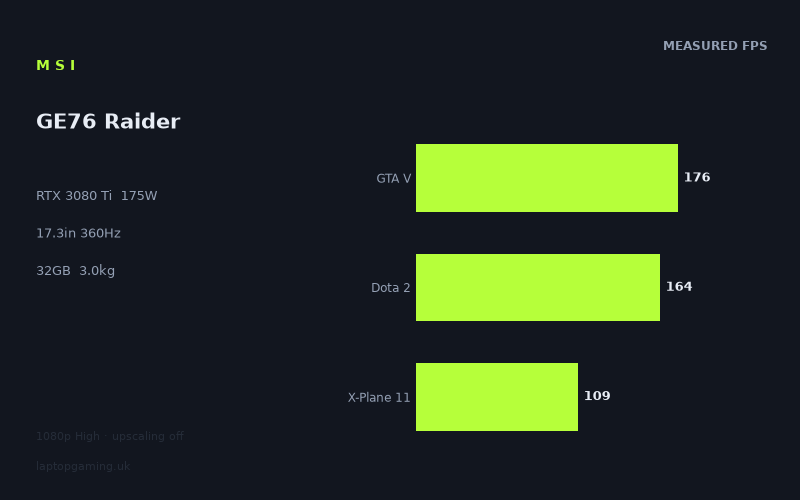
Frame rates
1920×1080, High preset, upscaling off.
Measured on this machine. Source: Notebookcheck, 2022-01-25.
Not scored: incomplete benchmark suite
Every scored laptop on this site is averaged over the same 5 games, and this one is short of Cyberpunk 2077, Baldur's Gate 3. A mean over 5 games is not comparable to a mean over 5, so we publish the figures we have and leave the score blank rather than rank it against machines tested on a different set. The numbers below are real - the suite is just incomplete.
How these numbers were produced
Frame rates here are not measured by us, and we label how each one was arrived at. A figure marked measured comes from a published run on that exact machine. A figure marked representative is derived from the GPU and its power limit (TGP) and cross-referenced against published reviews - a sound estimate of what that configuration delivers, but not a measurement of that specific laptop. Unless stated otherwise, numbers are 1920x1080, High preset, upscaling off. Where a laptop ships in several power configurations we use the wattage of the exact SKU listed, because a 140W RTX 5070 and a 115W one are not the same product.
In use
The short version
The MSI GE76 Raider is a large-format, high-power gaming laptop built around an RTX 3080 Ti running at a 175 W GPU power limit, a Core i9-12900HK, 32 GB of memory and a 17.3in 1920x1080 360 Hz IPS display. Its published benchmark results make the case for that configuration clearly: at 1920x1080 on High settings with upscaling disabled, Notebookcheck recorded frame rates from 101fps in Cyberpunk 2077 1.0 to 378fps in Star Wars Squadrons.
That is an enormous range, but it is the right range to expect from a machine aimed at fast 1080p gaming rather than at a single fixed target in every game. The GE76 Raider is exceptionally quick in lighter, older and esports-friendly titles, where its 360 Hz panel can be used meaningfully. It is also very capable in the more demanding games in this data set, where results mostly remain well above 100fps at the stated settings. It is not, however, a laptop that turns every modern game into a 360fps experience simply because the screen refreshes at 360 Hz. Only Star Wars Squadrons reaches that refresh rate in the measured results, at 378fps. Doom Eternal comes close at 307fps, while F1 2021 reaches 289fps and Back 4 Blood manages 263fps. The majority of more graphically heavy games sit substantially below the panel ceiling.
That is not a criticism of the hardware. It is an important buying reality. A 360 Hz screen is valuable for the games that can exploit it, but it should not be mistaken for a promise that all games will run at 360fps at High settings without upscaling. The GE76’s benchmark data instead shows a machine with a strong high-refresh ceiling in favourable titles and a very high baseline in far more demanding ones.
The lack of a confirmed UK price for this exact configuration means there is no value judgement to make from the available information. The benchmark suite is complete and the laptop can be placed normally on the frame-rate leaderboard, but value cannot be calculated without a price. That is not a problem with the machine; it simply means the available evidence supports a performance verdict, not a value verdict.
This is a laptop for someone who specifically wants a 17.3in 1080p gaming system with a very fast panel, 32 GB of memory, 2 TB of SSD storage and a high-power RTX 3080 Ti configuration. It makes most sense for players of competitive and high-frame-rate games who also want strong results in demanding single-player releases. It makes less sense for somebody whose priority is low carry weight, a smaller screen, or a machine chosen primarily for one particular game where every last setting can be pushed without compromise. The published figures show excellent speed, but they also show that game engine, CPU load and graphics workload still matter greatly at 1080p.
Performance
A 175 W RTX 3080 Ti configuration
The most important specification in the GE76 Raider’s graphics configuration is not merely the RTX 3080 Ti name. It is the 175 W GPU power limit. Laptop graphics processors are not defined by their name alone: the configured power limit affects the performance a system can deliver. In this case, the GE76 is using a 175 W RTX 3080 Ti, supported by a Core i9-12900HK and 32 GB of memory. The result is a machine set up for high frame rates at its native 1920x1080 resolution rather than a lower-power implementation intended mainly to fit into a thinner chassis.
Notebookcheck’s figures were measured at 1920x1080 using the High preset with upscaling off, dated 2022-01-25. That test condition matters. These are not figures obtained by reducing resolution below the native panel resolution, and they are not results boosted by upscaling. They show what this specification delivered in the stated games at a reasonably demanding general-purpose setting.
The five-game scoring-suite mean is 166fps. That is useful as a broad indicator, but it should not be treated as the expected result for every game. The individual figures are much more informative. A mean can conceal whether a laptop is consistently fast or whether a few exceptionally light titles are lifting the average. Here, the full list shows both: the GE76 can run very far beyond 200fps in certain games, but it also encounters titles where graphics load, CPU load or the combination of both holds it close to 100fps.
That spread is precisely why a serious buying decision should be based on the games you actually play rather than on a single headline average. A player of Doom Eternal, F1 2021, Back 4 Blood, Dota 2 or Star Wars Squadrons will see a very different relationship with the 360 Hz screen from somebody mainly playing Cyberpunk 2077 1.0, Assassin’s Creed Valhalla, Crysis Remastered or Watch Dogs Legion.
The games that make the most of the hardware
Star Wars Squadrons is the standout result at 378fps. That is the only measured game in this list to exceed the display’s 360 Hz refresh rate. It establishes that the GE76 Raider can genuinely reach the sort of frame rate for which the panel was specified, but it should be viewed as an upper-end example rather than the normal outcome across the full benchmark set.
Doom Eternal reaches 307fps, which is below 360fps but still extraordinarily high. F1 2021 follows at 289fps, and Back 4 Blood records 263fps. Strange Brigade runs at 251fps, while The Witcher 3 manages 247fps. These are all results where the laptop is operating in a high-refresh territory that is visibly different from merely clearing 60fps or 100fps. The panel cannot display more than 360 refreshes per second, but a result in the 200fps range still gives the screen a great deal to work with.
Gears Tactics reaches 205fps and Hitman 3 records 197fps. Farming Simulator 22 is at 183fps, Hunt Showdown at 181fps, Days Gone at 177fps and GTA V at 176fps. Dota 2 runs at 164fps, Yakuza Like a Dragon at 160fps, Guardians of the Galaxy at 156fps, Alan Wake Remastered at 155fps and Outriders at 155fps. Mafia Definitive Edition reaches 151fps, while Death Stranding comes in at 150fps.
There is an important distinction within that group. A figure above 150fps is excellent for a game in general, but it is not necessarily enough to approach the 360 Hz panel’s maximum refresh rate. The GE76 Raider should therefore be understood as a laptop that often delivers a very fast experience at 1080p High settings, rather than one that locks every title close to 360fps. That distinction matters most to buyers whose main reason for choosing this display is competitive play.
For the titles near and above 200fps, the machine has ample performance for very high-refresh gaming at the stated settings. For games around 150fps to 180fps, it still offers substantially more than a conventional 60 Hz or 120 Hz target, while leaving the display’s full ceiling unused. That is not wasted performance: a 360 Hz panel can still present frames as they arrive up to its limit. It simply means the practical benefit differs by game.
The demanding middle of the benchmark list
Halo Infinite reaches 147fps, Forza Horizon 5 142fps and Dirt 5 141fps. Riders Republic records 138fps, Deathloop 133fps and Final Fantasy XV 131fps. Far Cry 6 is at 130fps, New World at 122fps and Battlefield 2042 at 121fps. God of War follows at 119fps.
This section of the results may be the most representative guide for a buyer who wants one laptop for a wide mixture of current games. The results are not hovering around a basic playability threshold. They are mostly in the 119fps to 147fps range, which is strong performance at 1920x1080 High with upscaling disabled. But they also make clear that the 360 Hz display is an aspirational ceiling in such games rather than a target the laptop will automatically meet.
That is where settings choices become personal rather than universal. The benchmark figures here are for High settings, not for every possible configuration. Someone who values visual settings can take the published results as a strong indication of the GE76’s performance at the tested preset. Someone whose priority is the highest possible frame rate in a particular competitive game may choose different settings, but there are no measured results in the supplied data for those altered settings, so no specific frame-rate claim should be made for them.
The key point is that the GE76 starts from a strong position. A result of 147fps in Halo Infinite or 142fps in Forza Horizon 5 is not evidence that the system is struggling. It is evidence that these games place a more demanding workload on the system than titles such as Doom Eternal or F1 2021. The difference between 307fps in Doom Eternal and 147fps in Halo Infinite is not a contradiction. It reflects that different games ask different things of the hardware at the same resolution and general quality preset.
New World at 122fps, Battlefield 2042 at 121fps and God of War at 119fps are particularly useful results because they show that the machine remains above 100fps even in titles that do not allow the GPU to run away into the several-hundred-frame range. If these are the sort of games a buyer plays most often, the 360 Hz panel is still a high-quality match in the sense that it does not constrain the laptop’s output. But buyers should approach it as a screen with substantial headroom, not as a panel that will be fully saturated in every demanding game.
The titles that expose the limits of the 360 Hz proposition
Watch Dogs Legion records 113fps, Serious Sam 4 109fps and X-Plane 11 109fps. Assassin’s Creed Valhalla and Crysis Remastered each record 103fps. Cyberpunk 2077 1.0 is the lowest figure in the measured set at 101fps.
These results are still high in absolute terms at the stated 1920x1080 High setting without upscaling. Yet they are also the clearest warning against choosing the GE76 Raider solely because the panel says 360 Hz. In Cyberpunk 2077 1.0, the measured figure is 101fps, leaving a large gap to 360fps. Assassin’s Creed Valhalla and Crysis Remastered at 103fps tell a similar story. Watch Dogs Legion at 113fps, along with Serious Sam 4 and X-Plane 11 at 109fps, reinforces it.
The laptop is not failing in these games. It is showing the basic truth that a fast display and a fast GPU do not remove the cost of demanding game engines. The 175 W RTX 3080 Ti gives the GE76 a high-performance foundation, but the system remains subject to the workload imposed by each title. At 1080p, some games also become more sensitive to processor performance and engine limits. The Core i9-12900HK is a high-end processor, but no single specification removes those title-specific limits.
This is especially relevant when comparing games at the same screen resolution. It is tempting to assume that 1920x1080 is simple enough for a top-end gaming laptop to run everything at extremely high frame rates. The data shows otherwise. 1080p reduces the graphics burden relative to a higher-resolution screen, but it also means that the GPU may reach a point where the game, processor or other system demands shape the result more strongly. That is why frame rates can vary so widely despite the same laptop, the same stated resolution and the same High preset.
What the benchmark spread actually says
From 378fps in Star Wars Squadrons to 101fps in Cyberpunk 2077 1.0, the measured range is broad. It is not helpful to reduce that range to a vague claim that the GE76 Raider is either “overpowered” or “not enough for 360 Hz”. Both statements would ignore what the data says.
It is powerful enough to exceed 360fps in Star Wars Squadrons and to deliver 307fps in Doom Eternal. It is powerful enough for 289fps in F1 2021 and 263fps in Back 4 Blood. It is also powerful enough to maintain 101fps in Cyberpunk 2077 1.0, 103fps in Assassin’s Creed Valhalla and 113fps in Watch Dogs Legion under the tested conditions. Those are all meaningful strengths, but they describe different use cases.
The practical conclusion is that this laptop rewards buyers who play a broad catalogue. It is not a one-trick competitive machine that only excels in low-demand games, because it also produces 156fps in Guardians of the Galaxy, 155fps in Alan Wake Remastered, 150fps in Death Stranding and 142fps in Forza Horizon 5. Equally, it is not a laptop whose excellent single-player performance means its 360 Hz screen is irrelevant, because it reaches 378fps in Star Wars Squadrons, 307fps in Doom Eternal and 251fps in Strange Brigade.
The best way to interpret the 166fps scoring-suite mean is as confirmation that the system is fast across a mixed selection, not as an estimate that every game will run around 166fps. The scoring-suite games themselves demonstrate that variation: Strange Brigade reaches 251fps, GTA V reaches 176fps, Dota 2 reaches 164fps, Final Fantasy XV reaches 131fps and X-Plane 11 reaches 109fps. A single average describes the group; the individual results describe the experience.
The screen
The GE76 Raider uses a 17.3in 1920x1080 IPS display with a 360 Hz refresh rate. That combination gives the laptop a very clear identity. This is not a system pursuing higher native resolution at the expense of frame rate. It is aimed at making 1080p look fluid in games where the hardware can generate frames quickly.
The screen resolution matches the benchmark resolution exactly. Notebookcheck’s measured figures were produced at 1920x1080, so the data directly reflects native-resolution gaming rather than an extrapolation from another resolution. That is useful because the central buying question is straightforward: can the RTX 3080 Ti at 175 W drive this panel effectively? The answer is yes, but with important game-by-game qualification.
At the top end, it can fully reach or nearly reach the panel’s refresh rate. Star Wars Squadrons at 378fps exceeds 360fps. Doom Eternal at 307fps is close enough to demonstrate that the display is not an arbitrary specification disconnected from the machine’s performance. F1 2021 at 289fps, Back 4 Blood at 263fps and Strange Brigade at 251fps also show that high-refresh gaming is a real use case for this laptop rather than an empty box-ticking exercise.
In a larger number of games, the GE76 delivers frame rates that are very high without reaching 360fps. The Witcher 3 at 247fps, Gears Tactics at 205fps, Hitman 3 at 197fps, Farming Simulator 22 at 183fps and Hunt Showdown at 181fps all fit that description. The display still has enough refresh capacity for these results; it simply has further headroom that the game is not filling at the tested settings.
For games around 130fps to 177fps, including Days Gone at 177fps, GTA V at 176fps, Dota 2 at 164fps, Yakuza Like a Dragon at 160fps, Guardians of the Galaxy at 156fps, Death Stranding at 150fps, Halo Infinite at 147fps and Forza Horizon 5 at 142fps, the screen remains a sensible pairing. A lower-refresh display would be more likely to become the limiting element in such cases. Here, the panel has room for the laptop’s output and for games that perform better than the measured result under different, unmeasured settings. What cannot be claimed from the data is exactly how particular settings changes would affect any of those games.
The mismatch becomes more obvious in the most demanding group. Cyberpunk 2077 1.0 at 101fps, Assassin’s Creed Valhalla and Crysis Remastered at 103fps, and Watch Dogs Legion at 113fps do not make full use of a 360 Hz refresh ceiling. That does not make the screen a mistake. It means the panel is configured for the laptop’s fastest possible cases, not for the most demanding case in every release.
Buyers should therefore separate two questions. First, is 1920x1080 appropriate for this RTX 3080 Ti system? Based on the benchmark data, yes: it enables very high frame rates across the full list, including the heaviest titles. Second, will 360 Hz be realised everywhere? Clearly not. The figures show one game above 360fps, several near or above 250fps, many between 100fps and 200fps, and no basis for suggesting universal 360fps operation.
The IPS panel type is part of the supplied specification, but there are no published measurements here for brightness, colour coverage, contrast, response times or panel behaviour. Those qualities should not be assumed. The evidence available supports a judgement on size, resolution, refresh rate and panel technology, and on how the measured gaming performance relates to the refresh rate. It does not support claims about image quality beyond that.
Build, size and portability
The GE76 Raider weighs 3.016 kg. That figure is enough to set expectations accurately: this is a substantial 17.3in gaming laptop, not a light machine selected primarily for effortless daily carrying. The 17.3in screen, high-power GPU configuration, Core i9-12900HK, 32 GB of memory and 2 TB SSD all point towards a desktop-replacement style of use, while the weight confirms that portability is a compromise rather than the central proposition.
That does not mean it cannot be moved. It means that a buyer should choose it because they want this level of screen size and performance, and should accept 3.016 kg as part of that decision. Someone regularly carrying a laptop between home, office, university or events needs to consider that weight honestly. A machine can be portable in the literal sense while still being inconvenient compared with a smaller and lighter system; the available specification gives no reason to present the GE76 as anything other than a large gaming laptop.
No physical dimensions are provided in the available information, so there is no basis for claims about how much desk space it occupies, how easily it fits a specific bag, or how it compares physically with the listed rivals. Likewise, there are no supplied battery-life, temperature or noise figures. Those omissions matter because a high-power gaming laptop is often judged as much by its behaviour away from a desk and under sustained load as by its headline specifications. The benchmark results establish the performance available at the stated test conditions, but they do not establish battery runtime, fan noise, surface temperature or long-term comfort during use.
The 17.3in display has a clear practical advantage for gaming: it provides a larger built-in viewing area than a smaller laptop screen. But it also reinforces the GE76’s role as a machine chosen for use where its size is welcome rather than something to be minimised. Buyers who want a compact travel companion should not buy a 3.016 kg 17.3in gaming laptop simply because its frame rates are excellent. Buyers who want a large native-1080p display and the performance to drive it have a much stronger reason to consider it.
How it compares
Against the MSI Prestige 15
The widest performance gap in the listed comparison group is against the MSI Prestige 15 with an RTX 3050 Ti at 105 W. Across four shared games, the GE76 Raider averages 91fps more. That is a major advantage, and it is consistent with the GE76’s broader specification: an RTX 3080 Ti at 175 W, Core i9-12900HK, 32 GB of memory and a 360 Hz display are all aimed at a markedly higher gaming-performance class.
The shared-game average does not tell us which individual titles make up the 91fps difference, so it would be wrong to invent game-by-game margins. It does, however, establish the overall scale clearly. The GE76 is not merely incrementally ahead of this Prestige 15 configuration. It is in a different performance bracket in the shared results.
For a buyer deciding between these two, the main question is not whether the GE76 is faster. The benchmark data already answers that decisively. The relevant question is whether the buyer wants the GE76’s much higher gaming performance badly enough to accept its 3.016 kg weight and 17.3in format. The Prestige 15 comparison demonstrates the performance value of the GE76’s high-power approach, but the available data does not provide a price for either exact configuration, so it does not establish which is better value.
Against the Asus ROG Strix Scar 17 SE
The Asus ROG Strix Scar 17 SE is listed with an RTX 3080 Ti at 150 W. Across five shared games, the GE76 Raider averages -0fps against it. In practical terms, the shared benchmark result is effectively identical.
That is a valuable reminder that the GPU power figure is important but does not act as a simple guaranteed frame-rate multiplier in every shared game. The GE76’s RTX 3080 Ti is configured at 175 W, while the Scar 17 SE is listed at 150 W, yet the five-game shared average does not show a measurable overall advantage for the GE76. At 1920x1080, lighter titles in the shared set can become CPU-bound, and those limits compress genuine GPU differences. The result is not evidence that GPU power limits do not matter. It is evidence that the selected games and resolution can prevent a power-limit difference from becoming a visible average lead.
Buyers should read this comparison with discipline. It does not prove the two machines are identical in every game, at every setting or at every resolution. It says that in the five shared games used here, their average result is effectively the same. That is the strongest conclusion the available data supports.
Against the Alienware x17 R2
The Alienware x17 R2 is also listed with an RTX 3080 Ti at 175 W. Against it, the MSI GE76 Raider averages -0fps across five shared games. Again, the practical result is a tie in the shared set.
This is the cleanest comparison in the group from a GPU power-limit perspective, because both machines are listed at 175 W. The published shared-game result suggests that there is no meaningful average separation in those five titles at the tested conditions. That does not mean every component or design choice is identical; it means the measured gaming output is effectively level across the common benchmark selection.
For a buyer focused purely on the published frame rates, there is no reason to favour one of these two machines over the other on the basis of that shared-game average. Other factors could decide between them, but the supplied information does not include price, battery figures, noise measurements, temperatures, physical dimensions or screen-quality measurements. Those should not be guessed at.
Against the MSI Raider GE77 HX
The MSI Raider GE77 HX is another RTX 3080 Ti laptop with a 175 W GPU power limit. It is the listed rival that beats the GE76 Raider by the largest margin, though the margin remains small: the GE76 averages 3fps less across five shared games.
A 3fps shared-game difference is not a meaningful reason by itself to dismiss the GE76. It is a slight result, not a gulf. It does show that the GE76 is not automatically the fastest machine among every listed RTX 3080 Ti 175 W configuration, but it does not undermine the central performance case. The GE76 remains effectively level with the Alienware x17 R2 in the shared data, effectively level with the 150 W Asus ROG Strix Scar 17 SE in its shared set, and far ahead of the RTX 3050 Ti-equipped MSI Prestige 15.
The broader comparison picture is therefore strong but not simplistic. The GE76 is vastly ahead of the lower-tier Prestige 15 comparison, essentially tied with two high-end RTX 3080 Ti rivals in the available shared results, and narrowly behind the Raider GE77 HX. That is exactly the outcome expected from a high-power RTX 3080 Ti laptop: it belongs among the fastest systems in its comparison set, but its performance cannot be reduced to the GPU label or TGP figure alone.
Who it’s for
The MSI GE76 Raider is for the buyer who wants a large gaming laptop with a 17.3in 1080p 360 Hz IPS display and has games that can genuinely benefit from very high frame rates. Star Wars Squadrons at 378fps, Doom Eternal at 307fps, F1 2021 at 289fps and Back 4 Blood at 263fps show the sort of performance that justifies this screen specification. Players who spend much of their time in titles with similar performance characteristics have a clear use for the GE76’s combination of GPU power and refresh rate.
It is also for someone who wants strong performance across graphically demanding games without needing the laptop to hit 360fps in all of them. Results including 156fps in Guardians of the Galaxy, 147fps in Halo Infinite, 142fps in Forza Horizon 5, 133fps in Deathloop, 121fps in Battlefield 2042 and 119fps in God of War show that the machine remains fast when the workload rises. The lower results in the set, including 113fps in Watch Dogs Legion and 101fps in Cyberpunk 2077 1.0, are still substantial at the tested native resolution, High preset and with upscaling disabled.
It suits buyers who value the supplied 32 GB memory and 2 TB SSD specification and do not want to start with a reduced-memory or small-storage configuration. It also suits buyers who see 3.016 kg as an acceptable trade-off for a 17.3in high-performance gaming system. The performance data supports the idea of the GE76 as a machine to use for serious gaming in one main location, with the option to move it when necessary, rather than as a system chosen for minimum weight.
It is not the right choice for somebody who wants a lightweight laptop first and a gaming laptop second. At 3.016 kg, the GE76 is simply not built around low mass. It is also not the obvious choice for somebody who expects every new, demanding game to run at the screen’s full 360 Hz refresh rate at 1920x1080 High with upscaling off. The measured results directly contradict that expectation: Cyberpunk 2077 1.0 reaches 101fps, Assassin’s Creed Valhalla 103fps, Crysis Remastered 103fps and X-Plane 11 109fps.
Buyers focused only on value should wait for a confirmed UK price for this exact configuration. The performance evidence is complete, but there is no basis for calling the GE76 good value, poor value or anything in between without that price. A high frame-rate result does not automatically make a laptop good value, and a large specification list does not settle the question either.
The final judgement is straightforward. The MSI GE76 Raider is a powerful, heavy, 17.3in gaming laptop whose RTX 3080 Ti at 175 W produces excellent native-1080p High-setting results across a wide range of games. It can use its 360 Hz display properly in the fastest titles, it remains very quick in demanding games that fall well short of 360fps, and it sits competitively against the listed RTX 3080 Ti rivals. Buy it for high-performance 1080p gaming on a large, high-refresh screen, not for ultra-light portability or the assumption that 360 Hz means 360fps in every game.