Review
MSI Creator Z16P review
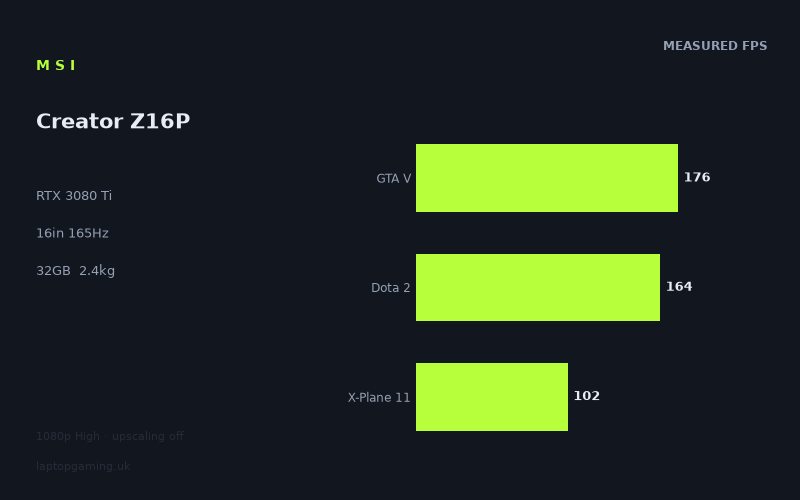
Frame rates
1920×1080, High preset, upscaling off.
Measured on this machine. Source: Notebookcheck, 2022-06-27.
Not scored: incomplete benchmark suite
Every scored laptop on this site is averaged over the same 5 games, and this one is short of Cyberpunk 2077, Baldur's Gate 3. A mean over 5 games is not comparable to a mean over 5, so we publish the figures we have and leave the score blank rather than rank it against machines tested on a different set. The numbers below are real - the suite is just incomplete.
How these numbers were produced
Frame rates here are not measured by us, and we label how each one was arrived at. A figure marked measured comes from a published run on that exact machine. A figure marked representative is derived from the GPU and its power limit (TGP) and cross-referenced against published reviews - a sound estimate of what that configuration delivers, but not a measurement of that specific laptop. Unless stated otherwise, numbers are 1920x1080, High preset, upscaling off. Where a laptop ships in several power configurations we use the wattage of the exact SKU listed, because a 140W RTX 5070 and a 115W one are not the same product.
In use
The short version
The MSI Creator Z16P (B12UHST) is a powerful 16in laptop built around an RTX 3080 Ti, Core i9-12900H, 32GB of memory and a 2TB SSD. Notebookcheck’s measured figures show that it is capable of extremely high frame rates in several lighter or older games, while more demanding recent releases expose the limits of its available graphics performance more clearly. It is fast, but the results are not uniformly close to the 165Hz panel refresh rate across every game.
The most important thing to understand before buying this machine is that the name of the GPU is not the whole story. An RTX 3080 Ti can be configured very differently between laptops, and the supplied specifications do not state the GPU power limit for this Creator Z16P. That means there is no basis for claiming that it is configured like a high-power gaming laptop, or that it will perform like one. The benchmark data is more useful than the badge here.
At 1920x1080 using the High preset with upscaling disabled, Notebookcheck recorded 176fps in GTA V, 164fps in Dota 2, 159fps in Strange Brigade, 145fps in The Witcher 3 and 134fps in Far Cry 5. Those are excellent figures for a 165Hz display, especially in the games where the measured result is close to the panel’s refresh rate. X-Plane 11 reached 102fps and Final Fantasy XV managed 94fps, both still strong results but no longer close to fully using the screen’s refresh capability. The more punishing end of the set is represented by Forza Horizon 5 at 66fps and Elex 2 at 43fps. Those figures matter because they show that this is not a machine where the RTX 3080 Ti label guarantees high-refresh gaming in every demanding title.
The mean across the scoring-suite games is 139fps. That is a strong result, but the spread is substantial. The Creator Z16P is therefore best understood as a machine capable of very high frame rates in suitable games, rather than one that can simply be assumed to deliver 165fps-class performance everywhere. Buyers primarily playing Dota 2, GTA V, Strange Brigade or similar lighter titles have a very different experience ahead of them from buyers concentrating on Forza Horizon 5 or Elex 2.
There is no confirmed UK price for this exact configuration, so no value judgement can be made from the available information. The benchmark suite is complete and the machine ranks normally on the frame-rate leaderboard; the missing price only prevents a value assessment. It would be wrong to guess what this configuration should cost or to describe it as good or poor value without a confirmed UK price.
This is a sensible choice for someone who wants a large, high-resolution IPS display, substantial memory and storage, and strong gaming performance without buying a machine whose identity is solely defined by gaming. It is less convincing for a buyer whose priority is extracting the highest possible frame rates from an RTX 3080 Ti, because the MSI Raider GE77 HX with the same named GPU is materially faster in the shared data. It is also not the obvious option for someone who needs a genuinely light portable machine: at 2.387kg before considering any accessories, this is portable in the sense that it can travel, not portable in the sense that it disappears into a daily routine.
Performance
What the benchmark data actually says
Notebookcheck measured the MSI Creator Z16P at 1920x1080, using the High preset and with upscaling disabled. That test method is useful because it removes one major source of ambiguity: these are not figures boosted by an upscaling mode. The results show the machine’s performance across a varied group of games, from titles that can run at very high frame rates to demanding releases where graphics load becomes more restrictive.
GTA V is the fastest result in the supplied set at 176fps. That is above the screen’s 165Hz refresh rate. For a buyer whose gaming is centred on GTA V, the Creator Z16P has enough measured performance to make the high-refresh panel meaningful at the tested settings and resolution. The result also shows that the laptop is not generally limited to modest frame rates merely because it is a Creator-branded model rather than a conventional gaming chassis.
Dota 2 follows at 164fps, which is effectively aligned with the panel’s 165Hz refresh rate. That is a particularly good match between game performance and display specification. The difference between 164fps and 165Hz should not be read as a practical failure of the display concept. It instead shows that, in this game at the supplied settings, the laptop can operate very close to the screen’s maximum refresh capability.
Strange Brigade reaches 159fps. Again, that is close to the panel’s 165Hz refresh rate, and it gives the screen a clear purpose. A 165Hz panel is most valuable when the machine can feed it frame rates substantially above the levels seen in the more difficult games. Strange Brigade is one of the examples where the Creator Z16P does exactly that.
The Witcher 3 returns 145fps. This is lower than the results in GTA V, Dota 2 and Strange Brigade, but it remains a high frame rate and is still well suited to a fast display. The gap to 165Hz is meaningful if the aim is to keep the panel fully fed at all times, but it is not evidence of weak performance. It is evidence that game engine and workload matter. The same laptop, same tested resolution and same High preset can produce sharply different outcomes depending on the title.
Far Cry 5 reaches 134fps. That is another strong result, although it sits further below the display refresh rate. The Creator Z16P can still make good use of a high-refresh screen in this game, but the benchmark figure does not support a claim that it will hold the panel’s maximum refresh rate. Buyers should distinguish between “high frame rate” and “always at the display limit”. This machine demonstrates the former in Far Cry 5, not necessarily the latter.
X-Plane 11 records 102fps. This is a major step down from the fastest titles in the set, but it remains a substantial frame rate. It also illustrates why a single average is not enough to describe gaming performance. A laptop with a 139fps mean across the scoring-suite games can still be near 100fps in a title such as X-Plane 11, while being close to 165fps or above in other games. Anyone buying specifically for simulation workloads should pay attention to this individual result rather than relying only on the mean.
Final Fantasy XV reaches 94fps. The figure is below the 165Hz display refresh rate by a sizeable margin, but it remains far from a poor result in isolation. The key point is not that 94fps is inadequate. The key point is that the panel is capable of displaying more frames than the measured result supplies in this game. The screen’s refresh rate remains useful, but the benchmark does not suggest that Final Fantasy XV at the tested settings will exploit its full 165Hz capability.
Forza Horizon 5 produces 66fps. This is where the Creator Z16P’s benchmark profile changes from high-refresh territory to a more conventional gaming result. The laptop still runs the game at a measured figure well above the slowest result in the set, but it is nowhere near the panel’s 165Hz refresh rate. This is an important reality check for buyers who see RTX 3080 Ti and assume that the screen’s refresh rate will automatically be matched in every game.
Elex 2 is the lowest result at 43fps. It is the clearest example of the Creator Z16P facing a demanding game where the available performance is much more constrained. This one number does not define the laptop, but it cannot be ignored. The difference between Elex 2 at 43fps and GTA V at 176fps is dramatic, despite both results coming from the same machine under the same broad test approach. That range is the central story of this review.
The benchmark spread matters more than the GPU name
The supplied figures span from 43fps in Elex 2 to 176fps in GTA V. That is not a narrow performance profile. It is a broad one, and it demonstrates why buying by GPU name alone is risky. The RTX 3080 Ti is a high-end GPU designation, but actual game performance is influenced by the game itself, the laptop’s broader design, its cooling and power behaviour, the processor, and the selected graphics settings. The benchmark data does not allow every one of those factors to be separated, but it does show their combined outcome.
The Creator Z16P is exceptionally capable in the lighter end of the tested selection. GTA V, Dota 2 and Strange Brigade all sit close to or above the 165Hz display refresh rate. The Witcher 3 and Far Cry 5 remain high-frame-rate results, even though they do not reach the same level. That gives the machine a strong case for games where smoothness and responsiveness matter and where the graphics workload does not overwhelm the configuration.
The lower results are just as useful. X-Plane 11 at 102fps and Final Fantasy XV at 94fps show a machine that can still produce strong performance but cannot be expected to operate at the display limit. Forza Horizon 5 at 66fps and Elex 2 at 43fps show that some games demand much more compromise if the aim is to pursue higher frame rates than the measured figures. The available data does not tell us what result would be obtained with altered settings, native display resolution, or upscaling enabled, so those figures should not be invented. What can be said is that the tested High preset without upscaling produces a wide range of outcomes.
The mean of 139fps across the scoring-suite games is useful as a broad summary, but it should not override the game-by-game evidence. A mean can make the machine look closer to a fully high-refresh gaming laptop than several individual games suggest. It is strongest as an indication that the Creator Z16P is generally fast, not as a promise that every game will run anywhere near 139fps.
GPU power limit: what is known and what is not
The supplied specifications identify an RTX 3080 Ti but do not give the GPU power limit for this Creator Z16P. That absence matters. Laptop GPUs carrying the same name can perform differently, and the comparison data makes that point particularly clearly. The MSI Raider GE77 HX is also an RTX 3080 Ti machine, but its GPU is specified at 175W and it averages 30fps more than the Creator Z16P across five shared games.
It would be tempting to treat that comparison as proof of a particular power limit in the Creator Z16P. The data does not support that level of certainty. The Creator’s GPU limit is not listed here, and a laptop’s performance depends on more than the GPU limit alone. What the figures do support is the practical conclusion: the Creator Z16P does not perform like the faster Raider in the shared selection, despite both carrying RTX 3080 Ti graphics.
This is why the Creator Z16P should not be bought on the assumption that every RTX 3080 Ti laptop is interchangeable. The GPU name tells a buyer that the machine belongs to a certain tier of hardware, but the actual measured results tell the more useful story. In the Creator, that story is strong performance with clear limits in harder games and a material deficit against at least one more aggressively configured RTX 3080 Ti rival.
The comparison with the Aorus 15 is also instructive. That machine has an RTX 3080 Ti and averages the same frame rate as the Creator Z16P across four shared games. This suggests that, in that particular shared selection, the Creator’s real-world results are not inherently weak for the GPU class. It sits level with one RTX 3080 Ti rival while falling well behind another. The correct conclusion is not that RTX 3080 Ti performance is fixed; it is that laptop implementation matters.
Processor, memory and storage in context
The Creator Z16P pairs the RTX 3080 Ti with a Core i9-12900H, 32GB of memory and a 2TB SSD. These are substantial specifications, but the review should remain anchored to what has been measured. The benchmark data shows that the system can reach very high frame rates in GTA V, Dota 2 and Strange Brigade, where the combination of processor and graphics hardware is clearly able to deliver well above 100fps.
At 1920x1080, lighter titles can become limited by factors other than raw GPU capability. The supplied rival notes explicitly warn that lighter games in the shared set are CPU-bound at this resolution and compress genuine GPU gaps. That is important when interpreting the zero-frame-rate averages against the Gigabyte Aero 17 HDR YD and Aorus 15. A level result in a shared 1080p set does not prove that every aspect of the machines is identical. It means that, in the games compared, the measured outcomes were level on average.
The 32GB memory capacity and 2TB SSD capacity are generous specifications for a laptop of this type, but no claims should be made about upgradeability, internal layout, storage speed or application behaviour because those details are not supplied. Their relevance here is straightforward: the laptop arrives with substantial memory and storage capacity alongside the Core i9-12900H and RTX 3080 Ti. Buyers who need more information about internal access or component layout would need evidence beyond this fact sheet.
The screen
A high-resolution, high-refresh IPS display
The MSI Creator Z16P has a 16in IPS display with a 2560x1600 resolution and a 165Hz refresh rate. On paper, that is an appealing combination because it offers more desktop space than a 1920x1080 screen while also providing a refresh rate aimed at smoother motion than a conventional display. The IPS panel type is also specified, although the supplied information does not include brightness, colour coverage, contrast, response times, calibration, adaptive-sync support or any other panel measurements. Those qualities should not be assumed.
The 2560x1600 resolution is not the same as the 1920x1080 benchmark resolution. This distinction is essential. Notebookcheck’s frame rates were measured at 1920x1080, High settings and with upscaling off. They are not native-resolution 2560x1600 figures. A buyer should therefore not read 176fps in GTA V or 66fps in Forza Horizon 5 as direct evidence of what will happen when gaming at the panel’s full resolution.
That does not make the benchmark results less useful. They remain directly comparable figures under a stated test method. It does mean that the relationship between the display and the gaming numbers needs to be handled honestly. At the tested resolution, several games approach or exceed the 165Hz refresh rate. At the display’s native resolution, no measured frame-rate data is supplied. The right conclusion is that the screen has the capacity for high-refresh gaming, while the benchmark figures establish only how the machine performs at 1920x1080.
Which measured games suit 165Hz best
GTA V at 176fps is the clearest match for the 165Hz display. The measured figure exceeds the panel refresh rate, showing that the laptop can generate frames faster than the screen can refresh in that game under the stated conditions. Dota 2 at 164fps is almost exactly aligned with the panel’s capability. Strange Brigade at 159fps is similarly close. These are the games where the Creator Z16P’s display specification and measured performance most obviously complement each other.
The Witcher 3 at 145fps and Far Cry 5 at 134fps remain good fits for a 165Hz panel, even though they do not fully reach its maximum refresh rate. The display does not become pointless below 165fps. Rather, its maximum capability is not fully occupied by the measured frame rate. These results still sit in the high-frame-rate range and are much closer to the display’s upper limit than the lower results in the benchmark list.
X-Plane 11 at 102fps and Final Fantasy XV at 94fps demonstrate another category: frame rates where the display’s high refresh capacity is available, but the game is not supplying frames near the limit. The experience implied by these figures is still substantially different from Elex 2 at 43fps, but the 165Hz headline is not the defining performance characteristic in these titles.
Forza Horizon 5 at 66fps and Elex 2 at 43fps are the clearest reminders that a 165Hz panel does not guarantee 165fps gameplay. A high-refresh display can still be desirable for general responsiveness and for the games where the laptop is faster, but buyers whose main interest is these more demanding titles should focus on the actual measured performance rather than the refresh-rate figure printed in the specifications.
Resolution versus frame rate
The Creator Z16P’s display asks a reasonable question of the buyer: is the priority the panel’s 2560x1600 native resolution, its 165Hz refresh rate, or a balance between the two? The supplied benchmark data cannot answer that question with native-resolution performance numbers, because it was gathered at 1920x1080. It does, however, show why the choice matters.
In games such as GTA V, Dota 2 and Strange Brigade, the machine has enough performance at 1920x1080 High without upscaling to approach or exceed the refresh rate. In Forza Horizon 5 and Elex 2, the same test conditions deliver much lower results. It is therefore sensible to expect that buyers will need to pay close attention to game settings and resolution choices, particularly in demanding titles. The evidence does not tell us which exact setting combination is best, so the review should not pretend otherwise.
The display is likely to be most satisfying for someone who values the 16in 2560x1600 workspace as much as peak game frame rate. That description fits the Creator identity better than it fits a purely gaming-first laptop. The panel specification gives the machine a versatile display proposition: high resolution for work and a high refresh rate for games capable of taking advantage of it. The limitation is that the supplied data does not show full-resolution gaming performance.
Build, size and portability
Portable, but not lightweight
The MSI Creator Z16P weighs 2.387kg. That makes it a substantial laptop to carry. The available information does not include dimensions, chassis materials, port selection, keyboard details, trackpad measurements, charger weight, cooling noise, surface temperatures or battery-life measurements, so none of those areas should be filled in with assumptions. The weight is the firm piece of portability evidence available here.
At 2.387kg, this is not the kind of machine that should be chosen primarily because it is easy to carry every day with little thought. It is a 16in laptop with a high-end CPU, RTX 3080 Ti graphics, 32GB of memory, 2TB of storage and a 90Wh battery. The weight is consistent with a system intended to provide substantial capability in a single device, but buyers should be realistic about the difference between occasional travel and frequent mobile use.
The Creator Z16P is more naturally suited to moving between a desk, studio, office, campus or temporary workspace than to being carried continuously. That is not a criticism of the machine’s specification; it is a practical reading of 2.387kg. Someone who mainly works from one place and occasionally transports the laptop can reasonably accept that weight for the hardware on offer. Someone who carries a laptop for long periods may place far more value on lower weight than on the RTX 3080 Ti and 16in high-resolution display.
The battery specification is not a battery-life result
The battery is rated at 90Wh. This is a capacity specification, not a measured endurance figure. No battery-life data is supplied, and it would be misleading to translate 90Wh into an expected number of hours. Battery life depends on workload, display use, power settings, software activity and many other factors that are not covered here.
The right way to read the battery specification is simply that the Creator Z16P includes a 90Wh battery. It does not establish whether the laptop is suitable for a full day away from mains power, whether it can sustain gaming on battery, or how its display affects endurance. Buyers for whom battery life is decisive need measured battery data before treating this as a safe purchase.
A Creator machine with gaming-class hardware
The most interesting physical-positioning point is not something that can be proven by exterior photographs or material descriptions, because those details are not part of the supplied information. It comes from the specification mix. The Creator Z16P combines a 16in 2560x1600 IPS display, Core i9-12900H, RTX 3080 Ti, 32GB of memory and 2TB of storage. That is a configuration with the capacity to serve someone whose needs extend beyond games.
However, the gaming data shows that the machine should not be dismissed as merely a content-creation laptop with a gaming-capable GPU attached. The 176fps, 164fps and 159fps results are too high for that description. Equally, the 66fps and 43fps results mean it should not be treated as an uncompromising gaming chassis solely because it contains RTX 3080 Ti graphics. Its identity lies between those extremes.
How it compares
Against the MSI Prestige 15
The MSI Prestige 15 has an RTX 3050 Ti specified at 105W. Across four shared games, the Creator Z16P averages 80fps more. That is the largest positive gap among the listed comparisons, and it is a meaningful one. The Creator is in a clearly different performance class from the Prestige in the games that both machines have been measured in.
The comparison is useful because it illustrates what the Creator’s RTX 3080 Ti and Core i9-12900H configuration can deliver relative to a lower-tier RTX 3050 Ti machine. The gap is not a minor variation caused by a single title. It is an average across the shared set. For a buyer deciding between a performance-oriented Creator Z16P and the Prestige 15, the benchmark evidence strongly favours the Creator where gaming frame rate is important.
Both machines lack a confirmed UK price in the supplied information, so this cannot become a value comparison. The Creator is faster in the shared benchmark data. That is all the evidence supports. It would be wrong to say whether that performance advantage is worth any particular price difference when neither exact UK price is confirmed.
Against the Gigabyte Aero 17 HDR YD
The Gigabyte Aero 17 HDR YD uses an RTX 3080. Across five shared games, the Creator Z16P averages the same frame rate. At first glance, an RTX 3080 Ti drawing level with an RTX 3080 may appear surprising. The supplied comparison note explains why a near-zero difference should not be dismissed: at 1920x1080, lighter titles in the shared set can be CPU-bound and compress genuine GPU gaps.
The meaningful conclusion is not that RTX 3080 and RTX 3080 Ti are automatically identical in every laptop. It is that these two specific machines delivered the same average across the five games they share under the available comparison method. For a buyer looking only at the benchmark results, there is no measured frame-rate reason to prefer one over the other from this shared-game average alone.
That makes the missing information more important, not less. Screen characteristics, weight, storage, memory, price, battery-life data and other aspects could affect a purchase decision, but only the Creator’s supplied specifications can be discussed here. The Creator has a 16in 2560x1600 165Hz IPS display, weighs 2.387kg, includes 32GB of memory and a 2TB SSD. The Aero’s corresponding details are not supplied here, so the comparison should remain confined to the shared gaming result: level on average.
Against the Aorus 15
The Aorus 15 also uses an RTX 3080 Ti. Across four shared games, it averages the same frame rate as the Creator Z16P. This is a valuable comparison because it prevents the Raider result from becoming the only reference point for RTX 3080 Ti performance. The Creator is not simply slow for its GPU designation. In the available shared data, it matches another RTX 3080 Ti laptop.
As with the Aero comparison, the zero-frame-rate average should be interpreted carefully. A near-zero difference is a real measured outcome, but it does not establish that every game, setting or resolution will remain tied. The comparison is at 1920x1080 and the lighter titles in the shared set can be CPU-bound, reducing the visible difference between machines that may have different graphics configurations. The result is still useful: buyers choosing between these two machines should not expect a clear frame-rate lead for either one from the supplied shared-game average.
This is where the Creator’s own specification mix becomes relevant. The 16in 2560x1600 IPS display, 165Hz refresh rate, 32GB memory and 2TB SSD may make it attractive to a buyer who needs more than game performance, while the 2.387kg weight may make it less attractive to someone prioritising mobility. But the available benchmark evidence itself says the Creator and Aorus are level across their shared games.
Against the MSI Raider GE77 HX
The MSI Raider GE77 HX is the comparison that most clearly defines the Creator Z16P’s ceiling. It also uses an RTX 3080 Ti, but its GPU is specified at 175W. Across five shared games, the Creator averages 30fps less. This is not a negligible difference and should not be softened into a claim that the machines are broadly identical because they share a GPU name.
The Raider’s lead illustrates the practical significance of laptop configuration. The Creator’s own GPU power limit is not supplied, so no exact technical explanation should be asserted. But the real-world benchmark outcome is clear: the higher-power Raider produces a substantially higher average frame rate in the shared set.
For a buyer whose chief purpose is gaming, especially gaming in more demanding titles or gaming where the 165Hz panel is expected to be used as fully as possible, the Raider comparison is difficult to ignore. The Creator remains fast, but it is not the faster RTX 3080 Ti implementation in this group. The 30fps average deficit is evidence that the Creator prioritises something other than outright shared-game performance, or at least does not match the Raider’s performance outcome.
That does not make the Creator unsuitable for gaming. Its own results remain excellent in GTA V, Dota 2 and Strange Brigade, and strong in The Witcher 3 and Far Cry 5. The difference is one of buyer priority. The Creator suits someone who values its 16in 2560x1600 165Hz IPS display and substantial memory and storage alongside gaming capability. The Raider is the more compelling reference point for someone who wants the highest measured RTX 3080 Ti frame rates in this comparison group.
Who it’s for
Buy it if the display and balanced specification matter as much as gaming
The MSI Creator Z16P makes the strongest case for a buyer who wants a powerful all-round laptop with serious gaming capability, rather than a buyer who wants a gaming laptop defined only by maximum frame rate. Its 16in 2560x1600 IPS display, 165Hz refresh rate, Core i9-12900H, RTX 3080 Ti, 32GB of memory and 2TB SSD form a high-end configuration with breadth as well as gaming power.
It is particularly well suited to someone playing the titles where Notebookcheck’s measured figures are close to the display refresh rate: GTA V at 176fps, Dota 2 at 164fps and Strange Brigade at 159fps. The Witcher 3 at 145fps and Far Cry 5 at 134fps also support a high-frame-rate gaming use case. Buyers who spend much of their gaming time in this part of the performance range can reasonably see the 165Hz screen as a meaningful feature rather than an unused specification.
It also suits buyers who understand the distinction between the supplied 1920x1080 benchmark figures and the panel’s 2560x1600 native resolution. The screen is high resolution, but there is no native-resolution benchmark data in the fact sheet. A buyer comfortable adjusting expectations according to game demands, rather than expecting one result to describe every title, is the right audience for this laptop.
The 32GB memory and 2TB SSD are also useful for someone who wants a machine with substantial capacity from the outset. No assumptions should be made about how that hardware performs in specific applications, but the capacities themselves are generous. A buyer who wants to avoid choosing between gaming hardware and ample memory and storage may find the configuration appealing.
Buy something else if maximum gaming performance is the only priority
The Creator Z16P is not the clearest choice for a buyer who wants the fastest possible RTX 3080 Ti results. The MSI Raider GE77 HX averages 30fps more across five shared games and has a 175W RTX 3080 Ti. That is the most important competitive evidence in the supplied data. The Creator may be a strong laptop, but it is not the performance leader among the listed RTX 3080 Ti machines.
Buyers concentrating on demanding games should also take the individual results seriously. Forza Horizon 5 at 66fps and Elex 2 at 43fps show that this laptop does not deliver 165fps-class performance across the board at the tested 1920x1080 High settings with upscaling disabled. Anyone buying primarily to drive a 165Hz panel at its limit in demanding releases should seek a machine with stronger measured results in the games they actually play.
Someone who mainly wants a light daily-carry laptop should also consider another category of machine. At 2.387kg, the Creator Z16P is not lightweight. It may be suitable for travel and moving between locations, but the figure does not support presenting it as effortless to carry. The supplied information does not include dimensions or charger weight, so the full travelling burden cannot be quantified, but the laptop’s own weight is enough to make portability a genuine consideration.
Buyers for whom battery endurance is central should wait for measured battery-life information. The machine has a 90Wh battery, but no endurance figure is supplied. Capacity alone does not answer whether the laptop suits long periods away from mains power. This is an area where uncertainty should remain uncertainty.
The final buying judgement
The Creator Z16P is a capable and interesting machine whose benchmark results need to be read with more care than its RTX 3080 Ti badge might initially suggest. It can run GTA V at 176fps, Dota 2 at 164fps and Strange Brigade at 159fps, giving its 165Hz panel a clear gaming role. It can also produce 145fps in The Witcher 3 and 134fps in Far Cry 5, which are strong results even if they sit below the display limit.
At the same time, X-Plane 11 at 102fps, Final Fantasy XV at 94fps, Forza Horizon 5 at 66fps and Elex 2 at 43fps show a more constrained side to the system. Those figures do not make the laptop weak. They make it honest to describe it as a high-performance machine with game-dependent results, not a universal 165fps solution.
The comparison data reinforces that view. It is far ahead of the RTX 3050 Ti MSI Prestige 15, level with the RTX 3080 Gigabyte Aero 17 HDR YD and RTX 3080 Ti Aorus 15 in the available shared-game averages, but materially behind the 175W RTX 3080 Ti MSI Raider GE77 HX. That is a useful place to sit: clearly powerful, competitive with some similarly positioned hardware, but not the answer for buyers chasing the highest available gaming output.
Choose the Creator Z16P if you want its combination of 16in 2560x1600 IPS display, 165Hz refresh rate, Core i9-12900H, RTX 3080 Ti, 32GB memory, 2TB SSD and strong measured gaming performance. Look elsewhere if maximum frame rate, low carry weight, confirmed battery endurance or a confirmed UK value judgement is essential to the purchase. The data supports confidence in its strengths, but it also gives clear reasons not to overstate them.