Review
Lenovo Legion S7 15ACH6 review
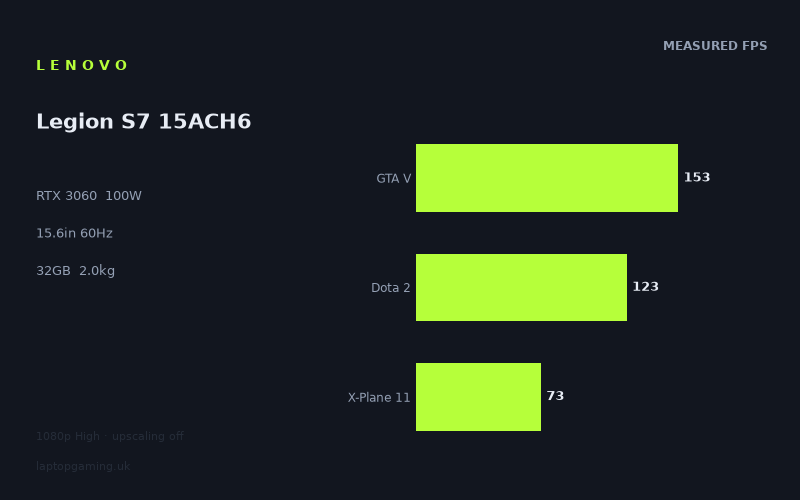
Frame rates
1920×1080, High preset, upscaling off.
Measured on this machine. Source: Notebookcheck, 2021-11-05.
Not scored: incomplete benchmark suite
Every scored laptop on this site is averaged over the same 5 games, and this one is short of Cyberpunk 2077, Baldur's Gate 3. A mean over 5 games is not comparable to a mean over 5, so we publish the figures we have and leave the score blank rather than rank it against machines tested on a different set. The numbers below are real - the suite is just incomplete.
How these numbers were produced
Frame rates here are not measured by us, and we label how each one was arrived at. A figure marked measured comes from a published run on that exact machine. A figure marked representative is derived from the GPU and its power limit (TGP) and cross-referenced against published reviews - a sound estimate of what that configuration delivers, but not a measurement of that specific laptop. Unless stated otherwise, numbers are 1920x1080, High preset, upscaling off. Where a laptop ships in several power configurations we use the wattage of the exact SKU listed, because a 140W RTX 5070 and a 115W one are not the same product.
In use
The short version
The Lenovo Legion S7 15ACH6 is a powerful but slightly awkward gaming laptop configuration: it pairs an RTX 3060 running at a 100W GPU power limit with a Ryzen 9 5900HX, 32GB of memory, a 1TB SSD and a 15.6in IPS display, but that display is a 3840x2160, 60Hz panel while the available game results are measured at 1920x1080 using the High preset with upscaling disabled.
At 1080p, Notebookcheck’s benchmark data is strong. The machine reaches 170fps in Back 4 Blood, 157fps in F1 2021, 155fps in Strange Brigade and 153fps in GTA V. Even the lowest result in the supplied set, X-Plane 11 at 73fps, is above the panel’s 60Hz refresh ceiling when playing at 1080p. There is therefore no shortage of performance for a 60Hz screen in the measured settings. The issue is not whether the Legion can exceed 60fps at 1080p. It plainly can. The issue is that its native display resolution is far more ambitious than the benchmark resolution, and there are no supplied native-resolution frame rates to show how often it can sustain that same result at 3840x2160.
That makes this a machine for someone who values the combination of a high-resolution 15.6in screen, substantial memory capacity and a relatively modest 1.966kg weight, but is comfortable treating 1080p gaming as the realistic baseline for the available evidence. It should appeal to buyers who want good measured performance in a wide range of games, do not need a high-refresh panel, and would rather have a sharper desktop and media display than a screen built around extremely high frame rates.
It is less convincing for the buyer whose priority is straightforward, native-resolution gaming. The screen is 3840x2160, while the cited figures are all from 1920x1080. Running games below native resolution is not inherently wrong, especially when the available measurements show comfortably high performance, but it is a compromise that needs acknowledging before spending money. A 60Hz panel also means that much of the machine’s best 1080p performance cannot be displayed as additional full refreshes on the internal screen. Back 4 Blood at 170fps and F1 2021 at 157fps are impressive figures, but the internal display remains a 60Hz panel.
The 100W RTX 3060 is neither a token low-power implementation nor a particularly high-power gaming-laptop example. It sits in the middle of the RTX 3060 field represented here, and the comparison data shows why power limit figures cannot be read in isolation. Against the 95W RTX 3060 in the Asus TUF Gaming F17, the Legion is effectively level across the shared games. Against the MSI Prestige 15 with a 105W RTX 3050 Ti, it holds a substantial lead. Yet against a much more heavily powered RTX 3080 Ti machine, the MSI Raider GE77 HX, it gives away a substantial amount of performance. The 100W specification provides useful context, but the measured game results are the meaningful evidence.
There is no confirmed UK price for this exact configuration. As a result, a value assessment cannot be calculated because price is required for that part of the assessment; this is not a comment on the laptop’s benchmark standing or on the completeness of the performance data. Anyone considering the Legion S7 15ACH6 should therefore judge it as a specification-and-performance proposition rather than assume it is either good or poor value.
Performance
What the measured figures say
The available figures come from Notebookcheck, dated 2021-11-05, and use 1920x1080, the High preset and no upscaling. That is an important test condition, not a footnote. These are not native 3840x2160 results, not maximum-quality results, and not results enhanced by upscaling. They show what the Legion S7 15ACH6 can do in a sensible 1080p gaming mode with image-quality settings that are still substantial enough to make the results useful.
The strongest part of the results is the breadth of performance. This is not a machine which posts one unusually flattering figure in a light title and then falls apart as games become more demanding. The figures range from 170fps in Back 4 Blood to 73fps in X-Plane 11, with every listed game clearing the internal panel’s 60Hz refresh rate at the measured settings. That does not prove that every moment in every game will remain above 60fps, because average figures cannot describe every scene or workload. It does show that the benchmarked settings are well matched to a 60Hz gaming target.
At the upper end, Back 4 Blood reaches 170fps, F1 2021 reaches 157fps, Strange Brigade reaches 155fps and GTA V reaches 153fps. These are frame rates that would make much more sense on a high-refresh display than on the Legion’s own 60Hz panel. They are still useful, however. High averages leave room for heavier scenes, background activity and occasional dips without immediately putting a 60Hz target under pressure. More importantly, they show that the RTX 3060 and Ryzen 9 5900HX combination has considerable headroom in games that are not especially restrictive at the measured settings.
The scoring-suite mean is 116fps across Strange Brigade, GTA V, Dota 2, Final Fantasy XV and X-Plane 11. That mean is a useful summary because it covers a less flattering selection than simply quoting the fastest games. Strange Brigade and GTA V are both above 150fps, Dota 2 reaches 123fps, Final Fantasy XV reaches 77fps and X-Plane 11 reaches 73fps. The spread is wide, which is exactly why the mean should not be treated as a promise that all games will run at around the same rate. It tells us that the laptop has a healthy overall 1080p High result across the selected set. It does not erase the difference between a game at 155fps and one at 73fps.
Dota 2 at 123fps is another result that comfortably exceeds the display refresh rate. It reinforces the point that the internal panel, rather than the laptop’s 1080p gaming capability, is the limiting factor in the lighter and better-scaling entries here. A player focused on such games may value the sharp 3840x2160 desktop resolution more than a very high refresh rate, but someone buying primarily for fast motion should be clear about the trade-off. The panel can refresh at 60Hz. The benchmark data shows the system frequently produces more frames than that at 1080p.
The middle of the benchmark spread
Far Cry 5 records 113fps, Guardians of the Galaxy records 107fps and Far Cry 6 records 97fps. These results are especially useful because they sit closer to the performance range where the machine’s 60Hz display becomes a practical advantage rather than a hard cap that discards a large amount of potential refresh-rate benefit. At 97fps in Far Cry 6, the Legion still has measured performance above the panel’s refresh rate, but the margin is less extravagant than it is in Back 4 Blood or F1 2021.
Call of Duty Black Ops Cold War reaches 93fps and Riders Republic reaches 88fps. Alan Wake Remastered and Deathloop both reach 82fps. Final Fantasy XV reaches 77fps, New World reaches 76fps, and X-Plane 11 reaches 73fps. This lower half of the results is where the Legion S7 makes its clearest practical case as a 60Hz 1080p gaming machine. None of these results need an extremely fast panel to look viable on paper. All of them are above 60fps in the supplied measurements, and several are only moderately above that mark rather than wildly beyond it.
It would be wrong to describe 73fps in X-Plane 11 as the same gaming experience as 170fps in Back 4 Blood merely because both exceed 60Hz. The figures show a material difference in available headroom. X-Plane 11 is the lowest measured result in the supplied list, so it offers the least room for a game becoming more demanding in situations not represented by the average. Likewise, Final Fantasy XV at 77fps, New World at 76fps, and Alan Wake Remastered and Deathloop at 82fps are the games where the choice of settings matters more. These are not poor results for a 60Hz target at 1080p High with no upscaling. They are simply less excessive than the results in the fastest titles.
This distinction matters when judging a laptop with a 3840x2160 display. At 1080p High, every supplied result clears 60fps. At native resolution, no equivalent measurements have been provided. There is no basis here for claiming that the machine reaches 60fps in the same games at the panel’s native resolution, nor for claiming that it does not. The responsible conclusion is narrower: the machine has measured 1080p High performance that suits its 60Hz refresh rate, while native-resolution gaming remains unquantified by the supplied data.
What the 100W RTX 3060 means in practice
The RTX 3060 name alone does not tell a buyer everything useful about gaming performance. The Legion’s graphics processor has a 100W GPU power limit, and that specification matters because laptop GPUs with the same name can operate within different power limits. A comparison between machines therefore needs more than a glance at the GPU label. It needs measured results in shared games, using comparable conditions.
In this laptop, the 100W RTX 3060 produces a scoring-suite mean of 116fps. It is capable of more than 150fps in Strange Brigade and GTA V, 123fps in Dota 2, and still holds 77fps in Final Fantasy XV and 73fps in X-Plane 11. That is a balanced result profile. It does not suggest an RTX 3060 that is being reduced to low-end performance by an aggressively restricted power limit. Nor does it support any claim that it performs like a far larger, more heavily powered gaming machine. The comparisons below make that boundary clear.
The right interpretation of 100W is not that it guarantees a particular rank in every game. Different games respond differently to CPU performance, graphics workload, engine behaviour and the chosen settings. The supplied rival data includes an instructive near-tie with an RTX 3060 at 95W, a large advantage over an RTX 3050 Ti at 105W, and a substantial deficit against an RTX 3080 Ti at 175W. The power limit is part of the explanation, but not the whole explanation. GPU class, the shared games and the balance of the wider system all influence the final result.
The Ryzen 9 5900HX, 32GB of memory and 1TB SSD are a strong supporting specification on paper, but the available evidence does not split out their individual impact on game performance. It would be speculation to claim that a particular title is faster because of the memory capacity or storage configuration. What can be said is that the published results come from the complete listed configuration, not from an isolated GPU. A buyer should therefore regard the Notebookcheck numbers as evidence for this machine as configured, rather than assuming that every RTX 3060 laptop will behave identically.
The 32GB memory allocation is notable because it avoids the impression of an otherwise premium configuration being paired with a minimal memory figure. However, no application benchmarks, multitasking measurements or upgrade information are supplied. It is sensible to acknowledge the capacity without making unsupported claims about content creation, virtual machines, workloads or future software requirements. The same restraint applies to the 1TB SSD: it is a substantial listed capacity, but there are no supplied read speeds, write speeds, expansion details or loading-time results.
Understanding the variation between games
The gap between the fastest and slowest entries is not a sign that the results are inconsistent or unreliable. It is the normal consequence of different games placing different demands on the system. At the same 1920x1080 High settings, Back 4 Blood reaches 170fps while X-Plane 11 reaches 73fps. The laptop has not changed between those results; the workload has. That is why a single average is useful for broad comparison but insufficient for deciding whether the Legion suits a particular library.
The high figures in Back 4 Blood, F1 2021, Strange Brigade and GTA V show where the Legion has enough performance that a 60Hz display is clearly the visible limiter. The lower results in Final Fantasy XV, New World and X-Plane 11 show where 60Hz is a more natural match. The results in Far Cry 6, Call of Duty Black Ops Cold War, Riders Republic, Alan Wake Remastered and Deathloop occupy the middle ground: they are still above the screen’s refresh ceiling at the measured settings, but they are close enough to it that changing resolution or graphics settings would matter more than it would in the fastest games.
The supplied rival notes also explain why small differences between machines should be read carefully. At 1080p, the lighter titles in a shared set can become CPU-bound and compress genuine GPU gaps. That matters particularly when comparing the Legion with machines carrying nominally more powerful graphics hardware. A near-zero shared-game result does not mean the hardware is identical in every workload. It means that, in the shared titles and measured conditions, the games did not expose a meaningful average difference. That is a real result, but it is not a licence to ignore the wider hardware differences.
For a buyer, the practical lesson is simple. If the games most often played resemble the faster entries in the list, the Legion’s internal 60Hz display will be the main constraint at 1080p High. If they resemble X-Plane 11, New World, Final Fantasy XV or the cluster around the eighties, the laptop’s performance is still appropriate for 60Hz gaming at the measured settings, but there is less reason to pay for or seek out a much faster screen. The machine’s results cover both situations, which is why its screen choice is not obviously nonsensical. It is just specialised towards resolution and general display sharpness rather than high-refresh gaming.
The screen
A high-resolution panel with a modest refresh target
The Legion S7 15ACH6 uses a 15.6in IPS display with a 3840x2160 resolution and a 60Hz refresh rate. That specification immediately sets it apart from a gaming laptop designed around a 1080p high-refresh panel. The screen prioritises resolution rather than refresh rate. Whether that is a strength depends heavily on how the laptop will be used.
For desktop work, video and non-gaming use, a 3840x2160 display gives the machine a different character from a conventional 1080p gaming laptop. However, there are no supplied measurements for brightness, colour coverage, contrast, response time, colour accuracy, adaptive-sync support or outdoor visibility. It would be inappropriate to make claims about image quality beyond the stated IPS panel type, resolution and refresh rate. IPS describes the panel technology, but the fact sheet does not provide enough information to judge how well this particular panel has been implemented.
For gaming, the central tension is clear. The measured results are at 1920x1080, while the panel’s native resolution is 3840x2160. Every supplied game result exceeds 60fps at 1080p High with upscaling disabled, which establishes a solid baseline for playing on the internal display at that resolution. But the results do not establish native-resolution performance. A buyer expecting the laptop to use its full panel resolution in every modern game needs more evidence than is available here.
There is nothing misleading about discussing a 1080p benchmark on a 4K-class laptop screen so long as the distinction is explicit. 1080p is a common performance reference point and provides an informative way to compare systems. The mistake would be treating those figures as though they were delivered at 3840x2160. They are not. The Legion’s 170fps in Back 4 Blood, 157fps in F1 2021 and 153fps in GTA V are excellent 1080p results. They should not be repurposed as evidence of 4K gaming performance.
How well the panel matches the benchmark data
At 1080p High, the internal 60Hz panel is fully covered by the supplied figures. Back 4 Blood, F1 2021, Strange Brigade, GTA V, The Witcher 3, Dota 2, Far Cry 5, Guardians of the Galaxy, Far Cry 6, Call of Duty Black Ops Cold War, Riders Republic, Alan Wake Remastered, Deathloop, Final Fantasy XV, New World and X-Plane 11 all record frame rates above 60fps. This is a rare case where the answer to “can the GPU drive the panel?” depends entirely on which resolution is meant.
At 1920x1080, yes: the benchmark data says the laptop can exceed the display’s 60Hz refresh rate in every listed game at High settings with no upscaling. At 3840x2160, the fact sheet does not provide the numbers required to answer. The machine may be suitable for native-resolution play in some games or at altered settings, but no frame-rate claim can be made from the available data. A buyer should not fill that gap with assumptions based only on the RTX 3060 name.
The 60Hz refresh rate also changes how the highest frame-rate results should be valued. A laptop producing 170fps in Back 4 Blood or 155fps in Strange Brigade has performance beyond what the internal display can show as distinct refreshes. That does not make the performance meaningless, since high average frame rates can still matter for responsiveness and for use with another display, but the fact sheet does not include response, latency or external-display information. The safe conclusion is simply that the internal panel does not have a refresh rate high enough to display all of the frames produced in the fastest measured games.
Conversely, the 60Hz panel is not an obvious mismatch for the slower titles in the list. X-Plane 11 at 73fps, New World at 76fps, Final Fantasy XV at 77fps, and Alan Wake Remastered and Deathloop at 82fps all sit in a range where a 60Hz screen is much more proportionate to the measured performance. The Legion therefore looks less like a machine with an inexplicably slow screen and more like one with a display designed around a different priority: high resolution first, refresh rate second.
Choosing settings for this display
The available evidence supports one clear recommendation: treat 1080p High without upscaling as the known gaming baseline. It is not the only setting combination the laptop can use, but it is the one for which there is a full set of measured figures. If a buyer wants a predictable starting point, this is it. The numbers show that this baseline is enough to exceed 60fps in every listed game.
Beyond that, the data runs out. There are no supplied measurements for lower presets, higher presets, ray tracing, native-resolution gaming, resolution scaling or upscaling modes. It would be easy to assume that one of those routes will solve the resolution-performance trade-off, but assumptions are exactly what an attributable benchmark-led review should avoid. The machine may give its owner options; the supplied measurements do not quantify them.
This makes the screen a purchase decision rather than a simple specification win. Buyers who want the sharpness and workspace implied by a 3840x2160 screen, and who are content to use a measured 1080p gaming mode, have a coherent reason to choose it. Buyers who want a panel explicitly matched to the 170fps, 157fps and 155fps results should look for a higher-refresh alternative. Buyers who insist on native-resolution game performance need native-resolution measurements before concluding that this is the right machine.
Build, size and portability
The Legion S7 15ACH6 weighs 1.966kg. For a machine with a 15.6in display, RTX 3060 graphics, Ryzen 9 5900HX processor, 32GB of memory, 1TB SSD and 71Wh battery, that is the most concrete portability figure available. It is not a weightless ultraportable, but neither does the specification suggest that this is solely a large desktop-replacement concept. The 1.966kg figure puts it in a category where carrying it is a realistic part of ownership, while its internal hardware remains intended for serious gaming at the measured 1080p settings.
There are no supplied chassis dimensions, thickness figures, power-adapter weight, port details, materials, keyboard measurements, trackpad information, webcam details or durability observations. Those omissions matter. Weight alone cannot tell a buyer whether a laptop fits a particular bag, how much desk space it requires, whether its charger is bulky, or how convenient its ports are for a specific setup. The honest assessment has to stay with what is known: the laptop weighs 1.966kg, has a 15.6in screen and contains the listed hardware.
The 71Wh battery is also a specification rather than a measured endurance result. No battery-life figures are supplied for browsing, video, office use, gaming or standby. It would be wrong to infer a number from the battery capacity or from the laptop’s weight. Gaming laptops can behave very differently depending on workload, display settings and system configuration, and none of those variables are quantified here. The 71Wh capacity tells us the size of the battery, not how long the Legion runs away from mains power.
That said, the combination of a 1.966kg weight and 71Wh battery makes this a more interesting prospect for mixed use than a machine whose available facts point only towards permanent desk duty. The key word is “mixed”, not “all-day”. There is insufficient battery evidence to promise extended unplugged operation, and there is no reason to assume that the 1080p gaming figures carry over to battery-powered gaming. The published game measurements do not state battery mode, so no battery-performance claim should be attached to them.
The practical buyer should therefore separate portability into two questions. The first is physical portability: at 1.966kg, the laptop is not defined by extreme mass. The second is independent use away from a socket: the 71Wh capacity is known, but actual endurance is not. The first can be judged from the stated weight. The second cannot be judged responsibly without measured battery-life data.
There is a similar limit around cooling and acoustics. The laptop has a 100W GPU power limit, but no temperatures, noise figures, fan behaviour observations or sustained-performance measurements are supplied. It would be unjustified to call it quiet, loud, cool-running or hot. A 100W figure does not answer those questions. Buyers who are particularly sensitive to fan noise or surface temperatures should seek attributable measurements before deciding, because the fact sheet provides none.
What can be said is that the specification is not minimal. The Ryzen 9 5900HX, RTX 3060, 32GB of memory and 1TB SSD form a high-end configuration for a laptop of this broad type, while the 15.6in 3840x2160 screen and 1.966kg weight push it towards a machine intended to do more than sit under a desk. The data does not tell us whether Lenovo succeeded in making that combination comfortable, quiet or exceptionally slim. It tells us that the hardware and weight make the combination plausible, and that the gaming results at 1080p are strong.
How it compares
Against the MSI Prestige 15
The MSI Prestige 15 uses an RTX 3050 Ti at 105W. Across four shared games, the Legion S7 15ACH6 averages 53fps ahead. That is the Legion’s largest positive comparison in the supplied rival set, and it is substantial enough that it should influence a purchase decision more than the apparently similar power-limit numbers.
The Prestige has a 105W GPU power limit, slightly above the Legion’s 100W figure, but it uses a different GPU class. The shared-game result demonstrates why the RTX 3060 label matters more here than a superficial comparison of power limits. The Legion’s advantage is not a tiny benchmark fluctuation. An average lead of 53fps across the shared games is a meaningful performance separation.
No confirmed UK price is supplied for the Prestige 15, so this cannot become a value comparison. It is strictly a performance comparison. On that evidence, the Legion is the stronger gaming machine. A buyer looking at both systems should not assume that the Prestige’s 105W figure places it on equal footing with the Legion simply because the wattage figure is close. The benchmark data says otherwise.
Against the Asus TUF Gaming F17
The Asus TUF Gaming F17 also uses an RTX 3060, with a 95W GPU power limit. Across five shared games, the Legion averages 1fps ahead. This is effectively a tie in the available shared-game data, and it is important not to inflate a 1fps average difference into a meaningful buying recommendation.
The Legion’s 100W limit is higher than the TUF’s 95W limit, but the measured shared-game outcome is near-zero. This is precisely the kind of result that needs explanation rather than repetition. At 1080p, lighter titles in a shared set can become CPU-bound and compress genuine GPU gaps. That means the small average difference does not prove the two implementations are identical in every game or at every setting. It does prove that the shared games, under the compared conditions, did not provide a significant average advantage for the Legion.
For a buyer deciding between these two machines, other verified factors would matter more than this shared-game performance gap. The Legion has a 15.6in 3840x2160, 60Hz IPS display and weighs 1.966kg, but the supplied fact sheet does not provide corresponding screen or weight details for the TUF. Therefore, the fair conclusion is limited: gaming performance is essentially level in the shared set, despite the Legion’s slightly higher stated GPU power limit.
Against the Asus ROG Zephyrus G15
The Asus ROG Zephyrus G15 is listed with an RTX 3080. Across three shared games, the Legion averages minus 0fps against it. In plain language, the available comparison is a dead heat. It may appear surprising that an RTX 3060 laptop can match an RTX 3080 laptop in a shared sample, but the result should be read in the context supplied: the comparison covers only three shared games, and at 1080p lighter titles can become CPU-bound and compress real GPU differences.
This does not establish that the Legion S7 is generally equivalent to an RTX 3080 laptop. It establishes something narrower and still useful: in the three games both machines hold in the comparison, there is no average performance difference. A buyer should not discard this result merely because it is counterintuitive, but should not overextend it either. The small shared set and 1080p conditions limit what it can prove.
The Legion’s result is nonetheless a useful reminder that buying solely by GPU label can produce poor conclusions. In the games represented by the comparison, the system-level result is level. In other games, at other resolutions or settings, the outcome may differ, but no figures are supplied here to quantify that. The evidence supports a tie in the listed shared sample, not an across-the-board claim.
Against the MSI Raider GE77 HX
The MSI Raider GE77 HX is the machine that beats the Legion by the greatest amount in the supplied rival group. It uses an RTX 3080 Ti at 175W, and the Legion averages 53fps behind across five shared games. This is the comparison that most clearly defines the limit of the Legion S7’s 100W RTX 3060.
The difference is not surprising in broad hardware terms: the Raider is listed with a more powerful GPU class and a much higher GPU power limit. More importantly, the shared-game measurement shows that the gap is visible in actual frame-rate output rather than merely theoretical. A 53fps average deficit across five shared games is not a CPU-bound near-tie or an inconclusive single-title result. It is a substantial performance advantage for the Raider.
That does not automatically make the Raider the better purchase. There is no confirmed UK price for either machine in the supplied information, and no Raider weight, screen or battery figures are provided here. But it does make the Raider the better choice for the buyer who prioritises maximum shared-game frame rates above all else. The Legion is not a substitute for a 175W RTX 3080 Ti gaming machine when the goal is to maximise performance in the games both machines hold.
What the rival spread actually tells us
The comparison set is useful because it does not flatter the Legion with only one carefully chosen rival. It shows the machine against a lower GPU class, a near-identical GPU class, an ostensibly higher GPU class that is level in a restricted shared sample, and a clearly more powerful machine that pulls decisively ahead.
Against the RTX 3050 Ti Prestige, the Legion’s advantage is clear. Against the RTX 3060 TUF, it is effectively tied. Against the RTX 3080 Zephyrus, it is tied only within a small shared set where 1080p CPU limits can obscure GPU separation. Against the RTX 3080 Ti Raider, it loses clearly. That is a credible performance position for a 100W RTX 3060 laptop: strong enough to beat a lower class decisively, competitive with another RTX 3060 implementation, and not able to consistently match the most heavily powered hardware.
This is why the Legion should be judged on its measured 1080p performance rather than on the idea that it is either a slim high-resolution laptop or a conventional maximum-performance gaming machine. It is in between those categories. Its results are too strong to dismiss it as a secondary gaming device, but its panel and rival comparison also show that it is not designed around chasing the highest possible frame rates in every circumstance.
Who it’s for
Buy it for a high-resolution mixed-use direction, with known 1080p gaming strength
The Legion S7 15ACH6 makes the most sense for the buyer who wants a 15.6in laptop with a 3840x2160 IPS display, 32GB of memory, 1TB SSD storage, a Ryzen 9 5900HX and RTX 3060 graphics, but does not need a high-refresh internal screen. The measured 1080p results are excellent for a 60Hz target. Every listed game exceeds 60fps at High settings with no upscaling, and the scoring-suite mean is 116fps.
It is particularly suitable for someone whose game library includes titles that resemble the faster end of the data: Back 4 Blood at 170fps, F1 2021 at 157fps, Strange Brigade at 155fps, GTA V at 153fps, The Witcher 3 at 141fps and Dota 2 at 123fps. In those games, the Legion has more than enough measured 1080p performance for its own screen. The 60Hz panel will not expose the full frame-rate potential, but it will not be starved of frames either.
It also suits the player whose games resemble the middle and lower part of the supplied list, provided the expectation is a stable-looking 60Hz-class target rather than a high-refresh experience. Far Cry 6 at 97fps, Call of Duty Black Ops Cold War at 93fps, Riders Republic at 88fps, Alan Wake Remastered and Deathloop at 82fps, Final Fantasy XV at 77fps, New World at 76fps and X-Plane 11 at 73fps all sit above the screen refresh rate at the measured settings. The performance margin is smaller than in the fastest games, but the basic pairing still makes sense at 1080p High.
The 1.966kg weight also makes it a reasonable candidate for a buyer who expects to move the laptop rather than leave it in one place indefinitely. That should not be read as a promise of exceptional portability, because dimensions and charger weight are not provided. It does mean that the listed weight is not in the territory of an obviously immovable large-format gaming machine. The 71Wh battery may also be relevant to mixed-use buyers, but no endurance measurement is available and it should not be used to infer all-day use or gaming time away from mains power.
Buy something else if native-resolution gaming is the priority
A buyer who wants to game primarily at 3840x2160 should look elsewhere unless separate native-resolution benchmarks confirm the games they play run as desired. The Legion’s display is 3840x2160, but every supplied game result is at 1920x1080. This is the most important limitation in the available evidence. The machine may be capable of useful native-resolution results in selected circumstances, but there are no numbers here to support a buying recommendation built around that assumption.
Someone who sees “4K-class screen” and expects every game to run natively at the panel resolution without compromise should not buy on the basis of these 1080p figures. That buyer needs measured native-resolution performance, preferably in the specific games they play. The Legion’s strongest known gaming case is not “it drives everything at 3840x2160”; it is “it exceeds 60fps in every listed game at 1920x1080 High without upscaling.”
Buy something else if a high-refresh display matters more than resolution
The Legion is also the wrong fit for the buyer who wants their internal screen to display the full benefit of the fastest measured results. A 60Hz panel cannot show 170fps, 157fps, 155fps or 153fps as equivalent refresh-rate output. If fast-motion gaming and high frame-rate presentation are the central priorities, a laptop with a higher-refresh display is a more coherent match for this level of 1080p performance.
This is not an argument that the Legion is too fast for its screen in every game. The results in X-Plane 11, New World, Final Fantasy XV, Alan Wake Remastered and Deathloop show why 60Hz remains a reasonable target in more demanding software. It is an argument about buyer priorities. The Legion’s display specification says resolution is the priority. Buyers who disagree with that priority should not try to rationalise it after purchase.
Buy something else if maximum frame rate is non-negotiable
The MSI Raider GE77 HX comparison is decisive for the buyer who wants the highest possible gaming performance among the listed machines. The Legion trails the RTX 3080 Ti at 175W Raider by an average of 53fps across five shared games. There is no need to soften that result. The Legion’s 100W RTX 3060 is capable, but it is not intended to compete directly with a much more heavily powered RTX 3080 Ti system when the shared benchmark results are examined.
By contrast, the Legion is a sound choice for someone who does not need that extreme performance tier and wants evidence that an RTX 3060 configuration can handle a broad 1080p High game set. The machine beats the RTX 3050 Ti Prestige by an average of 53fps across four shared games and is effectively level with the RTX 3060 TUF across five shared games. Those are useful reference points for a buyer trying to avoid paying for more GPU than their own 60Hz gaming target requires.
The final buying judgement
The Lenovo Legion S7 15ACH6 is best understood as a high-resolution 15.6in laptop with genuinely strong measured 1080p gaming performance, rather than as a native-resolution gaming specialist or a high-refresh esports-first machine. Its RTX 3060 at 100W delivers a wide and credible spread of results: 170fps at the top end, 73fps at the bottom end, and 116fps across the scoring-suite games. Every supplied result is above the 60Hz display refresh rate at 1080p High with upscaling disabled.
The specification has obvious attractions: Ryzen 9 5900HX processing, 32GB memory, 1TB SSD storage, a 3840x2160 IPS screen, a 71Wh battery and a 1.966kg weight. But it also has obvious questions that the supplied facts cannot answer: native-resolution game performance, battery life, display brightness and colour behaviour, noise, temperatures, dimensions, ports and upgradeability. Those are not reasons to reject the laptop automatically. They are reasons not to pretend the available benchmark data answers more than it does.
If the intended use is 1080p High gaming on the internal 60Hz panel, alongside work or media use that benefits from a high-resolution display, the Legion’s numbers make a persuasive case. If the intended use is native 3840x2160 gaming, high-refresh competitive play, or maximum frame rates against heavily powered RTX 3080 Ti systems, the evidence points towards a different type of laptop.