Review
MSI GE67 HX review
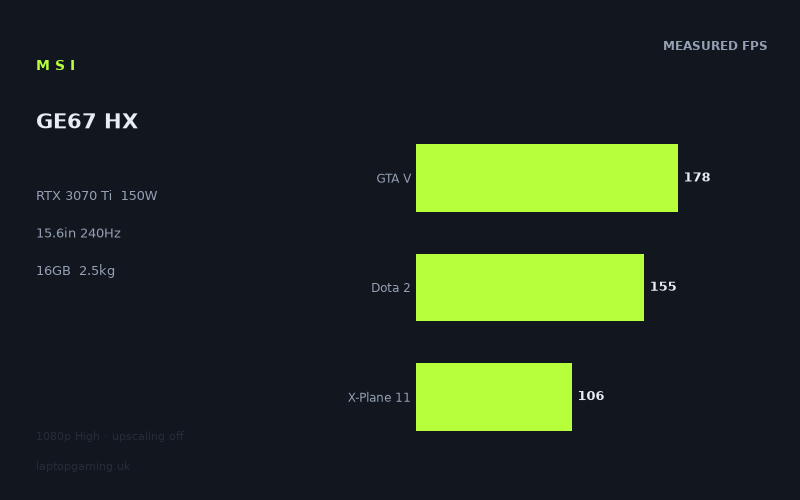
Frame rates
1920×1080, High preset, upscaling off.
Measured on this machine. Source: Notebookcheck, 2022-07-14.
Not scored: incomplete benchmark suite
Every scored laptop on this site is averaged over the same 5 games, and this one is short of Cyberpunk 2077, Baldur's Gate 3. A mean over 5 games is not comparable to a mean over 5, so we publish the figures we have and leave the score blank rather than rank it against machines tested on a different set. The numbers below are real - the suite is just incomplete.
How these numbers were produced
Frame rates here are not measured by us, and we label how each one was arrived at. A figure marked measured comes from a published run on that exact machine. A figure marked representative is derived from the GPU and its power limit (TGP) and cross-referenced against published reviews - a sound estimate of what that configuration delivers, but not a measurement of that specific laptop. Unless stated otherwise, numbers are 1920x1080, High preset, upscaling off. Where a laptop ships in several power configurations we use the wattage of the exact SKU listed, because a 140W RTX 5070 and a 115W one are not the same product.
In use
The short version
The MSI GE67 HX is a performance-led gaming laptop built around an RTX 3070 Ti running at a stated 150W GPU power limit, paired with a Core i7-12800HX, 16GB of memory and a 15.6in 1920x1080 OLED display with a 240Hz refresh rate. The important part is that the published benchmark data backs up the ambitious specification: this is a quick 1080p gaming machine, particularly in the older, lighter and more esports-friendly games where its frame rates get very close to the display’s refresh ceiling.
Notebookcheck’s measured figures show 235fps in Strange Brigade, 223fps in The Witcher 3, 178fps in GTA V and 155fps in Dota 2. Those are strong results for a laptop with a 240Hz panel, even if only Strange Brigade comes close to fully matching that refresh rate in the measured games. The heavier titles are still properly playable at the stated High preset with upscaling disabled, but they tell a more useful story about the limits of the configuration: Final Fantasy XV reaches 122fps, while Cyberpunk 2077 1.6 and X-Plane 11 both reach 106fps. That is fast, but it is not 240Hz-class performance in every game simply because the screen can refresh at 240Hz.
The mean result across the five scoring-suite games is 159fps. That places the GE67 HX in the category of laptop that should be bought for high-frame-rate 1080p gaming rather than for a specification-sheet promise of universal 240fps performance. It has enough performance to make a fast screen worthwhile, enough GPU power allocation to avoid looking artificially constrained, and a CPU that is well suited to games that can become processor-limited at this resolution.
The caveat is straightforward. There is no score for this exact configuration because no confirmed UK price is available. The benchmark suite is complete and the machine ranks normally on the frame-rate leaderboard, but value cannot be judged responsibly without a current UK price. That is not a warning about the laptop itself; it is a limit on what can be said about whether it represents good buying value.
For the right buyer, the GE67 HX makes sense as a relatively substantial gaming laptop intended to spend much of its time plugged in, playing at 1920x1080 and aiming for high refresh rates. It is particularly appealing if you want an OLED panel, play games that respond well to high frame rates, and care more about the quality of the laptop’s actual measured performance than about chasing a higher GPU badge. It is less convincing for someone who wants the lightest possible machine for regular travel, someone who needs a confirmed purchase price before making a decision, or someone expecting every demanding modern game to run anywhere near 240fps without changing settings or using upscaling.
Performance
A 150W RTX 3070 Ti with results that match the intent
The central performance fact is not merely that this MSI uses an RTX 3070 Ti. It is that the GPU has a stated 150W power limit. Laptop GPU names do not tell the whole story on their own, because machines with the same broad GPU class can be configured differently. The power limit is part of the explanation for why the GE67 HX is competitive with laptops carrying ostensibly higher-tier graphics hardware in the shared-game comparison data.
That does not mean the GE67 HX automatically wins every comparison or that GPU power limit alone determines game speed. The CPU, the game engine, the selected resolution, the High preset, and the absence of upscaling all matter. At 1920x1080, some games can become constrained more by the processor or by the game itself than by available GPU performance. The benchmark spread here shows exactly why a single GPU label is not enough to predict every result.
Notebookcheck measured 235fps in Strange Brigade. Of all the reported results, this is the one that most directly demonstrates the point of pairing the GE67 HX with a 240Hz screen. It falls only slightly short of the panel’s stated refresh rate and should make the fast display feel purposeful in a game that can run at this kind of speed. The result also shows that the laptop is capable of extremely high output at 1080p when the workload allows it.
The Witcher 3 reaches 223fps, another exceptionally high result and another figure that sits close to the 240Hz panel limit. This is not quite a measured 240fps result, so it would be wrong to describe the display as fully saturated by the benchmark figure. Still, 223fps is close enough to the screen’s refresh rate to show that the GE67 HX can deliver a very high-refresh experience in the games that suit it.
GTA V records 178fps. That is clearly below 240Hz, but it remains a strong high-frame-rate result. A common mistake in laptop buying is to treat any result below the panel maximum as a failure to justify a high-refresh display. That is too simplistic. A 178fps result still sits far above the level associated with merely basic playability, and it gives the fast panel a meaningful amount of frame-rate headroom. It simply does not mean the game is measured at the display’s full refresh rate.
Dota 2 reaches 155fps. Again, that is short of 240fps but comfortably within the territory where a high-refresh panel remains relevant. This is also one of the games where the CPU can matter a great deal at 1080p. The fact that lighter games in the shared comparison set can be CPU-bound helps explain why the GE67 HX is not separated by a dramatic margin from every laptop with a lower or higher GPU specification. At these sorts of frame rates, the GPU is not always the sole limiting factor.
Final Fantasy XV reaches 122fps. This is still a solid result at the stated 1920x1080 High preset with upscaling off, but it is a different class of result from Strange Brigade or The Witcher 3. It is roughly the point in this set where the distinction between “high-refresh capable” and “able to drive the full 240Hz panel” becomes impossible to ignore. The GE67 HX can produce a fluid frame rate here, but the measured figure does not suggest that a buyer should select this laptop specifically because they expect this game to approach 240fps under the stated settings.
Cyberpunk 2077 1.6 records 106fps. That is one of the most useful figures in the entire set because it places the machine in a demanding modern game without leaning on upscaling. The result is well below the screen’s maximum refresh rate, yet it remains a three-figure frame rate at the specified preset. Buyers who play demanding games should look at this result more closely than the headline-grabbing figures from lighter titles. It is a more realistic guide to what the GE67 HX can do when a game places sustained pressure on the graphics subsystem.
X-Plane 11 also records 106fps. Matching the Cyberpunk 2077 1.6 result does not mean that the games behave in the same way or place the same kind of load on the hardware. What it does show is that the GE67 HX’s performance is not locked into a single pattern. The machine can reach very high figures in some games, but in more demanding or differently balanced workloads it settles into a lower, still fast range. That is normal and it is why the mean across the scoring-suite games matters.
The five scoring-suite games produce a mean of 159fps. This is a useful summary, but it should not replace the individual figures. A mean of 159fps can sound as if every game lands in the same broad area. They do not. Strange Brigade reaches 235fps, while X-Plane 11 reaches 106fps. The GE67 HX is therefore not a laptop with a uniform performance character. It is a laptop with a high average created by a mixture of near-panel-limit results in lighter games and lower, though still strong, results in heavier games.
What the benchmark spread tells you
The spread from 235fps in Strange Brigade to 106fps in X-Plane 11 is substantial, and it is more informative than simply saying that the GE67 HX is “fast”. It tells a prospective owner to think in terms of game categories rather than expecting one performance experience across an entire library.
In the lighter or more favourable titles, the GE67 HX can get close to making full use of the 240Hz OLED display. Strange Brigade at 235fps is the clearest example, while The Witcher 3 at 223fps is close behind. These are the results that make the laptop attractive to someone who values a responsive high-refresh presentation and spends time in games able to run at very high frame rates.
GTA V at 178fps and Dota 2 at 155fps occupy a middle position. They are not measured at the panel maximum, but they are still well above the result of a machine aimed only at basic 1080p gaming. This is where the GE67 HX looks like a sensible match for a 240Hz screen rather than an obvious overmatch. The screen is capable of more than the measured frame rate, but the game output is still high enough for the refresh rate to matter.
Final Fantasy XV at 122fps, Cyberpunk 2077 1.6 at 106fps and X-Plane 11 at 106fps are the reminder that demanding gaming is not the same thing as chasing maximum refresh. These figures are all above 100fps, which is plainly strong at the stated settings, but the gap to 240Hz is large. Anyone buying the GE67 HX mainly for demanding games should treat the 240Hz panel as useful headroom rather than a target the machine will always meet.
This distinction matters because laptop marketing often encourages buyers to join GPU, panel refresh rate and game performance into a single claim. The data here does not support that sort of claim. The GE67 HX has a 240Hz screen. It can produce 235fps in Strange Brigade and 223fps in The Witcher 3. It can also produce 106fps in Cyberpunk 2077 1.6 and 106fps in X-Plane 11. All of those statements are true at the same time, and the sensible purchasing conclusion is that the machine is very capable at 1080p but not universally a 240fps laptop.
The use of the High preset with upscaling off is also important. These are not figures built around an upscaling mode that could obscure the native rendering workload. The benchmark data represents the stated 1920x1080 resolution and High preset without upscaling. That makes the results easier to interpret: they show what the configuration delivers under those specific settings, not what it might deliver after changing the rendering method.
It would be wrong, however, to extend those numbers beyond the conditions given. There is no published frame-rate figure here for another resolution, another preset, another upscaling setting, or another game. There is also no basis in this fact sheet for claiming how the laptop behaves in ray-traced workloads, competitive settings, or games outside the listed set. The evidence supports a strong conclusion about the measured games at 1920x1080 High with upscaling off. It does not support invented performance estimates elsewhere.
How close is it to the panel limit?
The 240Hz display is best understood as a ceiling, not as an automatic performance guarantee. The GE67 HX gets closest in Strange Brigade, where Notebookcheck measured 235fps. The Witcher 3 follows at 223fps. Those are the games in this set where the machine is most likely to make the display’s high refresh rate feel like an integral part of the package rather than simply a specification advantage waiting for the right game.
GTA V at 178fps and Dota 2 at 155fps are still high-refresh results, but neither fully reaches the panel’s stated refresh rate. This is not a criticism of the display. Rather, it is a reminder that a 240Hz panel gives the system room to run fast; it does not compel every game engine and every workload to produce 240 frames each second.
Final Fantasy XV at 122fps is around half of the panel’s refresh rate, while Cyberpunk 2077 1.6 and X-Plane 11 at 106fps are lower again. These figures do not make the screen pointless. They demonstrate that this laptop’s real appeal is breadth: it can run certain games close to the panel limit and others at a lower but still very capable frame rate. A buyer who understands that difference is likely to be satisfied. A buyer expecting the display specification to predict performance in every demanding game may not be.
The practical conclusion is simple. If your games resemble Strange Brigade or The Witcher 3 in their measured behaviour, the GE67 HX has a particularly convincing screen-and-performance pairing. If your priority is demanding titles closer to Cyberpunk 2077 1.6, then the laptop remains capable but the defining benefit is not full-refresh gaming. It is strong three-figure performance at the stated settings.
Why the CPU still matters at 1080p
The GE67 HX uses a Core i7-12800HX, and that matters most when game performance is no longer determined only by the GPU. At 1920x1080, especially in lighter games that can run at high frame rates, the processor and the game engine can become the constraint. The supplied rival data explicitly notes that lighter titles in the shared set are CPU-bound at 1080p and can compress genuine GPU gaps.
This is important when reading the surprisingly narrow results against some rivals. A laptop with a different GPU class is not necessarily going to pull far ahead when the shared games are already producing high frame rates and the workload is constrained elsewhere. Conversely, a much weaker GPU can still fall far behind when the shared games expose a substantial graphics-performance difference. The comparison section makes both points clear.
For the GE67 HX itself, the processor helps explain why the machine has the ingredients to be effective in high-frame-rate 1080p gaming. It also means that buyers should not look at the RTX 3070 Ti badge in isolation. The measured results come from the full configuration: the GPU, its 150W power limit, the Core i7-12800HX, and the conditions of the benchmark.
There is no need to pretend that this turns the laptop into a guaranteed winner in all CPU-sensitive games. No figures for additional CPU-focused tests are supplied here. What can be said is narrower and more useful: the machine’s published gaming data is strong, and the close shared-game results against certain laptops should be read in the context of 1080p CPU limits rather than as proof that all GPU configurations are equivalent.
The screen
15.6in OLED at 1920x1080 and 240Hz
The MSI GE67 HX has a 15.6in OLED panel with a 1920x1080 resolution and a 240Hz refresh rate. That combination gives the laptop a very clear identity. It is not built around increasing pixel count beyond 1080p. It is built around a conventional gaming resolution paired with a high refresh rate and an OLED panel type.
For this particular hardware, 1920x1080 is a sensible match for the measured gaming performance. The benchmark data was gathered at the panel’s native stated resolution, with the High preset and upscaling off. That means there is no need to guess how well the RTX 3070 Ti handles the screen’s resolution: the listed game results already answer that question for the benchmark set.
The answer is that it handles 1080p very well, with caveats based on game demand. Strange Brigade at 235fps is close to the panel’s 240Hz refresh rate. The Witcher 3 at 223fps is also close. GTA V at 178fps and Dota 2 at 155fps remain strong high-refresh results. Final Fantasy XV at 122fps, Cyberpunk 2077 1.6 at 106fps and X-Plane 11 at 106fps are well below the refresh ceiling, but they are still substantial frame rates at the stated settings.
That is the right way to judge the display pairing. The screen is not excessive simply because the heaviest measured games do not reach 240fps. A 240Hz panel can still be useful when a game runs below its maximum refresh rate. Equally, it would be misleading to suggest that the panel is fully exploited by every game in the test set. The benchmark data supports a more measured verdict: the screen is an excellent fit for the faster end of the GE67 HX’s performance range and a generous upper limit for the demanding end.
The OLED designation matters, but the available evidence has limits
The panel is specified as OLED, which is a meaningful part of the GE67 HX specification. It distinguishes this laptop from machines that may have the same broad performance class but a different display type. For a buyer choosing between otherwise similar gaming laptops, that can be a major reason to prefer the MSI.
However, the supplied information does not include measured display brightness, colour coverage, response behaviour, calibration, or any other panel measurement. There is therefore no responsible basis for making numerical claims about image quality, claiming a particular level of colour accuracy, or declaring it superior to a specific rival screen. The fact sheet confirms the panel type, resolution, size and refresh rate; it does not provide a full display test.
That limitation should not be treated as a flaw in the laptop. It is simply the limit of the evidence available for this review. The display can be described accurately as a 15.6in 1920x1080 240Hz OLED panel. It can also be assessed in relation to the measured gaming figures. Beyond that, stronger display claims would need data that is not supplied here.
Refresh rate versus actual game output
The most useful buying advice is to match the panel to your own games. Someone who spends most of their time in games that behave more like Strange Brigade or The Witcher 3 in this data will get a particularly coherent package. The laptop has the panel refresh rate and the measured output to make very high frame-rate gaming central to the experience.
Someone whose regular games are more demanding should not reject the screen merely because Cyberpunk 2077 1.6 and X-Plane 11 reach 106fps rather than 240fps. Both are still high frame-rate results under the measured conditions. The difference is that the 240Hz specification is no longer the performance target; it is headroom beyond what those specific games produce at High with upscaling disabled.
This is a more honest position than saying either “240Hz is wasted” or “the GPU drives 240Hz”. Neither statement fits the full benchmark set. The GE67 HX demonstrates both scenarios depending on the game. It comes close to the refresh limit in the fastest listed results and sits well below it in the hardest workloads. Buyers should expect both patterns.
Build, size and portability
A 2.469kg gaming laptop, not a lightweight travel-first machine
The GE67 HX weighs 2.469kg. That figure places the machine firmly in the category of laptop where portability exists, but it is not the defining reason to buy it. A buyer can move it between rooms, take it to a different location, or carry it when necessary, but the specification points much more strongly towards a machine intended to prioritise gaming capability over minimal carry weight.
That reading fits the rest of the configuration. The RTX 3070 Ti has a 150W power limit, the processor is a Core i7-12800HX, and the screen is a 15.6in 240Hz OLED panel. Taken together, those details describe a performance-oriented laptop rather than an understated portable designed around making itself disappear in a bag.
The weight is especially relevant because this is a machine whose best case is likely to involve taking advantage of its gaming hardware and high-refresh screen. The more you value the performance shown in Strange Brigade, The Witcher 3, GTA V and Dota 2, the more reasonable the 2.469kg weight becomes as part of the trade-off. If your main priority is carrying a laptop regularly with the least possible burden, the GE67 HX’s performance focus may be more than you need.
No dimensions are provided in the fact sheet, so there is no basis for claiming how much desk space the chassis occupies, how thin it is, or how easily it fits into a particular bag. There are also no supplied figures for battery life, temperatures or noise. Those are meaningful ownership considerations for any gaming laptop, particularly one configured around a 150W GPU power limit, but they cannot be filled in with assumptions.
What the available specification does and does not tell you
The available information supports a clear conclusion about weight and intended use. At 2.469kg, this is not a machine to choose solely because you want the most convenient laptop to carry every day. It is better understood as a portable gaming system that can be moved when needed, with performance taking precedence over outright lightness.
It does not support broader claims about chassis quality, keyboard layout, port selection, upgrade access, cooling design, battery runtime or acoustics. None of those details are included. A good review should not turn absent information into a confident story. If those factors are decisive for you, they need checking from a source that has measured or documented them for this exact MSI GE67 HX configuration.
What is clear is that the laptop’s weight, screen and performance all point in the same direction. It is a machine for someone willing to accept a substantial gaming-laptop form factor in exchange for high measured 1080p frame rates and an OLED 240Hz panel. It is not presented by the facts as a compromise-free machine for both constant travel and high-power gaming.
How it compares
Against the MSI Prestige 15 with RTX 3050 Ti at 105W
The widest gap in the supplied comparison set is against the MSI Prestige 15, which uses an RTX 3050 Ti at 105W. Across four shared games, the GE67 HX averages 86fps ahead. This is the comparison that most clearly shows the benefit of the GE67 HX’s performance-focused configuration.
That 86fps advantage is not a small margin created by a single title. It is large enough to change how the two machines should be considered by a gaming buyer. The GE67 HX has the 150W RTX 3070 Ti, the Core i7-12800HX and the measured results needed to support a 240Hz gaming display. The Prestige 15 comparison result suggests a far lower level of gaming performance across the shared set.
The fact that the comparison covers four shared games rather than five should be kept in mind. It is not a directly identical suite to every other rival comparison here. Even so, the size of the published average advantage is decisive. If the choice is between these two machines for high-frame-rate 1080p gaming, the GE67 HX is the performance choice by a very large margin.
That does not make the Prestige 15 meaningless for every buyer. It simply means that a shopper focused on the sort of frame rates shown by the GE67 HX should not treat the two as interchangeable because they are both laptops with discrete RTX graphics. The published shared-game gap says otherwise.
Against the Eurocom Nightsky with RTX 3070 at 115W
The Eurocom Nightsky provides a much closer comparison. It uses an RTX 3070 at 115W, and the GE67 HX averages only 2fps ahead across five shared games. At first glance, that can look surprising. The MSI has an RTX 3070 Ti with a stated 150W power limit, yet the shared-game average is almost level.
The supplied explanation matters: at 1080p, lighter titles in the shared set are CPU-bound and compress genuine GPU gaps. In other words, a near-zero difference is not evidence that the GPU configurations are identical in all circumstances. It is evidence that, in these particular shared games at this resolution, some of the workload is limited by factors other than raw GPU capacity.
This is exactly why benchmark comparisons should be read as data rather than as badge-ranking exercises. The GE67 HX does not need to be dramatically ahead of the Nightsky in every shared game to remain a distinctly specified machine. Its RTX 3070 Ti is allocated 150W, while the Nightsky’s RTX 3070 is specified at 115W. But the shared-game evidence tells a buyer that, for the tested 1080p set, the practical average difference is only 2fps.
For a buyer deciding solely on the shared-game frame rates, the GE67 HX does not establish a meaningful performance lead over the Nightsky. The result is effectively a tie in this set. Choosing between them would therefore need to depend on factors that are actually confirmed for the individual configurations, such as display specification, weight, price if available, or other documented features. Here, both machines lack a confirmed UK price, so there is no sound value verdict to add.
The lesson is not that the GE67 HX is disappointing. The lesson is that the available games are capable of compressing the gap. This is most likely in lighter titles at 1080p, where the system can reach high frame rates and the CPU or game engine can become a limiting factor. The MSI’s own results in Strange Brigade, The Witcher 3, GTA V and Dota 2 show why that kind of compression can happen: once frame rates are already very high, extra GPU potential is not guaranteed to turn into an equally large published gap.
Against the MSI Raider GE66 with RTX 3080 Ti
The MSI Raider GE66 has an RTX 3080 Ti, yet the GE67 HX averages only 1fps behind across five shared games. This is another near-zero result, and it should be read in the same careful way as the Nightsky comparison.
It would be inaccurate to reduce this to “the RTX 3070 Ti is as fast as the RTX 3080 Ti”. The data does not establish that broad claim. It establishes something narrower: in the five shared games used for this comparison, at the stated conditions, the GE67 HX is only 1fps behind on average. That is a genuine result, but it is not a licence to ignore differences in GPU specification outside the measured set.
Again, the 1080p CPU-bound behaviour of lighter shared titles is relevant. When games are not fully exposing a GPU performance gap, a machine with a higher-tier graphics label can end up looking very close in the average. The GE67 HX’s Core i7-12800HX and 150W GPU allocation help it remain competitive, while the choice of resolution and the characteristics of the shared games prevent the comparison from becoming a simple hierarchy of GPU names.
For a prospective buyer, this is good news if the relevant games resemble the shared suite. It means the GE67 HX can offer performance that is extremely close to the Raider GE66 despite the rival’s RTX 3080 Ti designation. But it is not proof that the MSI GE67 HX will remain 1fps behind in every game, every setting, or every graphical workload. The measured comparison is valuable precisely because it is specific.
Neither machine has a confirmed UK price in the supplied information. That prevents the comparison from reaching the most important purchasing conclusion: whether the tiny shared-game difference makes one a smarter buy than the other. If the two were similarly priced, the display, weight and other verified features could decide the choice. If they were priced very differently, value could change the recommendation. Without confirmed pricing, neither conclusion can be made.
Against the MSI Raider GE77 HX with RTX 3080 Ti at 175W
The MSI Raider GE77 HX is the rival that beats the GE67 HX by the largest supplied margin. It has an RTX 3080 Ti at 175W, and the GE67 HX averages 10fps behind across five shared games.
A 10fps deficit is more meaningful than the near-level results against the Eurocom Nightsky and Raider GE66, but it is still not a vast gulf in the context of the GE67 HX’s own results. It confirms that the GE77 HX has an advantage in the shared set, while also showing that the GE67 HX remains competitive rather than being left behind.
The Raider GE77 HX’s 175W GPU power limit is higher than the GE67 HX’s 150W figure, and it uses an RTX 3080 Ti rather than an RTX 3070 Ti. The comparison result follows the general expectation that the more aggressively specified rival can move ahead. But the margin is only 10fps in the shared games, not an overwhelming lead. As with the other close comparisons, the 1080p shared set and CPU-bound lighter titles can compress genuine GPU differences.
The practical takeaway is that the GE77 HX has the stronger shared-game result, but the GE67 HX is not made obsolete by it. If your decision is based strictly on the five shared games, the GE77 HX is ahead. If the display format, 2.469kg weight, or other confirmed features matter more, then the smaller MSI may still be the more suitable machine. The facts provided here do not include the GE77 HX’s weight, display specification or UK price, so those questions cannot be resolved in this review.
As with the other rivals, no confirmed UK price is available. That means the performance lead cannot be converted into a value judgement. The GE77 HX may be worth seeking out for a buyer who wants the best shared-game figures among these named machines, but there is no basis here for saying whether its advantage is worth any potential price difference.
What the rival set says about the GE67 HX
The comparison spread gives the GE67 HX a more interesting position than its specification alone might suggest. It is vastly ahead of the Prestige 15 in the shared games, effectively level with the Eurocom Nightsky, effectively level with the Raider GE66, and behind the Raider GE77 HX by 10fps on average.
That is not the pattern of a laptop that can be dismissed as merely mid-range within its generation. Nor is it the pattern of an uncontested performance leader. It is a high-performing 1080p gaming laptop whose 150W RTX 3070 Ti and Core i7-12800HX configuration keep it close to more imposing rivals in the supplied shared-game data.
The most important caution is that the nearest comparisons are not proof of universal equality. The fact sheet explicitly explains that lighter 1080p games can be CPU-bound and compress GPU gaps. Buyers should therefore use the comparisons to understand likely performance in the shared set, not to conclude that the GPU hierarchy has disappeared.
Who it’s for
Buy the MSI GE67 HX if high-refresh 1080p gaming is the priority
The GE67 HX is best suited to a buyer who wants strong measured 1080p performance and intends to make use of a 240Hz screen in games capable of producing very high frame rates. Strange Brigade at 235fps and The Witcher 3 at 223fps are the headline results for that buyer. GTA V at 178fps and Dota 2 at 155fps reinforce the point: this laptop is capable of far more than simply meeting a basic gaming threshold.
It is also a sensible choice for someone who wants a laptop that remains strong when the games become more demanding. Final Fantasy XV at 122fps, Cyberpunk 2077 1.6 at 106fps and X-Plane 11 at 106fps show that the machine does not depend entirely on lightweight games to look good. The frame rates are lower, as they should be in harder workloads, but they remain firmly in high-frame-rate territory at 1920x1080 High with upscaling off.
The OLED panel is another clear reason to choose this model if panel type is important to you. The available information confirms the 15.6in OLED display, its 1920x1080 resolution and its 240Hz refresh rate. What cannot be said from the supplied facts is how it performs in detailed display measurements, but the basic specification is already distinctive.
The GE67 HX also suits a buyer who understands that a gaming laptop can be portable without being travel-first. At 2.469kg, it is a machine to carry when needed, not one selected mainly for minimal weight. If most of its use will be at a desk, in a fixed room, or moved only occasionally, that trade-off is easier to justify.
Buy something else if you need a confirmed value verdict
The biggest reason not to buy immediately is not a benchmark weakness. It is the absence of a confirmed UK price for this exact configuration. Without that, no responsible recommendation can say whether the GE67 HX represents good, ordinary or poor value against the alternatives.
If you are choosing between several laptops and your budget is fixed, wait until a confirmed UK price is available or choose a competing configuration with verified pricing. Performance alone is only part of a purchase. The GE67 HX has strong evidence behind its gaming speed, but it cannot be judged as a deal without knowing what it costs.
The same caution applies to the named rivals because their UK prices are also unconfirmed in the supplied information. The GE67 HX may be close to the Eurocom Nightsky and MSI Raider GE66 in shared-game performance, while trailing the Raider GE77 HX by 10fps. But without prices, those comparisons cannot answer the question of which machine gives you more for your money.
Buy something else if you expect universal 240fps performance
The 240Hz OLED display is a strength, but it should not be mistaken for evidence that all games will run at 240fps. The measured data disproves that expectation. Strange Brigade reaches 235fps and The Witcher 3 reaches 223fps, but GTA V reaches 178fps, Dota 2 reaches 155fps, Final Fantasy XV reaches 122fps, and both Cyberpunk 2077 1.6 and X-Plane 11 reach 106fps.
If your requirement is to maximise the chance of reaching the panel limit in demanding games at the stated settings, the GE67 HX is not the machine to buy on the basis of these numbers alone. It is fast, but its benchmark profile is mixed in exactly the way most capable gaming laptops are mixed: lighter games can approach the refresh limit, while demanding workloads run at lower frame rates.
A buyer who sees 240Hz as a useful upper limit rather than a minimum target will be much better matched to this MSI. A buyer who sees anything short of 240fps as a disappointment should look for evidence from the specific games they play rather than assuming the screen specification answers the question.
Buy something else if low weight is more important than gaming headroom
At 2.469kg, the GE67 HX is not the obvious choice for someone who carries a laptop constantly and wants the smallest possible burden. The facts do not provide dimensions, so there is no precise physical-size comparison to make, but the stated weight is enough to establish that this is a substantial gaming machine.
That weight may be entirely acceptable if the laptop spends most of its time in one place and gaming performance is the priority. It is less appealing if the machine will be carried throughout the day and gaming is secondary. In that case, a less performance-focused laptop may be the better fit, even if it cannot match the GE67 HX’s 235fps Strange Brigade result, 223fps The Witcher 3 result, or 159fps scoring-suite mean.
Final recommendation
The MSI GE67 HX is a strong gaming laptop on the evidence that matters most for gaming: attributable measured frame rates. Its RTX 3070 Ti at 150W and Core i7-12800HX deliver excellent 1080p results, with a 159fps mean across the scoring suite and standout figures of 235fps in Strange Brigade and 223fps in The Witcher 3. The 15.6in 1920x1080 240Hz OLED panel is a sensible match for the fastest results and still offers generous headroom in the more demanding games.
Its limits are equally clear. Not every game reaches the 240Hz ceiling, and the demanding titles in the set land at 122fps or 106fps rather than near the panel maximum. At 2.469kg, it is a performance-first laptop rather than a lightweight everyday companion. There are no supplied dimensions, battery, temperature or noise figures, so those ownership questions remain open. Most importantly, there is no confirmed UK price, which means the machine’s value cannot be judged.
If you want a substantial 1080p gaming laptop with an OLED high-refresh display and published performance that remains highly competitive against the named same-generation rivals, the GE67 HX is an attractive configuration. If price certainty, low carry weight, or guaranteed 240fps results in demanding games matter more, wait for the missing information or look elsewhere.