Review
Acer Predator Helios 300 (i7-12700H, RTX 3070 Ti) review
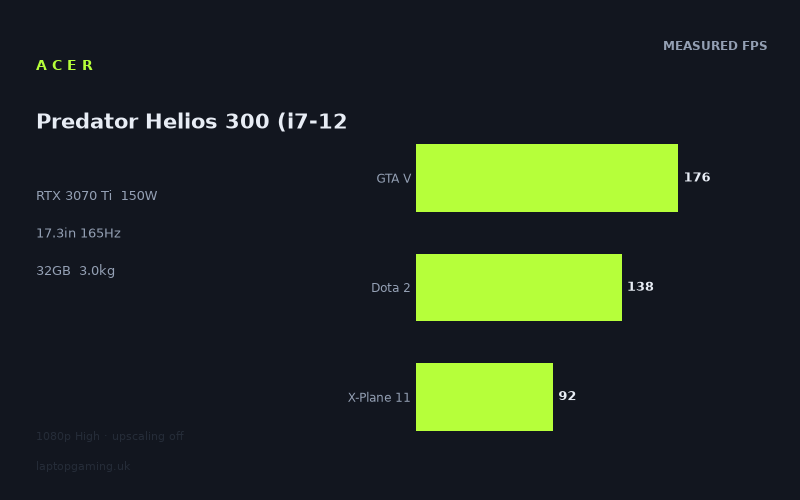
Frame rates
1920×1080, High preset, upscaling off.
Measured on this machine. Source: Notebookcheck, 2022-11-19.
Not scored: incomplete benchmark suite
Every scored laptop on this site is averaged over the same 5 games, and this one is short of Cyberpunk 2077, Baldur's Gate 3. A mean over 5 games is not comparable to a mean over 5, so we publish the figures we have and leave the score blank rather than rank it against machines tested on a different set. The numbers below are real - the suite is just incomplete.
How these numbers were produced
Frame rates here are not measured by us, and we label how each one was arrived at. A figure marked measured comes from a published run on that exact machine. A figure marked representative is derived from the GPU and its power limit (TGP) and cross-referenced against published reviews - a sound estimate of what that configuration delivers, but not a measurement of that specific laptop. Unless stated otherwise, numbers are 1920x1080, High preset, upscaling off. Where a laptop ships in several power configurations we use the wattage of the exact SKU listed, because a 140W RTX 5070 and a 115W one are not the same product.
In use
The short version
The Acer Predator Helios 300 configuration considered here is a large, performance-led gaming laptop built around an RTX 3070 Ti running at a substantial 150W GPU power limit, paired with a Core i7-12700H, 32GB of memory and a 17.3in 2560x1440 IPS display with a 165Hz refresh rate. The headline from Notebookcheck’s benchmark data is straightforward: this is still a very quick 1080p High-preset machine, with a measured average of 153fps across the five scoring-suite games.
That average is useful, but the individual figures matter more than any single summary number. Strange Brigade reaches 241fps, The Witcher 3 reaches 210fps, GTA V manages 176fps, and Dota 2 delivers 138fps. Those are strong results for a 165Hz screen, particularly in games where high refresh rate responsiveness is the point. At the tougher end of the tested group, Final Fantasy XV records 117fps, X-Plane 11 records 92fps and Dying Light 2 records 86fps. Those figures are still playable-looking results at the tested settings, but they are a clear reminder that a 165Hz panel is not the same thing as guaranteed 165fps in every game.
The most important qualification is that all of the supplied game results were measured at 1920x1080, using the High preset with upscaling disabled. The Predator’s own display is 2560x1440. These results therefore show what the hardware can do at 1080p under Notebookcheck’s consistent test conditions; they do not prove that every game will run at the screen’s native resolution at the same frame rate. That distinction matters especially for the lower results, where there is less performance headroom before moving from 1080p to 1440p.
The Helios 300 makes most sense for someone who wants a genuinely fast, desk-oriented gaming machine with a large QHD screen and who values a high-power RTX 3070 Ti implementation more than low weight. It is also a sensible choice for someone playing a mixture of older, lighter or competitive games alongside more demanding releases, because the measured spread shows that it can take full or near-full advantage of a 165Hz display in the lighter parts of the library while retaining respectable performance in harder games.
It is less persuasive as a carry-everywhere laptop. At 2.993kg, before considering any charger or other accessories, this is a machine to move occasionally rather than an especially easy option for daily commuting. The 90Wh battery is a useful specification to have on paper, but there is no measured battery-life figure in the supplied data, so it would be irresponsible to promise a particular unplugged runtime.
There is no overall score for this exact configuration because its UK price is not confirmed. The benchmark suite is complete and the laptop can be placed normally on the frame-rate leaderboard, but value cannot be judged properly without a current UK price. That is not a performance caveat; it is simply a missing piece of the buying calculation.
Performance
A strong RTX 3070 Ti implementation, not merely an RTX 3070 Ti label
The RTX 3070 Ti name tells only part of the story. This Predator Helios 300 gives its GPU a 150W power limit, and the comparative data makes clear why that number deserves attention. Laptop GPUs with the same or even higher model name can perform very differently when their power limits differ. In this case, the Predator sits alongside the Asus ROG Strix Scar 15, another RTX 3070 Ti system with a 150W limit, and the shared-game result is effectively level: the Acer averages only 1fps ahead across their shared games.
That near-tie is useful evidence that the Helios 300 is operating in the expected performance territory for a fully powered RTX 3070 Ti laptop. It is not a cut-down implementation struggling to keep pace with another machine carrying the same GPU label. The measured data instead puts it very close to an equivalent-power competitor, while also showing that a higher model number does not automatically guarantee a higher result. The Razer Blade 15 has an RTX 3080 Ti but a lower 110W power limit, and the two machines are level across five shared games.
At the other end of the comparison, the MSI Raider GE77 HX combines an RTX 3080 Ti with a higher 175W power limit and comes out ahead. The Helios 300 averages 16fps behind it across five shared games. That is not a surprising result, but it is a valuable one. It shows that the Predator’s 150W RTX 3070 Ti is powerful, yet it does not erase the benefit of a more heavily powered top-tier GPU in a larger performance-focused system.
The practical message is that the 150W figure should be seen as a meaningful strength of this configuration. It helps the Predator compete where it should compete: against other high-power gaming laptops from the same generation. It does not mean the laptop becomes universally equal to every faster GPU in every chassis, nor does it mean every game becomes refresh-rate limited. The game-by-game results make that much clearer than the GPU badge alone.
The benchmark spread matters more than the average
Notebookcheck’s figures span from 86fps in Dying Light 2 to 241fps in Strange Brigade. That is a very wide range, and it is exactly why buyers should not make a purchasing decision from a single mean result. The 153fps scoring-suite average gives a useful broad indication of performance, but it combines games with very different demands and different limits.
At the fast end, Strange Brigade reaches 241fps. That is comfortably above the display’s 165Hz refresh rate, meaning the panel cannot show every frame produced in that benchmark run as a separate refresh. It does not make the additional frame rate meaningless; high frame rates can still reduce the interval between rendered frames. But for a 165Hz display, the practical takeaway is that the Helios 300 has more than enough measured 1080p High performance in this game to keep the screen fully fed.
The Witcher 3 at 210fps reaches the same broad conclusion. The measured figure is above 165fps, so at the tested settings this is another game where the Predator can exceed the panel’s maximum refresh rate. GTA V is closer to the screen limit at 176fps, but it still clears 165fps in the supplied result. For these three games, the combination of 150W RTX 3070 Ti hardware and 165Hz panel is well matched at 1080p High without upscaling.
Dota 2 comes in at 138fps. That remains a high figure, especially in the context of a laptop display running at 165Hz, but it is below the panel’s maximum refresh rate. It should not be described as a failure to run the game smoothly; rather, it is a reminder that “high refresh” and “always at the panel limit” are different standards. A 138fps measurement provides a strong basis for high-refresh play, but the measured figure does not reach the full 165Hz ceiling.
Far Cry 5 produces 136fps, placing it very close to Dota 2 in the supplied results. Again, this is below the panel’s 165Hz maximum but is still firmly in high-frame-rate territory at the tested 1080p High settings. It is also a useful point of comparison because it sits well below the 210fps of The Witcher 3 and far below the 241fps of Strange Brigade. This system is quick, but game engine behaviour and workload matter enormously.
Final Fantasy XV at 117fps is where the result starts to look more like a conventional high-performance gaming figure than a screen-saturating one. A measured 117fps is still substantially above a basic 60Hz experience, but it leaves obvious space below 165Hz. Anyone buying the Helios 300 specifically to see a near-constant 165fps in visually demanding games should read this result carefully. The laptop has the performance to make the game run rapidly at the tested settings, but the data does not support an assumption that it will reach the panel’s ceiling.
X-Plane 11 records 92fps. The figure is well below the results in Strange Brigade, The Witcher 3 and GTA V, and it helps demonstrate that the laptop’s real-world position cannot be boiled down to “around 153fps” in every type of title. Simulation workloads can behave differently from conventional action benchmarks, and the supplied result is a reminder that CPU behaviour, game engine design and scene complexity can shape performance alongside GPU power.
Dying Light 2 is the slowest supplied result at 86fps. This is still a useful frame rate for a demanding game at 1080p High with upscaling off, but it is nowhere near the 165Hz display limit. If Dying Light 2 represents the sort of demanding games you play most, the Helios 300 should be viewed as a laptop offering solid high-frame-rate performance rather than one that automatically makes its 165Hz panel fully relevant in every modern demanding title. That is not a criticism unique to this machine. It is a realistic reading of the measured figure.
What the 1080p High results actually tell you
All of these results were recorded under the same stated conditions: 1920x1080, High preset, and upscaling switched off. That consistency is valuable because it makes the spread between titles meaningful. The Predator is not being judged from a collection of mismatched settings or selectively flattering modes. The results show the laptop’s performance across a range of games using a common test approach.
The absence of upscaling is particularly important. The numbers are not boosted by a resolution reconstruction mode. That makes the 241fps in Strange Brigade, 210fps in The Witcher 3 and 176fps in GTA V straightforward 1080p High figures rather than results that need caveats about an upscaling setting. Equally, the 86fps in Dying Light 2 is an honest indication that demanding games remain demanding even on a strong GPU when upscaling is not part of the selected benchmark configuration.
Buyers should nevertheless avoid treating the supplied results as a native-resolution guarantee. The Helios 300’s own panel has 2560x1440 pixels, whereas the benchmark data is at 1920x1080. Native QHD gaming asks more of the GPU than the benchmark resolution. The supplied information does not include 1440p frame rates, so the correct conclusion is limited: this machine is demonstrably fast at 1080p High in the tested games, while its exact performance at the panel’s native resolution is not established by these figures.
That limitation matters most for the games already below 165fps. A result of 86fps, 92fps or 117fps at 1080p High does not provide a factual basis for claiming the same game will hold those rates at 2560x1440. By contrast, titles producing 210fps or 241fps at 1080p have more visible headroom before reaching the 165Hz threshold, though even there the measured data does not permit a precise QHD prediction.
The sensible way to read the results is therefore by category. Strange Brigade, The Witcher 3 and GTA V show that the Helios 300 can deliver frame rates above the 165Hz panel limit under the supplied test conditions. Dota 2 and Far Cry 5 show high-refresh performance that falls short of completely filling the screen’s refresh capacity. Final Fantasy XV offers a strong triple-digit result without reaching 165fps. X-Plane 11 and Dying Light 2 demonstrate that tougher or differently structured workloads can pull the machine well below that threshold.
CPU limits can disguise GPU differences at 1080p
The Core i7-12700H is paired with 32GB of memory, which is a suitably serious specification for a gaming laptop built around a 150W RTX 3070 Ti. However, the rival comparisons reveal an important point about 1080p benchmark results: not every shared-game comparison is purely a measure of GPU power.
The Helios 300 is just 1fps ahead of the Asus ROG Strix Scar 15 across four shared games despite both using an RTX 3070 Ti at 150W. That is what a genuine near-equal result looks like. It does not need elaborate excuses or claims of a hidden win. The machines are effectively tied across the available shared data.
The more striking comparison is the Razer Blade 15. That laptop carries an RTX 3080 Ti, yet the Helios 300 is level with it across five shared games. The explanation supplied with the rival data is important: at 1080p, lighter titles in the shared set can become CPU-bound, compressing genuine GPU gaps. In other words, once a game is limited more by processor-side work or the game engine than by the graphics hardware, a faster GPU cannot necessarily translate its theoretical advantage into a visibly higher average frame rate.
This does not mean that the RTX 3080 Ti and RTX 3070 Ti are equivalent GPUs, nor does it mean the Razer’s 110W power limit is irrelevant. It means the shared 1080p selection does not expose a meaningful overall advantage for the Razer in those particular tests. That is a result worth respecting, but it should be interpreted within the benchmark conditions rather than turned into a sweeping claim that GPU class never matters.
The MSI Raider GE77 HX shows the other side of that same principle. Its RTX 3080 Ti runs at 175W, above the Helios 300’s 150W limit, and it is 16fps ahead across five shared games. In a shared set that provides more room for GPU power to matter, the larger power allowance and higher GPU tier result in a clear lead. The Helios 300 remains competitive, but the Raider demonstrates that a higher-powered top-end configuration can still pull away.
For prospective buyers, this is a reason to look at specific measured results rather than relying on tier labels. “RTX 3080 Ti” does not automatically mean an overwhelming win over this Predator at 1080p. “RTX 3070 Ti” does not automatically mean every 3070 Ti laptop is equal. The TGP, the game selection and the resolution all affect what the benchmark data reveals.
The screen
A large QHD IPS display with a high-refresh target
The Helios 300 uses a 17.3in IPS display at 2560x1440 with a 165Hz refresh rate. On the specification alone, that is a good fit for the kind of machine this is trying to be: a large gaming laptop intended to offer more screen space and more pixel density than a conventional 1080p panel, while retaining a refresh rate high enough to reward fast frame rates.
The 17.3in size matters because it makes the 2560x1440 resolution more practical as a gaming and general-use workspace than a smaller display would be. There is more physical room for the QHD pixel count, and the large screen suits a laptop that is already closer to a semi-portable gaming system than an ultralight machine. The supplied specifications do not include brightness, colour coverage, response-time measurements, contrast data or any assessment of backlight behaviour, so those aspects cannot be judged here. IPS is the known panel type; beyond that, the evidence provided is limited.
The 165Hz refresh rate is the display feature most directly connected to the benchmark results. In the most favourable 1080p High outcomes, the laptop can exceed it. Strange Brigade at 241fps and The Witcher 3 at 210fps are both well beyond 165fps. GTA V at 176fps also clears the refresh threshold. In those games, at those settings and resolution, the panel is a sensible match for the machine’s performance rather than an unnecessarily ambitious specification.
Dota 2 at 138fps and Far Cry 5 at 136fps are close enough to the refresh ceiling to make high-refresh gaming relevant, but they do not fully reach it. Final Fantasy XV at 117fps is further below, while X-Plane 11 at 92fps and Dying Light 2 at 86fps are examples where the panel’s maximum refresh rate is not the limiting factor. The limiting factor is simply that those games are more demanding under the tested conditions.
The key compromise: benchmark resolution versus panel resolution
The display’s native resolution is 2560x1440, but the frame-rate data is at 1920x1080. This is not a flaw in the benchmark data: a fixed, repeatable test resolution is useful for comparing laptops. But it does change how the figures should be used when judging this particular screen.
The results show that 1080p High gaming is very strong. They do not tell us exactly how much performance remains at native QHD. There are no supplied 2560x1440 figures for Strange Brigade, The Witcher 3, GTA V, Dota 2, Far Cry 5, Final Fantasy XV, X-Plane 11 or Dying Light 2. A review should not fill that gap with invented estimates, especially when the difference between a result above 165fps and one below it can matter to a buyer selecting settings.
The good news is that the screen gives the owner options. A 165Hz QHD panel can be used to prioritise native-resolution image detail in games where the available performance suits it, or to prioritise frame rate in games where 1080p performance is the priority. The benchmark data strongly supports the latter approach, because it was measured at 1080p and delivers consistently high figures across the tested set. What it cannot do is prove the best setting balance at native QHD for each game.
That makes the display best understood as a higher-resolution panel with a high-refresh capability, not as a promise that every demanding game will operate at 2560x1440 and 165fps simultaneously. For buyers who mostly play lighter or older titles, the high 1080p results suggest plenty of performance. For buyers focused on the most demanding games, Dying Light 2’s 86fps and X-Plane 11’s 92fps are stronger reasons to be measured about expectations.
Who will get the most from 165Hz?
The clearest beneficiaries are players whose regular games resemble the fastest entries in the supplied list. Strange Brigade, The Witcher 3 and GTA V all reach or exceed the refresh limit at 1080p High. In those circumstances, the 165Hz display is not merely a specification for the box; it has the frame-rate support to be meaningfully used.
Players of Dota 2 and Far Cry 5 are still well served, but the figures show a different relationship with the panel. At 138fps and 136fps respectively, the Helios 300 does not quite reach 165fps in the measured runs. The gap is not enormous, but it is real. It would be misleading to say that the laptop saturates its display in these games at the stated test settings.
For Final Fantasy XV, X-Plane 11 and Dying Light 2, the 165Hz display is more about preserving headroom and flexibility than about matching the benchmark rate frame for frame. At 117fps, 92fps and 86fps, respectively, the laptop is not supplying 165 frames each second under the tested conditions. That does not make a high-refresh display pointless; it simply means the panel specification is ahead of what these games demandingly allow in the published benchmark run.
Build, size and portability
This is a large machine in practical terms
The known physical figure is 2.993kg. That places the Predator Helios 300 firmly in the substantial gaming-laptop category. It is not an impossible weight to transport, but it is also not the kind of system that disappears into a bag or encourages casual all-day carrying. The 17.3in display reinforces that conclusion: this is designed around a large-screen experience, and the weight is consistent with a machine that prioritises gaming capability and screen size over minimal bulk.
The supplied information does not include the laptop’s dimensions, chassis materials, port selection, keyboard layout, touchpad quality, webcam specification, speaker measurements or noise and temperature data. Those details affect how pleasant a large gaming laptop is to use, but they cannot be reliably inferred from weight alone. It would be wrong to claim that the chassis is thin, thick, rigid, cool, quiet or loud without the relevant evidence.
What can be said is that 2.993kg changes the ownership pattern. This is best suited to a desk, a regular place in the home, or occasional travel where the benefit of a 17.3in screen outweighs the burden of carrying a heavier device. It is a less natural fit for someone whose laptop must be taken to work, classes or meetings every day and then used for gaming in the evening. The hardware is strong, but the form factor asks the buyer to accept that strength in a sizeable package.
The battery specification is capacity, not runtime evidence
The Helios 300 has a 90Wh battery. That is the battery capacity provided in the fact sheet. It is useful information, but it should not be turned into a claimed number of hours because no measured battery-life result is supplied.
Gaming laptops can behave very differently away from mains power depending on the workload, display settings, power mode and game. None of those variables can be resolved from the battery capacity alone. Buyers wanting a laptop primarily for long periods away from a socket should therefore treat the 90Wh figure as a specification to investigate further, not as proof of a particular endurance result.
There is also a broader practical point. The performance figures discussed throughout this review are benchmark results from Notebookcheck under stated game settings. They establish gaming performance in those test conditions, not battery gaming performance. There is no provided evidence for how the RTX 3070 Ti behaves while unplugged, so no claim should be made about maintaining the quoted 241fps, 210fps, 176fps or any other benchmark result on battery power.
Memory and the desk-replacement proposition
The 32GB memory allocation suits the Predator’s broader position as a large, high-performance machine. It complements the Core i7-12700H and 150W RTX 3070 Ti rather than looking like an obvious compromise beside them. The supplied data does not provide memory speed, configuration or upgrade information, so there is no basis for claims about dual-channel arrangement or future expandability. Still, 32GB is a notable part of the configuration because it supports the idea that this is intended as a serious gaming system rather than a stripped-back entry-level laptop.
Put together, the 17.3in QHD display, 2.993kg weight, 90Wh battery and 32GB of memory point toward a desktop-replacement style of ownership. It is a machine for buyers who want one large screen, strong 1080p benchmark results, and enough hardware to tackle a broad range of games without treating portability as the first priority.
How it compares
Against the MSI Prestige 15: a decisive gaming-performance gap
The Acer Predator Helios 300 averages 77fps ahead of the MSI Prestige 15 across four shared games. The MSI uses an RTX 3050 Ti with a 105W power limit, compared with the Acer’s RTX 3070 Ti at 150W. This is the widest favourable comparison in the supplied rival group, and it is large enough to affect the kind of gaming experience each machine can reasonably target.
The significance is not just that the Helios 300 is faster in a narrow technical sense. A 77fps shared-game advantage is consistent with the Predator being in a different performance class for buyers who care primarily about frame rate. The Acer’s 150W GPU power limit, larger gaming-oriented format and 17.3in 165Hz display make sense together in a way that the Prestige’s lower-power RTX 3050 Ti cannot match on shared benchmark performance.
That does not establish every non-gaming difference between the two laptops; the supplied data does not include the Prestige’s weight, display or battery details. It does establish the point that matters for this comparison: if gaming performance is the priority, the Helios 300 is decisively ahead in the shared games.
Against the Asus ROG Strix Scar 15: essentially the same result
The Asus ROG Strix Scar 15 is the closest performance comparison. Both laptops use an RTX 3070 Ti with a 150W power limit. Across four shared games, the Acer averages 1fps ahead.
That should be read as a practical tie, not as a reason to declare one machine categorically faster than the other. A 1fps average difference across shared games is near-zero in real terms. It confirms that the Helios 300 is running where a 150W RTX 3070 Ti system should run, but it does not create a meaningful performance advantage over the Scar 15.
The Scar 15 is listed at £1,865. The Acer’s UK price for this exact configuration is not confirmed, so the available data does not support a direct value judgement between the two. What it does support is a clear buying principle: if these are the two machines under consideration, benchmark performance is unlikely to be the deciding factor. The shared-game data says they are effectively level. Other confirmed differences would need to decide the purchase.
Against the Razer Blade 15: GPU naming alone is not enough
The Razer Blade 15 carries an RTX 3080 Ti, a higher GPU tier by name than the Helios 300’s RTX 3070 Ti. However, its stated GPU power limit is 110W, substantially below the Acer’s 150W. Across five shared games, the two machines average a difference of 0fps.
This is exactly the sort of comparison that justifies looking beyond GPU branding. The Razer has the higher-numbered GPU, yet the shared 1080p benchmark selection does not give it an overall advantage. The supplied explanation is that lighter titles in the shared set can become CPU-bound at 1080p, compressing genuine GPU gaps. Once that happens, GPU capability cannot fully express itself in the resulting frame-rate average.
The correct conclusion is not that the Razer’s RTX 3080 Ti is pointless or that the Helios 300 has somehow become equivalent in all workloads. The conclusion is narrower and more useful: in the five shared games at the tested conditions, there is no measured average performance advantage either way. A buyer comparing these two machines should not pay attention only to the GPU badge. They should recognise that the Predator’s 150W RTX 3070 Ti can stand level with a lower-power RTX 3080 Ti in this specific 1080p shared-game data.
Against the MSI Raider GE77 HX: more power still produces a real lead
The MSI Raider GE77 HX is the rival that beats the Helios 300 by the largest amount in the supplied spread. Its RTX 3080 Ti has a 175W power limit, above the Acer’s 150W, and the Raider averages 16fps ahead across five shared games.
This comparison provides a useful ceiling check for the Helios 300. The Acer is very strong for an RTX 3070 Ti laptop, particularly given its near-tie with the equally powered Scar 15 and its level result against the lower-power RTX 3080 Ti Razer. But it does not displace a more aggressively powered RTX 3080 Ti system. The Raider’s lead is clear enough to matter, even if it is not so large as to make the Helios 300 uncompetitive.
For someone chasing the highest possible performance among these same-generation options, the Raider has the measured advantage. For someone who sees the Helios 300’s results as already sufficient, the comparison instead shows that the Acer sits close enough to stronger hardware that it remains a serious performance option rather than a compromise-tier choice.
What the rival spread says overall
The rival group is more informative as a spread than as a simple ranking. The Helios 300 is far ahead of the RTX 3050 Ti MSI Prestige 15, effectively tied with the same-power RTX 3070 Ti Asus ROG Strix Scar 15, level with the lower-power RTX 3080 Ti Razer Blade 15 in the shared 1080p set, and behind the higher-power RTX 3080 Ti MSI Raider GE77 HX.
That is a coherent position. The Predator’s 150W RTX 3070 Ti is not entry-level hardware and it is not a low-power interpretation of the GPU. It delivers performance consistent with a high-end gaming laptop of its generation. At the same time, the Raider comparison prevents exaggerated claims: more GPU tier and more available power can still create a measurable advantage.
The comparisons also underline why 1080p testing should be read carefully. Where lighter shared games become CPU-bound, differences between GPUs can be compressed. Where a system has more scope to exercise its additional GPU power, such as the Raider, the lead becomes clearer. The Helios 300 benefits from this context because it shows both its strength and its limits without relying on marketing hierarchy.
Who it’s for
Buy it if you want high-end 1080p performance on a large screen
The Helios 300 is best suited to buyers who want a powerful gaming laptop for regular desk use, who appreciate a 17.3in display, and who are comfortable with a machine weighing 2.993kg. The Notebookcheck results make a strong case for 1080p High gaming with upscaling disabled. A 153fps mean across the scoring suite is excellent, and the individual results show the laptop reaching 241fps in Strange Brigade, 210fps in The Witcher 3 and 176fps in GTA V.
It is especially suitable for players whose games can benefit from high refresh rate. The 165Hz panel is supported by measured frame rates above 165fps in three of the listed games. Even where the Predator does not reach that level, Dota 2 at 138fps, Far Cry 5 at 136fps and Final Fantasy XV at 117fps remain high-frame-rate results. The laptop is not dependent on upscaling to produce those figures because the supplied benchmark condition has upscaling off.
It also suits buyers who understand the value of a high-power GPU implementation. The 150W RTX 3070 Ti does not merely look good in a specification list; it performs at essentially the same level as the 150W RTX 3070 Ti Asus ROG Strix Scar 15 and holds level with the 110W RTX 3080 Ti Razer Blade 15 in the available shared-game average. That is persuasive evidence that this is a properly performance-focused configuration.
The 32GB memory specification also makes sense for someone buying a laptop intended to remain a substantial gaming system rather than a basic machine built around a single headline part. The fact sheet does not establish upgrade options or memory arrangement, but the installed capacity itself fits the machine’s high-end intent.
Buy something else if portability is your priority
A buyer who carries a laptop daily should look elsewhere unless they specifically need this machine’s large display and gaming performance. At 2.993kg, the Predator Helios 300 is not the obvious choice for frequent travel. The 17.3in screen is an advantage when gaming or working at a desk, but it also makes the laptop fundamentally less compact than a smaller-screen alternative.
The 90Wh battery should not be mistaken for a proven all-day portability result. There is no battery-life measurement supplied, and there is no evidence here for unplugged gaming performance. Anyone whose buying priority is confirmed battery endurance should seek measured battery data rather than make a decision from capacity alone.
Buy something else if native 1440p performance is non-negotiable
The screen is 2560x1440, but the published frame rates are all at 1920x1080. Buyers who insist on native-QHD benchmark evidence should not assume it from these results. The Helios 300 clearly has strong 1080p High performance, but there are no supplied 1440p figures to show which games will reach 165fps, 120fps, 90fps or any other threshold at the panel’s native resolution.
This matters most for games already running below the refresh limit at 1080p. Dying Light 2 at 86fps, X-Plane 11 at 92fps and Final Fantasy XV at 117fps do not leave enough published evidence to make confident native-QHD claims. A buyer happy to choose settings according to game demands can still find the QHD panel attractive. A buyer requiring measured native-resolution performance should wait for that specific data.
Buy something else if you want the absolute fastest rival in this set
The MSI Raider GE77 HX is faster in the shared comparison, averaging 16fps ahead across five games. Its RTX 3080 Ti runs at 175W, compared with the Predator’s RTX 3070 Ti at 150W. If the sole priority is extracting the highest shared-game frame rate from these listed machines, the Raider has the evidence-backed advantage.
That said, the Raider result should not obscure the Predator’s position. The Helios 300 is still far ahead of the MSI Prestige 15 by 77fps across four shared games, tied with the Asus ROG Strix Scar 15, and level with the Razer Blade 15 in the available five-game comparison. It is a strong gaming laptop, simply not the top measured performer in this particular rival spread.
Final buying view
The Acer Predator Helios 300 with Core i7-12700H and 150W RTX 3070 Ti is a convincing performance machine on published 1080p data. The best results are excellent, the scoring-suite average is high, and the slower results remain useful while honestly showing where a 165Hz display will not be fully saturated. The large 17.3in QHD IPS panel gives the laptop an appropriately ambitious screen specification, but buyers should keep the benchmark-resolution difference firmly in mind.
Its strongest argument is not a single peak frame rate. It is the consistency of its position among same-generation rivals. It is dramatically faster than the RTX 3050 Ti Prestige 15, effectively identical to the equal-power RTX 3070 Ti Scar 15, able to match a lower-power RTX 3080 Ti Blade 15 in the shared 1080p set, and only clearly eclipsed by the 175W RTX 3080 Ti Raider GE77 HX.
If you want a large, heavy, high-performance laptop for 1080p High gaming and can make practical use of a 165Hz QHD display, the data supports putting the Helios 300 on the shortlist. If you need proven battery life, low carry weight, detailed chassis information, thermal and noise figures, or confirmed native-1440p gaming results, those are questions the supplied evidence cannot answer and should be resolved before buying.