Review
Asus ROG Zephyrus G14 2025 5070 Ti review
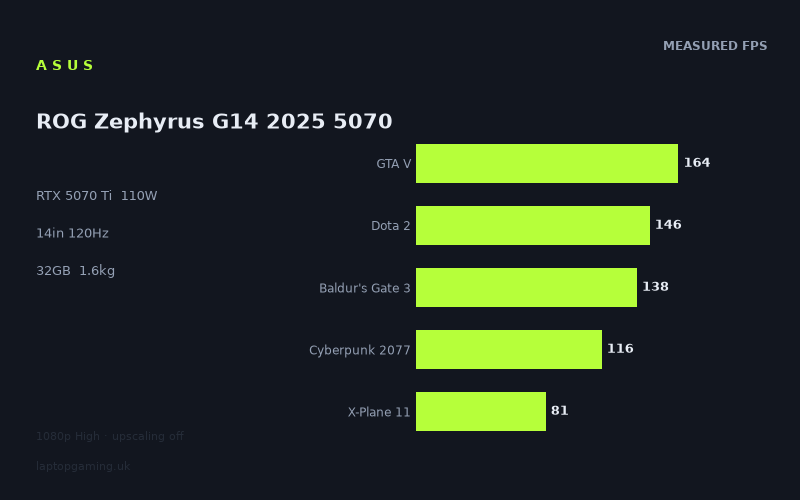
Frame rates
1920×1080, High preset, upscaling off. Averages 129fps across the 5 core benchmark games.
Measured on this machine. Source: Notebookcheck, 2025-06-05.
Not scored: no confirmed UK price
We have the full benchmark suite for this machine, so it ranks on the frame rate leaderboard like any other. What we don't have is a UK listing for this exact configuration - it's sold as a European review unit, or only in specifications that differ from the one tested. Since 30% of our score is value for money, scoring it would mean pretending price is no object, which would flatter it against every laptop you can actually buy. The frame rates below are real and comparable; there is just no buying recommendation to make yet.
How these numbers were produced
Frame rates here are not measured by us, and we label how each one was arrived at. A figure marked measured comes from a published run on that exact machine. A figure marked representative is derived from the GPU and its power limit (TGP) and cross-referenced against published reviews - a sound estimate of what that configuration delivers, but not a measurement of that specific laptop. Unless stated otherwise, numbers are 1920x1080, High preset, upscaling off. Where a laptop ships in several power configurations we use the wattage of the exact SKU listed, because a 140W RTX 5070 and a 115W one are not the same product.
In use
The short version
The Asus ROG Zephyrus G14 2025 with the RTX 5070 Ti is a compact high-end gaming laptop with performance that is far more serious than its 14in format suggests. Notebookcheck’s measured figures show it delivering very high frame rates in lighter and older games, strong results in demanding modern releases, and usable performance even in the most punishing titles in the published set. Its RTX 5070 Ti runs at a 110W GPU power limit, rather than at an unrestricted desktop-style power level, but the benchmark data indicates that Asus has still extracted enough performance for this to sit close to substantially more expensive and physically larger-looking rivals.
The important limitation is the screen resolution. The laptop has a 2880x1800 OLED display with a 120Hz refresh rate, while the available frame rates are measured at 1920x1080 on the High preset with upscaling disabled. That is useful benchmark data because it shows the underlying capability of the hardware, but it is not a promise that every game will run at the screen’s native resolution at the same frame rate. There is a large difference between rendering at 1920x1080 and rendering at 2880x1800. Buyers should treat the published figures as a strong indication of the laptop’s performance class, not as a native-resolution prediction.
At the measured settings, the Zephyrus G14 is comfortably capable of exploiting a 120Hz panel in games such as Strange Brigade, F1 24, F1 25, GTA V, Dota 2, Baldur’s Gate 3, Final Fantasy XV and Cyberpunk 2077. It is close enough in Indiana Jones and the Great Circle that a small settings adjustment could matter, although the published data does not show the result of that adjustment. Alan Wake 2, X-Plane 11 and Assassin’s Creed Shadows are more demanding cases. Their figures remain playable at the tested settings, but they do not naturally fill the display’s 120Hz refresh rate.
This is therefore not a machine to buy simply because it has the latest badge on the GPU. It is a machine to buy because the measured game results show a convincing balance between speed, screen quality, storage capacity, memory capacity and low carrying weight. The RTX 5070 Ti is backed by 12GB of VRAM, 32GB of memory and a 2048GB SSD, so there is no obvious weak specification elsewhere in the supplied configuration. The 73Wh battery is a reasonable capacity figure for the category, but there is no battery-life measurement in the available information, so it would be wrong to make a runtime claim.
The absence of a confirmed UK price prevents a value judgement. The benchmark suite is complete and the laptop ranks normally on frame-rate performance, but value cannot be calculated without a price for this exact configuration. That is not a criticism of the machine; it simply means that it is not possible to say whether the G14 is a sensible purchase relative to its alternatives until a confirmed UK price exists.
If its eventual price lands at a level appropriate for a compact RTX 5070 Ti laptop with 32GB of memory, 2048GB of storage and an OLED screen, the underlying product looks highly compelling. If it arrives priced too close to more powerful configurations, the argument weakens quickly. The frame-rate comparisons show that it is competitive with several RTX 5070 laptops and remarkably close to the higher-spec RTX 5080 version of the same Zephyrus G14. That makes price especially important: performance is not the problem here.
Performance
Notebookcheck’s benchmark data was recorded at 1920x1080, using the High preset with upscaling disabled. Those conditions matter. High settings are demanding enough to distinguish gaming hardware properly, while disabling upscaling gives a cleaner view of conventional rendering performance. The results should not be read as maximum possible frame rates with every performance feature enabled, nor should they be treated as native 2880x1800 results for the built-in display. They show what this specific RTX 5070 Ti configuration achieved under a consistent published test method.
Across the five games used in the scoring suite, the Zephyrus G14 averages 129fps. That is an excellent average for a 14in laptop, particularly when the machine weighs 1.576kg and carries a 110W RTX 5070 Ti rather than a much higher-power GPU. An average alone can hide the experience in individual games, though. The useful question is not merely whether the laptop produces a strong mean, but where it is fast enough for a 120Hz panel, where it is merely smooth, and where more selective settings choices will be required.
The high-frame-rate games
Strange Brigade is the standout result at 308fps. That is far beyond the 120Hz refresh rate of the built-in screen. In practical terms, the panel will be the limiting part of the experience at the tested settings, not the GPU. The result is still useful because it demonstrates that the G14 has abundant performance headroom in games with lighter rendering demands. At 1920x1080 High, this is not a laptop that is close to running out of GPU capacity in Strange Brigade.
F1 24 reaches 217fps, another result far above the display refresh rate. F1 25 follows at 168fps. The difference between the two games is notable because it illustrates why a GPU tier cannot be described honestly with a single headline frame rate. The same laptop, same GPU power limit and same general test conditions can look dramatically different depending on the game engine, graphical workload and CPU demand. Both F1 results are comfortably beyond 120fps at the measured settings, but F1 24 has far more surplus performance than F1 25.
GTA V runs at 164fps and Dota 2 at 146fps. Both clear the panel’s 120Hz limit in the published test. These are the kinds of games where the combination of a 120Hz display and the G14’s measured performance makes immediate sense. The GPU can provide more frames than the panel can show under the test conditions, leaving room for different in-game settings choices, external displays or higher rendering resolution. The available figures do not say how far settings can be raised or what happens at 2880x1800, but they do establish that the laptop is not constrained to merely console-like frame rates in these titles.
Baldur’s Gate 3 records 138fps. That is also above 120fps, although by a smaller margin than GTA V, Dota 2 or the F1 games. It is still a strong result. A game that can exceed the screen refresh rate at 1920x1080 High without upscaling is well served by this hardware, even if native-resolution play will place more pressure on the GPU. The important point is that the G14 is not just capable of running Baldur’s Gate 3 smoothly; it has sufficient measured performance to make high-refresh play realistic at the benchmark settings.
Final Fantasy XV reaches 136fps. Again, that is above the screen refresh rate. The pattern across these results is clear: in a substantial part of the published suite, the RTX 5070 Ti at 110W has enough performance to push past 120fps at 1920x1080 High. For buyers whose gaming library includes older, competitive, strategy or less punishing releases, the G14’s 120Hz panel is not an aspirational specification that the GPU cannot support. It can be properly used.
The games around the 120Hz threshold
Cyberpunk 2077 posts 116fps. That is just below the 120Hz refresh rate, and it is one of the most useful figures in the entire set because it shows the G14 approaching the screen’s ceiling in a demanding modern game. At the measured settings, the laptop is not quite delivering a sustained 120fps average in Cyberpunk 2077, but it is close. That is a much stronger position than merely aiming for 60fps, especially given that upscaling was disabled for the published result.
The distinction between 116fps and 120fps should be handled sensibly. The measured figure is below the refresh rate, so it would be inaccurate to say that the machine fully saturates the panel in Cyberpunk 2077. Equally, it would be misleading to frame 116fps as a disappointing result. The benchmark data shows a laptop that is operating in the high-refresh territory of the game at 1920x1080 High. It is close enough that the display remains a good match for the measured performance, even if the panel is not fully fed at all times by the average result.
Indiana Jones and the Great Circle reaches 102fps. That is below the screen’s 120Hz limit, but still clearly above the 60fps threshold that many buyers would regard as the baseline for smooth action gaming. It is a good example of a game where the 120Hz screen still has value without being fully utilised. A result around this level can look responsive and fluid, but it does not offer the same high-refresh certainty as the 164fps in GTA V or the 217fps in F1 24.
These games also underline the practical importance of the test resolution. Cyberpunk 2077 at 116fps and Indiana Jones and the Great Circle at 102fps were measured at 1920x1080. The built-in screen has substantially more pixels at 2880x1800. It is therefore sensible to expect native-resolution play to demand more from the GPU, but the available data does not provide a numerical estimate of the reduction. Buyers who want to use the full native resolution in every demanding game should not assume that the published 1920x1080 numbers will carry over unchanged.
The demanding games
Alan Wake 2 runs at 82fps in the published result. This is a respectable outcome for a game that is clearly more demanding than the titles above it in the table, but it is not a result that matches the 120Hz panel. It should be described as comfortably playable rather than high-refresh performance. The laptop has enough speed to make the game viable at the benchmark settings, but the screen has more refresh capacity than the measured average can use.
X-Plane 11 reaches 81fps. This is another useful reminder that gaming performance does not rise and fall solely with GPU specification. Simulation workloads can behave differently from conventional action games, and X-Plane 11’s result sits far below the frame rates seen in Strange Brigade, F1 24 or GTA V. The Ryzen AI 9 HX 370 is part of the configuration, but the published figures do not separate CPU and GPU limitations. It would be inappropriate to claim a specific bottleneck. What can be said is that this machine’s performance varies sharply by title, and X-Plane 11 is a case where the available benchmark data suggests that 120Hz is not the realistic average target at the tested settings.
Assassin’s Creed Shadows is the lowest figure in the supplied set at 70fps. That remains above 60fps, which is important, but it is well short of the laptop’s 120Hz refresh rate. This is the clearest example of why buyers should not look at the 129fps mean across the scoring suite and assume every modern game will behave similarly. The average is strong because several games run well above 120fps. Assassin’s Creed Shadows demonstrates the other side of the equation: demanding current releases can still reduce a high-end compact laptop to a more conventional performance level.
The spread from 308fps in Strange Brigade to 70fps in Assassin’s Creed Shadows is not a weakness in the benchmark process. It is the benchmark process doing its job. Gaming laptops should be assessed across multiple workloads because different engines, asset complexity, lighting methods, simulation demands and graphics settings produce different levels of stress. A system that performs well in one title cannot be assumed to perform identically in another. The Zephyrus G14’s published data shows a wide spread, but it also shows that the lower end of that spread remains playable at 1920x1080 High without upscaling.
What the 110W GPU power limit means
The RTX 5070 Ti in this G14 has a 110W GPU power limit. That is a defining part of the machine’s identity. Laptop GPUs are not interchangeable simply because they share a name. Power limits, cooling design and chassis constraints can change the performance that a GPU delivers. The 110W figure tells buyers that Asus is balancing performance against the demands of a 14in, 1.576kg laptop rather than building around the largest possible cooling system.
The benchmark data suggests that this balance has been handled well. The G14 does not merely outperform older or weaker categories of laptop hardware; it stays extremely close to the RTX 5080 version of the same 2025 Zephyrus G14. Across the shared games in the database, this RTX 5070 Ti configuration averages only 1fps behind the RTX 5080 G14, despite the latter having a 120W GPU power limit. That is an unusually small gap in the published comparison and should make buyers look carefully at configuration and price rather than assuming that the higher GPU label automatically creates a clearly different gaming experience.
There is an important caveat. The comparison is only across games both machines have been measured in, and it covers shared-game averages rather than every possible workload. It does not prove that the RTX 5070 Ti and RTX 5080 versions are equal in all games, at all settings or at native resolution. It does show that, in the available shared results, the lower-tier GPU version is extremely close. That is valuable evidence, but it is not a licence to erase the distinction between the configurations.
The 110W limit also helps explain why the G14 should be judged differently from a large 16in or 17in gaming laptop. A heavier chassis may have more room for higher sustained GPU power, larger cooling hardware or fewer compromises around size. The supplied benchmarks do not include temperatures, noise measurements or sustained-duration behaviour, so there is no basis for declaring the G14 quieter, cooler or more stable than its rivals. The evidence supports a narrower conclusion: despite its compact form and stated power limit, the G14 produces frame rates that place it directly alongside several more conventional gaming laptops.
The 12GB of VRAM is another relevant part of the performance specification. It is not possible from the supplied information to state which specific games are VRAM-limited, whether any benchmark encountered a memory issue, or how the system behaves with texture settings beyond High. What can be said is that the configuration does not pair its RTX 5070 Ti with a low memory capacity elsewhere in the system. It has 32GB of system memory and 12GB of graphics memory, alongside a 2048GB SSD. On paper, that is a suitably serious specification for a premium portable gaming machine, though the benchmark figures remain the more meaningful evidence of actual game performance.
The screen
The Zephyrus G14 has a 14in 2880x1800 OLED display with a 120Hz refresh rate. That is an ambitious panel specification for a compact gaming laptop. The resolution is considerably higher than the 1920x1080 benchmark setting, while the 120Hz refresh rate is high enough to reward the strong results this system achieves in many games. OLED is also a significant panel choice, although the supplied facts do not provide brightness, colour coverage, response-time or HDR measurements. Those qualities should not be assumed from the panel type alone.
The first practical point is that the screen is not automatically the best resolution target for every game. The G14’s display has 2880x1800 pixels, but Notebookcheck’s results were measured at 1920x1080. Rendering at the laptop’s native resolution requires substantially more GPU work. The published data is therefore most useful for understanding which games have spare performance and which games are already demanding at the benchmark setting.
Strange Brigade at 308fps has so much headroom at 1920x1080 High that the G14 is plainly not limited by its 120Hz panel under those test conditions. F1 24 at 217fps, F1 25 at 168fps, GTA V at 164fps, Dota 2 at 146fps, Baldur’s Gate 3 at 138fps and Final Fantasy XV at 136fps all exceed 120fps. Those figures suggest that these games are sensible candidates for experimenting with the display’s native resolution or higher image-quality options, but only as an experiment. There is no native-resolution benchmark supplied, so there is no evidence for a specific expected frame rate.
Cyberpunk 2077 at 116fps is close enough to the 120Hz ceiling that the screen remains well matched to the hardware at 1920x1080 High. Indiana Jones and the Great Circle at 102fps sits below that threshold, but still benefits from a fast panel. Alan Wake 2 at 82fps, X-Plane 11 at 81fps and Assassin’s Creed Shadows at 70fps are different. In these games, the display’s 120Hz capability is not fully used by the published average at the benchmark settings. Buyers should value the panel for its general quality specification and for flexibility across their library, not assume that every demanding release will run at 120fps.
The practical advantage of a 120Hz screen is not restricted to a literal 120fps result. Games running at 102fps, 82fps, 81fps or 70fps can still be smoother than a 60fps experience. But there is a difference between “benefits from a high-refresh display” and “matches the refresh rate”. The G14 achieves the latter in several games, approaches it in Cyberpunk 2077, and falls below it in the most demanding titles in the provided data. That is a balanced and believable result for a 110W RTX 5070 Ti laptop.
The screen size also changes the calculation. A 14in panel is physically smaller than the displays fitted to many gaming laptops. A high 2880x1800 resolution can make sense for general desktop use, sharp text and non-gaming work, but the supplied information does not include productivity measurements or display calibration data. For gaming, the key point is simply that the panel gives the owner a high-resolution option, while the benchmark results show enough performance at 1920x1080 to make lower-resolution high-refresh play credible in many titles.
There is no need to pretend that one rendering mode is universally correct. A buyer focused on competitive games and frame rate may favour lower rendering resolution and settings choices aimed at sustaining the panel’s refresh rate. A buyer focused on image detail in slower-paced games may prefer the native 2880x1800 resolution and accept lower frame rates. The benchmark data supports both use cases in principle, but it does not establish exact native-resolution outcomes. That uncertainty should be respected rather than filled with invented estimates.
Build, size and portability
The strongest portability fact is the weight: 1.576kg. For a gaming laptop with an RTX 5070 Ti at 110W, 32GB of memory, a 2048GB SSD and a 14in OLED display, that is a notably low carrying weight. It places the G14 in a different practical category from the larger 16in and 17in gaming machines in the comparison list. A laptop at this weight is more plausible as a system that moves regularly between home, work, study and travel rather than one that mainly lives on a desk.
The supplied information does not include dimensions, chassis materials, port selection, keyboard details, webcam details, cooling measurements, temperature results or fan-noise results. Those are all important parts of a real ownership decision, especially in a performance-focused 14in system, but there is no basis for making claims about them here. It would be wrong to describe the chassis as thin, thick, quiet, loud, cool-running, premium-feeling or well-connected without published evidence in the facts provided.
What the known specification does establish is a clear design direction. Asus has put a high-end GPU, 32GB of memory, a 2048GB SSD and a 73Wh battery into a 14in laptop weighing 1.576kg. That is a concentrated set of components. Buyers should expect the central trade-off of the category: strong performance in a machine designed to be carried, rather than the physical scale of a large desktop replacement.
The 73Wh battery capacity is worth noting, but capacity is not runtime. Battery life depends on workload, display settings, power management and use case. There are no battery-life measurements in the supplied information, so this cannot be presented as an all-day laptop, a short-lived gaming machine or anything in between. Gaming away from mains power is particularly difficult to assess from capacity alone, and no battery gaming frame-rate figures are available.
The 2048GB SSD is more straightforwardly useful. Modern game installations can consume substantial storage space, and a 2048GB drive gives the owner more room for a serious installed library than a smaller drive would. There is no information about SSD speed, additional storage slots or upgradeability, so no claim should be made about those aspects. The capacity itself is nevertheless a material strength of this configuration because it reduces the immediate need to manage a small game library.
The same applies to the 32GB memory allocation. It is a high capacity for a gaming laptop, and it suits a premium machine intended to handle demanding games alongside broader use. The supplied benchmark results do not isolate memory demand or demonstrate multitasking behaviour, so it is not possible to quantify its impact. Still, it avoids the obvious mismatch of pairing a powerful GPU with a minimal memory configuration.
The G14’s portability case is strongest for someone who wants a single system that can travel without giving up high-end game performance when plugged in. It is weaker for someone whose laptop will never move and who values the largest display, the biggest chassis or the possibility of higher GPU power above all else. The available data does not prove that every larger laptop is faster, but it does show that the G14 has chosen a compact format without collapsing into mid-range performance.
How it compares
The closest comparisons in the database are especially revealing because the Zephyrus G14 does not sit in isolation. It is surrounded by laptops with RTX 5070, RTX 5080 and RTX 5090 graphics, different GPU power limits, different screen sizes and very different confirmed-price situations. The shared-game figures should be read carefully: each comparison covers only games measured on both machines. They are not complete catalogue-wide rankings, and they should not be turned into claims about unmeasured titles.
Against the RTX 5080 Zephyrus G14
The nearest performance rival is the Asus ROG Zephyrus G14 2025 with an RTX 5080 at 120W. That machine has a confirmed UK price of £3,811. Across 11 shared games, the RTX 5070 Ti G14 averages 1fps behind it. That is the most striking comparison in the supplied data.
On pure shared-game performance, the gap is essentially negligible. The RTX 5080 version has a higher GPU tier and a 120W power limit, compared with 110W here, yet the benchmark average difference across the shared set is only 1fps. It would be wrong to call the two machines identical, because the data does not show identical results in every game. It would also be wrong to dismiss the RTX 5080 version purely on that basis, since it may differ in games not shared by the two benchmark records. But the available evidence says very clearly that the RTX 5070 Ti configuration is not far behind.
That comparison makes the missing UK price for this machine more important, not less. If the RTX 5070 Ti version is meaningfully cheaper than £3,811, the shared-game performance evidence could make it the more rational choice for buyers focused on frame rate rather than GPU naming. If it is priced too close to £3,811, the RTX 5080 version becomes harder to ignore. No speculative price should be inserted into that argument; the right conclusion is simply that the G14 RTX 5070 Ti needs a confirmed UK price before a value verdict is possible.
Against RTX 5070 laptops
The MSI Katana 17 HX with an RTX 5070 is listed at £2,312. Across six shared games, the Zephyrus G14 RTX 5070 Ti averages 2fps ahead. That is a small advantage. It does not establish domination, but it does show that the G14 is not sacrificing performance simply because it uses a 14in format and weighs 1.576kg.
The small margin also reinforces a broader lesson about gaming laptops: GPU labels are only part of the story. The Katana uses an RTX 5070, while this G14 uses an RTX 5070 Ti, but the published shared-game gap is only 2fps. Chassis design, GPU power settings, CPU behaviour and the individual mix of games all matter. Buyers should not assume that a Ti label automatically produces a large lead in every laptop comparison.
The Lenovo Legion 5 15IRX10 with an RTX 5070 is priced at £2,359. Across nine shared games, the G14 averages 4fps ahead. That is a clearer lead than the comparison with the Katana, though it is still not an overwhelming separation. The G14’s advantage is meaningful in the context of its lower weight and smaller screen size, but the Legion’s confirmed price matters. Until the Asus price is known, it is impossible to say whether the G14’s modest performance lead is worth any potential premium.
The Alienware 16X Aurora with an RTX 5070 has a confirmed UK price of £2,569. Across eight shared games, the G14 averages 3fps behind. This is the most direct warning against treating the G14 as automatically superior to every RTX 5070 laptop. In the shared data, the Alienware is ahead by a small amount. The difference is not huge, but it is real in the available comparison.
The decision between the G14 and the Alienware therefore cannot be reduced to raw performance. The G14’s 1.576kg weight and 14in OLED screen are part of its appeal; the Alienware’s shared-game lead is part of its appeal. Buyers who want the smaller and lighter machine may accept a small frame-rate deficit. Buyers who prioritise the highest published shared-game result and have no special need for portability should take the Alienware’s lead seriously. The unknown G14 price remains the missing factor.
Against the RTX 5090 Razer Blade 16
The Razer Blade 16 2025 with an RTX 5090 at 160W has no confirmed UK price in the supplied data. Across nine shared games, the Zephyrus G14 RTX 5070 Ti averages 5fps behind it. That is an exceptionally close result considering the stated GPU classes and power limits. The Razer has an RTX 5090 at 160W, while the G14 has an RTX 5070 Ti at 110W, yet the shared-game difference is only 5fps.
This should not be overstated. The shared-game average does not mean an RTX 5070 Ti is universally equivalent to an RTX 5090, and it does not describe every setting, resolution or game. It does, however, make a strong point about this particular G14 implementation: it is extracting performance at a level that keeps it near a machine with a substantially more imposing specification on paper.
The Razer’s lack of a confirmed UK price prevents a value comparison just as the G14’s missing price does. Still, buyers can take a practical conclusion from the frame-rate data. If portability matters, the G14’s 1.576kg weight and 14in format offer a very different ownership proposition from a 16in machine, while the shared benchmark gap remains limited. If maximum performance in every possible scenario matters more than portability, the higher-tier GPU configuration may retain advantages outside the shared data. The evidence supports caution, not sweeping claims.
What the comparisons collectively say
The G14 RTX 5070 Ti sits in an unusually competitive position. It is 1fps behind the RTX 5080 G14 across 11 shared games, 2fps ahead of the MSI Katana 17 HX across six shared games, 3fps behind the Alienware 16X Aurora across eight shared games, 4fps ahead of the Lenovo Legion 5 15IRX10 across nine shared games, and 5fps behind the RTX 5090 Razer Blade 16 across nine shared games.
That pattern does not mean all these machines are interchangeable. Different shared-game sets can produce different averages, and the comparisons cover different numbers of games. It does mean that the G14 is operating in a very tightly packed performance group. Its RTX 5070 Ti designation and 110W power limit do not place it at the back of this group. In the available data, it remains close to machines with stronger GPU labels and trades small margins with RTX 5070 systems.
For a buyer, this puts the focus where it belongs: on the full configuration, portability needs, display preferences and confirmed price. The G14’s 32GB memory, 2048GB SSD, 14in OLED screen, 120Hz refresh rate and 1.576kg weight are all concrete advantages for the right buyer. The competing systems have their own arguments, including confirmed prices and, in the Alienware’s case, a small shared-game lead. There is no honest way to pick a universal winner without the Asus price.
Who it’s for
The Asus ROG Zephyrus G14 2025 RTX 5070 Ti is for the buyer who wants genuinely high-end gaming performance without carrying a large gaming laptop. Its 1.576kg weight is central to that appeal. This is not merely a small machine with entry-level graphics; Notebookcheck’s figures show 308fps in Strange Brigade, 217fps in F1 24, 168fps in F1 25, 164fps in GTA V, 146fps in Dota 2 and 138fps in Baldur’s Gate 3. Those are the results of a laptop that can properly serve high-refresh gaming at 1920x1080 High in a broad range of titles.
It is also for someone who values a strong all-round specification instead of a GPU-only purchase. The RTX 5070 Ti is paired with 12GB of VRAM, 32GB of memory and a 2048GB SSD. The display is a 14in 2880x1800 OLED panel at 120Hz. Those components make sense together. There is enough system memory to suit a premium laptop, enough storage to install a substantial game library, and a screen specification that is more ambitious than a basic 1920x1080 panel.
It is particularly suitable for players who spend time in games where the measured data is above 120fps. F1 24, F1 25, GTA V, Dota 2, Baldur’s Gate 3, Final Fantasy XV and Strange Brigade all show that the laptop can exceed the panel’s refresh rate at the stated benchmark settings. Competitive players, racing-game fans, strategy players and anyone with a mixed library of demanding and less demanding games have a strong reason to consider it.
It also suits buyers who want demanding modern games to remain playable without relying on upscaling in the published benchmark. Cyberpunk 2077 at 116fps, Indiana Jones and the Great Circle at 102fps, Alan Wake 2 at 82fps and Assassin’s Creed Shadows at 70fps show that the machine remains capable when games become much harder to run. The experience will not always be a 120fps one, but the benchmark data does not suggest a laptop struggling to reach acceptable performance at 1920x1080 High.
Buy something else if your priority is native 2880x1800 performance at the highest settings in every demanding game. The G14’s display is 2880x1800, but the available frame rates are measured at 1920x1080. There is no published native-resolution result in the supplied information. The lower results in Alan Wake 2, X-Plane 11 and Assassin’s Creed Shadows are a reason to be cautious about assuming that the screen’s full resolution will be easy to drive at high settings in all current games.
Buy something else if your primary requirement is the largest possible display. A 14in screen is the right choice for portability, not for someone who wants the physical scale of a 16in or 17in gaming laptop. The OLED panel may be appealing, but its size remains 14in. No amount of GPU performance changes that basic preference.
Buy something else if you want a machine selected purely on confirmed value. There is no confirmed UK price for this exact G14 configuration. That prevents a meaningful purchase recommendation against the MSI Katana 17 HX at £2,312, the Lenovo Legion 5 15IRX10 at £2,359, the Alienware 16X Aurora at £2,569 or the RTX 5080 Zephyrus G14 at £3,811. The G14’s performance case is clear; its value case must wait for a price.
Buy something else if you need verified information about battery life, noise, temperatures, ports, dimensions or upgradeability before committing. None of those details are included in the facts available here. The 73Wh battery capacity and 1.576kg weight are useful specifications, but they do not answer every practical ownership question. A careful buyer should not fill those gaps with assumptions.
The most convincing reason to choose the Zephyrus G14 RTX 5070 Ti is the combination of compactness and published frame-rate performance. It is a 14in, 1.576kg gaming laptop that averages 129fps across the five scoring-suite games and stays close to several larger or higher-labelled rivals in shared benchmarks. The RTX 5070 Ti at 110W is not a paper exercise: the measured figures show a machine that is fast enough to make its 120Hz OLED display worthwhile in many games, while still delivering playable results in the demanding titles where 120fps is unrealistic.
The final judgement is therefore conditional but positive. The hardware and benchmark data make this one of the more interesting compact gaming laptops in the database. It should be on the shortlist for anyone who wants serious gaming performance in a portable format, wants 32GB of memory and 2048GB of storage as part of the package, and can accept that the most demanding games will not always match the panel’s refresh rate. The remaining question is not whether it performs well. Notebookcheck’s figures show that it does. The remaining question is whether Asus prices it sensibly in the UK.