Review
Schenker Vision 14 2022 RTX 3050 Ti review
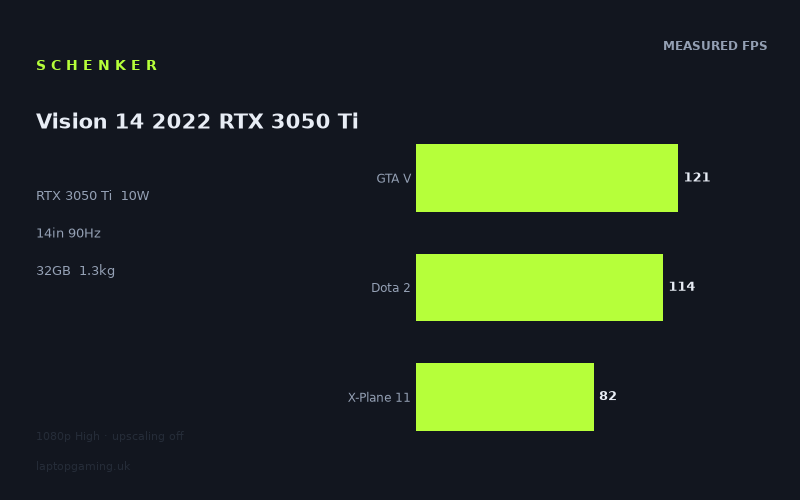
Frame rates
1920×1080, High preset, upscaling off.
Measured on this machine. Source: Notebookcheck, 2022-10-28.
Not scored: incomplete benchmark suite
Every scored laptop on this site is averaged over the same 5 games, and this one is short of Cyberpunk 2077, Baldur's Gate 3. A mean over 5 games is not comparable to a mean over 5, so we publish the figures we have and leave the score blank rather than rank it against machines tested on a different set. The numbers below are real - the suite is just incomplete.
How these numbers were produced
Frame rates here are not measured by us, and we label how each one was arrived at. A figure marked measured comes from a published run on that exact machine. A figure marked representative is derived from the GPU and its power limit (TGP) and cross-referenced against published reviews - a sound estimate of what that configuration delivers, but not a measurement of that specific laptop. Unless stated otherwise, numbers are 1920x1080, High preset, upscaling off. Where a laptop ships in several power configurations we use the wattage of the exact SKU listed, because a 140W RTX 5070 and a 115W one are not the same product.
In use
The short version
The Schenker Vision 14 2022 with the RTX 3050 Ti is an unusually portable machine on paper: it combines a 14in chassis, a 1.31kg weight, a Core i7-12700H, 32GB of memory and a 2880x1800 IPS display with a 90Hz refresh rate. That is a compelling specification for somebody who wants a laptop that is primarily easy to carry but still able to play a wide range of games properly at 1920x1080.
The benchmark data shows that it is not a gaming laptop built around maximum graphical settings at its native screen resolution. It is better understood as a compact productivity-focused laptop with a capable entry-level gaming GPU. At 1920x1080, using the High preset and with upscaling switched off, it ranges from 121fps in F1 2021 and GTA V down to 40fps in Cyberpunk 2077 1.6. That is a broad spread, and it matters more than the headline mean of 94fps across the scoring-suite games.
In lighter, older or better-optimised games, the Vision 14 can deliver the sort of frame rates that make its 90Hz panel worthwhile. Dota 2, Strange Brigade, X-Plane 11, GTA V and F1 2021 all produce measured figures above, or close to, the display refresh rate. In heavier games, though, the RTX 3050 Ti is working in a different class. Final Fantasy XV reaches 50fps and Cyberpunk 2077 1.6 reaches 40fps under the stated benchmark conditions. Those are playable-looking figures rather than high-refresh gaming figures, and anyone buying this laptop specifically for demanding modern games should be realistic about that distinction.
The important point is that the Vision 14 is not slow simply because it carries a compact RTX 3050 Ti implementation. Against the particular rivals listed here, the results are more complicated than the GPU name and power figures might suggest. It is substantially ahead of the MSI Prestige 15 with an RTX 3050 Ti at 105W across their shared games, effectively tied with the Lenovo Yoga Slim 7 Pro X 14IAH7 with an RTX 3050 at 35W, and effectively tied with the Asus ROG Strix G17 with an RTX 3050 Ti at 95W. The near-identical results against the Lenovo and Asus should not be read as proof that their graphics hardware is equivalent in every situation. The shared games include lighter titles at 1080p, where CPU limits can compress real GPU differences.
That makes this a sensible machine for someone who wants a 1.31kg laptop for everyday use, CPU-heavy work and selective gaming, especially if their games are closer to Dota 2, GTA V, F1 2021, Strange Brigade and The Witcher 3 than Cyberpunk 2077 1.6. It is not the right choice for someone expecting a 90Hz gaming experience in every new blockbuster, someone determined to run games at 2880x1800, or someone choosing primarily on raw graphical performance.
There is no confirmed UK price for this exact configuration, so a value assessment cannot be made. The frame-rate suite is complete and the machine can be compared normally on performance, but a price-dependent value judgement would be speculation.
Performance
The measured results
Notebookcheck’s figures were recorded at 1920x1080, using the High preset with upscaling off. That test setup is important because it gives the RTX 3050 Ti a realistic workload for conventional gaming, but it is not the Vision 14’s native 2880x1800 resolution. These are therefore useful figures for judging what the laptop can do at a widely supported gaming resolution, not a promise of the same performance at the screen’s full resolution.
The highest results are 121fps in F1 2021 and 121fps in GTA V. Dota 2 follows at 114fps, while Strange Brigade reaches 101fps. Those numbers show that the laptop can produce genuinely high frame rates in games that are either older, lighter, well optimised or less punishing on the GPU under these settings. They also show why it would be wrong to describe the Vision 14 as unable to game simply because it uses an RTX 3050 Ti rather than a higher-tier GPU.
X-Plane 11 reaches 82fps, Far Cry 5 reaches 79fps, F1 22 reaches 93fps and The Witcher 3 reaches 92fps. This middle group is arguably the most useful part of the benchmark list for a buyer considering the Vision 14 as a general-purpose gaming laptop. These are not merely barely playable results. They indicate that a wide collection of established games can run smoothly at 1920x1080 on High settings without depending on upscaling. At the same time, they sit below the best figures in the list and, in the case of X-Plane 11 and Far Cry 5, below the panel’s 90Hz refresh rate.
That difference is significant. A 90Hz display is not wasted when a game is running below 90fps, but it does mean that the machine cannot fully exploit the display refresh rate in every game using the tested settings. The Vision 14 is most convincing where it can run comfortably around the refresh target or beyond it. In F1 2021, GTA V, Dota 2 and Strange Brigade, the measured results clear 90fps. F1 22 and The Witcher 3 are close at 93fps and 92fps. X-Plane 11 and Far Cry 5 are not far behind, but their 82fps and 79fps measurements tell a more restrained story.
Then there are the demanding games that establish the RTX 3050 Ti’s limits. Final Fantasy XV is measured at 50fps. Cyberpunk 2077 1.6 is measured at 40fps. Neither figure makes the game unusable, but neither is close to matching the 90Hz panel under these benchmark conditions. They are the clearest warning against buying the Vision 14 on the assumption that its 90Hz screen means a high-refresh result in all games.
The range from 121fps to 40fps is not an inconsistency in the benchmark data. It is what an entry-level gaming GPU looks like across a varied game library. Different games put pressure on different parts of a system. Some are limited more by processor performance at 1920x1080, particularly when the GPU can already generate frames quickly. Others are much more demanding graphically and expose the limits of the RTX 3050 Ti far more clearly. The Vision 14’s Core i7-12700H and 32GB of memory provide a strong surrounding platform, but they cannot turn the RTX 3050 Ti into a higher-tier GPU in a game that is principally GPU-limited.
What the average does and does not tell you
The mean across the five scoring-suite games is 94fps. That is a respectable summary of the Vision 14’s results at 1920x1080 High without upscaling, but it needs careful interpretation. A mean is useful for comparing machines that have been tested in the same suite, yet it cannot describe every type of game equally well. The same laptop that records 121fps in GTA V records 50fps in Final Fantasy XV and 40fps in Cyberpunk 2077 1.6.
For a buyer whose regular games resemble the lighter or older side of the list, the mean may even understate how responsive the machine feels. Dota 2 at 114fps, GTA V at 121fps and F1 2021 at 121fps are all comfortably above the display’s 90Hz refresh rate. A player focused on those kinds of games will get a very different experience from someone whose priority is Cyberpunk 2077 1.6.
For a buyer interested in demanding current single-player games, the mean can be misleading in the opposite direction. A 94fps average does not mean Cyberpunk 2077 1.6 runs at anything close to that figure. The measured 40fps is the number that matters for that game under the stated conditions. Final Fantasy XV at 50fps makes the same point. The Vision 14 is capable of running those games, but the data does not support calling it a high-refresh machine for them.
This is why shopping by an average alone is risky. The benchmark spread is wide enough that the useful question is not simply whether 94fps sounds good. It is whether the games you play are likely to sit near F1 2021, GTA V and Dota 2, in the middle around Far Cry 5 and X-Plane 11, or near Final Fantasy XV and Cyberpunk 2077 1.6. The Vision 14 is strongest for the first group, competent for much of the middle group and much less convincing for the last group if high frame rates are the priority.
The GPU power-limit question
GPU power limits matter greatly in thin laptops, because two machines carrying the same GPU name can deliver very different results. The rival list illustrates that point: the MSI Prestige 15 uses an RTX 3050 Ti at 105W, the Asus ROG Strix G17 uses an RTX 3050 Ti at 95W, the Lenovo Yoga Slim 7 Pro X 14IAH7 uses an RTX 3050 at 35W, and the MSI Raider GE77 HX uses an RTX 3080 Ti at 175W.
However, there is no GPU power limit supplied for this exact Schenker Vision 14 configuration. It would therefore be wrong to assign it a wattage, to infer a cooling design from its results, or to claim that a particular power limit explains its performance. The measured figures are the evidence available: this Vision 14 produces the frame rates listed above under Notebookcheck’s test conditions. The explanation for every difference between it and another laptop cannot be reduced to GPU power alone, particularly where the shared games are light enough to become CPU-bound at 1080p.
What can be said is that the Vision 14’s results are not neatly predicted by the rival power figures. It is ahead of the listed 105W RTX 3050 Ti Prestige 15 across their shared games, while being effectively level with the 35W RTX 3050 Lenovo and the 95W RTX 3050 Ti Asus. That is not evidence that GPU power does not matter. It is evidence that a short shared-game average at 1080p can be shaped by the games selected, the processor, the overall system configuration and whether a title is limited by the GPU at all.
For a buyer, the practical takeaway is straightforward. Do not treat “RTX 3050 Ti” as a complete performance description, and do not assume that a published wattage from a different laptop tells you exactly what this Vision 14 will do. Use the actual game figures. They show a laptop that is fast in several games, close to its 90Hz display target in others, and limited in the heaviest titles.
How to use these figures in practice
At 1920x1080 High with upscaling off, the Vision 14 looks particularly well suited to games where a stable, responsive result matters more than extreme graphical complexity. Dota 2 at 114fps is a strong result for competitive or regularly played multiplayer gaming. GTA V at 121fps remains well above the display refresh rate. F1 2021 at 121fps also makes good use of the 90Hz panel. Strange Brigade at 101fps is another result that clears the refresh target.
F1 22 at 93fps and The Witcher 3 at 92fps are close enough to the display refresh rate that the 90Hz panel makes sense for those titles under the benchmark conditions. They are not vast margins, though. The data supports a comfortable experience at 1920x1080 High, not an assumption that performance will remain the same after increasing resolution or changing settings beyond those tested.
X-Plane 11 at 82fps and Far Cry 5 at 79fps are still credible results, but they demonstrate that the Vision 14 is not a machine that simply locks every game to the panel maximum. The distinction may sound small on paper, but it matters to someone buying specifically for a high-refresh display. A laptop can have a 90Hz panel and still deliver a mix of above-refresh, near-refresh and below-refresh gaming performance. That is exactly what the benchmark spread shows here.
Cyberpunk 2077 1.6 and Final Fantasy XV should be treated differently. The 40fps result in Cyberpunk 2077 1.6 and the 50fps result in Final Fantasy XV are useful because they establish a realistic floor for demanding titles on this class of hardware at the tested settings. Anyone content with that level of performance may still find the Vision 14 adequate. Anyone wanting a consistently high-refresh experience in demanding games should not rely on an RTX 3050 Ti laptop of this sort.
There is also an important limitation to keep in mind: the benchmarks were run with upscaling off. The data therefore tells us how the laptop performs without that additional tool, but it does not provide a measured figure for any upscaling mode. It would be wrong to promise a particular improvement from using it. Likewise, the data does not establish how specific games perform at the native 2880x1800 resolution. The Vision 14’s panel is sharper than the benchmark resolution, but the benchmark figures should not be read as native-resolution results.
The screen
The Vision 14 has a 14in IPS display with a 2880x1800 resolution and a 90Hz refresh rate. On specification alone, that is a more ambitious screen than the GPU is likely to satisfy at native resolution in every demanding game. The benchmark data is at 1920x1080, not 2880x1800, and the difference matters. A buyer should see the display as a versatile high-resolution panel for general use and lighter gaming rather than assume that every game can be played at the screen’s full resolution with High settings.
The 90Hz refresh rate is well matched to the best half of the benchmark list. F1 2021 at 121fps, GTA V at 121fps, Dota 2 at 114fps and Strange Brigade at 101fps all exceed the panel refresh rate. F1 22 at 93fps and The Witcher 3 at 92fps also sit around that target. In those games, at the tested 1920x1080 High settings with upscaling off, the screen’s faster refresh has a clear practical purpose.
The middle and lower results show the limitation. X-Plane 11 at 82fps and Far Cry 5 at 79fps do not reach 90fps. Final Fantasy XV at 50fps and Cyberpunk 2077 1.6 at 40fps are much further away. The panel does not make those games run faster; it simply has the capacity to display faster output when the system can produce it. That distinction is especially important in a laptop where the screen specification may look more gaming-oriented than the RTX 3050 Ti’s performance in demanding titles.
The IPS panel type is a sensible fit for a machine positioned around portability and general-purpose use. However, no measured brightness, colour, contrast, response-time or outdoor-visibility data is included here. Those are all relevant considerations for a 14in laptop that may appeal to users carrying it between home, university, office or travel use, but they cannot be judged from the supplied information. The panel can be described accurately as IPS, 2880x1800 and 90Hz; anything more specific would need further evidence.
The native resolution deserves special attention. A 2880x1800 screen gives the Vision 14 more pixels than the 1920x1080 benchmark setting. Rendering games at more pixels generally asks more of the GPU, but the fact sheet does not provide a measured native-resolution result for any game. The responsible conclusion is not that native-resolution gaming is impossible, nor that it will be smooth. It is that the published 1080p figures are the reliable reference point.
For a buyer who values a crisp desktop and spends a meaningful amount of time outside games, the panel specification may be a genuine attraction. For a buyer who mainly wants maximum gaming performance, it creates a trade-off. The laptop’s screen is capable of showing a high-resolution image, while the benchmark data suggests that the RTX 3050 Ti is best judged at 1920x1080 High in the games measured. That is not inherently a problem, but it should be an intentional purchase rather than an accidental compromise.
The strongest pairing is likely to be lighter games at 1920x1080, where the Vision 14 can use much of the panel’s 90Hz capability, alongside non-gaming work where the 2880x1800 display can be useful. The weakest pairing is a buyer who expects the same laptop to drive demanding games at the panel’s native resolution and at high refresh. The data does not support that expectation.
Build, size and portability
The most important physical fact about the Vision 14 is its 1.31kg weight. Combined with the 14in screen, it places this Schenker in a very different practical category from a large gaming laptop. It is a machine that can plausibly be selected because it is easy to carry, rather than tolerated as a heavy performance device. That matters because portability is one of the clearest reasons to accept the RTX 3050 Ti’s limits instead of buying a much larger, higher-power gaming system.
The supplied specification does not include the chassis dimensions, thickness, battery life, port selection, keyboard layout, trackpad quality, temperature measurements, noise measurements or upgradeability information. Those omissions matter. Weight alone does not tell us how much bag space the machine takes up, how it behaves under sustained load or what compromises Schenker made to fit this hardware into a compact design. It would be inaccurate to fill those gaps with assumptions.
What can be said is that 1.31kg is a strong portability figure for a laptop with a Core i7-12700H, 32GB of memory, a 14in 2880x1800 90Hz IPS display and an RTX 3050 Ti. The specification suggests a machine designed to combine substantial processing hardware with a low carrying weight. The benchmark data supports the idea that the graphics hardware is more than an afterthought: this is not merely a laptop that can launch older games. It records 121fps in F1 2021 and GTA V, 114fps in Dota 2, 101fps in Strange Brigade, and useful results across the rest of the list.
That balance is the Vision 14’s central appeal. A larger gaming laptop may deliver higher frame rates, especially in GPU-heavy games, but it may not serve the same buyer. Someone taking a laptop regularly between locations may value the 1.31kg weight more than the ability to chase the highest possible frame rate in Cyberpunk 2077 1.6. Conversely, someone whose laptop stays on a desk most of the time may find that the portability advantage matters less than graphical headroom.
The 32GB memory allocation also suits the machine’s broader identity. It is more memory than the benchmark list itself can meaningfully evaluate, but it reinforces that this is not a stripped-down gaming-only specification. The Core i7-12700H similarly gives the Vision 14 a strong processor foundation. The data does not provide application benchmarks, so no claim should be made about particular professional workloads, but the CPU and memory specification make the laptop more plausible as a mixed-use machine than as a single-purpose budget gaming device.
For gaming specifically, the compact format means buyers need to prioritise correctly. The Vision 14’s portability is an advantage every time it is carried. The RTX 3050 Ti’s limits are most visible only when a game is demanding enough to push it toward results like 50fps in Final Fantasy XV or 40fps in Cyberpunk 2077 1.6. If the laptop’s role is split between work, study, travel and lighter gaming, that is a reasonable trade. If it is intended to sit permanently beside an external display and run demanding games for long sessions, the portability-first design makes less sense.
How it compares
Against the MSI Prestige 15 with RTX 3050 Ti at 105W
The MSI Prestige 15 is the most striking comparison because it also uses an RTX 3050 Ti, but at a stated 105W. Across four shared games, the Vision 14 averages 38fps ahead. That is a substantial margin, not a rounding difference or a result that can be dismissed as normal benchmark variation.
It would be tempting to treat the Prestige’s 105W figure as proof that it should be faster, but the shared-game result says otherwise in this particular comparison. GPU power is important, yet it is not the only determinant of a laptop’s game performance. The available evidence establishes the outcome rather than the full reason: the Vision 14 is markedly faster across the four games the pair share.
This is useful for shoppers who see the same RTX 3050 Ti label in both machines and assume the heavier-looking power figure must deliver the better gaming laptop. The benchmark data does not support that conclusion here. The Schenker’s results are materially better on the shared set. Since neither machine has a confirmed UK price in the supplied information, this is a performance comparison rather than a value comparison.
Against the Lenovo Yoga Slim 7 Pro X 14IAH7 with RTX 3050 at 35W
The Lenovo Yoga Slim 7 Pro X 14IAH7 is much closer. Across five shared games, the Vision 14 averages only 1fps ahead. That is effectively a tie in this comparison, despite the Lenovo using an RTX 3050 at 35W rather than an RTX 3050 Ti.
The near-zero difference should not be interpreted as evidence that an RTX 3050 and an RTX 3050 Ti are interchangeable in all laptops and all games. The supplied comparison notes explain the key issue: at 1080p, lighter titles in the shared set can become CPU-bound and compress genuine GPU gaps. If the processor, game engine or other part of the system is setting the limit, a more capable GPU does not necessarily create a proportionally higher frame rate.
For a buyer choosing between these specific machines on gaming performance alone, the shared-game average does not establish a meaningful advantage for the Schenker. That makes the Vision 14’s wider specification more important: it has a 14in 2880x1800 90Hz IPS display, a 1.31kg weight, a Core i7-12700H and 32GB of memory. The fact sheet does not provide equivalent specification detail for the Lenovo beyond its GPU and stated 35W figure, so a complete purchasing decision cannot be made here. But the gaming comparison itself is close enough that neither machine should be presented as decisively faster from this shared set.
Against the Asus ROG Strix G17 with RTX 3050 Ti at 95W
The Asus ROG Strix G17 is another near tie. Across five shared games, the Vision 14 averages 1fps behind. Again, this is not a meaningful practical gap in the context of the comparison. It is particularly notable because the Asus is a ROG Strix G17 with an RTX 3050 Ti at 95W, while the Schenker is a 1.31kg 14in machine.
The right reading is not that the Vision 14 has conclusively matched the Asus in every gaming circumstance. It has not been given an identical result in every possible title, setting and resolution. The proper conclusion is narrower and more useful: on the five shared games, tested in the available comparison, there is no meaningful performance separation. The benchmark set is sufficiently affected by lighter 1080p titles that CPU limits can narrow differences between machines that might otherwise show a clearer GPU gap.
The Asus has a confirmed UK price of GBP 1,256. No confirmed UK price is provided for the Schenker, so no direct affordability conclusion can be drawn. What the data does show is that a buyer attracted to the Schenker’s lower weight should not automatically assume they are accepting dramatically worse frame rates than this particular RTX 3050 Ti ROG Strix G17. In the shared results, they are effectively level.
Against the MSI Raider GE77 HX with RTX 3080 Ti at 175W
The MSI Raider GE77 HX establishes the other end of the performance range. It uses an RTX 3080 Ti at 175W and averages 76fps ahead of the Vision 14 across five shared games. This is the comparison that shows most clearly what the Schenker is not. It is not a substitute for a large, high-power gaming laptop with a much higher-tier GPU.
A 76fps shared-game deficit is substantial. It is far beyond the near-zero results against the Lenovo and Asus, and it aligns with the Vision 14’s weaker showings in demanding games such as Final Fantasy XV and Cyberpunk 2077 1.6. Buyers who place graphical performance first should expect a laptop in the Raider class to deliver a fundamentally different gaming proposition.
That does not invalidate the Vision 14. It clarifies its role. The Schenker’s advantage is not demonstrated here as raw GPU speed; it is its 14in format and 1.31kg weight combined with performance that remains strong in many games at 1920x1080 High. The Raider comparison is useful because it prevents an unrealistic expectation. If the aim is to maximise frame rates in demanding titles, the RTX 3080 Ti machine is in a different league. If the aim is to carry a laptop easily and still play a broad set of games at sensible settings, the Vision 14 is pursuing a different compromise.
Who it’s for
The Vision 14 is for the buyer who wants a portable laptop first and a gaming-capable laptop second, but does not want gaming to be an afterthought. The 1.31kg weight and 14in screen are central to that appeal. This is the kind of specification that makes sense for somebody who carries their laptop regularly and wants more graphical capability than an integrated-only machine, while still avoiding the bulk normally associated with gaming hardware.
It is especially suitable for players of games represented by the stronger end of the benchmark list. F1 2021 at 121fps, GTA V at 121fps, Dota 2 at 114fps and Strange Brigade at 101fps all show that the RTX 3050 Ti can make productive use of the 90Hz panel at 1920x1080 High with upscaling off. F1 22 at 93fps and The Witcher 3 at 92fps further reinforce that this is not limited to the easiest titles in the list.
It also suits someone who wants a mixed-use specification. The Core i7-12700H and 32GB of memory make it a more substantial platform than a basic lightweight laptop, while the 2880x1800 IPS display gives it a higher-resolution screen than the benchmark setting. The evidence supplied does not establish its application performance, battery life, noise, thermals or connectivity, but the specification itself clearly points toward a laptop intended to do more than run games.
The Vision 14 makes most sense when the buyer accepts a practical gaming approach: use 1920x1080 when performance matters, treat the 90Hz screen as an opportunity in lighter and moderately demanding games rather than a guarantee in every title, and recognise that demanding games may run closer to 50fps or 40fps under the stated High-preset conditions.
It is not for the buyer whose main priority is Cyberpunk 2077 1.6-style gaming at high refresh rates. The measured 40fps result is the relevant evidence, and no amount of enthusiasm for the rest of the specification changes it. It is also not for someone who expects every game to run at 2880x1800 simply because that is the native screen resolution. The benchmark results are from 1920x1080, and there is no native-resolution data supplied.
It is not the obvious choice for someone who wants the greatest available GPU performance regardless of size. The MSI Raider GE77 HX comparison shows a 76fps advantage for the RTX 3080 Ti machine across five shared games. Buyers whose laptop rarely moves from a desk and who want demanding games to run as quickly as possible should look toward that higher-power class rather than trying to make a 1.31kg RTX 3050 Ti laptop fulfil the same role.
It is also not ideal for someone who treats a GPU name as enough information. The comparisons with the MSI Prestige 15, Lenovo Yoga Slim 7 Pro X 14IAH7 and Asus ROG Strix G17 show why that approach fails. The Vision 14 is 38fps ahead of the Prestige across four shared games, 1fps ahead of the Lenovo across five shared games, and 1fps behind the Asus across five shared games. Those outcomes do not line up neatly with the rival GPU labels and stated power figures. Actual benchmark data is more useful than assumptions.
The final judgement is therefore conditional but positive. The Schenker Vision 14 2022 RTX 3050 Ti is a credible compact gaming machine when judged at 1920x1080 High with upscaling off. It is capable of high-refresh performance in a meaningful number of games, it remains solid in several more demanding titles, and it has a genuinely low 1.31kg weight for its class of specification. Its limits are equally clear: heavy games can fall to 50fps or 40fps, the 90Hz display will not be fully utilised in every title, and native 2880x1800 gaming is not established by the available measurements.
Buy it for portability, a strong CPU and memory configuration, a sharp 14in display and dependable 1080p gaming across a varied but not uniformly demanding game library. Buy something larger and more powerful if your priority is maximum frame rate in the latest GPU-heavy games.