Review
Lenovo Legion Slim 7i 16 Gen 8 review
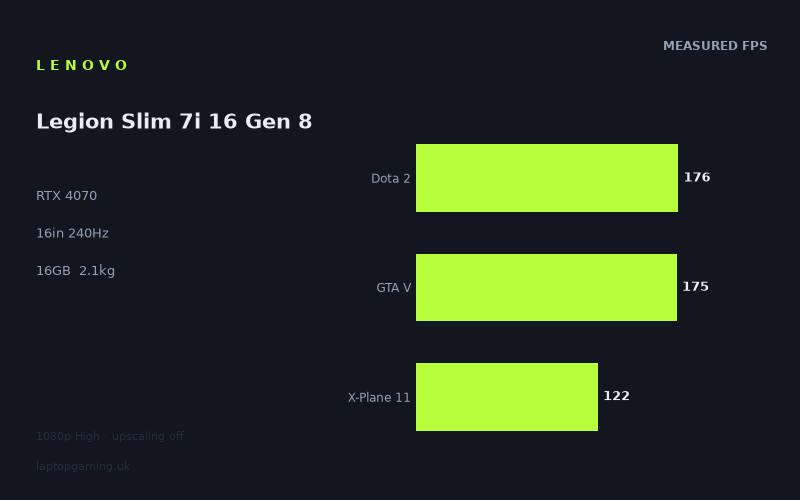
Frame rates
1920×1080, High preset, upscaling off.
Measured on this machine. Source: Notebookcheck, 2023-07-03.
Not scored: incomplete benchmark suite
Every scored laptop on this site is averaged over the same 5 games, and this one is short of Cyberpunk 2077, Baldur's Gate 3. A mean over 3 games is not comparable to a mean over 5, so we publish the figures we have and leave the score blank rather than rank it against machines tested on a different set. The numbers below are real - the suite is just incomplete.
How these numbers were produced
Frame rates here are not measured by us, and we label how each one was arrived at. A figure marked measured comes from a published run on that exact machine. A figure marked representative is derived from the GPU and its power limit (TGP) and cross-referenced against published reviews - a sound estimate of what that configuration delivers, but not a measurement of that specific laptop. Unless stated otherwise, numbers are 1920x1080, High preset, upscaling off. Where a laptop ships in several power configurations we use the wattage of the exact SKU listed, because a 140W RTX 5070 and a 115W one are not the same product.
In use
The short version
The Lenovo Legion Slim 7i 16 Gen 8 is an attempt to put desktop-replacement components into something you would actually be willing to carry. An RTX 4070 and a Core i9-13900H, a 16in 2560x1600 panel at 240Hz, and a chassis that weighs 2.132kg. That last figure is the one that defines the machine. It is meaningfully lighter than most 16in laptops carrying this class of GPU, and every other judgement about this laptop has to be made in the light of it.
The measured frame rates are good. Nine directly comparable titles in our record run from 259fps in Strange Brigade down to 76fps in Returnal, with a strong middle band and no result that could be called poor. Returnal at 76fps, measured at native 1920x1080 on High with upscaling switched off, is the number that best characterises the machine: it is the hardest workload in the comparable set and it still lands comfortably clear of any playability threshold.
There is a significant gap in our record for this machine, and it is not a small one. We do not hold a GPU power limit. On a machine like this, that is the specification you would most want, because the whole question about a slim 16in laptop with a 4070 in it is how much sustained power the chassis lets that GPU draw. The same GPU can be configured across a wide band, and the difference between the top and bottom of that band is worth an entire product tier. Our record is silent on it, and we are not going to infer a figure from frame rates and present it as though it were a specification. It is a gap that needs verifying against the manufacturer's documentation.
Buy it if the weight is the point — if you want something close to a full-power 16in gaming laptop that you will genuinely carry rather than resent. Look elsewhere if you want maximum frames per pound, because slim chassis engineering is expensive and the comparison figures below show mid-range machines matching this one in the games where the measurement can see least. As with the rest of this configuration, we have no confirmed UK price, so the value half of the argument cannot be closed here.
Performance
All the frame rates below were measured by Notebookcheck on 3 July 2023, at 1920x1080, High preset, upscaling off. That methodology matters at both ends: nothing at the bottom of the list is being propped up by reconstruction, and nothing at the top is inflated.
The power limit we do not have
Start with the gap, because it shapes how much weight to put on everything else. Our record contains no GPU power limit for this machine. That is unusual and it is unfortunate, and on this particular laptop it is the most consequential missing field it could be.
The reason is straightforward. A laptop GPU is not a fixed quantity. Manufacturers configure the same silicon across a wide range of sustained power, and the resulting performance difference between a conservative implementation and an aggressive one is large enough to erase a tier gap entirely — a well-fed part from a lower tier can beat a starved part from a higher one. In a large, heavy chassis you can generally assume a high configuration, because the cooling is there and the manufacturer has no reason not to use it. In a slim chassis you can assume nothing, because reducing the power limit is exactly how a thin machine is made to work thermally and acoustically.
This machine weighs 2.132kg with a 4070 and a Core i9-13900H inside it, which is precisely the design where the question arises. Our record cannot answer it. We would treat the missing power limit as something to verify from the specification sheet before buying, and we would treat any review that states a figure without a source with corresponding suspicion.
What the frame rates permit us to say is only this: the measured results are consistent with a competent implementation rather than a crippled one. Returnal at 76fps and Final Fantasy XV at 123fps are the two most GPU-dependent results in the comparable set, and neither looks like the output of a badly starved graphics part. That is an observation about the numbers, not a claim about the specification, and we are not going to dress it up as more.
The processor half
The Core i9-13900H is worth a moment, because the model name is easy to misread. This is an H-class part rather than one of the higher-power HX processors that appear in larger gaming machines, and that is entirely consistent with the design brief: a slim chassis has a total power and thermal budget to divide between the CPU and the GPU, and choosing a more efficient processor leaves more of that budget for graphics.
The consequence shows in the CPU-limited titles. Dota 2 at 176fps, GTA V at 175fps and X-Plane 11 at 122fps are results driven far more by the processor and by ageing game engines than by the graphics part, and they are solid. They are not, as the comparison section shows in detail, meaningfully different from what a variety of other machines produce in the same titles, because that whole category of game runs into the same limits on any reasonably fast modern processor.
The top of the list
Strange Brigade at 259fps heads the set and is, as always, more useful as a demonstration of ceiling than as a guide to gameplay. It is a well-optimised older title that scales generously and asks little of current hardware. The Witcher 3 at 226fps and F1 22 at 219fps follow, both far past what any player can perceive and both — on a 240Hz panel — close to or beyond what the display can show.
The Witcher 3 figure deserves a note on methodology. Our record holds this as an untagged entry, which means it is the workload the rest of our database uses. Where a machine's record instead carries a version-tagged variant of a game, that is a different workload and cannot be compared with the untagged one — a distinction that becomes directly relevant to Cyberpunk 2077 on this machine, below.
F1 22 at 219fps is a genuinely useful result rather than a ceiling curiosity, because racing games are one of the categories where very high frame rates translate into a tangible difference in feel and input latency, and because the 240Hz panel can actually show a substantial portion of it.
The middle, and the floor
Dota 2 at 176fps and GTA V at 175fps sit in the upper middle and are, as noted, CPU results. Tiny Tina's Wonderlands at 144fps is a more modern GPU workload and a strong showing. Final Fantasy XV at 123fps and X-Plane 11 at 122fps land almost on top of each other from completely different directions — the former an effects-heavy older engine that leans on the GPU, the latter a simulator bound by draw-call throughput and single-thread processor performance. Two identical-looking numbers, two entirely unrelated bottlenecks. That coincidence is a good illustration of why a benchmark suite needs games of different characters in it.
Returnal at 76fps is the floor of the comparable set and it is a long way below the next result up. It is a demanding modern title with dense effects work, and 76fps at native 1080p with no upscaling is a comfortable, playable result with real margin above any threshold that matters. It is also the single most informative number for anyone considering this machine for current-generation games, because it is the one where the GPU is unambiguously the constraint.
The distribution across the nine comparable titles is healthy: a high ceiling, a strong middle band clustered in the 120s to 170s, and one heavy outlier that is still well clear of trouble. There is nothing in this record that this machine handles badly.
The Cyberpunk 2077 entry, and why it does not count
Our record holds a figure of 106fps for this machine in Cyberpunk 2077 1.6 — that is, a specific older build of the game. That is not the same workload as the untagged Cyberpunk 2077 used in our scoring suite. The game changed substantially across versions, in ways that affect how much work it asks of the hardware, and treating a figure from one build as though it were a figure from another would corrupt every comparison it touched.
So the 106fps figure does not count towards the scoring suite, it is not merged with anything, and it is not used as a substitute for the missing Cyberpunk 2077 entry. It is worth citing purely as context — it indicates that this class of hardware handled that build of the game at a comfortable rate — and it should be read as nothing more than that.
We are spelling this out because it is exactly the kind of shortcut that makes benchmark databases untrustworthy. It would be very easy to slot 106fps into the missing slot, complete the suite and publish a rank. The number would look authoritative and it would be wrong.
Why there is no ranking for this machine
Every laptop we score is averaged over the same five games so the comparison is genuinely like for like. Our record here holds three of them — Dota 2, GTA V and X-Plane 11, averaging 158fps — and lacks Cyberpunk 2077 and Baldur's Gate 3.
The three we hold are, as this review has repeatedly noted, the CPU-limited ones. The two we lack are the heavy modern titles where the graphics hardware would actually be the thing under measurement. Averaging over three games and presenting the result against machines averaged over five would be comparing two different things while implying they were one, and in this specific case it would produce a figure dominated by the processor. That is why there is no rank on this page, and why the 158fps three-game average should be read as a description of three particular games rather than a score wearing different clothes.
The screen
16in, 2560x1600, 240Hz, IPS. For a machine of this weight this is an ambitious specification, and it is one of the strongest parts of the package.
The resolution the benchmarks were not run at
Every figure above was measured at 1920x1080. The panel is 2560x1600 — considerably more pixels — and our record holds no native-resolution measurements for this machine.
We will not estimate what they would be. A scaling guess printed next to real measurements is how benchmark data stops being worth anything. The mechanism, though, is worth understanding, because it lets you reason about the list yourself. The titles limited by the processor — GTA V, Dota 2, X-Plane 11, and to a large extent Strange Brigade and The Witcher 3 — lose relatively little when the pixel count rises, because their bottleneck is elsewhere until the GPU becomes the constraint. The titles limited by the GPU — Returnal above all, then Final Fantasy XV and Tiny Tina's Wonderlands — lose the most.
Returnal at 76fps is therefore the figure to interrogate if native-resolution gaming without upscaling is your requirement. It is the one with the least margin and the clearest GPU dependency, and our record cannot tell you where it lands at 2560x1600.
Is the pairing sensible?
Broadly, yes — with the usual modern caveat. A 4070 is a reasonable partner for a 1600p panel in most of what people play, and the shape of the 1080p list supports that: a middle band well up in three figures leaves genuine headroom to spend on extra pixels. In the heaviest current games, upscaling moves from optional to expected, which is the normal condition of every laptop in this class rather than a peculiarity of this one.
The unresolved variable is the power limit. How much headroom this particular 4070 actually has at native resolution depends on how much sustained power the chassis grants it, and that is the field our record is missing. In a heavier machine we would be confident the answer is "plenty". In a 2.132kg chassis we would want to see the number first.
240Hz on this hardware
A 240Hz panel invites scepticism on a machine that is not a pure esports laptop, and the measured figures partly answer it. Strange Brigade at 259fps exceeds the panel outright; The Witcher 3 at 226fps and F1 22 at 219fps come close enough that the display is doing real work. So the refresh rate is not decorative — in light and well-optimised titles this hardware genuinely produces frames at rates a slower panel would discard.
In the rest of the set the panel is ahead of the hardware, which is the correct relationship. A display should never be the bottleneck, and high refresh brings benefits that have nothing to do with hitting the number: smoother handling of variable frame rates, better cursor and window movement in ordinary desktop work, and — with variable refresh — a wider band in which frame-time variation is absorbed rather than shown as a stutter.
Panel type
IPS: predictable viewing angles, no exposure to the burn-in questions that follow OLED panels asked to display static game interfaces and toolbars for hundreds of hours, and no unusual behaviour to plan around. The cost against OLED is contrast — blacks read as dark grey in a dim room and high-dynamic-range material lacks the same impact.
Our record holds no brightness, contrast, gamut or response-time measurements for this panel, so we are not going to characterise its quality. IPS covers an enormous range in practice and the label alone does not place this one within it.
Build, size and portability
2.132kg for a 16in machine with a 4070 and a Core i9. This is the specification that justifies the machine's existence.
What the weight actually changes
A few hundred grams sounds trivial written down and is not trivial in use. It is roughly the difference between a machine you put in a bag without thinking and a machine you decide whether to take. Over months of ownership that changes how much use you get out of it — a gaming laptop that stays at home because carrying it is a chore is a worse purchase than a slightly slower one that goes with you.
The power supply is the qualifier, as always. Feeding a 4070 and a Core i9-13900H requires a real adapter, and it travels with the machine because no laptop in this class performs properly on battery. The realistic total in the bag is well above the headline figure, and anyone comparing 2.132kg against an ultraportable is comparing the wrong numbers.
Still, within the category, this is genuinely light for a 16in machine with this hardware, and that is an engineering achievement rather than a spec-sheet trick. It is also the thing you are paying for. Slim chassis design costs money — better thermal materials, denser boards, more careful airflow — and machines like this are consistently more expensive than conventional laptops with the same components.
The trade-off you cannot see in our record
Here the missing power limit returns, because it is the other side of the weight. Thin machines achieve their thinness partly through configuration: a lower sustained GPU power limit produces less heat, which permits a smaller cooling system, which permits a thinner chassis. That is the standard engineering path, and it is why slim gaming laptops so often underperform their specification labels.
We cannot tell you whether that trade has been made here, because we do not hold the figure. The measured frame rates do not look like those of a heavily constrained machine, but frame rates alone cannot distinguish a modest power limit paired with an efficient processor from a generous one paired with something less efficient. Anyone buying this laptop specifically because it is a slim 4070 machine should establish the number before committing.
Battery
Our record does not include a battery capacity for this machine, so we have nothing to report and will not guess. That is a second gap in the same record, and combined with the missing power limit it means this laptop's specification is less completely documented on our side than most.
The structural point applies regardless of capacity: no gaming laptop runs its GPU at full power from a battery, performance drops substantially when unplugged, and any cell in a machine of this type exists to make non-gaming work away from a socket possible rather than to support gaming. A slim, efficient-processor design of this kind is at least the sort of configuration where away-from-mains use is a realistic proposition, which is more than can be said for the larger machines further up the stack.
What our record does not cover
No surface temperatures, no fan noise measurements, no keyboard or port assessment, no build-quality observations. For a slim chassis running high-power components, acoustics and surface heat are among the most important practical considerations there are, and we hold neither. Our record covers performance and specification, and on this machine it does not even cover the specification completely.
How it compares
Each comparison uses only games both machines hold, preferring the scoring suite. That is the honest method and it has a systematic effect that dominates this section: the games laptops most commonly share are GTA V, Dota 2 and X-Plane 11, all of which are limited at 1080p by the processor and by old game engines rather than by the graphics part. A three-game comparison built on those titles compresses genuine GPU differences, sometimes to nothing at all.
Three of the four comparisons below rest on exactly that trio. Read them with that in mind, and then read the fourth, which shows what the same method does when the gap is large enough to survive the compression.
MSI Thin GF63 (RTX 4050) — this machine averages 70fps ahead across three shared games
The widest win in the set and the least surprising. A 4050 in a thin, inexpensive chassis against a 4070 with a Core i9-13900H is a mismatch on both halves of the specification.
What makes this result more interesting than it first appears is that it emerges from the same three-game basis that produces nothing in the two comparisons below. If the shared trio were incapable of separating machines at all, this would be near zero too. It is not — it is 70fps. So the trio does have some resolution: it can see a gap when the gap is between a strong processor and GPU pairing and a weak one. What it cannot see is a difference that lives purely in graphics capability.
We hold no confirmed UK price for the GF63, so we cannot say whether it is cheap enough to be a rational alternative for a tight budget. On performance grounds there is no comparison.
Medion Erazer Major X20 (RTX 4070 at 140W) — this machine averages one frame per second behind across three shared games
This is the comparison a prospective buyer most wants to see, and the one that frustrates most, because it is the direct slim-versus-conventional test and the shared set cannot perform it.
The Medion carries the same GPU tier at a documented 140W. Our machine's power limit is unrecorded. That is precisely the question — does the slim chassis cost you performance? — and across three shared games the answer comes back as a difference of about one frame per second, which is inside the range where nothing is being measured at all.
That result does not mean the two machines are equivalent. It means the three games in common are limited by their processors and their engines, and that both machines have processors fast enough to reach those limits. The 140W figure on the Medion has nothing to do in GTA V, Dota 2 or X-Plane 11, and neither would any figure on this machine. The comparison is silent on the question it appears to answer.
What would settle it is a shared set including genuinely GPU-limited titles — Returnal, or the untagged Cyberpunk 2077 our record lacks for this machine. We do not have that overlap, and we are not going to construct a conclusion from the overlap we do have.
Lenovo Legion Pro 5 16ARX8 (Ryzen 5 7645HX, RTX 4050) — this machine averages one frame per second behind across three shared games
The same pattern, and a more provocative version of it, because this rival sits two GPU tiers lower and carries a mid-range Ryzen 5 processor rather than a Core i9. Across the shared trio, it is fractionally ahead.
Nobody should conclude from this that a 4050 machine is the equal of this one. What it demonstrates is the ceiling effect in its clearest form: in GTA V, Dota 2 and X-Plane 11 at 1080p, the limiting factor is reached by any competent modern processor, and once it is reached, additional graphics capability produces nothing. A Ryzen 5 7645HX is entirely capable of reaching it. So is a Core i9-13900H. Both machines stop at the same place, for reasons that have nothing to do with their GPUs.
This comparison is genuinely useful in one narrow, money-saving way: if your library consists mainly of older and lighter games, the expensive hardware in this machine will not produce frames you can see, and a cheaper laptop will serve you just as well in those titles. It is useless as a guide to what happens in Returnal.
Asus ROG Strix Scar 17 (RTX 4090) — this machine averages 41fps behind across three shared games
The machine that beats this one by the widest margin, and the result that makes sense of the rest of the section.
Three shared games — the same narrow, CPU-heavy basis that reported a single frame of difference twice — and here it produces a 41fps gap. That is unambiguous and it is large. The instrument is not blind; when two machines are genuinely far apart, this comparison finds it even through the compression.
That is what makes the near-zero results above meaningful rather than suspicious. They are real findings about specific games, not artefacts of a broken method. And it is what makes the Medion comparison genuinely inconclusive rather than reassuring: the absence of a gap there tells you the trio could not see one, not that there is nothing to see.
Our record holds no confirmed UK price for the Strix Scar 17 and no GPU power limit for it either, so we are not going to characterise its configuration or its value — only its measured position relative to this machine.
Reading all four together
70fps ahead of a 4050 machine, one frame behind a 140W 4070 machine, one frame behind another 4050 machine, 41fps behind a 4090 machine — all across three shared games. The spread from 70fps ahead to 41fps behind proves the measurement has range. The two results clustered at zero in the middle are what happens when the machines being compared all have processors fast enough to max out the shared titles.
For a buyer the conclusion is clear enough. The case for this laptop is not that it produces higher frame rates than cheaper machines in the games most people play most of the time — on the evidence here, in those games, it does not. The case is the weight, the panel, the processor and the headroom in demanding titles that the shared comparisons cannot show. If those things are not worth a premium to you, the comparison figures are telling you something useful about where your money should go.
Who it's for
Buy it if
Portability is the actual requirement. This is the whole argument. 2.132kg for a 16in machine with a 4070 and a Core i9 is genuinely light for the class, and it is the reason to pay a premium over a conventional laptop with similar components. If the machine is going to move regularly, that difference compounds every single time.
You want a very good screen in a light machine. A 2560x1600 240Hz panel in a chassis this weight is a strong combination, and the measured figures show the refresh rate is genuinely used in lighter titles rather than being a number on a box.
Your gaming is broad rather than extreme. Nine comparable titles with a floor of 76fps and a healthy middle band is a machine that plays everything in our record comfortably. If you are not chasing native-resolution maximums in the heaviest releases, this is more than enough hardware.
You do work as well as gaming. The 16:10 panel, the high resolution and the Core i9 make this credible for development and content work, and the weight makes it credible as a machine you take to an office.
Buy something else if
You want the most performance for the money. Slim engineering costs money, and the comparison section shows conventional and cheaper machines matching this one in the games where the measurement can see least. A heavier laptop with a documented high power limit will almost certainly deliver more frames per pound spent — and there is a specific version of this in the set, since the Medion Erazer Major X20 carries the same GPU tier at a documented 140W.
You need certainty about the GPU configuration. Our record has no power limit for this machine, and in a slim chassis that is the field that most determines how it behaves in demanding games. Anyone whose purchase hinges on that number should establish it from the manufacturer before buying, and we would rather say so than fill the gap with an assumption.
You want native-resolution performance in the heaviest current games with no upscaling. Returnal at 76fps is a 1080p figure and the panel has substantially more pixels than that. This is a capable mid-to-upper-range machine, not a flagship, and the Strix Scar 17 comparison puts a figure on the distance even in a measurement that compresses it.
You mainly play older and lighter games. The two near-level comparisons are unambiguous on this point. In that category this machine gives up nothing to considerably cheaper hardware — and gains nothing from its own. Buy on screen, weight and build instead, or spend less.
What we do not know
Stated plainly, because it is unusually extensive on this machine: we have no GPU power limit, no battery capacity, and no confirmed UK price. We have no untagged Cyberpunk 2077 figure and no Baldur's Gate 3 figure, so no complete scoring set and no ranking against the rest of our database. The Cyberpunk 2077 1.6 result we do hold is from a different build of that game, is cited as context only, and is not merged with or substituted for the missing entry. We have no native-resolution measurements at the panel's own 2560x1600, no thermal or acoustic data, and no panel measurements beyond resolution, refresh and type. Everything above derives from the specification in our record and from Notebookcheck's measurements of 3 July 2023 at 1920x1080 on High with upscaling off.
Within those limits, this is a good machine with a clear purpose. It runs everything in our record well, its worst comparable result is still comfortable, and it does all of that in a chassis that is genuinely light for what it contains. The reservations are about documentation rather than performance: on a slim machine, the power limit is the number that determines everything, and it is the number our record is missing.