Review
HP Omen Transcend 16-u1095ng review
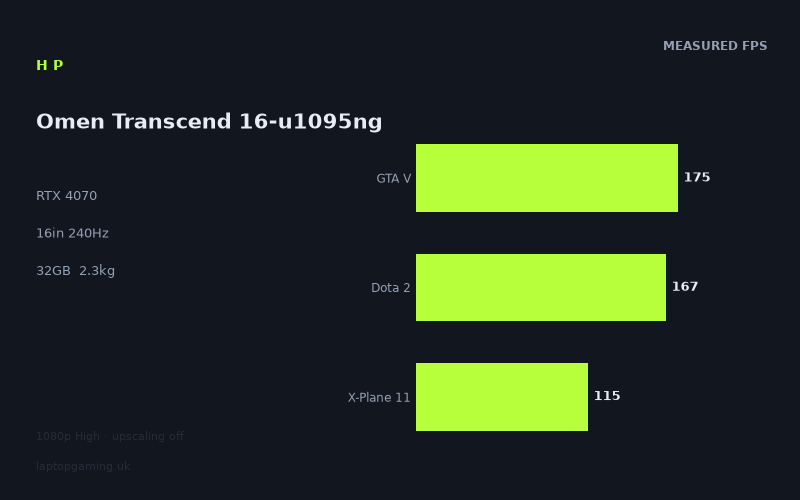
Frame rates
1920×1080, High preset, upscaling off.
Measured on this machine. Source: Notebookcheck, 2024-02-14.
Not scored: incomplete benchmark suite
Every scored laptop on this site is averaged over the same 5 games, and this one is short of Cyberpunk 2077, Baldur's Gate 3. A mean over 3 games is not comparable to a mean over 5, so we publish the figures we have and leave the score blank rather than rank it against machines tested on a different set. The numbers below are real - the suite is just incomplete.
How these numbers were produced
Frame rates here are not measured by us, and we label how each one was arrived at. A figure marked measured comes from a published run on that exact machine. A figure marked representative is derived from the GPU and its power limit (TGP) and cross-referenced against published reviews - a sound estimate of what that configuration delivers, but not a measurement of that specific laptop. Unless stated otherwise, numbers are 1920x1080, High preset, upscaling off. Where a laptop ships in several power configurations we use the wattage of the exact SKU listed, because a 140W RTX 5070 and a 115W one are not the same product.
In use
The short version
The HP Omen Transcend 16-u1095ng is a 16in machine weighing 2.284kg, built around an RTX 4070 and a Core i9-14900HX, with 32GB of memory, a 97Wh battery and a 2560x1600 OLED panel running at 240Hz. Notebookcheck's measured figures, dated 14 February 2024, cover ten titles at 1920x1080 on the High preset with upscaling switched off. They run from 358fps in Prince of Persia The Lost Crown down to 92fps in Helldivers 2.
Two things make this record more useful than most. The first is that the measured set is genuinely contemporary — Prince of Persia The Lost Crown, Ready or Not, The Finals, Palworld and Helldivers 2 are all recent releases, and they sit alongside the older reference titles rather than being crowded out by them. Most laptop benchmark records lean heavily on games from three or four years ago. This one tells you what the machine does with software people are actually playing now.
The second is that the set includes two shooters — Ready or Not at 194fps and The Finals at 168fps — which finally gives the 240Hz panel some evidence to be judged against. On most machines with a display like this we are reduced to saying that the refresh rate exists for a genre the measurements do not cover. Here we can say something concrete about it.
The Core i9-14900HX is the specification that shapes the rest. It is an HX-class desktop-derived processor, the most powerful category of mobile chip in this generation, and it sits behind results like GTA V at 175fps and Dota 2 at 167fps — figures set by the processor rather than the graphics card. It also has a very substantial appetite for power, and in a 2.284kg 16in chassis it is sharing its thermal budget with the RTX 4070. That tension is the central engineering question about this machine and the performance section works through it.
There is no score on this page. Our scoring suite is five games, identical for every ranked laptop, and this machine holds three: GTA V at 175fps, Dota 2 at 167fps and X-Plane 11 at 115fps, averaging 152fps. We have no figure for Cyberpunk 2077 and none for Baldur's Gate 3, both substantially heavier than anything in the three we hold. Averaging a partial set against machines averaged over the full five would flatter this laptop in a direction we can predict, so we publish nothing rather than something we know is skewed.
We also hold no confirmed UK price for this configuration, no power limit for its RTX 4070, and no confirmed price for any of the four rivals it is compared against. This page is therefore about capability rather than value, and we would rather say that plainly than imply a verdict we cannot support.
Buy it if you want one machine that is genuinely excellent at both halves of the job — a professional-grade OLED display for work, an HX-class processor and a 240Hz refresh rate for competitive play — and 2.284kg is a weight you can live with. Look elsewhere if you need the strongest possible graphics performance for the money, because the comparisons below suggest this machine's graphics card is not what makes it special.
Performance
The power limit our record does not hold
The most predictive figure for any laptop graphics card in this generation is the power limit its manufacturer chose. Nvidia sells identical silicon to every laptop maker with a configurable ceiling, and each maker picks a point in that band based on how much heat the chassis can move, how much fan noise they will ship and what the machine is meant to cost. The consequence is a product stack in which the gap between a well-fed GPU and a starved one of the same model routinely exceeds the gap between adjacent model numbers. That is the normal behaviour of this generation, not an edge case.
Our record does not hold a power limit for this machine's RTX 4070. That is a genuine gap and it removes the most useful single predictor available. We will not invent a figure, and nothing below should be read as implying one.
The reasoning we can do from the rest of the record is more interesting here than usual, because the machine contains a specific tension. The Omen Transcend line is HP's thin-and-light gaming range — machines that carry gaming-class graphics in bodies substantially lighter than dedicated gaming laptops of the same screen size. At 2.284kg on a 16in footprint, this sits several hundred grams below what a purpose-built 16in gaming machine typically weighs, and that mass difference is heatsink, fan volume and structural metal that is not present.
Into that chassis HP has put a Core i9-14900HX, which is not a modest component. HX-class processors are derived from desktop silicon and they draw accordingly — they are the most power-hungry mobile CPUs of the generation by a considerable margin. In a machine of this size, the processor and the graphics card are drawing from a shared and finite thermal budget, and when both are loaded simultaneously something has to give.
This matters because it is the most likely explanation for the pattern in the comparisons further down. A machine with an HX-class processor will produce excellent numbers in titles limited by the CPU, because that is where the processor's advantage lands. It may produce more ordinary numbers in titles limited by the graphics card, if the GPU's share of a constrained thermal budget is smaller than it would be in a heavier chassis. That is a hypothesis rather than a measurement — we do not hold the power figure that would confirm it — but it is consistent with everything on this page and worth carrying into the comparison section.
A modern measured set, and why that changes the analysis
Before the individual numbers, the composition of this record deserves attention, because it is unusual enough to change what can be concluded from it.
The ten titles are Prince of Persia The Lost Crown at 358fps, Strange Brigade at 220fps, Ready or Not at 194fps, GTA V at 175fps, The Finals at 168fps, Dota 2 at 167fps, X-Plane 11 at 115fps, Final Fantasy XV at 108fps, Palworld at 102fps and Helldivers 2 at 92fps.
Five of those — Prince of Persia The Lost Crown, Ready or Not, The Finals, Palworld and Helldivers 2 — are recent releases. That is a far more current set than most laptop records contain, and it makes this page more useful in two specific ways.
First, the results describe engines and rendering techniques in current use rather than ones from several years ago, which means they generalise better to whatever a buyer plays next. Second, the set includes multiplayer and competitive titles, which is the category most badly served by conventional benchmark suites and the category this machine's 240Hz display is built for. A record containing The Finals and Ready or Not can say something evidence-based about a high-refresh panel. Most cannot.
The trade-off is that these titles are not in our scoring suite, so they cannot contribute to a ranking. The three suite games we hold — GTA V, Dota 2 and X-Plane 11 — are the older, more conventional ones. That is worth remembering when reading the comparisons, all of which are built from the suite rather than from the modern titles.
The top: 358fps, and what it is and is not worth
Prince of Persia The Lost Crown at 358fps is by a wide margin the highest result in the record, and it is also the least representative. It is a stylised, comparatively light title by design — beautiful, but not a heavy renderer — and 358fps at 1080p is a demonstration of headroom rather than a test of it.
It is worth one specific observation. 358fps is substantially beyond the panel's 240Hz refresh rate, which means roughly a third of those frames could be displayed and the rest could not. It also confirms something structurally useful: the platform as a whole, processor included, can reach well past 300fps in a favourable workload. Nothing in the machine's design imposes a cap below that, which is a relevant fact for anyone playing competitive titles with light renderers.
Strange Brigade at 220fps is a more conventional high-end result. It is a well-optimised title that has produced generous numbers on modest hardware for years, and 220fps at native 1080p is comfortable rather than remarkable — but it sits just under the panel's refresh rate, close enough to treat as filling it.
Both results are, at these frame rates, limited by the processor rather than the graphics card, and both are consequences of the Core i9-14900HX. When a game runs at 358fps the GPU is finishing frames faster than any CPU could feed it, and what you are reading is the processor. That observation is central to the whole comparison section below.
The middle: Ready or Not, GTA V, The Finals and Dota 2
Four titles cluster between 167fps and 194fps, and this is the most practically important band on the page because it contains the games the machine's display exists for.
Ready or Not at 194fps is the strongest of them. It is a tactical shooter with a demanding renderer, and 194fps at native 1080p on High is a serious result — the sort of frame rate that makes a high-refresh panel worth having rather than an ornament.
The Finals at 168fps is the more interesting of the two shooters, because it is a genuinely heavy competitive title with destructible environments and a substantial physics cost. 168fps in that game is a considerably harder achievement than 194fps in most others, and it is the single best evidence on this page that the machine suits the use its display implies.
GTA V at 175fps and Dota 2 at 167fps are two of the three scoring-suite results and behave as expected: older, lighter titles running well clear of any hardware limit, their numbers set by the processor. Dota 2 at 167fps in particular is a strong result for that title and reflects the HX-class chip behind it.
All four sit between 167fps and 194fps, which is to say all four land in the band where a 240Hz panel is doing real work — displaying substantially more frames than a 120Hz or 144Hz display could, even though none of them saturates it. That distinction is worth stating clearly because it is often got wrong: you do not need to reach 240fps for a 240Hz panel to be better than a 120Hz one. A display refreshing at 240Hz can present a 168fps stream with less latency and less staleness than a 120Hz panel can, and the benefit is continuous rather than a threshold that switches on at 240.
The floor: 115fps down to 92fps
Four titles sit between 115fps and 92fps: X-Plane 11 at 115fps, Final Fantasy XV at 108fps, Palworld at 102fps and Helldivers 2 at 92fps. This is where the graphics card, rather than the processor, is doing the deciding.
Helldivers 2 at 92fps is the lowest result and the most informative in the whole record. It is a demanding modern co-operative shooter with heavy particle and effects work, and it is precisely the kind of title where a graphics card's power budget shows. 92fps at native 1080p on High with upscaling off is a good result in absolute terms — comfortably playable, comfortably smooth — but it is well under half the panel's refresh rate, and it is measured at a resolution below the panel's native one.
Palworld at 102fps tells a similar story from a different kind of workload: a large open world with substantial streaming and simulation demands. Final Fantasy XV at 108fps is a heavier graphics workload with expensive effects. X-Plane 11 at 115fps is a flight simulator that leans hard on the processor, so its position here says more about the nature of the title than about the graphics card.
What is notable is how tightly these four are clustered — 23fps separates the highest from the lowest, across four titles of quite different character. When dissimilar workloads compress like that, it usually indicates a common constraint rather than each hitting its own. That constraint is the graphics card, and its position is the most useful single fact about what this machine will do in demanding games.
The overall shape of the record is a very wide top and a narrow bottom: 358fps to 167fps across six titles, then 115fps to 92fps across four, with a 52fps gap between the two groups and nothing in it. That is the fingerprint of a strong processor paired with a graphics card that reaches its limit and stays there. Above the gap, the CPU is deciding and the machine is exceptional. Below it, the GPU is deciding and the machine is merely good.
Why there is no score
Our scoring suite is five games and every ranked laptop is averaged over the same five, so that any two machines can be compared like for like. Here we hold three: GTA V at 175fps, Dota 2 at 167fps and X-Plane 11 at 115fps, for a mean of 152fps.
We hold no figure for Cyberpunk 2077 and none for Baldur's Gate 3. Both are substantially heavier than any of the three we do hold, and this machine's record makes the consequence easy to predict: results collapse from the 167-to-358fps band into the 92-to-115fps band as soon as the graphics card becomes the constraint. Cyberpunk 2077 and Baldur's Gate 3 would land in the lower band, not the upper one, and a five-game average including them would fall a long way below 152fps.
Publishing a three-game average against machines averaged over five would therefore not be a rough approximation — it would be a systematic overstatement with a known direction, and it would overstate most against exactly the machines best equipped to win the two missing games. That is why the page carries no number.
The screen
The display is a 16in OLED panel at 2560x1600, refreshing at 240Hz, and it is the best specification of any component in this machine. High-resolution OLED panels usually come at 60Hz or 120Hz; high-refresh gaming panels are usually IPS. This is both at once, which is genuinely rare.
2560x1600 against a 1080p benchmark
The arithmetic first. 2560x1600 is 4.10 million pixels. 1920x1080, the resolution at which every measured figure was taken, is 2.07 million. The panel therefore carries almost exactly twice the pixel count of the benchmark resolution.
That is a modest gap by the standards of high-resolution laptop displays, and it matters. Games do not scale linearly with pixel count and we are not going to build native-resolution estimates from 1080p figures — that would mean publishing numbers we do not hold. But a machine with a 92fps floor facing a resolution step of two times the pixels is in a very different position from one facing four and a half times. There is real headroom here, and 2560x1600 is a realistic target for most of this record rather than an aspiration.
The panel is 16:10 and the benchmark resolution is 16:9, so the two do not divide evenly and running at 1080p means non-integer scaling or letterboxing. That is a minor practical note rather than a problem, and modern GPU scaling handles it competently.
2560x1600 is arguably the ideal resolution for a 16in gaming panel. 1920x1200 on a screen this size is visibly coarse at normal viewing distance; 4K would demand far more than an RTX 4070 has to give at the frame rates a 240Hz panel implies. HP has chosen the setting the hardware can actually drive, which is a more disciplined decision than the specification-sheet alternatives.
240Hz, and the two shooters that justify it
Of the ten measured titles, one exceeds the panel's refresh rate — Prince of Persia The Lost Crown at 358fps — and one comes close, Strange Brigade at 220fps. The other eight fall below it, four of them by a wide margin.
On most machines with a 240Hz display, that is where the analysis has to stop, with a note that the refresh rate exists for a genre the benchmark set does not cover. This record is better than that. Ready or Not at 194fps and The Finals at 168fps are competitive shooters, they are the genre 240Hz panels are built for, and both produce frame rates that make real use of the display.
The point that needs making clearly is that saturating a 240Hz panel is not the standard by which it should be judged. A display refreshing at 240Hz presents a 168fps stream with a fresher image and lower presentation latency than a 120Hz or 144Hz display can, and the benefit is continuous rather than a threshold. A player running The Finals at 168fps on this machine is getting a genuine advantage from the panel — not the full theoretical advantage, but a substantial share of it. The same argument applies to Ready or Not at 194fps with more force still.
So the honest assessment is more favourable than the raw count suggests. The panel is not filled by most of the measured set, but the titles it exists to serve produce frame rates well into the range where it does useful work. That is a coherent pairing rather than a specification-sheet mismatch.
The caveat runs the other way. In the four heaviest titles — 115fps down to 92fps — the display is idling badly, presenting less than half of what it could. Those are the games where the graphics card is the constraint, and where a buyer will get no return at all on the refresh rate they paid for.
OLED at 240Hz
The panel technology is OLED, and combining it with a 240Hz refresh rate is the specification that makes this display unusual. Per-pixel illumination gives true black, effectively infinite static contrast and no backlight bleed, and OLED's pixel response is inherently very fast — which is what makes a high refresh rate meaningful rather than nominal on this panel type.
Our record holds the panel type, resolution and refresh rate. It does not hold brightness, contrast measurements, colour gamut coverage, colour accuracy or measured response times, so we are not going to characterise those.
What the combination establishes is that this display is not making the trade most laptops make. The usual choice is a high-resolution OLED for image quality at a low refresh rate, or a high-refresh IPS for gaming at lower contrast. This machine declines to choose, which is the strongest argument for it as a single machine covering both creative work and competitive play. Paired with 32GB of memory and an HX-class processor, the intent is unambiguous: one laptop, both jobs, no second machine required.
Build, size and portability
2.284kg on a 16in footprint is the specification that defines how this machine gets used, and it sits in an interesting middle position.
It is not light in absolute terms. A 2.28kg laptop is roughly twice the weight of a thin-and-light productivity machine, and a 16in footprint is bulky in a bag regardless of mass. Nobody will mistake this for a portable computer in the way a 14in machine is portable.
But it is meaningfully lighter than a dedicated 16in gaming laptop, which is the comparison HP intends and the one that makes sense. Purpose-built gaming machines of this screen size routinely sit several hundred grams heavier, and on a 16in chassis that difference decides whether the laptop travels occasionally or effectively never. The Omen Transcend line exists precisely in this gap: gaming-class hardware in a body light enough to move without it being an expedition.
The trade is the one identified at the top of the performance section, and here it is sharper than usual because of what is inside. A 2.284kg 16in chassis has less heatsink volume, less fan capacity and less surface area than a 2.7kg one, and it is being asked to cool a Core i9-14900HX — an HX-class processor derived from desktop silicon and one of the hungriest mobile chips of the generation — alongside an RTX 4070. Those two components compete for the same thermal budget whenever both are loaded, which is exactly what happens in a game.
We do not hold a power figure for the graphics card and will not guess at one. But the structural point is worth stating for a buyer cross-shopping on specification lists: a 2.284kg 16in machine with an HX-class processor and an RTX 4070 is not the same product as a 2.7kg 16in machine with the same two components, and the difference will express itself in exactly the workloads where the graphics card is the constraint. The bottom of this record — 92fps to 115fps — is where to look for it.
The battery is 97Wh, which is a large pack, close to the practical ceiling for a machine intended to travel by air. Our record holds no measured runtime for this configuration and we are not going to estimate one — an OLED panel's draw varies enormously with screen content and an HX-class processor's varies enormously with workload, so capacity alone predicts very little. What is safe to say is that 97Wh is a serious capacity, that it is a sensible pairing with a machine meant to move, and that no laptop of this class games meaningfully away from mains power regardless.
The memory configuration is 32GB, which is generous, well beyond what any title in the measured set requires, and appropriate for a machine expected to handle creative work alongside games. It removes one of the more common upgrade worries.
How it compares
The four machines below all carry graphics cards from this same generation and are a deliberate spread rather than a list of nearest neighbours: the two closest results, the machine this one beats by the widest margin, and the machine that beats it by the widest. Each comparison uses only games both machines hold, drawing preferentially on our scoring-suite titles.
Two limitations apply to all four. Every comparison rests on a three-game overlap, which is shallow, and those three games will be drawn from the suite titles we hold — GTA V, Dota 2 and X-Plane 11 — rather than from the modern shooters that make this machine's record distinctive. And we hold no confirmed UK price for this machine or for any of the four rivals, so nothing here can be a value judgement. This section is about capability alone.
MSI Thin GF63 — an RTX 4050, and 65 frames per second
The MSI Thin GF63 carries an RTX 4050. Across three shared games, the Omen Transcend 16 averages 65 frames per second more.
This is the widest winning margin in the set and the most straightforward. An RTX 4070 paired with a Core i9-14900HX and 32GB in a 16in chassis is a substantially more capable platform than an RTX 4050 in a thin budget 15in one, and the measurement reflects it.
The detail worth noticing is where the margin comes from. The three shared titles are the same partly processor-limited set that produces zeroes in the two comparisons below, and this machine is 65fps clear in them. That is not a graphics result — it is a platform result. The HX-class processor reaches a ceiling in those titles that the GF63's platform cannot approach, and the gap opens accordingly.
It is a useful demonstration that near-zero margins elsewhere on this page are not a property of the benchmark being blunt. On the identical three-game depth, this comparison produces the largest positive margin in the set.
Schenker XMG Pro 15 (E23) — an RTX 4060, and a gap of nothing
The Schenker XMG Pro 15 (E23) carries an RTX 4060. We hold no confirmed UK price for it. Across three shared games, the Omen Transcend 16 averages level with it: the difference rounds to zero.
An RTX 4070 machine with an HX-class processor drawing level with an RTX 4060 machine looks like a poor result, and it needs unpicking rather than accepting.
The three shared titles are, on hardware of this class, substantially limited by the processor and the platform rather than by the graphics card. GTA V at 175fps and Dota 2 at 167fps are firmly in that territory, and X-Plane 11 leans on the CPU by design. In all three, a more capable graphics card contributes nothing — it finishes each frame early and waits for work.
What that means is that this comparison is largely a test of the two platforms rather than the two graphics cards, and the two platforms land in the same place. It is not evidence that an RTX 4060 matches this machine's RTX 4070; it is evidence that these three games at 1080p cannot tell them apart.
The proof is in this machine's own record. Helldivers 2 at 92fps and Palworld at 102fps are results that describe the graphics card working hard and reaching its limit. That is the class of workload where a tier difference would express itself, and it is precisely the class this three-game comparison does not touch. A buyer should read the zero as a fact about the overlap, not about the hardware — while noting honestly that we have no measurement proving the gap exists, only a well-supported reason to expect it.
Aorus 15X ASF — an RTX 4070 at 140W, and also a gap of nothing
The Aorus 15X ASF carries an RTX 4070 at 140W. We hold no confirmed UK price for it. Across three shared games, the Omen Transcend 16 averages level with it.
This is the most informative of the two zeroes, because it holds the graphics model constant and varies only the power budget. The Aorus runs the same RTX 4070 at a stated 140W — a generous configuration, towards the top of the band this chip is sold across — and produces the same frame rates as this machine in three shared games.
The explanation is the same as above, and this pairing sharpens it. If these three titles were genuinely testing the graphics cards, a 140W RTX 4070 would be expected to separate itself from an RTX 4070 in a lighter chassis — particularly one sharing its thermal budget with an HX-class processor. It does not, because in these titles neither graphics card is the constraint. Both machines are waiting on their processors, and both processors reach a similar ceiling.
This comparison is also the closest thing we have to information about the Omen's own power configuration, and it is worth being careful about what it can and cannot support. It does not establish that HP runs its RTX 4070 at or near 140W — the comparison is not sensitive enough to show a difference if one exists. It establishes only that in three processor-limited titles the two machines are indistinguishable, which would be true across a wide range of possible configurations. Our record does not hold this machine's power limit and this comparison does not supply one.
Asus ROG Strix Scar 17 — an RTX 4090, and 47 frames per second
The Asus ROG Strix Scar 17 carries an RTX 4090, the fastest laptop graphics card of the generation. We hold no confirmed UK price for it. Across three shared games, the Omen Transcend 16 averages 47 frames per second behind it.
This is the result that demonstrates the benchmark can separate machines. On the same three-game depth that produced zeroes against an RTX 4060 and a 140W RTX 4070, the Strix Scar opens a 47fps gap. Whatever the limitations of a shallow overlap, it is plainly capable of showing a difference when a genuine platform difference exists.
The more interesting observation is how narrow 47fps is for a comparison against the top of the range. The Strix Scar carries the fastest GPU available in a mobile machine, and in three shared games it is 47fps ahead — less than the 65fps this machine puts on an RTX 4050. The gap upward to the best is smaller than the gap downward to a two-tier-lower card.
The most plausible explanation is the Core i9-14900HX. In processor-limited titles, the ceiling is set by the CPU, and an HX-class chip of this generation is at or near the top of what mobile silicon can reach. A machine so equipped comes close to the platform ceiling in those games, which leaves a faster graphics card with less room to demonstrate its advantage. Against a machine with a weaker processor, the same RTX 4090 would have more headroom to exploit and would likely open a wider gap.
The corollary matters for a buyer. In a heavier shared set — the kind of workload that puts this machine at 92fps rather than 358fps — the gap to an RTX 4090 would very likely be substantially wider, because that is where the graphics card decides the outcome. 47fps is measured in the games least favourable to showing it, and should be read as a floor rather than a ceiling.
What the four say together
Against an RTX 4050: 65fps ahead. Against an RTX 4060: level. Against a 140W RTX 4070: level. Against an RTX 4090: 47fps behind.
Read as a set, and with the three-game overlap in mind throughout, two conclusions stand out.
First, these comparisons are measuring the platform, not the graphics card. The two that produce margins are against machines whose platforms differ substantially — a weak budget laptop below, a top-end machine above. The two that produce nothing are against machines whose platforms are competent enough to reach the same processor-limited ceiling. The graphics cards involved range from an RTX 4050 to an RTX 4090 and the pattern does not track them.
Second, the Core i9-14900HX is doing a great deal of the work in this machine's results. It is what puts 65fps on an RTX 4050 machine, and it is the most plausible reason the gap to an RTX 4090 is narrower than the gap to an RTX 4050. That is a real strength and a genuine reason to want this laptop — but it is worth a buyer understanding that the processor, not the graphics card, is what these comparisons are showcasing. Where the graphics card decides, this machine's record shows 92fps to 115fps, and none of these four comparisons reaches that territory.
Who it's for
Buy it if you want one machine for two jobs and are unwilling to compromise on either. This is the clearest case for the Omen Transcend 16. A 2560x1600 OLED panel at 240Hz is both a professional-grade display and a competitive gaming display, which is a combination almost nothing else offers. Add 32GB of memory and an HX-class processor and you have a machine that handles heavy creative work and high-frame-rate gaming without asking you to choose. If you would otherwise be buying two machines, this is a strong argument for one.
Buy it if you play competitive shooters. This is the rare record that contains evidence for that use rather than requiring extrapolation. Ready or Not at 194fps and The Finals at 168fps are real measurements in the genre the 240Hz panel exists for, and they are strong enough that the display does meaningful work. The processor is the right one for that use too — competitive titles are frequently processor-limited, and this machine has one of the best mobile chips of the generation.
Buy it if you want a 16in machine that actually travels. 2.284kg is several hundred grams below what dedicated 16in gaming laptops weigh, and the 97Wh battery is sized for it. If a large screen and genuine mobility both matter, this is a coherent answer where most 16in gaming machines are not.
Do not buy it if raw graphics performance per pound is the goal. Everything on this page points the same way: the processor and the display are what make this machine special, and the graphics card is competent rather than exceptional. It draws level with an RTX 4060 machine and with a 140W RTX 4070 machine in shared titles, and its floor across ten games is 92fps. A buyer who simply wants the most frames available for the money should look at heavier machines that spend their thermal budget differently.
Do not buy it expecting the panel to be filled. One title in ten exceeds 240fps and four sit below 120fps, all measured at a resolution below the panel's native one. The display does useful work in the shooters and idles badly in the heavy titles. If your library is dominated by demanding single-player games, you are paying for refresh headroom those games will not use.
Do not buy it as a portable computer. A 16in footprint is awkward in a bag whatever it weighs, and 2.284kg is only light by the standards of gaming laptops. If the machine has to be carried daily, a 14in chassis is the right category and this is not it.
Be careful about what we do not hold. There is no confirmed UK price for this machine or for any of the four comparisons, which removes value from the discussion entirely — and for a machine whose appeal rests on a premium display and a top-tier processor, price is exactly the variable that decides whether it is shrewd or indulgent. We also hold no power limit for the RTX 4070, which is the figure that would settle the central question about how the thermal budget is split with the Core i9-14900HX. We hold no measured battery runtime, no noise or temperature figures, and no results for two of the five games we rank on. What we do hold is ten measured frame rates from one source on one date, unusually weighted towards current software, and they describe a machine with an exceptional platform, an exceptional display and a graphics card that is the least remarkable thing about it.