Review
Alienware x14 i7 RTX review
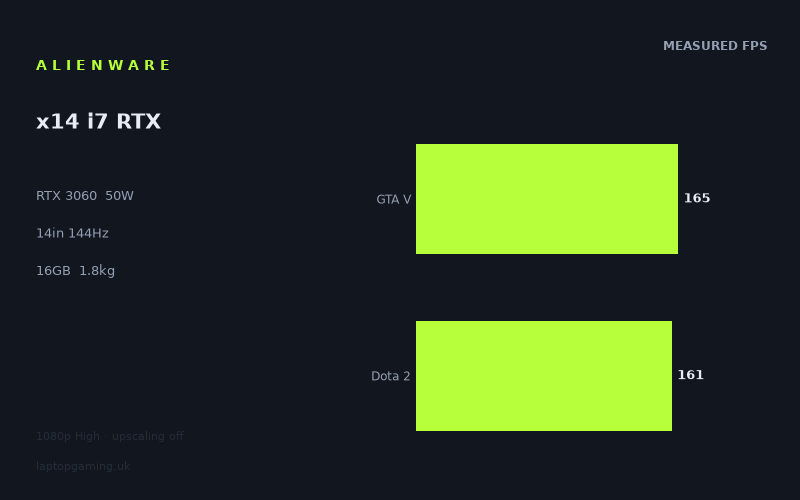
Frame rates
1920×1080, High preset, upscaling off.
Measured on this machine. Source: Notebookcheck, 2022-03-17.
Not scored: incomplete benchmark suite
Every scored laptop on this site is averaged over the same 5 games, and this one is short of Cyberpunk 2077, Baldur's Gate 3, X-Plane 11. A mean over 4 games is not comparable to a mean over 5, so we publish the figures we have and leave the score blank rather than rank it against machines tested on a different set. The numbers below are real - the suite is just incomplete.
How these numbers were produced
Frame rates here are not measured by us, and we label how each one was arrived at. A figure marked measured comes from a published run on that exact machine. A figure marked representative is derived from the GPU and its power limit (TGP) and cross-referenced against published reviews - a sound estimate of what that configuration delivers, but not a measurement of that specific laptop. Unless stated otherwise, numbers are 1920x1080, High preset, upscaling off. Where a laptop ships in several power configurations we use the wattage of the exact SKU listed, because a 140W RTX 5070 and a 115W one are not the same product.
In use
The short version
The Alienware x14 i7 RTX is a compact gaming laptop built around an RTX 3060, a Core i7-12700H, 16GB of memory and a 14in 1920x1080 IPS display with a 144Hz refresh rate. Its published Notebookcheck figures show a machine that is very capable at its native resolution, but not one that can be treated as a 144fps laptop in every demanding game at the High preset with upscaling disabled.
That distinction matters. The measured results are excellent in the less demanding end of the test set: F1 2021 and GTA V both reach 165fps, while Dota 2 records 161fps. Strange Brigade reaches 145fps and The Witcher 3 reaches 144fps, so those games meet or effectively meet the panel’s refresh ceiling under the stated test conditions. GRID Legends at 131fps is also close enough to make the 144Hz panel worthwhile, even though it does not quite fill it.
The picture changes in heavier games. Far Cry 5 records 105fps, Final Fantasy XV records 74fps and Cyberpunk 2077 1.6 records 65fps. Those are still playable-looking figures in isolation, especially given that they were recorded at 1920x1080, High settings and with upscaling off, but they are a long way from 144fps. Anyone buying the x14 specifically because the screen is 144Hz should therefore understand that the display is a ceiling, not a promise that every game will reach it without changing settings.
The published mean across the available scoring-suite games is 136fps. That is a strong result on paper, but it needs to be read alongside the individual figures rather than as a guarantee of a single gaming experience. A mean is lifted by the 165fps results in GTA V and by Dota 2 at 161fps. It does not tell the buyer that Final Fantasy XV is at 74fps or that Cyberpunk 2077 1.6 is at 65fps. The x14 is fast in the games where its hardware can push high frame rates at 1080p, but its benchmark spread shows clearly that it has limits in the more demanding titles.
There is no confirmed UK price in the available information. That prevents a final judgement on value. The hardware specification is sensible for a premium compact machine: the Core i7-12700H, 16GB of memory, 1TB SSD, 80Wh battery and sub-2kg weight make a coherent package on paper. But without a confirmed price, it is not possible to say whether the Alienware asks a reasonable premium for its small chassis and screen, or whether a larger RTX 3060 machine would offer materially better value.
It is also important not to overstate the benchmark comparison position. The scoring suite is incomplete because there is no published X-Plane 11 figure for this machine. The site’s ranked laptops are averaged over the same full set of games, so this Alienware cannot honestly be placed in that ranking from the partial result. The available figures are useful, and they are enough to establish what the x14 can do in the games listed, but they are not enough to claim a directly comparable overall standing against laptops with a complete suite.
The strongest case for the Alienware x14 is therefore straightforward: it suits someone who wants a 14in, 1.793kg gaming laptop and mainly plays games whose measured results are near or above the screen’s 144Hz refresh rate. It also suits someone happy with 65fps to 105fps in the more demanding titles included here, rather than expecting a locked high-refresh experience in every game at High settings.
It is a less convincing choice for the buyer whose priority is maximum performance per pound, because there is no confirmed UK price and because the available comparison data shows that a much larger RTX 3080 Ti machine can be substantially faster. It is also not the right laptop for anyone who regards 144fps as a minimum requirement for every game, or for anyone who wants published evidence of battery life, noise, temperatures, dimensions or the Alienware’s GPU power limit before buying. Those figures are not available in the supplied data and should not be guessed.
Performance
What the benchmark data actually says
Notebookcheck measured the Alienware x14 at 1920x1080 using the High preset with upscaling disabled. Those conditions are important. The figures are not maximum possible frame rates after lowering visual settings, enabling upscaling or reducing resolution. They show what this specific configuration delivered at the laptop’s native screen resolution under a relatively demanding preset.
At the top of the results, F1 2021 records 165fps and GTA V also records 165fps. Both figures exceed the 144Hz panel refresh rate. In practical terms, the laptop has enough performance in those games at the stated settings to reach the display’s maximum refresh capability. The screen cannot show more than 144 refreshes per second, so the importance of a measured result above that point is not that the panel becomes faster, but that there is performance headroom at the tested settings.
Dota 2 records 161fps, again above the display’s 144Hz refresh rate. Strange Brigade reaches 145fps, effectively matching it, while The Witcher 3 lands exactly at 144fps. These are particularly useful results because they show that the x14 is not merely capable of high peaks in one or two older or lighter benchmarks. Across several titles in the supplied list, it reaches the level needed to make the 144Hz panel meaningful without requiring a reduction from the High preset or the use of upscaling.
GRID Legends at 131fps is only below the panel refresh rate by a relatively small margin. The important point is not to pretend that 131fps is the same as 144fps; it is not. But it remains a high frame rate at 1920x1080 High with upscaling off, and it is close enough to the panel limit that the fast display is still well matched to the game’s measured performance. This is the sort of result that supports the Alienware’s 144Hz screen choice even if it does not perfectly saturate it.
Far Cry 5 at 105fps marks a more noticeable step down. It remains above 100fps, so it is still substantially higher than a conventional 60Hz target, but it leaves a sizeable portion of the 144Hz panel’s capability unused at the tested settings. The difference is not a failure of the screen; it is simply evidence that the RTX 3060 in this laptop does not deliver identical frame rates across all titles. The benchmark list varies from 165fps to 65fps, which is why buyers should make decisions from the games they actually play rather than from the mean alone.
Final Fantasy XV records 74fps. That is much lower than the figures for F1 2021, GTA V and Dota 2, but it is still above 60fps at the stated resolution and preset. The x14 can therefore be described as capable of a conventional smooth-play target in this result, but not as a machine that turns the game into a 144Hz showcase without adjustment. The gap between 74fps and 144fps is large enough that it should influence the buying decision if Final Fantasy XV is representative of the games the buyer intends to play.
Cyberpunk 2077 1.6 is the lowest listed result at 65fps. That number is useful precisely because it stops the rest of the test set being overinterpreted. An RTX 3060 laptop can produce very high frame rates at 1080p High in some games, yet the same laptop can be only modestly above 60fps in a heavier title under the same broad test conditions. The Alienware’s performance profile is not unusually inconsistent; it is an example of why a gaming laptop should be judged across a spread of games rather than by its fastest result.
The available scoring-suite mean is 136fps across GTA V, Dota 2, Strange Brigade and Final Fantasy XV. It is a helpful summary of those four games, but the range within them is wide: GTA V is at 165fps, Dota 2 at 161fps, Strange Brigade at 145fps and Final Fantasy XV at 74fps. A buyer who plays the first three will see an experience much closer to the x14’s high-refresh promise. A buyer whose library looks more like the Final Fantasy XV and Cyberpunk 2077 results should view the machine as a competent 1080p laptop rather than a blanket 144fps performer.
The 144Hz target is title-dependent
The clearest way to read the data is to divide the measured games into three practical groups. The first group consists of F1 2021, GTA V, Dota 2, Strange Brigade and The Witcher 3. Their results range from 144fps to 165fps, which means they meet or exceed the refresh rate of the Alienware’s 144Hz screen at the tested settings. This is where the screen and GPU combination is at its best.
The second group is GRID Legends and Far Cry 5. At 131fps and 105fps respectively, neither fully reaches 144fps, but both results are still high enough to make a fast panel relevant. These titles demonstrate that there is room between “fully saturates the display” and “the display is wasted”. A 144Hz panel does not become pointless because a game produces 131fps or 105fps. It simply has more headroom than the game uses at this particular preset.
The third group is Final Fantasy XV and Cyberpunk 2077 1.6. Their 74fps and 65fps results do not align closely with the panel’s maximum refresh rate. In these games, the display is not the limiting factor; the benchmark data indicates that GPU performance at 1920x1080 High with upscaling disabled is. The sensible expectation is not that the Alienware will produce the same number in every game, but that it will range from very high-refresh performance in some titles to more traditional 60fps-class performance in others.
This matters because laptop marketing often collapses screen refresh rate and gaming performance into one idea. They are not the same. The x14 has a 144Hz screen, but the benchmark evidence supports different claims depending on the game. In F1 2021 and GTA V, 165fps provides more than enough performance to meet the panel. In Cyberpunk 2077 1.6, 65fps does not. Both statements are true at the same time, and a useful buying decision depends on accepting both rather than selecting only the more flattering figure.
The test configuration also provides a useful boundary. Upscaling was off. That means the listed frame rates should not be read as a statement of what might happen if upscaling is enabled; no such figures are supplied. Equally, the data does not establish what frame rates would be possible at lower settings. It would be easy to assume that the x14 could reach 144fps by making compromises in a title such as Cyberpunk 2077 1.6, but that would be speculation. The defensible conclusion is narrower: at 1920x1080 High, without upscaling, it records 65fps in that game.
GPU power limit: an important unknown
The GPU is an RTX 3060, but the supplied information does not confirm the Alienware x14’s GPU power limit. That omission matters because GPU power limits can materially affect performance between laptops using the same GPU name. It would be wrong to assume that every RTX 3060 laptop behaves identically, just as it would be wrong to infer the Alienware’s power limit from a rival’s specification.
The rival data makes this especially relevant. The Schenker XMG Core 15 is listed with an RTX 3060 at 140W, while the Alienware’s RTX 3060 power limit is not supplied. The two laptops are nearly level in their shared-game average, with the Alienware ahead by 1fps across four games. That result is more valuable than an unsupported claim about the x14’s power configuration. It tells us that, in the specific shared games and measurements available, the Alienware’s observed output is effectively the same as that Schenker’s, despite the Schenker’s stated 140W RTX 3060.
However, it does not prove that the two laptops have identical power behaviour, nor does it establish that the Alienware can sustain the same relationship in every game. The shared-game average is an average, not a complete architectural explanation. A buyer should resist two opposite mistakes: assuming that the Alienware must be slower because no power figure is listed, or assuming that its near tie with the Schenker means the underlying hardware configuration is identical. The data supports performance comparison in the shared games; it does not support a claim about an unconfirmed power limit.
There is also no supplied information on temperatures, fan noise or sustained performance behaviour. Those are closely related to how a compact 14in gaming laptop is experienced, but they cannot be responsibly filled in from the weight or from the benchmark results alone. The x14 weighs 1.793kg, which makes it relatively easy to discuss as a portable gaming laptop, but it does not tell us how hot or loud the system becomes. No temperature or noise figure should be inferred.
What can be said is that the observed results are strong enough to show that the RTX 3060 is not being wasted in the tested 1080p games. The Alienware reaches 144fps or more in several titles and sits close to that mark in GRID Legends. At the same time, the lower results in Final Fantasy XV and Cyberpunk 2077 1.6 show that the RTX 3060 remains the central performance constraint in demanding games at High settings. The laptop’s compact format has not prevented high frame rates across the board, but neither has it transformed this class of GPU into a universal 144fps solution.
Why the spread is more useful than a single average
The 100fps gap between the highest and lowest measured results is the most revealing part of the data. F1 2021 and GTA V both reach 165fps, while Cyberpunk 2077 1.6 reaches 65fps. It would be misleading to characterise the Alienware solely as a 165fps machine, and equally misleading to call it a 65fps machine. Its performance depends heavily on the game under the common test conditions.
The results show that native 1920x1080 High remains a sensible target for the hardware, but with different expectations by title. The x14 is capable of using all of its 144Hz panel in several games. In others, it runs below that threshold while remaining well above 60fps. In the lowest measured result it is only slightly above 60fps. There is no contradiction in that range. It is the normal consequence of games placing different demands on the system, and it is why a broad benchmark list is more valuable than a single headline result.
The buyer should therefore start with the relevant part of the table. Someone mainly interested in F1 2021, GTA V, Dota 2, Strange Brigade or The Witcher 3 has published evidence of performance at or around the screen’s full refresh rate. Someone primarily interested in Final Fantasy XV or Cyberpunk 2077 1.6 has evidence of results in the 74fps and 65fps range at High settings without upscaling. Someone who plays all of them should expect a laptop that varies from panel-limited to GPU-limited depending on the title.
The Core i7-12700H is paired with 16GB of memory and a 1TB SSD. Those are the stated specifications, but the supplied figures do not isolate CPU performance, memory capacity effects or storage behaviour in the benchmarks. It would therefore be inappropriate to attribute the 165fps results to the processor, or the 65fps result to a shortage of memory. The frame rates are system-level measured figures. They establish what the configured laptop achieved, not a component-by-component diagnosis.
That restraint is particularly important in the near ties against other RTX 3060 laptops. At 1080p, lighter titles in the shared set can become CPU-bound, which compresses genuine GPU differences. A close shared-game average does not necessarily mean every component is performing identically. It means that the final measured frame-rate outcome in those games was close. For the buyer, that outcome is still useful: it shows that the Alienware is competitive in the relevant shared tests. But it should not be turned into a claim about identical GPU power, cooling, CPU behaviour or display performance where no such data is available.
The screen
A sensible native resolution for the available performance
The Alienware x14 uses a 14in IPS display with a 1920x1080 resolution and 144Hz refresh rate. Based on the benchmark data, 1920x1080 is a sensible match for the RTX 3060. The machine can reach high frame rates at this resolution in a meaningful portion of the measured games, and it avoids asking the GPU to drive a higher native resolution for which no figures are supplied.
The screen is not merely a specification-sheet extra. Its 144Hz refresh rate is supported directly by the measured results in F1 2021, GTA V, Dota 2, Strange Brigade and The Witcher 3. The first two run at 165fps, Dota 2 at 161fps, Strange Brigade at 145fps and The Witcher 3 at 144fps. In those titles, the panel’s refresh capability is appropriately ambitious rather than unrealistic.
GRID Legends at 131fps sits just below the panel limit. That remains a good pairing in terms of the data available: the laptop is producing a high frame rate, even if it does not exactly match 144Hz. Far Cry 5 at 105fps is further away but still well above 60fps. The screen’s refresh rate gives the system room to show those higher results rather than capping them at a lower refresh threshold.
The harder titles demonstrate the other side of the match. Final Fantasy XV at 74fps and Cyberpunk 2077 1.6 at 65fps do not come close to filling a 144Hz panel under the stated conditions. This does not make the display a poor choice, because the same laptop also runs other games at 144fps or more. It simply means that the buyer should not treat the display specification as evidence that every game will run at that rate.
High refresh is a capability, not a fixed outcome
A 144Hz screen can display up to 144 refreshes per second, but the GPU must supply the frame rate. The Alienware does so in some of the measured games and does not in others. The distinction is especially clear between The Witcher 3 at 144fps and Cyberpunk 2077 1.6 at 65fps. Both are measured at the same stated resolution, preset and upscaling condition, yet they place the x14 in very different performance positions relative to the panel.
For buyers who value high frame rates above all else, the useful games here are F1 2021, GTA V and Dota 2. Each is above the screen refresh rate. Strange Brigade and The Witcher 3 also meet it. For buyers who care more about maintaining the High preset in demanding games, the Final Fantasy XV and Cyberpunk 2077 1.6 figures are more relevant: the laptop remains above 60fps, but it does not reach the screen’s maximum refresh rate.
No display brightness, colour coverage, response-time, contrast or adaptive-sync information is provided. The IPS panel type and 144Hz refresh rate are known, but they are not enough to make broader claims about image quality or motion handling. A buyer who needs those details should seek published measurements rather than assuming that all IPS 144Hz panels behave the same way.
The absence of those figures does not undermine the basic gaming conclusion. The panel’s resolution is well aligned with the benchmark configuration, since the tests were performed at 1920x1080. The refresh rate is well used in several games, partly used in GRID Legends and Far Cry 5, and not reached in Final Fantasy XV or Cyberpunk 2077 1.6. That is a clear and useful match assessment based on the available data.
Build, size and portability
The Alienware x14 weighs 1.793kg. That is the most concrete portability figure available, and it is central to the laptop’s appeal. A gaming laptop at this weight is easier to place in a bag and move between locations than a larger, heavier performance-focused machine, while still carrying an RTX 3060, Core i7-12700H, 16GB of memory and 1TB SSD.
The 14in screen is equally important to how the machine is positioned. This is not a large-screen desktop replacement by specification. It is a compact gaming system whose display, weight and hardware are intended to coexist in a smaller format. The benchmark figures show that the compact format has not prevented strong 1080p results: several measured games reach or exceed the 144Hz screen refresh rate, and the lowest listed result remains 65fps in Cyberpunk 2077 1.6 under the stated conditions.
There are no dimensions in the supplied information. That means no claim should be made about thickness, footprint, bag fit or desk space beyond the fact that it uses a 14in display and weighs 1.793kg. Similarly, no claim can be made about chassis materials, keyboard feel, port selection, webcam quality, upgrade access or internal layout. These may matter greatly to a buyer considering a compact gaming laptop, but they are not covered by the available facts.
The 80Wh battery is another potentially important specification that must be handled carefully. It tells us the battery capacity, but it does not tell us battery life. There is no published runtime here for web use, video playback, gaming or any other workload. It would be inappropriate to turn an 80Wh capacity into a claim about how long the Alienware lasts away from mains power. Battery capacity is not the same thing as measured endurance.
The same restraint applies to gaming away from mains power. The Notebookcheck figures were supplied as 1920x1080 High measurements with upscaling off, but no battery-performance condition is stated. There is therefore no basis for claiming that the listed frame rates apply when running on battery. Buyers should regard them as the published benchmark figures for the tested laptop configuration, not as evidence of unplugged gaming performance.
The x14’s practical attraction is therefore its combination of stated 14in size category, 1.793kg weight, 80Wh battery capacity and serious internal specification. Its practical unknowns are just as significant for some buyers: dimensions, battery runtime, noise, temperatures and the exact GPU power limit are not confirmed here. Someone who needs a machine primarily for moving around can reasonably see the low weight as a major advantage. Someone choosing between several laptops on cooling behaviour or real battery longevity does not have enough information in this dataset to make that call.
The 1TB SSD is a useful capacity specification, but no storage benchmark, drive model or expansion information is provided. The 16GB memory capacity is similarly clear as a specification but not as a statement about future upgradeability or memory configuration. The right conclusion is not that these aspects are poor or excellent; it is that the published information establishes the capacity fitted, while leaving several practical implementation details unmeasured.
How it compares
Against the MSI Prestige 15
The MSI Prestige 15 uses an RTX 3050 Ti at 105W. Across three shared games, the Alienware averages 82fps more. That is a very large measured advantage and the clearest performance separation in the listed comparisons in the Alienware’s favour.
The comparison should still be read correctly. It covers three shared games, not the whole benchmark list, and no confirmed UK price is available for either machine. It therefore proves a substantial performance advantage in the games both laptops hold, but it does not settle a value comparison. If the choice is centred on frame rate in those shared titles, the x14 is decisively ahead. If the choice is centred on price, portability details, battery life or display characteristics beyond the stated specifications, the supplied information does not provide enough evidence.
The 82fps advantage also helps establish the practical tier of the Alienware’s RTX 3060 performance. The x14 is not merely marginally ahead of the RTX 3050 Ti comparison machine. In the shared games, it delivers a much higher average result. That matters for a 144Hz display, because higher frame rates are more likely to make use of the panel’s refresh capability. The Alienware’s own results support that: several titles are at 144fps or more.
Against the Schenker XMG Core 15
The Schenker XMG Core 15 is listed with an RTX 3060 at 140W. Across four shared games, the Alienware averages 1fps more. That is effectively a tie in the available comparison set rather than meaningful evidence that one machine is faster in general use.
This is the comparison that most clearly shows why GPU names and power figures should not be treated as complete performance answers. The Schenker’s GPU power limit is stated at 140W, while the Alienware’s is not confirmed. Yet the observed shared-game average places the Alienware 1fps ahead. The right interpretation is not that the unconfirmed Alienware configuration must equal 140W, or that the Schenker’s power limit has no relevance. It is that the actual frame-rate outcomes in these four shared games are essentially level.
At 1080p, lighter titles in the shared set can become CPU-bound, compressing genuine GPU differences. That helps explain why a near-zero difference can be a real result rather than a data error or an invitation to invent a power-limit explanation. Once the GPU is not the only bottleneck, extra GPU capability may not translate into a proportionate frame-rate lead. The published comparison therefore says that buyers should not assume the larger or more explicitly specified RTX 3060 machine automatically wins every 1080p benchmark.
It also means that choosing between these machines should not rest on a 1fps difference. The Alienware’s 14in screen and 1.793kg weight are known. The Schenker’s specific chassis characteristics are not supplied here, beyond its name and GPU specification. No confirmed UK price is available for either. The benchmark data establishes a tie-like performance outcome across the shared games; it does not support a wider conclusion about which is the better purchase for every buyer.
Against the Lenovo Legion Slim 7-16IAH
The Lenovo Legion Slim 7-16IAH is another RTX 3060 laptop. Across four shared games, the Alienware averages 1fps fewer. Again, that is effectively a tie. It is not evidence that the Lenovo has a meaningful broad performance advantage, and it is certainly not a reason to dismiss the Alienware’s compact form.
The same 1080p limitation applies here. Lighter games can become CPU-bound and reduce the visible difference between GPUs or laptop configurations. A 1fps shared-game average gap is best treated as a result showing that the machines are closely matched in the available tests, not as a reliable hierarchy for every title or workload.
The Alienware has a 14in 1920x1080 144Hz IPS screen and weighs 1.793kg. The rival’s screen, weight, dimensions, price and battery information are not included here, so they should not be assumed. The available comparison is deliberately narrow: on the shared game measurements, the Lenovo is ahead by an amount too small to support a strong practical performance claim.
For a buyer deciding between the two, the useful lesson is that the Alienware does not appear to give away meaningful shared-game performance merely because it is a 14in machine. The x14’s own figures back that up, with results from 65fps to 165fps depending on the title and several outcomes at the panel’s full refresh rate. But the comparison does not establish which laptop has better battery life, thermals, noise, upgrade options or UK value, because those facts are not available.
Against the MSI Raider GE77 HX
The MSI Raider GE77 HX uses an RTX 3080 Ti at 175W. Across four shared games, the Alienware averages 45fps fewer. This is the largest deficit in the listed comparison set and it is substantial. The Raider is in a different performance class in the shared games, which is exactly what a buyer should expect from the measured gap rather than from a name alone.
The 45fps deficit is large enough that it should not be explained away by the same CPU-bound argument used for the near ties. CPU limits can compress differences in lighter 1080p games, but the published shared-game average still leaves the Raider far ahead. If the buyer’s priority is maximum frame rate, the MSI’s benchmark position is materially stronger than the Alienware’s in those common titles.
That does not automatically make the Raider the better laptop for every person. The Alienware weighs 1.793kg and has a 14in display, while no comparable portability figure for the Raider is supplied in this fact sheet. The two machines are not presented as interchangeable purchases. The x14’s appeal is high performance within a compact configuration; the Raider’s shared-game advantage is raw frame rate. The right choice depends on which of those priorities matters more.
No confirmed UK price is available for either machine in the supplied information, so the performance gap cannot be translated into a value judgement. A 45fps advantage is plainly important for gaming performance, but whether it is worth any potential price difference cannot be established without confirmed UK pricing. Nor can the comparison settle issues such as noise, heat or battery runtime.
What the rival spread tells us
The four rivals are more useful together than separately. Against the RTX 3050 Ti MSI Prestige 15, the Alienware holds a major lead. Against the Schenker RTX 3060 at 140W and the Lenovo RTX 3060, it is effectively level in the available shared-game averages. Against the RTX 3080 Ti MSI Raider GE77 HX, it is materially behind.
That is a credible performance position for the x14. It is clearly above a lower RTX tier in the shared games, competitive with the comparable RTX 3060 machines, and unable to match the much stronger RTX 3080 Ti configuration. The comparison does not require exaggeration. The Alienware is neither an underperforming RTX 3060 based on the available shared figures nor a substitute for a far more powerful gaming system.
It also reinforces the importance of considering the x14’s own frame-rate distribution. A laptop can be roughly level with other RTX 3060 machines in shared games while still delivering 165fps in GTA V and 65fps in Cyberpunk 2077 1.6. The class label tells only part of the story. The actual titles, resolution, preset and upscaling setting matter at least as much.
Who it’s for
Buy it for compact 1080p gaming with realistic expectations
The Alienware x14 is best suited to the buyer who wants a genuinely portable gaming laptop by the available weight figure, but does not want to give up the ability to run several games at or around 144fps. At 1.793kg with a 14in 1920x1080 144Hz IPS display, it is aimed at someone who values a smaller machine without accepting low-end gaming performance.
It is particularly well suited to someone whose regular games resemble F1 2021, GTA V, Dota 2, Strange Brigade or The Witcher 3 in the supplied data. The measured figures of 165fps, 165fps, 161fps, 145fps and 144fps show that the laptop can meet the panel’s refresh rate in those titles at High settings with upscaling off. This is the strongest performance case for the x14.
It also suits a buyer content with strong but not maximum-refresh performance in games such as GRID Legends and Far Cry 5. Their 131fps and 105fps results do not fully use the panel’s 144Hz ceiling, but they are still high frame rates at the stated settings. A buyer who sees 100fps-class performance as attractive rather than as a failure to hit 144fps will find the Alienware’s results easier to justify.
The machine can also suit someone happy with 60fps-class results in more demanding games while keeping the tested 1920x1080 High configuration and leaving upscaling off. Final Fantasy XV at 74fps and Cyberpunk 2077 1.6 at 65fps show that the laptop is not restricted to the lighter end of the suite. They also define the compromise clearly: demanding games may run well enough for many buyers, but they are not using the panel’s full refresh rate under these conditions.
The 1TB SSD, 16GB memory and Core i7-12700H make the specification coherent for a buyer seeking one compact machine for general use and gaming, although the supplied evidence is specifically strongest for gaming frame rates. The 80Wh battery may appeal on capacity alone, but it should not be treated as evidence of a particular runtime because no battery-life measurements are available.
Buy something else if maximum frame rate is the priority
The MSI Raider GE77 HX is the clearer alternative for the buyer who values maximum frame rate above compactness, based on the supplied shared-game comparison. Its RTX 3080 Ti at 175W leads the Alienware by 45fps on average across four shared games. That is a major advantage, not a rounding difference.
The Alienware is not the laptop to choose if the goal is to make every game a 144fps experience at 1920x1080 High with upscaling off. Its own results make that plain. It achieves 144fps or more in several games, but GRID Legends is at 131fps, Far Cry 5 at 105fps, Final Fantasy XV at 74fps and Cyberpunk 2077 1.6 at 65fps. A buyer who sees anything below the panel refresh rate as unacceptable should choose hardware with more measured headroom.
It is also not the right choice for someone who wants a complete benchmark ranking against the site’s scored laptops. There is no X-Plane 11 result, so the scoring suite is incomplete. A partial average cannot be ranked fairly against systems averaged over the complete common game set. The available data is enough to assess the listed games, but not enough to make a complete ranking claim.
Buyers who need confirmed details on GPU power limit, noise, temperatures, battery life or dimensions should also wait for those measurements or choose a laptop with those facts published. The x14’s portability case is supported by its 1.793kg weight and 14in screen, but not by detailed chassis measurements. Its 80Wh battery is specified, but endurance is not. Its gaming frame rates are published, but its thermal and acoustic behaviour is not.
The final buying judgement
The Alienware x14 i7 RTX is a strong compact 1080p gaming laptop where the measured game suits the hardware. It can drive its 144Hz display fully in F1 2021, GTA V, Dota 2, Strange Brigade and The Witcher 3 at the stated test settings. It remains fast in GRID Legends and Far Cry 5. It becomes much more conventional in Final Fantasy XV and Cyberpunk 2077 1.6, where the figures are 74fps and 65fps.
Its comparison position is equally clear. It is substantially ahead of the RTX 3050 Ti MSI Prestige 15 in the shared games, essentially level with the Schenker XMG Core 15 and Lenovo Legion Slim 7-16IAH, and substantially behind the RTX 3080 Ti MSI Raider GE77 HX. That is the right context for the x14: a compact RTX 3060 machine with competitive measured performance against comparable RTX 3060 laptops, not a replacement for a higher-tier performance system.
Without a confirmed UK price, the recommendation has to stop short of a value verdict. If the price is acceptable to the buyer and the priority is a 14in, 1.793kg laptop that can deliver very high frame rates in many 1080p games, the Alienware has convincing benchmark evidence behind it. If the priority is the highest possible frame rates in demanding games, complete benchmark coverage, or published proof of battery, thermal and acoustic behaviour, there are important unanswered questions and stronger performance-focused alternatives in the comparison set.