Review
MSI Katana A15 AI review
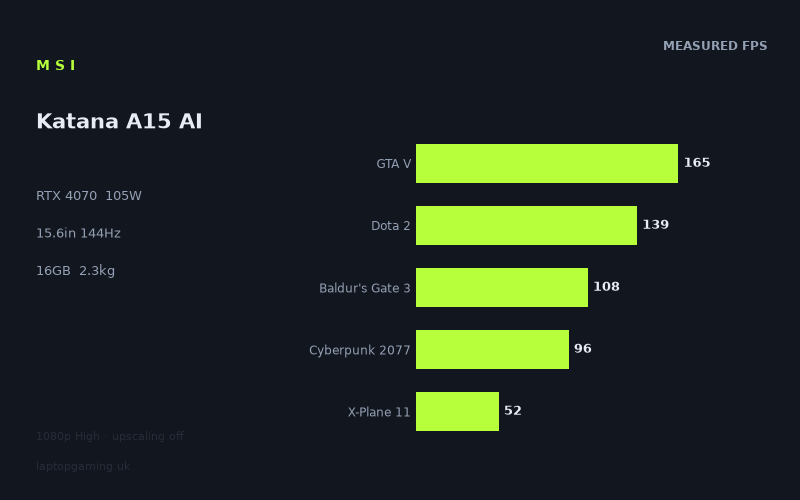
Frame rates
1920×1080, High preset, upscaling off. Averages 112fps across the 5 core benchmark games.
Measured on this machine. Source: Notebookcheck, 2025-01-04.
Not scored: no confirmed UK price
We have the full benchmark suite for this machine, so it ranks on the frame rate leaderboard like any other. What we don't have is a UK listing for this exact configuration - it's sold as a European review unit, or only in specifications that differ from the one tested. Since 30% of our score is value for money, scoring it would mean pretending price is no object, which would flatter it against every laptop you can actually buy. The frame rates below are real and comparable; there is just no buying recommendation to make yet.
How these numbers were produced
Frame rates here are not measured by us, and we label how each one was arrived at. A figure marked measured comes from a published run on that exact machine. A figure marked representative is derived from the GPU and its power limit (TGP) and cross-referenced against published reviews - a sound estimate of what that configuration delivers, but not a measurement of that specific laptop. Unless stated otherwise, numbers are 1920x1080, High preset, upscaling off. Where a laptop ships in several power configurations we use the wattage of the exact SKU listed, because a 140W RTX 5070 and a 115W one are not the same product.
In use
The short version
The MSI Katana A15 AI is a straightforward performance-led gaming laptop built around an RTX 4070 running at a 105W GPU power limit, a Ryzen 9 8945HS, 16GB of memory and a 15.6in 1920x1080 144Hz IPS display. The important part is that its measured game results are generally strong for this class of hardware at its native resolution, particularly in older, lighter or well-optimised games. It can also deliver clearly playable results in demanding recent releases without upscaling, although it does not maintain anything close to the screen’s 144Hz ceiling in every modern blockbuster.
Notebookcheck’s benchmark data shows a machine with a very wide spread between the easiest and hardest games. Prince of Persia The Lost Crown reaches 322fps, GTA V manages 165fps, Dota 2 records 139fps and Baldur’s Gate 3 reaches 108fps. Those are excellent figures for a 144Hz Full HD panel, especially for players focused on competitive games, older titles, esports games or broadly undemanding single-player releases.
At the heavier end, the picture is more restrained but still useful. Cyberpunk 2077 runs at 96fps, God of War Ragnarök at 98fps and Space Marine 2 at 74fps. These are not 144fps experiences at the stated High preset with upscaling off, but they are comfortably above the point where a demanding game feels compromised by low frame rate. More difficult titles such as Until Dawn, Final Fantasy XVI, X-Plane 11 and Stalker 2 sit between 50fps and 63fps, while Star Wars Outlaws is the toughest result here at 40fps.
That distinction matters. The Katana A15 AI is not a laptop that turns every modern game into a 144fps showcase merely because it has a 144Hz display. It is a laptop that can use that refresh rate very well in selected games, while delivering solid conventional performance in many demanding releases. Buyers should approach it as a capable Full HD machine rather than as an all-purpose high-refresh gaming solution for every new release at High settings with no upscaling.
The 105W RTX 4070 is the key specification to interpret alongside the results. A laptop GPU name alone is not enough to explain performance, because the power limit affects what a given GPU implementation can sustain. Here, the measured figures provide the more useful answer than the badge: this Katana can run very fast in the lighter games, remains strong in several demanding titles, and still encounters clear limits in the most difficult current releases. That is exactly why the individual game results matter more than a single headline average.
The mean across the five scoring-suite games is 112fps. That is a healthy result at 1920x1080 with the High preset and upscaling off, but it should not be mistaken for a promise that every game will run around that level. GTA V, Dota 2 and Baldur’s Gate 3 pull the average upwards, while X-Plane 11 is much lower. The average is useful as a broad summary; the individual figures are more useful for deciding whether the Katana A15 AI suits the games you actually play.
This exact configuration has no confirmed UK price, so a value assessment and overall score cannot be calculated. That is not a criticism of the laptop or of its benchmark data; it simply means the price-dependent part of the assessment cannot be completed without a verified UK selling price.
As a buying proposition, the Katana A15 AI makes most sense for someone who wants a conventional 15.6in gaming laptop, values Full HD performance more than thinness, and plays a mixture of esports, older games and demanding current releases. It is less convincing for someone who expects all recent games to sit at the display’s maximum refresh rate without changing settings, or for someone who needs a particularly light machine for regular travel.
Performance
What the benchmark data says
The benchmark data was measured by Notebookcheck at 1920x1080 using the High preset with upscaling off. That test setup is important because it gives the RTX 4070 a direct Full HD workload rather than masking performance with upscaling. The figures therefore show what the laptop can do at the native resolution of its own panel under a demanding but sensible settings choice.
At the top of the results, Prince of Persia The Lost Crown reaches 322fps. That is far beyond the 144Hz refresh rate of the screen. In practical terms, the panel cannot display every individual frame produced at that rate, but the result still matters because it shows that the hardware has substantial spare performance in this game. It also suggests that players who care about responsiveness rather than visual extravagance will have no difficulty getting an extremely fast experience from this title at the tested settings.
GTA V records 165fps. This is another result above the screen’s 144Hz refresh rate, so the Katana A15 AI can fully feed its display in this game at the tested High preset. GTA V remains a useful result because it is still widely played, but it should not be used as proof that every game will perform at the same level. Its 165fps result belongs to the lighter end of this benchmark spread, not the demanding modern end represented by titles such as Stalker 2 and Star Wars Outlaws.
Dota 2 reaches 139fps. That is just below the panel’s 144Hz ceiling and is effectively in the range where the display’s high refresh rate is being used properly. The difference between 139fps and 144Hz should not be interpreted as a practical shortcoming. It instead shows that this is a laptop well suited to a game where consistently high frame rates and input responsiveness are more important than extracting maximum visual settings from a graphically extreme engine.
Baldur’s Gate 3 returns 108fps. That is below the display’s maximum refresh rate, but it remains a strong result for a game that benefits from smooth camera movement and responsive control without requiring esports-level frame rates to be enjoyable. At 108fps, the Katana A15 AI is not merely adequate: it has enough performance to make the 144Hz screen worthwhile even if it is not saturating it. The gap between 108fps and 144Hz is also much less consequential in a turn-based role-playing game than it would be in a competitive shooter.
Final Fantasy XV records 101fps, placing it in much the same broad category as Baldur’s Gate 3. It does not make full use of the display’s peak refresh rate, but it is comfortably above 60fps. That gives the Katana A15 AI a useful amount of headroom for a smooth Full HD experience without relying on the upscaling features excluded from this test.
God of War Ragnarök reaches 98fps and Cyberpunk 2077 reaches 96fps. These are particularly useful figures because they show the machine dealing well with demanding games without presenting an unrealistic picture of perfect 144fps performance. Both results are near 100fps, which is a strong place to be at Full HD High settings with upscaling off. The Katana A15 AI has enough performance here to deliver visibly smoother motion than a 60fps target, even if it cannot match the panel’s maximum refresh rate in these workloads.
Cyberpunk 2077 is one of the five scoring-suite games and is especially helpful for judging the laptop’s broader position. Its 96fps result is lower than the figures in GTA V, Dota 2 and Baldur’s Gate 3, but that is the point: the game is more demanding. Anyone looking only at the 112fps scoring-suite mean should keep Cyberpunk 2077 in mind as a better guide to what to expect from graphically intensive games. The Katana A15 AI is strong at Full HD, but demanding modern rendering workloads still bring the frame rate below the display’s headline refresh figure.
Space Marine 2 runs at 74fps. That remains comfortably playable and is above a conventional 60fps expectation, but it also marks a shift in the benchmark list. This is where the Katana A15 AI moves away from high-refresh gaming and towards solid standard gaming performance. The distinction is not negative. A measured 74fps at High settings with upscaling off is a credible result. It simply means that players buying the laptop for the screen’s 144Hz capability should expect to reserve that level of performance for less demanding games.
Until Dawn records 63fps. This is just above 60fps and is still a perfectly workable result for a cinematic game. It is not a result that calls for alarm, but it does show that the RTX 4070 at 105W cannot be treated as unlimited at High settings. There is a meaningful difference between a title at 63fps and one at 139fps, even though both are technically playable. The former is smooth enough for many players; the latter makes a high-refresh panel feel genuinely central to the experience.
Final Fantasy XVI reaches 59fps. This is close to 60fps rather than comfortably beyond it, so it is one of the results where the laptop’s display refresh rate offers little direct benefit at the tested settings. That does not make the game unsuitable for the Katana A15 AI. It does mean that a buyer whose main concern is playing this specific type of demanding release at very high frame rates should set expectations carefully. The hardware can run it, but the result is not in the same performance class as the laptop’s strongest games.
X-Plane 11 produces 52fps. As another scoring-suite title, this figure is important because it stops the 112fps mean from becoming misleadingly optimistic. The Katana A15 AI is fast in several games, but its performance is not uniformly high across every engine and workload. Simulation games can have very different demands from action games, and the X-Plane 11 result demonstrates why a single average should never replace checking the titles closest to your own library.
Stalker 2 records 50fps. This is still playable, but it is among the clearest examples of where the tested High preset is demanding enough that the machine cannot maintain a conventional 60fps target. A player focused on Stalker 2 should not buy this laptop on the strength of the much higher GTA V or Prince of Persia The Lost Crown figures. The relevant number is 50fps, because it shows the experience in that game under the stated conditions.
Star Wars Outlaws is the lowest result at 40fps. This is the benchmark that most clearly defines the Katana A15 AI’s limitation at Full HD High settings with upscaling off. It can run the game, but 40fps is far from the 144Hz display ceiling and below the level many buyers would consider an ideal result for a new gaming laptop. This does not make the machine unusually poor; it shows that the game is a far more difficult workload than the titles producing figures above 100fps. It also reinforces the practical point that settings choices and upscaling options matter if this sort of game is your priority.
The spread between games is the real story
The difference between 322fps in Prince of Persia The Lost Crown and 40fps in Star Wars Outlaws is enormous. It is tempting to call one of those figures representative and dismiss the other as an outlier, but that would be the wrong approach. Both are relevant because both show a plausible use case for the same hardware. One reflects a title where the RTX 4070 and Ryzen 9 combination has abundant performance at Full HD. The other reflects a title where even this class of GPU is under much more pressure at the tested settings.
That spread comes from the games rather than from inconsistency in the published measurements. Different engines place different demands on graphics hardware, processors and memory. Some games are light enough at 1920x1080 that the GPU is no longer the only meaningful limitation. Others are demanding enough that the graphics workload dominates. The Katana A15 AI’s results span both situations, which is why its frame-rate range is so broad.
The lighter titles are where the machine’s processor and overall platform matter more visibly. Prince of Persia The Lost Crown, GTA V and Dota 2 all record very high frame rates. At this level, the practical objective is no longer simply achieving smooth gameplay. It becomes maintaining strong frame pacing, low input latency and enough spare performance that temporary fluctuations are less likely to drag the experience down towards ordinary 60fps territory. The published figures cannot tell us frame pacing or latency, so those should not be assumed, but the raw frame-rate headroom is clearly present.
The more difficult games shift the focus. In Cyberpunk 2077, God of War Ragnarök and Space Marine 2, the main advantage is not that the laptop reaches the panel limit. The advantage is that it remains convincingly above 60fps while using High settings and no upscaling. That is a more realistic target for demanding modern games on a Full HD laptop. In these titles, the Katana A15 AI looks capable rather than extravagant.
In Final Fantasy XVI, X-Plane 11, Stalker 2 and Star Wars Outlaws, the machine’s limits become visible. The results from 40fps to 59fps are not failures, but they are the part of the benchmark list that should shape buying expectations. If those games are central to your purchase decision, the laptop’s appeal depends on whether you are comfortable adjusting settings, enabling upscaling where available, or accepting lower frame rates than the display’s specification might initially suggest. The fact sheet does not provide figures for alternative presets or upscaling modes, so it would be wrong to promise a particular outcome from either.
What the 105W GPU power limit means in practice
The RTX 4070 is specified here with a 105W GPU power limit. That figure matters because laptop RTX GPUs are implemented at different power limits, and the label alone does not tell the whole performance story. The useful way to assess this 105W implementation is through the measured results rather than through assumptions about where it should sit on a specification sheet.
In practice, this power limit is associated here with very strong performance in the least demanding games, roughly 100fps performance in several substantial titles, and more modest results in the hardest current releases. That is not a contradiction. It is what a balanced gaming laptop result looks like when the benchmark selection includes both light games and technically demanding new releases.
The 105W limit should also discourage overly simple comparisons with other RTX 4070 laptops. A rival can have the same GPU name but a different power limit, a different processor, a different screen resolution, or a different balance of CPU and GPU constraints in the games being compared. The rival data below demonstrates this directly: the Katana A15 AI does not automatically pull ahead of every lower-power RTX 4070 system in the shared results, because the games involved can compress GPU differences at 1080p.
For buyers, the practical conclusion is that the Katana’s RTX 4070 should be treated as a good match for a 1920x1080 display, not as a guarantee of maximum settings and maximum refresh in every game. The published frame rates support that conclusion strongly. The laptop has the headroom for fast competitive and lighter gaming, substantial strength in many graphically heavy releases, and obvious pressure points in the newest or most demanding titles.
The screen
The Katana A15 AI has a 15.6in IPS display with a 1920x1080 resolution and a 144Hz refresh rate. This is a conventional and sensible screen specification for the performance shown by the benchmark data. Full HD is not an extravagant resolution for an RTX 4070 laptop, but that is precisely why it works here: it gives the GPU a realistic chance of delivering high frame rates in a meaningful proportion of games.
The 144Hz refresh rate is genuinely useful in the titles where the Katana reaches or approaches it. GTA V at 165fps is above the panel’s refresh limit, while Dota 2 at 139fps sits very close to it. Prince of Persia The Lost Crown at 322fps is far above it. In these games, the display is not an aspirational specification that the hardware rarely touches; it is a feature the system can actually exploit.
There is also a middle group where the display remains worthwhile even without being fully saturated. Baldur’s Gate 3 at 108fps, Final Fantasy XV at 101fps, God of War Ragnarök at 98fps and Cyberpunk 2077 at 96fps all sit well above 60fps. A 144Hz screen can still present those frame rates more fluidly than a conventional 60Hz panel, even though the laptop is not reaching 144fps. For a buyer who plays a mix of genres, this middle ground is arguably the most important category because it includes several substantial games rather than only the lightest titles.
Below that, Space Marine 2 at 74fps is still a good fit for a 144Hz screen, though not a complete one. The experience should have more scope for smooth motion than at 60fps, but the laptop is clearly not using the full refresh ceiling. Until Dawn at 63fps and Final Fantasy XVI at 59fps make the panel’s headline speed less central. Stalker 2 at 50fps and Star Wars Outlaws at 40fps are further away again.
This is not a flaw in the display choice. A 144Hz Full HD panel is a better match for the Katana A15 AI than a higher-resolution screen would be if the aim is to keep frame rates high. The trade-off is simply that the refresh rate describes the display’s capability, not a minimum performance guarantee. The measured figures make that distinction unusually clear.
The IPS panel type tells us the display technology, but the fact sheet does not provide measurements for brightness, contrast, colour coverage, response times, backlight behaviour or outdoor visibility. Those are all important aspects of screen quality, particularly for buyers who also want to use the laptop for photo work, video work or frequent use away from a desk. They should not be guessed from the IPS label alone.
For gaming, the screen is best considered a Full HD high-refresh panel suited to the Katana’s strongest results. It is most compelling for Dota 2, GTA V and similarly light games where high frame rates are achievable. It remains a sensible panel in the 96fps to 108fps range seen in Cyberpunk 2077, God of War Ragnarök, Final Fantasy XV and Baldur’s Gate 3. It becomes less relevant as frame rates move towards 40fps to 59fps, where settings choices matter more than the display’s maximum refresh rate.
Build, size and portability
The MSI Katana A15 AI weighs 2.3kg. That places it firmly in the category of a laptop that can be moved between locations, but should not be treated as effortless to carry every day. A 2.3kg machine is realistic for commuting occasionally, taking to university, moving between rooms or carrying to a friend’s house, but it is not the kind of weight that disappears into a bag.
The 15.6in screen also points towards a conventional gaming-laptop role. This is not a compact ultraportable with a small display and reduced ambitions. The Katana A15 AI is designed around a larger gaming panel, substantial internal hardware and a standard laptop footprint rather than an ultra-light travel-first approach. That fits the performance data: it is a system intended to play games properly at Full HD rather than a thin machine making large compromises for portability.
The fact sheet does not provide the laptop’s physical dimensions, so there is no basis here for claiming how deep, wide or slim it is. Likewise, there are no published figures supplied for battery life, charger size, keyboard layout, port selection, chassis materials, cooling noise or surface temperatures. Those omissions matter because they affect whether a 2.3kg laptop is merely portable enough or genuinely convenient to transport.
What can be said is that the Katana A15 AI is unlikely to be the best choice for a buyer whose first priority is minimum carry weight. There are lighter gaming laptops in the wider market, but this review cannot quantify that difference without measurements in the fact sheet. The more useful point is that 2.3kg is a meaningful commitment for regular carrying. Anyone shopping for a machine to live in a backpack for long periods should think carefully about whether gaming performance or mobility comes first.
Conversely, buyers who mostly use the laptop on a desk, at home, in student accommodation, or in a fixed work-and-play setup may find the weight entirely reasonable. In that use case, the 15.6in screen and measured Full HD gaming performance are more important than having the lightest possible chassis. The Katana’s appeal is strongest when it is treated as a portable desktop replacement rather than as a travel companion first and gaming system second.
There is also a practical connection between size, weight and the 105W RTX 4070 configuration. The machine is not presented as an ultra-thin low-power design. The published specification instead points to a conventional gaming laptop with a meaningful GPU power limit and a 2.3kg weight. That does not tell us anything specific about cooling performance or noise, because neither has been supplied, but it does explain why the Katana is better judged as a performance-oriented 15.6in system than as a lightweight premium portable.
How it compares
Against the MSI Thin GF63
Against the MSI Thin GF63 with an RTX 4050, the Katana A15 AI averages 35fps more across five shared games. That is the clearest performance advantage in the listed comparisons and the strongest evidence that the Katana’s RTX 4070 configuration offers a materially higher gaming tier than this RTX 4050 rival.
An average advantage of 35fps across five shared games is large enough to matter in practical use. It can be the difference between merely acceptable performance and a clearly smooth result, or between a game that sits below the 144Hz target and one that makes much better use of the panel. The exact benefit will vary by game, as the Katana’s own benchmark spread shows, but this is not a near-tie. The available shared-game comparison supports choosing the Katana if performance is the deciding factor between these two MSI machines.
There is no confirmed UK price for the MSI Thin GF63 in the supplied information, so this is a performance comparison only. It would be wrong to declare one better value than the other without verified pricing for both exact configurations. What the data does show is that the Katana has a clear frame-rate lead across the shared set.
Against the Asus ROG Zephyrus G14 2024
The comparison with the Asus ROG Zephyrus G14 2024 is more interesting. That machine also uses an RTX 4070, but at a 75W GPU power limit. The Katana A15 AI averages 0fps more across four shared games. This is a genuine near-zero result, not a missing conclusion.
At first glance, it may seem surprising that a 105W RTX 4070 does not establish a clear shared-game lead over a 75W RTX 4070. The supplied comparison notes explain why: at 1080p, lighter titles in the shared set are CPU-bound and compress genuine GPU gaps. In other words, once a game is light enough that the graphics hardware is not the dominant limit, giving one GPU more power does not necessarily produce a proportionally higher average frame rate.
This does not mean the GPU power limit is meaningless. The Katana’s own results in demanding games show that performance still varies hugely when the workload becomes more graphics-heavy. It means only that the four shared games are not a clean way to isolate the effect of the GPU power difference. Buyers should not take the 0fps average as evidence that all RTX 4070 laptop implementations perform identically.
The Zephyrus G14 2024 is listed at GBP 2,301. The Katana A15 AI has no confirmed UK price, so there is no responsible price comparison to make. The frame-rate result alone says that these shared 1080p games do not separate them. A buyer deciding between the two should therefore avoid assuming that the Katana’s higher stated GPU power limit automatically guarantees a lead in every game.
Against the Acer Swift X
The Acer Swift X uses an RTX 4050, yet the Katana A15 AI averages 0fps more across three shared games. As with the Zephyrus G14 2024 comparison, that is a real result which needs explanation rather than repetition.
The shared set is small, and the comparison notes make clear that lighter games at 1080p can become CPU-bound. When that happens, a more powerful GPU does not necessarily translate into a visible average advantage. The Katana’s broad benchmark list is again helpful context. It is much faster in some games than in others, so a small shared sample can easily miss the workloads where the RTX 4070’s greater capability is most evident.
It would therefore be incorrect to conclude that the RTX 4070 Katana and RTX 4050 Swift X are generally equal gaming laptops. The supplied three-game comparison only tells us that they are effectively level in those particular shared tests. It does not replace the broader evidence from the Katana’s own results, nor does it establish what would happen in Cyberpunk 2077, Space Marine 2, Stalker 2 or Star Wars Outlaws unless both machines have comparable published results.
The Acer Swift X also has no confirmed UK price in the supplied information. Again, this has to remain a performance-only observation. The useful lesson is that GPU names and power limits should be read alongside the actual game data, especially at Full HD where CPU limits can reduce the visible difference between graphics configurations.
Against the Asus ROG Strix Scar 17
The Asus ROG Strix Scar 17 with an RTX 4090 is the machine that beats the Katana A15 AI by the largest margin in the listed comparison group. The Katana averages 80fps less across three shared games. That is a substantial deficit and demonstrates the gap between the Katana’s RTX 4070 configuration and a far more powerful RTX 4090 gaming laptop.
This is the comparison that establishes the Katana’s position most clearly. It is not a top-end replacement for every premium performance machine, and the 105W RTX 4070 should not be presented as though it were one. Where the Scar 17 has room to pull away, it does so decisively in the shared games.
The ROG Strix Scar 17 is listed at GBP 4,866. That is a known price for the rival, but the Katana A15 AI does not have a confirmed UK price in the supplied information. It is therefore possible to say that the Scar 17 is the higher-performing machine in the shared benchmark results, but not possible to make a defensible value judgement between them. Performance and value are related, but they are not the same question.
For buyers, this comparison is useful mainly as a ceiling. If your aim is the highest possible frame rates in the most demanding games, the Katana is not the machine to target. If your aim is strong Full HD gaming in a more conventional 15.6in format, the Katana remains relevant. The gap to the RTX 4090 rival is real, but so is the difference in product class suggested by the hardware and the available price information.
Who it’s for
The MSI Katana A15 AI is for buyers who want strong Full HD gaming performance and understand that a 144Hz screen is a capability rather than a guarantee in every game. It suits someone who plays titles such as Dota 2, GTA V and Prince of Persia The Lost Crown, where the measured figures are near or above the panel’s refresh limit. It also suits someone who plays demanding games such as Cyberpunk 2077, God of War Ragnarök and Baldur’s Gate 3, provided they are happy with results around the 96fps to 108fps range rather than expecting 144fps at all times.
It is a good fit for a mixed library. The benchmark data does not show a machine narrowly optimised for one kind of game. Instead, it shows excellent results in lighter games, strong results in several demanding releases, and still playable performance in titles that push the hardware much harder. That makes the Katana A15 AI sensible for a buyer who moves between multiplayer games, single-player action games, role-playing games and older releases.
It also makes sense for a buyer who wants to use the laptop mainly at a desk or in a relatively fixed location. At 2.3kg, it can travel, but portability is not its defining advantage. A student moving between accommodation and home, or a buyer who occasionally takes the laptop elsewhere, may find it manageable. Someone carrying it all day should be more cautious, especially as the fact sheet provides no dimensions, battery-life results or charger information to complete the mobility picture.
The Katana is particularly suitable for buyers who prioritise native-resolution gaming. The benchmark results are already taken at 1920x1080 with upscaling off, so there is no need to assume that the laptop depends on image reconstruction to reach its published figures. In the games where it performs strongly, it is doing so directly at the screen’s native resolution. That is a meaningful advantage for someone who prefers to judge performance without relying on unmeasured alternative settings.
It is also for buyers who are willing to treat demanding games individually. Cyberpunk 2077 at 96fps and Star Wars Outlaws at 40fps are both part of the same benchmark list. A sensible owner will recognise that those games call for different expectations and potentially different settings priorities. The Katana rewards that practical approach. It is not a machine that makes every settings decision for you, but it has enough underlying performance to be versatile at Full HD.
Buy something else if your main aim is to play the most demanding current games at High settings, with upscaling off, while staying near 144fps. The data does not support that expectation. Space Marine 2 reaches 74fps, Until Dawn reaches 63fps, Final Fantasy XVI reaches 59fps, X-Plane 11 reaches 52fps, Stalker 2 reaches 50fps and Star Wars Outlaws reaches 40fps. These are usable results, but they are not high-refresh results. A buyer who regards 144fps as essential in those sorts of games needs a different level of hardware.
Buy something else if the lowest possible weight matters more than gaming speed. A 2.3kg laptop is not absurdly heavy for gaming hardware, but it is substantial enough that regular carrying will be noticeable. The Katana is better suited to being moved when needed than to being selected specifically for travel convenience.
Buy something else if display quality beyond refresh rate and panel type is central to your decision. The supplied information confirms a 15.6in 1920x1080 144Hz IPS panel, but does not provide brightness, contrast, colour or response-time measurements. Buyers who need a screen for colour-critical work, frequent outdoor use or specialist display requirements need those measurements rather than assumptions based on the IPS label.
Finally, buy something else if your priority is outright top-end gaming performance regardless of price or size. The comparison with the RTX 4090 Asus ROG Strix Scar 17 shows the Katana trailing by 80fps on average across three shared games. That is not a small distinction. The Katana A15 AI is a capable Full HD gaming laptop with a 105W RTX 4070, not an attempt to match the highest-performance machines in every workload.
For the right buyer, that is not a weakness. The Katana A15 AI’s strongest case is clear: a conventional 15.6in Full HD gaming laptop that can run lighter games extremely fast, handle many demanding games around or near 100fps, and remain playable in the hardest titles without upscaling. Its limitations are equally clear: the 144Hz screen is fully exploited selectively rather than universally, the 2.3kg weight makes it more transportable than truly portable, and the lack of a confirmed UK price prevents a final value judgement. If those trade-offs suit your games and your use pattern, the benchmark data gives the Katana A15 AI a credible performance case.