Review
Asus ROG Strix Scar 17 SE review
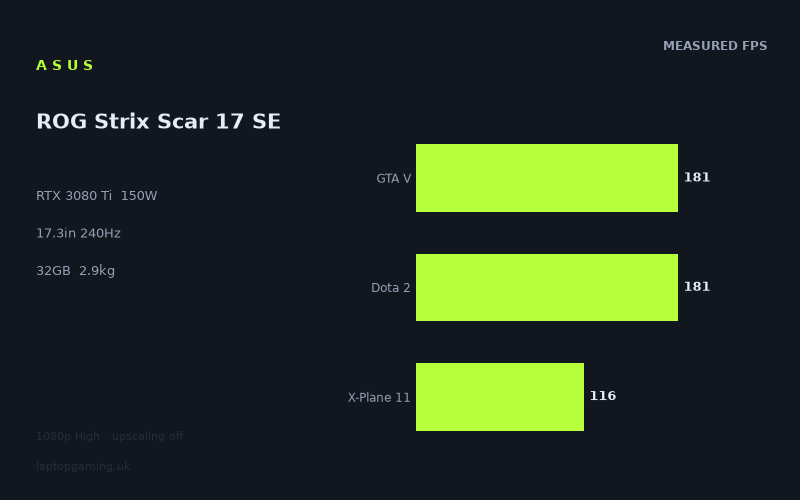
Frame rates
1920×1080, High preset, upscaling off.
Measured on this machine. Source: Notebookcheck, 2022-11-20.
Not scored: incomplete benchmark suite
Every scored laptop on this site is averaged over the same 5 games, and this one is short of Cyberpunk 2077, Baldur's Gate 3. A mean over 5 games is not comparable to a mean over 5, so we publish the figures we have and leave the score blank rather than rank it against machines tested on a different set. The numbers below are real - the suite is just incomplete.
How these numbers were produced
Frame rates here are not measured by us, and we label how each one was arrived at. A figure marked measured comes from a published run on that exact machine. A figure marked representative is derived from the GPU and its power limit (TGP) and cross-referenced against published reviews - a sound estimate of what that configuration delivers, but not a measurement of that specific laptop. Unless stated otherwise, numbers are 1920x1080, High preset, upscaling off. Where a laptop ships in several power configurations we use the wattage of the exact SKU listed, because a 140W RTX 5070 and a 115W one are not the same product.
In use
The short version
The Asus ROG Strix Scar 17 SE is a large-format gaming laptop built around an RTX 3080 Ti running at a 150W GPU power limit, a Core i9-12950HX processor and 32GB of memory. The published Notebookcheck benchmark data shows that this is still an extremely quick machine at 1920x1080 on the High preset with upscaling disabled. Its mean across the five-game scoring suite is 166fps, and several results are comfortably above 180fps.
That makes the Scar 17 SE a strong fit for somebody who wants a desktop-replacement gaming machine with enough speed for high-refresh competitive games, demanding single-player titles and general heavyweight use. Strange Brigade reaches 236fps, F1 2021 reaches 211fps, F1 22 reaches 200fps, while both Dota 2 and GTA V sit at 181fps. These are very fast results, particularly when considered alongside the machine’s 17.3in 2560x1440 240Hz IPS display.
The important qualification is that the measured figures are at 1920x1080 rather than the screen’s native 2560x1440 resolution. There is enough evidence here to say that the Scar 17 SE has substantial performance headroom in lighter or better-scaling games, but there is not enough evidence to publish a native-resolution frame rate. A buyer who expects every modern game to run at 240fps at 2560x1440 should not make that assumption. The benchmark spread makes clear that the laptop is not limited by one simple, universal number: some games are far beyond 200fps, while Cyberpunk 2077 1.6 is measured at 98fps and Final Fantasy XV at 118fps.
That variation is normal for a gaming laptop of this class. It is also useful. It tells you much more than a single average can. The Scar 17 SE is capable of exploiting a high-refresh display in games such as Strange Brigade, F1 2021, F1 22, Dota 2 and GTA V at the measured settings. In more demanding games, it is still delivering frame rates that should feel responsive, but the 240Hz panel is better understood as capacity for suitable games rather than a target this machine will meet everywhere.
The 150W RTX 3080 Ti is particularly interesting because the closest listed RTX 3080 Ti rivals all use a 175W GPU power limit. In the shared-game comparisons, however, the Asus lands effectively level with the MSI GE76 Raider and Alienware x17 R2, while trailing the MSI Raider GE77 HX by only 3fps across the shared set. That does not mean GPU power limits are meaningless. It means the games used in the overlap, particularly at 1920x1080, can become constrained by factors other than raw GPU throughput. Lighter titles can be CPU-bound at this resolution, compressing what may be a real graphics-power advantage in a different game or at a higher resolution.
The machine’s biggest practical compromise is obvious from the specification: at 2.927kg, this is not a laptop chosen primarily for light travel. It is a machine for a desk, a home setup, a shared workspace or regular relocation between places where a substantial bag and power supply are acceptable. The 90Wh battery is a healthy capacity figure, but there is no battery-life measurement in the available data, so it would be irresponsible to turn that capacity into a claimed number of hours.
There is no confirmed UK price for this exact G733CX-LL014W configuration. As a result, no value judgement can be made and no overall score can be calculated, despite the benchmark suite being complete and the machine ranking normally on the frame-rate leaderboard. That is not a criticism of the laptop. It is simply the consequence of not having a verified UK purchase price for this specific specification.
Buy the Scar 17 SE if you want high-end RTX 3080 Ti performance, a 17.3in QHD high-refresh screen, 32GB of memory and a machine that is clearly intended to spend much of its life near mains power. Look elsewhere if portability is your main requirement, if you need verified battery-life evidence before buying, or if your priority is guaranteed 240fps performance in every game at the panel’s native resolution. The published figures support a verdict of powerful and well-balanced for its class, but they do not support promises beyond the measured settings.
Performance
What the benchmark data says
Notebookcheck measured the Asus ROG Strix Scar 17 SE at 1920x1080 using the High preset with upscaling disabled. That last detail matters. These are not results inflated by turning on an upscaler, and they are not low-detail competitive settings designed solely to maximise a frame-rate figure. They show the machine operating at a meaningful visual preset while retaining strong performance across a varied collection of games.
The standout result is Strange Brigade at 236fps. That is the only measured game here to get close to the display’s 240Hz refresh rate, but it is close enough to demonstrate that the Scar 17 SE has the hardware capability to make very high refresh worthwhile in the right title. A 240Hz panel is not wasted merely because every game does not reach 240fps. It is most useful when the game, graphics settings and processor-GPU balance permit it, and Strange Brigade is clear evidence that this laptop can operate in that territory.
F1 2021 follows at 211fps, with F1 22 measured at 200fps. These are excellent numbers for racing games, where high frame rates can make steering response, motion clarity and the general sense of immediacy feel better than a conventional lower-refresh experience. Neither result reaches the panel’s maximum refresh rate, but both are high enough that the Scar 17 SE can make meaningful use of a fast screen without requiring the owner to abandon the High preset used for these published figures.
Dota 2 and GTA V both return 181fps. Those are strong results and particularly relevant because both sit in the five-game scoring suite. Their matching frame-rate figures should not be mistaken for matching hardware demands or identical rendering behaviour. Different games reach a similar final result for different reasons. At 1920x1080, especially in lighter or older titles, the graphics processor can stop being the sole deciding factor. Processor performance, game-engine behaviour, draw-call load and the way a title uses CPU threads can all matter. The Core i9-12950HX is a high-end processor, and the figures suggest that the Scar 17 SE has the processor performance needed to avoid becoming an obvious weak link in these high-frame-rate scenarios.
Final Fantasy XV is measured at 118fps. That remains a good gaming result, but it is a useful step down from the 181fps and above seen in several lighter titles. It shows why the 166fps mean across the scoring suite should not be treated as an expectation for every game. An average describes the group of games selected. It does not remove the differences between them. A buyer focused on the kind of games represented by Strange Brigade, Dota 2 or GTA V will see one picture. A buyer focused on heavier, visually demanding games should pay more attention to Final Fantasy XV, X-Plane 11 and Cyberpunk 2077 1.6.
X-Plane 11 reaches 116fps. Flight simulation is often a useful reminder that laptop gaming performance is not just about the graphics card’s model name. Simulation workloads can be demanding in ways that differ from a conventional action game. The published number is still well beyond what is required for fluid play, but it is much further from the screen’s 240Hz ceiling than the results in Strange Brigade or the F1 games. For a buyer interested in simulators, the sensible conclusion is not that the Scar 17 SE lacks performance. It is that the panel’s maximum refresh rate should not be treated as a realistic universal expectation for this type of workload.
Cyberpunk 2077 1.6 is the lowest measured result at 98fps. It is nevertheless an important result because it gives the performance discussion a more demanding reference point. The Scar 17 SE is not merely producing huge numbers in relatively easy games. It is also close to 100fps in Cyberpunk 2077 1.6 at the measured 1920x1080 High setting, without upscaling. That is a credible outcome for a laptop RTX 3080 Ti, and it is the figure buyers should keep in mind if their library is weighted towards heavier modern games rather than competitive titles or older engines.
The scoring-suite average in context
The mean across the five scoring-suite games is 166fps. This is a high average, but its main value is as a broad indicator of where the Scar 17 SE sits in the performance landscape rather than a promise of a particular in-game experience. The five games in that suite are Strange Brigade, Dota 2, GTA V, Final Fantasy XV and X-Plane 11. The results range from 236fps in Strange Brigade to 116fps in X-Plane 11. That is a wide enough spread to make a simple average incomplete without the individual figures alongside it.
For high-refresh gaming, the average tells a favourable story. A machine averaging 166fps in this particular suite has substantial capability at the tested settings. But the individual results tell the more practical story. In the games at 181fps, 211fps and 236fps, the 240Hz display has a clear role. In the games at 116fps and 118fps, the screen remains a high-quality specification to have, but its full refresh ceiling is not the relevant performance target. In Cyberpunk 2077 1.6 at 98fps, the question becomes less about reaching 240Hz and more about whether the user values the quality level represented by the High preset, wants to change settings, or is happy with the measured result.
This is why gaming-laptop reviews should not reduce performance to a single number or a headline GPU badge. The RTX 3080 Ti is a powerful graphics processor, but its actual result is shaped by its power limit, the cooling system’s ability to sustain that limit, the game engine, the resolution, the selected preset, the processor and the workload itself. The available measurements show the end result. They do not let us separate every individual influence, but they do show that the Scar 17 SE performs very strongly across the suite rather than relying on a single unusually favourable game.
What the 150W GPU power limit means
The Scar 17 SE’s RTX 3080 Ti is specified at a 150W GPU power limit. That puts it below the 175W figure listed for the MSI GE76 Raider, Alienware x17 R2 and MSI Raider GE77 HX comparisons. On paper, that difference matters because a GPU power limit influences how much electrical power the graphics processor can use. In practical terms, a higher limit can create the opportunity for higher performance when a game is limited by GPU throughput and when the laptop’s cooling system can support the workload.
It would be wrong, however, to assume that the difference in the stated power limit must translate directly into a matching difference in every measured game. The shared-game comparison data demonstrates exactly why. The Scar 17 SE averages +0fps against the MSI GE76 Raider across five shared games and +0fps against the Alienware x17 R2 across five shared games. Against the MSI Raider GE77 HX, it averages -3fps across five shared games. Those are very small differences in the context of the machines being compared.
The explanation supplied by the benchmark context is important: at 1920x1080, lighter titles in the shared set can be CPU-bound and compress genuine GPU gaps. When a title is waiting on processor work, game-engine behaviour or another non-GPU bottleneck, increasing available graphics power does not necessarily produce a proportionate frame-rate gain. That is particularly relevant when frame rates are already high. A machine delivering a very large frame rate in a lighter game may have enough GPU performance in reserve that the graphics card is no longer the only thing setting the result.
This does not turn the 150W RTX 3080 Ti into the same thing as a 175W RTX 3080 Ti in every situation. It means the published shared-game results should be read carefully. The Scar 17 SE is competitive with those higher-power RTX 3080 Ti laptops in the measured 1920x1080 overlap. A buyer should not extend that finding into an unsupported claim about every game, every graphics preset or the native 2560x1440 panel resolution. Higher resolution and more demanding graphics settings can shift the workload towards the GPU, where power-limit differences may matter more. There are no published figures here that quantify that effect for this Asus.
The stronger conclusion is that Asus has not left the Scar 17 SE looking underpowered in the available benchmark data. Its 150W configuration remains close to the listed 175W RTX 3080 Ti machines where they share measured games. That is a good result for the Asus, but it is not evidence that buyers should ignore the power-limit specification altogether. It is evidence that performance must be judged through actual game data, not only through a higher or lower wattage figure.
Which games suit the high-refresh display
At the tested settings, Strange Brigade is the clearest match for the 240Hz display. Its 236fps measurement is close enough to the panel’s refresh ceiling that the high-refresh specification is directly relevant. The laptop is not simply capable of smooth play in this title; it is operating at a level where the screen can show a great deal of temporal detail.
F1 2021 at 211fps and F1 22 at 200fps are also very good pairings for a 240Hz panel. They fall below the maximum refresh rate, but they remain far above the frame rates commonly associated with basic smooth gaming. In these titles, the display is not being driven to its maximum measured refresh capacity, yet the Scar 17 SE is still delivering enough frames for the 240Hz specification to be meaningful rather than decorative.
Dota 2 and GTA V at 181fps are another step down, but still firmly in high-refresh territory. For somebody choosing this machine primarily for games where response and motion clarity matter, those figures are encouraging. They also show that the system does not require a minimal graphics configuration to post high numbers: these figures are from the High preset at 1920x1080 with upscaling disabled.
Final Fantasy XV at 118fps and X-Plane 11 at 116fps make a different case for the display. They will not fill the 240Hz panel at the tested settings, but a 240Hz screen does not stop working well because a game is below its maximum refresh rate. The benefit simply becomes less about reaching the headline refresh figure and more about having a fast display available when the game, settings and workload permit it. These results still indicate fluid performance, but they do not justify telling a buyer that the laptop turns every game into a 240fps experience.
Cyberpunk 2077 1.6 at 98fps is further from that maximum, and it is the best reminder that even a high-end gaming laptop has limits. The Scar 17 SE is still fast in the context of a demanding title at the stated settings, but the screen’s refresh rate should be viewed as headroom rather than a performance guarantee. If Cyberpunk 2077 1.6 is representative of the games you care about most, the purchase case is about strong high-end performance and a premium display specification, not about chasing the panel’s full refresh rate in every scene.
The screen
A QHD panel with serious refresh capacity
The Scar 17 SE has a 17.3in IPS display with a 2560x1440 resolution and a 240Hz refresh rate. On paper, that is a very appealing gaming-screen combination. The 2560x1440 resolution gives the panel more desktop and game-image detail than 1920x1080, while 240Hz provides far more refresh capacity than a conventional display. For a machine with RTX 3080 Ti graphics and a Core i9-12950HX, this is the correct sort of screen specification: it gives the hardware room to show its strengths rather than pairing it with a low-refresh panel that would restrict the visible benefit in faster games.
The IPS panel type is also relevant. IPS is a familiar choice for gaming laptops because it is used in displays intended to balance gaming responsiveness with general-purpose image quality and viewing versatility. The available fact sheet does not provide measured brightness, contrast, colour coverage, response times or HDR behaviour, so those should not be assumed. There is no basis here for describing the panel as unusually bright, especially colour-accurate or especially fast in pixel-response terms. The reliable facts are its size, resolution, refresh rate and IPS technology.
The 17.3in size suits the machine’s overall character. This is not a compact ultraportable trying to offer a high-resolution panel in the smallest possible chassis. It is a substantial gaming laptop, and the larger screen makes sense for games, simulation titles, desktop work and any use where a roomier display is more valuable than minimum carrying weight. A 2560x1440 resolution on a 17.3in panel is also a sensible middle ground for a powerful gaming laptop: it is more demanding than 1920x1080, but less demanding than a higher-resolution configuration would be.
The gap between the benchmark resolution and native resolution
The key point is that Notebookcheck’s measured frame rates were recorded at 1920x1080, while this panel is natively 2560x1440. The benchmark data is therefore highly useful for understanding the Scar 17 SE’s general performance class, its relative standing against rivals and the way it handles the tested games at High settings. It is not a direct record of what each game will achieve at the screen’s native resolution.
A buyer should not take 236fps in Strange Brigade and assume 236fps at 2560x1440. Equally, a buyer should not see 98fps in Cyberpunk 2077 1.6 and assume that this is the native-resolution result. The measurements do not say either of those things. The panel has more pixels than the benchmark setting, so native-resolution gaming presents a different workload. Without published results at 2560x1440, the responsible position is to avoid inventing an estimate.
What can be said is that the 1920x1080 results establish a clear hierarchy of likely use cases. Games that are already close to or above 200fps at the tested setting are the obvious candidates for using the display’s high refresh capability. Games closer to 100fps at the tested setting are the ones where the buyer should expect to make a deliberate choice between resolution, graphics settings and frame-rate ambitions. That is not a weakness unique to this Asus. It is the practical reality of combining a QHD 240Hz display with modern games whose demands vary sharply.
The display therefore makes most sense for a buyer who values flexibility. They may choose native 2560x1440 when image detail is the priority, or prefer the tested 1920x1080 setting in games where frame rate is the overriding concern. The fact sheet does not provide scaling-quality measurements or game-specific native-resolution results, so there is no basis for claiming how either option looks in practice. But the hardware and panel specification clearly support the idea of a machine designed to accommodate different types of game rather than one fixed performance target.
Is 240Hz overkill?
No, but it should be understood properly. A 240Hz display is not only useful when every game reaches 240fps. The benchmark results show why. Strange Brigade at 236fps comes close to the screen’s maximum. F1 2021 at 211fps, F1 22 at 200fps, Dota 2 at 181fps and GTA V at 181fps all have enough speed for a high-refresh panel to remain relevant. Those are not marginal gains over a low-refresh experience.
At the same time, the panel should not become the basis for exaggerated expectations. Final Fantasy XV at 118fps, X-Plane 11 at 116fps and Cyberpunk 2077 1.6 at 98fps show that there are demanding games where the laptop’s measured performance is well below 240fps. This is especially important because the figures were obtained at 1920x1080, not the panel’s 2560x1440 native resolution. The display is a premium asset, but it is not a magic route to a fixed frame rate.
For competitive and lighter games, the screen is one of the Scar 17 SE’s strongest specifications. For cinematic, graphically intensive or simulation-heavy games, it is better viewed as a high-quality panel with considerable headroom rather than a specification that must always be fully saturated. That is a more useful way to buy a gaming laptop: choose the display for the range of experiences it can support, not for a single maximum number printed on the specification sheet.
Build, size and portability
A desktop-replacement rather than a casual carry machine
The Scar 17 SE weighs 2.927kg. That single figure is enough to place it firmly in desktop-replacement territory. This is a laptop that can be moved, transported and set up in different places, but it is not a machine selected because it disappears into a bag or makes daily travel effortless. The 17.3in display, RTX 3080 Ti graphics, Core i9-12950HX processor and 90Wh battery all point in the same direction: this is a high-performance system designed to prioritise capability over minimum mass.
For a buyer whose typical use is one main desk with occasional movement to another room, another home, a university residence or a workplace, 2.927kg may be entirely reasonable. The advantage is that the system brings a large screen and high-end gaming hardware with it. For a buyer walking long distances every day, taking frequent public transport, travelling regularly by air or carrying books and other equipment alongside the laptop, the weight becomes a more consequential compromise.
There are no dimensions in the available fact sheet, so no precise statement can be made about footprint, thickness or bag compatibility. That matters because weight does not tell the whole portability story. A machine can be heavy but compact, or comparatively lighter while occupying a large amount of space. The reliable conclusion is limited to what is known: the Scar 17 SE is a 17.3in laptop weighing 2.927kg, and that makes it substantially more suited to deliberate transport than to constant carry.
Battery capacity without battery-life claims
The battery is rated at 90Wh. That is useful information, but it is not a battery-life result. Actual runtime depends on workload, display settings, background activity, power mode and many other variables. Gaming battery life is particularly difficult to infer from capacity alone, especially in a machine with high-end RTX 3080 Ti graphics and a 240Hz QHD display.
There is therefore no responsible basis for claiming a number of hours away from the mains. Buyers who need a laptop primarily for all-day mobile work should seek verified battery-life measurements before making a decision. The 90Wh capacity is a meaningful specification, but it should not be converted into a promise that is absent from the data.
For gaming use, the more important practical point is that this class of machine is best understood as one that will deliver its intended performance when used as a plugged-in gaming system. The notebook benchmark figures show what the Scar 17 SE can do under the stated test conditions, but they are not evidence of gaming performance on battery power. Anyone considering this laptop as a replacement for a desktop should plan around mains-powered use rather than treating the battery as the core of the ownership experience.
Who should accept the size trade-off
The Scar 17 SE’s weight will be an acceptable compromise for players who value a large panel, high refresh rate and strong GPU performance more than low carrying burden. It suits somebody building a gaming setup around one laptop rather than maintaining a separate desktop and travel computer. It also suits a buyer who wants a single system for demanding games, simulation work, heavy multitasking and general compute-intensive use, provided they are comfortable with the physical scale implied by the 17.3in format and 2.927kg weight.
It is a less convincing fit for the buyer whose first requirement is portability. Even if the performance is attractive, the specification does not suggest an easy everyday companion. A smaller laptop with a lower-power GPU may offer a more practical travel balance, though it would not necessarily match the Scar 17 SE’s benchmark capability. The right choice depends on whether the laptop spends more time on a desk or in transit. For the Scar 17 SE, the data clearly suggests the desk should be the centre of its life.
How it compares
Against the MSI Prestige 15
The largest favourable comparison in the listed group is against the MSI Prestige 15 with its RTX 3050 Ti at a 105W GPU power limit. Across four shared games, the Asus ROG Strix Scar 17 SE averages 95fps more. That is a substantial gap, and it reflects the difference in class between an RTX 3080 Ti machine with a 150W limit and an RTX 3050 Ti machine with a 105W limit.
The comparison is useful because it shows what the Scar 17 SE is buying in performance terms. This is not a small incremental upgrade over a lower-tier GPU configuration. In the shared benchmark data, it is dramatically faster. For a buyer deciding between a machine intended for genuinely high-refresh gaming and one aimed at a more modest performance tier, the Asus has a clear advantage.
There is no confirmed UK price for the MSI Prestige 15 configuration listed here, so this cannot become a value comparison. Nor should the 95fps shared-game advantage be mistaken for a claim that every game will have the same difference. It is an average across the games both machines hold. Even with those limits, the conclusion is straightforward: the Scar 17 SE is in a much higher performance category than the RTX 3050 Ti Prestige 15 in the available game overlap.
Against the MSI GE76 Raider
The MSI GE76 Raider uses an RTX 3080 Ti with a 175W GPU power limit, compared with 150W for the Asus. Across five shared games, the Scar 17 SE averages +0fps. That near-zero difference is a genuine benchmark result, not a missing comparison or an error to be ignored.
The proper interpretation is not that the two laptops must be identical in every workload. The shared-game result is at 1920x1080, where lighter titles can become CPU-bound and reduce the visible impact of GPU power-limit differences. If both machines are already producing high frame rates in a game that is constrained elsewhere, the extra stated GPU power limit of the MSI may not create a measurable average lead in that particular overlap.
For a buyer comparing these two models on the published shared-game evidence alone, the Scar 17 SE does not give ground to the MSI GE76 Raider. That is a strong showing for the Asus because it is working with the lower stated RTX 3080 Ti power limit. But the conclusion must remain bounded by the data. There is no shared native-2560x1440 comparison here, no pricing comparison and no basis for declaring one machine universally faster in every game.
Against the Alienware x17 R2
The Alienware x17 R2 is another RTX 3080 Ti laptop with a 175W GPU power limit. Again, the Scar 17 SE averages +0fps across five shared games. The same explanation applies. At 1920x1080, especially in titles where frame rates are already high, CPU limits and game-engine behaviour can compress hardware differences that might otherwise be clearer in more GPU-bound conditions.
This is still a meaningful result for the Asus. The Scar 17 SE is not simply close to a 175W RTX 3080 Ti rival; it is level in the reported shared-game average. Buyers should view that as evidence that the Asus platform is well configured for the tested workload. The Core i9-12950HX and the system as a whole are clearly capable of supporting strong high-frame-rate performance rather than leaving the GPU unable to show its potential.
As with the MSI GE76 Raider, there is no confirmed UK price for the Alienware configuration listed. Price can change the recommendation sharply between machines that are broadly level in performance. Without it, the useful comparison is restricted to measured speed. On that basis, there is no average advantage for the Alienware x17 R2 in the shared data provided.
Against the MSI Raider GE77 HX
The MSI Raider GE77 HX is the listed rival that beats the Scar 17 SE by the most, though “most” needs perspective here. It uses an RTX 3080 Ti at a 175W GPU power limit and averages 3fps ahead of the Asus across five shared games. That is a very small gap.
It would be misleading to describe the GE77 HX as decisively faster on the strength of that shared-game average. The result indicates a modest advantage in the measured overlap, not a different performance class. The Scar 17 SE remains very close despite its 150W GPU power limit. This is another example of why a higher power-limit figure should not be used as a substitute for benchmark evidence.
At the same time, the Asus should not be declared the equal of the GE77 HX in all conditions simply because the difference is small. The GE77 HX has the higher stated GPU power limit, and there may be workloads where that matters more. The fact sheet does not provide the data needed to quantify where or by how much. The honest reading is narrow but useful: in the five shared games at the measured 1920x1080 settings, the MSI Raider GE77 HX is ahead by 3fps on average, while the Asus remains extremely close.
What the rival set tells us overall
The rival spread is more informative than comparing the Scar 17 SE only with one neighbouring machine. Against the lower-tier RTX 3050 Ti MSI Prestige 15, the Asus is ahead by 95fps across four shared games. Against the RTX 3080 Ti systems with higher 175W GPU power limits, it is level with the MSI GE76 Raider and Alienware x17 R2, and only 3fps behind the MSI Raider GE77 HX across five shared games.
That places the Scar 17 SE in a strong position within its generation. It has a clear advantage over a substantially lower-tier GPU configuration, while remaining closely competitive with higher-power RTX 3080 Ti rivals. The reason to avoid overclaiming is not that the Asus result is weak. It is that the benchmark context matters. These are shared-game averages at 1920x1080, and near-zero differences can be real results produced by CPU-bound behaviour in lighter titles.
For a buyer, the practical message is simple. Do not reject the Scar 17 SE merely because its RTX 3080 Ti is rated at 150W rather than 175W. In the available data, that lower figure does not produce a meaningful average deficit against two of the listed 175W machines, and it produces only a slight deficit against the third. But equally, do not assume those comparisons prove that the power-limit difference will never matter. Use the measured data for what it establishes, and be cautious where the data ends.
Who it’s for
Buy it if high-end desktop-replacement gaming is the goal
The Asus ROG Strix Scar 17 SE is for the buyer who wants a powerful gaming laptop first and a portable computer second. Its combination of RTX 3080 Ti graphics, a 150W GPU power limit, Core i9-12950HX processor, 32GB of memory, 17.3in QHD IPS screen and 240Hz refresh rate is aimed at someone who wants serious capability from a single machine.
It is particularly well suited to players who spend time in games where high frame rates are realistic and valuable. Strange Brigade at 236fps, F1 2021 at 211fps, F1 22 at 200fps, Dota 2 at 181fps and GTA V at 181fps all show that this system can make good use of its fast display at the tested 1920x1080 High setting. If your idea of a gaming laptop includes competitive titles, racing games and older or lighter games where frame rate matters as much as visual detail, the Scar 17 SE has the measured performance to justify its panel specification.
It also suits the player who enjoys demanding single-player games but does not require every title to run at the panel’s maximum refresh rate. Cyberpunk 2077 1.6 at 98fps, Final Fantasy XV at 118fps and X-Plane 11 at 116fps demonstrate that the Asus remains quick in heavier workloads. The sensible expectation is not universal 240fps; it is strong performance across a broad range of game types, with the fastest titles benefiting most from the screen’s refresh capacity.
The 32GB memory configuration is another reason this machine makes sense as an all-purpose high-end system rather than a narrowly focused esports laptop. The available data does not provide application benchmarks, so no specific productivity claim should be made. But the memory capacity and high-end processor specification support the broader impression of a machine intended for demanding use beyond a single lightweight game.
Buy something else if portability matters more than raw speed
The Scar 17 SE is not the right choice for a buyer who needs to carry a laptop constantly. At 2.927kg, it is substantial. The 17.3in screen is attractive for gaming and desk use, but that larger format is part of the portability trade-off. If the laptop will be carried through a full day of travel, used in confined spaces or packed alongside a lot of other equipment, a smaller and lighter model is likely to be more practical even if it gives up some gaming performance.
It is also not the best fit for someone who needs verified long battery life. The machine has a 90Wh battery, but the available information contains no runtime measurement. Battery capacity alone cannot tell a buyer how long the system will last during web use, video playback, office work or gaming. If unplugged use is central to your purchase decision, look for a laptop with published battery-life data rather than making assumptions from the 90Wh figure.
Buyers who want confirmed 2560x1440 gaming frame rates should also wait for data that actually measures the machine at its native panel resolution. The published 1920x1080 figures are excellent and useful, but they are not substitutes for native-resolution results. This is especially important if you are buying the Scar 17 SE specifically because of its 2560x1440 display and want to know how a particular demanding game will run without changing resolution or settings.
A sensible buyer profile
The most sensible Scar 17 SE buyer is someone with a fixed or mostly fixed place to use it, access to mains power for gaming and a preference for a large high-refresh display. They want high-end performance now, but they also understand that different games produce different frame rates. They will appreciate 236fps in Strange Brigade and more than 200fps in the F1 games, while accepting that Cyberpunk 2077 1.6 at the measured settings sits at 98fps rather than anywhere near 240fps.
They should also be comfortable judging the laptop on evidence rather than on a single power-limit comparison. The 150W RTX 3080 Ti might look disadvantaged beside 175W RTX 3080 Ti rivals on a specification sheet, but the shared-game data shows the Asus level with the MSI GE76 Raider and Alienware x17 R2, and only narrowly behind the MSI Raider GE77 HX. That is a strong practical result.
The buyer who should avoid it is equally clear: somebody looking for an ultraportable, somebody who needs known battery-life figures, somebody who expects native-QHD results without checking them, or somebody whose budget decision depends on a confirmed UK price. The last point is especially important here because no confirmed UK price is available for this exact configuration. Performance can be assessed from the complete benchmark suite, but value cannot be responsibly assessed without a verified price.
As a performance proposition, the Asus ROG Strix Scar 17 SE is convincing. The Notebookcheck figures show a machine that is extremely fast in several games, strong in the heavier titles measured and unusually competitive with higher-power RTX 3080 Ti rivals in the available shared-game comparisons. Its compromises are not hidden: it is a 2.927kg 17.3in laptop, it is built for plugged-in use, and its native-resolution gaming performance is not provided by the available data. For the right buyer, those are acceptable trade-offs for a powerful, large-screen gaming system with genuine high-refresh capability.